Lexicon Embedded Syntax
Alain Polgu`ere
ATILF UMR 7118, CNRS-Universit´e de Lorraine 44 avenue de la Lib´eration, BP 30687
54063 Nancy cedex, France
Abstract
This paper explores the notion of lexicon embedded syntax: syntactic structures that are preassembled in natural language lex-icons. Section 1 proposes a lexicologi-cal perspective on (dependency) syntax: first, it deals with the well-known problem of lexicon-grammar dichotomy, then intro-duces the notion of lexicon embedded syn-tax and, finally, presents the lexical mod-els this discussion is based on: lexical sys-tems, as implemented in the English and French Lexical Networks. Two cases of lexicon embedded syntax are then treated: the syntax of idioms, section 2, and the syntax of collocations, section 3. Section 4 concludes on the possible exploitation of syntactic structures that can be extracted from lexical systems.
1 Lexicological Perspective on Syntax
1.1 Lexicon-Grammar Dichotomy
The task of modeling languages is often equated with a task of writing so-calledgrammars. This is clearly demonstrated by the fact that most theoret-ical proposals in modern linguistics are designated as specific types of grammars: Generative mar, Case Grammar, Lexical Functional Gram-mar, Word GramGram-mar, Generalized Phrase Struc-ture Grammar, Construction Grammar(s), Role and Reference Grammar, Functional Discourse Grammar, etc. (Polgu`ere, 2011, pp 82–83). It should be noted that this focalization on an all-encompassing notion of grammar runs deep. For instance, the 1795 law that created the school of oriental language studies in France (INALCO1)
specified as follows the linguistic descriptive task assigned to its professors:
1http://www.inalco.fr
“Lesdits professeurs composeront en franc¸ais la grammaire des langues qu’ils enseigneront: ces divers ouvrages seront remis au comit´e d’instruction publique.”2
No mention of a need to compiledictionaries
for oriental languages, as if it were natural to des-ignate with the termgrammarthe main tool to be used by XVIIIth century officials and merchants
for communicating with “locals”. It should be stressed that this rather confusing notion of Gram-mar – with a capitalG– is extremely broad and en-compasses the set ofalllinguistic rules that make up a natural language. It is distinct from the gram-mar as a language module that stands in opposi-tion with its funcopposi-tional counterpart: the lexicon. Both linguistic modules have been loosely charac-terized as follows by O. Jespersen – in terms of their corresponding fields of study:
“[g]rammar deals with the general facts of language, and lexicology with special facts” (Jespersen, 1924, p 32).
In the present discussion, we will strictly abide by the above characterization and consider the grammar of a language as being the system of all general rules of that language – i.e. rules that are not properties assigned to given words – and the lexicon of that language as being the system of all its word-specific rules.
It is a well-established fact that there exists a blurry demarcation between grammar and lexicon (Keizer, 2007). Rules that are specific to linguistic entities that present analogies with “words” but are not strictly speaking lexical units are less lexical in nature and possess a certain grammatical flavor. For instance, rules that account for the properties 2‘Said professors will elaborate in French the grammar of languages they will be teaching: these various books will be submitted to the public instruction committee.’
of bound morphemes (the English derivative suf-fix -ly, the prefix poly-, etc.) belong to the lexi-con because they are specific to a linguistic sign, hence not general, but they are borderline due to the morphological nature of the sign in question. In what follows, quite a few linguistic entities will be presented as belonging to lexical models based on this preliminary characterization of the respec-tive scope of grammar and lexicon and in spite of widespread practices that may tend to view lexi-cons strictly as repositories of lexical units.
1.2 Focus on Lexicon Embedded Syntax
Another factor that blurs the lexicon-grammar par-tition is the very fact that, in any natural language, a considerable number of syntactic structures are preassembled in the lexicon. Valency-controlled dependencies – whose modeling is directly rele-vant to lexicological studies – are the most ob-vious manifestation of this phenomenon. A va-lency dictionary or lexical database (Fillmore et al., 2003; Mertens, 2010) is nothing but a lexi-cographic description of a significant part of lex-icon embedded syntax. This fact is now widely acknowledged. What is much less known and/or taken into account, specially in Natural Language Processing, is the extent to which syntactic struc-tures of natural languages find their origins in lex-icons, thanks to the omnipresence of phraseology (Becker, 1975).
In what follows, we will focus of two types of lexicon embedded syntactic structures:
• lexico-syntactic structures of idioms
(sec-tion 2);
• collocational syntactic structures (section 3).
We are particularly interested in showing how a rich formal lexical model (see 1.3 below) can account for lexicon embedded syntax and serve as repository of “canned” syntactic structures that are directly extractable from lexical data.
1.3 Lexical Systems
In order to provide data for the proper treatment of lexicon embedded syntax, lexical models need to have “phraseological genes”: they have to be based on theoretical and descriptive principles that fully take into consideration the omnipres-ence of phraseology in natural languages. Such is the case of Explanatory Combinatorial Lexicology
(Mel’ˇcuk et al., 1995; Mel’ˇcuk, 2006), that is be-ing used as theoretical background in the present discussion. More specifically, we will refer to a new type of lexical model built within this frame-work – lexical systems (Polgu`ere, 2009) –, using two specific instances of such models: theEnglish
andFrench Lexical Networks– hereafter,en-and
fr-LNs.
Lexical systems are huge graphs of intercon-nected lexical entities. Polgu`ere (2014) discusses the rationale behind the choice of this particular type of structure, formally characterized by four main properties.
Property 1. The lexical system of a languageL is mathematically defined as an oriented graph: a set of nodes and a set of oriented edges (= ordered pairs of nodes).
• Nodes correspond, first, to lexical units of L (lexemes and idioms) and, second, to quasi-lexical units (linguistic clich´es, prover-bial clauses, etc.).
• Edges correspond primarily to Meaning-Text
lexical function relations (Mel’ˇcuk, 1996).3
Property 2. Nodes of the graph are non-atomic entities. They are “containers” for a rich variety of semantic and combinatorial information about the corresponding unit (grammatical characteris-tics, definition, etc.); they also contain pointers to lexicographic examples (sense illustrations), their content being informationally analogous to that of dictionary articles (Polgu`ere, 2014, pp 15–16).
Property 3. Lexical systems possess a non-ontological graph structure that belongs to the family of so-called small-world networks. As such, they display remarkable mathematical prop-erties (Gader et al., 2014, §3) that can be used
to extract node clusters corresponding to seman-tic spaces(Polgu`ere, 2014,§2.2.2).
Property 4. Each important piece of informa-tion in lexical systems (existence of a lexical unit, assignment of a grammatical characteristic, lexi-cal link, etc.) possesses an associated measure of 3Other relations are, at the moment: copolysemy links (FOREST1[of oak trees] andFOREST2[of antennas] belong
confidence that can be used to perform probabilis-tic computing on the graph. Measurement of con-fidence is particularly relevant for the implemen-tation ofanalogical reasoningon lexical models.
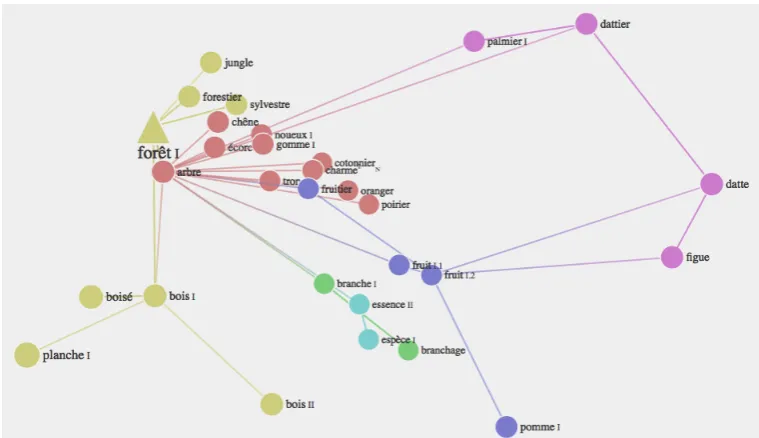
Figure 1 illustrates the graph structure of lexical systems. It visualizes a semantic space controlled by the French lexeme FORETˆ I ‘forest’ in the fr-LN. In this figure, spatialization and coloring of nodes visualize the result of an automatic seman-tic clustering performed on the lexical graph; this mode of visualization reflects semantic proximity inferred from the topology of the graph (Chudy et al., 2013).
Work on lexical systems started with exper-iments on the mechanical compilation of tra-ditional Explanatory and Combinatorial models (Polgu`ere, 2009), then evolved into full-scale lex-icography with the construction of the fr-LN, the first manually-built lexical system (Lux-Pogodalla and Polgu`ere, 2011; Gader et al., 2012). While lexicographically developing the fr-LN, a first ver-sion of a lexical system for the English language – the en-LN – has been automatically compiled from the Princeton WordNet (Gader et al., 2014). This latter lexical system offers a large-scale coverage of English in terms of wordlist. It is however es-sentially based on synonymy-like relations, inher-ited from WordNet; only the fr-LN fully reflects the amplitude of both paradigmatic and syntag-matic lexical function relations. Additionally, it is only in the fr-LN that the actual Explanatory Com-binatorial approach to phraseology is fully imple-mented at present. For this reason, we will need to use both French and English illustrations in the following discussion, depending on the availabil-ity of data in the current language models.
Table 1 gives statistics on the en- and fr-LNs in their present state.
Graph characteriscs en-LN fr-LN Num. lexical units = senses (LU) 206 995 26 020 Num. vocables = dict. entries (V) 156 587 16 981 Polysemy rate (LU/V) 1.32 1.53 Num. lexical functions links (LFL) 945 971 49 539 Num. other links (OL) 46 13 672 Connectivity rate ((LFL+OL)/LU) 4.57 2.43 Table 1: Current statistics on the en- and fr-LNs
2 Syntax of Idioms
We can now proceed with the examination of the first type of lexicon embedded syntax: the syntax
of idioms. By this we mean lexico-syntactic struc-tures that are associated with idioms in the fr-LN.4
Because they are semantically
non-compositional, idioms are considered as full-fledged lexical units in Explanatory Combinato-rial Lexicology. For this reason, they possess, just like lexemes, their own individual description in the fr-LN.
On the one hand, the behavior of idioms is known to be highly irregular (for instance, some idioms allow syntactic modification on some of their lexical constituents and other do not); on the other hand, it can be expected that general rules could be identified that condition part of id-ioms’ behaviors, based on their lexico-syntactic structure. For this reason, it has been decided to specify, for each individual idiom in the fr-LN wordlist, its constitutive lexemes and its basic syn-tactic structure (Paus´e, to appear). This is imple-mented as follows.
First, each phrasal part of speech – nominal idiom, verbal idiom, etc. – is linked to a set of syntactic templates that identify possible syn-tactic structures for idioms belonging to this part of speech. For instance, the verbal idiom part of speech (Fr. locution verbale) is associated, among others, with a syntactic template named
V Art NC (‘Verb + Article + Common noun’)
that designates the syntactic structure shown in Figure 2.
Figure 2: Syntactic structure of the V Art NC
idiom template.
Second, each time an idiom is created in the fr-LN, two operations are performed:
1. the newly created idiom is linked to one of the syntactic templates associated to its part of speech;
Figure 1: Semantic space controlled byFr. FORETˆ I‘forest’ in the French Lexical Network (fr-LN)
2. lexical nodes in this syntactic template are linked to actual lexical units that make up the idiom.
For instance, Figure 3 shows how the lexico-syntactic structure of the idiom pSUCRER LES FRAISESIq ‘to tremble because of advanced age’ (lit. ‘to sugar.the.strawberries’)5is
specified on the V Art NC template using the fr-LN lexicographic editor. In this figure, names appearing in the Sense column correspond to actual pointers to lexemes (senses) of the fr-LN; names in the Form column are only wordforms that will be used when displaying the instantiated syntactic template. (If nothing is specified, the name in the corresponding Sense cell will be displayed.)
Figure 3: Specifying a lexico-syntactic structure.
Once the lexico-syntactic structure of pSUCRER LES FRAISESIq has been fully
in-5There is another sense pSUCRER LES FRAISESIIq, de-rived from the first one, that means ‘to be senile’.
[image:4.595.72.289.570.672.2]stanciated (Figure 3), in can be interpreted by the general – hence, grammatical – syntactic template of Figure 2 in order to derive the fully lexicalized syntactic structure shown in Figure 4.6
Figure 4: Syntax ofpSUCRER LES FRAISESIq.
To our knowledge, the fr-LN is the first lexi-cal database that systematilexi-cally accounts for the lexico-syntactic structure of idioms it contains – in point of fact, current lexical resources seldom provide individual descriptions for idioms. At present, it is possible to derive from fr-LN data 3,018 syntactic structures of individual idioms (such as that in Figure 4), which is only a small portion of the syntax of idioms embedded in the French lexicon.
6An important piece of information is missing in this structure: the fact that the lexeme FRAISE11 has to
3 Syntax of Collocations
3.1 Functional notion of collocation
We now examined a second case of lexicon em-bedded syntax: the syntax of collocations. Collo-cation is understood here as designating a func-tional rather than statistical notion (Hausmann, 1979); it can be defined as follows.
A collocation, e.g. to run a fever, is a phraseological but compositional phrase made up of two main elements:
1. a semantically autonomous ele-ment – fever – called base of the collocation;
2. a bound element – to run– called
collocate of the base; the collo-cate is said to be bound, or not “free”, because its selection by the Speaker in order to express a given meaning depends on the prior se-lection of the base.
As collocations are modeled in lexical systems by means of standard syntagmatic lexical func-tions, we will start with a brief presentation of the notion of lexical functions (3.2). We will then pro-ceed with the interpretation of syntagmatic lexical functions as a special type of grammar rules (3.3). Finally (3.4), we will show how such rules can be used to derive a considerable amount syntactic structures embedded in natural language lexicons.
3.2 Standard Lexical Functions
A given standard lexical function is a generaliza-tion of a lexical link that possesses the following properties:
• it is either paradigmatic (synonyms,
antonyms, nominalizations, verbaliza-tions, actant names, etc.) or syntagmatic (collocates that are intensifiers [driving rain], light verbs[to runa fever], etc.);
• it is recurrent and universally present in
natu-ral languages;
• it is often (though not necessarily) expressed by morphological means (drive→driver [ac-tant name],store→megastore[intensifier], etc.).
For instance,Magnis the standard lexical func-tion that denotes collocafunc-tional intensifiers; it can
be applied to any full lexical unit in order to re-turn the set of all typical intensifiers for that unit.7
This is illustrated in (1), with the two semantically related unitsFEVERandHEADACHEas arguments ofMagn.
(1) a. Magn(fever) =high<raging
b. Magn(headache) =bad,severe<
ter-rible,violent<pounding,splitting
Note that collocative meanings can sometimes be expressed synthetically (within a paradigmatically related term) rather than analytically (as collo-cates). This phenomenon is callfusionand fused values of syntagmatic lexical functions are flagged with the “//” symbol in lexicographic descriptions; for instance:
(2) Magn(rainV) =hard,heavily, //pour down
Years of lexical studies on a wide spectrum of natural languages have allowed for the identifica-tion of a now stable set of approximately 65 sim-ple lexical functions;8additionally, these functions
can be combined to formcomplex lexical functions
(Kahane and Polgu`ere, 2001).
The system of lexical functions is a descriptive tool that allows for a rationalization and formal-ization of the web of paradigmatic and syntag-matic links that connect lexical units in natural lan-guages. This explains why we have adopted lexi-cal functions as the main structuring principle for lexical systems.
3.3 Standard Syntagmatic Lexical Functions as Grammar Rules
We will now focus on standard syntagmatic lexi-cal functions in order to examine how they offer an original treatment of the syntax of collocations. For this, we will use as illustration one specific standard syntagmatic lexical function: Real1. It is
commonly characterized as follows.
The lexical function application Real1( L ) stands for a full verb:
• that expresses such meanings as ‘to realize L’, ‘to do what is supposed to be done as regards to L’ . . . ;
7A lexical function is thus quite similar to an algebraic functionf, that can be applied to a given numberxin order to return a given valuey:f(x) =y.
• that takes L as second deep-syntactic actant (i.e. first comple-ment) and the first deep-syntactic actant of L as its first deep-syntactic actant (i.e. grammatical subject).9
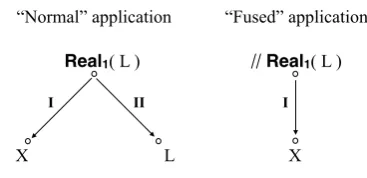
In case of fusion, the meaning ‘L’ is encapsu-lated in the meaning of the lexical function appli-cation, together with the sense of realization, and therefore//Real1( L ) doesn’t take L as second
syn-tactic actant.
As an illustration, Figure 5 gives the so-called
article-view ofReal1 values for BALLOONN2 [We
could get there by balloon.]in the en-LN.10
Figure 5:Real1(balloonN2) in the en-LN.
Standard lexical functions such asReal1 can be
conceptualized from at least two perspectives.
• From the viewpoint of the structure of lexical
knowledge, they are universal relations that paradigmatically and syntagmatically con-nect lexical units within lexical systems.
• From the viewpoint of the universal system of
deep-syntactic paraphrasing (Mel’ˇcuk, 2013, Chap. 9), they are “meta lexical units” whose application to a given lexical unit (argument of the lexical function) stands for a set possi-ble lexicalizations in a deep-syntactic struc-ture.
In this latter case, it is important to note that each standard syntagmatic lexical function actu-ally denotes two dependency structures: one for “normal” values of the lexical function applica-tion and one for “fused” values. Therefore, the two deep-syntactic trees11 in Figure 6 are
inher-ently associated toReal1.
If we refer to what was said earlier about the lexicon-grammar dichotomy (section 1.1), we are 9On the notions of semantic and deep-/surface-syntactic actants, see Mel’ˇcuk (2015, Chap. 12).
10An article-view, in the lexicographic editor used for building the en- and fr-LNs, is a textual rendering of lexical data associated with a given headword. For details on how lexical function applications are computationally encoded in the en- and fr-LNs, see Gader et al. (2012).
[image:6.595.321.505.62.151.2]11For a concise presentation of Meaning-Text levels of sentence representation and the deep-vs.surface-syntax di-chotomy, see Kahane (2003).
Figure 6:Real1’s Deep-syntactic structures.
entitled to consider that trees in Figure 6, because they correspond to general (in this case, universal) linguistic rules about syntactic structuring, are in essence grammatical: they designate syntactic po-tential that can be run on any lexical rules of the type illustrated in Figure 5 in order to participate in the generation of actual surface-syntactic struc-tures.
3.4 Deriving surface-syntactic structures
[image:6.595.312.532.402.564.2]In this particular case, rules in Figures 5 and 6 allow for the generation of the three surface-syntactic structures in Figure 7.
Figure 7: Derived surface-syntactic structures.
If we consider the prospect of such derivation throughout a full lexical system for a given lan-guage, we see that a considerable amount of lexi-con embedded syntactic structures are extractable from these models. At present, a total number of 7,739 surface-syntactic micro-structures of the type given in Figure 7 can be extracted from the fr-LN.12This is of course only a small portion of
what is available in the actual French lexicon.
4 Conclusion: Lexicalized Grammars the Other Way Round
By presenting the syntax of idioms and colloca-tions, we hope to have shown that syntactic in-formation embedded in natural language lexicons goes far beyond phenomena associated to active valency (subcategorization frames). Lexicon em-bedded syntax is conceptuallyand quantitatively
an essential element of lexical knowledge. It was also our goal to demonstrate that lexical systems such as the fr-LN are particularly suited to the modeling of embedded syntax. In our view, one very promising exploitation of such models for Natural Language Processing (NLP) is the use of large collections of extracted syntactic struc-tures by NLP parsers, for such tasks as disam-biguation or processing of phraseological expres-sions found in corpora.
Collections of syntactic structures extractable from lexical systems bear some conceptual resem-blance withlexicalized grammars(Schabes et al., 1988), except for the fact that the perspective is to-tally inverted: rather than lexicalizing grammars, we propose to extract from lexical systems every-thing actual grammars do not know about syntax.
Acknowledgments
Lexicographic work on the French Lexical Net-work (fr-LN) originally started at the ATILF CNRS laboratory (Nancy, France) in the context of the RELIEF project funded by the Agence de Mobilisation ´Economique de Lorraine (AMEL) and the European Regional Development Fund (ERDF).
References
Joseph D. Becker. 1975. The Phrasal Lexicon. In:
Proceedings of the 1975 Workshop on Theoreti-cal Issues in Natural Language Processing (TIN-LAP’75). Association for Computational Linguis-tics, Cambridge, Mass., 60–63.
Yannick Chudy, Yann Desalle, Benoıt Gaillard, Bruno Gaume, Pierre Magistry and Emmanuel Navarro. 2013. Tmuse: Lexical Network Exploration. In:
The Companion Volume of the Proceedings of IJC-NLP 2013: System Demonstrations. Asian Federa-tion of NLP, Nagoya, 41–44.
Charles J. Fillmore, Christopher R. Johnson and Miriam R. L. Petruck. 2003. Background to FrameNet. International Journal of Lexicography, 16(3):235–250.
Nabil Gader, Veronika Lux-Pogodalla and Alain Polgu`ere. 2012. Hand-Crafting a Lexical Network With a Knowledge-Based Graph Editor. In: Pro-ceedings of the Third Workshop on Cognitive As-pects of the Lexicon (CogALex III). The COLING 2012 Organizing Committee, Mumbai, 109–125.
Nabil Gader, Sandrine Ollinger and Alain Polgu`ere. 2014. One Lexicon, Two Structures: So What Gives? In Heili Orav, Christiane Fellbaum and Piek Vossen (eds.): Proceedings of the Seventh Global Wordnet Conference (GWC2014). Global WordNet Association, Tartu, 163–171.
Franz Josef Hausmann. 1979. Un dictionnaire des collocations est-il possible? Travaux de litt´erature et de linguistique de l’Universit´e de Strasbourg, XVII(1):187–195.
Otto Jespersen. 1924. The Philosophy of Grammar. George Allen & Unwin, London.
Sylvain Kahane. 2003. The Meaning-Text Theory. In Vilmos ´Agel, Ludwig M. Eichinger, Hans Werner Eroms, Peter Hellwig, Hans J¨urgen Heringer and Henning Lobin (eds.):Dependency and Valency. An International Handbook of Contemporary Research. Handb¨ucher zur Sprach- und Kommunikationswis-senschaft / Handbooks of Linguistics and Commu-nication Science, de Gruyter, Berlin & New York, 546–569.
Sylvain Kahane and Alain Polgu`ere. 2001. Formal Foundation of Lexical Functions. In: Proceed-ings of “COLLOCATION: Computational Extrac-tion, Analysis and Exploitation”. 39thAnnual Meet-ing and 10th Conference of the European Chapter of the Association for Computational Linguistics, Toulouse, 8–15.
Evelien Keizer. 2007. The lexical-grammatical di-chotomy in Functional Discourse Grammar. Alfa – Revista de Ling¨u´ıstica, 51(2):35–56.
Veronika Lux-Pogodalla and Alain Polgu`ere. 2011. Construction of a French Lexical Network: Method-ological Issues. In:Proceedings of the First Interna-tional Workshop on Lexical Resources, WoLeR 2011. An ESSLLI 2011 Workshop. Ljubljana, 54–61.
Igor Mel’ˇcuk. 1996. Lexical Functions: A Tool for the Description of Lexical Relations in the Lexicon. In Leo Wanner (ed.): Lexical Functions in Lexicog-raphy and Natural Language Processing. Studies in Language Companion Series 31, John Benjamins, Amsterdam/Philadelphia, 37–102.
Igor Mel’ˇcuk. 2006. Explanatory Combinatorial Dic-tionary. In Giandomenico Sica (ed.): Open Prob-lems in Linguistics and Lexicography. Polimetrica, Monza, 225–355.
Igor Mel’ˇcuk. 2015.Semantics: From meaning to text, volume 3. Studies in Language Companion Series 168, John Benjamins, Amsterdam/Philadelphia.
Igor Mel’ˇcuk, Andr´e Clas and Alain Polgu`ere. 1995.
Introduction `a la lexicologie explicative et combina-toire. Duculot, Paris/Louvain-la-Neuve.
Piet Mertens. 2010. Restrictions de s´election et r´ealisations syntagmatiques dans DICOVALENCE.
Conversion vers un format utilisable en TAL. In:
Proceedings of TALN 2010. Montr´eal.
Marie-Sophie Paus´e. To appear. Mod´elisation de la structure lexico-syntaxique des locutions au sein d’un r´eseau lexical. In Maurice Kauffer (ed.):Actes du colloque international “Approches th´eoriques et empiriques en phras´eologie”. Eurogermanistik Se-ries, Stauffenburg Verlag, T¨ubingen.
Alain Polgu`ere. 2009. Lexical systems: graph models of natural language lexicons. Language Resources and Evaluation, 43(1):41–55.
Alain Polgu`ere. 2011. Perspective ´epist´emologique sur l’approche linguistique Sens-Texte. M´emoires de la Soci´et´e de Linguistique de Paris, XX:79–114.
Alain Polgu`ere. 2014. From Writing Dictionaries to Weaving Lexical Networks. International Journal of Lexicography, 27(4):396–418.
Yves Schabes, Anne Abeill´e and Aravind K. Joshi. 1988. Parsing Strategies with ‘Lexicalized’ Gram-mars: Application to Tree Adjoining Grammars. In:
Proceedings of the 12th Conference on