Munich Personal RePEc Archive
Efficiency of cattle in Russia in the
context of implementation of state
programs
Zinchenko, Aleksey
Russian Timiryazev State Agricultural University
January 2015
Federal State Budgetary Educational Institution
of Higher Education
“Russian Timiryazev State Agrarian University”
(FSBEI HE RT SAU)
Faculty of Economics and Finances
Department of Statistics and Econometrics
A. Р. ZINCHENKO, M.V. KAGIROVA
EFFICIENCY OF CATTLE IN RUSSIA
IN THE CONTEXT OF IMPLEMENTATION OF
STATE PROGRAMS
The article was published in russian language in Scientific-theoretical Journal of the Russian Timiryazev State Agricultural University
“Izvestiya of Timiryazev Agricultural Academy” 2015. No. 1. P. 108-124. URL:
http://www.timacad.ru/deyatel/izdat/izvestia/izvestijatsha_1_2015.pdf
2
Annotation
The article is devoted to statistical analysis of efficiency of dairy cattle breeding of the Russian Federation in view of production at enterprises conjugate products - milk and livestock production, as well as beef cattle, during the implementation of the sovereign-governmental programs for the development of agriculture and regulation of agricultural products, raw materials and food.
Keywords: cattle, the state program, the efficiency of production of milk and meat products as a conjugate, animal productivity, costs and prices, the intensity of production.
The transformation of the social system in Russia after 1990 has led to an acute crisis in agriculture, reducing its production, particularly livestock, decline of the country's food self-sufficiency. The total amount of livestock gross production (in constant prices) decreased annually until 1999 inclusively, and its general decline reached 50.3% at the same time. After the default of 1998, increased cost of imports and increased demand for domestic products selling prices of animal products rose sharply (in 1999 by 82.4% and for 1998-2001 by 2.9 times). The growth of prices has led to the decline in production suspension in 2000, and an increase in the volume of livestock production for 1999-2002 by 7.7%. But by 2003, the default effect has been exhausted and the continued decline in production (for 2 years by 2.3%) required a revision of the agricultural policy and the search for other ways of development of animal husbandry and agriculture in general.
For the improvement of agriculture in 2005, Russia has begun the development and implementation of the priority national project "Development of agriculture" for 2006-2007years, and then the "State program of agricultural development and regulation of agricultural products, raw materials and food for 2008-2012» and a similar program for 2013-2020 years. During the two years of implementation of the priority national project the total increase in the gross output of livestock amounted to 11.0%. But the planned state programs indicators of growth have not been achieved - instead of the expected in 2007-2013 years the growth by 29.6% in livestock production the actual level of it was only 14.9%. This increase was primarily due to increased production of poultry meat by 99.0% and pigs by 45.9%, while reducing the gross output of cattle by 4.3%.
3
Table 1
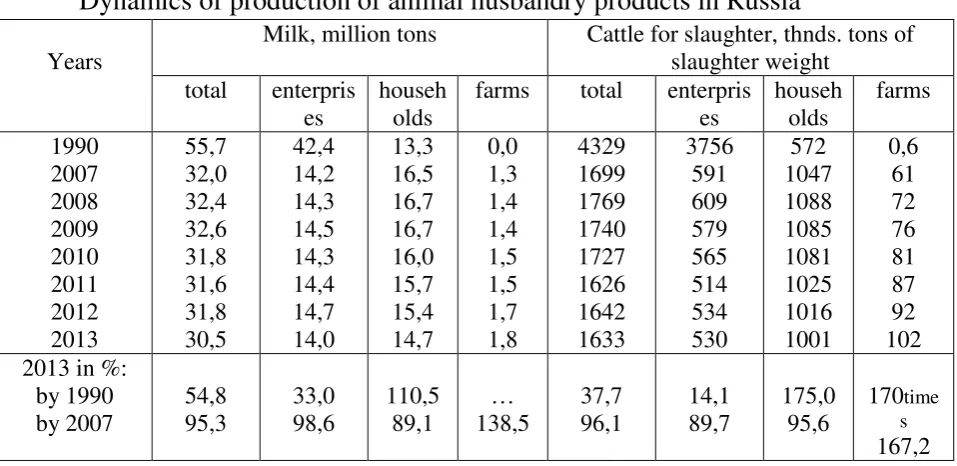
Dynamics of production of animal husbandry products in Russia
Years
Milk, million tons Cattle for slaughter, thnds. tons of slaughter weight
total enterpris es
househ olds
farms total enterpris es househ olds farms 1990 2007 2008 2009 2010 2011 2012 2013 55,7 32,0 32,4 32,6 31,8 31,6 31,8 30,5 42,4 14,2 14,3 14,5 14,3 14,4 14,7 14,0 13,3 16,5 16,7 16,7 16,0 15,7 15,4 14,7 0,0 1,3 1,4 1,4 1,5 1,5 1,7 1,8 4329 1699 1769 1740 1727 1626 1642 1633 3756 591 609 579 565 514 534 530 572 1047 1088 1085 1081 1025 1016 1001 0,6 61 72 76 81 87 92 102 2013 in %:
by 1990 by 2007 54,8 95,3 33,0 98,6 110,5 89,1 … 138,5 37,7 96,1 14,1 89,7 175,0 95,6 170time s 167,2
Milk production after 1990 was reduced by 2013 in Russia by 45.2% in the first instance in the agricultural organizations - by 67.0%, with a slight increase in households by 10.5%, as well as farms. Livestock meat production fell to a greater extent (62.3% overall) first of all in agricultural organizations (85.9%) with an increase in the households (75.0%). The State Program for 2008-2012, as well as the branch target program "Development of cattle breeding and increase milk production in the Russian Federation for 2009-2012" provides for the growth in milk production in 2012 to 37.0 million tons, have not been met. The priority of the first level in the production of the state program for 2013-2020 is the development of animal husbandry industry as the backbone, using the competitive advantages of the country, most notably the presence of large areas of agricultural land. But in 2007-2013 the production of milk and meat cattle declined in all categories except farms, including individual entrepreneurs, which provided 5.9% of the production of milk in 2013. During January-December 2014, milk production has increased overall by 0.1% while the reduction in the households and an increase in organizations by 2.3%.
4
[image:5.595.77.557.159.368.2]Reduction of volumes of production of cattle breeding is directly dependent on the dynamics of the number of animals (Table. 2), and their productivity.
Table 2
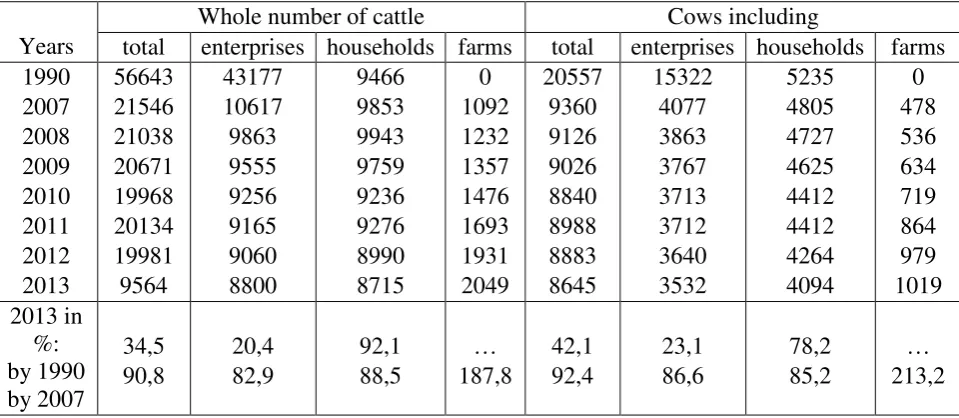
The dynamics of the cattle population in Russia for the end of the year, thnds. heads
Years
Whole number of cattle Cows including
total enterprises households farms total enterprises households farms 1990 2007 2008 2009 2010 2011 2012 2013 56643 21546 21038 20671 19968 20134 19981 9564 43177 10617 9863 9555 9256 9165 9060 8800 9466 9853 9943 9759 9236 9276 8990 8715 0 1092 1232 1357 1476 1693 1931 2049 20557 9360 9126 9026 8840 8988 8883 8645 15322 4077 3863 3767 3713 3712 3640 3532 5235 4805 4727 4625 4412 4412 4264 4094 0 478 536 634 719 864 979 1019 2013 in %: by 1990 by 2007 34,5 90,8 20,4 82,9 92,1 88,5 … 187,8 42,1 92,4 23,1 86,6 78,2 85,2 … 213,2
Reducing the number of cattle in general occurred to a greater extent than the decline in production of milk and meat, especially in the agricultural organizations and partly in households. In 2014, a number of cattle has decreased overall by 2.2%, including cows by 2.5%. The sector was formed anew in the farms, while the number of population was growing faster than production.
Reduced production was restrained by increasing the productivity of animals. Thus, the milk yield per cow was raised in Russia on average between 1990 and 2013 from 27.3 quintals to 38.9 quintals of milk, or 42.5%, which indicates an increase in technological efficiency of production of the surviving population. At the same time the task set in the target program to achieve the milk production per cow of 4500 kg in 2012 has not been reached. The milk yields rose to 45.2 quintals in enterprises and to 35.4 quintals in households, in farms the milk yield per cow dairy herd was 33.2 quintals in 2013 according to Rosstat.
5
For a comprehensive evaluation of the effectiveness of the development of cattle breeding it should be borne in mind all its types - social, economic and environmental. Social efficiency of animal husbandry industry of Russia for the whole period of transformation has declined in general and the state program
hasn’t made it to increase, as can be seen from the following data:
1. Consumption of cattle products per capita has reduced. Since the average per capita consumption of milk and dairy products fell from 386 kg in 1990 to 249 kg in 2012, with the rational norm of 360 kg per year. The import share of milk and milk products has increased, the share of domestic products in the total volume of this resource significantly below the threshold of food independence of the country and the state program assignments. This is even more reduced consumption of beef, its per capita production fell from 29.3 kg in 1990 to 11.4 kg in 2013. Russia, in fact, lost food independence for cattle production.
2. Reducing the number of livestock of cattle on 37 million goals led to a reduction in rural employment in this industry for more than two million people, as well as employment in the feed production, processing and other branches of agriculture, to the growth of unemployment, migration from rural areas and other negative social consequences; the number of villages on the census of 2010 decreased by 8.5 thousand compared to 2002.
3. Earnings of employed workers in the industry have decreased; wage in agriculture is now about half relative to the average in the economy (in cattle it is equal to 45%) compared with the achieved level in 1990 more than 90%. It disrupts the normal reproduction, not only in production but also in the social sphere of the village.
Dairy cattle in Russia haven’t become a market sector yet and it constrains the overall formation of effective market relations in the country. On average, across all categories of farms marketability milk in 2007 to the beginning of the implementation of the state program was only 58.1% and reached only 61.6%, compared to 92-95% in developed market economies by 2013. A similar situation exists with the marketability of beef in connection with a high proportion of its production in low market households.
6
System analysis of ranching requires study a large set of factors that characterize the conditions and the nature of production. The internal factors of the industry in the different categories of organizations embrace the technology and organization of production, forage production, reproduction and quality of animal herds, intake and feed quality, specialization and scale of production, work organization, training, etc. External conditions include the demand for livestock products in the domestic and foreign markets, the level and disparity of prices, monopoly buyers of products, government support and regulation of the industry, competition with imported products and its other species (the meat of pigs and poultry), climatic conditions etc. Economic efficiency of cattle production reflects the ratio of results (output and income) from the use of resources (labor, feed and other production and service facilities) and costs. The indicators of cost recovery, profit and profitability are of great importance as a basis for providing simple and expanded reproduction in a market economy. In assessing the effectiveness of animal husbandry of Russia it is important to take into account the peculiarities of the period of transformations and conducting at the present stage multistructure agriculture and the analysis carried out not only in general, but also in the context of categories of farms that have different conditions and mechanisms of management.
Let us first consider briefly the economy of households, which now holds much of the production of animal husbandry products (48.2% of milk and 61.3% of meat products). The increase in their milk and meat production since 1990, its relatively weak reduction in the period of implementation of state programs, as well as the increase in the number of cattle (Table 1 and 2), was due to the hard necessity of survival of the rural and urban population, which crisis and a slump in real incomes has not been able to provide for their vital needs through the market due to lack of funds and the weak development of the market. In households prevailed subsistence production and in 90-th the marketability of milk was about 15% there, and in 2012 it reached 31.8% compared to 67.7% in individual farms and 92.9% in enterprises. The marketability of livestock and poultry in 2012 reached 45.3%, this was primarily cattle meat products, which in 2013 in households had 43.5% of all their meat products.
7
households concentrated feed, 0.14 and 0.39 feed units. Feed costs for 1 quintal of weight gain of cattle in households were 6.3 feed units versus 13.8 centners in enterprises. Cheap green fodder was used more substantially as a part of the feed, in 2011the proportion of pasture forage in cattle was in households 33%, while only 12% in enterprises. At the same time, as shown by the analysis of the cost per head, it should be noted that in farms that are studied by the state statistics using the sampling method, the value of costs is underestimated because most of them use the resources of large agricultural and other organizations free of charge or at reduced prices. Expert estimates show that in spite of the feed costs in households are underestimated by 20-30%, but they remain lower than in the enterprises.
At lower material costs per unit of production, households at higher prices sell the marketable part of cattle production. So, in 2000 the price of milk produced by households were higher than in enterprises by 22%, and of meat products by 32%. Such differences are retained until the present time and are often more powerful because of the high demand for the products in the local markets. It should also be borne in mind that the prices for the products of animal husbandry in the households are significantly lower than retail prices in retail chains. For example, in 2005-2007 sale price of 1 kg of milk in households was 9.16 rubles, 7.65 rubles in enterprises [2, p. 70], and the consumer price was 20.50 rubles.
At the same time due to the low intensity and the small scale of production in households, the milk productivity of cows is less and its potential is practically in the range of 40 quintals. Gradually, the production of cattle breeding in the
8
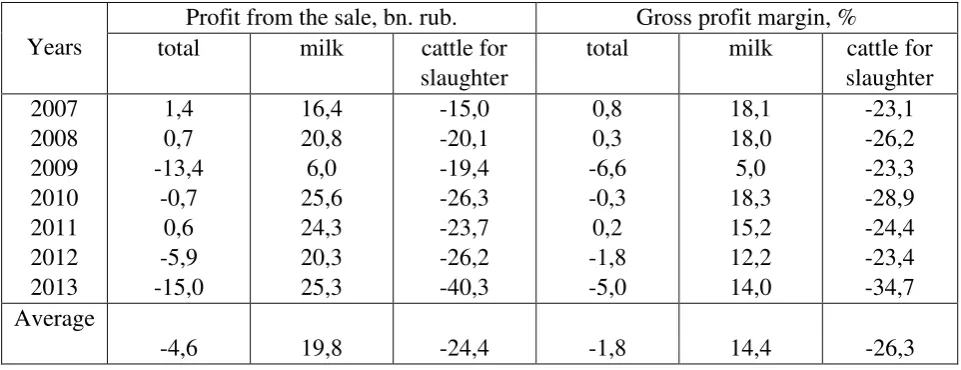
[image:9.595.79.560.454.639.2]Agricultural organizations, including small businesses, are commercial organizations operating in market conditions, and their main task and the main indicator of economic efficiency is to make profit at the appropriate level of public employees' salaries and providing this way of self-sufficiency and expanded reproduction. In Russia, in the assessment of development and economic efficiency of dairy cattle breeding is recommended to take into account the organic connection of production of two conjugate products - milk and meat cattle breeding dairy in every large organization, as there is no a system of specialized enterprises for separate production of milk and rearing and cows in Russia. The system of agricultural organizations previously established, as well as cattle-fattening enterprises has been liquidated. The purchase of breeding cows abroad is limited and there is no possibility for the large organizations to purchase young cows in the domestic market, this is only possible for farms and households from their small size of production. Therefore, the indicators of production efficiency should be considered first over the dairy farming as a whole, and then conduct in-depth analysis on specific products. Table 3 presents the data on agricultural organizations that the Ministry of Agriculture of the Russian Federation accounted for the period of the state program of development of agriculture after 2007, while taken all products sold cattle in view of its processing in the enterprise.
Table 3
Profitability of the implementation of animal husbandry production by enterprises in Russia (without subsidies)
Years
Profit from the sale, bn. rub. Gross profit margin, %
total milk cattle for
slaughter
total milk cattle for
slaughter 2007
2008 2009 2010 2011 2012 2013
1,4 0,7 -13,4
-0,7 0,6 -5,9 -15,0
16,4 20,8 6,0 25,6 24,3 20,3 25,3
-15,0 -20,1 -19,4 -26,3 -23,7 -26,2 -40,3
0,8 0,3 -6,6 -0,3 0,2 -1,8 -5,0
18,1 18,0 5,0 18,3 15,2 12,2 14,0
-23,1 -26,2 -23,3 -28,9 -24,4 -23,4 -34,7 Average
-4,6 19,8 -24,4 -1,8 14,4 -26,3
9
implementation of meat is deeply unprofitable and loss ratio does not tend to decrease.
The state support for the sector remains low, especially when compared with developed countries providing for dairy farming the largest share of subsidies that are often an order of magnitude higher than in Russia. In Russia, the amount of public subsidies attributable to the production, from the budgets of all levels in relation to the total cost of sales amounted to 9.1% for milk and meat cattle only 6.5% (at comparable figures for 2009-2012). The total profitability of the conjugate products of cattle industry including subsidies was 6.0% in these years, which was insufficient for normal reproduction, especially for the transformation of animal husbandry industry on modern technical and technological basis, establishing a solid food supply and the return obtained in recent years loans given that the total amount payable in enterprises under consideration reached 2.1 trillion. rub. or 138% relative to revenue. It is clear that without a significant increase in profitability and strengthen state support of cattle breeding based on the experience of developed countries to solve the problems of the industry is impossible.
In assessing profitability of cattle breeding production and agriculture in general, it should be borne in mind that the current level it is formed at a low wage. If wages in the industry has been at the level of the average for the country's economy, profitability of cattle breeding with current grant size would be negative, and the losses would have reached 10%. Because of the low wages in the organizations cannot be complete teams of workers and highly skilled staff ensure the sustainability of production processes, it becomes absolutely essential, given the increasing technical and technological level of modern competitive livestock. During the period of reforms in the agricultural organizations of Russia accelerated turnover of the labor force for the reception and disposal, which is particularly adversely affected when working with animals and plants. If in 1995-1998 agricultural total factor workforce for the reception and disposal of turnover was 34% and was below the average for the economy by 12%, than in 2008-2012, it reached 80% and was higher than 12% on average. Therefore, it cannot be considered sufficient levels of profitability of agriculture, taking into account subsidies, not less than 12-15%, and 55% of salary to the average for the economy scheduled by elaborated State Program for 2013-2020 years [6].
10
reduction of production in agricultural organizations in general and in the sector of cattle breeding. To ensure technical and technological modernization and expanded reproduction in agriculture, its profitability as a whole at the socially necessary level of remuneration should be at the level of 25% [1, p. 150]. This level of profitability can be achieved by a simultaneous decrease in the cost per unit of output, increase in sales prices and government subsidies. In order to provide food security it's necessary to take into account the experience of soviet Russia of introducing the allowances to purchase prices for the solution of such problems of cattle breeding sector and the profitability of corporate farms was generally 36,3% in 1990, including 56.6 milk and meat 17.9%; and the level of wages in agriculture was 94% relative to the average for the economy. To reduce losses enterprises are forced to reduce production of meat products in absolute and relative terms. The proportion of the cost of meat production of cattle (the full cost of sales) in the enterprises in 1990 amounted to 52.5%, in 2007 it decreased to 41.7%, and in highly unprofitable in 2013 to 39, 1%.
It is obvious that in modern conditions the solution of the problems of development of dairy cattle breeding assumes the elimination of unprofitable meat products and improve the efficiency of milk production. This, along with a significant increase in the level of prices and subsidies on products, in turn, requires finding ways to reduce costs on the basis of a comprehensive analysis of the factors separately for milk and meat production.
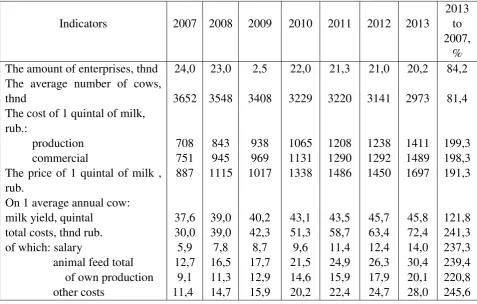
Profitability of production of certain products is determined by the price and cost of production ratio, which depends on the cost of keeping animals and their productivity. A number of indicators for production and sale of milk from the dairy herd, are presented in Table 4.
11
[image:12.595.80.558.176.480.2]relatively high quality of milk increases the average selling price - its ratio to standard in the implementation was greater than one and reached 1,068 in 2013 compared to 1,058 in 2011.
Table 4
Costs for maintenance and milk productivity of cows in enterprises accounted by the Russian Ministry of Agriculture
Indicators 2007 2008 2009 2010 2011 2012 2013
2013 to 2007,
% The amount of enterprises, thnd
The average number of cows, thnd
The cost of 1 quintal of milk, rub.:
production commercial
The price of 1 quintal of milk , rub.
On 1 average annual cow: milk yield, quintal
total costs, thnd rub. of which: salary
animal feed total of own production other costs 24,0 3652 708 751 887 37,6 30,0 5,9 12,7 9,1 11,4 23,0 3548 843 945 1115 39,0 39,0 7,8 16,5 11,3 14,7 2,5 3408 938 969 1017 40,2 42,3 8,7 17,7 12,9 15,9 22,0 3229 1065 1131 1338 43,1 51,3 9,6 21,5 14,6 20,2 21,3 3220 1208 1290 1486 43,5 58,7 11,4 24,9 15,9 22,4 21,0 3141 1238 1292 1450 45,7 63,4 12,4 26,3 17,9 24,7 20,2 2973 1411 1489 1697 45,8 72,4 14,0 30,4 20,1 28,0 84,2 81,4 199,3 198,3 191,3 121,8 241,3 237,3 239,4 220,8 245,6
In the context of inter-state sanctions, depreciation of the ruble in 2014 and ensuring import substitution, producer prices for milk will grow due to the expansion of domestic demand for domestic products in the same way as it did after the 1998 default. But it should be borne in mind that the favorable agricultural price increase was accompanied by a decline in the standard of living and a fall in demand for food products (1998-1999 real incomes of the Russian population fell by 26.3% in relation to 1997, and retail sale of dairy products fell for two years by 12.8% and of butter by 16.3%).
12
growing faster than labor productivity, but is still very low. For example, the salary of milking machine operators and dairymaids rose to 2.63 times by increasing the number of cows serviced by 1.53 times, and in 2013 reached 13.4 thousand rub. per month (44.7% of the national average). Direct labor costs for production of 1 quintal of milk remain high - in 2013, 2.4 man-hours, which is several times higher than the potential level of costs during the development of modern industrial technology. The main item of the cost of milk production is the animal feed, the cost per cow has grown over the years 2007-2013 by 139.4% due to the increased consumption of feed per cow by 18.4%, and at the same time the growth of the cost of 1 quintal of fodder units by 102.2% and per 1 quintal of milk by 96.6%, since the costs of feed units on its production were reduced by 2.8%, due to increasing of milk productivity in this period by 21.8%.
The main part of feed consumed by cattle is animal feed of own production, but the proportion of the cost of them has decreased in the last 7 years, from 71.6 to 66.2%. Feeding cattle breeding base in enterprises is of low productivity (as can be judged, for example, on productivity of hay sown grass, not exceeding 10 centners of fodder units) and its dynamics is unstable. In arid 2010 and 2012 coarse and succulent fodder was harvested less then in 2007 by 29.8 and 21.7%, as a result the number of cows fell by 11.4 and 14.0% in those years, and the number of operating enterprises decreased by 8.3 and 12.5%. The large size of milk production imply stabling cows wherein the consumption of green and pasture animal feed is very low, so hayfields and pastures are in poor condition and almost hardly used. To ensure a high level of cattle feeding in these circumstances enterprises are forced to increase the consumption of purchased primarily expensive concentrate feed, which increases the cost of rations. Only in the years 2007-2013 the price of animal feed purchased in Russia grew by 76.3%. The level of cows feeding, composition and quality of forages mainly determine the level of milk productivity, which heavily affects on the cost of production. The average milk yield per cow achieved in agricultural organizations is 45.8 centners (in large and medium-sized enterprises in 2013 50.0 c) and it is generally still low and uncompetitive because in competing countries with a developed dairy cattle this indicator is 70-80 centners, and in the United States almost 100 centners. The quality of the herd of cows and its use requires further improvement (Tab. 5).
13
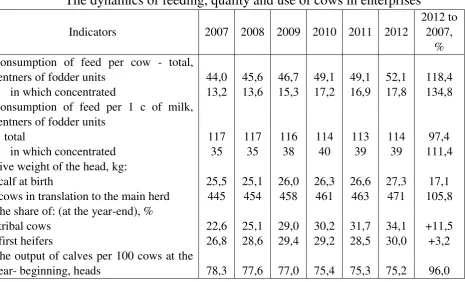
[image:14.595.93.559.185.467.2]that reduced the efficiency production, such as feeding level of growth was mainly due to the concentrated feed, the output of calves per 100 cows remained very low and decreased, grew their barrenness, accelerated turnover and culling cows, which were used to produce offspring and dairy products a little more than 3 years instead of 4-5 years possible.
Table 5
The dynamics of feeding, quality and use of cows in enterprises
Indicators 2007 2008 2009 2010 2011 2012
2012 to 2007,
% Consumption of feed per cow - total,
centners of fodder units in which concentrated
Consumption of feed per 1 с of milk, centners of fodder units
total
in which concentrated Live weight of the head, kg: calf at birth
cows in translation to the main herd The share of: (at the year-end), % tribal cows
first heifers
The output of calves per 100 cows at the year- beginning, heads
44,0 13,2 117 35 25,5 445 22,6 26,8 78,3 45,6 13,6 117 35 25,1 454 25,1 28,6 77,6 46,7 15,3 116 38 26,0 458 29,0 29,4 77,0 49,1 17,2 114 40 26,3 461 30,2 29,2 75,4 49,1 16,9 113 39 26,6 463 31,7 28,5 75,3 52,1 17,8 114 39 27,3 471 34,1 30,0 75,2 118,4 134,8 97,4 111,4 17,1 105,8 +11,5 +3,2 96,0
The potential productivity of cows is generally sufficient to obtain high yields. In the current food base, a modern herd (average live weight per 1 cow in enterprises without small enterprises is 487 kg) and the output of milk per 100 kg of live weight of cows about 1000 kg milk yield per cow can be reached within about 50 quintals. In order to achieve yields of 65-70 centners it is necessary to raise the level of nutrition and feed quality, to improve the quality of dairy cows herd milk yield and to achieve the live weight 1200-1400 kg near 100 kg. Such indicators, as shown by our study [3, p. 26], have already been achieved in many organizations with modern technology; 50 agricultural enterprises produced 72.6 centners of milk from cows with a live weight of 527 kg, while feed costs are reduced up to 85 feeding units per 1c of milk, providing high productivity and profitability of milk production.
14
the cost of electricity, fuel, oil, repair materials, payment of transport, veterinary and other services. The main reason for the increase of these costs is to increase tariffs without the necessary differentiation for agriculture and monopoly in suppliers of resources with insufficient government subsidies. Thus, in 2007-2013 the purchase price of fuel increased by 129.2%, of electricity by 100.1%, fuel and lubricants by 65.9%. Total electricity consumption on production needs in these enterprises decreased over the years by 12.6% and electricity costs increased by 103.0% in primary production.
A great impact on the overall cost increase also had a sharp increase in the amount of depreciation of fixed assets. Together with an increase in the total value of fixed assets in enterprises is 2.5 times the amount of accumulated depreciation in the main production increased by 3.8 times, and 5.0 times in animal husbandry. The share of depreciation in the total costs of livestock production as a whole rose from 5.2% in 2007 to 10.8% in 2013 due to the rising costs of basic means of production, changes in the structure of funds for modernization of production and the acceleration of the timing of their depreciation. The current trend in the last period of growth in cattle costs in the short term will continue in connection with the need to quickly improve the level of pay to secure qualified personnel, improve the capital-labor ratio and labor armament, creating a solid food base and improve the quality of the herd. The process of modernization of milk production will take a long time due to the long duration of the reproductive cycle and a low coefficient of turnover in this type of activity. Therefore, together with the improvement of equipment, technology and organization of production of milk it is necessary to increase the efficiency of meat production in cattle, including through the development of beef cattle.
15
competition (in 2005-2007., accordingly, 3638 and 4988 rubles for 1 quintal) [2, p. 70], its loss ratio would have been virtually eliminated.
[image:16.595.77.560.336.569.2]In addition to the rising prices and government subsidies for meat products the most important area of growth is its effectiveness, as well as in the production of milk, increase animal productivity and reduce production costs of livestock rearing as dairy and specialized breeds and cross-breeds of beef cattle. The sectoral program for the development of beef cattle is implemented in the Russian Federation, it was designed to solve many of the issues of providing population with beef as an indispensable product of nutrition, as well as to achieve food security. This article does not attempt to detailed analysis of the production efficiency of beef and Table. 6 shows a number of indicators of the dynamics of the production of meat products for dairy and beef cattle.
Table 6
Production of meat products by dairy and beef cattle in the agricultural organizations of the Russian Federation
Indicators 2007 2013 2013 to
2007, % Production of cattle breeding, thnd tons:
dairy cattle beef cattle
The average daily gain during rearing and fattening, gram: dairy cattle
beef cattle
Production cost of livestock rearing, rub. for 1 quintal: dairy cattle
beef cattle
Direct labor costs for 1 quintal of production of livestock rearing, man-hour.:
dairy cattle beef cattle
996,9 53,6
426 445
6995 5332
34,9 54,8
828,0 151,7
467 539
14253 12526
24,6 17,7
83,1 283,0
109,6 121,1
203,8 234,9
70,5 32,3
16
[image:17.595.84.556.175.627.2]can be judged according to the grouping of regions for 2012 to the value of the average annual milk yield per 1 cow, reflecting the general level of development of the industry (tab. 7).
Table 7
The level of development of dairy farming enterprises in the regions of Russia with different productivity of cows
Indicators
The groups of regions by milk productivity, quintal
High group to low group % low below 40 medium 40–50
high above.
50
The number of regions Per 1 average annual cow: milk yield, quintal
weight gain during rearing and fattening, quintal reared and nourished average animals
Gross milk yield per 1 quintal of weight gain, quintal The average weight gain during rearing and fattening, gram
The production cost of 1 quintal, rub.: milk
weight gain
Consumption of feed for 1 annual average head, centners of fodder units:
cows
young animals in growing and fattening
Consumption of feed per 1 quintal of production, centners of fodder units:
milk
weight gain
Prime cost of 1 quintal of fodder units in rubles. in production of:
milk
weight gain
The share of top grade milk, %
21 36,2 2,23 1,46 16,2 420 1127 10650 46,8 23,0 1,29 15,0 394 375 29,1 31 45,5 2,64 1,54 17,2 470 1222 11617 57,8 26,0 1,27 15,2 455 417 32,3 15 58,5 2,74 1,36 21,4 551 1323 12638 56,7 25,3 0,97 12,6 636 543 52,7 71,4 161,6 122,9 93,2 132,1 131,1 117,4 118,7 121,1 110,0 75,2 84,0 161,4 144,8 23,6
17
bottom group) more expensive feeds (by 61.6%) and reducing their costs per 1 quintal of milk (24.6%). Feed of the best quality and other resources are directed primarily at the production of milk, which can be judged by a higher index of 32.1% of milk production per 1 quintal of weight gain. At the same time the growth of productivity of cows in the region increases the intensity of animal rearing (average daily weight gain higher by almost a third), which is important for growing herds of cows with high productivity.
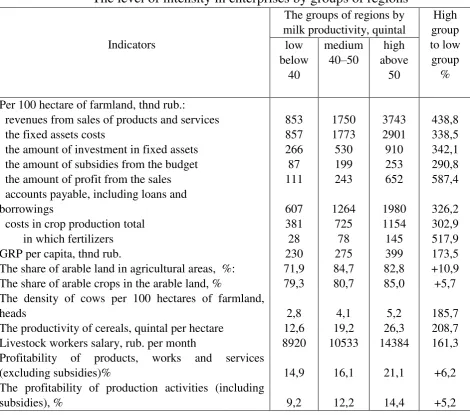
[image:18.595.86.557.282.697.2]Differences across regions due to a complex of factors - a high level of organization and intensification of agricultural production in general, as well as environmental conditions (Tab. 8).
Table 8
The level of intensity in enterprises by groups of regions
Indicators
The groups of regions by milk productivity, quintal
High group to low group % low below 40 medium 40–50
high above
50
Per 100 hectare of farmland, thnd rub.:
revenues from sales of products and services the fixed assets costs
the amount of investment in fixed assets the amount of subsidies from the budget the amount of profit from the sales accounts payable, including loans and borrowings
costs in crop production total in which fertilizers GRP per capita, thnd rub.
The share of arable land in agricultural areas, %: The share of arable crops in the arable land, %
The density of cows per 100 hectares of farmland, heads
The productivity of cereals, quintal per hectare Livestock workers salary, rub. per month
Profitability of products, works and services (excluding subsidies)%
The profitability of production activities (including subsidies), % 853 857 266 87 111 607 381 28 230 71,9 79,3 2,8 12,6 8920 14,9 9,2 1750 1773 530 199 243 1264 725 78 275 84,7 80,7 4,1 19,2 10533 16,1 12,2 3743 2901 910 253 652 1980 1154 145 399 82,8 85,0 5,2 26,3 14384 21,1 14,4 438,8 338,5 342,1 290,8 587,4 326,2 302,9 517,9 173,5 +10,9 +5,7 185,7 208,7 161,3 +6,2 +5,2
18
The economies of these regions is more developed, as evidenced by the large amount of gross regional product per capita by 73.5%, therefore, demand for food is higher and as a result agriculture is more developed. At higher provision of asset (in 3.4 times) the use of arable land for crops is better, the crop yields and intensity level of grain and forage crops, the density of the number of animals and the overall size of the production are higher. At the expense of debt and equity with government support investment in the renewal and modernization of the resource potential are carried out intensively. The profitability of sales and services is higher by 6.2%, the wage is also higher that contributes to better work organization. But the overall profitability and the highest group of regions is still not high enough for the expanded reproduction on the basis of innovation.
In the regions of the lower group, which is 40% of agricultural land and almost a third of the cattle enterprises, the main problem is to increase the overall level of economic development, intensification of crop and livestock, production of GRP per capita and on this basis to enhance the demand for livestock products. On order to increase the productivity of land and animal productivity and wages these regions are in dire need to create favorable conditions for business development, integration and cooperation of production, as well as to enhance public support for the WTO rules for regions with unfavorable conditions for farming.
References
1. Buzdalov, I.N. On the intensification of Russian agriculture // Voprosy Economiki. 2013. no 12. p. 141-152.
2. Zinchenko, A.P. Agriculture revenues and reproduction in households //
APK : èkonomika, upravlenie. 2010. no 8. p. 64-71.
3. Zinchenko, A.P.; Kagirova, M.V. Trends and factors of dairy cows product-efficiency // Economy of Agricultural and Processing Enterprises. 2010. no 3. p. 24-27.
4. The Ministry of Agriculture of the Russian Federation. [Electronic resource]. Access - http://www.mcx.ru/.
5. The national report " On the progress and results of the implementation in 2013 of the state program of agricultural development and regulation of agricultural products, raw materials and food for 2013-2020." M. 2014.
6. Government Resolution №1421 from 19.12.2014 "On Amendments to the
State Agriculture Development Programme hozyayst Islands and the regulation of agricultural products, raw materials and food for 2013-2020».
7. Agriculture in Russia. State Statistics Committee of Russia. 1998, 2000, 2002.
19
9. Federal State Statistics Service. [Electronic resource]. Access - http://www.gks.ru/.
Zinchenko Aleksey Pavlovich — Doctor of Economics, Corresponding Member of the Russian Academy of Sciences, Professor of the Department of Statistics and Econometrics, Russian Timiryazev State Agrarian University (127550, Moscow, Timiryazevskaya street, 49; tel.: +7 (499) 976-12-53; e-mail: [email protected]).
Kagirova Marya Vyacheslavovna — PhD in Economics, Associate Professor of the Department of Statistics and Econometrics, Russian Timiryazev State Agrarian University (127550, Moscow, Timiryazevskaya street, 49; tel.: +7 (499) 976-12-53; e-mail: [email protected]).
© Zinchenko, 2016