A Scalable Global Model for Summarization
Dan Gillick1,2, Benoit Favre2
1 Computer Science Division, University of California Berkeley, USA 2International Computer Science Institute, Berkeley, USA
{dgillick,favre}@icsi.berkeley.edu
Abstract
We present an Integer Linear Program for exact inference under a maximum coverage model for automatic summarization. We com-pare our model, which operates at the sub-sentence or “concept”-level, to a sub- sentence-level model, previously solved with an ILP. Our model scales more efficiently to larger problems because it does not require a quadratic number of variables to address re-dundancy in pairs of selected sentences. We also show how to include sentence compres-sion in the ILP formulation, which has the desirable property of performing compression and sentence selection simultaneously. The resulting system performs at least as well as the best systems participating in the recent Text Analysis Conference, as judged by a va-riety of automatic and manual content-based metrics.
1 Introduction
Automatic summarization systems are typically ex-tractive or absex-tractive. Since abstraction is quite hard, the most successful systems tested at the Text Analysis Conference (TAC) and Document Under-standing Conference (DUC)1, for example, are ex-tractive. In particular, sentence selection represents a reasonable trade-off between linguistic quality, guaranteed by longer textual units, and summary content, often improved with shorter units.
Whereas the majority of approaches employ a greedy search to find a set of sentences that is
1TAC is a continuation of DUC, which ran from 2001-2007.
both relevant and non-redundant (Goldstein et al., 2000; Nenkova and Vanderwende, 2005), some re-cent work focuses on improved search (McDonald, 2007; Yih et al., 2007). Among them, McDonald is the first to consider a non-approximated maximiza-tion of an objective funcmaximiza-tion through Integer Linear Programming (ILP), which improves on a greedy search by 4-12%. His formulation assumes that the quality of a summary is proportional to the sum of the relevance scores of the selected sentences, penal-ized by the sum of the redundancy scores of all pairs of selected sentences. Under a maximum summary length constraint, this problem can be expressed as a quadratic knapsack (Gallo et al., 1980) and many methods are available to solve it (Pisinger et al., 2005). However, McDonald reports that the method is not scalable above 100 input sentences and dis-cusses more practical approximations. Still, an ILP formulation is appealing because it gives exact so-lutions and lends itself well to extensions through additional constraints.
Methods like McDonald’s, including the well-known Maximal Marginal Relevance (MMR) algo-rithm (Goldstein et al., 2000), are subject to an-other problem: Summary-level redundancy is not always well modeled by pairwise sentence-level re-dundancy. Figure 1 shows an example where the combination of sentences (1) and (2) overlaps com-pletely with sentence (3), a fact not captured by pair-wise redundancy measures. Redundancy, like con-tent selection, is a global problem.
Here, we discuss a model for sentence selection with a globally optimal solution that also addresses redundancy globally. We choose to represent
(1) The cat is in the kitchen. (2) The cat drinks the milk.
(3) The cat drinks the milk in the kitchen.
Figure 1: Example of sentences redundant as a group. Their redundancy is only partially captured by sentence-level pairwise measurement.
mation at a finer granularity than sentences, with concepts, and assume that the value of a summary is the sum of the values of the unique concepts it con-tains. While the concepts we use in experiments are word n-grams, we use the generic term to emphasize that this is just one possible definition. Only credit-ing each concept once serves as an implicit global constraint on redundancy. We show how the result-ing optimization problem can be mapped to an ILP that can be solved efficiently with standard software. We begin by comparing our model to McDonald’s (section 2) and detail the differences between the re-sulting ILP formulations (section 3), showing that ours can give competitive results (section 4) and of-fer better scalability2 (section 5). Next we demon-strate how our ILP formulation can be extended to include efficient parse-tree-based sentence compres-sion (section 6). We review related work (section 7) and conclude with a discussion of potential improve-ments to the model (section 8).
2 Models
The model proposed by McDonald (2007) considers information and redundancy at the sentence level. The score of a summary is defined as the sum of the relevance scores of the sentences it contains mi-nus the sum of the redundancy scores of each pair of these sentences. Ifsiis an indicator for the presence of sentenceiin the summary,Reli is its relevance, andRedij is its redundancy with sentence j, then a summary is scored according to:
X
i
Relisi− X
ij
Redijsisj
Generating a summary under this model involves maximizing this objective function, subject to a
2Strictly speaking, exact inference for the models discussed
in this paper is NP-hard. Thus we use the term “scalable” in a purely practical sense.
length constraint. A variety of choices forReliand
Redij are possible, from simple word overlap met-rics to the output of feature-based classifiers trained to perform information retrieval and textual entail-ment.
As an alternative, we consider information and re-dundancy at a sub-sentence, “concept” level, model-ing the value of a summary as a function of the con-cepts it covers. While McDonald uses an explicit redundancy term, we model redundancy implicitly: a summary only benefits from including each con-cept once. Withci an indicator for the presence of conceptiin the summary, and its weightwi, the ob-jective function is:
X
i
wici
We generate a summary by choosing a set of sen-tences that maximizes this objective function, sub-ject to the usual length constraint.
In summing over concept weights, we assume that the value of including a concept is not effected by the presence of any other concept in the summary. That is, concepts are assumed to be independent. Choos-ing a suitable definition for concepts, and a map-ping from the input documents to concept weights, is both important and difficult. Concepts could be words, named entities, syntactic subtrees or seman-tic relations, for example. While deeper semanseman-tics make more appealing concepts, their extraction and weighting are much more error-prone. Any error in concept extraction can result in a biased objective function, leading to poor sentence selection.
3 Inference by ILP
Each model presented above can be formalized as an Integer Linear Program, with a solution represent-ing an optimal selection of sentences under the ob-jective function, subject to a length constraint. Mc-Donald observes that the redundancy term makes for a quadratic objective function, which he coerces to a linear function by introducing additional variables
the whole summary, the resulting ILP is:
Maximize: X
i
Relisi− X
ij
Redijsij
Subject to: X j
ljsj ≤L
sij ≤si sij ≤sj ∀i, j
si+sj−sij ≤1 ∀i, j
si∈ {0,1} ∀i
sij ∈ {0,1} ∀i, j
To express our concept-based model as an ILP, we maintain our notation from section 2, withci an in-dicator for the presence of conceptiin the summary andsjan indicator for the presence of sentencejin the summary. We addOccij to indicate the occur-rence of conceptiin sentencej, resulting in a new ILP:
Maximize: X
i
wici
Subject to: X j
ljsj ≤L
sjOccij ≤ci, ∀i, j (1) X
j
sjOccij ≥ci ∀i (2)
ci ∈ {0,1} ∀i
sj ∈ {0,1} ∀j
Note thatOcc, likeRelandRed, is a constant pa-rameter. The constraints formalized in equations (1) and (2) ensure the logical consistency of the solu-tion: selecting a sentence necessitates selecting all the concepts it contains and selecting a concept is only possible if it is present in at least one selected sentence. Constraint (1) also prevents the inclusion of concept-less sentences.
4 Performance
Here we compare both models on a common sum-marization task. The data is part of the Text Analy-sis Conference (TAC) multi-document summariza-tion evaluasummariza-tion and involves generating 100-word summaries from 10 newswire documents, each on a given topic. While the 2008 edition of TAC also includes an update task—additional summaries as-suming some prior knowledge—we focus only on
the standard task. This includes 48 topics, averag-ing 235 input sentences (rangaverag-ing from 47 to 652). Since the mean sentence length is around 25 words, a typical summary consists of 4 sentences.
In order to facilitate comparison, we generate summaries from both models using a common pipeline:
1. Clean input documents. A simple set of rules removes headers and formatting markup.
2. Split text into sentences. We use the unsuper-vised Punkt system (Kiss and Strunk, 2006).
3. Prune sentences shorter than 5 words.
4. Compute parameters needed by the models.
5. Map to ILP format and solve. We use an open source solver3.
6. Order sentences picked by the ILP for inclusion in the summary.
The specifics of step 4 are described in detail in (McDonald, 2007) and (Gillick et al., 2008). Mc-Donald’s sentence relevance combines word-level cosine similarity with the source document and the inverse of its position (early sentences tend to be more important). Redundancy between a pair of sen-tences is their cosine similarity. For sentence iin documentD,
Reli =cosine(i, D) + 1/pos(i, D)
Redij =cosine(i, j)
In our concept-based model, we use word bi-grams, weighted by the number of input documents in which they appear. While word bigrams stretch the notion of a concept a bit thin, they are eas-ily extracted and matched (we use stemming to al-low slightly more robust matching). Table 1 pro-vides some justification for document frequency as a weighting function. Note that bigrams gave consis-tently better performance than unigrams or trigrams for a variety of ROUGE measures. Normalizing by document frequency measured over a generic set (TFIDF weighting) degraded ROUGE performance.
Bigrams consisting of two stopwords are pruned, as are those appearing in fewer than three documents.
We largely ignore the sentence ordering problem, sorting the resulting sentences first by source docu-ment date, and then by position, so that the order of two originally adjacent sentences is preserved, for example.
Doc. Freq. (D) 1 2 3 4 5 6
In Gold Set 156 48 25 15 10 7
Not in Gold Set 5270 448 114 42 21 11
Relevant (P) 0.03 0.10 0.18 0.26 0.33 0.39
Table 1: There is a strong relationship between the docu-ment frequency of input bigrams and the fraction of those bigrams that appear in the human generated “gold” set: Letdibe document frequencyiandpi be the percent of
input bigrams with di that are actually in the gold set.
Then the correlationρ(D, P) = 0.95for DUC 2007 and 0.97for DUC 2006. Data here averaged over all prob-lems in DUC 2007.
The summaries produced by the two systems have been evaluated automatically with ROUGE and manually with the Pyramid metric. In particular, ROUGE-2 is the recall in bigrams with a set of human-written abstractive summaries (Lin, 2004). The Pyramid score arises from a manual alignment of basic facts from the reference summaries, called Summary Content Units (SCUs), in a hypothesis summary (Nenkova and Passonneau, 2004). We used the SCUs provided by the TAC evaluation.
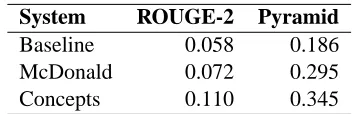
Table 2 compares these results, alongside a base-line that uses the first 100 words of the most re-cent document. All the scores are significantly different, showing that according to both human and automatic content evaluation, the concept-based model outperforms McDonald’s sentence-based model, which in turn outperforms the base-line. Of course, the relevance and redundancy func-tions used for McDonald’s formulation in this exper-iment are rather primitive, and results would likely improve with better relevance features as used in many TAC systems. Nonetheless, our system based on word bigram concepts, similarly primitive, per-formed at least as well as any in the TAC evaluation, according to two-tailed t-tests comparing ROUGE, Pyramid, and manually evaluated “content respon-siveness” (Dang and Owczarzak, 2008) of our sys-tem and the highest scoring syssys-tem in each category.
System ROUGE-2 Pyramid
Baseline 0.058 0.186
McDonald 0.072 0.295
[image:4.612.337.514.53.110.2]Concepts 0.110 0.345
Table 2: Scores for both systems and a baseline on TAC 2008 data (Set A) for ROUGE-2 and Pyramid evalua-tions.
5 Scalability
McDonald’s sentence-level formulation corresponds to a quadratic knapsack, and he shows his particu-lar variant is NP-hard by reduction to 3-D matching. The concept-level formulation is similar in spirit to the classical maximum coverage problem: Given a set of itemsX, a set of subsetsS ofX, and an in-teger k, the goal is to pick at most ksubsets from
Sthat maximizes the size of their union. Maximum coverage is known to be NP-hard by reduction to the set cover problem (Hochbaum, 1996).
Perhaps the simplest way to show that our formu-lation is NP-hard is by reduction to the knapsack problem (Karp, 1972). Consider the special case where sentences do not share any overlapping con-cepts. Then, the value of each sentence to the sum-mary is independent of every other sentence. This is a knapsack problem: trying to maximize the value in a container of limited size. Given a solver for our problem, we could solve all knapsack problem in-stances, so our problem must also be NP-hard.
With n input sentences and m concepts, both formulations generate a quadratic number of con-straints. However, McDonald’s hasO(n2)variables
while ours has O(n+m). In practice, scalability is largely determined by the sparsity of the redun-dancy matrixRedand the sentence-concept matrix
Occ. Efficient solutions thus depend heavily on the choice of redundancy measure in McDonald’s for-mulation and the choice of concepts in ours. Prun-ing to reduce complexity involves removPrun-ing low-relevance sentences or ignoring low redundancy val-ues in the former, and corresponds to removing low-weight concepts in the latter. Note that pruning con-cepts may be more desirable: Pruned sentences are irretrievable, but pruned concepts may well appear in the selected sentences through co-occurrence.
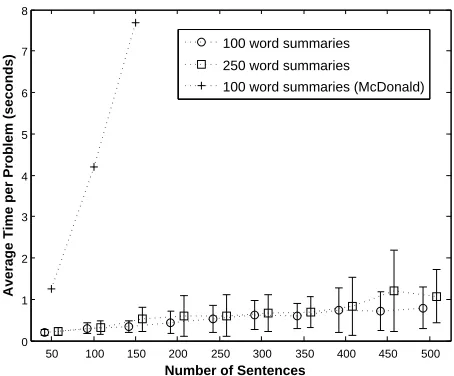
formulations, using a set of 25 topics from DUC 2007, each of which have at least 500 input sen-tences. These are very similar to the TAC 2008 topics, but more input documents are provided for each topic, which allowed us to extend the analysis to larger problems. While the ILP solver finds opti-mal solutions efficiently for our concept-based for-mulation, run-time for McDonald’s approach grows very rapidly. The plot includes timing results for 250-word summaries as well, showing that our ap-proach is fast even for much more complex prob-lems: A rough estimate for the number of possible summaries has 5004 = 2.6×10⁹for 100-word
sum-maries and 50010 = 2.5×10²⁰for 250 words
sum-maries.
While exact solutions are theoretically appealing, they are only useful in practice if fast approxima-tions are inferior. A greedy approximation of our objective function gives 10% lower ROUGE scores than the exact solution, a gap that separates the high-est scoring systems from the middle of the pack in the TAC evaluation. The greedy solution (linear in the number of sentences, assuming a constant sum-mary length) marks an upper bound on speed and a lower bound on performance; The ILP solution marks an upper bound on performance but is subject to the perils of exponential scaling. While we have not experimented with much larger documents, ap-proximate methods will likely be valuable in bridg-ing the performance gap for complex problems. Pre-liminary experiments with local search methods are promising in this regard.
6 Extensions
Here we describe how our ILP formulation can be extended with additional constraints to incor-porate sentence compression. In particular, we are interested in creating compressed alternatives for the original sentence by manipulating its parse tree (Knight and Marcu, 2000). This idea has been applied with some success to summarization (Turner and Charniak, 2005; Hovy et al., 2005; Nenkova, 2008) with the goal of removing irrelevant or redun-dant details, thus freeing space for more relevant in-formation. One way to achieve this end is to gen-erate compressed candidates for each sentence, cre-ating an expanded pool of input sentences, and
em-50 100 150 200 250 300 350 400 450 500 0
1 2 3 4 5 6 7 8
Number of Sentences
Average Time per Problem (seconds)
100 word summaries 250 word summaries
[image:5.612.314.541.52.240.2]100 word summaries (McDonald)
Figure 2: A comparison of ILP run-times (on an AMD 1.8Ghz desktop machine) of McDonald’s sentence-based formulation and our concept-based formulation with an increasing number of input sentences.
ploy some redundancy removal on the final selec-tion (Madnani et al., 2007).
We adapt this approach to fit the ILP formulations so that the optimization procedure decides which compressed alternatives to pick. Formally, each compression candidate belongs to a groupgk corre-sponding to its original sentence. We can then craft a constraint to ensure that at most one sentence can be selected from groupgk, which also includes the original:
X
i∈gk
si ≤1,∀gk
Assuming that all the compressed candidates are themselves well-formed, meaningful sentences, we would expect this approach to generate higher qual-ity summaries. In general, however, compression algorithms can generate an exponential number of candidates. Within McDonald’s framework, this can increase the number of variables and constraints tremendously. Thus, we seek a compact representa-tion for compression in our concept framework.
is dropped (a temporal clause, for example) that pre-serves the grammaticality of the sentence. In sub-stitution, one substring is replaced by another (US replaces United States, for example).
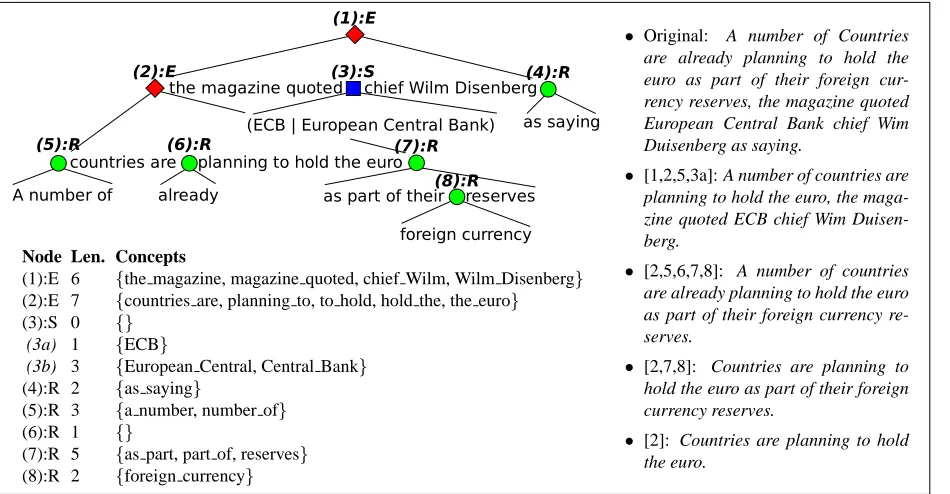
Arbitrary combinations of these operations are too general to be represented efficiently in an ILP. In particular, we need to compute the length of a sentence and the concepts it covers for all compres-sion candidates. Thus, we insist that the operations can only affect non-overlapping spans of text, and end up with a tree representation of each sentence: Nodes correspond to compression operations and leaves map to the words. Each node holds the length it contributes to the sentence recursively, as the sum of the lengths of its children. Similarly, the concepts covered by a node are the union of the concepts cov-ered by its children. When a node is activated in the ILP, we consider that the text attached to it is present in the summary and update the length constraint and concept selection accordingly. Figure 3 gives an ex-ample of this tree representation for a sentence from the TAC data, showing the derivations of some com-pressed candidates.
For a given sentencej, letNj be the set of nodes in its compression tree, Ej ⊆ Nj be the set of nodes that can be extracted (used as independent sentences), Rj ⊆ Nj be the set of nodes that can be removed, and Sj ⊆ Nj be the set of substitu-tion group nodes. Letxandybe nodes fromNj; we create binary variablesnxandnyto represent the in-clusion ofxoryin the summary. Letxydenote the fact thatx ∈ Nj is a direct parent of y ∈ Nj. The constraints corresponding to the compression tree are:
X
x∈Ej
nx ≤1 ∀j (3)
X
xy
ny =nx ∀x∈Sj ∀j (4)
nx≥ny ∀(y x∧x /∈ {Rj ∪Sj}) ∀j (5)
nx≤ny ∀(yx∧x /∈ {Ej ∪Sj}) ∀j (6)
Eq. (3) enforces that only one sub-sentence is ex-tracted from the original sentence; eq. (4) enforces that one child of a substitution group is selected if and only if the substitution node is selected; eq. (5) ensures that a child node is selected when its parent is selected unless the child is removable (or a
substi-tution group); eq. (6) ensures that if a child node is selected, its parent is also selected unless the child is an extraction node (that can be used as a root).
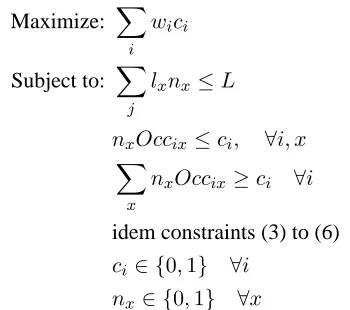
Each node is associated with the words and the concepts it contains directly (which are not con-tained by a child node) in order to compute the new length constraints and activate concepts in the ob-jective function. We setOccix to represent the oc-currence of concept i in node x as a direct child. Letlxbe the length contributed to node xas direct children. The resulting ILP for performing sentence compression jointly with sentence selection is:
Maximize: X
i
wici
Subject to: X j
lxnx ≤L
nxOccix ≤ci, ∀i, x X
x
nxOccix ≥ci ∀i
idem constraints (3) to (6)
ci∈ {0,1} ∀i
nx ∈ {0,1} ∀x
While this framework can be used to imple-ment a wide range of compression techniques, we choose to derive the compression tree from the sentence’s parse tree, extracted with the Berkeley parser (Petrov and Klein, 2007), and use a set of rules to label parse tree nodes with compression op-erations. For example, declarative clauses contain-ing a subject and a verb are labeled with the extract (E) operation; adverbial clauses and non-mandatory prepositional clauses are labeled with the remove (R) operation; Acronyms can be replaced by their full form by using substitution (S) operations and a primitive form of co-reference resolution is used to allow the substitution of noun phrases by their refer-ent.
System R-2 Pyr. LQ
No comp. 0.110 0.345 2.479
[image:6.612.339.514.221.376.2]Comp. 0.111 0.323 2.021
Table 3: Scores of the system with and without sentence compression included in the ILP (TAC’08 Set A data).
countries are planning to hold the euro
as part of their reserves the magazine quoted chief Wilm Disenberg
as saying
already
(ECB | European Central Bank)
foreign currency (1):E
(2):E
(6):R (7):R
(8):R
(4):R (3):S
A number of (5):R
Node Len. Concepts
(1):E 6 {the magazine, magazine quoted, chief Wilm, Wilm Disenberg} (2):E 7 {countries are, planning to, to hold, hold the, the euro}
(3):S 0 {}
(3a) 1 {ECB}
(3b) 3 {European Central, Central Bank}
(4):R 2 {as saying}
(5):R 3 {a number, number of}
(6):R 1 {}
(7):R 5 {as part, part of, reserves} (8):R 2 {foreign currency}
• Original: A number of Countries are already planning to hold the euro as part of their foreign cur-rency reserves, the magazine quoted European Central Bank chief Wim Duisenberg as saying.
• [1,2,5,3a]: A number of countries are planning to hold the euro, the maga-zine quoted ECB chief Wim Duisen-berg.
• [2,5,6,7,8]: A number of countries are already planning to hold the euro as part of their foreign currency re-serves.
• [2,7,8]: Countries are planning to hold the euro as part of their foreign currency reserves.
[image:7.612.74.549.54.301.2]• [2]: Countries are planning to hold the euro.
Figure 3: A compression tree for an example sentence. E-nodes (diamonds) can be extracted and used as an indepen-dent sentences, R-nodes (circles) can be removed, and S-nodes (squares) contain substitution alternatives. The table shows the word bigram concepts covered by each node and the length it contributes to the summary. Examples of resulting compression candidates are given on the right side, with the list of nodes activated in their derivations.
in ROUGE-2 score (see Table 3), but a reduction in Pyramid score. An analysis of the resulting sum-maries showed that the rules used for implementing sentence compression fail to ensure that all com-pression candidates are valid sentences, and about 60% of the summaries contain ungrammatical sen-tences. This is confirmed by the linguistic qual-ity4 score drop for this system. The poor quality of the compressed sentences explains the reduction in Pyramid scores: Human judges tend to not give credit to ungrammatical sentences because they ob-scure the SCUs.
We have shown in this section how sentence com-pression can be implemented in a more scalable way under the concept-based model, but it remains to be shown that such a technique can improve summary quality.
7 Related work
In addition to proposing an ILP for the sentence-level model, McDonald (2007) discusses a kind of summary-level model: The score of a summary is
4As measured according to the TAC’08 guidelines.
determined by its cosine similarity to the collection of input documents. Though this idea is only imple-mented with approximate methods, it is similar in spirit to our concept-based model since it relies on weights for individual summary words rather than sentences.
Using a maximum coverage model for summa-rization is not new. Filatova (2004) formalizes the idea, discussing its similarity to the classical NP-hard problem, but in the end uses a greedy approxi-mation to generate summaries. More recently, Yih et al. (2007) employ a similar model and uses a stack decoder to improve on a greedy search. Globally optimal summaries are also discussed by Liu (2006) and Jaoua Kallel (2004) who apply genetic algo-rithms for finding selections of sentences that maxi-mize summary-level metrics. Hassel (2006) uses hill climbing to build summaries that maximize a global information criterion based on random indexing.
fre-quency). Conroy (2006) describes a bag-of-words model, with the goal of approximating the distribu-tion of words from the input documents in the sum-mary. Others, like (Yih et al., 2007) train a model to learn the value of each word from a set of features including frequency and position. Filatova’s model is most theoretically similar to ours, though the con-cepts she chooses are “events”.
8 Conclusion and Future Work
We have synthesized a number of ideas from the field of automatic summarization, including concept-level weighting, a maximum coverage model to minimize redundancy globally, and sen-tence compression derived from parse trees. While an ILP formulation for summarization is not novel, ours provides reasonably scalable, efficient solutions for practical problems, including those in recent TAC and DUC evaluations. We have also shown how it can be extended to perform sentence com-pression and sentence selection jointly.
In ROUGE and Pyramid evaluation, our system significantly outperformed McDonald’s ILP sys-tem. However, we would note that better design of sentence-level scoring would likely yield better re-sults as suggested by the success of greedy sentence-based methods at the DUC and TAC conferences (see for instance (Toutanova et al., 2007)). Still, the performance of our system, on par with the current state-of-the-art, is encouraging.
There are three principal directions for future work. First, word bigram concepts are convenient, but semantically unappealing. We plan to explore concepts derived from parse trees, where weights may be a function of frequency as well as hierar-chical relationships.
Second, our current approach relies entirely on word frequency, a reasonable proxy for relevance, but likely inferior to learning weights from train-ing data. A number of systems have shown im-provements by learning word values, though prelim-inary attempts to improve on our frequency heuristic by learning bigram values have not produced sig-nificant gains. Better features may be necessary. However, since the ILP gives optimal solutions so quickly, we are more interested in discriminative training where we learn weights for features that
push the resulting summaries in the right direction, as opposed to the individual concept values.
Third, our rule-based sentence compression is more of a proof of concept, showing that joint com-pression and optimal selection is feasible. Better statistical methods have been developed for produc-ing high quality compression candidates (McDon-ald, 2006), that maintain linguistic quality, some re-cent work even uses ILPs for exact inference (Clarke and Lapata, 2008). The addition of compressed sen-tences tends to yield less coherent summaries, mak-ing sentence ordermak-ing more important. We would like to add constraints on sentence ordering to the ILP formulation to address this issue.
Acknowledgments
This work is supported by the Defense Advanced Research Projects Agency (DARPA) GALE project, under Contract No. HR0011-06-C-0023. Any opin-ions, findings, conclusions or recommendations ex-pressed in this material are those of the authors and do not necessarily reflect the views of DARPA.
References
James Clarke and Mirella Lapata. 2008. Global infer-ence for sentinfer-ence compression: An integer linear pro-gramming approach. Journal of Artificial Intelligence Research, 31:273–381.
John M. Conroy, Judith D. Schlesinger, and Dianne P. O’Leary. 2006. Topic-focused multi-document sum-marization using an approximate oracle score. In Pro-ceedings of COLING/ACL.
Hoa Trang Dang and Karolina Owczarzak. 2008. Overview of the TAC 2008 Update Summarization Task. In Proceedings of Text Analysis Conference. E. Filatova and V. Hatzivassiloglou. 2004. Event-based
extractive summarization. In Proceedings of ACL Workshop on Summarization, volume 111.
G. Gallo, PL Hammer, and B. Simeone. 1980. Quadratic knapsack problems. Mathematical Programming Study, 12:132–149.
D. Gillick, B. Favre, and D. Hakkani-Tur. 2008. The ICSI Summarization System at TAC 2008. In Pro-ceedings of the Text Understanding Conference. Jade Goldstein, Vibhu Mittal, Jaime Carbonell, and Mark
Martin Hassel and Jonas Sj¨obergh. 2006. Towards holistic summarization: Selecting summaries, not sen-tences. In Proceedings of Language Resources and Evaluation.
D.S. Hochbaum. 1996. Approximating covering and packing problems: set cover, vertex cover, indepen-dent set, and related problems. PWS Publishing Co. Boston, MA, USA, pages 94–143.
E. Hovy, C.Y. Lin, and L. Zhou. 2005. A BE-based multi-document summarizer with sentence compres-sion. In Proceedings of Multilingual Summarization Evaluation.
Fatma Jaoua Kallel, Maher Jaoua, Lamia Bel-guith Hadrich, and Abdelmajid Ben Hamadou. 2004. Summarization at LARIS Laboratory. In Proceedings of the Document Understanding Conference.
Richard Manning Karp. 1972. Reducibility among com-binatorial problems. Complexity of Computer Compu-tations, 43:85–103.
Tibor Kiss and Jan Strunk. 2006. Unsupervised multi-lingual sentence boundary detection. Computational Linguistics, 32.
K. Knight and D. Marcu. 2000. Statistics-Based Summarization-Step One: Sentence Compression. In Proceedings of the National Conference on Artificial Intelligence, pages 703–710. Menlo Park, CA; Cam-bridge, MA; London; AAAI Press; MIT Press; 1999. Chin-Yew Lin. 2004. ROUGE: A Package for
Auto-matic Evaluation of Summaries. In Proceedings of the Workshop on Text Summarization Branches Out (WAS 2004), pages 25–26.
D. Liu, Y. Wang, C. Liu, and Z. Wang. 2006. Multiple Documents Summarization Based on Genetic Algo-rithm. Lecture Notes in Computer Science, 4223:355. N. Madnani, D. Zajic, B. Dorr, N.F. Ayan, and J. Lin.
2007. Multiple Alternative Sentence Compressions for Automatic Text Summarization. In Proceed-ings of the Document Understanding Conference at NLT/NAACL.
R. McDonald. 2006. Discriminative sentence compres-sion with soft syntactic constraints. In Proceedings of the 11th EACL, pages 297–304.
R. McDonald. 2007. A Study of Global Inference Al-gorithms in Multi-document Summarization. Lecture Notes in Computer Science, 4425:557.
Ani Nenkova and Rebecca Passonneau. 2004. Evaluat-ing content selection in summarization: The pyramid method. In Proceedings of HLT-NAACL.
A. Nenkova and L. Vanderwende. 2005. The impact of frequency on summarization. Technical Report MSR-TR-2005-101, Microsoft Research, Redmond, Wash-ington.
A. Nenkova. 2008. Entity-driven rewrite for multidocu-ment summarization. Proceedings of IJCNLP.
Slav Petrov and Dan Klein. 2007. Learning and infer-ence for hierarchically split PCFGs. In AAAI 2007 (Nectar Track).
D. Pisinger, A.B. Rasmussen, and R. Sandvik. 2005. Solution of large-sized quadratic knapsack problems through aggressive reduction. INFORMS Journal on Computing.
K. Toutanova, C. Brockett, M. Gamon, J. Jagarlamudi, H. Suzuki, and L. Vanderwende. 2007. The Pythy Summarization System: Microsoft Research at DUC 2007. In Proceedings of the Document Understanding Conference.
J. Turner and E. Charniak. 2005. Supervised and Unsu-pervised Learning for Sentence Compression. In Pro-ceedings of ACL.