A Collaborative Tool for the Computational Modelling of Child
Language Acquisition
Kris Jack
CEA LIST, Laboratoire d'ingénerie de la connaissance multimédia multilingue
18 route du Panorama, BP6
FontenayauxRoses, F92265 France
[email protected]
Abstract
A large number of computational language learners have been proposed for modelling the process of child language acquisition. Com paring them, however, can be difficult due to the different assumptions that they make, the diverse test results presented, and the different linguistic behaviours investigated. This paper introduces a toolkit that allows different lan guage learners to be trained, tested and ana lysed under standardised conditions. The res ults can be easily compared with one another and with typical child language development to highlight the relative advantages and disad vantages of learners.
1 Introduction
The computational modelling of language acquis ition can help in understanding the acquisition process by estimating the problem faced by chil dren and designing algorithms that solve it in a similar way as they do. Many such models have been produced in recent years, tackling various linguistic behaviours. Like in any relatively new domain of research, however, the treatment of one problem often reveals the presence of several more that in turn require new solutions of their own. This has led to the design and implementa tion of numerous learners that differ in either subtle or fundamental ways. Given such variety, it is not yet clear which kind of model, or com bination of models, can best account for the over all behaviour witnessed during child language de velopment.
When surveying the computational language acquisition literature, the relative advantages and
disadvantages of language learners are not al ways clear. As such, it can be very difficult to compare different learners with one another. The main problem is the lack of standardisation in the field. Language learners are constructed with different underlying assumptions, largely due to the lack of consensus in linguistic theory, are trained using different data (that can vary from miniature languages to full blown natural lan guages) and are tested using different testing measures (some of which include the 'Looks good to me' approach).
In this paper, a toolkit for investigating the computational modelling of child language ac quisition is proposed. The Language Acquisition Toolkit (LAT) allows researchers to work collab oratively in solving the modelling task, while ad dressing the problems introduced. It is an at tempt to bring the field forward by creating a standardised way for testing and implementing language acquisition learners. The issues ad dressed in this paper are largely driven by engin eering concerns although the choices that are made by the modeller will impact not only on their learner but also on the associated language theory. The driving motivation behind the LAT is that the best way to compare different language learners is to compare the behaviours that they produce. The closer a learner's behaviour is to the behaviour witnessed in children, the better the model.
2 Background
The process of modelling child language acquisi tion is very complex, as many of the first at tempts confirmed (Feldman et al., 1990; Suppes, Liang & Bottner, 1991). Rather than modelling the process in entirety, an undoubtedly daunting task, modellers took the simplified approach of focusing upon individual linguistic behaviours, leading to much research into relatively con strained problems such as understanding over and undergeneralisation errors (Plunkett, Sinha, Moller & Strandsby, 1992), single word learning (Regier, 2005), syntactic category acquisition (Redington, Chater & Finch, 1988) and past tense learning (Rumelhart & Mcclelland, 1986). While such models have led to valuable insights in the domain, it can be difficult to see how each of them is related to one another given the lack of standardised learning, testing and analysis.
Often, the variety found in computational models reflects the divisions between linguistic theories pertaining to child language acquisition (Kaplan, Oudeyer & Bergen, 2008). Given that linguists remain divided about how children learn language, it is not surprising to find a similar di vision in the computational modelling com munity as well. One of the fundamental issues that separates modellers is the kind of data that the learner learns. This can range from the use of plain textual data (Elman, 1993), to grounded sensorbased input (Roy, 2008). Standardising the type of learning data would thus be useful for comparing language learners.
Typical computational models are often tested under different circumstances and using different techniques. For example, while some papers of fer a general analysis of the model's behaviour, others focus on particular features, while some test language comprehension, others test lan guage production, and while some consider de velopmental growth, others consider only the start and end points of training. Although this is often justifiable in the context of the research problem, it makes it difficult to directly compare two models. It would be useful to put all models through the same set of rigorous tests in order to find out how they are similar and how they differ from one another. Such standardised testing will often reveal important differences that may have previously been hidden.
Practically, however, not all models that are described in the literature are made available for
download. As a result, researchers often have to spend time recreating models. This assumes, of course, that the model has been described in enough detail that it can be faithfully recreated. Much time could be saved if such models were available for download, from a common reposit ory, such as the Weka makes machine learning algorithms freely available in a software work bench (http://www.cs.waikato.ac.nz/~ml/).
A good language learner should not just solve language learning problems, but should do so in a similar way as is witnessed in children. Based on psycholinguistic evidence, several linguistic timetables have been derived containing import ant linguistic milestones (Brown, 1973; Ingram, 1989; Pinker, 1994; Tomasello, 2005). The char acter of language development is a significant feature in child language acquisition and model lers should be encouraged to model it to better understand the process. A language learner that demonstrates a good use of syntax at the same time as producing its first words is not very real istic. Instead, there should be a prolonged period in which words are learned followed by the emer gence of syntax. Unfortunately, a language mod el can often produce behaviours at unexpected times, signalling a problem with the linguistic theory that it embodies. A standardised approach to analysing the linguistic development of a lan guage learner would be an advantage.
3 The Language Acquisition Toolkit
3.1 Introduction
The Language Acquisition Toolkit (LAT) is a piece of software that allows researchers to de velop and test computational language learners within a standardised environment. The LAT's target users are researchers who have basic skills in software development and are comfortable us ing the programming language Java. It assumes that the language learner operates under the re strictions imposed in the miniature language paradigm (Feldman et al., 1990). The LAT can be obtained from www.langac.com and is avail able under a GNU public license meaning that the code can be reproduced and modified without obtaining permission.
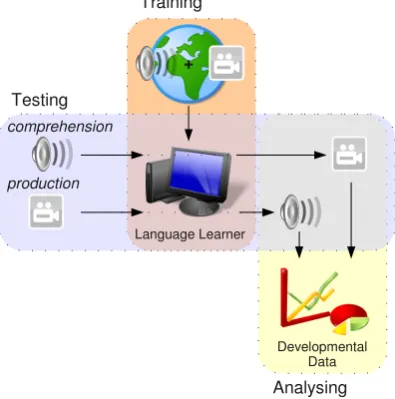
simulated world in which actionbased events oc cur. Both simulated descriptions and visual data are sent to the language learner for analysis. The LAT then tests both the language learner's com prehension and production capacities. Compre hension is tested by sending a description to the language learner and scoring the visual data that are produced. Similarly, production is tested by sending visual data to language learner and scor ing the descriptions produced. The LAT then analyses the results obtained from testing and de velops data describing the learner's development.
Figure 1: LAT Overview. A language learner is placed in the LAT's simulated world where it learns from simulated audio and visual data. The
LAT tests the learner and the results are used to produce data describing its development.
3.2 Training
The LAT can be configured to train different language learners by generating a simulated en vironment in which actionbased events occur. The simulated environment operates within the miniature language acquisition paradigm (Feld man et al., 1990), a simplified simulation of the realworld. A simulation is employed rather than grounding the model in the realworld in order to better control the number and type of problems that are being investigated in a single experiment. While the miniature language paradigm imposes a number of constraints, the proposed simulation contains enough complexity to justify its use.
The learner is trained by watching an event that is simulated in the blocks world in which a number of geometric objects can be found. When an event occurs, a symbolic representation of the description and visual data are generated.
More concretely, an event is the pairing of a sim ulated description and a action, e=〈d , a〉. Events are represented following evidence from child studies. First, it is assumed that the learner can establish a triadic relationship between an object, a speaker and themselves in order to asso ciate a description with an action. This kind of relationship is typically called jointattention and does not appear in children until around 12 monthsold (Tomasello, 1995). As such, the symbolic content present in descriptions and ac tions are limited to those found in child literature during the first year of life.
An infant's acoustic sensitivity is so attuned that from fourdaysold she demonstrates the ability to differentiate between native and non native speech (Mehler et al., 1988). Such dis crimination lies in rhythmic properties that differ over language groups (DehaeneLambertz & Houston, 1998; Mehler, Dupoux, Nazzi & De haeneLambertz, 1996) and is likely to be syl lablebased since infants detect change in syllable quantity, but not in phoneme quantity over samples of speech (BijeljacBabic, Bertoncini & Mehler, 1993). Infants also detect vowel change, a syllable covariant, more readily than consonant change (Bertoncini et al., 1988), further support ing a syllabic base. A description is thus repres ented as a nonzero length ordered list of syl lables in the LAT. Word segmentations are not included as there is no acoustic equivalent of the blank space in written language.
In terms of visual sensitivity, infants can identify objects through retinal and object dis placement during motion from four monthsold (Kellman, Gleitman & Spelke, 1987), and make relative spacial distinctions between left and right, and above and below, from three to ten months old (Quinn & Schyns, 2003). Infants can also make use of shape and colour to differentiate between objects in the first year of life (Landau, Smith & Jones, 1988). The LAT thus describes the physical properties of objects that inhabit the blocks world (e.g. shape, colour, size and posi tion), referred to as features. An action is defined as a nonzero length ordered list of feature sets, where each feature set is associated with a unique time interval. A set of features describes all ob jects that can be seen in an event. Note that ac tions in this terminology do not relate to actions in terms of verbs in natural language, but to a list of descriptions of scenes. Properties such as Analysing
Training
comprehension
Testing
+
production
Language Learner
push and pull are thus not explicitly represented as symbolic features.
Two types of events can occur in the blocks world: actionbased; and descriptive. In the case of an actionbased event, an object performs an action while in the case of a descriptive event, objects do not change. As a result, actionbased events contain different feature sets, giving the impression of change, while descriptive events contain the same feature sets, indicating no change. The description in an actionbased event describes the action while the description in a de scriptive event describes an object in the static scene. Objects can perform several actions in cluding moving, flashing, growing, shrinking, ap pearing, disappearing, destroying another object, hitting another object, pushing another object and pulling another object.
The LAT randomly generate events that can be used as training data. It can create objects, make them perform actions, and describe the events by instantiating appropriate grammar fragments. To encourage the use of standardised sets of training data, a number of sets of data have been ran domly generated that each contain 10,000 events. These data have been generated from different parameters (e.g. amount of noise, probability that an object will perform an action in an event, probabilities for each action to occur, number of time intervals for an event, number of colours/shapes/sizes/actions possible) with differ ent language properties (e.g. recursion present/ not present, number of rules, language in use).
To provide concrete examples of typical LAT training data, one data set, called the Appearance data set will be presented in detail. The appear ance data set is inspired from a study with real participants. Participants sat in front of a com puter screen that initially showed a blank white screen. They were asked to describe all changes that were made to the screen in enough detail that a stranger could recreate the scene using only their descriptions. By pressing a key on the key board, a new geometric object appeared on the screen and the change was described by the parti cipant. While the addition of an object to a scene appears to be a trivial change, participants pro duced complex linguistic descriptions that re vealed a deep knowledge of their language. For example, descriptions such as “a blue circle ap peared to the upper right of the green square at the bottom” and “a red circle appeared between
the four squares making the shape of a cross” (Jack, 2005).
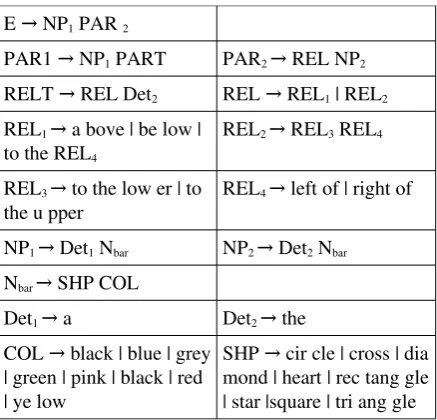
Given the complexity of the language pro duced, a simplified version the task was construc ted in which only the appearance of one object next to another object was considered. By re stricting the context, there is less demand for a computational language learner to have a rich se mantic representation of scenes. This served as a reasonable starting point from which to conduct the investigation. The actions in the Appearance data set were constructed by randomly generating one object and placing it in the middle of a 3x3 grid scene and then adding a second object, which was also randomly generated, in a differ ent position. Eight colours and shapes were used. Each action was also accompanied by an appro priate description that was generated using a grammar fragment (Figure 2).
E NP→ 1 PAR 2
PAR1 NP→ 1 PART PAR2 → REL NP2 RELT REL Det→ 2 REL REL→ 1 | REL2 REL1 → a bove | be low |
to the REL4
REL2 → REL3 REL4
REL3 → to the low er | to
the u pper REL
4 → left of | right of
NP1 → Det1 Nbar NP2 → Det2 Nbar Nbar → SHP COL
[image:4.595.307.526.333.543.2]Det1 → a Det2 → the COL black | blue | grey→
| green | pink | black | red | ye low
SHP cir cle | cross | dia→ mond | heart | rec tang gle | star |square | tri ang gle
Figure 2: Miniature Language from Appearance Data Set. All strings are syllable segmented rather
than word segmented.
nised as the same object before and after an ac tion occurs.
Before action (t=1) After action (t=2)
O1: square O1: blue O1: x2 O1: y2
O1: square O1: blue O1: x2 O1: y2
O2: circle O2: yellow O2: x3 O2: y3
[image:5.595.70.291.109.283.2]a ye low cir cle to the u pper right of the blue square
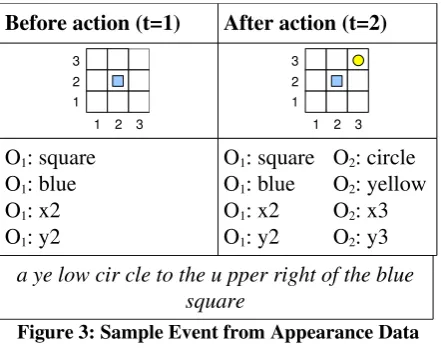
Figure 3: Sample Event from Appearance Data Set. Two time frames represented graphically and
as feature sets. The accompanying syllable seg mented description of the event is also shown.
The remaining data sets contain more complex events in which more actions and richer mini ature languages are employed. Actions are ran domly generated, with respect to the constraints imposed on the data set (e.g. number of colours, shapes, and actions) and appropriate descriptions are generated. These descriptions are produced by following a heuristic that minimises the num ber of syllables that can appear in a single de scription. This reduces the production of unnat ural sentences. For example, take the case where an object appears in a scene amongst 10 other ob jects. A description could be generated to de scribe the action with respect to one other object, two other objects or as many as 10 other objects. While such descriptions are all valid, many of them would sound unnatural if employed. The algorithm selects descriptions by favouring those that have fewer syllables. A parser is then em ployed that eliminates invalid descriptions that can be misinterpreted. By making a parsimoni ous use of syllables, more natural descriptions tend to be produced. More abstract language can also be found such as the use of the word 'bully ing' to describe pushing, pulling and hitting.
3.3 Testing
The LAT monitors the linguistic development of a language leaner by testing its comprehension and production capacities. The learner's compre hension and production are tested at every round of training.
For each set of training data, there is an associ ated set of testing data, ensuring a standardised test procedure for language learners. Test data is produced using grammar rules for producing de scriptions and heuristics for producing actions. The tests are constructed to reflect the properties found in the training data's miniature language. As such, the learner is only tested on the kind of descriptions and actions that it has the opportun ity to learn through observing events. Con cretely, a testing set is a set of events where each event relates one or more descriptions to one or more actions. The set of testing data associated with the Appearance training data set can be used to test the learner's vocabulary, certain multi word combinations and full sentences. Using the terminology found in Appearance's grammar fragment (Figure 2), the LAT tests for the com prehension of shapes (SHP), colours (COL), ob jects (Nbar), indefinite objects (NP1), definite ob jects (NP2) and events (E).
In testing the learner's comprehension, the LAT sends a description as input and receives a set of actions as output. The output is automatic ally scored by comparing it with the expected output that is associated with the description. Actions are compared based on the feature values that are relevant to the given description. Given the description “a ye low cir cle to the u pper right of the blue square” (Figure 3), the colours, shapes and relative positions of the objects are relevant whereas their exact positions are not. The LAT equally accepts a yellow circle that ap pears higher or further right than its idealised po sition with respect to the blue square, as long as the relative positions remain correct.
Borrowing from research in child language ac quisition studies, four kinds of incorrect re sponses are identified: overextended; underex tended; mismatched; or incorrect. For example, the meaning of the description “square” is under extended if the learner only uses it to refer to red squares, blue squares and green squares, but not to squares of other colours. Similarly, the mean ing of the description “red square” is overexten ded if it refers to red squares, blue squares and red circles. A mismatch is found if the descrip tion “square” is used to refer to objects other than squares, for examples circles and triangles, but never to squares themselves. Results that deviate from these cases are simply considered incorrect. 3
2 1
1 2 3
3 2 1
The LAT can score both single words and phrases based on these categories.
In addition, the output produced by the learner can also be described using the standard informa tion retrieval measures of precision, recall, and the emeasure which is a weighted combination of the two former values (van Rijsbergen, 1979).
The process of testing the learner's production is similar to that of testing comprehension. Rather than the LAT sending a description as in put, however, it sends an action. The learner then produces a set of descriptions as output. Results from production are scored using the same prin ciples as applied during comprehension. That is, the learner's output is compared to the expected output and it is scored as either correct, overex tended, underextended, mismatched or incorrect.
3.4 Analysing
Both the comprehension and production res ults that are produced from testing are used to evaluate the learner's linguistic stage of develop ment. Several types of analysis have been de signed to ease learner comparisons: roundbased; trialbased; and learnerbased. Roundbased ana lyses analyse the results produced from a single round of testing. Trialbased analyses take roundbased statistics and compare them with previous rounds in order to find behavioural trends in the data. Finally, learnerbased ana lyses compare trialbased data for several trials in order to extract general behavioural trends. By performing analyses at all three levels of detail, a more complete account of the learner's behaviour is produced.
The LAT is currently able to perform a num ber of roundbased analyses that are often found in the literature: summary of test results in terms of correct results and errors; chart the linguistic generativity of the learner; and present evidence of syntactic activity.
Roundbased analyses produce results that are then used to determine the model's stage of lin guistic development using data from child lan guage studies: prelinguistic; holophrastic; early multiword; late multiword; and abstract stages.
A number of trialbased analyses are per formed using these data, in order to identify par ticular linguistic behaviours: linguistic develop ment; vocabulary acquisition; comprehension/ production imbalance. With the creation of a lin guistic development timetable, all data can also
be presented in terms of stages. For example, the number of words that are correctly comprehen ded and the rate of vocabulary acquisition can be shown by stage.
Modelbased analyses can performed when the results from several trials are available. Each of the results, such as the rate of vocabulary acquisi tion during a stage, are compared across trials to identify general behavioural trends.
The LAT thus offers a standardised platform for training, testing and analysing language mod els. The results from all analyses can be auto matically compared to determine the differences between learners and which learner best fits child language data.
4
DiscussionThe LAT is a freely available tool that offers a standardised environment from which language modellers can develop their language learners. It is an attempt to advance the domain by offering a platform where common goals can be focussed upon in a collaborative environment. It aims to standardise the training, testing and analysing of language learners by understanding the needs of language modellers through collaboration.
environment where vast volumes of data are available for processing.
The results from learning can then be tested using a standardised set of tests. The learner is treated as a black box, meaning that the LAT evaluates its output alone without entering into its inner workings. This helps to keep the LAT's functionality independent from the learner by fo cussing on the way in which it behaves rather than how it produces particular behaviours, simil ar to the relationship found between the linguist and child in the real world. By testing both com prehension and production on a large set of de scriptions and actions, a complete picture of the learner's linguistic state can be derived. The LAT also checks for language errors such as overextensions, underextensions and mis matches. Individual results are made available to the researcher in a tabular format as well as providing overall recall, precision and emeasure scores.
By standardising the test results, different lan guage learners can be easily compared with one another. The LAT can analyse these results to discover behavioural trends in the data with can be used in further comparisons. It is also inter esting to note that the LAT makes an attempt to compare the behaviour produced by a language learner with that of children. Inspired by child language development timetables, a set of mile stones has been derived that are used to charac terise the learner's behaviour in terms of stages. The LAT attempts to encourage researchers to consider the developmental behaviour of their language learners over time.
It is important to note that the LAT is a work in progress. This disclaimer is likely to remain true for many years. Developing a gold standard is a difficult task and one that risks to evolve over time. The LAT should be regarded as a proposal for standardisation. Being a collaborative pro ject, any contributor can challenge this proposal by offering their own solutions. Contributors are encouraged to create their own data and al gorithms and to upload them to the LAT. A gold standard can only emerge from the selections that are made by other modellers, who vote by using certain data and algorithms in their own model ling tasks. In this sense, the proposed instanti ation of the LAT described in this article is less important than the idea behind the LAT itself.
5
Future ConsiderationsIn designing the LAT, it quickly became clear that the task was not straightforward. Designing a tool that can make useful and standardised comparisons between language learners is a com plex task. A balancing act between not excluding certain types of learners and creating a con strained, manageable environment is not without its difficulties. As such, it is worth considering future developments for the LAT. While still in a preliminary state of development, it is hoped that a collaborative approach to the task will allow it to be steered in the directions that are best adap ted to its potential users. A number of these dir ections are now considered.
The miniature language paradigm is at the heart of the LAT. This language can be extended to include more complex linguistic constructions and a larger vocabulary. It is suggested that a systematic approach is followed in which the learning task is made progressively complex by adding linguistic features that tend to be wit nessed in children during development. It seems reasonable to follow a longitudinal approach to development. Contributors are also encouraged to create and submit new training data sets in or der to explore how complex a miniature language can become.
The type of information that is available to the learner could also be changed. At present, the descriptions lack acoustic information such as tone. Such data is indispensable in investigating certain languages such as Mandarin and Swahili. Similarly, the symbolic representations of visual objects can be refined to better represent reality. Colours can be represented by RGB values rather than linguisticallyrelated symbols, as it is un likely that children start with such predefined se mantic categories from the outset of learning.
It is also worthwhile considering more com plex testing and analysis algorithms. It is likely that they will be developed in step with new lin guistic phenomena that are investigated, building a useful catalogue of tools. In addition, it may be useful to develop learnerdependant analysis tools in order to demonstrate how the inner work ings are related to the outward behaviour.
flexibility of looking at different aspects of ac quisition under different settings and with differ ent types of data. They can then inform language modellers directly about how particular language models perform well and poorly in certain cases. The collaborative aspect of the LAT encourages not just programmers to share their code, but for everyone to share their ideas.
6
ConclusionThis article proposes a tool that facilitates the consolidation of research into the computational modelling of child language acquisition under the miniature language paradigm. The workshop is being used to launch a first version of the LAT, that is hoped to help language modellers and child language experts to communicate and share their knowledge.
7
AcknowledgementsThis research was supported by the JeanLuc Lagardère Foundation (http://www.fondation jeanluclagardere.com).
Many thanks to the anonymous reviewers for their constructive comments.
References
Bertoncini, J., BijeljacBabic, R., Jusczyk, P., Kennedy, L. & Mehler, J. (1988). An investigation of Young infants' perceptual representations of speech sounds. Journal of experimental psychology, 117, pp. 2133.
BijeljacBabic, R., Bertoncini, J. & Mehler, J. (1993). How Do 4DayOld Infants Categorize Multisyllabic Utter ances?. Developmental Psychology, 29, pp. 711721. Brown, R. (1973). A First Language: The Early Stages.
Harvard University Press.
DehaeneLambertz, G. & Houston, D. (1998). Faster Ori entation Latencies Toward Native Language in Two MonthOld Infants. Language and Speech, 41, pp. 2143.
Elman, J. (1993). Learning and development in neural net works: the importance of starting small. Cognition, 48, pp. 7199.
Feldman, J., Lakoff, G., Stolcke, A. & Weber, S. (1990,). Miniature Language Acquisition: A Touchstone for Cognitive Science.
Ingram, D. (1989). First Language Acquisition: Method, Description and Explanation. Cambridge University Press.
Jack, K. (2005,). Introducing a Scene Building Game to Model Early First Language Acquisition, CLUK, Manchester, England.
Kaplan, F., Oudeyer, P. & Bergen, B. (2008). Computa tional models in the debate over language learnability. Infant and Child Development, 17, pp. 5580.
Kellman, P., Gleitman, H. & Spelke, E. (1987). Object and observer motion in the perception of objects by infants. Journal of experimental psychology. Human perception and performance, 13, pp. 586593.
Landau, B., Smith, L. & Jones, S. (1988). The importance of shape in early lexical learning. Cognitive Develop ment, 3, pp. 299321.
Mehler, J., Dupoux, T., Nazzi, T. & DehaeneLambertz, G. (1996). Coping with linguistic diversity: The infant's viewpoint. Lawrence Erlbaum.
Mehler, J., Jusczyk, P., Lambertz, G., Halsted, N., Berton cini, J. & AmielTison, C. (1988). A precursor of lan guage acquisition in young infants. Cognition, 29, pp. 143178.
Pinker, S. (1994). The Language Instinct. William Mor row.
Plunkett, K., Sinha, C., Moller, M. & Strandsby, O. (1992). Symbol grounding or the emergence of symbols? Vocabulary growth in children and a connectionist net. Connection Science, 4, pp. 293312.
Quinn, P. & Schyns, P. (2003). What goes up may come down: perceptual process and knowledge access in the organization of complex visual patterns by young in fants. Cognitive Science, 27, pp. 923935.
Redington, M., Chater, N. & Finch, S. (1988). Distribu tional Information: A powerful cue for acquiring syn tactic categories. Cognitive Science, 22, pp. 425469. Regier, T. (2005). The emergence of words : Attentional
learning in form and meaning. Cognitive Science, 29, pp. 819865.
Roy, D. (2008). A mechanistic model of three facets of meaning. In M. D. Vega, G. Glennberg & G. Graesser (Eds.), Symbols and Embodiment. Oxford University Press.
Rumelhart, D. & Mcclelland, J. (1986). On learning the past tenses of English verbs. In D. Rumelhart & J. Mc clelland (Eds.), Parallel distributed processing: explor ations in the microstructure of cognition. MIT Press. pp. 216271.
Suppes, P., Liang, L. & Bottner, M. (1991). Complexity Is sues in Robotic Machine Learning of Natural Language. In L. Lam & V. Naroditsky (Eds.), Modeling Complex Phenomena. Springer Verlag.
Tomasello, M. (1995). Joint attention as social cognition. In C. Moore & P. J. Dunham (Eds.), Joint attention: Its origins and role in development. Erlbaum.
Tomasello, M. (2005). Constructing a Language : A Us ageBased Theory of Language Acquisition. Harvard University Press.