Using collocation segmentation to augment the phrase table
Carlos A. Henríquez Q.
∗, Marta R. Costa-jussà
†, Vidas Daudaravicius
‡
Rafael E. Banchs
†, José B. Mariño
∗∗
TALP Research Center, Universitat Politècnica de Catalunya, Barcelona, Spain
{carlos.henriquez,jose.marino}@upc.edu
†Barcelona Media Innovation Center, Barcelona, Spain
{marta.ruiz,rafael.banchs}@barcelonamedia.org
‡
Faculty of Informatics, Vytautas Magnus University, Kaunas, Lithuania
[email protected]
Abstract
This paper describes the 2010 phrase-based statistical machine translation system de-veloped at the TALP Research Center of the UPC1in cooperation with BMIC2and
VMU3. In phrase-based SMT, the phrase
table is the main tool in translation. It is created extracting phrases from an aligned parallel corpus and then computing trans-lation model scores with them. Performing a collocation segmentation over the source and target corpus before the alignment causes that dierent and larger phrases are extracted from the same original doc-uments. We performed this segmentation and used the union of this phrase set with the phrase set extracted from the non-segmented corpus to compute the phrase table. We present the congurations con-sidered and also report results obtained with internal and ocial test sets.
1 Introduction
The TALP Research Center of the UPC1 in
coop-eration with BMIC2and VMU3participated in the
Spanish-to-English WMT task. Our primary sub-mission was a phrase-based SMT system enhanced with POS tags and our contrastive submission was an augmented phrase-based system using colloca-tion segmentacolloca-tion (Costa-jussà et al., 2010), which mainly is a way of introducing new phrases in the translation table. This paper presents the descrip-tion of both systems together with the results that we obtained in the evaluation task and is organized as follows: rst, Section 2 and 3 present a brief de-scription of a phrase-based SMT, followed by a gen-eral explanation of collocation segmentation. Sec-tion 4 presents the experimental framework, corpus used and a description of the dierent systems built for the translation task; the section ends showing the results we obtained over the ocial test set. Fi-nally, section 5 presents the conclusions obtained from the experiments.
1Universitat Politècnica de Catalunya 2Barcelona Media Innovation Center 3Vytautas Magnus University
2 Phrase-based SMT
This approach to SMT performs the translation splitting the source sentence in segments and as-signing to each segment a bilingual phrase from a phrase-table. Bilingual phrases are translation units that contain source words and target words, e.g. < unidad de traduccion´ |translation unit >,
and have dierent scores associated to them. These bilingual phrases are then sorted in order to max-imize a linear combination of feature functions. Such strategy is known as the log-linear model (Och and Ney, 2003) and it is formally dened as:
ˆ
e= arg max e
" M X
m=1
λmhm(e, f) #
(1)
where hm are dierent feature functions with
weights λm. The two main feature functions
are the translation model (TM) and the target language model (LM). Additional models include POS target language models, lexical weights, word penalty and reordering models among others.
3 Collocation segmentation
Collocation segmentation is the process of de-tecting boundaries between collocation segments within a text (Daudaravicius and Marcinkeviciene, 2004). A collocation segment is a piece of text be-tween boundaries. The boundaries are established in two steps using two dierent measures: the Dice score and a Average Minimum Law (AML).
The Dice score is used to measure the associa-tion strength between two words. It has been used before in the collocation compiler XTract (Smadja, 1993) and in the lexicon extraction system Cham-pollion (Smadja et al., 1996). It is dened as fol-lows:
Dice(x;y) = 2f(x, y)
f(x) +f(y) (2)
wheref(x, y)is the frequency of co-occurrence of x and y, and f(x) and f(y) the frequencies of
occurrence ofxandyanywhere in the text. It gives
high scores when x and y occur in conjunction.
The rst step then establishes a boundary between
two adjacent words when the Dice score is lower than a threshold t =exp(−8). Such a threshold
was established following the results obtained in (Costa-jussà et al., 2010), where an integration of this technique and a SMT system was performed over the Bible corpus.
The second step of the procedure uses the AML. It denes a boundary between words xi−1 and xi
when:
Dice(xi−2;xi−1) +Dice(xi;xi+1)
2 > Dice(xi−1;xi)
(3) That is, the boundary is set when the Dice value between wordsxi andxi−1is lower than the
aver-age of preceding and following values.
4 Experimental Framework
All systems were built using Moses (Koehn et al., 2007), a state-of-the-art software for phrase-based SMT. For preprocessing Spanish, we used Freeling (Atserias et al., 2006), an open source library of natural language analyzers. For English, we used TnT (Brants, 2000) and Moses' tokenizer. The language models were built using SRILM (Stolcke, 2002).
4.1 Corpus
This year, the translation task provided four dif-ferent sources to collect corpora for the Spanish-English pair. Bilingual corpora included version 5 of the Europarl Corpus (Koehn, 2005), the News Commentary corpus and the United Nations cor-pus. Additional English corpora was available from the News corpus. The organizers also allowed the use of the English Gigaword Third and Fourth Edi-tion, released by the LDC. As for development and internal test, the test sets from 2008 and 2009 translation tasks were available.
For our experiments, we selected as training data the union of the Europarl and the News Commen-tary. Development was performed with a section of the 2008 test set and the 2009 test set was se-lected as internal test. We deleted all empty lines, removed pairs that were longer than40words,
ei-ther in Spanish or English; and also removed pairs whose ratio between number of words were bigger than3.
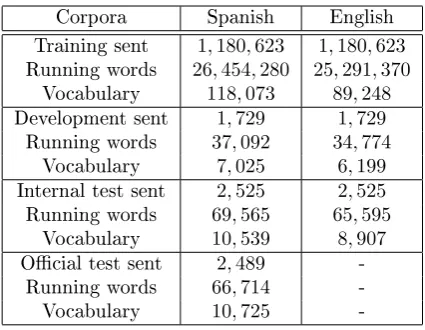
As a preprocess, all corpora were lower-cased and tokenized. The Spanish corpus was tokenized and POS tags were extracted using Freeling, which split clitics from verbs and also separated words like del into de el. In order to build a POS tar-get language model, we also obtained POS tags from the English corpus using the TnT tagger. Statistics of the selected corpus can be seen in Ta-ble 1.
Corpora Spanish English Training sent 1,180,623 1,180,623
Running words 26,454,280 25,291,370
Vocabulary 118,073 89,248
Development sent 1,729 1,729
Running words 37,092 34,774
Vocabulary 7,025 6,199
Internal test sent 2,525 2,525
Running words 69,565 65,595
Vocabulary 10,539 8,907
Ocial test sent 2,489
-Running words 66,714
-Vocabulary 10,725
-Table 1: Statistics for the training, development and test sets.
Internal test Ocial test Adjectives 137 72
Common nouns 369 188
Proper nouns 408 2,106
Verbs 213 128
Others 119 168
[image:2.595.310.523.60.225.2]Total 1246 2662
Table 2: Unknown words found in internal and ocial test sets
It is important to notice that neither the United Nations nor the Gigaword corpus were used for bilingual training. Nevertheless, the English part from the United Nations and the monolingual News corpus were used to build the language model of our systems.
4.1.1 Unknown words
We analyzed the content from the internal and of-cial test and realized that they both contained many words that were not seen in the training data. Table 2 shows the number of unknown words found in both sets, classied according to their POS.
In average, we may expect an unknown word every two sentences in the internal test and more than one per sentence in the ocial test set. It can also be seen that most of those unknown words are proper nouns, representing 32% and 79% of the
unknown sets, respectively. Common nouns were the second most frequent type of unknown words, followed by verbs and adjectives.
4.2 Systems
We submitted two dierent systems for the trans-lation task. First a baseline using the training data mentioned before; and then an augmented system, where the baseline-extracted phrase list was ex-tended with additional phrases coming from a seg-mented version of the training corpus.
[image:2.595.311.522.265.357.2]with two dierent decoding path, a standard path from words to words and POS and an alternative path from stems to words and POS in the target side. At the end, we did not submit this system to the translation task because it did not provide better results than the previous two in our internal test.
The set of feature functions used include: source-to-target and target-to-source relative frequen-cies, source-to-target and target-to-source lexical weights, word and phrase penalties, a target lan-guage model, a POS target lanlan-guage model, and a lexicalized reordering model (Tillman, 2004). 4.2.1 Considering stems as an alternate
decoding path.
Using Moses' framework for factored translation models we dened a system with two decoding paths: one decoding path using words and the other decoding path using stems in the source lan-guage and words in the target lanlan-guage. Both de-coding paths only had a single translation step. The possibility of using multiple alternative decod-ing path was developed by Birch et. al. (2007).
This system tried to solve the problem with the unknown words. Because Spanish is morphologi-cally richer than English, this alternative decoding path allowed the decoder translate words that were not seen in the training data and shared the same root with other known words.
4.2.2 Expanding the phrase table using collocation segmentation.
In order to build the augmented phrase table with the technique mentioned in section 3, we seg-mented each language of the bilingual corpus in-dependently and then, using the collocation seg-ments as words, we aligned the corpus and ex-tracted the phrases from it. Once the phrases were extracted, the segments of each phrase were split again in words to have standard phrases. Finally, we use the union of this phrases and the phrases extracted from the baseline system to compute the nal phrase table. A diagram of the whole proce-dure can be seen in gure 1.
The objective of this integration is to add new phrases in the translation table and to enhance the relative frequency of the phrases that were ex-tracted from both methods.
4.2.3 Language model interpolation. Because SMT systems are trained with a bilingual corpus, they ended highly tied to the domain the corpus belong to. Therefore, when the documents we want to translate belong to a dierent domain, additional domain adaptation techniques are rec-ommended to build the system. Those techniques usually employ additional corpora that correspond to the domain we want to translate from.
internal test baseline 24.25
baseline+stem 23.45
[image:3.595.334.496.58.197.2]augmented 23.9
Table 3: Internal test results.
test testcased−detok
baseline 26.1 25.1
augmented 26.1 25.1
Table 4: Results from translation task
The test set for this translation task comes from the news domain, but most of our bilingual cor-pora belonged to a political domain, the Europarl. Therefore we use the additional monolingual cor-pus to adapt the language model to the news do-main.
The strategy used followed the experiment per-formed last year in (R. Fonollosa et al., 2009). We used SRILM during the whole process. All language models were order ve and used modi-ed Kneser-Ney discount and interpolation. First, we build three dierent language models accord-ing to their domain: Europarl, United Nations and news; then, we obtained the perplexity of each lan-guage model over the News Commentary develop-ment corpus; next, we used compute-best-mix to obtain weights for each language model that di-minish the global perplexity. Finally, the models were combined using those weights.
In our experiments all systems used the resulting language model, therefore the dierence obtained in our results were cause only by the translation model.
4.3 Results
We present results from the three systems devel-oped this year. First, the baseline, which included all the features mentioned in section 4.2; then, the system with an alternative decoding path, called baseline+stem; and nally the augmented system, which integrated collocation segmentation to the baseline. Internal test results can be seen in table 3. Automatic scores provided by the WMT 2010 organizers for the ocial test can be found in ta-ble 4. All BLEU scores are case-insensitive and tokenized except for the ocial test set which also contains case-sensitive and non-tokenized score.
We obtained a BLEU score of26.1and 25.1for
our case-insensitive and sensitive outputs, respec-tively. The highest score was obtained by Uni-versity of Cambridge, with 30.5 and 29.1 BLEU
Figure 1: Example of the expansion of the phrase table using collocation segmentation. New phrases added by the collocation-based system are marked with a∗∗.
4.3.1 Comparing systems
Once we obtained the translation outputs from the baseline and the augmented system, we performed a manual comparison of them. Even though we did not nd any signicant advantages of the aug-mented system over the baseline, the collocation segmentation strategy chose a better morphologi-cal structures in some cases as can be seen in Table 5 (only sentence sub-segments are shown):
5 Conclusion
We presented two dierent submissions for the Spanish-English language pair. The language model for both system was built interpolating two big out-of-domain language models and one smaller in-domain language model. The rst system was a baseline with POS target language model; and the second one an augmented system, that integrates the baseline with collocation segmentation. Re-sults over the ocial test set showed no dierence in BLEU between these two, even though internal results showed that the baseline obtained a better score.
We also considered adding an additional decod-ing path from stems to words in the baseline but internal tests showed that it did not improve trans-lation quality either. The high number of unknown words found in Spanish suggested us that consider-ing in parallel the simple form of stems could help
us achieve better results. Nevertheless, a deeper study of the unknown set showed us that most of those words were proper nouns, which do not have inection and therefore cannot beneted from stems.
Finally, despite that internal test did not showed an improvement with the augmented system, we submitted it as a secondary run looking for the eect these phrases could have over human evalu-ation.
Acknowledgment
The research leading to these results has received funding from the European Community's Seventh Framework Programme (FP7/2007-2013) under grant agreement number 247762, from the Span-ish Ministry of Science and Innovation through the Buceador project (TEC2009-14094-C04-01) and the Juan de la Cierva fellowship program. The authors also wants to thank the Barcelona Media Innovation Centre for its support and permission to publish this research.
References
Original: sabiendo que está recibiendo el premio Baseline: knowing that it receive the prize
Augmented: knowing that he is receiving the prize Original: muchos de mis amigos preeren no separarla. Baseline: many of my friends prefer not to separate them. Augmented: many of my friends prefer not to separate it. Original: Los estadounidenses contarán con un teléfono móvil Baseline: The Americans have a mobile phone
Augmented: The Americans will have a mobile phone
Original: es plenamente consciente del camino más largo que debe emprender Baseline: is fully aware of the longest journey must undertake
[image:5.595.116.485.62.208.2]Augmented: is fully aware of the longest journey that need to be taken
Table 5: Comparison between baseline and augmented outputs
library. In Proceedings of the fth interna-tional conference on Language Resources and Evaluation (LREC 2006), ELRA, Genoa, Italy, May.
Alexandra Birch, Miles Osborne, and Philipp Koehn. 2007. Ccg supertags in factored statis-tical machine translation. In StatMT '07: Pro-ceedings of the Second Workshop on Statistical Machine Translation, pages 916, Morristown, NJ, USA. Association for Computational Lin-guistics.
Thorsten Brants. 2000. TnT a statistical part-of-speech tagger. In Proceedings of the Sixth Applied Natural Language Processing (ANLP-2000), Seattle, WA.
Marta R. Costa-jussà, Vidas Daudaravicius, and Rafael E. Banchs. 2010. Integration of statisti-cal collocation segmentations in a phrase-based statistical machine translation system. In 14th Annual Conference of the European Association for Machine Translation.
Vidas Daudaravicius and Ruta Marcinkeviciene. 2004. Gravity counts for the boundaries of col-locations. International Journal of Corpus Lin-guistics, 9:321348(28).
Philipp Koehn, Hieu Hoang, Alexandra Birch, Chris Callison-Burch, Marcello Federico, Nicola Bertoldi, Brooke Cowan, Wade Shen, Christine Moran, Richard Zens, Chris Dyer, Ond°ej Bojar, Alexandra Constantin, and Evan Herbst. 2007. Moses: Open Source Toolkit for Statistical Ma-chine Translation. In ACL '07: Proceedings of the 45th Annual Meeting of the ACL on Interac-tive Poster and Demonstration Sessions, pages 177180, Morristown, NJ, USA. Association for Computational Linguistics.
Philipp Koehn. 2005. Europarl: A Parallel Corpus for Statistical Machine Translation. In Machine Translation Summit.
Franz Josef Och and Hermann Ney. 2003. A Sys-tematic Comparison of Various Statistical Align-ment Models. Computational Linguistics, 29:19 51.
José A. R. Fonollosa, Maxim Khalilov, Marta R. Costa-jussá, José B. Mariño, Carlos A. Hen-ríquez Q., Adolfo Hernández H., and Rafael E. Banchs. 2009. The TALP-UPC phrase-based translation system for EACL-WMT 2009. In Proceedings of the Fourth Workshop on Statis-tical Machine Translation, pages 8589, Athens, Greece, March. Association for Computational Linguistics.
Frank A. Smadja, Kathleen McKeown, and Vasileios Hatzivassiloglou. 1996. Translating collocations for bilingual lexicons: A statistical approach. Computational Linguistics, 22(1):1 38.
Frank Smadja. 1993. Retrieving collocations from text: Xtract. Comput. Linguist., 19(1):143177. Andreas Stolcke. 2002. SRILM an extensible
language modeling toolkit. pages 901904. Christoph Tillman. 2004. A Unigram Orientation