Using SVMs with the Command Relation Features to
Identify Negated Events in Biomedical Literature
Farzaneh Sarafraz
School of Computer Science
University of Manchester
Manchester, United Kingdom
Goran Nenadic
School of Computer Science
University of Manchester
Manchester, United Kingdom
[email protected]Abstract
In this paper we explore the identification of negated molecular events (e.g. protein binding, gene expressions, regulation, etc.) in biomedi-cal research abstracts. We construe the prob-lem as a classification task and apply a ma-chine learning (ML) approach that uses lexi-cal, syntactic, and semantic features associated with sentences that represent events. Lexical features include negation cues, whereas syn-tactic features are engineered from constitu-ency parse trees and the command relation be-tween constituents. Semantic features include event type and participants. We also consider a rule-based approach that uses only the com-mand relation. On a test dataset, the ML ap-proach showed significantly better results (51% F-measure) compared to the command-based rules (35-42% F-measure). Training a separate classifier for each event class proved to be useful, as the micro-averaged F-score improved to 63% (with 88% precision), dem-onstrating the potential of task-specific ML approaches to negation detection.
1
Introduction
With almost 2000 new papers published every day, biomedical knowledge is mainly communi-cated through a growing body of research papers. As the amount of textual information increases, the need for sophisticated information extraction (IE) methods are becoming more than evident. IE methods rely on a range of language processing methods such as named entity recognition and parsing to extract the required information in a more structured form which can be used for knowledge exploration and hypothesis genera-tion (Donaldson et al. 2003; Natarajan et al. 2006).
Given the large number of publications, the identification of conflicting or contradicting facts
is critical for systematic mining of biomedical literature and knowledge consolidation. Detec-tion of negaDetec-tions is of particular importance for IE methods, as it often can hugely affect the quality of the extracted information. For exam-ple, when mining molecular events, a key piece of information is whether the text states that the two proteins are or are not interacting, or that a given gene is or is not expressed. In recent years, several challenges and shared tasks have in-cluded the extraction of negations, typically as part of other tasks (e.g. the BioNLP’09 Shared Task 3 (Kim et al. 2009)).
Several systems and methods have aimed to handle negation detection in order to improve the quality of extracted information (Hakenberg et al. 2009; Morante and Daelemans 2009). Prior research on this topic has primarily focused on finding negated concepts by negation cues and scopes. These concepts are usually represented by a set of predefined terms, and negation detec-tion typically aims to determine whether a term falls within the scope of a negation cue.
In this paper we address the task of identifi-cation of negated events. We present a machine learning (ML) method that combines a set of fea-tures mainly engineered from a sentence parse tree with lexical cues. More specifically, parse-based features use the notion of the command relation that models the scope affected by an element (Langacker, 1969). We use molecular events as a case study and experiment on the BioNLP’09 data, which comprises a gold-standard corpus of research abstracts manually annotated for events and negations (Kim et al. 2009). The evaluation shows that, by using the proposed approach, negated events can be identi-fied with precision of 88% and recall of 49% (63% F-measure). We compare these results with two rule-based approaches that achieved the maximum F-measure of 42%.
The rest of this paper is organised as follows. Section 2 summarises and reviews previous re-search on negation extraction. Section 3 defines the problem and introduces the data used for the case study. Section 4 focuses on the ML-based methodology for extracting negated events. The final sections contain the results and discussions.
2
Related Work
There have been numerous contemplations of the concept of negation (Lawler, 2010), but no gen-eral agreement so far exists on its definition, form, and function. We adopt here a definition of negation as given by Cambridge Encyclopedia of Language Sciences: “Negation is a comparison between a ‘real’ situation lacking some element and an ‘imaginal’ situation that does not lack it”. The imaginal situation is affirmative compared with the negative real situation. The element whose polarity differs between the two situations is the negation target.
Negations in natural language can be ex-pressed by syntactically negative expressions, i.e. with the use of negating words such as no, not, never, etc. The word or phrase that makes the sentence wholly or partially negative is the nega-tion cue and the part of the sentence that is af-fected by the negation cue and has become nega-tive is the negation scope.
We briefly review two classes of approaches to detect negations: those aiming at negated con-cepts and those targeting negated events.
2.1 Detecting Negated Concepts and Phrases
There have been a number of approaches sug-gested for detection of negated targets and scopes. Most of them rely on task-specific, hand-crafted rules of various complexities. They differ in the size and composition of the list of negation cues, and the way to utilise such a list. Some methods use parse trees, whilst others use results of shallow parsing.
Rule-based methods range from simple co-occurrence based approaches to patterns that rely on shallow parsing. The ‘bag-of-words’ ap-proach, looking for proximate co-occurrences of negation cues and terms in the same sentence, is probably the simplest method for finding nega-tions, and is used by many as a baseline method. Many approaches have targeted the clinical and biomedical domains. NegEx (Chapman et al. 2001), for example, uses two generic regular
ex-pressions that are triggered by negation phrases such as:
<negation cue> * <target term> <target term> * <negation cue>
where the asterisk (*) represents a string of up to five tokens. Target terms represent domain con-cepts that are terms from the Unified Medical Language System (UMLS1). The cue set com-prises 272 clinically-specific negation cues, in-cluding those such as denial of or absence of. Although simple, the proposed approach showed good results on clinical data (78% sensitivity (recall), 84% precision, and 94% specificity).
In addition to concepts that are explicitly ne-gated by negation phrases, Patrick et al. (2006) further consider so-called pre-coordinated nega-tive terms (e.g. headache) that have been col-lected from SNOMED CT2 medical terminology. Similarly, NegFinder uses hand-crafted rules to detect negated UMLS terms, including simple conjunctive and disjunctive statements (Mutalik et al. 2001). They used a list of 60 negation cues. Tolentino et al. (2006), however, show that using rules on a small set of only five negation cues (no, neither/nor, ruled out, denies, without) can still be reasonably successful in detecting nega-tions in medical reports (F-score 91%).
Huang and Lowe (2007) introduced a negation grammar that used regular expressions and de-pendency parse trees to identify negation cues and their scope in the sentence. They applied the rules to a set of radiology reports and reported a precision of 99% and a recall of 92%.
Not many efforts have been reported on using machine learning to detect patterns in sentences that contain negative expressions. Still, Morante and Daelemans (2009), for example, used vari-ous classifiers (Memory-based Learners, Support Vector Machines, and Conditional Random Fields) to detect negation cues and their scope. An extensive list of features included the token’s stem and part-of-speech, as well as those of the neighbouring tokens. Separate classifiers were used for detecting negation cues and negation scopes. The method was applied to clinical text, biomedical abstracts, and biomedical papers with F-scores of 80%, 77%, and 68% respectively.
2.2 Detecting Negated Events
Several approaches have recently been suggested for the extraction of negated events, particularly
1
http://www.nlm.nih.gov/research/umls/ 2
in the biomedical domain. Events are typically represented via participants (biomedical entities that take part in an event) and event triggers (to-kens that indicate presence of the event). Van Landeghem et al. (2008) used a rule-based ap-proach based on token distances in sentence and lexical information in event triggers to detect negated molecular events. Kilicoglu and Bergler (2009), Hakenberg et al. (2009), and Sanchez (2007) used a number of heuristic rules concern-ing the type of the negation cue and the type of the dependency relation to detect negated mo-lecular events described in text. For example, a rule can state that if the negation cue is “lack” or “absence”, then the trigger has to be in the prepositional phrase of the cue; or that if the cue is “unable” or “fail”, then the trigger has to be in the clausal complement of the cue (Kilicoglu and Bergler 2009). As expected, such approaches suffer from lower recall.
MacKinlay et al. (2009), on the other hand, use ML, assigning a vector of complex deep parse features (including syntactic predicates to capture negation scopes, conjunctions and se-mantically negated verbs) to every event trigger. The system achieved an F-score of 36% on the same dataset as used in this paper.
We note that the methods mentioned above mainly focus on finding negated triggers in order to detect negated events. In this paper we explore not only negation of triggers but also phrases in which participants are negated (consider, for ex-ample, “SLP-76” in the sentence “In contrast, Grb2 can be coimmunoprecipitated with Sos1 and Sos2 but not with SLP-76.”)
3
Molecular Events
As a case study, we look at identification of ne-gated molecular events. In general, molecular events include various types of reactions that affect genes and protein molecules. Each event is of a particular type (e.g. binding, phosphoryla-tion, regulaphosphoryla-tion, etc.). Depending on the type,
each event may have one or more participating proteins (sometimes referred to as themes). Regulatory events are particularly complex, as they can have a cause (a protein or another event) in addition to a theme, which can be either a protein or another event. Table 1 shows exam-ples of five events, where participants are bio-medical entities (events 1-3) or other events (events 4 and 5). Note that a sentence can ex-press more than one molecular event.
Identification of molecular events in the litera-ture is a challenging IE task (Kim et al. 2009; Sarafraz et al. 2009). For the task of identifying negated events, we assume that events have al-ready been identified in text. Each event is repre-sented by its type, a textual trigger, and one or more participants or causes (see Table 1). Since the participants of different event types can vary in both their number and type, we consider three classes of events to support our analysis (see Section 5):
• Class I comprises events with exactly one entity theme (e.g. transcription, protein ca-tabolism, localization, gene expression, phosphorylation).
• Class II events include binding events only, which have one or more entity participants. • Class III contains regulation events, which
have exactly one theme and possibly one cause. However, the theme and the cause can be entities or events of any type.
The corpus used in this study is provided by the BioNLP’09 challenge (Kim et al. 2009). It contains two sets of biomedical abstracts: a “training” set (containing 800 abstracts used for training and analysis purposes) and a “develop-ment” set (containing 150 abstracts used for test-ing purposes only). Both document sets are manually annotated with information about en-tity mentions (e.g. genes and proteins). Sentences that report molecular events are further annotated with the corresponding event type, textual trigger and participants. In total, nine event types are
“The effect of this synergism was perceptible at the level of induction of the IL-2 gene.”
Event Trigger Type Participant (theme) Cause
Event 1 “induction” Gene expression IL-2
“Overexpression of full-length ALG-4 induced transcription of FasL and, consequently, apoptosis.”
Event Trigger Type Participant (theme) Cause
Event 2 “transcription” Transcription FasL Event 3 “Overexpression” Gene expression ALG-4 Event 4 “Overexpression” Positive regulation Event 3
[image:3.612.98.523.580.694.2]considered (gene expression, transcription, pro-tein catabolism, localization, phosphorylation, binding, regulation, positive regulation, and negative regulation). In addition, every event has been tagged as either affirmative (reporting a specific interaction) or negative (reporting that a specific interaction has not been observed).
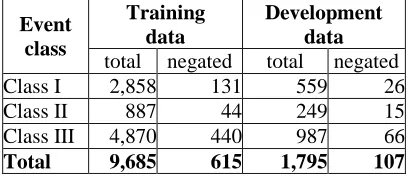
Table 2 provides an overview of the two BioNLP’09 datasets. We note that only around 6% of events are negated.
Training data
Development data Event
class
total negated total negated
Class I 2,858 131 559 26
Class II 887 44 249 15
Class III 4,870 440 987 66
[image:4.612.97.302.179.267.2]Total 9,685 615 1,795 107
Table 2: Overview of the total number of events and negated event annotations in the two datasets.
4
Methodology
We consider two approaches to extract negated events. We first discuss a rule-based approach that uses constituency parse trees and the com-mand relation to identify negated events. Then, we introduce a ML method that combines lexi-cal, syntactic and semantic features to identify negated events. Note that in all cases, input sen-tences have been pre-annotated for entity men-tions, event triggers, types, and participants.
4.1 Negation Detection Using the Command Relation Rules
The question of which parts of a syntactic struc-ture affect the other parts has been extensively investigated. Langacker (1969) introduced the concept of command to determine the scope within a sentence affected by an element. More precisely, if a and b are nodes in the constituency parse tree of a sentence, then a X-commands b iff the lowest ancestor of a with label X is also an ancestor of b. Note that the command relation is not symmetrical. Langacker observed that when a S-commands b, then a affects the scope containing b. For simplicity, we say “command” when we mean S-command.
To determine whether token a commands to-ken b, given the parse tree of a sentence, we use a simple algorithm introduced by McCawley (1993): trace up the branches of the constituency parse tree from a until you hit a node that is la-belled X. If b is reachable by tracing down the
branches of the tree from that node, then a X-commands b; otherwise, it does not.
We hypothesise that if a negation cue com-mands an event trigger or participant, then the associated event is negated.
4.2 Negation Detection Using Machine Learning on Parse Tree Features
Given a sentence that describes an event, we fur-ther construe the negation detection problem as a classification task: the aim is to classify the event as affirmative or negative. We explore both a single SVM (support vector machine) classifier for all events and three separate SVMs for each of the event classes. The following features have been engineered from an event-representing sen-tence:
1. Event type (one of the nine types as defined in BioNLP’09);
2. Whether the sentence contains a negation cue from the cue list;
3. The negation cue itself (if present);
4. The part-of-speech (POS) tag of the negation cue;
5. The POS tag of the event trigger;
6. The POS tag of the participants of the event. If the participant is another event, the POS tag of the trigger of that event is used; 7. The parse node type of the lowest common
ancestor of the trigger and the cue (i.e. the type of the smallest phrase that contains both the trigger and the cue, e.g. S, VP, PP, etc.); 8. Whether or not the negation cue commands
any of the participants; nested events (for Class III) are treated as above (i.e. as being represented by their triggers);
9. Whether or not the negation cue commands the trigger;
10. The parse-tree distance between the event trigger and the negation cue.
We use a default value (null) where none of the other values apply (e.g. when there is no cue in feature 3, 4, 7). These features have been used to train four SVMs on the training dataset: one modelled all events together, and the others modelled the three event classes separately.
5
Results
negated events), then precision, recall, and F-score would be appropriate measures. If we con-sider the classification aspect of the task, speci-ficity is more appropriate if true negative hits are considered as valuable as true positive ones. We therefore use the following metrics to evaluate the two methods:
Precision= TP TP+FP
Recall=Sensitivity= TP TP+FN
F1= 2× Precision×Recall
Precision+Recall
Specificity= TN TN+FP
where TP denotes the number of true positives (the number of correctly identified negated events), FN is the number of false negatives (the number of negated events that have been re-ported as affirmative), with TN and FP defined accordingly.
Two sets of negation cues were used in order to compare their influence. A smaller set was derived from related work, whereas additional cues were semi-automatically extracted by ex-ploring the training data. The small negation cue set contains 14 words3, whereas the larger nega-tion cue set contains 32 words4. As expected, the larger set resulted in increased recall, but de-creased precision. However, the effects on the F-score were typically not significant. The results are only shown using the larger cue set.
The texts were processed using the GENIA tagger (Tsuruoka and Tsujii 2005).We used con-stituency parse trees automatically produced by two different constituency parsers reported in (McClosky et al. 2006) and (Bikel 2004). No major differences were observed in the results using the two parsers. The data shown in the re-sults are produced by the former.
5.1 Baseline Results
Our baseline method relies on an implementation of the NegEx algorithm as explained in Section 2.1. Event triggers were used as negation targets for the algorithm. An event is then considered to be negated if the trigger is negated; otherwise it
3
Negation cues in this set include: no, not, none,
negative, without, absence, fail, fails, failed, fail-ure, cannot, lack, lacking, lacked.
4
Negation cues in this set include the smaller set and 18 task-specific words: inactive, neither, nor,
in-hibit, unable, blocks, blocking, preventing, pre-vents, absent, never, unaffected, unchanged, im-paired, little, independent, except, and exception.
is affirmative. The results (see Table 3) are sub-stantially lower than those reported for NegEx on clinical data (specificity of 94% and sensitivity of 78%). For comparison, the table also provides an even simpler baseline approach that tags as negated any event whose associated sentence contains any negation cue word.
Approach P R F1 Spec.
[image:5.612.314.513.143.184.2]any negation cue present 20% 78% 32% 81% NegEx 36% 37% 36% 93%
Table 3: Baseline results. (NegEx and a ‘bag-of-words’ approach)
5.2 Rules Based on the Command Relation
Table 4 shows the results of applying the S-command relation rule for negation detection. We experimented with three possible ap-proaches: an event is considered negated if
- the negation cue commands any event participant in the parse tree;
- the negation cue commands the event trigger in the tree;
- the negation cue commands both.
Approach P R F1 Spec.
negation cue commands
any participant 23% 76% 35% 84% negation cue
commands trigger 23% 68% 34% 85% negation cue
commands both 23% 68% 35% 86%
Table 4: Performance when only the S-command relation is used.
Compared with the baseline methods, the rules based on the command relation did not improve the performance. While precision was low (23%), recall was high (around 70%), indicating that in the majority of cases there is an S-command relation in particular with the partici-pants (the highest recall). We also note a signifi-cant drop in specificity, as many affirmative events have triggers/participants S-commanded by a negation cue (not “linked” to a given event).
5.3 Machine Learning Results
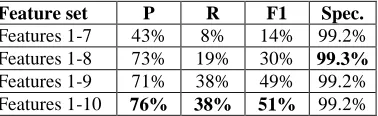
Compared to previous methods, there was sig-nificant improvement in precision, while recall was relatively low. Still, the overall F-measure was significantly better compared with the rule-based methods (51% vs. 35%).
Feature set P R F1 Spec.
[image:6.612.100.289.118.176.2]Features 1-7 43% 8% 14% 99.2% Features 1-8 73% 19% 30% 99.3% Features 1-9 71% 38% 49% 99.2% Features 1-10 76% 38% 51% 99.2%
Table 5: The results of the single SVM classifier. tures 1-7 are lexical and POS tag-based features. Fea-ture 8 models whether the cue S-commands any of the
participants. Feature 9 is related to the cue S-commanding the trigger. Feature 10 is the parse-tree
distance between the cue and trigger.
We first experimented with the effect of differ-ent types of feature on the quality of the negation prediction. Table 5 shows the results of the first classifier with an incremental addition of lexical features, parse tree-related features, and finally a combination of those with the command relation between the negation cue and event trigger and participants. It is worth noting that both precision and recall improved as more features are added.
We also separately trained classifiers on the three classes of events (see Table 6). This further increased the performance: compared with the results of the single classifier, the F1 micro-average improved from 51% to 63%, with simi-lar gains for both precision and recall.
Event class P R F1 Spec.
Class I
(559 events) 94% 65% 77% 99.8% Class II
(249 events) 100% 33% 50% 100% Class III
(987 events) 81% 44% 57% 99.2% Micro Average
(1,795 events) 88% 49% 63% 99.4% Macro Average
(3 classes) 92% 47% 62% 99.7%
Table 6: The results of the separate classifiers on dif-ferent classes using common features.
6
Discussion
As expected, approaches that focus only on event triggers and their surface distances from negation cues proved inadequate for biomedical scientific articles. Low recall was mainly caused by many
event triggers being too far from the negation cue to be detected as within the scope.
Furthermore, compared to clinical notes, for example, sentences that describe molecular events are significantly more complex. For ex-ample, the event-describing sentences in the training data have on average 2.6 event triggers. The number of events per sentence is even higher, as the same trigger can indicate multiple events, sometimes with opposite polarities. Con-sider for example the sentence
“We also demonstrate that the IKK complex, but not p90 (rsk), is responsible for the in vivo phosphorylation of I-kappa-B-alpha mediated by the co-activation of PKC and calcineurin.” Here, the trigger (phosphorylation) is linked with one affirmative and one negative regulatory event by two different molecules, hence trigger-ing two events of opposite polarities.
These findings, together with previous work, suggested that for any method to effectively de-tect negations, it should be able to link the nega-tion cue to the specific token, event trigger or entity name in question. Therefore, more com-plex models are needed to capture the specific structure of the sentence as well as the composi-tion of the interaccomposi-tion and the arrangement of its trigger and participants.
By combining several feature types (lexical, syntactic and semantic), the machine learning approach proved to provide significantly better results. In the incremental feature addition explo-ration process, adding the cue-commands-participant feature had the greatest effect on the F-score, suggesting the significance of treating event participants. We note, however, that many of the previous attempts focus on event triggers only, although participants do play an important role in the detection of negations in biomedical events and thus should be used as negation tar-gets instead of or in addition to triggers. It is in-teresting that adding parse-tree distance between the trigger and negation cue improves precision by 5%.
[image:6.612.94.296.456.581.2]the easiest to detect (F-score of 77%). Class II negated events (which can have multiple partici-pants), demonstrated the lowest recall (33%). A likely reason is that the feature set used is not suitable for multi-participant events: for exam-ple, feature 8 focuses on the negation cue com-manding any of the participants, and not all of them. It is surprising that negated regulation events (Class III) were not the most difficult to identify, given their complexity.
We applied the negation detection on the type, trigger and participants of pre-identified events in order to explore the complexity of ne-gations, unaffected by automatic named entity recognition, event trigger detection, participant identification, etc. As these steps are typically performed before further characterisation of events, this assumption is not superficial and such information can be used as input to the ne-gation detection module. MacKinlay et al. (2009) also used gold annotations as input for negation detection, and reported precision, recall, and F-score of 68%, 24%, and 36% respectively on the same dataset (compared to 88%, 49% and 63% in our case). The best performing negation detec-tion approach in the BioNLP’09 shared task re-ported recall of up to 15%, but with overall event detection sensitivity of 33% (Kilicoglu and Ber-gler 2009) on a ‘test’ dataset (different from that used in this study). This makes it difficult to di-rectly compare their results to our work, but we can still provide some rough estimates: had all events been correctly identified, their negation detection approach could have reached 45% re-call (compared to 49% in our case). With preci-sion of around 50%, their projected F-score, again assuming perfect event identification, could have been in the region of 50% (compared to 63% in our case).
The experiments with rules that were based on the command relations have proven to be ge-neric, providing very high recall (~70%) but with poor precision. Although only the results with S-command relations have been reported here (see Table 4), we examined other types of command relation, namely NP-, PP-, SBAR-, and VP-command. The only variation able to improve prediction accuracy was whether the cue VP-commands any of the participants, with an F-score of 42%, which is higher than the results achieved by the S-command (F-score of 35%). The S-command relation was used in the SVM modules as VP-command did not make the re-sults significantly better.
One of the issues we faced was the manage-ment of multi-token and sub-token entities and triggers (e.g. alpha B1 and alpha B2 in “alpha B1/alpha B2 ratio”, which will be typically to-kenised as “alpha”, “B1/alpha”, and “B2”). In our approach, we considered all the entities that are either multi-token or sub-token. However, if we assign participants that are both multi-token and sub-token simultaneously to events and ex-tract similar features for the classifier from them as from simple entities, the F-score is reduced by about 2%. It would be probably better to assign a new category to those participants and add a new value for them specifically in every feature.
7
Conclusions
Given the number of published articles, detection of negations is of particular importance for bio-medical IE. Here we explored the identification of negated molecular events, given their triggers (to characterise event type) and participants. We considered two approaches:5 a rule-based ap-proach using constituency parse trees and the command relation to identify negation cues and scopes, and a machine learning method that combines a set of lexical, syntactic and semantic features engineered from the associated sentence. When compared with a regular-expression-based baseline method (NegEx-like), the proposed ML method achieved significantly better results: 63% F-score with 88% precision. The best results were obtained when separate classifiers were trained for each of the three event classes, as dif-ferences between them (in the number and type of participants) proved to be important.
The results presented here were obtained by using the ‘gold’ event annotations as the input. It would be interesting to explore the impact of typically noisy automatic event extraction on negation identification. Furthermore, an immedi-ate future step would be to explore class-specific features (e.g. type of theme and cause for Class III events, and whether the cue S-commands all participants for Class II events). In addition, in the current approach we used constituency parse trees. Our previous attempts to identify molecu-lar events (Sarafraz et al. 2009) as well as those discussed in Section 2 use dependency parse trees. A topic open for future research will be to combine information from both dependency and constituency parse trees as features for detecting negated events.
5
Acknowledgments
We are grateful to the organisers of BioNLP’09 for providing the annotated data.
References
Daniel Bikel. 2004. A Distributional Analysis of a Lexicalized Statistical Parsing. Proc. Conference
on Empirical Methods in Natural Language.
Wendy Chapman. 2001. A Simple Algorithm for Identifying Negated Findings and Diseases in Dis-charge Summaries. Journal of Biomedical
Infor-matics, 34(5):301-310.
Ian Donaldson, Martin, J., de Bruijn, B., Wolting, C., Lay, V., Tuekam, B., Zhang, S., Baskin, B., Bader, G. D., Michalickova, K., Pawson, T. and Hogue, C. W. 2003. PreBIND and Textomy--mining the bio-medical literature for protein-protein interactions using a support vector machine. BMC Bioinf. 4: 11.
Jörg Hakenberg, Illés Solt, Domonkos Tikk, Luis Tari, Astrid Rheinländer, Quang L. Ngyuen, Graciela Gonzalez and Ulf Leser. 2009. Molecular event extraction from link grammar parse trees.
BioNLP’09: Proceedings of the Workshop on BioNLP. 86-94.
Yang Huang and Henry J. Lowe. 2007. A Novel Hy-brid Approach to Automated Negation Detection in Clinical Radiology Reports. Journal of the
Ameri-can Medical Informatics Association,
14(3):304-311.
Thorsten Joachims. 1999. Making large-Scale SVM
Learning Practical. Advances in Kernel Methods -
Support Vector Learning, B. Schölkopf and C. Burges and A. Smola (ed.) MIT-Press, MA.
Halil Kilicoglu, and Sabine Bergler. 2009. Syntactic dependency based heuristics for biological event extraction. BioNLP’09: Proceedings of the
Work-shop on BioNLP. 119-127.
Jin-Dong Kim, Tomoko Ohta, Sampo Pyysalo, Yo-shinobu Kano, Jun’ichi Tsujii. 2009. Overview of BioNLP’09 shared task on event extraction.
BioNLP’09: Proceedings of the Workshop on BioNLP. 1-9.
Sofie Van Landeghem, Yvan Saeys, Bernard De Baets and Yves Van de Peer. 2008. Extracting Pro-tein-Protein Interactions from Text using Rich Fea-ture Vectors and FeaFea-ture Selection. Proceedings of
the Third International Symposium on Semantic Mining in Biomedicine. 77-84.
Ronald Langacker. 1969. On Pronominalization and
the Chain of Command. In D. Reibel and S. Schane
(eds.), Modern Studies in English, Prentice-Hall, Englewood Cliffs, NJ. 160–186.
John Lawler. 2010. Negation and Negative Polarity.
The Cambridge Encyclopedia of the Language
Sci-ences. Patrick Colm Hogan (ed.) Cambridge
Uni-versity Press. Cambridge, UK.
Andrew MacKinlay, David Martinez and Timothy Baldwin. 2009. Biomedical Event Annotation with CRFs and Precision Grammars. BioNLP’09:
Pro-ceedings of the Workshop on BioNLP. 77-85.
James McCawley. 1993. Everything that Linguists
have Always Wanted to Know about Logic But Were Ashamed to Ask. 2nd edition. The University of Chicago Press. Chicago, IL.
David McClosky, Eugene Charniak, and Mark John-son. 2006. Effective Self-Training for Parsing.
Proceedings of HLT/NAACL 2006. 152-159.
Roser Morante and Walter Daelemans. 2009. A Metalearning Approach to Processing the Scope of Negation. CoNLL ‘09: Proceedings of the 13th
Conference on Computational Natural Language Learning. 21-29.
Pradeep Mutalik, Aniruddha Deshpande, and Prakash M. Nadkarni. 2001. Use of General-purpose Nega-tion DetecNega-tion to Augment Concept Indexing of Medical Documents: A Quantitative Study using the UMLS. Journal of the American Medical
In-formatics Association : JAMIA. 8(6):598-609.
Jeyakumar Natarajan, Berrar, D., Dubitzky, W., Hack, C., Zhang, Y., DeSesa, C., Van Brocklyn, J. R. and Bremer, E.G. 2006. Text mining of full-text journal articles combined with gene expression analysis reveals a relationship between sphingosine-1-phosphate and invasiveness of a glioblastoma cell line. BMC Bioinformatics. 7: 373.
Jon Patrick, Yefeng Wang, and Peter Budd. 2006. Automatic Mapping Clinical Notes to Medical Terminologies. Proc. Of the 2006 Australian
Lan-guage Technology Workshop. 75-82.
Olivia Sanchez. 2007. Text mining applied to
biologi-cal texts: beyond the extraction of protein-protein interactions. PhD Thesis.
Farzaneh Sarafraz, James Eales, Reza Mohammadi, Jonathan Dickerson, David Robertson and Goran Nenadic. 2009. Biomedical Event Detection using Rules, Conditional Random Fields and Parse Tree Distances. BioNLP’09: Proceedings of the
Work-shop on BioNLP.
Herman Tolentino, Michael Matters, Wikke Walop, Barbara Law, Wesley Tong, Fang Liu, Paul Fon-telo, Katrin Kohl, and Daniel Payne. 2006. Concept Negation in Free Text Components of Vaccine Safety Reports. AMIA Annual Symposium proc.
Yoshimasa Tsuruoka, and Jun’ichi Tsujii. 2005. Bidi-rectional Inference with the Easiest-First Strategy for Tagging Sequence Data. Proceedings of