Workshop on Monolingual Text-To-Text Generation, pages 43–53,
Towards Strict Sentence Intersection: Decoding and Evaluation Strategies
Kapil Thadani and Kathleen McKeown Department of Computer Science
Columbia University New York, NY 10027, USA
{kapil,kathy}@cs.columbia.edu
Abstract
We examine the task of strict sentence inter-section: a variant of sentence fusion in which the output must only contain the informa-tion present in all input sentences and nothing more. Our proposed approach involves align-ment and generalization over the input sen-tences to produce a generation lattice; we then compare a standard search-based approach for decoding an intersection from this lattice to an integer linear program that preserves aligned content while minimizing the disfluency in interleaving text segments. In addition, we introduce novel evaluation strategies for in-tersection problems that employ entailment-style judgments for determining the validity of system-generated intersections. Our experi-ments show that the proposed models produce valid intersections a majority of the time and that the segmented decoder yields advantages over the search-based approach.
1 Introduction
In recent years, there has been growing interest in text-to-text generation problems which transform text according to specifications. Tasks such as sen-tence compression, which strives to retain the most salient content of an input sentence, and sentence fu-sion, which attempts to combine the important con-tent in related sentences, are useful components for tackling larger natural language problems such as abstractive summarization of documents. Systems for these types of text-to-text problems are typically evaluated on the informativeness of the output text as judged by human annotators.
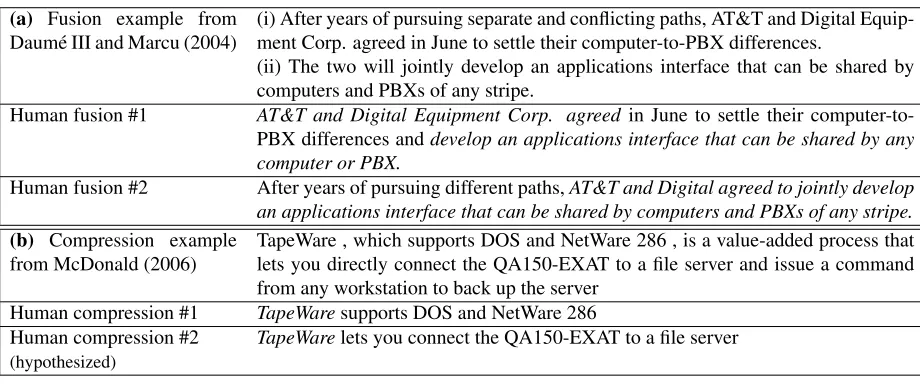
A natural aspect of most text generation systems is that a given input can map to a range of lexi-cally diverse outputs. However, text-to-text tasks defined with vague criteria such as the preserva-tion of the “important” informapreserva-tion in text can also permit outputs that are semantically distinct. This can make evaluation difficult; for instance, system-generated sentences may differ (partially or com-pletely) in informational content from reference human-annotated text. This phenomenon has been noted and discussed in the task of pairwise sentence fusion (Daum´e III and Marcu, 2004) and also in sen-tence compression (McDonald, 2006). Some exam-ples are listed in Table 1.
In this work, we examine the task ofsentence in-tersection: a variant of sentence fusion that does not permit semantic variation in the output. A strict1 in-tersection system is expected to produce a fused sen-tence that contains all the information common to its input sentences andavoidinformation that is in just one of the inputs. In other words, a valid intersection should only contain information that is substantiated by all input sentences. The set-theoretic notions of intersection (along with union) have been employed to describe variants of sentence fusion tasks in previ-ous work (Marsi and Krahmer, 2005; Krahmer et al., 2008) but, to our knowledge, this work is the first to explicitly tackle and evaluate the strict intersection task.
We focus on the case of unsupervised pairwise sentence intersection and propose a strategy to yield
1
We use the termstrictto make explicit the distinction from traditional fusion systems, which generally aim at notions of intersection but are not formally evaluated with respect to it.
(a) Fusion example from Daum´e III and Marcu (2004)
(i) After years of pursuing separate and conflicting paths, AT&T and Digital Equip-ment Corp. agreed in June to settle their computer-to-PBX differences.
(ii) The two will jointly develop an applications interface that can be shared by computers and PBXs of any stripe.
Human fusion #1 AT&T and Digital Equipment Corp. agreed in June to settle their computer-to-PBX differences anddevelop an applications interface that can be shared by any computer or PBX.
Human fusion #2 After years of pursuing different paths,AT&T and Digital agreed to jointly develop an applications interface that can be shared by computers and PBXs of any stripe.
(b) Compression example from McDonald (2006)
TapeWare , which supports DOS and NetWare 286 , is a value-added process that lets you directly connect the QA150-EXAT to a file server and issue a command from any workstation to back up the server
Human compression #1 TapeWaresupports DOS and NetWare 286
[image:2.612.75.535.57.250.2]Human compression #2 TapeWarelets you connect the QA150-EXAT to a file server (hypothesized)
Table 1: Examples of text-to-text generation problems with multiple valid human-generated outputs that differ signif-icantly in semantic content. Italicized text is used to indicate fragments that are semantically identical.
valid intersections that follows the basic framework of previous unsupervised fusion systems (Barzilay and McKeown, 2005; Filippova and Strube, 2008b). In our approach, the input sentences are first aligned using a modified version of a recent phrase-based alignment approach (MacCartney et al., 2008). We assume the alignments that are produced define as-pects of the input that must appear in the output fu-sion and consider decoding strategies to recover in-tersections that preserve these alignments. In addi-tion to a search-based decoding strategy, we propose a constrained integer linear programming (ILP) for-mulation that attempts to decode the most fluent sen-tence covering all these aspects while minimizing the size and disfluency of interleaving text. This is a fairly general model which can also be extended to other alignment-based tasks such as pairwise union and difference.
As this is a substantially more constrained task than generic sentence fusion, we also present a novel evaluation approach that avoids out-of-context salience judgments. We make use of a recently-released corpus of fusion candidates (McKeown et al., 2010) and propose a crowdsourced entailment-style evaluation to determine the validityof gener-ated intersections, as well as the grammaticality of the sentences produced. Additionally, automated machine translation (MT) metrics are explored to quantify the amount of information missing from valid intersections. Our decoding strategies show
promise under these experiments and we discuss po-tential directions for improving intersection perfor-mance.
2 Related Work
The distinction between intersection and union of text was introduced in the context of sentence fu-sion (Krahmer et al., 2008; Marsi and Krahmer, 2005) in order to distinguish between traditional fu-sion strategies that attempted to include only com-mon content and fusions that attempted to include all non-redundant content from the input. We fo-cus here on strict sentence intersection, explicitly incorporating a constraint that requires that a pro-duced fusion must not contain information that is not present in all input sentences. This distin-guishes our approach from traditional sentence fu-sion approaches (Jing and McKeown, 2000; Barzi-lay and McKeown, 2005; Filippova and Strube, 2008b) which generally attempt to retain common information but are typically evaluated in an abstrac-tive summarization context in which additional in-formation in the fusion output does not negatively impact judgments.
com-pressions in which the redundancy of information content across input sentences in a multidocument setting is assumed to directly indicate its salience, thereby consigning it to the output.
Additionally, in this work, we frequently con-sider the sentence intersection task from the per-spective of textual entailment (cf.§5.1). The textual entailment task involves automatically determining whether a given hypothesis can be inferred from a textual premise (Dagan et al., 2005; Bar-Haim et al., 2006). Automatic construction of positive and neg-ative entailment examples has been explored in the past (Bensley and Hickl, 2008) to provide training data for entailment systems; however the produc-tion of text that is simultaneously entailed by two (or more) sentences is a far more constrained and difficult challenge.
ILP has been used extensively for text-to-text gen-eration problems in recent years (Clarke and Lapata, 2008; Filippova and Strube, 2008b; Woodsend et al., 2010), including techniques which incorporate syn-tax directly into the decoding to imporove the flu-ency of the resulting text. In this paper, we focus on generating valid intersections and do not incorporate syntactic and semantic constraints into our ILP mod-els; these are areas we intend to explore in the future.
3 The Intersection Task
The need for strict variants of fusion is motivated by considerations of evaluation and utility in text-to-text generation tasks. Without explicit constraints on the semantic content of valid output, the operational definition of fusion can encompass the full spectrum from sentence intersection to sentence union. This makes the comparison of different fusion systems dependent on task-based utility2. In addition, inter-section comprises an interesting problem in its own right. It necessitates the use of generalization over phrases in order to convey only the content of the input sentences when different wording is used and therefore involves more than just word deletion.
The analogy to set-theoretic intersection in this task implies an underlying consideration of each sentence as a set of informational concepts,
sim-2
For instance, systems may trade off conciseness against grammaticality, or informational content with degree of support across the input sentences.
ilar to previous work in summarization and re-dundancy (Filatova and Hatzivassiloglou, 2004; Thadani and McKeown, 2008). While we don’t commit to any semantic representation for such el-ements of information, we can nevertheless attempt toidentify repeated information using well-studied natural language analysis techniques such as align-ment and paraphrase recognition, and furthermore isolatethis information through text-to-text genera-tion techniques.
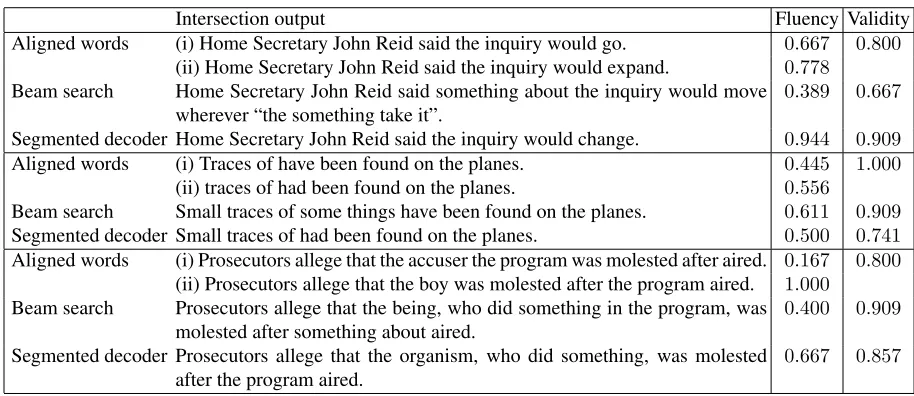
Consider, for example, the first sentence pair from the examples in Table 2. A valid intersection for these sentences must not contain any information that is not substantiated by both of them, so a fu-sion that mentions “Mr Litvinenko’s poisoning”, “Britain” or “Sunday” would not satisfy this crite-rion. In other words, a valid intersection must neces-sarily be textually entailed by every input sentence. Following this, we can interpret the sentence inter-section task as one that requires the generation of fluent text that ismutually entailedby all input sen-tences3. We use this perspective in developing an evaluation technique for strict intersection in§5.1.
A major distinguishing factor between this work and previous work on fusion is that simply adding or deleting words in a sentence is not adequate; in many cases, intersections require additional words or phrases to be introduced in order to general-ize over related but non-interchangeable aligned terms (such as “go” and “expand”). Additionally, we must attempt to avoid introducing additional content-bearing text in the output while simultane-ously striving to maintain the fluency of text.
3.1 Dataset
A corpus of sentence fusion instances was recently made available by McKeown et al. (2010), consist-ing of 297 sentence pairs taken from newswire clus-ters and manually judged as being good candidates for fusion. Each sentence pair is accompanied by human-produced intersections and unions collected via Amazon’s Mechanical Turk service4. McKeown et al. (2010) noted that union responses are mostly valid but intersections are frequently incorrect and 3From this perspective, the complementary task of sentence
union involves the generation of fluent text that entails all the input sentences.
4
1 (i) Home Secretary John Reid said Sunday the inquiry would go wherever “the police take it.”
(ii) It comes as Home Secretary John Reid said the inquiry into Mr Litvinenko’s poisoning would expand beyond Britain.
2 (i) Traces of polonium have been found on the planes on which they are believed to have travelled between London and Moscow.
(ii) Small traces of radioactive substances had been found on the planes.
3 (i) Prosecutors allege that the accuser, who appeared in the program, was molested after the show aired. (ii) Prosecutors allege that the boy, a cancer survivor, was molested twice after the program aired.
Table 2: Example sentence pairs from the McKeown et al. (2010) corpus. Table 3 contains the corresponding system-generated intersections for these sentence pairs.
hypothesized that the task is more confusing for untrained annotators. A similar phenomenon was noted by Krahmer et al. (2008): while demonstrat-ing that query-based human fusions exhibited less variation than generic fusions, it was also observed that intersections varied more than unions.
Due to the absence of adequate training data for intersection, our approach to the task is unsuper-vised, similar to previous work in fusion (Barzilay and McKeown, 2005; Filippova and Strube, 2008b) and sentence compression (Clarke and Lapata, 2008; Filippova and Strube, 2008a). Additionally, we fo-cus on the case of pairwise sentence intersection and assume that the common information between the input sentence pair can be represented within a sin-gle output sentence. As a result, although the McK-eown et al. (2010) corpus cannot be used for training an intersection model, we can make use of the sen-tence pairs it contains for evaluation.
4 Models for intersection
Our proposed strategies for sentence intersection in-volve phrase-based alignment, intermediate general-ization steps that build a generation lattice and tech-niques for decoding an output sentence, as described below.
4.1 Phrase-based alignment
The alignment phase is a major component of any intersection system as it is used to uncover the common segments in the input that must be pre-served in the output. We make use of an adapta-tion of the supervised MANLI phrase-based align-ment technique originally developed for textual en-tailment systems (MacCartney et al., 2008); our implementation replaces approximate search-based
decoding with exact ILP-based alignment decod-ing and incorporates syntactic constraints to pro-duce more precise alignments (Thadani and McKe-own, 2011). The aligner is trained on a corpus of human-generated alignment annotations produced by Microsoft Research (Brockett, 2007) for infer-ence problems from the second Recognizing Tex-tual Entailment (RTE2) challenge (Bar-Haim et al., 2006).
Entailment problems are inherently asymmetric because premise text is generally larger than hypoth-esis text; however, this does not apply to our inter-section problems and consequently our MANLI im-plementation drops asymmetric indicator features. The absence of these features impacts alignment performance on RTE2 data but our reimplementa-tion performs comparably to the original model un-der the alignment evaluation from MacCartney et al. (2008).
4.2 Ontology-based generalization
An aligned phrase pair produced by the previous step does not necessarily indicate that the phrases are equivalent but merely that they are similar in the given sentence context (such as “accuser” and “boy” in the third example from Table 2). We need to generalize over these phrases as they are not inter-changeable from the perspective of the intersection task. We consider an alignment as containing three types of aligned phrases:
1. Identical phrases or paraphrases: Either of these may appear in the output
2. Entailed phrases: Only the entailed phrase must appear in a valid intersection
Although generalization of words within stan-dalone sentences is usually hampered by word sense ambiguity, our approach is less likely to encounter this problem because we can generalize simultane-ouslyover phrases which have already been aligned using additional information (such as their neighbor-ing context), thus avoidneighbor-ing generalizations that do not fit the alignment.
For our experiments, we make use of the Wordnet ontology (Miller, 1995) to find the hypernyms com-mon to every aligned pair of non-identical phrases, and only attempt to detect entailments which are comprised of specific instances that entail general concepts. This approach can be augmented by the use of entailment corpora and distributional cluster-ing which we intend to explore in future work. We also use the lexical resource CatVar (Habash and Dorr, 2003) to try to generate morphological vari-ants of aligned words that enable them to be inter-changed without creating disfluencies.
4.3 Pragmatic abstraction
Our strategy assumes that aligned text must be pre-served in output intersections whereas unaligned text must be minimized. However, unaligned text cannot simply be dropped as it may contain vital portions for generating fluent text. In addition, un-aligned phrases can be caused by paraphrased or metaphorical text that the aligner is not capable of identifying. For example, the phrases “polonium” and “radioactive substances” in the second sentence pair from Table 2 fail to align with each other.
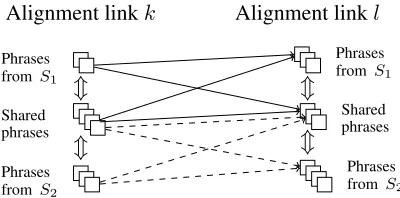
On the other hand, retaining unaligned text from one of the input sentences for the sake of fluency is likely to introduce information that is not sup-ported by the other input sentence. We therefore need to abstract away as much content from the un-aligned portions of the text as possible. For this purpose, we generate a large number of potential compressions and abstractions for every unaligned span that occurs between two consecutive aligned phrases in each sentence. These compressions and abstractions, referred to as interleaving paths, be-tween pairs of aligned phrases essentially construct a lattice over the input sentences that encodes all po-tential intersection outputs.
Generation of interleaving paths is accomplished through the application of rules on the dependency
parse structure over unaligned text spans from a sin-gle sentence (as well as spans that occur before the first aligned phrase and after the last aligned phrase in each sentence). Interleaving paths are generated by applying rules that:
1. Drop insignificant dependent words and un-aligned prepositional phrases
2. Replace content-bearing verbs with tense-adjusted generic variants such as “did some-thing” and “happened”, with an exception for statement verbs
3. Replace nouns with generic words such as “someone” or “something”, using Wordnet to determine which generic variant fits a noun 4. Suggest connective text fragments such as
“something about” to cover long spans and clause boundaries
Our abstraction rules are relatively simple but can often generate reasonable interleaving paths. In gen-eral, we note that shorter abstractions are less likely to include glaring grammatical errors because long unaligned spans are often indicative of problematic alignments that either incorrectly relate unconnected terms or fail to recognize paraphrases.
4.4 Decoding strategies
Alignment linkk
m m
m m Phrases
from S1
Shared phrases
Phrases from S2
Alignment linkl
Phrases from S1
Shared phrases
[image:6.612.75.275.62.161.2]Phrases from S2
Figure 1: The general structure of one segment of the alignment lattice, illustrating the potential interleaving paths between aligned phrases. Solid lines indicate paths derived from sentence 1 and dashed lines indicate paths derived from sentence 2
strategy that leverages our initial assumption that all aligned phrases must appear in the output.
4.4.1 Beam search
Search-based decoding is often employed in phrase-based MT systems (Och and Ney, 2003) and is implemented in the Moses toolkit5; similar ap-proaches have also been used in text-to-text gener-ation tasks (Barzilay and McKeown, 2005; Soricut and Marcu, 2006). This technique attempts to find the highest-scoring sentence string under the LM by unwrapping and searching through a lattice. Since the dynamic programming search could require an exponential number of search states, a fixed-width beam can be used to control the number of search states being actively considered at each step.
In order to decode an intersection problem, we first pick a beam sizeBand initialize the list of can-didate search states with the first interleaving paths in each sentence. At every iteration, we consider the
Bcandidates with the highest normalized scores un-der the LM and remove them from the candidate list. Each candidate is then advanced, i.e., all aligned phrases and interleaving paths following it are ex-amined, scored and added to the candidate list. We continue searching in this manner untilBcandidates have covered all aligned phrases; the highest scoring candidate is then retrieved as the target intersection.
4.4.2 Segmented decoding
While beam search is a viable strategy for decoding intersections, its performance is contingent on the
5
http://www.statmt.org/moses/
beam size parameter and it is not guaranteed to re-turn the highest scoring sentence under the LM. For instance, if a potential intersection starts with un-usual text, it is unlikely to be explored by the search-based approach even if it is the optimal solution to the decoding problem. To address this, we also pro-pose an alternative decoding problem that can be formulated as the optimization of a linear objective function with linear constraints. This can then be solved exactly by well-studied algorithms using off-the-shelf ILP solvers6.
This decoding problem does not look for the highest scoring sentence under the LM; instead, it attempts to find the set of interleaving paths and aligned phrases that are most locally coherent7 un-der the LM. Good phrase-path combinations that oc-cur towards the tail end of an intersection can thus be put on even footing with the combinations that appear in the beginning. Although the two problems consider different objective functions, they are both engaged in the same overall goal: that of recovering a fluent sentence from the lattice.
We first define boolean indicator variablesak i ∈
Akfor every aligned phrase in each aligned linkAk present in the intersection problem I. We also in-troduce indicator variablespkl
ij for every possible in-terleaving path between aligned phrasesaki andalj. The linear objective forI that maximizes the local coherence of all phrases can be expressed as
f = max X
Ak,Al∈I |Ak|
X
i=0 |Al|
X
j=0
pklij ×score(pklij)
wherescore(pklij)is the normalized LM score of the fragment of text representing aki pklij alj. In other words, the score for each interleaving path is cal-culated by appending it and the two phrases it con-nects into a single fragment of text and determining the score of that fragment under an LM8.
6
We use LPsolve:http://lpsolve.sourceforge.net/
7As noted by Clarke and Lapata (2008), normalizing LM
scores cannot be easily accomplished with linear constraints and we do not have training data to devise appropriate word-insertion penalties as used in MT.
8
We now introduce linear constraints to keep the problem well-formed. First, we add a restriction to ensure that only one phrase from each alignment link is present in the solution.
X
ak i∈Ak
aki = 1 ∀Ak ∈ I
We can also ensure that interleaving paths are only in the solution when the aligned phrases that they con-nect together are themselves present using the fol-lowing set of constraints.
aki − |Ak|
X
i=0
pki∗∗= 1 ∀aki ∈Ak, Ak∈ I
alj− |Al|
X
j=0
p∗∗lj = 1 ∀alj ∈Al, Al∈ I
pklij −aki <= 0 ∀i, j, k, l
pklij −alj <= 0 ∀i, j, k, l
As we don’t restrict the structure of the lattice in any way and allow crossing alignment links, the program as defined thus far is capable of generating cyclic and fragmented solutions. To combat this, we add dummy start and end phrase variables and introduce additionalsingle commodity flowconstraints (Mag-nanti and Wolsey, 1994) adapted from Martins et al. (2009) over the interleaving paths to guarantee that the output will only involve a linear sequence of aligned phrases and paths.
5 Evaluation
We now turn to the design of experiments for the strict sentence intersection task and discuss the per-formance of the proposed models using the corpus provided by McKeown et al. (2010). We use a beam size of 50 for the beam search decoder and a 4-gram LM for all experiments. Dependency parsing is ac-complished with MICA, a TAG-based parser (Ban-galore et al., 2009). Our primary considerations for studying system-generated fusions are validity (whether the output contains only the information common to each sentence), coverage (whether the output contains all the common information in the input sentences) and thefluencyof the output.
5.1 Evaluating Validity and Fluency
Evaluating the validity of an intersection involves determining whether it contains only the informa-tion contained in each sentence and nothing else. In order to do this, we make use of the interpretation of valid intersections as being mutually entailed by the input sentences. It follows that the task of judging the validity of an intersection can simply be decom-posed into two tasks that judge whether the intersec-tion is entailed by each input sentence.
We make use of Amazon’s Mechanical Turk (AMT) platform to have humans evaluate the in-tersections produced. Crowdsourcing annotations and judgments in this manner has been shown to be cheap and effective for natural language tasks (Snow et al., 2008) and has recently been employed in sim-ilar entailment-detection tasks (Negri and Mehdad, 2010; Buzek et al., 2010). Since we only seek judg-ments on produced intersections and avoid present-ing both input sentences to users, we do not antic-ipate the noisiness that was noted by McKeown et al. (2010) when asking AMT users togenerate in-tersections.
Each entailment task is framed as a multiple choice question. An AMT user is shown just one input sentence (thepremisein entailment terminol-ogy) along with a potential intersection (the hypoth-esis) and is required to respond to whether there is any new or different information in the latter that is not in the former. They can respond on a 3-point scale (yes/no/maybe) wheremaybeis clarified to in-clude ambiguous rewording in the intersection. For a given intersection instance, the responses9 using each input sentence as the premise are averaged sep-arately and then combined10 to give a measure of
how well the intersection is entailed by both sen-tences.
A second question allows the user to specify the grammaticality of the intersection on a 4-point scale. As this measure doesn’t depend on the input sen-tence presented to the AMT user, all scores provided are simply averaged per intersection.
9Each instance is presented to 6 AMT users, 3 per premise.
Responses were automatically filtered for spam and removing the largest outlier from each per-premise or per-intersection group did not yield a notable change in relative performance.
10We use the harmonic mean for combination, but the results
Intersection output Fluency Validity Aligned words (i) Home Secretary John Reid said the inquiry would go. 0.667 0.800
(ii) Home Secretary John Reid said the inquiry would expand. 0.778
Beam search Home Secretary John Reid said something about the inquiry would move wherever “the something take it”.
0.389 0.667
Segmented decoder Home Secretary John Reid said the inquiry would change. 0.944 0.909
Aligned words (i) Traces of have been found on the planes. 0.445 1.000
(ii) traces of had been found on the planes. 0.556
Beam search Small traces of some things have been found on the planes. 0.611 0.909
Segmented decoder Small traces of had been found on the planes. 0.500 0.741
Aligned words (i) Prosecutors allege that the accuser the program was molested after aired. 0.167 0.800
(ii) Prosecutors allege that the boy was molested after the program aired. 1.000
Beam search Prosecutors allege that the being, who did something in the program, was molested after something about aired.
0.400 0.909
Segmented decoder Prosecutors allege that the organism, who did something, was molested after the program aired.
[image:8.612.70.527.57.255.2]0.667 0.857
Table 3: Intersections produced for the examples introduced in Table 2 along with judgments from AMT users.
Validity Fluency Har. Mean Other sentence 0.188 0.945 0.314
Aligned words 0.863 0.563† 0.682†
Beam search 0.729 0.450 0.557
Segmented decoder 0.812† 0.504 0.622
Oracle combination 0.813† 0.575† 0.674†
Table 4: Results of the AMT evaluation described in§5.1. Statistically insignificant differences within columns are indicated with†; all other entries are significantly distinct atp≤0.05.
5.2 Results of AMT evaluation
Table 4 contains the results from this evaluation over the McKeown et al. (2010) corpus11 and
Ta-ble 3 shows the system-produced intersections cor-responding to the examples from§3. We report nor-malized scores of validity and fluency for ease of comparison, as well as their unweighted harmonic mean as a crude measure of combined human judg-ment. In addition to the beam search and segmented decoders, we report the performance of two upper-bound systems that present artificial hypothesis sen-tences to AMT users. Other sentence is simply the sentence that is not the current premise from the sen-tence pair; although this is rarely an appropriate in-tersection in the data, it is useful as a measure of how well humans judge grammaticality and
infor-11
The first 20 sentence pairs of the corpus were examined when devising abstraction rules and are therefore excluded from these results.
mation content. Aligned wordsis the aligned subset of the premise sentence; this is quite likely to be con-sidered a valid entailment by AMT users as no new words are introduced. Although the latter also scores surprisingly well on fluency, we must note that this is not an actual intersection solution: the aligned words displayed to AMT users for a given intersec-tion instance are different depending on which input sentence is displayed as the premise.
Turning to the systems under study, we observe that the ILP-based segmented decoder produces text that is judged more fluent on average than the beam search decoder. In order to judge the degree of over-lap between the two systems, we also report the performance of a pseudo-hybridoracle combination system which assumes the presence of an oracle that runs both decoders and always chooses the output intersection that is more grammatical. The improved performance illustrates that each decoder has its ad-vantages and that a real hybrid system might yield improvements over either approach.
5.3 Evaluating Coverage
BLEU NIST
Aligned words 0.682 11.10
Beam search 0.726 10.53
[image:9.612.74.295.61.110.2]Segmented decoder 0.818 11.56
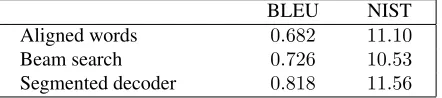
Table 5: Results of the automated evaluation for coverage of intersections described in§5.3.
without annotators who understand the concept of intersection.
We instead attempt to utilize the high-quality human-generated union dataset from McKeown et al. (2010) in evaluating the coverage of our inter-section systems. Using the simple absorption law
A∩(A∪B) = A, we assume that the coverage of intersection systems can be judged by how well they can recover an input sentence from human-generated unions. The resulting outputs are com-pared to the original input sentences in an MT-style evaluation under two commonly-used metrics: BLEU (Papineni et al., 2002) and NIST (Dodding-ton, 2002).
The results of this automated evaluation are shown in Table 5. The aligned words system here always considers words from the union sentence and can therefore be seen as a baseline system. We ob-serve that the segmented decoder produces output that is judged most similar to the input sentences under BLEU, which measures n-gram overlap, al-though results under NIST (which gives additional weight torarern-grams) are less conclusive.
6 Discussion
The experimental results indicate that the two sys-tems we describe, particularly the segmented de-coder, do a reasonable job of finding valid intersec-tions with good coverage; however, producing fluent output remains a challenge. Analysis of the inter-sections produced leads us to note that the quality of interleaving paths is the prime obstacle to im-proving intersection output (cf. Table 3): produc-ing syntactically-valid textual abstractions to con-nect text is a challenge that is not met by our sim-ple rule-based approach. Furthermore, we notice that the quality of alignment also factors in to this problem: systems that miss phrases which should be aligned or systems that mistakenly align faraway fragments both cause spans of unaligned text that
must be then abstracted over.
We hypothesize that these issues could be tackled with the use of joint models: a system that aligns as it decodes could reduce the need for abstrac-tion over long unaligned spans, although care would have to be taken to ensure that coverage is main-tained. Additionally, richer lexical resources such as wider-coverage ontologies (Snow et al., 2006) and entailment/paraphrase dictionaries could aid in improving coverage. Finally, previous work in fu-sion (Filippova and Strube, 2008b; Filippova and Strube, 2009) has noted that models based on syntax outperform techniques that rely solely on LM scores to determine fluency, and strict intersection appears to be well-suited for further exploration in this vein.
7 Conclusion
We have examined the text-to-text generation task of strict sentence intersection, which restricts semantic variation in the output and necessarily invokes the problems of generalization and abstraction in addi-tion to the usual challenge of producing fluent text. We tackle the task as lattice decoding and discuss two decoding strategies for producing valid tions. In addition, we assume that strict intersec-tion tasks are best considered as problems of mu-tual entailment generation and describe evaluation strategies for this task that make use of both human judgments as well as automated metrics run over a related corpus. Experimental results indicate that these systems are fairly effective at generating valid intersections and that our novel segmented decoder strategy outperforms the traditional beam search ap-proach. Although fluency remains a challenge, we hypothesize that the use of joint models, syntac-tic constraints and lexical resources could bring im-provements.
Acknowledgments
References
Srinivas Bangalore, Pierre Boullier, Alexis Nasr, Owen Rambow, and Benoˆıt Sagot. 2009. MICA: a prob-abilistic dependency parser based on tree insertion grammars. InProceedings of HLT-NAACL: Short Pa-pers, pages 185–188.
Roy Bar-Haim, Ido Dagan, Bill Dolan, Lisa Ferro, Danilo Giampiccolo, Bernardo Magnini, and Idan Szpektor. 2006. The second PASCAL Recognising Textual En-tailment challenge. In Proceedings of the Second PASCAL Challenges Workshop on Recognising Tex-tual Entailment.
Regina Barzilay and Kathleen R. McKeown. 2005. Sen-tence fusion for multidocument news summarization.
Computational Linguistics, 31(3):297–328.
Jeremy Bensley and Andrew Hickl. 2008. Unsupervised resource creation for textual inference applications. In
Proceedings of LREC.
Chris Brockett. 2007. Aligning the 2006 RTE cor-pus. Technical Report MSR-TR-2007-77, Microsoft Research.
Olivia Buzek, Philip Resnik, and Benjamin B. Bederson. 2010. Error driven paraphrase annotation using me-chanical turk. InProceedings of the NAACL HLT 2010 Workshop on Creating Speech and Language Data with Amazon’s Mechanical Turk, pages 217–221. James Clarke and Mirella Lapata. 2008. Global
infer-ence for sentinfer-ence compression: an integer linear pro-gramming approach. Journal of Artifical Intelligence Research, 31:399–429, March.
Trevor Cohn and Mirella Lapata. 2009. Sentence com-pression as tree transduction. Journal of Artificial In-telligence Research, 34:637–674.
Ido Dagan, Oren Glickman, and Bernardo Magnini. 2005. The pascal recognising textual entailment chal-lenge. In Proceedings of the PASCAL Challenges Workshop on Recognising Textual Entailment. Hal Daum´e III and Daniel Marcu. 2004. Generic
sen-tence fusion is an ill-defined summarization task. In
Proceedings of the ACL Text Summarization Branches Out Workshop, pages 96–103.
George Doddington. 2002. Automatic evaluation of ma-chine translation quality using n-gram co-occurrence statistics. InProceedings of HLT, pages 138–145. Elena Filatova and Vasileios Hatzivassiloglou. 2004.
A formal model for information selection in multi-sentence text extraction. InProceedings of COLING, page 397.
Katja Filippova and Michael Strube. 2008a. Dependency tree based sentence compression. In Proceedings of the Fifth International Natural Language Generation Conference, INLG ’08, pages 25–32.
Katja Filippova and Michael Strube. 2008b. Sentence fu-sion via dependency graph compresfu-sion. In Proceed-ings of EMNLP, pages 177–185.
Katja Filippova and Michael Strube. 2009. Tree linearization in English: improving language model based approaches. In Proceedings of NAACL, pages 225–228.
Nizar Habash and Bonnie Dorr. 2003. A categorial vari-ation database for English. InProceedings of NAACL, NAACL ’03, pages 17–23.
Hongyan Jing and Kathleen R. McKeown. 2000. Cut and paste based text summarization. InProceedings of NAACL, pages 178–185.
Emiel Krahmer, Erwin Marsi, and Paul van Pelt. 2008. Query-based sentence fusion is better defined and leads to more preferred results than generic sentence fusion. InProceedings of ACL, pages 193–196. Bill MacCartney, Michel Galley, and Christopher D.
Manning. 2008. A phrase-based alignment model for natural language inference. In Proceedings of EMNLP, pages 802–811.
Thomas L. Magnanti and Laurence A. Wolsey. 1994. Optimal trees. In Technical Report 290-94, Massechusetts Institute of Technology, Operations Re-search Center.
Erwin Marsi and Emiel Krahmer. 2005. Explorations in sentence fusion. In Proceedings of the European Workshop on Natural Language Generation, pages 109–117.
Erwin Marsi, Emiel Krahmer, Iris Hendrickx, and Wal-ter Daelemans. 2010. On the limits of sentence compression by deletion. In Emiel Krahmer and Mari¨et Theune, editors,Empirical Methods in Natural Language Generation, pages 45–66. Springer-Verlag, Berlin, Heidelberg.
Andr´e F. T. Martins, Noah A. Smith, and Eric P. Xing. 2009. Concise integer linear programming formula-tions for dependency parsing. InProceedings of ACL-IJCNLP, pages 342–350.
Ryan McDonald. 2006. Discriminative sentence com-pression with soft syntactic evidence. InProceedings of EACL, pages 297–304.
Kathleen McKeown, Sara Rosenthal, Kapil Thadani, and Coleman Moore. 2010. Time-efficient creation of an accurate sentence fusion corpus. In Proceedings of NAACL-HLT.
George A. Miller. 1995. Wordnet: a lexical database for english. Communications of the ACM, 38:39–41, November.
Speech and Language Data with Amazon’s Mechani-cal Turk, pages 212–216.
Franz Josef Och and Hermann Ney. 2003. A system-atic comparison of various statistical alignment mod-els. Computational Linguistics, 29:19–51, March. Kishore Papineni, Salim Roukos, Todd Ward, and
Wei-Jing Zhu. 2002. Bleu: a method for automatic evalu-ation of machine translevalu-ation. InProceedings of ACL, ACL ’02, pages 311–318, Stroudsburg, PA, USA. As-sociation for Computational Linguistics.
Rion Snow, Daniel Jurafsky, and Andrew Y. Ng. 2006. Semantic taxonomy induction from heterogenous evi-dence. InProceedings of ACL, pages 801–808. Rion Snow, Brendan O’Connor, Daniel Jurafsky, and
An-drew Y. Ng. 2008. Cheap and fast—but is it good?: evaluating non-expert annotations for natural language tasks. InProceedings of EMNLP, pages 254–263. Radu Soricut and Daniel Marcu. 2006. Stochastic
lan-guage generation using widl-expressions and its appli-cation in machine translation and summarization. In
Proceedings of ACL, pages 1105–1112.
Kapil Thadani and Kathleen McKeown. 2008. A frame-work for identifying textual redundancy. In Proceed-ings of COLING, pages 873–880.
Kapil Thadani and Kathleen McKeown. 2011. Optimal and syntactically-informed decoding for monolingual phrase-based alignment. InProceedings of ACL. Jenine Turner and Eugene Charniak. 2005. Supervised
and unsupervised learning for sentence compression. InProceedings of ACL, pages 290–297.