Proceedings of the Workshop on Distributional Semantics and Compositionality (DiSCo’2011), pages 21–28,
Distributional Semantics and Compositionality 2011:
Shared Task Description and Results
Chris Biemann
UKP lab, Technical University of Darmstadt Hochschulstr. 10
64289 Darmstadt, Germany
Eugenie Giesbrecht
FZI Forschungszentrum Informatik Haid-und-Neu-Str. 10-14 76131 Karlsruhe, Germany
Abstract
This paper gives an overview of the shared task at the ACL-HLT 2011 DiSCo (Distribu-tional Semantics and Composi(Distribu-tionality) work-shop. We describe in detail the motivation for the shared task, the acquisition of datasets, the evaluation methodology and the results of participating systems. The task of assign-ing a numerical score for a phrase accord-ing to its compositionality showed to be hard. Many groups reported features that intuitively should work, yet showed no correlation with the training data. The evaluation reveals that most systems outperform simple baselines, yet have difficulties in reliably assigning a compo-sitionality score that closely matches the gold standard. Overall, approaches based on word space models performed slightly better than methods relying solely on statistical associa-tion measures.
1 Introduction
Any NLP system that does semantic processing re-lies on the assumption of semantic compositionality: the meaning of a phrase is determined by the mean-ings of its parts and their combination. However, this assumption does not hold for lexicalized phrases such as idiomatic expressions, which causes troubles not only for semantic, but also for syntactic process-ing (Sag et al., 2002). In particular, while distribu-tional methods in semantics have proved to be very efficient in tackling a wide range of tasks in natural language processing, e.g., document retrieval, clus-tering and classification, question answering, query
expansion, word similarity, synonym extraction, re-lation extraction, textual advertisement matching in search engines, etc. (see Turney and Pantel (2010) for a detailed overview), they are still strongly lim-ited by being inherently word-based. While dictio-naries and other lexical resources contain multiword entries, these are expensive to obtain and not avail-able for all languages to a sufficient extent. Fur-thermore, the definition of a multiword varies across resources, and non-compositional phrases are often merely a subclass of multiword units.
This shared task addressed researchers that are interested in extracting non-compositional phrases from large corpora by applying distributional mod-els that assign a graded compositionality score to a phrase, as well as researchers interested in express-ing compositional meanexpress-ing with such models. The score denotes the extent to which the composition-ality assumption holds for a given expression. The latter can be used, for example, to decide whether the phrase should be treated as a single unit in ap-plications. We emphasized that the focus is on au-tomatically acquiring semantic compositionality and explicitly did not invite approaches that employ pre-fabricated lists of non-compositional phrases.
It is often the case that compositionality of a phrase depends on the context. Though we have used a sentence context in the process of construct-ing the gold standard, we have decided not to pro-vide it with the dataset: we have asked for a sin-gle compositionality score per phrase. In an appli-cation, this could play the role of a compositional-ity prior that could, e.g., be stored in a dictionary. There is a long-living tradition within the research
community working on multiword units (MWUs) to automatically classify MWUs into either composi-tional or non-composicomposi-tional ones. However, it has been often noted that compositionality comes in de-grees, and a binary classification is not valid enough in many cases (Bannard et al., 2003; Katz and Gies-brecht, 2006). To the best of our knowledge, this has been the first attempt to offer a dataset and a shared task that allows to explicitly evaluate the models of graded compositionality.
2 Shared Task Description
For the shared task, we aimed to get composition-ality scores for phrases frequently occurring in cor-pora. Since distributional models need large corpora to perform reliable statistics, and these statistics are more reliable for frequent items, we chose to restrict the candidate set to the most frequent phrases from the freely available WaCky1web corpora (Baroni et al., 2009). Those are currently downloadable for En-glish, French, German and Italian. They have al-ready been automatically sentence-split, tokenized, part-of-speech (POS) tagged and lemmatized, which reduces the load on both organizers and participants that decide to make use of these corpora. Further, WaCky corpora provide a good starting point for ex-perimenting with distributional models due to their size, ranging between 1-2 billion tokens, and exten-sive efforts to make these corpora as clean as possi-ble.
2.1 Candidate Selection
There is a wide range of subsentential units that can function as a non-compositional construction. These units do not have to be realized continuously in the surface realization and can consist of an arbitrary number of lexical items. While it would be interest-ing to examine unrestricted forms of multiwords and compositional phrases, we decided to restrict candi-date selection to certain grammatical constructions to make the task more tangible. Specifically, we use word pairs in the following relations:
• ADJ NN: Adjective modifying a noun, e.g. ”red herring” or ”blue skies”
1
http://wacky.sslmit.unibo.it
• V SUBJ: Noun in subject position and verb, e..g. ”flies fly” or ”people transfer (sth.)”
• V OBJ: Noun in object position and verb, e.g. ”lose keys”, ”play song”
While it is possible to extract the relations fairly ac-curately from parsed English text, there is – to our knowledge – no reliable, freely available method that can tell verb-subjects from verb-objects for Ger-man. Thus, we employed a three-step selection procedure for producing a set of candidate phrases per grammatical relation and language that involved heavy manual intervention.
1. Extract candidates using (possibly over-generating) patterns over part-of-speech sequences and sort by frequency
2. Manually select plausible candidates for the target grammatical relation in order of decreas-ing frequency
3. Balance the candidate set to select enough non-compositional phrases
For English, we used the following POS pat-terns: ADJ NN: ”JJ* NN*”; V SUBJ: ”NN* VV*”; V OBJ: ”VV* DT|CD NN*” and ”VV* NN*”. The star * denotes continuation of tag labels: e.g. VV* matches all tags starting with ”VV”, such as VV, VVD, VVG, VVN, VVP and VVZ.
For German, we used ”ADJ* NN*” for ADJ NN. For relations involving nouns and verbs, we ex-tracted all noun-verb pairs in a window of 4 tokens and manually filtered by relation on the aggregated frequency list. Frequencies were computed on the lemma forms.
This introduces a bias on the possible construc-tions that realize the target relaconstruc-tions, especially for the verb-noun pairs. Further, the selection procedure is biased by the intuition of the person that performs the selection. We only admitted what we thought were clear-cut cases (only nouns that are typically found in subject respectively object position) to the candidate set at this stage.
selected, an overwhelming number of compositional phrases would have rendered the task very hard to evaluate, since a baseline system predicting high compositionality in all cases would have achieved a very high score. We argue that since we are es-pecially interested in non-compositional phrases in this competition, it is valid to bias the dataset in this way.
After we collected a candidate list, we randomly selected seven sentences per candidate from the cor-pus. Through manual filtering, we checked whether the target word pair was in fact found in the target relation in these sentences. Further we removed in-complete and too long sentences, so that we ended up with five sentences per target phrase. Some can-didate phrases that only occurred in very fixed con-texts (e.g. disclaimers) or did not have enough well-formed sentences were removed in this step.
Figure 1 shows the sentences for ”V OBJ: buck trend” as an example output of this procedure.
2.2 Annotation
The sample usages of target phrases now had to be annotated for compositionality. We employed the crowdsourcing service Amazon Turk2 for realizing these annotations. The advantage of crowdsourc-ing is its scalability through the large numbers of workers that are ready to perform small tasks for pay. The disadvantage is that tasks usually cannot be very complex, since quality issues (scammers) have to be addressed either with test items or redundancy or both – mechanisms that only work for types of tasks where there is clearly a correct answer.
Previous experiences in constructing linguistic annotations with Amazon Turk (Biemann and Ny-gaard, 2010) made us stick to the following two-step procedure that more or less ensured the quality of annotation by hand-picking workers:
1. Gather high quality workers: In an open task for a small data sample with unquestionable de-cisions, we collected annotations from a large number of workers. Workers were asked to provide reasons for their decisions. Workers that performed well, gave reasons that demon-strated their understanding of the task and com-pleted a significant amount of the examples
2
http://www.mturk.com
were invited for a closed task. Net pay was 2 US cents for completing a HIT.
2. Get annotations for the real task: In the closed task, only invited workers were admitted and redundancy was reduced to four workers per HIT. Net pay was 3 US cents for completing a HIT.
Figure 2 shows a sample HIT (human intelligence task) for English on Amazon turk, including in-structions. Workers were asked to enter a judgment from 0-10 about the literacy of the highlighted tar-get phrase in the respective context. For the German data, we used an equivalent task definition in Ger-man.
All five contexts per target phrase were scored by four workers each. A few items were identified as problematic by the workers (e.g. missing highlight-ing, too little context), and one worker was excluded during the English experiment for starting to delib-erately scam. For this worker, all judgments were re-moved and not repeated. Thus, the standard number of judgments per target phrase was 20, with some targets receiving less judgments because of these problems. The minimum number of judgments per target phrase was 12: four HITs with three judg-ments each.
From this, we computed a score by averaging over all judgments per phrase and multiplying the over-all score by 10 to get scores in the range of 0-100. This score cannot help in discriminating moderately compositional phrases like ”V OBJ: make decision” from phrases that are dependent on the context like ”V OBJ: wait minute” which had two HITs for the idiomatic use of ”wait a minute!” and three HITs with literally minutes to spend idling.
• I would like tobuckthetrendof complaint !
• One company that isbuckingthetrendis Flowcrete Group plc located in Sandbach , Cheshire . • ” We are now moving into a new phase where we are hoping tobuckthetrend.
• With a claimed 11,000 customers and what look like aggressive growth plans , including recent acquisitions of Infinium Software , Interbiz and earlier also Max international , the firm does seem to bebuckingthetrendof difficult times .
• Every time we get a new PocketPC in to Pocket-Lint tower , it seems to offer more features for less money and the HP iPaq 4150 is n’t about tobuckthetrend.
Figure 1: sentences for V OBJ: buck trend after manual filtering and selection. The target ishighlighted.
How literal is this phrase?
Can you infer the meaning of a given phrase by only considering their parts literally, or does the phrase carry a ’special’ meaning? In the context below, how literal is the meaning of the phrase in bold?
Enter a number between 0 and 10.
• 0 means: this phrase is not to be understood literally at all.
• 10 means: this phrase is to be understood very literally.
• Use values in between to grade your decision. Please, however, try totake a stand as often as possible.
In case the context is unclear or nonsensical, please enter ”66” and use the comment field to explain. However, please try to make sense of it even if the sentences are incomplete. Example 1 :
There was a red truck parked curbside. It looked like someone was living in it. YOUR ANSWER: 10
reason: the color of the truck is red, this can be inferred from the parts ”red” and ”truck” only - without any special knowledge.
? Example 2 :
What a tour! We were on cloud nine when we got back to headquarters but we kept our mouths shut. YOUR ANSWER: 0
reason: ”cloud nine” means to be blissfully happy. It does NOT refer to a cloud with the number nine.
Example 3 :
Yellow fever is found only in parts of South America and Africa. YOUR ANSWER: 7
reason: ”yellow fever” refers to a disease causing high body temperature. However, the fever itself is not yellow. Overall, this phrase is fairly literal, but not totally, hence answering with a value between 5 and 8 is appropriate.
We take rejection seriously and will not reject a HIT unless done carelessly. Entering anything else but numbers between 0 and 10 or 66 in the judgment field will automatically trigger rejection.
YOUR CONTEXT withbig day
Special Offers : Please call FREEPHONE 0800 0762205 to receive your free copy of ’ Groom ’ the full colour magazine dedicated to dressing up for thebig dayand details of Moss Bros Hire rates .
How literal is the bolded phrase in the context above between 0 and 10? [ ]
OPTIONAL: leave a comment, tell us about what is broken, help us to improve this type of HIT: [ ]
EN ADJ NN V SUBJ V OBJ Sum Train 58 (43) 30 (23) 52 (41) 140 (107)
Vali. 10 (7) 9 (6) 16 (13) 35 (26)
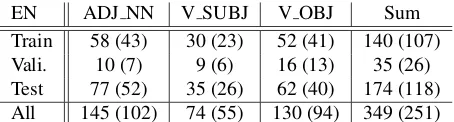
[image:5.612.75.302.57.118.2]Test 77 (52) 35 (26) 62 (40) 174 (118) All 145 (102) 74 (55) 130 (94) 349 (251) Table 1: English dataset: number of target phrases (with coarse scores)
DE ADJ NN V SUBJ V OBJ Sum
Train 49 (42) 26 (23) 44 (33) 119 (98)
Vali. 11 (8) 9 (8) 9 (7) 29 (23)
Test 63 (48) 29 (28) 57 (44) 149 (120) All 123 (98) 64 (59) 110 () 297 (241) Table 2: German dataset: number of target phrases (with coarse scores)
Additionally to the numerical scores, we’ve also provided coarse-grained labels. This is motivated by the following: for some applications, it is prob-ably enough to decide whether a phrase is always compositional, somewhat compositional or usually not compositional, without the need of more fine-grained distinctions. For this, we’ve transformed the numerical scores in the range of 0-25 to coarse la-bel ”low”, those between 38-62 have been lala-beled as ”medium”, and the ones from 75 to 100 have re-ceived the value ”high”. All other phrases have been excluded from the corresponding training and test datasets for ”coarse evaluation” (s. Section 2.4.2): 28.1% of English and 18.9% of German phrases.
2.3 Datasets
Now we describe the datasets in detail. Table 1 sum-marizes the English data, Table 2 describes the Ger-man data quantitatively. Per language and relation, the data was randomly split in approximatively 40% training, 10% validation and 50% test.
2.4 Scoring of system responses
We provided evaluation scripts along with the train-ing and validation data. Additionally, we report cor-relation values (Spearman’s rho and Kendall’s tau) in Section 4.
2.4.1 Numerical Scoring
For numerical scoring, the evaluation script com-putes the distance between the system responses
S = {starget1, starget2, ...stargetN} and the gold
standard G = {gtarget1, gtarget2, ...gtargetN} in points, averaged over all items:
N U M SCORE(S, G) = N1 ∑i=1..N|gi−si|. Missing values in the system scores are filled with the default value of 50. A perfect score is 0, indicating no difference between the system responses and the gold standard.
2.4.2 Coarse Scoring
We use precision on coarse label predictions for coarse scoring:
COARSE(S, G) =
1
N
∑
i=1..N
{ s
i ==gi : 1
otherwise: 0.
As with numerical scoring, missing system re-sponses are filled with a default value, in this case ’medium’. A perfect score would be 1.00, connot-ing complete congruence of gold standard and sys-tem response labels.
3 Participants
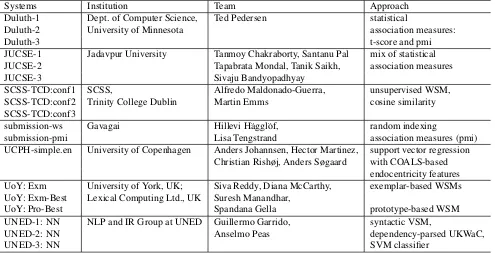
Seven teams participated in the shared task. Table 3 summarizes the participants and their systems. Four of the teams (Duluth, UoY, JUCSE, SCSS-TCD) submitted three runs for the whole English test set. One team participated with two systems, one of which was for the entire English dataset and an-other one included entries only for English V SUBJ and V OBJ relations. A team from UNED provided scores solely for English ADJ NN pairs. UCPH was the only team that delivered results for both English and German.
Systems can be split into approaches based on sta-tistical association measures and approaches based on word space models. On top, some systems used a machine-learned classifier to predict numerical scores or coarse labels.
4 Results
The results of the official evaluation for English are shown in Tables 4 and 5.
Systems Institution Team Approach
Duluth-1 Dept. of Computer Science, Ted Pedersen statistical
Duluth-2 University of Minnesota association measures:
Duluth-3 t-score and pmi
JUCSE-1 Jadavpur University Tanmoy Chakraborty, Santanu Pal mix of statistical
JUCSE-2 Tapabrata Mondal, Tanik Saikh, association measures
JUCSE-3 Sivaju Bandyopadhyay
SCSS-TCD:conf1 SCSS, Alfredo Maldonado-Guerra, unsupervised WSM,
SCSS-TCD:conf2 Trinity College Dublin Martin Emms cosine similarity
SCSS-TCD:conf3
submission-ws Gavagai Hillevi H¨aggl¨of, random indexing
submission-pmi Lisa Tengstrand association measures (pmi)
UCPH-simple.en University of Copenhagen Anders Johannsen, Hector Martinez, support vector regression Christian Rishøj, Anders Søgaard with COALS-based
endocentricity features UoY: Exm University of York, UK; Siva Reddy, Diana McCarthy, exemplar-based WSMs UoY: Exm-Best Lexical Computing Ltd., UK Suresh Manandhar,
UoY: Pro-Best Spandana Gella prototype-based WSM
UNED-1: NN NLP and IR Group at UNED Guillermo Garrido, syntactic VSM,
UNED-2: NN Anselmo Peas dependency-parsed UKWaC,
[image:6.612.76.571.58.311.2]UNED-3: NN SVM classifier
Table 3: Participants of DiSCo’2011 Shared Task
in the numerical evaluation are all based on different variations of word space models.
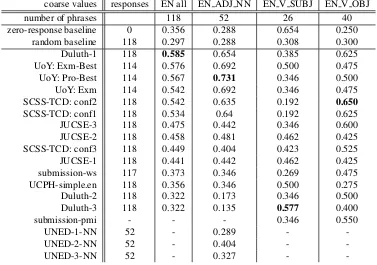
The outcome of evaluation for coarse scores is displayed in Table 5. Here,Duluth-1performs high-est with 0.585, followed closely by UoY:ExmBest with 0.576 and UoY: ProBest with 0.567. Duluth-1is an approach purely based on association mea-sures.
Both tables also report ZERO-response and RANDOM-response baselines. ZERO-response means that, if no score is reported for a phrase, it gets a default value of 50 (fifty) points in numerical evaluation and ’medium’ in coarse evaluation. Ran-dom baselines were created by using ranRan-dom labels from a uniform distribution. Most systems beat the RANDOM-response baseline, only about half of the systems are better than ZERO-response.
Apart from the officially announced scoring meth-ods, we provide Spearman’s rho and Kendall’s tau rank correlations for numerical scoring. Rank cor-relation scores that are not significant are noted in parentheses. With correlations, the higher the score, the better is the system’s ability to order the phrases according to their compositionality scores. Here, systems UoY: Exm-Best, UoY: Pro-Best / JUCSE-1and JUCSE-2achieved the first, second and third
best results respectively.
Overall, there is no clear winner for the English dataset. However, across different scoring mecha-nisms,UoY: Exm-Bestis the most robust of the sys-tems. TheUCPH-simple.ensystem has a stellar per-formance on V OBJ but apparently uses a subopti-mal way of assigning coarse labels. TheDuluth-1 system, on the other hand, is not able to produce a numerical ranking that is significant according to the correlation measures, but excels in the coarse scor-ing.
When comparing word space models and asso-ciation measures, it seems that the former do a slightly better job on modeling graded composition-ality, which is especially obvious in the numerical evaluation.
numerical scores responses ρ τ EN all EN ADJ NN EN V SUBJ EN V OBJ
number of phrases 174 77 35 62
0-response baseline 0 - - 23.42 24.67 17.03 25.47
random baseline 174 (0.02) (0.02) 32.82 34.57 29.83 32.34
UCPH-simple.en 174 0.27 0.18 16.19 14.93 21.64 14.66
UoY: Exm-Best 169 0.35 0.24 16.51 15.19 15.72 18.6
UoY: Pro-Best 169 0.33 0.23 16.79 14.62 18.89 18.31
UoY: Exm 169 0.26 0.18 17.28 15.82 18.18 18.6
SCSS-TCD: conf1 174 0.27 0.19 17.95 18.56 20.8 15.58
SCSS-TCD: conf2 174 0.28 0.19 18.35 19.62 20.2 15.73
Duluth-1 174 (-0.01) (-0.01) 21.22 19.35 26.71 20.45
JUCSE-1 174 0.33 0.23 22.67 25.32 17.71 22.16
JUCSE-2 174 0.32 0.22 22.94 25.69 17.51 22.6
SCSS-TCD: conf3 174 0.18 0.12 25.59 24.16 32.04 23.73
JUCSE-3 174 (-0.04) (-0.03) 25.75 30.03 26.91 19.77
Duluth-2 174 (-0.06) (-0.04) 27.93 37.45 17.74 21.85
Duluth-3 174 (-0.08) (-0.05) 33.04 44.04 17.6 28.09
submission-ws 173 0.24 0.16 44.27 37.24 50.06 49.72
submission-pmi 96 - - - - 52.13 50.46
UNED-1: NN 77 - - - 17.02 -
-UNED-2: NN 77 - - - 17.18 -
-UNED-3: NN 77 - - - 17.29 -
-Table 4: Numerical evaluation scores for English: average point difference and correlation measures (not significant values in parentheses)
coarse values responses EN all EN ADJ NN EN V SUBJ EN V OBJ
number of phrases 118 52 26 40
zero-response baseline 0 0.356 0.288 0.654 0.250
random baseline 118 0.297 0.288 0.308 0.300
Duluth-1 118 0.585 0.654 0.385 0.625
UoY: Exm-Best 114 0.576 0.692 0.500 0.475
UoY: Pro-Best 114 0.567 0.731 0.346 0.500
UoY: Exm 114 0.542 0.692 0.346 0.475
SCSS-TCD: conf2 118 0.542 0.635 0.192 0.650
SCSS-TCD: conf1 118 0.534 0.64 0.192 0.625
JUCSE-3 118 0.475 0.442 0.346 0.600
JUCSE-2 118 0.458 0.481 0.462 0.425
SCSS-TCD: conf3 118 0.449 0.404 0.423 0.525
JUCSE-1 118 0.441 0.442 0.462 0.425
submission-ws 117 0.373 0.346 0.269 0.475
UCPH-simple.en 118 0.356 0.346 0.500 0.275
Duluth-2 118 0.322 0.173 0.346 0.500
Duluth-3 118 0.322 0.135 0.577 0.400
submission-pmi - - - 0.346 0.550
UNED-1-NN 52 - 0.289 -
-UNED-2-NN 52 - 0.404 -
-UNED-3-NN 52 - 0.327 -
[image:7.612.74.515.71.335.2] [image:7.612.73.450.404.669.2]numerical scores responses ρ τ DE all DE ADJ NN DE V SUBJ DE V OBJ
number of phrases 149 63 29 57
0-response baseline 0 - - 32.51 32.21 38.00 30.05
random baseline 149 (0.005) (0.004) 37.79 36.27 47.45 34.54
[image:8.612.71.554.56.132.2]UCPH-simple.de 148 0.171 0.116 24.03 27.09 15.55 24.06
Table 6: Numerical evaluation scores for German
heightcoarse values responses DE all DE ADJ NN DE V SUBJ DE V OBJ
number of phrases 120 48 28 44
0-response baseline 0 0.158 0.208 0.071 0.159
random baseline 120 0.283 0.313 0.214 0.295
UCPH-simple.de 119 0.283 0.375 0.286 0.182
Table 7: Coarse evaluation scores for German
For more details on the systems as well as fine-grained analysis of the results, please consult the corresponding system description papers.
5 Conclusion
DiSCo Shared Task attracted seven groups that sub-mitted results for 19 systems. We consider this a success, taking into consideration that the task is new and difficult. The opportunity to evaluate language-independent models for languages other than English was unfortunately not taken up by most participants.
The teams applied a variety of approaches that can be classified into lexical association measures and word space models of various flavors. From the evaluation, it is hard to decide what method is currently more suited for the task of automatic ac-quisition of compositionality, with a slight favor for approaches based on word space model.
A takeaway message is that a pure corpus-based acquisition of graded compositionality is a hard task. While some approaches clearly outperform base-lines, further advances are needed for automatic sys-tems to be able to reproduce semantic composition-ality.
Acknowledgments
We thank Emiliano Guevara for helping with the preparation of the evaluation scripts and the ini-tial task description. This work was parini-tially sup-ported by the German Federal Ministry of Eco-nomics (BMWi) under the project Theseus (number
01MQ07019).
References
Colin Bannard, Timothy Baldwin, and Alex Lascarides. 2003. A statistical approach to the semantics of verb-particles. In Proc. of the ACL-SIGLEX Workshop on Multiword Expressions: Analysis, Acquisition and Treatment, pages 65–72, Sapporo, Japan.
Marco Baroni, Silvia Bernardini, Adriano Ferraresi, and Eros Zanchetta. 2009. The WaCky wide web: a collection of very large linguistically processed web-crawled corpora. Language Resources and Evalua-tion.
Chris Biemann and Valerie Nygaard. 2010. Crowdsourc-ing WordNet. InProc. of the 5th International Confer-ence of the Global WordNet Association (GWC-2010), Mumbai, India.
Graham Katz and Eugenie Giesbrecht. 2006. Auto-matic identification of non-compositional multi-word expressions using latent semantic analysis. In Pro-ceedings of the ACL/COLING-06 Workshop on Multi-word Expressions: Identifying and Exploiting Under-lying Properties, pages 12–19, Sydney, Australia. Ivan A. Sag, Timothy Baldwin, Francis Bond, Ann
Copestake, and Dan Flickinger. 2002. Multiword Ex-pressions: A Pain in the Neck for NLP. InProc. of the 3rd International Conference on Intelligent Text Processing and Computational Linguistics (CICLing-2002), pages 1–15, Mexico City, Mexico.