ROYAL SCHOOL OF ARTILLERY
BASIC SCIENCE & TECHNOLOGY SECTION
Warheads
THE NATURE OF EXPLOSIONS
T
he phenomenon called explosion is easier to define than the term explosive. An explosion is a violent expansion of gas at high pressure.Physical Explosions
Explosions are common in nature, ranging over a wide scale of magnitude from the cosmic to the terrestrial. Island volcanoes such as Krakatoa can explode with great violence, and at the lower end of the scale a dis-charge of lightning can explosively damage a tree trunk. These examples are due to the sudden vapourisation of water without any chemical change occurring. Other physical explosions can occur from man-made causes, such as the bursting of a high-pressure boiler. Pressurised gas cylinders can explode if broken, a reminder that high temperature is not a necessary pre-requisite for an explosion; nor does any of these exam-ples require the existence of what is normally called an explosive substance. Nevertheless, physical explosions are inherently destructive processes, capable of causing damage by airblast and by the propulsion of debris at high velocity.
Nuclear Explosions
A second class of explosions is the nuclear type. These are the result of nuclear fission or fusion processes, which release enormous amounts of heat very rapidly. The actual expansion is mostly that of the air
surround-ing the device; primary material damage is due to air-blast and heat. The radio-active elements which pro-duce nuclear explosions are not referred to as explo-sives, but it is, incidentally, necessary to use a chemical explosive to trigger a nuclear weapon.
Chemical Explosions
This brings us to the third class of explosion, the chem-ical type,
A chemical change or decomposition, accompanied by the liberation of heat is described as ‘exothermic or heat liberating. This occurs when Iron rusts (or oxidises) but so slowly that the heat is dissipated before it has any effect on Its surroundings. Other substances. such as wood or coal ‘burn’ more quickly, that is to say they com-bine with the oxygen in the atmosphere to the accom-paniment of flame and smoke and the heat liberation is more apparent. The process is further speeded up when an explosive substance is induced to undergo a similar change; but the effects now become so rapid that vast quantities of heat-expanded gas are liberated in such a way as to produce sudden high pressures. Moreover, most explosive substances contain their own ‘built-in’ oxygen so that they can be initiated when confined. See Fig 2 for the definition of explosion
There are numerous substances known to chemists which are so unstable that they may explode at room temperature even when little or no stimulus is applied.
An exothermic reaction which takes the form of an extremely rapid combustion accompanied by the formation of large quantities of heat-expand-ed gas, producing sudden high pressures.
Fig3: Definition of “Detonation”
An exothermic reaction resulting in an extreme-ly rapid chemical change in the mass of an explosive, accompanied not only by formation of of heat-expanded gases, but characterised particularly by a molecular disturbance brought about by the intensity of the accompanying shock wave.
Fig2: Definition of “Chemical Explosion”
Types of Explosions
Physical
Nuclear
Pyrotechnics
Propellants
High Explosives
Primary Secondary
Therefore,if we simply define an explosive as a sub-stance capable of causing an explosion, we shall include many which are of no practical value and are dangerous .In order to be of use to man, an explo-sive substance must possess properties such that it will explode only when it is required to do so. In practice this implies that it must be chemically inert to any other substance with which it may commonly come into contact, including air and moisture, and that it must be thermally stable at normal ambient temperatures. At the same time its ignition temperature must be low enough to allow initiation by some convenient means. It is a characteristic of practical explosives that the mini-mum energy required for initiation is invariably small compared with the subsequent release of energy by the charge. These various properties collectively form the basis of two essential requirements of a practical explo-sive, namely safety and reliability. The application of these two criteria rules out many explosive substances.
TYPES OF CHEMICAL EXPLOSIVES
T
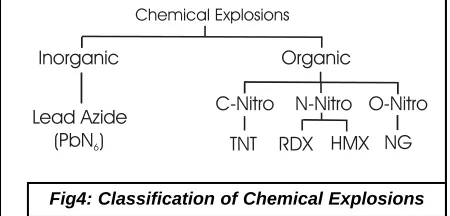
here are two main classifications of chemical explo-sives (Fig 4)• Inorganic Chemical Explosives • Organic Chemical Explosives
Inorganic Chemical Explosives
An example of an Inorganic Chemical explosive is
Lead azide (PbN6), which is now widely employed. It reacts easily to friction. If you touched a milligram of Lead Azide with a feather there would be a large explo-sion. Therefore is it used as an intiator rather than the main ingredient of the warhead. It is unaffected by hot storage, cannot be over compressed pressed and does not react in the presence of damp. When employed as a main detonator filling it is usually topped with a sensi-tizing ingredient. Rapier uses this compound to deto-nate the Warhead. It is called Lead Azide RZY
Organic Chemical Explosives
The high explosives themselves can be divided into’ dif-ferent classes according to the nature of the bond between the nitro group, which carries the oxygen in the molecule, and the rest of the explosive. The three types are:
C-nitro- where the nitro group is attached to a carbon atom e.g. TNT (trinitrotoluene)
N-nitro - where the nitro group is attached to a nitrogen atom e.g. RDX and HMX
0-nitro - where the nitro group is attached to an oxygen atom e.g. NG (nitroglycerine)
TRINITROTOLUENE (TNT)
T
rinitrotoluene, commonly known as TNT, is a con-stituent of many explosives, such as amatol, pento-lite, tetrytol, torpex, tritonal, picratol, ednatol, and com-position B. It has been used under such names as Triton, Trotyl, Trilite, Trinol, and Tritolo. TNT, as its name suggests is made by nitrating Toluene using Nitric and Sulphuric acid. In a refined form, TNT is one of the most stable of high explosives and can be stored over long periods of time. It is relatively insensitive to blows or fric-tion. It is nonhygroscopic (does not absorb water) and does not form sensitive compounds with metals, but it is readily acted upon by alkalies to form unstable com-pounds that are very sensitive to heat and impact. TNT may exude an oily brown liquid. This exudate oozes out around the threads at the nose of the shell and may form a pool on the floor. The exudate is flammable and may contain particles of TNT. Pools of exudate should be carefully removed. TNT can be used as a booster or as a bursting charge for high-explosive shells and bombs. It gives off black smoke during the explosion due to the production of Carbon. The reason for the pro-duction of this carbon is the relative shortage of Oxygen within the TNT molecular structure (Fig5). The oxygen balance is –74% See later notes.CYCLOTRIMETHYLENETRINITRAMINE (RDX)
R
dx is also called cyclotrimethylenetrinitramine or cyclonite or hexogen. It is produced by nitrating hexamine (C6H12N4). Figure 6 shows the resulting RDX (C3H6N6O6) explosive. RDX is a colourless white crystalline solid usually used in mixtures with other explosives, oils, or waxes; it is rarely used alone. It has Chemical ExplosionsInorganic Organic
C-Nitro N-Nitro O-Nitro Lead Azide
(PbN )6 TNT RDX HMX NG
H
NO
2C
NO
2CH
3C
C
C
C
C
H
[image:2.595.43.268.47.155.2]TNT=C H N O
7 5 3 6a high degree of stability in storage and is considered the most powerful andbrisant (defined later) of the mil-itary high explosives. The melting point of RDX is 203ºC (high). RDX compositions are mixtures of RDX, other explosive ingredients, and desensitizers or plasticizers. Incorporated with other explosives or inert material at the manufacturing plants, RDX forms the base for com-mon military explosives. It is mixed with TNT. RDX is mixed with wax and Aluminium powder in the Rapier warhead.
NITROGLYCERINE
N
itroglycerine is an explosive liquid which was first made by Ascanio Sobrero in 1846 by treating glyc-erol or glycerine, with a mixture of nitric and sulphuric acid. See Fig7. The reaction which follows is highly exothermic, i.e. it generates heat and will result in an explosion unless the mixture is cooled while the reaction is taking place. Liquid nitroglycerine is colourless if pure. It is soluble in alcohols but insoluble in water. Nitroglycerine is extremely sensitive to shock and in the early days, when impure nitroglycerine was used, it was very difficult to predict under which conditions nitroglyc-erine would explode. Alfred Nobel studied these prob-lems in detail, and was thefirst to produce nitroglyc-erine on an industrial scale. His first major invention was a blasting cap (igniter), a wooden plug filled with black gunpowder, which could be detonated by lighting a fuse. This in turn, caused an explosion of the sur-rounding nitroglycerine.Alfred Nobel worked hard to improve nitroglycerine as an explosive that could be used in blasting rock and in mining. He made one of his most important discover-ies when he found that by mixing nitroglycerine, an oily fluid, with silica, the mixture could be turned into a paste.
This material could be kneaded and shaped into rods suitable for insertion into drilling holes. He called his paste dynamiteand went on to develop a blasting cap which could be used to detonate dynamite under con-trolled conditions.
Glycerine is a byproduct of the soap and candle making industries so it is plentiful supply.
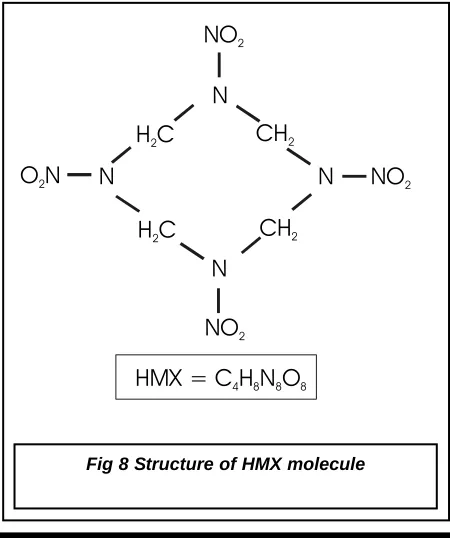
HMX
D
escribed as High melting point explosive, and named, Cyclotetramethylenetetramine (Fig 8) gives a more violent explosion but is considerably more expensive to produce. When employed with TNT and a little RDX and Wax, it forms a pourable mixture called EDC1 (Explosives Division Compound 1)HBX
H
BX-1 and HBX-3 are binary explosives that are castable mixtures of RDX, TNT, powdered alu-minum, and D-2 wax with calcium chloride. TheseH C
2NO
2CH
2NO
2CH
2N
N
N
O N
2RDX = C H N O
3 6 6 6O
O
O
C
C
C
NO
2H
H
NITROGLYCERINE = C H N O
3 5 3 9H
H
NO
2 [image:3.595.328.552.46.284.2]NO
2H
[image:3.595.71.296.49.360.2]Fig 7 Structure of Nitroglycerine molecule
Fig 6 Structure of RDX molecule
H C
2NO
2NO
2CH
2N
N
N
O N
2CH
2N
H C
2NO
2HMX = C H N O
4 8 8 8 [image:3.595.328.553.533.802.2]explosives are used in missile warheads and underwa-ter ordnance.
H-6
H
-6 is a binary explosive that is a castable mixture of RDX, TNT, powdered aluminum, and D-2 wax with calcium chloride added. H-6 is used as the standard bursting charge for general purpose bombs.CYCLOTOL
C
yclotol is manufactured in three formulations by varying mixture percentages of RDX and TNT. Cyclotols are used for loading shaped-charge bombs, special fragmentation projectiles, and grenades.PLATONISERS
T
he addition of substances to help provide a more constant burning rate is generally referred to as “Platonisation”. Examples of Platonisers are Oxamide, Ammonium perchlorate, ammonium pcrate.PYROTECHNICS
P
yrotechnics burn in order to produce the following effects:• Ignite propellants (see below) • Produce delays
• Produce heat, smoke, light or noise
PROPELLANTS
P
ropellants burn in order to produce the following effects:• propel projectiles and rockets
• Start engines and pressurise other piston devices • Rotate Gyros and turbines
All propellants contain Nitrocellulose (NC) and most pro-pellants have other explosives and additives mixed in. The aim of propellant design is to produce a mixture that enables smooth burning without detonation. Nitrocellulose is a gel-like material made by nitrating the natural polymer called Cellulose. The degree of nitration controls the amount of energy liberated when it is burnt. The chemical formula for Cellulose is C6H7O2(OH)3. The effect of nitration is to replace the OH groups by NO3 groups. The resulting NitroCellulose molecule has the formula C6H7N3O11 and this molecule is repeated literally hundreds of times to form the NitroCellulose polymer.
Single Base Propellants contain only NitroCellulose as the explosive ingredient. The Heat of Explosion (Q Value) for these types are between 3100 J/g and 3700 J/g
Double Base propellants contain Nitroglycerine in addition to NitroCellulose. They are more energetic than Single Based and their Heat of Explosion have values between 4300 J/g and 5200 J/g
Triple Base propellants use NC, NG and up to 55% Nitroguanidine (picrite) and/or RDX. Their heats of Explosion are similar to Single Base Propellants, but the
main difference is that triple based propellants produce minimal gun flash, which makes a gun position less easy to locate during night firing.
HIGH EXPLOSIVES (HE)
H
igh Explosives detonate in order to produce the fol-lowing effects:• Create shock waves • Burst
• Shatter • Penetrate • Lift and heave • create airblast
A“Primary” HEis one that detonates easily by a small mechanical or electrical stimulus.
A“Secondary” HEis on that can be detonated but not as easily. A Secondary HE usually needs a shock wave to cause its own detonation.
THE POWER INDEX OF AN EXPLOSIVE
A
n effective explosive will produce a lot of heat Q (measured in Joules) and a large volume V ( meas-ured in cm3 of gas). To get a valid comparison, values are usually quoted for one gram of explosive. Also to combine these two factors we multiply these two quan-tities together. This product is calledThe Power Indexof an explosive
Power Index = Q x V
The Power Index unit is Jcm3g-1
Q is often called “Heat of Explosion” and its value can be looked up in the publication JSP 333
Example One
One gram of RDX produces 5130 J of energy and a vol-ume of gas equal to 908 cm3, (which is just under 1 litre)
Power Index = 5130 x 908 Power Index = 4658040 Jcm3g-1
Example Two
One gram of Lead Azide produces 1610 J of energy and a volume of gas equal to 230 cm3, (which is just under 1 litre)
Power Index = 1610 x 230 Power Index = 370300 Jcm3g-1
OXYGEN CONTENT
molecule by incorporating an extra three oxygen atoms. Thus.,
• NG is rich in Oxygen
• RDX is moderately rich in Oxygen • TNT is deficient in Oxygen
PRODUCTS FORMED BY THE EXPLOSION
H
aving considered some examples of explosive mol-ecules there is a need to examine the type of chem-ical reactions which occur when a material undergoes an explosion. Such an examination is difficult due to the speed of the chemical reaction during the combustion process. In burning, for example, the process is rela-tively slow, giving time to measure the reaction taking place. Typically, propellants will burn in milliseconds or longer. In the detonation reaction the time scale is very short, a matter of microseconds, the actual events occurring at the molecular level are not visible. Therefore, indirect observation of the ‘before and after’ type must be used.An explosive reaction may be regarded as a breaking of the explosive molecule into its component atoms fol-lowed by a re-arrangement of the atoms into a series of small stable molecules. The usual molecules are those of water (H20), carbon dioxide (CO2 ), carbon monoxide (CO) and nitrogen (N2) Molecules of hydrogen (H2 ) and carbon (C) are also found among the products of some explosives.
OXYGEN BALANCE
T
he variety of products from the explosion depends on the amount of oxygen available to the explosive. This in turn is a function of the type of explosive. When the formulae of the explosives are compared, the pro-portion of oxygen in each of the materials may be observed and related to the amount required for com-plete oxidation of the fuel elements, hydrogen and car-bon. NG has the greatest proportion of oxygen, it has more than the required amount. TNT has the least, it is very short of oxygen. ‘Oxygen balance’ is the formal quantified treatment of this concept and is defined thus: Oxygen balance is the percentage by mass of oxygen, positive or negative remaining after detonation when the products of detonation are carbon dioxide and water’.Taking RDX as an example: Formula of RDX: C3H6N6O6
Relative atomic masses: C 12 H 1 N 14 0 16
Relative molecular mass of RDX: (3x12) + (6x1) + (6x14) + (6x16) = 222
Equation for the production of carbon dioxide and water:
C3H6N6O6 = 3CO2 + 3H2O +3N2 – 3O
The figure of - 3O (3 Oxygen atoms) on the right hand side of the equation is required to balance the equation. This maintains six oxygen atoms on the right hand side, the same as are present on the left. This is just a form of ‘book keeping’ exercise to show how deficient the material is in oxygen.
Mass of oxygen remaining after reaction - 3 x 16 = -48 Total mass of RDX = 222 Percentage of oxygen remaining after reaction -48 x 100
222
= -21.6 %
Taking TNT as a second example:
Burning
Detonating
Cigarette end Gaseous products travel away from unburnt section
Detonator HE
[image:5.595.318.553.47.255.2]The shock wave travels in the direction towards the undetonated region.
Formula of TNT: C7H5N3O6
Relative molecular mass of TNT:
(7x12) + (5x1) + (3x14) + (6x16) = 227
Equation for the production of carbon dioxide and water
C7H5N3O6 = 7CO2 + 2.5H2O +1.5N2 – 10.5O
Mass of oxygen remaining after reaction -10.5 x 16 = -168 Percentage of oxygen remaining after reaction -168 x 100
222
= -74 %
TNT shows a low oxygen balance compared with RDX. If a similar calculation is carried out for NG then a small, positive oxygen balance results. The further away from oxygen balance, either positive or negative then the poorer the performance of the explosive in terms of energy released.
ENERGY OF DETONATION
O
xygen balance on its own does not give a large amount of informationabout a material. It is necessary to study the energy changes taking place in the molecule to obtain useful information. When chemical reactions take
place, be it the simple rusting of iron or the detonation of an explosive, the final products are more stable than the original materials unless energy has been introduced into the system. Thus any spontaneous reaction is one that generates materials of higher stability, and in the process, energy is released. Explosive materials gener-ally give out a large amount of energy as heat. Discussions of energy changes are beyond the scope of this handout. For further reading consult Publication JSP 333.(Service Textbook of Explosives).
DETONATION
S
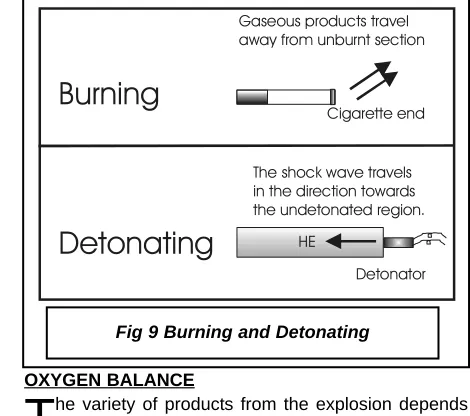
ubstances which content themselves with merely exploding, we group together as ‘low’ explosives; (This term “low” was dropped in favour of the word “Propellant” Substances which undergo “Detonation” have undergone a further step in the field of chemical decomposition. The term “Detonate” derives from the Latin ‘be’ (down) and ‘tonare’ (to thunder) Substances that detonate are called “High Explosive”(HE), Indicating that their behaviour pattern has become enhanced in some way. Usually, a high explosive starts to burn when initiated, but the action accelerates rapid-ly to a point where the pattern changes to a sudden wave of molecular disturbance which is propagated throughout the explosive substance (Fig 9) and is known as the ‘detonation wave’. See Fig 2 for a defini-tion of the word “Detonate”BRISANCE
T
he intense crushing, shattering effect (called “Brisance”) (The adjective form of this word is “brisant” ) which a detonating explosive can exert onhard materials is due to the shock wave. The Brisance of an explosive is a qualitative description of how much damage it will do when exploded. It is a function of the “Velocity of Detonation” and the pressure exerted by the shock wave, know as “Detonation Pressure” The word Brisant originates from the French verb, Briser, which means “To break” in English. Brisance does not have any scientific units and cannot be calculated.
DETONATION VELOCITY AND PRESSURE
T
he detonation velocity is defined as the velocity of sound in the explosive at the temperature it deto-nates at, added to the speed of the reacting material as it moves forward in the detonation wave.Example
Sound travels at 5400 ms-1 in detonating TNT. The speed of the reacting TNT as it moves forward in the detonation wave is 1500 ms-1
Answer
The Detonation Velocity of TNT is 5400 + 1500 = 6900 ms-1
The Detonation Pressure (P) can be calculated from the formula below
P = 2.5 x
∆∆
x D2 ÷ 1000 000
where:∆∆= Density of HE in gcm–3
D= Detonation velocity in ms–1
The units of Detonation pressure are kBar
Example
Given that the density of TNT is 1.57 gcm–-3 find the Detonation pressure.
Answer
P = 2.5 x 1.57 x 69002 ÷ 1000 000 P = 187 kBar
To get some idea of the size of this pressure here are three facts about 187 kBar
• It is 187 000 x Atmospheric Pressure
• It is 1000 x the pressure that liquid hydrogen must be stored at in order to keep it a liquid.
FRAGMENT VELOCITY FROM STATIC WARHEAD
W
hen the warhead has been detonated, the frag-ments will have a certain velocity, vf which depends on the following factors:vfwill be larger for small fragment mass, m(Kg) vf will be larger for a case has has a greater mass M (Kg) that contains the fragments,
vfwill be larger if an explosive with a faster velocity of detonation is used.The formula is as follows.
ion, D ms–1
Example
A cylindrical fragmenting warhead has a steel case of mass 8 kg filled with 12 kg RDX / TNT whose detonation velocity is 8100 ms–1. Find the initial speed of the frag-ments.
FRAGMENT VELOCITY FROM MOVING MISSILE
T
he fragments are blasted out of the warhead in a direction that is at right angles to the casing. The actual velocity of the fragments will be the resultant of this velocity and the forward velocity of the missile. The Resultant is found by using Pythagoras. The direction of the fragment resultant is found by using the Inverse Tangent FunctionExample
A missile travelling at 500 ms–1 ejects fragments that are travelling at 2500 ms–1. Find the resultant speed of the fragments and the direction they travel in
DAMAGE ASSESSMENT
I
n order to inflict damage, a large amount of energy must be spread over an area. If this area is too large, then the damage will be spread thinly and the enemy will be able to recover. Therefore it is necessary to specify the Kinetic Energy Density for threshold piercing or dis-ablement of materials. For example the human body can only stand 10 Joules per square millimetre, written this this 10 Jmm–2 A 10 mm thick steel plate requires 100 Jmm–2 for destruction or penetration. A 30 mm thick steel plate requires 250 Jmm–2 and tank armour requires 15 000 Jmm–2Effect of Friction due to air
When a fragment flies through the air, it will slow down, so it will have less kinetic energy and hence less Kinetic
1
2500
0.8571
2700
)
12
8
2
(
12
2
3
8100
−=
=
+
×
×
=
ms
v
v
v
f f f)
2
(
2
3
m
M
M
D
v
f+
=
Energy Density will experienced by the target. It is pos-sible to take account of this by working out the velocity needed at the target and then calculate what initial speed is required.This formula is an exponential decay type formula involving
• Distance between Warhead and Target • Fragment Density
• Drag coefficient of fragment • Mass of fragment
• Density of fragment
• X Sectional Area of Fragment
• Density of the air where detonation took place.
Fragment vel = 2500
θ
Resultant R
RAPIER MARK2 MISSILE
T
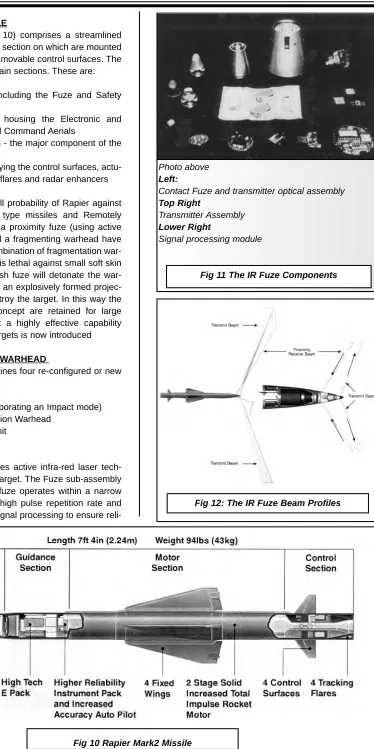
he Mk2 Missile (Fig 10) comprises a streamlined body of circular cross section on which are mounted four fixed wings and four movable control surfaces. The body is built up of four main sections. These are:• Warhead Section - including the Fuze and Safety and Arming Unit
• Guidance Section - housing the Electronic and Instrument Packs and Command Aerials
• Rocket Motor Section - the major component of the airframe
• Control Section - carrying the control surfaces, actu-ator system, tracking flares and radar enhancers
To improve the overall kill probability of Rapier against small targets, i.e.cruise type missiles and Remotely Piloted Vehicles (RPVs) a proximity fuze (using active infra-red technology) and a fragmenting warhead have been developed. The combination of fragmentation war-head with proximity fuze is lethal against small soft skin targets, whereas the crush fuze will detonate the war-head on impact, allowing an explosively formed projec-tile to penetrate and destroy the target. In this way the benefits of the hittile concept are retained for large armoured targets, whilst a highly effective capability against small soft skin targets is now introduced
PROXIMITY FUZE AND WARHEAD
T
he Mk2 Missile combines four re-configured or new elements. These are:• Proximity Fuze (incorporating an Impact mode) • Blast and Fragmentation Warhead
• Safety and Arming Unit • Forebody Profile
Proximity Fuze
T
he Proximity fuze uses active infra-red laser tech-nology to sense the target. The Fuze sub-assembly is shown in Fig 11 The fuze operates within a narrow spectral bandwidth at a high pulse repetition rate and incorporates advanced signal processing to ensurereli-Fig 10 Rapier Mark2 Missile
Photo above
Left:
Contact Fuze and transmitter optical assembly
Top Right
Transmitter Assembly
Lower Right
[image:8.595.144.518.34.783.2]Signal processing module
[image:8.595.285.525.42.530.2]Fig 11 The IR Fuze Components
able operation over a wide range of conditions. The pro-cessing algorithms optimise the warhead effectiveness using the missile I target geometry during the terminal flight phase. The fuze is designed to achieve the highest possible lethality against a range of target types. When the missile is on a collision course with the target the proximity fuze does not produce any output trigger sig-nals and impact fuzing occurs. The Proximity fuze trig-gers the warhead immediately following the closest passing point of the missile and target. The combination of blast and kinetic energy ensures a high probability of target kill. Missile lethality is thus maintained or bettered for large targets,and is greatly improved for small tar-gets. The Fuze is fully automatic requiring no operator pre-flight setting or low altitude inhibits. Fig 12 shows schematically the fuze operating beam profiles.
Shaped Charge, Blast and Fragmentation Warhead
To achieve a significant proximity kill potential whilst still maintaining the kill probability on impact of the Mkl Rapier Semi-Armour-Piercing warhead, a compact war-head of the blast, fragmentation and shaped armour piercing type is incorporated.
For direct impact conditions a high energy shaped charge provides penetration of armoured targets. At small miss distances the blast effect is
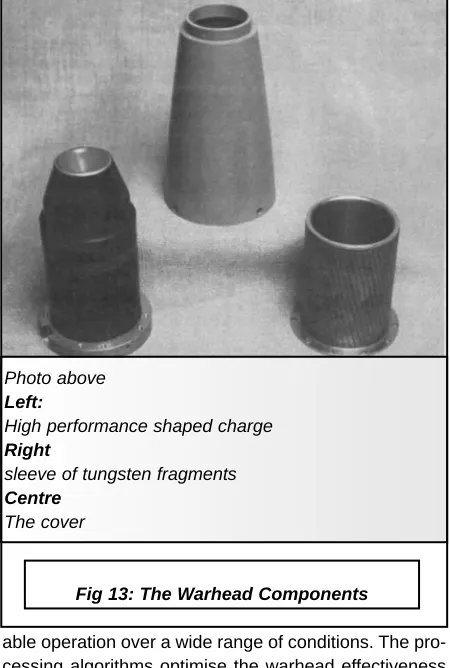
the primary damaging mechanism and so the Warhead blast pattern is optimised for the missile terminal approach flight profile. Fragmentation is the most effi-cient mechanism for transferring warhead energy over distances of several metres. The principal warhead components are shown in Fig 13 The Mk2 Missile war-head comprises a matrix of tungsten fragments in close contact with a body filled with high performance explo-sive. The explosive blast pressure accelerates the tung-sten fragments to a high velocity over a short distance, giving them an exceptional penetration capability. The Warhead destruction pattern is matched to the Proximity Fuze characteristics and, in conjunction with the low guidance errors of the Mk2 Missile, the fragment spread is small and the high velocity is retained over the short distances to a target. As a result the combined fragment kill probability is very high.
Safety and Arming Unit
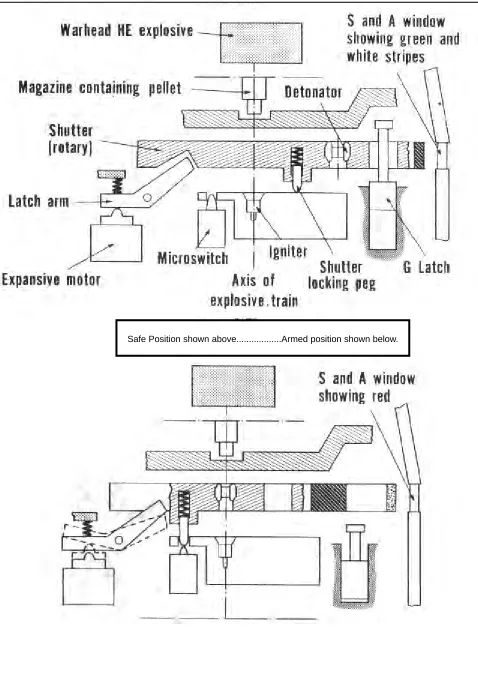
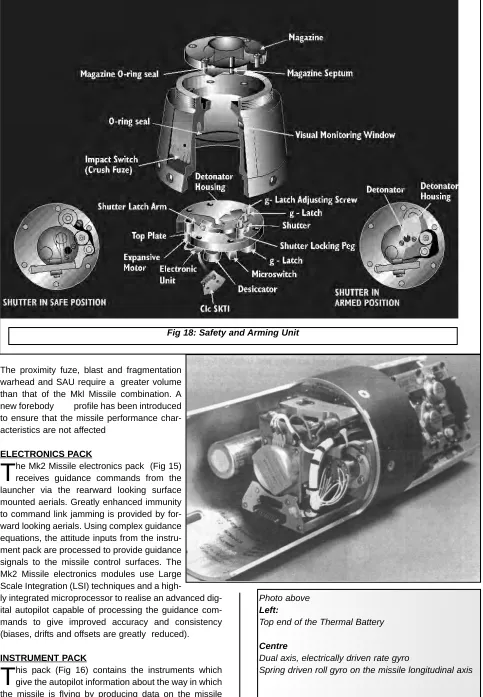
The SAU provides the safety interlocks associated with the warhead and detonator ensuring that the warhead cannot be detonated by any mishandling in use and, once launched, until a minimum safe distance has been travelled. It then allows detonation of the warhead when required by either the fuze or by removal of the com-mand guidance information. The function and construc-tion of the safety and arming unit benefits from the lat-est technological improvements. Three totally independ-ent criteria (forward missile acceleration, time from launch and distance travelled) are monitored to ensure that the missile remains safe and that the warhead can-not be activated until the missile has flown a safe tance from the launcher and operators. This safe dis-tance still ensures that the warhead is enabled for a minimum range engagement.
[image:9.595.324.555.47.338.2]Forebody Profile Fig 13: The Warhead Components
Photo above
Left:
High performance shaped charge
Right
sleeve of tungsten fragments
Centre
The cover
Fig 14: Missile Forebody
Fig 15: The The Electronics Pack
Photo above
Left:
Input connectors for the command link aerials
Centre
[image:9.595.71.296.48.382.2]Fig 17: The Safety and Arming Unit
The proximity fuze, blast and fragmentation warhead and SAU require a greater volume than that of the Mkl Missile combination. A new forebody profile has been introduced to ensure that the missile performance char-acteristics are not affected
ELECTRONICS PACK
T
he Mk2 Missile electronics pack (Fig 15) receives guidance commands from the launcher via the rearward looking surface mounted aerials. Greatly enhanced immunity to command link jamming is provided by for-ward looking aerials. Using complex guidance equations, the attitude inputs from the instru-ment pack are processed to provide guidance signals to the missile control surfaces. The Mk2 Missile electronics modules use Large Scale Integration (LSI) techniques and ahigh-ly integrated microprocessor to realise an advanced dig-ital autopilot capable of processing the guidance com-mands to give improved accuracy and consistency (biases, drifts and offsets are greatly reduced).
INSTRUMENT PACK
[image:11.595.72.555.47.744.2]T
his pack (Fig 16) contains the instruments which give the autopilot information about the way in which the missile is flying by producing data on the missile angular position and acceleration. To give improved reli-ability in the Mk2 Missile, the hot gas generators previ-ously used to drive the three gyros have been replaced,Fig 18: Safety and Arming Unit
Photo above
Left:
Top end of the Thermal Battery
Centre
Dual axis, electrically driven rate gyro
Spring driven roll gyro on the missile longitudinal axis
in two instances by a dual axis electrically driven rate gyro and in the third by a spring driven mechanism roll gyro.Additionally, the Instrument Pack houses the multi-voltage supply Missile Thermal Battery which is of the Lithium Anode technology type.
MISSILE ROCKET MOTOR
T
he missile rocket motor has been improved by the use of new propellants and casting techniques. The new Thermopylae motor gives an extended missile range, improved acceleration and velocity providing excellent short range manoeuvrability which is advanta-geous against short range pop-up targets.SELF TEST QUESTIONS
1 A Chemical reaction which brings about the emis-sion of heat is described to be
a Endothermic b Exothermic c Adiabatic d Oxidised
2 When a chemical reaction happens very rapidly accompanied by a shock wave through the explosive material, the material is said to have:
a Exploded b Imploded c Detonated d Oxidised
3 Lead Azide is best described as:
a an initiator
b an Organic Explosive c a C-nitro Explosive d an N-nitro Explosive
4 When TNT explodes,there is usually a lot of accom-panying black smoke: This is because of the lackof the following element in TNT’s molecular structure
a Carbon b Nitrogen c Hydrogen d Oxygen
5 TNT and RDX are respectively
a N-nitro, C-nitro explosives b O-nitro, N-nitro explosives c C-nitro, N-nitro explosives d N-nitro, O-nitro explosives
6 HMX and NG are respectively
a N-nitro, C-nitro explosives b O-nitro, N-nitro explosives c C-nitro, N-nitro explosives d N-nitro, O-nitro explosives
7 RDX is the chemical compound:
a Cyclotetramethylenetetramine b Cyclotol
c Cyclotrinitamine
d Cyclotrimethylenetrinitramine
8 HMX is the chemical compound:
a Cyclotrinitamine
b Cyclotrimethylenetrinitramine c Cyclotetramethylenetetramine d tetrytol
9 If an explosive is described as “brisant” it:
a will detonate quickly b will detonate slowly
c causes much damage when detonated d ignites quickly
10 When HMX is added to RDX, TNT and wax, it pro-duces the pourable mixture called
a HBX b EDC1 c ECD1 d H-6
11 A chemical compound whose purpose is to create smoke is called a
a Pyrotechnic b Propellant c High Explosive d Platoniser
12 A chemical compound whose purpose is to be deto-nated is called a
a Pyrotechnic b Propellant c High Explosive d Platoniser
13 A chemical compound whose purpose is to help to mantain a constant burning rate is called a
a Pyrotechnic b Propellant
c Inorganic Explosive d Platoniser
14 A chemical compound whose purpose is to get a gyro spinning is called a:
a Pyrotechnic b Propellant
c Secondary Explosive d Platoniser
15 The explosive that was used by Sir Alfred Nobel in the production of Dynamite was:
16 An explosive produces 800 cubic centimetres of gas for every gram of explosive. Its Heat of explosion is 5000 J/g. Its power index is therefore:
a 4 000 000 MJcm3g–1 b 4 MJcm3g–1
c 4 Jcm3g–1 d 40 MJcm3g–1
17 The Oxygen Balance for NG is approximately
a +3.5% b –3.5% c +21.6% d –21.6%
18 The Oxygen Balance for HMX is approximately
a +3.5% b –3.5% c +21.6% d –21.6%
19 An explosive has a density of 2 gcm–3 and sound travels at 4900 ms–1 in this material when it is detonat-ing. Given that the speed of the reacting explosive as it moves in the detonating wave is 100 ms–1,the detona-tion pressure in kBar is:
a 12.5 b 125 c 100 d 175
20 The gyros and thermal battery are housed in Rapier’s
a Rocket Motor casing b Electronics Pack c Instrument Pack d Main Warhead
21 A cylindrical fragmenting warhead has a steel case of mass 10 kg filled with 14 kg RDX / TNT whose deto-nation velocity is 7500 ms–1. The initial speed of the fragments is:
a 2900 ms–1 b 1814 ms–1 c 1914 ms–1 d 814 ms–1
22 A cylindrical fragmenting warhead has a steel case of mass 6 kg filled with 10 kg RDX / TNT whose deto-nation velocity is 9000 ms–1. The initial speed of the fragments is:
a 2900 ms–1 b 2675 ms–1 c 2134 ms–1 d 2038 ms–1
23 A missile travelling at 700 ms–1 ejects fragments that are travelling at 3000 ms–1. The resultant speed of the fragments and the direction they travel in are:
a 3081 ms–1 b 3053 ms–1 c 2081 ms–1 d 1381 ms–1
Answers to Self T est
1b 2c 3a 4d 5c 6d 7d 9c 10b 11a 12c 13d 14b 15a 16b 17a 18d 19b 20c 21b 22d 23a
Teaching Objectives Comments
W.01.1 Classify Explosions
W.01.01.01 Distinguish between Physical, Nuclear, and Chemical Explosions.
W.01.01.02 Classify Chemical Explosions according to Organic and Inorganic
W.01.01.03 Classify HE as Primary or Secondary
.
W.01.02 Describe the processes involved in explosions
W.01.02.01 Define the term Detonation and differentiate between this and Burning.
W.01.02.02 State what factors make an explosions more effective Heat + Gas Volume
W.01.02.03 Explain the term “Brisant”
W.01.02.04 Explain the term “Exothermic Reaction”
W.01.03 Know the Chemistry underlying the Science of Explosives
W.01.03.01 .State the chemical composition of the 6 main explosives TNT,NG,NC,RDX,HMX,ECD1
W.01.03.02 Appreciate that explosives are made by nitrating different moleclues
N-Nitro, O-Nitro, C-Nitro, Toluene, Benzene,Amine
W.01.03.03 Describe the main features of a particular explosive Brisance, Heat of Explosion, Vol of Gas per gram
W.01.03.04 Calculate the Power Index of an explosive.
W.01.03.05 .Calculate the Oxygen Balance of an explosive and discuss the result qualitatively
Close to zero = efficent.
W.01.03.06 .State the products formed by an explosive
W.01.03.07 .Calculate the detonation Pressure and appreciate the order of magnitude of pressures up to 187 kBar
W.01.03.08 .Understand the concept of detonation velocity
W.01.04 Understanding the warhead design in the context of Missile design
W.01.04.01 Identify the position of the warhead in the Rapier Missile
W.01.04.02 Have an idea of the warhead mass and design