Unsupervised Neural Hidden Markov Models
Ke Tran2∗ Yonatan Bisk1 Ashish Vaswani3∗ Daniel Marcu1 Kevin Knight1 1Information Sciences Institute, University of Southern California
2Informatics Institute, University of Amsterdam 3Google Brain, Mountain View
[email protected],[email protected],
[email protected],[email protected],[email protected]
Abstract
In this work, we present the first results for neuralizing an Unsupervised Hidden Markov Model. We evaluate our approach on tag in-duction. Our approach outperforms existing generative models and is competitive with the state-of-the-art though with a simpler model easily extended to include additional context.
1 Introduction
Probabilistic graphical models are among the most important tools available to the NLP community. In particular, the ability to train generative models us-ing Expectation-Maximization (EM), Variational In-ference (VI), and sampling methods like MCMC has enabled the development of unsupervised systems for tag and grammar induction, alignment, topic models and more. These latent variable models discover hid-den structure in text which aligns to known linguis-tic phenomena and whose clusters are easily identifi-able.
Recently, much of supervised NLP has found great success by augmenting or replacing context, features, and word representations with embeddings derived from Deep Neural Networks. These models allow for learning highly expressive non-convex functions by simply backpropagating prediction errors. Inspired byBerg-Kirkpatrick et al. (2010), who bridged the gap between supervised and unsupervised training with features, we bring neural networks to unsuper-vised learning by providing evidence that even in
∗This research was carried out while all authors were at the
Information Sciences Institute.
unsupervised settings, simple neural network mod-els trained to maximize the marginal likelihood can outperform more complicated models that use expen-sive inference.
In this work, we show how a single latent variable sequence model, Hidden Markov Models (HMMs), can be implemented with neural networks by sim-ply optimizing the incomplete data likelihood. The key insight is to perform standard forward-backward inference to compute posteriors of latent variables and then backpropagate the posteriors through the networks to maximize the likelihood of the data.
Using features in unsupervised learning has been a fruitful enterprise (Das and Petrov, 2011; Berg-Kirkpatrick and Klein, 2010;Cohen et al., 2011) and attempts to combine HMMs and Neural Networks date back to 1991 (Bengio et al., 1991). Addition-ally, similarity metrics derived from word embed-dings have also been shown to improve unsupervised word alignment (Songyot and Chiang, 2014).
Interest in the interface of graphical models and neural networks has grown recently as new infer-ence procedures have been proposed (Kingma and Welling, 2014; Johnson et al., 2016). Common to this work and ours is the use of neural networks to produce potentials. The approach presented here is easily applied to other latent variable models where inference is tractable and are typically trained with EM. We believe there are three important strengths:
1. Using a neural network to produce model prob-abilities allows for seamless integration of addi-tional context not easily represented by condi-tioning variables in a traditional model.
2. Gradient based training trivially allows for mul-tiple objectives in the same loss function. 3. Rich model representations do not saturate as
quickly and can therefore utilize large quantities of unlabeled text.
Our focus in this preliminary work is to present a generative neural approach to HMMs and demon-strate how this framework lends itself to modularity (e.g. the easy inclusion of morphological informa-tion via Convoluinforma-tional Neural Networks §5), and the addition of extra conditioning context (e.g. using an RNN to model the sentence §6). Our approach will be demonstrated and evaluated on the simple task of part-of-speech tag induction. Future work, should investigate the second and third proposed strengths.
2 Framework
Graphical models have been widely used in NLP. Typically potential functions ψ(z,x) over a set of latent variables, z, and observed variables, x, are defined based on hand-crafted features. Moreover, independence assumptions between variables are of-ten made for the sake of tractability. Here, we pro-pose using neural networks (NNs) to produce the po-tentials since neural networks are universal approx-imators. Neural networks can extract useful task-specific abstract representations of data. Addition-ally, Long Short-Term Memory (LSTM) ( Hochre-iter and Schmidhuber, 1997) based Recurrent Neural Networks (RNNs), allow for modeling unbounded context with far fewer parameters than naive one-hot feature encodings. The reparameterization of poten-tials with neural networks (NNs) is seamless:
ψ(z,x) =fNN(z,x|θ) (1) The sequence of observed variables are denoted asx={x1, . . . , xn}. In unsupervised learning, we
aim to find model parameters θthat maximize the evidencep(x|θ). We focus on cases when the pos-terior is tractable and we can use Generalized EM (Dempster et al., 1977) to estimateθ.
p(x) =X
z
p(x,z) (2)
=Eq(z)[lnp(x,z|θ)] + H[q(z)] (3) +KL(q(z)kp(z|x, θ)) (4)
Text Pierre Vinken will join the board
PTB NNP NNP MD VB DT NN
Table 1:Example Part-of-Speech tagged text.
whereq(z)is an arbitrary distribution, andHis the entropy function. The E-step of EM estimates the posteriorp(z|x)based on the current parametersθ. In the M-step, we chooseq(z) to be the posterior p(z|x), setting the KL-divergence to zero. Addition-ally, the entropy termH[q(z)]is a constant and can therefore be dropped. This means updatingθonly requires maximizingEp(z|x)[lnp(x,z|θ)]. The
gra-dient is therefore defined in terms of the gragra-dient of the joint probability scaled by the posteriors:
J(θ) =X
z
p(z|x)∂lnp(x,z|θ)
∂θ (5)
In order to perform the gradient update in Eq5, we need to compute the posterior p(z|x). This can be done efficiently with the Message Passing al-gorithm. Note that, in cases where the derivative
∂
∂θlnp(x,z|θ)is easy to evaluate, we can perform
direct marginal likelihood optimization ( Salakhutdi-nov et al., 2003). We do not address here the question of semi-supervised training, but believe the frame-work we present lends itself naturally to the incorpo-ration of constraints or labeled data. Next, we demon-strate the application of this framework to HMMs in the service of part-of-speech tag induction.
3 Part-of-Speech Induction
Part-of-speech tags encode morphosyntactic informa-tion about a language and are a fundamental tool in downstream NLP applications. In English, the Penn Treebank (Marcus et al., 1994) distinguishes 36 cate-gories and punctuation. Tag induction is the task of taking raw text and both discovering these latent clus-ters and assigning them to words in situ. Classes can be very specific (e.g. six types of verbs in English) to their syntactic role. Example tags are shown in Ta-ble1. In this example,boardis labeled as a singular noun whilePierre Vinkenis a singular proper noun.
z1 zt 1 zt zt+1 zT
xt xt+1
xt 1
[image:3.612.97.277.59.134.2]x1 xT
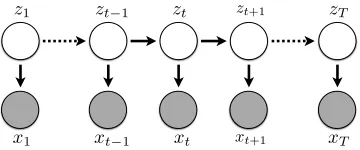
Figure 1:Pictorial representation of a Hidden Markov Model. Latent variable (zt) transitions depend on the previous value (zt−1), and emit an observed word (xt) at each time step.
3.1 The Hidden Markov Model
A common model for this task, and our primary workhorse, is the Hidden Markov Model trained with the unsupervised message passing algorithm, Baum-Welch (Welch, 2003).
Model HMMs model a sentence by assuming that (a) every word token is generated by a latent class, and (b) the current class at timetis conditioned on the local historyt−1. Formally, this gives us an emis-sionp(xt|zt)and transitionp(zt|zt−1)probability.
The graphical model is drawn pictorially in Figure1, where shaded circles denote observations and empty ones are latent. The probability of a given sequence of observationsxand latent variableszis given by multiplying transitions and emissions across all time steps (Eq.6). Finding the optimal sequence of latent classes corresponds to computing an argmax over the values ofz.
p(x,z) =
nY+1
t=1
p(zt|zt−1)
n
Y
t=1
p(xt|zt) (6)
Because our task is unsupervised we do not have a priori access to these distributions, but they can be estimated via Baum-Welch. The algorithm’s outline is provided in Algorithm1.
Training an HMM with EM is highly non-convex and likely to get stuck in local optima (Johnson, 2007). Despite this, sophisticated Bayesian smooth-ing leads to state-of-the-art performance (Blunsom and Cohn, 2011). Blunsom and Cohn (2011) fur-ther extend the HMM by augmenting its emission distributions with character models to capture mor-phological information and a tri-gram transition ma-trix which conditions on the previous two states. Re-cently, Lin et al. (2015) extended several models
Algorithm 1Baum-Welch Algorithm Randomly Initialize distributions (θ)
repeat
Compute forward messages: ∀i,t αi(t)
Compute backward messages: ∀i,t βi(t)
Compute posteriors:
p(zt=i|x, θ)∝αi(t)βi(t)
p(zt=i, zt+1 =j|x, θ)
∝αi(t)p(zt+1=j|zt=i)
×βj(t+ 1)p(xt+1|zt+1=j)
Updateθ
untilConverged
including the HMM to include pre-trained word em-beddings learned by different skip-gram models. Our work will fully neuralize the HMM and learn embed-dings during the training of our generative model. There has also been recent work on byRastogi et al. (2016) on neuralizing Finite-State Transducers.
3.2 Additional Comparisons
While the main focus of our paper is the seamless extension of an unsupervised generative latent vari-able model with neural networks, for completeness we will also include comparisons to other techniques which do not adhere to the generative assumption. We include Brown clusters (Brown et al., 1992) as a baseline and two clustering techniques as state-of-the-art comparisons: Christodoulopoulos et al. (2011) andYatbaz et al. (2012).
Of particular interest to us is the work ofBrown et al. (1992). Brown clusters group word types through a greedy agglomerative clustering according to their mutual information across the corpus based on bigram probabilities. Brown clusters do not ac-count for a word’s membership in multiple syntactic classes, but are a very strong baseline for tag induc-tion. It is possible our approach could be improved by augmenting our objective function to include mu-tual information computations or a bias towards a harder clustering.
4 Neural HMM
word types in our vocabulary. Our neural HMM (NHMM) will replace these matrices with the out-put of simple feed-forward neural networks. All con-ditioning variables will be presented as input to the network and its final softmax layer will provide prob-abilities. This should replicate the behavior of the standard HMM, but without an explicit representa-tion of the necessary distriburepresenta-tions.
4.1 Producing Probabilities
Producing emission and transition probabilities al-lows for standard inference to take place in the model.
Emission Architecture Let vk ∈ RD be vector
embedding of tagzk,wi ∈RDandbivector
embed-ding and bias of wordirespectively. The emission probabilityp(wi|zk)is given by
p(wi|zk) = exp(v
>
kwi+bi)
PV
j=1exp(vk>wj+bj)
(7)
The emission probability can be implemented by a neural network wherewi is the weight of unit iat
the output layer of the network. The tag embeddings vkare obtained by a simple feed-forward neural
net-work consisting of a lookup table following by a non-linear activation (ReLU). When using morphology information (§5), we will first use another network to produce the word embedddingswi.
Transition Architecture We produce the transi-tion probability directly by using a linear layer of D×K2. More specifically, letq∈RDbe aquery
embedding. The unnormalized transition matrixTis computed as
T=U>q+b (8)
whereU∈RD×K2
andb∈RK2
. We then reshape Tto aK×Kmatrix and apply a softmax layer per row to produce valid transition probabilities.
4.2 Training the Neural Network
The probabilities can now be used to perform the aforementioned forward and backward passes over the data to compute posteriors. In this way, we per-form the E-step as though we were training a vanilla HMM. Traditionally, these values would simply
be re-normalized during the M-step to re-estimate model parameters. Instead, we use them to re-scale our gradients (following the discussion from §2). Combining the HMM factorization of the joint proba-bilityp(x,z)from Eq.6with the gradient from Eq.5, yields the following update rule:
J(θ) =X
z
p(z|x)∂lnp(∂θx,z|θ)
=X
t
X
zt
p(zt|x)∂lnp(x∂θt|zt, θ)
+p(zt, zt−1|x)∂lnp(z∂θt|zt−1, θ) (9)
The posteriors p(zt|x) and p(zt, zt−1|x) are
ob-tained by running Baum-Welch as shown in Algo-rithm1. Where traditional supervised training can follow a clear gradient signal towards a specific assignment, here we are propagating the model’s (un)certainty instead. An additional complication in-troduced by this paradigm is the question of how many gradient steps to take on a given minibatch. In incremental EM the posteriors are simply accumu-lated and normalized. Here, we repeatedly recom-pute gradients on a minibatch until reaching the max-imum number of epochs or a convergence threshold is met.
Finally, notice that the factorization of the HMM allows us to evaluate the joint distributionp(x,z|θ)
easily. We therefore employ Direct Marginal Likeli-hood (DML) (Salakhutdinov et al., 2003) to optimize the model’s parameters. After trying both EM and DML we found EM to be slower to converge and per-form slightly weaker. For this reason, the presented results will all be trained with DML.
4.3 HMM and Neural HMM Equivalence
Tag embeddings ReLU Linear Softmax
[image:5.612.95.279.61.150.2]Char-CNN
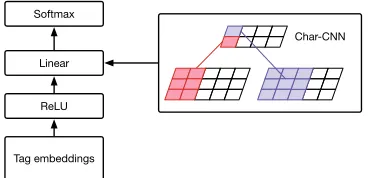
Figure 2:Computational graph of Char-CNN emission network. A character convolutional neural network is used to compute the weight of the linear layer for every minibatch.
following two sections will demonstrate the extensi-bility of this approach.
5 Convolutions for Morphology
The first benefit of moving to neural networks is the ease with which new information can be provided to the model. The first experiment we will perform is replacing words with embedding vectors derived from a Convolutional Neural Network (CNN) (Kim et al., 2016;Jozefowicz et al., 2016). We use a convo-lutional kernel with widths from 1 to 7, which covers up to 7 character n-grams (Figure2). This allows the model to automatically learn lexical representations based on prefix, suffix, and stem information about a word. No additional changes to learning are required for extension.
Adding the convolution does not dramatically slow down our model because the emission distribu-tions can be computed for the whole batch in one operation. We simply pass the whole vocabulary through the convolution in a single operation.
6 Infinite Context with LSTMs
One of the most powerful strengths of neural net-works is their ability to create compact representa-tion of data. We will explore this here in the crearepresenta-tion of transition matrices. In particular, we chose to aug-ment the transition matrix with all preceding words in the sentence:p(zt|zt−1, w0, . . . , wt−1).
Incorpo-rating this amount of context in a traditional HMM is intractable and impossible to estimate, as the number of parameters grows exponentially.
For this reason, we use an stacked LSTM to form a low dimensional representation of the sentence (C0...t−1) which can be easily fed to
our network when producing a transition matrix:
xt
xt 1
x1 xT
[image:5.612.350.500.62.153.2]Tt 1,t
Figure 3:A graphical representation of our LSTM transition network. Transition matrixTt−1,tfrom time stept−1totis computed based on the hidden state of the LSTM at timet−1.
p(zt|zt−1, C0...t−1) in Figure 3. By having the
LSTM only consume up to the previous word, we do not break any sequential generative model assump-tions.1In terms of model architecture, the query em-beddingqwill be replaced by a hidden stateht−1of
the LSTM at time stept−1.
7 Evaluation
Once a model is trained, the one best latent sequence is extracted for every sentence and evaluated on three metrics.
Many-to-One (M-1) Many-to-one computes the
most common true part-of-speech tag for each ter. It then computes tagging accuracy as if the clus-ter were replaced with that tag. This metric is easily gamed by introducing a large number of clusters.
One-to-One (1-1) One-to-One performs the same computation as Many-to-One but only one cluster is allowed to be assigned to a given tag. This prevents the gaming of M-1.
V-Measure (VM) V-Measure is an F-measure
which trades off conditional entropy between the clusters and gold tags. Christodoulopoulos et al. (2010) found VM is to be the most informative and consistent metric, in part because it is agnostic to the number of induced tags.
8 Data and Parameters
To evaluate our approaches, we follow the existing literature and train and test on the full WSJ corpus.
There are three components of our models which can be tuned. Something we have to be careful of when train and test are the same data. To avoid cheating, no values were tuned in this work.
Architecture The first parameter is the number of hidden units. We chose 512 because it was the largest power of two we could fit in memory. When we ex-tended our model to include the convolutional emis-sion network, we only used 128 units, due to the intensive computation of Char-CNN over the whole vocabulary per minibatch.
The second design choice was the number of LSTM layers. We used a three layer LSTM as it worked well for (Tran et al., 2016), and we applied dropout (Srivastava et al., 2014) over the vertical con-nections of the LSTMs (Pham et al., 2014) with a rate of 0.5.
Finally, the maximum number of inner loop up-dates applied per batch is set to six. We train all the models for five epochs and perform gradient clipping whenever the gradient norm is greater than five. To determine when to stop applying the gradient during training we simply check when the log probability has converged (new−old
old <10−4) or if the maximum number of inner loops has been reached. All opti-mization was done using Adam (Kingma and Ba, 2015) with default hyper-parameters.
Initialization In addition to architectural choices we have to initialize all of our parameters. Word em-beddings (and character emem-beddings in the CNN) are drawn from a GaussianN(0,1). The weights of all linear layers in the model are drawn from a uniform distribution with mean zero and a standard deviation ofp1/nin, wherenin is the input dimension of the
linear layer.2 Additionally, weights for the LSTMs are initialized usingN(0,1/2n), wherenis the
num-ber of hidden units, and the bias of the forget gate is set to 1, as suggested byJózefowicz et al. (2015). We present some parameter and modeling ablation analysis in §10.
It is worth emphasizing that parameters are shared at the lower level of our network architectures (see Figure 2 and Figure 3). Sharing parameters not only allows the networks to share statistical strength, but also reduces the computational cost of
comput-2This is the default parameter initialization in Torch.
System M-1 1-1 VM
Base
HMM 62.5 41.4 53.3
Brown 68.2 49.9 63.0
SO
TA
Clark (2003) 71.2 65.6
Christodoulopoulos (2011) 72.8 66.1
Blunsom (2011) 77.5 69.8
Yatbaz (2012) 80.2 72.1
Our
W
ork NHMM+ Conv 59.8 45.7 54.274.1 48.3 66.1
+ LSTM 65.1 52.4 60.4
[image:6.612.320.529.60.230.2]+ Conv & LSTM 79.1 60.7 71.7
Table 2:English Penn Treebank results with 45 induced clusters. We see significant gains from both morphology (+Conv) and ex-tended context (+LSTM). The combination of these approaches results in a very simple system which is competitive with the best generative model in the literature.
ing sufficient statistics during training due to the marginalization over latent variables.
In all of our experiments, we use minibatch size of 256 and sentences of 40 words or less due to mem-ory constraints. Evaluation was performed on all sentence lengths. Additionally, we map all the digits to0, but do not lower-case the data or perform any other preprocessing. All model code is available on-line for extension and replication at
https://github.com/ketranm/neuralHMM.
9 Results
Our results are presented in Table2along with two baseline systems, and the four top performing and state-of-the-art approaches. As noted earlier, we are happy to see that our NHMM performs almost iden-tically with the standard HMM. Second, we find that our approach, while simple and fast, is competitive with Blunsom (2011). Their Hierarchical Pitman-Yor Process for trigram HMMs with character modeling is a very sophisticated Bayesian approach and the most appropriate comparison to our work.
Configuration M-1 1-1 VM
Uniform initialization 65.5 50.1 61.7
1 LSTM layer, no dropout 69.3 52.7 63.6
1 LSTM layer, dropout 71.0 55.7 66.2
3 LSTM layers, no dropout 72.7 52.2 65.1
[image:7.612.80.293.61.158.2]Best Model 79.1 60.7 71.7
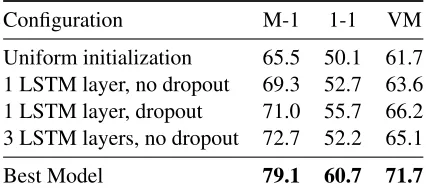
Table 3:Exploring different configurations of NHMM
VM improvement. This might imply that at least some of the syntactic context being captured by the LSTM is mirrored in the morphology of the language. This hypothesis is something future work should in-vestigate with morphologically rich languages.
Finally, the newer work ofYatbaz et al. (2012) outperforms our approach. It is possible our perfor-mance could be improved by following their lead and including knowledge of the future.
10 Parameter Ablation
Our model design decisions and weight initializa-tions were chosen based on best practices set forth in the supervised training literature. We are lucky that these also behaved well in the unsupervised set-ting. Within unsupervised structure prediction, to our best knowledge, there has been no empirical study on neural network architecture design and weight ini-tialization. We therefore provide an initial overview on the topic for several of our decisions.
Weight Initialization If we run our best model (NHMM+Conv+LSTM) with all the weights initial-ized from a uniform distributionU(−10−4,10−4)3 we find a dramatic drop in V-Measure performance (61.7 vs 71.7 in Table 3). This is consistent with the common wisdom that unlike supervised learning (Luong et al., 2015), weight initialization is impor-tant to achieve good performance on unsupervised tasks. It is possible that performance could be further enhance via the popular technique of ensembling, would would allow for combining models which con-verged to different local optima.
LSTM Layers And Dropout We find that dropout is important in training an unsupervised NHMM.
3We choose small standard derivation here for numerical sta-bility when computing forward-backward messages.
Removing dropout causes performance to drop six points. To avoid tuning the dropout rate, future work might investigate the effect of variational dropout (Kingma et al., 2015) in unsupervised learning. We also observed that the number of LSTM layers has an impact on V-Measure. Had we simply used a sin-gle layer we would have lost nearly five points. It is possible that more layers, perhaps coupled with more data, would yield even greater gains.
11 Future Work
In addition to parameter tuning and multilingual eval-uation, the biggest open questions for our approach are the effects of additional data and augmenting the loss function. Neural networks are notoriously data hungry, indicating that while we achieve competitive results, it is possible our model will scale well when run with large corpora. This would likely require the use of techniques like NCE (Gutmann and Hyväri-nen, 2010) which have been shown to be highly ef-fective in related tasks like neural language mod-eling (Mnih and Teh, 2012; Vaswani et al., 2013). Secondly, despite focusing on ways to augment an HMM, Brown clustering and systems inspired by it perform very well. They aim to maximize mutual information rather than likelihood. It is possible that augmenting or constraining our loss will yield addi-tional performance gains.
Outside of simply maximizing performance on tag induction, a more subtle, but powerful contribution of this work may be its demonstration of the easy and effective nature of using neural networks with Bayesian models traditionally trained by EM. We hope this approach scales well to many other do-mains and tasks.
Acknowledgments
This work was supported by Contracts W911NF-15-1-0543 and HR0011-15-C-0115 with the US Defense Advanced Research Projects Agency (DARPA) and the Army Research Office (ARO). Additional thanks to Christos Christodoulopoulos.
References
network - hidden markov model hybrid. In Proceed-ings of the International Joint Conference on Neural Networks, Seattle, WA.
Taylor Berg-Kirkpatrick and Dan Klein. 2010. Phyloge-netic grammar induction. InProceedings of the 48th Annual Meeting of the Association for Computational Linguistics, pages 1288–1297, Uppsala, Sweden, July. Taylor Berg-Kirkpatrick, Alexandre Bouchard-Côté, John DeNero, and Dan Klein. 2010. Painless unsupervised learning with features. InHuman Language Technolo-gies: The 2010 Annual Conference of the North Ameri-can Chapter of the Association for Computational Lin-guistics, pages 582–590.
Yonatan Bisk, Christos Christodoulopoulos, and Julia Hockenmaier. 2015. Labeled grammar induction with minimal supervision. InProceedings of the 53rd Annual Meeting of the Association for Computational Linguistics and the 7th International Joint Conference on Natural Language Processing (Volume 2: Short Pa-pers), pages 870–876, Beijing, China, July.
Phil Blunsom and Trevor Cohn. 2011. A Hierarchical Pitman-Yor Process HMM for Unsupervised Part of Speech Induction. InProceedings of the 49th Annual Meeting of the Association for Computational Linguis-tics: Human Language Technologies, pages 865–874, Portland, Oregon, USA, June.
Peter F Brown, Peter V deSouza, Robert L Mercer, Vin-cent J Della Pietra, and Jenifer C Lai. 1992. Class-Based n-gram Models of Natural Language. Computa-tional Linguistics, 18.
Christos Christodoulopoulos, Sharon Goldwater, and Mark Steedman. 2010. Two Decades of Unsupervised POS induction: How far have we come? In Proceed-ings of the 2010 Conference on Empirical Methods in Natural Language Processing, Cambridge, MA, Octo-ber.
Christos Christodoulopoulos, Sharon Goldwater, and Mark Steedman. 2011. A Bayesian Mixture Model for Part-of-Speech Induction Using Multiple Features. InProceedings of the 2011 Conference on Empirical Methods in Natural Language Processing, Edinburgh, Scotland, UK., July.
Shay B. Cohen, Dipanjan Das, and Noah A. Smith. 2011. Unsupervised structure prediction with non-parallel multilingual guidance. In Proceedings of the 2011 Conference on Empirical Methods in Natural Language Processing, pages 50–61, Edinburgh, Scot-land, UK., July.
Dipanjan Das and Slav Petrov. 2011. Unsupervised part-of-speech tagging with bilingual graph-based pro-jections. InProceedings of the 49th Annual Meeting of the Association for Computational Linguistics: Hu-man Language Technologies, pages 600–609, Portland, Oregon, USA, June.
A Dempster, N Laird, and D Rubin. 1977. Maxi-mum likelihood from incomplete data via the EM algo-rithm. Journal of the Royal Statistical Society. Series B (Methodological), January.
Michael Gutmann and Aapo Hyvärinen. 2010. Noise-contrastive estimation: A new estimation principle for unnormalized statistical models. InInternational Con-ference on Artificial Intelligence and Statistics. Sepp Hochreiter and Jürgen Schmidhuber. 1997. Long
short-term memory. Neural Computation, 9(8):1735– 1780, November.
Matthew J Johnson, David Duvenaud, Alexander B Wiltschko, Sandeep R Datta, and Ryan P Adams. 2016. Composing graphical models with neural networks for structured representations and fast inference. ArXiv e-prints, March.
Mark Johnson. 2007. Why doesn’t EM find good HMM POS-taggers. InProceedings of the 2007 Joint Confer-ence on Empirical Methods in Natural Language Pro-cessing and Computational Natural Language Learn-ing (EMNLP-CoNLL), January.
Rafal Józefowicz, Wojciech Zaremba, and Ilya Sutskever. 2015. An empirical exploration of recurrent network architectures. InProceedings of the 32nd International Conference on Machine Learning, ICML 2015, Lille, France, 6-11 July 2015, pages 2342–2350.
Rafal Jozefowicz, Oriol Vinyals, Mike Schuster, Noam Shazeer, and Yonghui Wu. 2016. Exploring the Limits of Language Modeling. ArXiv e-prints, February. Yoon Kim, Yacine Jernite, David Sontag, and
Alexan-der M Rush. 2016. Character-aware neural language models. AAAI.
Diederik Kingma and Jimmy Ba. 2015. Adam: A method for stochastic optimization. The International Conference on Learning Representations (ICLR). Diederik P Kingma and Max Welling. 2014.
Auto-encoding variational bayes. The International Confer-ence on Learning Representations (ICLR).
Diederik P Kingma, Tim Salimans, and Max Welling. 2015. Variational dropout and the local reparameteriza-tion trick. InAdvances in Neural Information Process-ing Systems 28, pages 2575–2583. Curran Associates, Inc.
Chu-Cheng Lin, Waleed Ammar, Chris Dyer, and Lori Levin. 2015. Unsupervised pos induction with word embeddings. InProceedings of the 2015 Conference of the North American Chapter of the Association for Computational Linguistics: Human Language Tech-nologies, pages 1311–1316, Denver, Colorado, May– June.
2015 Conference on Empirical Methods in Natural Language Processing, pages 1412–1421, Lisbon, Por-tugal, September.
Mitchell P Marcus, Grace Kim, Mary Ann Marcinkiewicz, Robert MacIntyre, Ann Bies, Mark Ferguson, Karen Katz, and Britta Schasberger. 1994. The Penn Tree-bank: Annotating Predicate Argument Structure. In
ARPA Human Language Technology Workshop. Andriy Mnih and Yee Whye Teh. 2012. A fast and
sim-ple algorithm for training neural probabilistic language models. InProceedings of the 29th International Con-ference on Machine Learning (ICML-12), pages 1751– 1758, New York, NY, USA, July.
Vu Pham, Christopher Bluche, Théodore Kermorvant, and Jérôme Louradour. 2014. Dropout improves recurrent neural networks for handwriting recognition. In In-ternational Conference on Frontiers in Handwriting Recognition (ICFHR), pages 285–290, Sept.
Pushpendre Rastogi, Ryan Cotterell, and Jason Eisner. 2016. Weighting finite-state transductions with neural context. InProceedings of the 2016 Conference of the North American Chapter of the Association for Compu-tational Linguistics: Human Language Technologies, pages 623–633, San Diego, California, June.
Ruslan Salakhutdinov, Sam Roweis, and Zoubin Ghahra-mani. 2003. Optimization with em and expectation-conjugate-gradient. InProceedings, Intl. Conf. on Machine Learning (ICML, pages 672–679.
Theerawat Songyot and David Chiang. 2014. Improving word alignment using word similarity. InProceedings of the 2014 Conference on Empirical Methods in Natu-ral Language Processing (EMNLP), pages 1840–1845, Doha, Qatar, October.
Valentin I. Spitkovsky, Hiyan Alshawi, Angel X. Chang, and Daniel Jurafsky. 2011. Unsupervised dependency parsing without gold part-of-speech tags. In Proceed-ings of the 2011 Conference on Empirical Methods in Natural Language Processing, pages 1281–1290, Ed-inburgh, Scotland, UK., July.
Nitish Srivastava, Geoffrey Hinton, Alex Krizhevsky, Ilya Sutskever, and Ruslan Salakhutdinov. 2014. Dropout: A simple way to prevent neural networks from overfit-ting. JMLR, (1):1929–1958, January.
Ke Tran, Arianna Bisazza, and Christof Monz. 2016. Re-current memory networks for language modeling. In
Proceedings of the 2016 Conference of the North Amer-ican Chapter of the Association for Computational Lin-guistics: Human Language Technologies, pages 321– 331, San Diego, California, June.
Ashish Vaswani, Yinggong Zhao, Victoria Fossum, and David Chiang. 2013. Decoding with large-scale neu-ral language models improves translation. In Proceed-ings of the 2013 Conference on Empirical Methods in
Natural Language Processing, pages 1387–1392, Seat-tle, Washington, USA, October.
Lloyd R Welch. 2003. Hidden Markov Models and the Baum-Welch Algorithm. IEEE Information Theory Society Newsletter, 53(4):1–24, December.