D S Sharma, R Sangal and A K Singh. Proc. of the 13th Intl. Conference on Natural Language Processing, pages 259–266, Varanasi, India. December 2016. c2016 NLP Association of India (NLPAI)
Use of Semantic Knowledge Base for Enhancement of Coherence of
Code-mixed Topic-Based Aspect Clusters
Kavita Asnani
Computer Engineering Dept Goa College of Engineering
Goa India
Jyoti D Pawar
Computer Science and Technology Dept Goa University
Goa India
Abstract
In social media code-mixing is getting very popular due to which there is enor-mous generation of noisy and sparse mul-tilingual text which exhibits high disper-sion of useful topics which people dis-cuss. Also, the semantics is expressed across random occurrence of code-mixed words. In this paper, we propose
code-mixedknowledge based LDA (cmk-LDA), which infers latent topic based as-pects from code-mixed social media data. We experimented on FIRE 2014, a code-mixed corpus and showed that with the help of semantic knowledge from mul-tilingual external knowledge base, cmk-LDA learns coherent topic-based aspects across languages and improves topic inter-pretibility and topic distinctiveness better than the baseline models . The same is shown to have agreed with human judg-ment.
1 Introduction
The huge amount of social media text available online is becoming increasingly popular thereby providing an additional opportunity of mining use-ful information from it. Therefore, most of the re-search on social media text has concentrated on English chat data or on multilingual data where each message as a component is monolingual. In social media, people often switch between two or more languages, both at conversation level and at message level (Ling et al., 2013). However, ma-jority of conversational data on social network-ing forums is informal and occurs in random mix of languages (Das and Gamb¨ack, 2014). When this code alternation occurs at or above the utter-ance level, the phenomenon is referred to as code-switching; when the alternation is utterance inter-nal, the term code-mixing is common (Gamb¨ack
and Das, 2016). Thus, code-mixing while chatting has become prevalent in current times. However, exponentially increasing large volumes of short and long code-mixed messages contain lot of noise and has useful information highly dispersed. Un-fortunately, it is not an easy task to retrieve useful knowledge from such data as code-mixing occurs at different levels of code-complexity and imposes fundamental challenges namely:
1. Code-mixed social media data is multilin-gual, usually bilingual (San, 2009). There-fore, semantics is spread across languages.
2. Social media data do not have specific termi-nology (Eisenstein, 2013).
Therefore, using training data from parallel or comparable corpora will not be useful in this con-text. Also, availability of pre annotated corpora for all language pairs used in social media may prac-tically be very difficult to obtain. Our objective is to model unsupervised aspect extraction using top-ics, from the code-mixed context to obtain useful knowledge. Probabilistic Latent Semantic Analy-sis (pLSA) (Hofmann, 1999) and Latent Dirichlet Allocation (LDA)(Blei et al., 2003) are popularly recommended unsupervised topic modeling meth-ods for this purpose; but a shortcoming with them is that they result in extracting some incoherent topics (Chang et al., 2009).This is due to the oc-currence of some irrelevant and polysemous terms in extraction (Chang et al., 2009), which is likely to get aggregated in multilingual content. There-fore, in code-mixed context extraction of incoher-ent topics are highly likely to occur. In order to cross over the word level language barrier and aug-ment each word with its semantic description we propose to leverage knowledge from external mul-tilingual semantic knowledge base such as Babel-Net v3.0 1 (Navigli et al., 2012) which is created
from integration of both Wikipedia and WordNet (Miller, 1995).
Our approach of incorporating semantic knowl-edge in LDA topic model has resemblance with General Knowledge based LDA (GK-LDA)(Chen et al., 2013) model. However, their sets were monolingual and were constructed using Word-Net. They called their semantic sets as Lexical Relation Sets(LR-sets) and were comprising of synonym, antonym and adjective relations. They addressed the problem of multiple senses using synonyms and antonyms in LR-Sets. However, in their work since semantic knowledge is aug-mented at word level not all LR-sets resulted in correct context knowledge. They handled this problem by using explicit word-correlation ma-trix and also fixed the wrong knowledge explic-itly. But we take a different approach. In a sin-gle step, we obtain disambiguated synsets for a code-mixed message, retrieving correct multilin-gual synsets appropriate to the context across lan-guages. This also resolves language related multi-ple senses issue. As per our knowledge, our pro-posed model is the first model to exploit semantic knowledge from BabelNet in topic models for pro-ducing coherent topics from code-mixed data.
The remaining part of the paper is organized as follows: Section 2 presents related work, Section 3 describes our proposed work, Section 4 gives implementation details, Section 5 presents experi-mental results and Section 6 states the conclusion.
2 Related Work
Code-switching and code-mixing are popularly been observed on social networking forums, es-pecially in highly multilingual societies. In this paper, we will use the term code-mixing to refer to both of these situations. In gen-eral, multilingual users communicate in two or more languages. In (Barman et al., 2014) study was performed on code-mixed content by col-lecting data from Facebook posts, code-mixed in three languages Bengali(BN)-English(EN)-Hindi(HI). However, in (Bali et al., 2014), the analysis of code-mixed bilingual English-Hindi data showed significant amount of code-mixing and proved that most of the active users on book are bilingual. Out of 43,012 words on face-book chat, 38,144 were written in Roman script and 2661 in Devanagari script. They claimed that the deeper analysis of such data requires
dis-course linguists. We first briefly describe survey studies addressing characteristics of code-mixed text content which are affected by linguistic chal-lenges. Linguistic processing of code-switched data was done by (Vyas et al., 2014) (Sequiera et al., 2015)(Solorio and Liu, 2008)(San, 2015) and they concluded that natural language processing tools are not equipped to resolve all issues related to pre-processing of code-mixed text. (Vyas et al., 2014) created multi-level annotated corpus of Hindi-English code-mixed text from Facebook fo-rums. The annotations were attributed across three levels representing POS tags, language identifica-tion and transliteraidentifica-tion respectively. They proved that POS tagging of code-mixed text cannot be done by placing two or more monolingual POS taggers together. They identified that it is complex to deal with code-mixed data due to spelling vari-ation. (Sequiera et al., 2015) experimented with joint modeling of language identification and POS tagging. (San, 2015) used Random Forest based method on 400 code-mixed utterances from Face-book and Twitter and reported 63.5% word level tagging accuracy. Their work also illustrates chal-lenge in POS tagging and need for transliteration.
of code-mixed documents and convert it into as-pects of the text in the form of clusters of similar themes together called as topics.
(Peng et al., 2014) proposed code-switched LDA (cs-LDA) which is used for topic alignment and to find correlations across languages from code-switched social media text. They used two code-switched corpora (English- Spanish Twitter data and English-Chinese Weibo data) and per-formed per topic language-specific word distribu-tion and per word language identificadistribu-tion. They showed that cs-LDA improves perplexity over LDA, and learns semantically coherent aligned topics as judged by the human annotators. In ad-dition, as code-mixed social media data involve words occurring in random mix of languages, very few languages have word-level language identifi-cation systems in place.
In this paper, we propose utilizing information from large multilingual semantic knowledge base called BabelNet (Navigli et al., 2012) as it pro-vides the same concept expressed in many dif-ferent languages; which can be used to augment information to code-mixed words, thereby drop-ping the language barrier. BabelNet (Navigli et al., 2012) offers wide coverage of lexicographic and encyclopedic terms. BabelNet provides multi-lingual synsets where each synset is represented by corresponding synonymous concepts in dif-ferent languages. BabelNet v3.0 offers coverage for 271 languages with 14 million entries com-prising of 6M concepts, 745M word senses and 380M semantic relations.The knowledge incorpo-rated from BabelNet is used to guide our proposed cmk-LDA topic model.
In order to handle wrong knowledge (injected due to multiple senses), Babelfy (Moro et al., 2014) is used to obtain disambiguated code-mixed words across the message. Babelfy leverages in-formation from BabelNet for its joint approach to multilingual word sense disambiguation and en-tity linking. It performs semantic interpretation of an ambiguous sentence using a graph and then extracts the densest subgraph as the most coher-ent interpretation. In order to discover knowl-edge from social media (Manchanda, 2015) inves-tigated to find new entities and disambiguation as a joint task on short microblog text. They aimed to improve the disambiguation of entities using linked datasets and also discovery of new entities from tweets, thus improving the overall accuracy
Figure 1: An Example
of the system.
3 Our Proposed Work
In this section we introduce our proposed work. We first present how we addressed random oc-currence of words in different languages in a code-mixed message. For this purpose, we utilize knowledge from BabelNet which helps augment semantic interpretations of code-mixed words across languages in the form ofmultilingual
knowledge Sets (mulkSets). We propose a new knowledge based LDA for code-mixed data, which we have called code-mixed knowledge based LDA (cmk-LDA). In order to automatically deal with random words occurring in different lan-guages we add a new latent variable k in LDA, which denotes the mulkSet assignment to each word. We initially tried to construct mulkSets by directly obtaining synsets from BabelNet. But for each code-mixed word it resulted in retrieval of large number of synsets. This is due to all the possible multilingual senses assigned at the word level. Therefore, for correct semantic interpreta-tion we had to ensure that code-mixed words shar-ing the same context should share similar sense in their mulkSets. Hence, we constructed mulkSet with disambiguated synsets using BabelFy2. Such
disambiguated synsets address the shared context across languages. An example is presented in Figure 1. Our disambiguated set therefore con-tains the revised vocabulary having three words. We found this knowledge to be beneficial to our proposed cmk-LDA topic model as each topic is a multinomial distribution over mulkSets. Thus, cmk-LDA model finds co-occuring words auto-matically in a language independent manner. For the purpose of demonstration at the sentence level we illustrate two instances in the Figure 3. The
first sentence in Figure 3 is an input code-mixed sentence to Babelfy and the second sentence is the disambiguated output further augmented with synsets across languages from BabelNet. Based on this knowledge, cmk-LDA model further gen-erates topic-based aspects across sentences by pro-cessing probability distribution over mulkSets.
3.1 The cmk-LDA Model
Given a collection of code-mixed messages M={mL1, mL2, mL3, ...., mLn }
where n denotes number of code-mixed messages in L=l1, l2, l3,..., lllanguages whereldenotes num-ber of languages in which code-mixing has oc-curred.
The code-mixed message is represented as
mLi ={wi1L, wLi2wi3L..., wiNLi}
whereNidenotes number of words in thei
th
mes-sage andwij denotesj
th
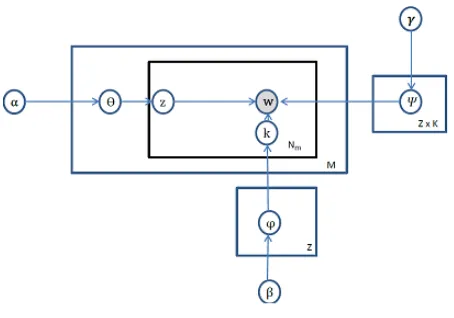
word of theith message. Figure 2 shows graphical representation for our proposed cmk-LDA model. Each circle node in-dicates a random variable and the shaded node indicates w, which is the only observed variable. We introduce new latent variable k, which assigns mulkSet to each word. Assume that there are K mulksets in total. Therefore, language indepen-dent code-mixed topics across the chat collection are given as: Z={z1, z2, z3,..., zk}
Each code-mixed message is thus considered as a mixture of K latent code-mixed topics from the set Z. These topic distributions are modeled by probability scoresP( zk mi) Thus, M is
repre-sented as set Z of latent concepts present in M. We have presented the generative process in Al-gorithm 1.
We performed approximate inference in cmk-LDA model using the block Gibbs sampler as followed typically in LDA. Gibbs sampling con-structs Markov chain over latent variables, by computing the conditional distribution to assign a topic z and the mulkSet k to the word. The condi-tional distribution for sampling posterior is given in Equation 1.
P(zi, kikz−i, k−i, w, α, β, γ)∝ nz,m−i +α
nm−i+zαX
(nk,z) −i+β nk
−i+Kβ X(n
z,k,wi)
−i+γ nz,k−i +W γ
(1)
1.foreachtopic z∈Zdo
Draw mulkSet distribution
ϕ∼Dir(β)
foreachmulkSet k∈ {1, ..., K}do
Draw mulkSet distribution over words
ψz x k∼Dir(γ) end
end
2.foreachcode-mixed message m∈Mdo
Draw topic distributionθm∼Dir(α) foreachcode-mix word
wlm,nwhere language l∈L and L ={ l1, l2, l3,..., ll}and n∈ {1...Nm}do
Draw a topic zm,n∼θm
Draw a k-mulkSetkm,n∼ϕzm,n
Draw a topic wm,n∼ψzm,n,km,n
end end
[image:4.612.314.541.384.543.2]Algorithm 1: cmk-LDA Generative Process
Figure 2: cmk-LDA Plate Notation
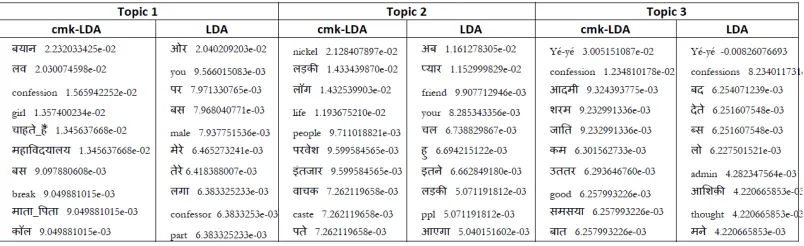
Figure 6 shows the sample clusters generated by cmk-LDA.
4 Implementation Details
We have evaluated the proposed cmk-LDA model and compare it with the two baselines pLSA (Hof-mann, 1999) and LDA(Blei et al., 2003). In our experiments, our proposed cmk-LDA model can deal with words randomly sharing context in ei-ther of the two languages Hindi or English. We compared the models by measuring coherence of aspect clusters. For evaluating semantic coherence of topics we used two evaluation metrics; topic co-herence(UMass) and KL-Divergence to measure topic interpretability and topic distinctiveness re-spectively. We performed experiments on four models based on use of external semantic knowl-edge. The two baselines are addressed as wek-PLSAandwek-LDA where wek indicates models
without external knowledge. We perform testing with different number of topics k and we made sure that we compare topic aspect clusters of the same size.
4.1 Dataset Used
We performed experiments on FIRE 20143(Forum
for IR Evaluation) for shared task on transliter-ated search. This dataset comprises of social media posts in English mixed with six other In-dian languages.The English-Hindi corpora from FIRE 2014 was introduced by (Das and Gamb¨ack, 2014). It consists of 700 messages with the total of 23,967 words which were taken from Facebook chat group for Indian University students. The data contained 63.33% of tokens in Hindi. The overall code-mixing percentage for English-Hindi corpus was as high as 80% due to the frequent slang used in two languages randomly during the chat (Das and Gamb¨ack, 2014).
4.2 Code-mixed data pre-processing
In our proposed cmk-LDA topic model we believe that a topic is semantically coherent if it assigns high probability scores to words that are semanti-cally related irrespective of the language in which they are written. In the pre-processing phase, we used Shallow parser (Sharma et al., 2016) for our purpose to obtain normalized output. (Sharma et al., 2016) experimented on the same code-mixed English-Hindi FIRE 2014 dataset as we did and
[image:5.612.318.564.56.101.2]3http://www.isical.ac.in/ fire/
Table 1: Cohens Kappa for inter-rater agreement
Index 1 2 3 4 5
k 3 6 9 12 15
Precision@k 0.899 0.798 0.876 0.712 0.766
they reported the accuracy on parsing as 74.48% and 75.07% respectively. Basically noise was eliminated by removal of stop-words 4 for Hindi
and English.
4.3 Code-Mixed Message as a Document
Topic models are applied to documents to produce topics from them (Titov and McDonald, 2008). The key step in our method is to determine context and for that we address the code-mixed words co-occurring in same context. Such words with sim-ilar probabilities belong to the same topic and re-jects words that have different probabilities across topics. Therefore, we treat each code-mixed mes-sage independently. Although, relationship be-tween messages is lost, the code-mixed words across the language vocabulary within the code-mix message contribute to the message context. This representation is fair enough as it is suitable to obtain relevant disambiguated sets from Ba-belfy as it resolves context at the message level.
5 Experimental Results
5.1 Measuring Topic Quality by Human Judgement
We followed (Mimno et al., 2011)(Chuang et al., 2013) to evaluate quality of each topic as (good, intermediate, or bad). The topics were annotated as good if they contained more than half of its words that could be grouped together thematically, otherwise bad. Each topic was presented as a list in the steps of 5, 10, 15 and 20 code- mixed aspects generated by cmk-LDA model and sorted in the descending order of probabilities under that topic. For each topic, the judges annotated the topics at word level and then we aggregated their results to annotate the cluster. Table 1 reports the Cohens Kappa score for topic annotation, which is above 0.5, indicating good agreement. We observed a high score at k=3 due to few aspect topics with context highly dispersed resulting in strong agreement on low quality clusters. According to the scale the Kappa score
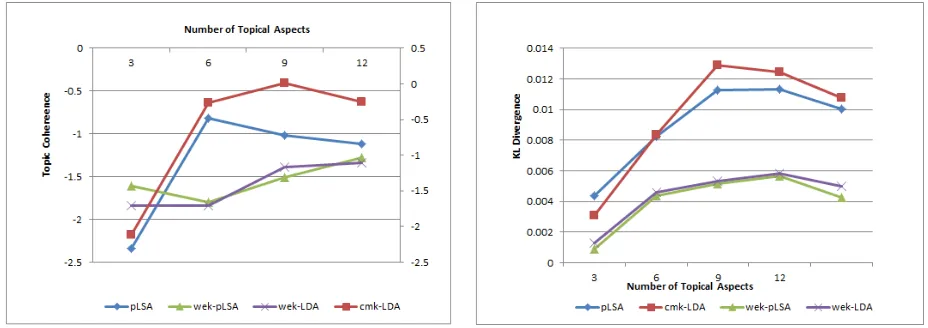
Figure 4: Topic Interpretibility Comparison
increases with more number of topic-based aspect clusters as the topics get semantically stronger. Relatively high agreement at k=9 points to the likely generation of good quality aspect topics.
5.2 Measuring Topic Interpretability
The UMass measure uses a pairwise score func-tion introduced by (Mimno et al., 2011). The score function is not symmetric as it is an increasing function of the empirical probability of common words. Figure 4 shows testing for topic inter-pretability of topic based aspect clusters for com-parison of all models with and without external knowledge. We see from the trend generated by cmk-LDA relative to the other models, generates rise indicating enhancement in coherence of topic distributions. Since most of the topics across lan-guages indicate common context, such high prob-ability topics in a cluster seem to be contributing to high UMass coherence. Both pLSA and cmk-LDA offer better topic interpretibility of clusters. These results confirm that incorporating multilin-gual external semantic knowledge in code-mixed data find higher quality topics offering better in-terpretation.
5.3 Measuring Topic Distinctiveness
[image:6.612.78.542.37.201.2]The Kullback Leibler (KL) divergence measure (Johnson and Sinanovic, 2001) is a standard mea-sure for comparing distributions. We apply sym-metrical version of KL Divergence and average it across the topics. Higher KL divergence score in-dicates that the words across the topics are dis-tinct and are considered to generate higher topic
Figure 5: Topic Distinctivity Comparison
distinctiveness. From the Figure 5, we can see that initially at k=3, cmk-LDA is lower because the context is wide and therefore words are com-mon across the clusters. While KL scores of pLSA model closely follow cmk-LDA, topics at k=9 have generated higher KL score for cmk-LDA. This suggests that though the interpretibility of topics gains is as high in cmk-LDA, the topics are more distinct as well.
6 Conclusion and Future Work
In order to enhance coherence of topic-based as-pects discovered from code -mixed social media data, we proposed a novel unsupervised cmk-LDA topic model which utilizes semantic knowledge from external resources. Such knowledge resolves semantic interpretations across random mix of lan-guages. Our evaluation results show that cmk-LDA outperforms the baselines. We state that our proposed framework supports the utility of lexical and semantic knowledge freely available in exter-nal multilingual resources which can drop the lan-guage barrier and can help discover useful aspects. We have not addressed mixed-script in our ex-periments. In our future experiments we will explore methods to perform term matching and spelling variation modelling the terms across the scripts.
References
David M Blei, Andrew Y Ng, and Michael I Jor-dan. Latent dirichlet allocation. Journal of machine Learning research, 3(Jan):993–1022, 2003.
Jonathan Chang, Sean Gerrish, Chong Wang,
Figure 6: Sample Topics with Probability (Top n probability aspects comprise topics)
dan L Boyd-Graber, and David M Blei. Reading tea leaves: How humans interpret topic models. In
Advances in neural information processing systems, pages 288–296, 2009.
Amitava Das and Bj¨orn Gamb¨ack. Identifying lan-guages at the word level in code-mixed indian social media text. 2014.
Jacob Eisenstein. What to do about bad language on
the internet. InHLT-NAACL, pages 359–369, 2013.
Thomas Hofmann. Probabilistic latent semantic
in-dexing. In Proceedings of the 22nd annual
inter-national ACM SIGIR conference on Research and development in information retrieval, pages 50–57. ACM, 1999.
Wang Ling, Guang Xiang, Chris Dyer, Alan W Black, and Isabel Trancoso. Microblogs as parallel cor-pora. InACL (1), pages 176–186, 2013.
Roberto Navigli and Simone Paolo Ponzetto. Babelnet: The automatic construction, evaluation and applica-tion of a wide-coverage multilingual semantic net-work. Artificial Intelligence, 193:217–250, 2012.
Hong Ka San. Chinese-english code-switching in
blogs by macao young people. Master’s thesis, The
University of Edinburgh, UK, 2009.
Utsab Barman, Amitava Das, Joachim Wagner, and Jennifer Foster. Code mixing: A challenge for lan-guage identification in the lanlan-guage of social media.
EMNLP 2014, 13, 2014.
Anupam Jamatia, Bj¨orn Gamb¨ack, and Amitava Das. Part-of-speech tagging for code-mixed english-hindi
twitter and facebook chat messages. Recent
Ad-vances in Natural Language Processing, Bulgaria, page 239–248, 2015.
Nanyun Peng, Yiming Wang, and Mark Dredze. Learn-ing polylLearn-ingual topic models from code-switched
so-cial media documents. InACL (2), pages 674–679,
2014.
Daniel Ramage, Susan T Dumais, and Daniel J
Liebling. Characterizing microblogs with topic
models.ICWSM, 10:1–1, 2010.
Royal Sequiera, Monojit Choudhury, and Kalika Bali. Pos tagging of hindi-english code mixed text from social media: Some machine learning experiments.
ICON 2015
Kalika Bali Jatin Sharma, Monojit Choudhury, and Yo-garshi Vyas. i am borrowing ya mixing? an analysis
of english-hindi code mixing in facebook. EMNLP
2014, page 116, 2014.
Thamar Solorio and Yang Liu. Part-of-speech tagging for english-spanish code-switched text. In Proceed-ings of the Conference on Empirical Methods in Nat-ural Language Processing, pages 1051–1060. Asso-ciation for Computational Linguistics, 2008. Yogarshi Vyas, Spandana Gella, Jatin Sharma,
Ka-lika Bali, and Monojit Choudhury. Pos tagging of english-hindi code-mixed social media content. In
EMNLP, volume 14, pages 974–979, 2014.
Arnav Sharma, Sakshi Gupta, Raveesh Motlani, Piyush Bansal, Manish Srivastava, Radhika Mamidi, and
Dipti M Sharma. Shallow parsing pipeline for
hindi-english code-mixed social media text. arXiv
preprint arXiv:1604.03136, 2016.
Andrea Moro, Alessandro Raganato, and Roberto Nav-igli. Entity linking meets word sense
disambigua-tion: a unified approach. Transactions of the
As-sociation for Computational Linguistics, 2:231–244, 2014.
Bj¨orn Gamb¨ack, and Amitava Das. Comparing the
Level of Code-Switching in Corpora.LREC, 2016.
Zhiyuan Chen, Arjun Mukherjee, Bing Liu, Meichun Hsu, Malu Castellanos, and Riddhiman Ghosh. Dis-covering coherent topics using general knowledge. InProceedings of the 22nd ACM international con-ference on Information & Knowledge Management, pages 209–218. ACM, 2013.
Jason Chuang, Sonal Gupta, Christopher D Manning, and Jeffrey Heer. Topic model diagnostics: As-sessing domain relevance via topical alignment. In
ICML (3), pages 612–620, 2013.
Don Johnson and Sinan Sinanovic. Symmetrizing the kullback-leibler distance. IEEE Transactions on In-formation Theory, 2001.
George A Miller. Wordnet: a lexical database for
en-glish. Communications of the ACM, 38(11):39–41,
1995.
Pikakshi Manchanda. Entity linking and knowledge
discovery in microblogs. ISWC-DC 2015 The ISWC
2015 Doctoral Consortium, page 25, 2015.
Ivan Titov and Ryan McDonald. Modeling online
re-views with multi-grain topic models. In
Proceed-ings of the 17th international conference on World Wide Web, pages 111–120. ACM, 2008.
David Mimno, Hanna M Wallach, Edmund Talley, Miriam Leenders, and Andrew McCallum.
Opti-mizing semantic coherence in topic models. In
Pro-ceedings of the Conference on Empirical Methods in Natural Language Processing, pages 262–272. As-sociation for Computational Linguistics, 2011.