On Grammaticality in the Syntactic Annotation of Learner Language
Markus Dickinson Indiana University Bloomington, IN USA [email protected]
Marwa Ragheb Indiana University Bloomington, IN USA [email protected]
Abstract
We examine some non-canonical annotation categories that license missing material (el-lipses and enumerations). In extending these categories to learner data, the distinctions seem to require an annotator to determine whether a sentence is grammatical or not when deciding between particular analyses. We un-pack the assumptions surrounding the annota-tion of learner language and how these partic-ular phenomena compare to competing analy-ses, pointing out the implications for annota-tion practice and second language analysis.
1 Introduction and Motivation
The grammatical principles underlying linguistic an-notation are often only implicit. The implicitness and undercommittal to any particular theory can be beneficial, as it: 1) allows multiple users of the notation to utilize it in different ways; 2) frees an-notators to extend existing categories to unforeseen constructions; and 3) treats annotation as indices for others to derive theories from. Without necessarily having to be a theoretically-driven corpus (Oepen et al., 2004), there are cases, however, where a gram-matical model for annotation may need to be made more explicit and the annotation categories more precise. For non-canonical data (e.g., historical, sec-ond language, and internet data), a thorough defi-nition of language categories should lead to a con-sistent application throughout a corpus. As one ex-ample, knowing whether a hashtag denotes a syn-tactic unit (e.g.,Got #college admissions questions ?) is important for obtaining a syntactic tree for
Twitter data (Kong et al., 2014). Even for canonical data, annotation categories are not truly meaningful without some specification or guidelines (Rambow, 2010). We here explore non-canonical categories
fornon-canonical data, specifically categories that
license “missing” material (ellipsis, enumeration) in the context of second language learner data, and we demonstrate that one needs to make clear to what extent the categories in the grammar underlying the annotation extend to novel constructions.
To gauge the impact on second language data of categories designed to cover more “peripheral” phe-nomena involving missing material requires inves-tigating, first, how these categories apply in gen-eral, and, secondly, how they extend to learner data and how they compare to competing, learner-specific analyses. We refer to categories which li-cense missing (or additional) semantic material as
non-canonical categories. Applying such categories
to learner data makes us question to what degree we need to know whether a sentence is grammatical— where grammatical refers to being licensed by the grammar underlying the annotation.
Focusing on the data of second language learn-ers and the annotation of syntactic dependencies, the question of grammaticality is compounded, not just by novel constructions, but by various research prac-tices. First, there is a long literature in second lan-guage acquisition (SLA) as to the nature of a second language grammar (interlanguage) (Selinker, 1972; Adjemian, 1976; Ellis, 1985; Lakshmanan and Selinker, 2001). Secondly, and sometimes compet-ingly, there are many schemes for annotating learner errors in corpora (D´ıaz-Negrillo and
Dom´ınguez, 2006; Granger, 2003; Nicholls, 2003; L¨udeling et al., 2005), where direct or indirect ref-erence is made to target (i.e., native) grammars in the annotation of corrections. Part of the tension be-tween these approaches is to what extent the gram-matical categories used for native language are ap-plicable to learner data.
Thus, non-canonical categories are worth in-vestigating not just to improve corpus annota-tion, but also to provide insight into these tradi-tions. In particular, there has been much discussion in SLA regarding the comparative fallacy (Bley-Vroman, 1983; Lakshmanan and Selinker, 2001; Tenfjord et al., 2006), wherein learner language is (over)compared to the target language, and the de-gree to which such comparison affects the conclu-sions drawn. The grammatical annotation of learner language is in some sense ideal for providing in-sight, as it provides a systematic characterization of everything in the data and thus allows one to assess the degree of over-comparison (Ragheb, 2014).
In section 2 we discuss the aims of linguistic an-notation for learner data, which leads directly to a unpacking of the grammaticality assumed in such annotation in section 3—examining both the source of the grammar and the way innovative learner ex-amples do or do not fit within the categories given by that grammar. After setting this stage, we turn to our two main areas of phenomena: 1) ellipsis and miss-ing heads (section 4); and 2) coordination, enumer-ation, and missing conjunctions (section 5). After seeing the issues involved in these categories and in the decision procedure for annotation (section 6)— at least for one annotation scheme—we conclude in section 7 that the main options for annotation are: 1) apply the native categories even to learner inno-vations; 2) develop tighter restrictions on the native categories; and/or 3) reference sentence-level gram-maticality in the definitions of categories.
This paper will likely raise more questions than it provides answers, as “answers” are ultimately going to be specific to one’s particular goals and project. However, we believe the questions are crucial to an-notating learner language: indeed, our own motiva-tion for raising these quesmotiva-tions stems from syntac-tically annotating our own learner corpus (Ragheb, 2014; Ragheb and Dickinson, 2014; Dickinson and Ragheb, 2013) and realizing we needed clarification
of certain categories, in particular those dealing with missing elements.
We examine phenomena surrounding ellipsis and enumeration because they are the main ones in our annotation scheme that license missing material, and missing material is important to investigate in the context of learner language, as learners often omit structures, e.g., determiners (see (Ragheb, 2014), ch. 7, and references therein). One other category could potentially be confused with categories licensing missing material, namely serial verb (SRL), which licenses a sequence of two verbs without a connector (similar to enumeration). Income hang with us, for example,hangis a SRL dependent ofcome. We ig-nore this category because: a) it is restricted tocome
andgo; b) what we say about distinguishing coor-dination from enumeration (section 5) can more or less be applied to SRL; and c) we have not noticed it specifically causing confusion.
2 Linguistic Annotation for Learner Data
As argued in (Ragheb and Dickinson, 2011), one way to approach the annotation of learner corpora is by annotating linguistic properties. A starting assumption is that the categories used for learner language are similar enough to those for native language to use native categories. However, one quickly finds that linguistic categories for native speaker data are inadequate to represent the full range of learner productions (D´ıaz-Negrillo et al., 2010). For example, in (1),1 the word he cannot
simply be marked as a nominative or accusative pro-noun because in some sense it is both. Thus, one may want to annotate multiple layers, in this case one POS layer for morphological evidence and one for syntactic distributional evidence (i.e., position).
(1) I must play withhe.
While errors (i.e., ungrammaticalities) can be de-rived from mismatches between annotation layers, they are not primary entities. The multi-layer lin-guistic annotation is primarily based on linlin-guistic evidence, not a sentence’s correctness.
There are two main wrinkles to separating lin-guistic annotation from error annotation, however:
1Example sentences in this paper come from the SALLE
1) annotation categories could employ a notion of grammatical correctness to define; and 2) the deci-sion process for ambiguous cases could reference a sentence’s correctness. In the former case, the is-sue often has to do with using categories that are not always clearly defined for native data, while in the latter case, the issue is in having categories which—even if well-defined on different annota-tion layers—are insufficient to handle the usage the learner presents. In the next few sections we discuss issues surrounding non-canonical annotation cate-gories and discuss the effect of the decision proce-dure in section 6.
To make the issues concrete, we rely on the syntactic annotation of the SALLE (Syntactically Annotating Learner Language of English) project (Ragheb, 2014; Ragheb and Dickinson, 2014), which employs multi-layer annotation. The is-sues are not specific to this annotation, but it illus-trates the difficulties in applying native categories to learner data. That is, the SALLE annotation scheme (Dickinson and Ragheb, 2013) helps define ques-tions of what constitutes appropriate linguistic an-notation for interlanguage.2
3 Grammatical Annotation
When annotating learner data, it is important to know what is meant bygrammatical. For error an-notation, for example, this defines what an error is; e.g., in Korean, a missing postpositional parti-cle may be an error or not depending on the level of formality underpinning grammaticality (Lee et al., 2012). The SALLE framework assumes a grammar based on the target language as an underpinning to the annotation (section 3.1), but, in the face of inno-vative learner usage, has focused on annotating the language as it appears and not on whether each sen-tence deviates from that grammar, i.e., is ungram-matical or not (section 3.2).
3.1 Target language grammar
To see the need to make clear the source of gram-maticality, consider morphological POS annotation (section 2). In a verbal sequence likecan promotes, for example, promotes intuitively has the morpho-logical evidence of a third person singular verb. But
2Guidelines at:http://cl.indiana.edu/˜salle/
to reference these morphological properties requires some notion of how these properties are defined, e.g., how-sstands for third person singular.
One obvious source of information is that “third person singular” comes from the definition of the-s
morpheme in English. To annotate this way means referencing grammatical concepts from the target language (L2). If a different grammar is chosen to define categories, such as the learner’s first language (L1), one might posit, e.g., -et as an indicator of “third person singular” (cf. Russian). In (Ragheb and Dickinson, 2012), we argue for using the L2 as the source of the grammar, as learners share many aspects of development in the L2 (Ellis, 2008) and as this can ensure annotation reliability.
3.2 Emerging categories
Annotation deals with the way facts from the gram-mar interact with phenomena occuring within a sen-tence. Consider objects, for example: a constellation of properties allows one to specify that two differ-ent sdiffer-entences both contain them. Objects can be de-fined as: a) occurring, roughly speaking, after a verb (syntactic distribution); b) fitting into the argu-ment structure of a verb, typically as a patient/theme (semantic distribution); and c) taking accusative case, as appropriate, e.g.,him(morphological dis-tribution). The class of objects emerges from these same patterns occurring across sentences within, in this case, English, and the task of annotation is to see whether a new instance fits into this class.
A distinction between categories—e.g., subjects and objects—arises from them having different sets of (typical) properties. With learner phenomena, there appear to benewkinds of emergent categories, ones which may overlap with previously-defined categories. When this happens, one has to specify which of the two categories a particular language in-stance falls into, and one way may be to say, “Cat-egory X is grammatical/native-like; cat“Cat-egory Y is not.” It such cases we cover in the next two sections. Before examining non-canonical categories, though, consider objects as they relate to the the usage of, for instance, onein (2). Doesonefit the (target) category of object (OBJ), some other target category, or something else entirely?
can go to a typical American city .
One possible approach (Reznicek et al., 2013; Re-hbein et al., 2012) is to say: 1) the usage ofoneis non-native; 2) a native-like target isI dreamed that
one day I could go ...; and 3) the grammatical
anno-tation ofonecan thus be based upon this target form (e.g., as a type of temporal adjunct ofcan go).
The approach used in SALLE, by contrast, as-sumes that, after splitting out the lingusitic evidence into different layers (section 2), many learner inno-vations should be able to fit into an existing target category. In this case, themorphosyntactic depen-dencyannotation layer ignores the semantic defini-tion of OBJ and focuses on the fact thatoneoccurs as a post-verbal nominal and is consistent with be-ing accusative case. Thus, it can be annotated as conveying the evidence of the target category OBJ.
The point here is that this style of annotation em-ploys definitions from a target grammar, in lieu of creating learner-specific categories or creating tar-get forms that make clear a discrepancy between non-native and native categories, i.e., which deem a sentence ungrammatical. For canonical categories, individual learner instances can be difficult to cate-gorize, but the categories themselves are, generally speaking, relatively well-defined.
4 Ellipsis and Missing Heads 4.1 Ellipsis
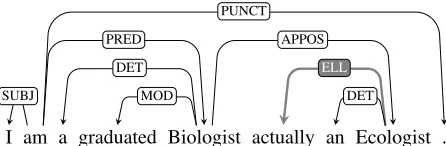
Ellipsis concerns omitted material in a sentence. In SALLE, an ELL label marks the relation between two categories that normally would not have a rela-tion, but nonetheless do because of missing material. This ELL label collapses several elliptical relations in the CHILDES project (MacWhinney, 2000) (sec. 12.2), where pairs of labels denote the chain of de-pendencies that, in a sense, should be present be-tween the two words (e.g., DET-OBJ). ELL is used when no other relation is possible and the dependent relation is not possible to specify locally, i.e., with-out crossing branches. An example is given in (3).
(3) I am a graduatedBiologistactually an Ecol-ogist.
Here, Ecologist restates Biologist as an apposi-tive; the adverbactually, however, is a verbal modi-fier. To indicate an elliptical structure (cf.actually[I
am]an Ecologist),actuallyis annotated as an ELL
dependent of Ecologist, as in figure 1. The word missing its head takes the ELL label (actually) and attaches to the head of the construction (Ecologist).3
I am a graduated Biologist actually an Ecologist .
SUBJ
DET MOD PRED
ELL
[image:4.612.316.539.121.194.2]DET APPOS PUNCT
Figure 1: Appositive with an elliptical modifier
4.2 Missing heads
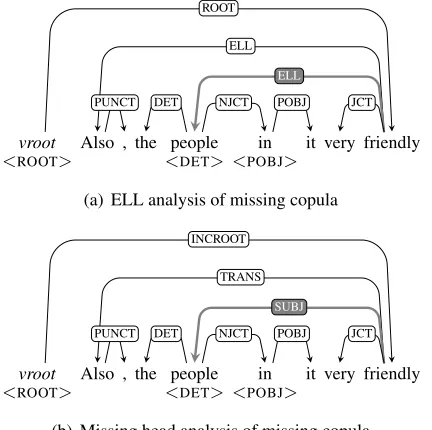
There are other cases of missing heads which are more clearly ungrammatical. One common case for learners concerns the omission of a finite verb in a sentence, as in (4). An analysis which continues the usage of the ELL label would annotate it as in fig-ure 2(a), where the label mitigates the relation be-tweenpeople(what would be the subject ifarewere present) andfriendly(what would be the predicate). Also shown here is asubcategorizationlayer, indi-cating which arguments each word is selecting for.
(4) Also , the people in it very friendly .
There is something satisfying and dissatisfying about the analysis. On the one hand, it stays in line with the annotation scheme by not marking anything peculiar. On the other hand, it poses two problems: 1) given the general side effect of mismatches be-tween annotation layers when something is ungram-matical, one expects there to be a mismatch here, yet there is not; and 2) given the goal to annotate based on the evidence at hand, one would hope to provide a more informative label than ELL when possible. For example,peopleis a SUBJ offriendly, at least in some semantic sense.
Unlike the cases of ellipsis in section 4.1, there is no head recoverable from the context; i.e., unlike in (3) whereamis present but just non-local, we do not haveareanywhere in the context. The evidence
3Note that the ELL label only concerns missing heads,
vroot Also , the people in it very friendly <ROOT> <DET> <POBJ>
ELL
PUNCT DET
ELL
NJCT POBJ JCT ROOT
(a) ELL analysis of missing copula
vroot Also , the people in it very friendly <ROOT> <DET> <POBJ>
TRANS
PUNCT DET
SUBJ
NJCT POBJ JCT INCROOT
[image:5.612.80.296.55.270.2](b) Missing head analysis of missing copula
Figure 2: Example of a missing copula
for this particular case is thus qualitatively different than in the more traditional elliptical cases—and so one may want to treat such cases differently.
There is additional reason for a separate missing head analysis: for some sentences, it is almost un-avoidable to posit a missing head. Consider (5), where a purpose clause lacks the infinitive marker
to. The constructionin order to is more of a fixed form, and it is clear that a particular function word is missing. While ellipsis is governed by some princi-ples (syntactic or otherwise) (e.g., (Sag, 1976; Gold-berg, 2005; Culicover and Jackendoff, 2005)), learn-ers can freely omit heads (and dependents) of vari-ous kinds—content or function words, fixed forms or open-ended constructions, etc.—and learner lan-guage annotation thus seems to need a separate treat-ment of missing heads.
(5) . . . I need more natural and friendly place to live with my wifein order understandeach values and natures . . .
The treatment of (4) in SALLE is shown in fig-ure 2(b). Here,peopleis the SUBJ offriendly; un-like ELL, SUBJ is an argument label, meaning it should be subcategorized for, but here it is not (indi-cated by having no<SUBJ>). Thus, there is a mis-match in annotation, and an informative, evidence-based label (SUBJ) being used. However, the
sen-tence is treated differently than some other cases with missing heads, namely ones deemed elliptical.
4.3 Ellipsis vs. missing head
The details of each particular analysis are less im-portant than noting the decision to make: should el-lipsis annotation extend to non-native missing head constructions? There is evidence suggesting that at least some types of these cases are different (e.g., non-local presence/absence of the locally missing head) and thus the ellipsis category may no longer apply.4 Additionally, there is an open question as
to whether one wishes to refer to elliptical construc-tions as grammatical and missing heads as ungram-matical in determining the distinction.
5 Coordination and Enumeration
Coordination and enumeration feature a similar di-chotomy, potentially dependent upon a sentence’s grammaticality when no conjunction is present.
5.1 Coordination
Coordination in SALLE is right-branching. In fig-ure 3, for example, knowledgeserves as the prepo-sitional object (POBJ); and is the CCC dependent
ofknowledge; andpersonality is the final
coordina-tion (COORD) element. An MCOORD (modifica-tory coordination) label is used between non-final elements in coordinations of three or more elements. COORD is an argument label and is thus subcatego-rized for (<COORD>), whereas MCOORD is not.5
on my knowledge and my personality <POBJ> <DET> <COORD> <DET>
POBJ
DET CCC COORD DET
Figure 3: Treatment of basic coordination
4There are various other distinctions between figure 2(a) and
figure 2(b), owing to other annotation scheme criteria, which we do not delve into here, i.e., ROOT vs. INCROOT, ELL vs. TRANS. See (Dickinson and Ragheb, 2013) for details.
5The right-branching analysis handles interactions with
[image:5.612.316.538.504.560.2]5.2 Enumeration
SALLE also includes an enumeration label for lists of things. In line with coordination, they are treated as right-branching, with an ENUM label, as illus-trated in figure 4. ENUM is not an argument label and thus does not need to be subcategorized for.
one two three four
[image:6.612.135.238.148.186.2]ENUM ENUM ENUM
Figure 4: Treatment of an enumerated list (constructed)
This distinction is borrowed from the CHILDES annotation scheme (MacWhinney, 2000; Sagae et al., 2010), but the exact defintion of enumeration is difficult to pin down. Its prototypical properties in-clude not needing a conjunction and often implying a continuation. Otherwise, the semantics are simi-lar to coordination: multiple items are functioning in a parallel fashion. Further, some coordinations in some languages allow for no conjunction (Mithun, 1988), and enumeration might be considered a form of degenerate coordination (W¨alchli, 2005).
5.3 Missing conjunction
The question of determining what enumeration refers to has a strong bearing on learner language, where there are constructions which could be ei-ther characterized as enumerations or as coordina-tions without a conjunction. Consider (6), with two separate sequences to consider. Focusing on the se-quence ofises, there may be something amiss in be-ing able to link them without a conjunction (in addi-tion to the anomalous connecaddi-tion between the noun
Santiagoand the following three adjectives).
(6) I am Chilean , my hometown is Santiago , is beautiful , is big , is nice .
A partial dependency tree for the missing con-junction analysis in SALLE is given in figure 5. The analysis here is to use a COORD relation that is not subcategorized for as the final dependency, thus cre-ating a mismatch indiccre-ating ungrammaticality.
It is hard to pinpoint exactly when a missing con-junction analysis should be utilized, and in this case part of the motivation has to do with capturing a formal written register of English. Additionally,
garden-variety run-on sentences could be analyzed as missing conjunctions—as the connection between the main clauses in (6) could be. Furthermore, there are sentences where the units being combined are non-parallel, as in the link between readings and
swim and runningin (7), again opening the door for
a possible missing conjunction analysis.
(7) Besides , I like swim and running , readings It should be noted that there is also an option of treating the construction as involving two distinct el-ements with the same function; for example, inmy
these tasks,taskscould have two separate
determin-ers. This option can complicate annotation, but does not change the question of how to separate coordi-nation from enumeration, and so we set it aside here.
5.4 Enumeration vs. missing conjunction
Again, the pertinent question is: should enumeration annotation extend to non-native missing conjunc-tions? As pointed out, there is some evidence sug-gesting that they are different constructions, and as with missing heads and ellipses (section 4.3), miss-ing conjunction coordinations can thus be defined as not being enumerations. For example, to be an enu-meration might mean that no conjunction is required by the context and can be indicated with evidence such as anetc, as in (8).
(8) and i sing in church , street , station etc . Again, an open question is whether one wishes to explicitly reference grammaticality (see, e.g., (Dick-inson and Ragheb, 2013), p. 71). Note that such questions could arise for native language annotation, but the greater variability in learner forms exacer-bates the problem: a string of items in sequence does not now necessarily mean it is an enumerated list.
6 Annotation Decision Procedure
my hometown is Santiago , is beautiful , is big , is nice <DET> <SUBJ,PRED> <SUBJ,PRED> <SUBJ,PRED> <SUBJ,PRED>
DET SUBJ PRED
PUNCT MCOORD
PRED PUNCT
MCOORD
PRED PUNCT
COORD
[image:7.612.79.551.54.125.2]PRED
Figure 5: Missing conjunction (secondary SUBJs not shown)
and a small number of annotators, the SALLE project focuses on this last point. The annotation scheme is in some sense independent of the decision procedure involved in assigning the annotation—but the procedure itself could employ a notion of grammaticality in choosing a best analysis.
As mentioned in section 2, the issue here is in hav-ing L2 categories that are too specific to handle the usage the learner presents, i.e., no categories fit the usage. For example, in (9), the usage ofwhatis not really a (question) determiner (DDQ) and the form is not that of a (subordinating) conjunction (CST).
(9) So when I admit to korea university , I de-cidewhati find my own way .
There are a number of possible analyses for han-dlingwhat i find my own way, including:
1. whatas an extraneous word with no clear func-tion and with a missing auxiliary (e.g.,would); 2. whatas a type of infinitival marker, withias an
extraneous word; or
3. what as a complementizer, albeit lexically anomalous, with the clause as valid (if odd). A main SALLE heuristic is to “give the learner the benefit of the doubt.” This heuristic favors analyses with fewer mismatches, i.e., discrepancies between different annotation layers, when no other evidence can distinguish the analyses. In this case, the third analysis is chosen because the lexical anomaly is the only indication of a learner-specific innovation.
Giving the learner the benefit of the doubt stems from treating the learner’s language as a system in its own right (section 7.2) and does reduce the ambigu-ity for annotation. However, to give the benefit of the doubt—in lieu of other evidence—means annotators are arguably aware of how good or bad a sentence is, as they use a lack of errors as a guide. This is
still qualitatively different than using explicit target hypotheses—as it is in terms of categories—but the degree to which this procedure references sentence correctness is a question that deserves closer inves-tigation in the future. As mentioned, alternatives are to include more trees or more meta-information to disambiguate, each of which has its own costs.
7 Implications
We have seen non-canonical categories that license missing material (ellipses and enumerations), dis-tinctions which could involve an annotator determin-ing whether a sentence is grammatical when decid-ing between analyses. The decision procedure to obtain a single annotation may also reference gram-maticality. The investigation in this paper and one’s particular choices in practice have implications for both annotation practice (section 7.1) and second language analysis (section 7.2).
7.1 Impact on annotation
There are several takeaway points here for annota-tion of native or native data. First, these non-canonical categories seem to require one to consider to what extent annotation labels are merely indices and to what extent they reflect some grammatical properties worth capturing; that is, is there truly a grammar underlying the annotation? One must also consider the effect of annotation heuristics on the definitions in the grammar.
Secondly, when faced with non-canonical data and potentially a new set of competing analyses, one must choose how to apply the non-canonical cate-gories. The main options seem to be the following:
ellipsis category may license nearly any con-nection between two words.
2. Develop tighter restrictions on the native cat-egories, so that differences in native and non-native instances emerge naturally. For example, ellipsis might be licensed only when the elided words can be literally recovered from the pre-vious context. It should be noted that, in the general case, this option may only be available for data with enough meta-data to consistently distinguish the categories.
3. Reference sentence-level grammaticality in the definitions of categories. In essence, solution #3 is a subtype of solution #2, where the tighter restriction references grammaticality.
We have shied away from #1 because: a) it al-lows for too many possible analyses, and b) it treats the learner innovations exactly on a par with con-structions that seem different. But note that this op-tion seems to be consistent with the annotaop-tion prac-tice of extending grammatical categories to new con-structions (cf. (Pustejovsky and Stubbs, 2013), ch. 4)), while options #2 and #3 seem to be more in line with treating the underlying grammar as generative, i.e., as defining the set of allowable sentences in a language (cf. work back to (Chomsky, 1965)).
In this light, option #3 could have an unusual in-terpretation: as we understand it, to say that a miss-ing head is not ellipsisbecause it is ungrammatical
is to say that it is not in the target grammar (as el-lipsis) because it is not in the grammar. Defining a category in terms of grammaticality may thus be a useful diagnostic for annotation practice, but further work should tease apart how principled this is. In general, being able to properly define a target cate-gory so that cases clearly do or do not fit (cf. sec-tions 4.3 and 5.4), i.e., continuing to be evidence-based, seems to be worth pursuing. Option #3 also impacts acquisition research, a point we turn to next.
7.2 Impact on the comparative fallacy
The comparative fallacy in SLA is the notion that a researcher may be over-comparing a learner’s language to the L2, and in that way treating the inter-language as a corrupt form of the L2 (Bley-Vroman, 1983). (Ragheb and Dickinson, 2011) argue that linguistic annotation avoids the comparative fallacy
in a way that error annotation doesn’t, but relying on sentence-level grammaticality judgments would make that picture more muddled.
Without delving too deeply into the issue here (including how much one should want to avoid the comparative fallacy), our discussion of non-canonical categories implies that, at least for anno-tation, the comparative fallacy is not a simple bi-nary distinction. Stemming from section 3, there is a distinction between analyzing target forms and target categories to consider in discussions of com-parison, as well as a question of analyzing emerging constructions by making some reference to the cor-rectness of a sentence, irrespective of a specific tar-get. Non-canonical categories such as ellipsis seem to force an investigation into these issues; perhaps not coincidentally, these structures have often been relegated to peripheral phenomena in the theoretical literature (Culicover and Jackendoff, 2005).
8 Outlook
By applying categories appropriate for native lan-guage to learner lanlan-guage, we have discovered non-canonical categories that are difficult to apply. Fur-ther annotation for English and oFur-ther languages will likely reveal other nuances, perhaps for distinctions generally difficult for dependency grammar, e.g., relative clauses. An immediate next step is to study categories which license extra arguments, such as topics and appositives.
Learner-specific annotation, such as underspeci-fied categories, may also prove to impact how one sees non-canonical data. In that light, we have only scratched the surface of the implications for second language research, and we have not begun to examine other kinds of non-canonical data (e.g., dialectal). Additionally, one would like to know which categories are indeed useful for acquisition research, and studies utilizing this and other anno-tation schemes should shed light on this question (Ragheb, 2014; Alexopoulou et al., to appear).
Acknowledgments
References
Christian Adjemian. 1976. On the nature of interlan-guage systems. Language Learning, 26(2):297–320. Theodora Alexopoulou, Jeroen Geertzen, Anna
Korho-nen, and Detmar Meurers. to appear. Exploring large educational learner corpora for sla research: perspec-tives on relative clauses. International Journal of
Learner Corpus Research, 1(1):96–129.
Robert Bley-Vroman. 1983. The comparative fallacy in interlanguage studies: The case of systematicity. Lan-guage Learning, 33(1):1–17.
Noam Chomsky. 1965. Aspects of the Theory of Syntax. MIT Press, Cambrdige, MA.
Peter W. Culicover and Ray Jackendoff. 2005. Simpler Syntax. Oxford University Press, Oxford.
Ana D´ıaz-Negrillo and Jes´us Fern´andez-Dom´ınguez. 2006. Error tagging systems for learner corpora.
RESLA, 19:83–102.
Ana D´ıaz-Negrillo, Detmar Meurers, Salvador Valera, and Holger Wunsch. 2010. Towards interlanguage POS annotation for effective learner corpora in SLA and FLT. Language Forum, 36(1–2):139–154. Spe-cial Issue on New Trends in Language Teaching. Markus Dickinson and Marwa Ragheb. 2011.
Depen-dency annotation of coordination for learner language. InProceedings of the International Conference on
De-pendency Linguistics (Depling 2011), pages 135–144,
Barcelona, Spain.
Markus Dickinson and Marwa Ragheb. 2013. Anno-tation for learner English guidelines, v. 0.1. Techni-cal report, Indiana University, Bloomington, IN, June. June 9, 2013.
Rod Ellis. 1985. Sources of variability in interlanguage. Applied Linguistics, 6(2):118–131.
Rod Ellis. 2008. The Study of Second Language Acquisi-tion. Oxford University Press, Oxford, second edition. Lotus Goldberg. 2005. Verb-Stranding VP Ellipsis: A Cross-Linguistic Study. Ph.D. thesis, McGill Univer-sity.
Sylviane Granger. 2003. Error-tagged learner corpora and CALL: A promising synergy. CALICO Journal, 20(3):465–480.
Lingpeng Kong, Nathan Schneider, Swabha Swayamdipta, Archna Bhatia, Chris Dyer, and Noah A. Smith. 2014. A dependency parser for tweets. In Proceedings of the 2014 Conference on Empirical Methods in Natural Language Processing
(EMNLP), pages 1001–1012, Doha, Qatar, October.
Association for Computational Linguistics.
Usha Lakshmanan and Larry Selinker. 2001. Analysing interlanguage: how do we know what learners know?
Second Language Research, 17(4):393–420.
Sun-Hee Lee, Markus Dickinson, and Ross Israel. 2012. Developing learner corpus annotation for Korean par-ticle errors. In Proceedings of the Sixth Linguistic
Annotation Workshop, LAW VI ’12, pages 129–133,
Stroudsburg, PA, USA. Association for Computational Linguistics.
Anke L¨udeling, Maik Walter, Emil Kroymann, and Peter Adolphs. 2005. Multi-level error annotation in learner corpora. InProceedings of Corpus Linguistics 2005, Birmingham.
Brian MacWhinney. 2000. The CHILDES Project:
Tools for Analyzing Talk. Lawrence Erlbaum
As-sociates, Mahwah, NJ, 3rd edition. Electronic Edition, updated April 25, 2012, Part 2: the CLAN Programs: http://childes.psy.cmu.
edu/manuals/CLAN.pdf.
Marianne Mithun. 1988. The grammaticization of co-ordination. In John Haiman and Sandra A. Thomp-son, editors,Clause Combining in Grammar and Dis-course, volume 18 ofTypological Studies in Language, pages 331–359. John Benjamins.
Diane Nicholls. 2003. The cambridge learner corpus -error coding and analysis for lexicography and ELT. In Dawn Archer, Paul Rayson, Andrew Wilson, and Tony McEnery, editors,Proceedings of the Corpus Linguis-tics 2003 Conference, volume 16, pages 572–581, Uni-versity Centre for Computer Corpus Research on Lan-guage, Technical Papers. Lancaster University. Stephan Oepen, Dan Flickinger, Kristina Toutanova, and
Christoper D. Manning. 2004. Lingo redwoods: A rich and dynamic treebank for hpsg.Research on
Lan-guage and Computation, 2(4):575–596.
Niels Ott, Ramon Ziai, and Detmar Meurers. 2012. Cre-ation and analysis of a reading comprehension exercise corpus: Towards evaluating meaning in context. In Thomas Schmidt and Kai Wrner, editors,Multilingual
Corpora and Multilingual Corpus Analysis, Hamburg
Studies in Multilingualism (HSM), pages 47–69. Ben-jamins, Amsterdam.
James Pustejovsky and Amber Stubbs. 2013. Natural
Language Annotation for Machine Learning. O’Reilly
Media, Inc., Sebastopol, CA.
Marwa Ragheb and Markus Dickinson. 2011. Avoid-ing the comparative fallacy in the annotation of learner corpora. InSelected Proceedings of the 2010 Second Language Research Forum: Reconsidering SLA
Re-search, Dimensions, and Directions, pages 114–124,
Somerville, MA. Cascadilla Proceedings Project. Marwa Ragheb and Markus Dickinson. 2012. Defining
Marwa Ragheb and Markus Dickinson. 2014. Devel-oping a corpus of syntactically-annotated learner lan-guage for English. InProceedings of the 13th Interna-tional Workshop on Treebanks and Linguistic Theories (TLT13), Poster Session, T¨ubingen, Germany. Marwa Ragheb. 2014. Building a
Syntactically-Annotated Corpus of Learner English. Ph.D. thesis,
Indiana University, Bloomington, IN, August. Owen Rambow. 2010. The simple truth about
depen-dency and phrase structure representations: An opin-ion piece. In Human Language Technologies: The 2010 Annual Conference of the North American Chap-ter of the Association for Computational Linguistics, pages 337–340, Los Angeles, CA, June.
Ines Rehbein, Hagen Hirschmann, Anke L¨udeling, and Marc Reznicek. 2012. Better tags give better trees -or do they? Linguistic Issues in Language Technology (LiLT), 7(10).
Marc Reznicek, Anke L¨udeling, Cedric Krummes, Franziska Schwantuschke, Maik Walter, Karin Schmidt, Hagen Hirschmann, and Torsten Andreas, 2012. Das Falko-Handbuch. Korpusaufbau und
Annotationen Version 2.01. Humboldt-Universit¨at zu
Berlin, Berlin.
Mark Reznicek, Anke L¨udeling, and Hagen Hirschmann. 2013. Competing target hypotheses in the Falko cor-pus: A flexible multi-layer corpus architecture. In Ana D´ıaz-Negrillo, Nicolas Ballier, and Paul Thompson, editors,Automatic Treatment and Analysis of Learner
Corpus Data, pages 101–123. John Benjamins,
Ams-terdam.
Ivan A. Sag. 1976. Deletion and logical form. Ph.D. thesis, Massachusetts Institute of Technology.
Kenji Sagae, Eric Davis, Alon Lavie, and Brian MacWhinney an Shuly Wintner. 2010. Morphosyntactic annotation of CHILDES transcripts.
Journal of Child Language, 37(3):705–729.
Larry Selinker. 1972. Interlanguage. International Re-view of Applied Linguistics, 10(3):209–231.
Kari Tenfjord, Jon Erik Hagen, and Hilde Johansen. 2006. The hows and whys of coding categories in a learner corpus (or “how and why an error-tagged learner corpus is not ipso facto one big comparative fallacy. Rivista di psicolinguistica applicata, 6(3):93– 108.
Bernhard W¨alchli. 2005. Co-Compounds and Natural
Coordination. Oxford Studies in Typology and