Studies on Automatic Recognition of Common Chinese Adverb’s
Usages Based on Statistical Methods
Hongying Zan
College of
Informa-tion Engineering,
Zhengzhou
Univer-sity
[email protected]
Junhui Zhang
College of
Infor-mation
Engineer-ing, Zhengzhou
University
zhangj.zzu@gmail
.com
Xuefeng Zhu
Key Laboratory of
Computational
Lin-guistics(Peking
University) of
China Ministry
Education
[email protected]
Shiwen Yu
Key Laboratory of
Computational
Lin-guistics(Peking
University) of
China Ministry
Education
[email protected]
Abstract
The study on Automatic Recognizing usages of Modern Chinese Adverbs is one of the important parts of the NLP-oriented research of Chinese Functional words Knowledge Base. To solve the problems of the existing rule-based method of adverbs’ usages recognition based on the previous work, this paper has studied auto-matically recognizing common Chi-nese adverbs’ usages using statistical methods. Three statistical models, viz. CRF, ME, and SVM, are used to la-bel several common Chinese ad-verbs’ usages on the segmentation and part-of-speech tagged corpus of People’s Daily(Jan 1998). The ex-periment results show that statistical-based method is effective in auto-matically recognizing of several common adverbs’ usages and has good application prospects.
1
Introduction
Chinese vocabulary can be divided into func-tional words and nofunc-tional words. In the field of Natural Language Processing(NLP), many studies on text computing or word meaning understanding are focused on the notional words, rarely involving functional words. Especially in some common NLP application fields, such as text summarization, text clas-sification, information retrieval, and so on, the researchers mainly take notional words as features, and list some functional word as stop words without considering their influ-ence on text meaning. This will impact the
deep analysis of text semantic, especailly for chinese, and become the bottleneck of ma-chine understanding on text content, and im-pede further improving the performance of application systems. Due to Chinese lacking morphological changes(Li X., 2005), Chi-nese functional words undertake the gram-matical functions and gramgram-matical meanings, and in other language these functions are mainly undertaken by morphological changes. So, functional words play an more important role in Chinese semantic under-standing and grammatical analysis. The study on functional words of modern Chi-nese semantic in ChiChi-nese text processing and understanding has great significance.
2
Related Researches
The work of automatically recognizing us-ages of adverbs of modern Chinese is part of the NLP-oriented research of Modern Chi-nese Functional Words Knowledge Base. Yu et al. proposed the idea of building the “Trin-ity” knowledge-base of generalized func-tional words(Yu, S., 2004), and defined the generalized functional words as adverbs, conjunctions, prepositions, modal particles, auxiliary, and localizer words(Yu, S., 2004)(Liu, Y., 2004). Zan et al. described adverb’s usages using formal rules(Zan, H., 2007a), and initially built the machine-oriented modern Chinese adverb dictionary and the usage rule base(Zan, H., 2007b),. Hao et al. imported the dictionary and rule base(Hao, L., 2007). Based on the previous work, Liu et al. realized an automatically rule-based recognizing system and got preci-sion at 74.89%(Liu, R., 2008).
The rule-based method has the advantage of simple, intuitive, strong pertinence, etc, but it also has the shortcomings of lower coverage, and it is difficult to be further op-timized or generalized. For example, there are some adverbs which different usages are difficult to describe using formal rules, such as:
(1)想睡觉尽管睡,反正是星期天。 [(1)It is Sunday, you can sleep in at will.]
(2)她们俩听报告时尽管说话,报告的内容 根本没听见。
[(2)They were always talking while lis-tensing report, so they catched nothing of the report content.]
In the adverb usage dictionary, the adverb “jinguan/尽管” has two meanings: <d_jin3guan3_1> and <d_jin3guan3_2>. The meaning of “jinguan/尽管” in sentence (1) is belong to <d_jin3guan3_1>, it means the action or behavior can be without any limitations; the meaning of “jinguan/尽管” in sentence (2) is belong to <d_jin3guan3_2>, it means the action or behavior is continu-ously. This two meanings are very easy to distinguish manually, but they are hard to identify automatically. The two meanings’ discrimination cannot accurately describe using formal rules.
Moreover, the rule-based method also ex-ists some other problem, for example, some
adverbs’ usages require modifying verb phrase, or clauses, or used in imperative, and so on. These problems need deep syntactic even semantic knowledge to solve. But this is lack in the segmentation and part-of-speech tagging corpus. So, the rule-based method will be unable to identify the ad-verbs’ usages in such situations.
To solve the problems of the existing rule-based method of adverbs’ usages recognition, based on the foundation of the previous work, this article considers using statistical method to recognize adverbs’ usages automatically. This method can be continuously optimized according to actual training data and lan-guage model, it will avoid the limitations of rule-based method.
3
Studies on Automatic Recognition
of Adverbs’ Usages Based on
Sta-tistical methods
In NLP, the research can be divided into three questions: point, sequence, and struc-ture(Vapnik V., 1998). For the Chinese ad-verbs’ usages recognition task, it can be taken as a point question which classify the context of adverbs, and also can be taken as a sequence question which recognize the ad-verb sequence in the sentence. So, we choose three statistical models: Conditional Random Fields(CRF), Maximum Entropy(ME), and Support Vector Machine(SVM), which have good performance and used widely in the field of machine learning. CRF and ME model can be used in sequence tagging, and SVM is a better statistical models in catego-ries.
3.1 Statistical models
CRF is advanced by J. Lafferty(Lafferty J., 2001). It is one of the undirected graph mod-els. Given input sequence corresponding conditional probability of label sequence, this model‘s training target is to find the maximum of conditional probability. It has been widely used in the field of NLP, such as Chinese Word Segmentation(Miao X., 2007), Named Entity Recognition(Chen W., 2006)(Shi S., 2006)(Guo J., 2007)(Zhang J., 2006), Syntactic Analysis(Fei Sha, 2003), and so on.
known event sets, and then choose a model which must satisfy the known constraint conditions, while possibly let the unknown event uniform distribution. In the NLP appli-cations, the language model based ME does not dependent on domain knowledge, and is independent of the specific task. It has been use in many key fields of NLP, and has achieved good results in Named Entity Rec-ognition(Wang J., 2005), POS tag-ging(Zhang L., 2008), Chunking Analy-sis(Li S., 2003), Text Emotional Tenden-cies Classification(Liu, K. 2008).
SVM is a statiscal machine learning method and has good performance in classi-fication(Vapnik V., 1998). In NLP, SVM is widely used in Phrases recognition(Li, G., 2005), Word Sense Disambiguation(Yu, K., 2005)(Lu, Z., 2006), Text classification, and so on. SVM has good generalization ability, and can well classify the data in the training sample limited circumstances. To the usage recognition of adverbs, the available data is limited, so using SVM may be good.
CRF, ME and SVM are the outstanding statistical models in machine learning. CRF can well consider the mutual influence be-tween usage marks, and overcomes the prob-lem of marker offset. This is good for some rare usage recognition of adverb. The lan-guage model built by ME method is inde-pendent to specific tasks, and domain knowl-edge. ME can effectively use context infor-mation, and comprehensively evaluate the various characteristics. SVM has good gen-eralization ability, and can well classify the data in the training sample limited circum-stances. The advantages of these models are beneficial to recognize adverbs’ usages cor-rectly.
In this paper, we use CRF++1, the ME toolkit maxent2 of Zhang Le, and LibSVM3 toolkit as the automatic tagging tool in our experiments.
3.2 Feature Selection of Models
Linguists Firth once said “You shall know a word by the company it keeps”(Firth, 1957). This refers to the mean of a word can only be
1
CRF++: Yet Another Toolkit[CP/OL]. http://www.chasen.org/~taku/software/CRF++ 2
http://homepages.inf.ed.ac.uk/s0450736/maxent_toolkit.html 3 http://www.csie.ntu.edu.tw/~cjlin/libsvm
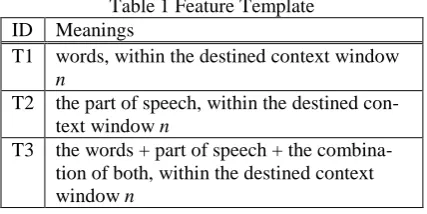
[image:3.595.299.513.213.320.2]judged and identified from the words associ-ated with it. To the adverbs’ usage recogni-tion, it also needs to get the word’s usage knowledge from the contexts. Through ana-lyzing some examples, we found that words and part of speech in the contexts are useful to identify adverbs’ usages. Therefore, in our experiment, to CRF and ME model, we se-lect 3 template features as table 1. The value of n can take 2, 3, 4, 5, 6, and 7.
Table 1 Feature Template ID Meanings
T1 words, within the destined context window
n
T2 the part of speech, within the destined con-text window n
T3 the words + part of speech + the combina-tion of both, within the destined context window n
In the SVM experiment, the feature is nu-meric characteristics. To the adverb in the sentence, through selecting the window size of the context, and then calculating the mu-tual information(MI) of the features in the window and the adverb, the result of MI as feature vector. The MI between word w and word u can be calculated as follows,
p p p I 1* 2
log
=
(1)
Where:
p1: the frequency of u in the corpus p2: the frequency of t in the corpus p: the co-occurrence frequency of w and u
4
Experiments and Results Analysis
4.1 Experimental Corpus
choose seven common Chinese adverbs which usage distribution is somewhat bal-anced in the corpus as the object of statistical learning.
4.2 Performance Evaluation
In the experiment, we use the precision(P) as the evaluation measure of the experimental results. To the word W and its usage i, we define P as followed:
i usage of number tag the
i usage of number tag correct the
P= (2)
4.3 Analysis of Experimental Results
In order to verify the performance of models, to every adverb, we use 4 fold cross-validation experiments. The results are the average results of cross-validation.
Experiment 1: Performance comparison
ex-periment of Statistical methods and rule method
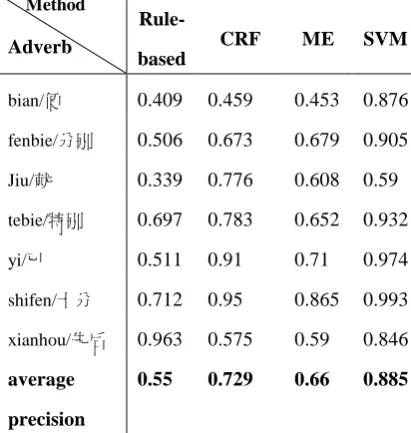
[image:4.595.86.292.470.687.2]Aiming at the different statistical models, by selecting different feature, we did 3 groups experimental separately. For CRF and ME, we select T1 while n=2. To SVM we take MI as feature while the window size is 2. Results are shown in Table 2.
Table 2 The experiment result of rule-based method and the statistic-based method
Method
Adverb
Rule-
based
CRF ME SVM
bian/便 0.409 0.459 0.453 0.876
fenbie/分别 0.506 0.673 0.679 0.905
Jiu/就 0.339 0.776 0.608 0.59
tebie/特别 0.697 0.783 0.652 0.932
yi/已 0.511 0.91 0.71 0.974
shifen/十分 0.712 0.95 0.865 0.993
xianhou/先后 0.963 0.575 0.59 0.846
average
precision
0.55 0.729 0.66 0.885
From Table 2 we can see that the statistic-based results are better than the rule-statistic-based results on the whole. The average precision has been raised from 55% to 88.5%. It can clearly be seen that the statistical method has
better adaptability and good application prospect in automatic identification of mod-ern Chinese adverbs’ usages.
At the same time, we can see that the sta-tistical result of adverb “xianhou/先后” is obviously lower than the rule-based method. This is because the different usage of it can be easily distinguished from its rule, so the precision of rule-based method is higher than statistic-based method. To these words, we consider to use the method that combines the statistics-based and rules-based method.
Experiment 2: Statistical experiment under different feature template
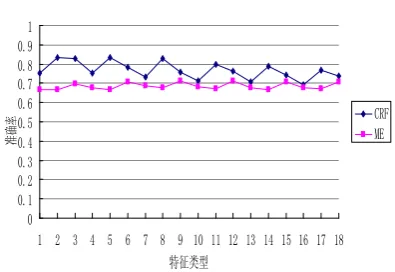
By choosing different feature templates, this experiment to analyze the influence of different feature to the statistical method. Figure 1 is the average results of 6 ad-verbs(removing adverb “xian hou/先后”) using three models. The abscissa 1-6 is the feature in the template T1 while n take 2, 3, 4, 5, 6, 7 separately. Figure 2 is the average results of these adverbs using CRF and ME with template T1, T2, and T3(see Table 1). The abscissa 1-3, 4-6, 7-9 ,10-12, 13-15, 16-18, is T1, T2, T3 while n take 2, 3 ,4 ,5, 6, 7. From Figure 1 and Figure 2, we can see that the precision of statistical results have not great changes by choosing different con-text window. In general it can be achieved the best result within the window size (-4, +4) of the context. So, in the current scale of corpus, big window size may be not better when recognizing usages of adverbs, and it may bring more noise for recognizing with the increase of window size. But observing experimental results of specific words, we found that it’s not all of the words exist this phenomenon. Figure 3 and Figure 4 is the result of adverb “jiu/就” and “bian/便” using three models with T1(n=2,…,7).
0 0.1 0.2 0.3 0.4 0.5 0.6 0.7 0.8 0.9 1
1 2 3 4 5 6 特征类型
准
确
率
[image:5.595.320.518.72.208.2]CRF ME SVM
Figure 1 Average result of three models with T1(n=2,…,7)
0 0.1 0.2 0.3 0.4 0.5 0.6 0.7 0.8 0.9 1
1 2 3 4 5 6 7 8 9 10 11 12 13 14 15 16 17 18 特征类型
准
确
率 CRF
ME
Figure 2 Average result of CRF and ME with T1, T2, T3(n=2,..,7)
0 0.1 0.2 0.3 0.4 0.5 0.6 0.7 0.8 0.9 1
1 2 3 4 5 6
特征类型
准
确
率
CRF ME SVM
Figure 3 Adverb Result of adverb “jiu/就” using three models with T1(n=2,…7)
0 0.1 0.2 0.3 0.4 0.5 0.6 0.7 0.8 0.9 1
1 2 3 4 5 6
特征类型
准
确
率 CRF
[image:5.595.110.300.76.384.2]ME SVM
Figure 4 Adverb Result of adverb “bian/便” using three models with T1(n=2,…7)
So, to different adverb, we may be select different statistical model based on its own characteristics. For some common Chinese adverb, it’s very important to study and con-trast case-by-case.
5
Conclusions
The article makes a preliminary study on automatically recognizing common adverbs’ usages. From the experimental results wen can see, compared with the rule-based method, statistic-based method has obvious advantages.
This article is a continuation of the work of Functional Word Knowledge Base. Fur-thermore, we will study the method that combines the rule-based method and the statistic-based method to automatically rec-ognizing adverbs’ usages, and further en-hance the recognition precision. We hope our study can help the Chinese lexical se-mantic analysis, and make a good base to the Chinese text machine understanding and the application of natural language process-ing.
Acknowledgement
The work in this paper was supported by the China National Natural Science Foundation (No. 60970083), the Open Project Program of the Key Laboratory of Computational Linguistics(Peking University)(KLCL 1004) of China Ministry Education, and the Out-standing Young Talents Technology Inno-vation Foundation of Henan Province(No. 104100510026).
References
Chen Wenliang, Zhang Yujie, Hitoshi Isahara.
Chinese named entity recognition with con-ditional random fields. In 5th SIGHAN Workshop on Chinese Language Processing, Australia, 2006.
[image:5.595.317.523.257.387.2]Firth J R., A Synopsis of L inguistic Theory 1930 - 1955 In Studies on L inguistic Analysis. L ondon: B lackwell 1957:101-126
Guo Jiaqing, Studies on the Chinese Named En-tity Recognition based on conditional ran-dom fields. Doctoral dissertation of the Shenyang Aviation Industry Colledge, China. 2007.
Hao, Liping, Zan, Hongying, Zhang, Kunli, Re-search on Chinese Adverb Usage for Ma-chine Recognition. In:Proceedings of the 7th International Conference on Chinese Computing (ICCC2007): 122-125
Lafferty, J., McCallum, A., Pereira F,. Condi-tional random fields: probabilistic models for segmenting and labeling sequence data.
In the Proceedings of International Confer-ence on Machine Learning, 2001: 282-289. Li, Xiaoqi, et al. The teaching materials on the
modern Chinese funciotnal word. Peking University press, Beijing, China, 2005. (in Chinese)
Li, Guozheng, Wang, Meng, Introduction on the Support Vector Machine. The electronic In-dustry Press. Beijing, China, 2005.
LI, Sujian, Liu, Qun, Yang Zhifeng, Chunk Parsing with Maximum Entropy Principle, Chinese Journal of Computers, 2003(12), 1722-1727.
Liu, Kang; Zhao, Jun, Sentence Sentiment Analysis Based on Cascaded CRFs Model, Journal of Chinese Information Processing, 2008(1), 123-128.
Liu, Rui,. et al. The Automatic Recognition Re-search on Contemporary Chinese Language, Computer Science, 2008(8A): 172-174. (in Chinese)
Liu, Yun, The construcion of Chinese funtional words konwledge base. Peking University. Postdoctoral reports of Peking University. 2004.
Lu, Zhimao, Liu, ting, Survey of the statitical word sense disambiguation study. Jounal of Electroniics, 2006.2
Ma,.Zhen, Study Methodology of the Modern Chinese Function Words. Commercial Press.2004.(in Chinese)
Miao Xuelei. A Random Conditional Fields Based Method to Chinese Word Sense Dis-ambiguation Research. Shenyang Institute of Aeronautical Engineering. 2007.
Shi Shumin, Wang Zhiqiang, Zhou Lang, Chi-nese Named Entity Recognition based on conditional random fields. In the Proceed-ings of the 3rd students computational lin-guistics conference . 2006.(In Chinese) Vapnik V., Statistical Learning Theory.
Wiley-Interscience ublication. John Wiley&Sons, Inc,1998
Wang, Jiangwei, Chinese named entity recogni-tion Based on Maximum Entropy, Doctoral dissertation of Nanjing University of Science and Technology, 2005.
Yu, Kun, Guan, Gang, Zhou, Ming. Resume in-formation extraction with cascaded hybrid model. Proceedings of the 43rd Annual Meeting on Association for Computational Linguistics. Ann Arbor, Michigan. 2005:
499-506
Yu, Shiwen, et al. Knowledge-base of General-ized Functional Words of Contemporary Chinese[J]. Journal of Chinese Language and Computing, 13(1): 89-98. 2004.
Zan, Hongying, Zhang Kunli, Chai,Yumei Yu, Shiwen. The Formal Description of Modern Chinese adverbs’ usages. In Proceedings of the 9th Chinese Lexical Semantics Work-shop(CLSW-2007), 52-56. 2007. (in Chinese) Zan, Hongying, Zhang, Kunli, Chai,Yumei, Yu,
Shiwen. Studies on the Functional Word Knowledge Base of Contemporary Chinese. Journal of Chinese Information Process-ing,2007(5): 107-111. (in Chinese)
Zhang Jian, Studies on the English Named Entity Recognition based on conditional random fields. Doctoral dissertation of the Harbin Industry University, China. 2006.