Delayed Tree-Locality, Set-locality, and Clitic Climbing
Joan Chen-Main*, Tonia Bleam+, and Aravind K. Joshi*
*Institute for Research in Cognitive Science +Department of Linguistics
University of Pennsylvania University of Maryland
Philadelphia, PA 19104, USA College Park, MD 20742, USA
{chenmain, joshi)@seas.upenn.edu [email protected]
Abstract
Since Bleam's (2000) initial claim that capturing clitic climbing patterns in Romance requires the descriptive power of set-local MCTAG (Weir, 1988), alternative approaches to relaxing tree-locality restrictions have been developed, including delayed tree-local MCTAG (Chiang and Scheffler, 2008), which, unlike set-local MCTAG, is weakly equivalent to standard TAG. This paper compares 2-delayed tree-local MCTAG with set-tree-local MCTAG in terms of how well the two formalisms can account for the clitic climbing data. We confirm that 2-delay tree-local MCTAG has the formal expressivity to cover the data by proposing an explicit grammar to do so. However, we also find that the constraint on set locality is particularly well-suited for capturing these clitic climbing patterns. I.e., though globally less restrictive, set-local MCTAG appears to be restrictive in just the right way in this specific case.
1 Introduction
Bleam (2000) argues that capturing patterns of clitic climbing in Spanish requires the descriptive power of set-local multi-component TAG (MCTAG) (Weir, 1988); the more restrictive tree-local MCTAG is not sufficient. Since Bleam’s initial claim, alternative approaches to relaxing locality restrictions have been developed. Delayed tree local MCTAG, introduced by Chiang and Scheffler (2008), 1 is
1 As part of Chiang and Scheffler’s proof showing the weak
equivalence of delayed tree-local MCTAG to standard TAG, they show that any tree-local MC-TAG with flexible composition G can be converted into a 2-delayed tree-local
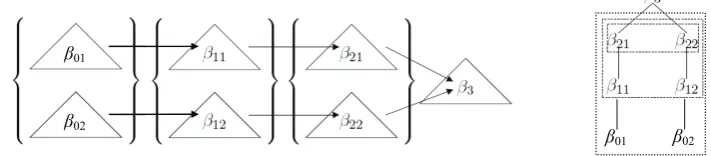
one such proposal, but unlike set-local MCTAG, it is weakly equivalent to standard TAG. Each use of a multicomponent set introduces a delay
into the derivation. A delay is the union of the paths in the derivation structure from each component of an MC-set S to the lowest node that dominates all members of S. A k-delayed tree-local MCTAG permits each node in the derivation structure to be a member of at most k
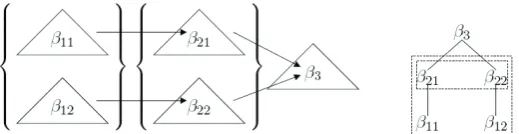
delays. Fig. 1 replicates the example of a 2-delayed tree-local derivation given in Chiang and Scheffler (2008). The dashed boxes mark the delays. Thus, a valid k-delayed tree local MCTAG derivation permits members of the same MC set to compose into different trees, so long as all members of the MC set eventually compose into the same tree without exceeding k
delays. Delayed tree-locality permits a limited amount of set-local composition, as illustrated in Fig.1, but it also permits some non-set-local derivational steps. 1-delayed and 2-delayed tree-local MCTAG have already been employed in linguistic analyses of anaphor binding (Chiang and Scheffler, 2008), non-local right node raising (Han et al., 2010), and binding variables (Storoshenko and Han, 2010).
This paper explores how well the additional descriptive power of 2-delayed tree-local MCTAG accommodates the available clitic climbing data and compares the new approach with the set-local MCTAG approach. In section 2, we review the data Bleam (2000) sought to account for. In section 3, we review why such data is problematic for tree-local MCTAG and
MCTAG G’ that is weakly equivalent to G and has exactly the same elementary structures as G. Described informally
as reverse adjoining (Joshi et al. 2003), it recasts some
Figure 1: A 2-delayed tree-local MCTAG derivation. Delays are marked with dashed boxes.
(Figure taken from Chiang and Scheffler (2008).)
present a set-local solution, slightly modified from Bleam (2000). In section 4, we provide and discuss a 2-delayed tree local MCTAG solution based on a small modification to our set-local MCTAG solution. In section 5, we show how the differences between the two MCTAG variants yield different predictions with respect to the number of clitics that can climb. However, the predictions turn out to be untestable given independent constraints on clitic clusters. In section 6, we conclude that though set-local MCTAG is particularly well-suited for modeling clitic climbing, we cannot escape the result that 2-delayed tree-local MCTAG eliminates the necessity of using set-local MCTAG.
2 Clitic Climbing in Romance
Spanish exhibits a phenomenon known as clitic climbing, whereby (one or more) pronominal clitics that are thematically dependent on a verb in an embedded clause can optionally appear in a higher clause. The phenomenon is illustrated in (1) and (2) where the clitic lo (“it”) is thematically dependent on the verb leer (to read), but it can optionally “climb” or appear in the higher clause as in (2).
(1) Mari quiere leer-lo Mari wants to.read-it (2) Mari lo quiere leer
Mari it wants to.read
Clitic climbing is one consequence of the more general phenomenon often referred to as
restructuring (Rizzi, 1982) or clause
reduction/union (Aissen and Perlmutter, 1983). These are cases where two or more clauses act as a single clause for purposes of clitic placement, NP movement (as in reflexive passive or tough-movement), or scrambling (in German, eg.). Thus, dependencies (or “movements”) that are usually clause-bounded are possible across clauses just in case the intervening predicates are all in the class of “trigger” predicates (Aissen and Perlmutter, 1983). Trigger predicates are those that select a “defective” or “reduced”
clausal complement, one that is tenseless, subjectless and that does not contain (intervening) functional elements such as sentential negation. In Bleam (2000), trigger verbs are analyzed as those that optionally select a VP complement (vs. a higher functional projection of the verb such as TP or CP).
As noted in Bleam (2000) and in other work, clitic climbing is unbounded. There appears to be no grammatical limit on the number of clauses that can be crossed by a clitic, as long as all of the intervening verbs are trigger verbs.2
(3) Juan quería dejar-te terminar de leer-lo Juan wanted to.let-you to.finish of to.read-it “Juan wanted to let you finish reading it” (4) Juan te lo quería dejar terminar de leer.
Clitic clusters can involve two clitics that are thematically dependent in a single clause or they can be formed by clitics originating in different clauses, climbing into a single higher clause, as shown in (3)-(4) and (5)-(7).
(5) Mari quiere permitir-te ver-lo Mari wants to.permit-you to.see-it ‘Mari wants to permit you to see it.’ (6) Mari te lo quiere permitir ver (7) Mari quiere permitir-te-lo ver
When there are multiple clitics originating in different clauses, the clitic originating in the lower clause can move up one clause to join the other clitic, as shown in (7), but cannot “move past” the clitic in the higher clause, as shown in (8), unless it carries the second clitic along.
(8) *Mari lo quiere permitir-te ver (9) Mari te quiere permitir ver-lo (10) *Mari te quiere permitir-lo ver
2 Of course processing becomes more difficult as the
(a) (b) (c)
(d) (e)
[image:3.595.88.477.84.412.2](f) (g)
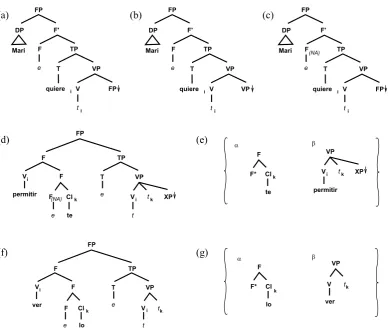
Figure 2: Grammar fragment for deriving patterns in (5) – (10). Three versions of quiere (a) used in the set-local account only, (b) used in both accounts, (c) used in the 2-delay tree-local account only;
two versions of permitir (d) used when clitic remains low, (e) used when clitic climbs; two versions of ver (f) used when clitic remains low, (g) used when clitic climbs.
Further, while the higher clitic can move into the matrix clause leaving the lower clitic in situ, as in (9), it cannot do so if the lower clitic has moved into its clause, as shown in (10). These constraints on clitic clustering, or “bandwagon effects” (Bleam 2000)3, suggest that there is a single position in the clause for clitics and that clitic clusters form a constituent.
3 Set-local MCTAG and Clitic
Climbing in Romance
To account for the clitic climbing facts in Spanish (and for restructuring more generally), Bleam (2000) adopts a defective-complement analysis. In the MCTAG analysis, every non-finite clause with clitic arguments has two versions, illustrated for permitir (“to permit”) in Figs. 2(d) and (e). 2(d) is a singleton set containing a contiguous tree containing the verb
3 These phenomena were observed by Aissen and Perlmutter
(1983) and fell out from their clause reduction analysis.
and its full extended projection4, which also (necessarily) includes the dependent clitic(s) in a functional head which is agnostically labeled F. This version is the one utilized in cases where the clitic stays in the embedded clause in which it is thematically dependent. In the second version, Fig. 2(e), the tree set contains two components: one tree containing the verb in a VP projection, lacking its functional structure, and the other tree containing the dependent clitic (attached to a “higher” functional head). This version is used to derive cases of clitic climbing. Because the clitic is “loose,” it is free to attach to the functional structure of a higher clause in the final derived tree. The linguistic intuition is that in the first case, the presence of higher functional structure in the same single tree with the verb provides a host site for the clitic and would entail a contiguous tree that included both verb and clitic.
4 I.e., in the sense of Grimshaw (1991), the functional
projections that accompany a verb.
t
e VP
TP F'
quiere DP
Mari FP
F
V
i T
i FP
t
e VP
TP F'
quiere DP
Mari FP
F
V
i T
i FP
(NA)
t e
VP VP TP F'
quiere DP
Mari FP
F
V
i T
i
t e
e
te
TP FP
V
Vi F
i
Cl F
F k tk
T VP
permitir XP
(NA)
Vi tk VP
XP
permitir te
k F*
F
Cl
t lo
e
e TP FP
V
ver V
i F
i
Cl F
F k tk
T VP
lo F*
F
Cl
k V tk
VP
ver
In the second case, the lack of higher functional structure necessitates a “loose” clitic in a separate component.
Trigger verbs (such as querer “to want”) are clausal complement taking verbs that are flexible in the type of complement they take. They can either take a VP complement, in which case clitic climbing occurs due to the selection of the defective complement tree set (e.g. Fig. 2 (e) or (g)); or they can take a full FP complement (e.g. Fig. 2 (d) or (f)), in which case there will be no clitic climbing, due to the selection of the non-defective complement tree which necessarily contains the clitic. Note that the trees for the tensed trigger verb, quiere, in Figs. 2 (a) and (b), are exactly alike except that one takes an FP complement while the other takes a VP complement.5 , 6Non-trigger verbs (that do not trigger restructuring) will only have the option of taking a non-defective complement (FP or CP).
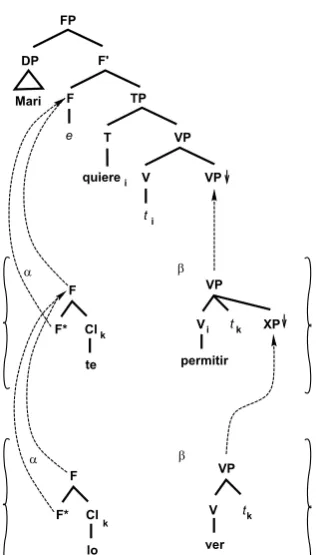
[image:4.595.323.482.94.372.2]The set-local derivation of (6), where both clitics originate in separate clauses but end up clustering together in a single clause, is given in Fig. 3. The derivation involves the tree sets in Fig. 2 (b), (e), and (g). The VP tree for the most embedded verb, ver, substitutes into the VP node of the permitir tree, while the component with the clitic lo adjoins into the component with the clitic te. This creates a derived multi-component set, one component with the embedded verbs and the other with the clitics. The former substitutes into the VP verb complement position of the matrix tree and the latter adjoins into the F node of the same tree.
As should be clear from the derivation in Fig. 3, multi-component TAG is necessary to account for clitic climbing if we want to maintain the idea that a verb and its dependent clitic need to be represented in the same elementary object. Furthermore, as shown in Bleam (2000), set-local MCTAG permits an account for cases such as (6) that preserves the linguistic intuition that the clitics combine with one another to form a cluster, while tree-local MCTAG cannot. Although the more powerful set-local MCTAG must be adopted, requiring set-locality still constrains the possible derivations in ways that are linguistically relevant. Note that traditional
5 The trees given here are modified from Bleam (2000) in
that the clitic host site F is higher than the verb in T(ense) in the tensed clause. This difference is justified in Appendix A.
6 The XP complement node in Fig. 2(d-e) is a short-cut for
indicating two separate trees, one taking an FP complement and one taking a VP (representing the fact that “permitir” is a trigger verb).
Figure 3: MCTAG derivation (set-local and also 2-delay tree-local) for climbed clitic clusters
set-local MCTAG does not allow for the ver
component of Fig. 2(g) to substitute into the
[image:4.595.336.455.607.710.2]permitir tree in (d) while the component for the clitic lo remains unattached. The clitic may not “jump over” the permitir clause and adjoin directly into the matrix quiere tree. This non-set-local derivation is shown schematically in Fig. 4. Hence, clitics cannot climb past a clause without combining with other clitics in the intermediate clause, forcing them to all move together. Against a backdrop of reasonable linguistic assumptions, we see that the Bandwagon Effects are derived by the formal properties of set-local MCTAG.
Figure 4: Derivation that is illegal in set-local MCTAG but legal in 2-delay tree-local MCTAG
t e
VP VP TP F'
quiere DP
Mari FP
F
V
i T
i
Vi tk VP
XP
permitir te
k F*
F
Cl
lo F*
F
Cl
k V tk
VP
ver
(a) (b) (c) (d)
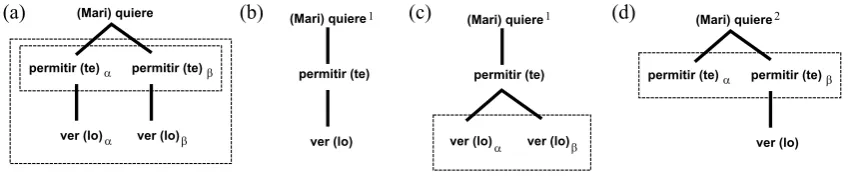
Figure 5. Derivation structures for examples (6), (5), (7), and (9), respectively, with delays marked
One final note is in order. Kulick (2000) identifies two types of constructions which he claims remain incorrectly prohibited by the Bleam analysis: constructions where clitic climbing co-occurs with raising or with long distance wh-movement. We show in Appendix A that set-local MCTAG actually is able to handle this data.
4 2-Delayed Tree-Local MCTAG and Clitic Climbing in Romance
Recall that in Bleam’s set-local account, a sentence with two climbed clitics is formed by combining the two clitics and combining the two embedded predicates. This derivation is permitted in 2-delayed tree-local MCTAG. Fig.5(a) is the derivation tree for the derivation in Fig. 3 with delays marked. Note that the shape of Fig. 5(a) is exactly that of the example 2-delayed MCTAG derivation given in Fig.1. By considering the shapes of the derivations permitted by 2-delayed tree-local MCTAG, we can conclude that some account must be possible for the clitic climbing data presented here.
Recall also that it is the prohibition against the kind of derivation depicted in Fig. 4 in set-local MCTAG that ruled out the patterns exemplified by (8) and (10) where clitics ungrammatically do not cluster. Since the derivation in Fig. 4 is permitted by delayed tree-local MCTAG, the challenge for providing a 2-delayed MCTAG analysis of available clitic climbing data is how to avoid overgeneration.
It turns out that only a minor modification to the grammar fragment used for our set-local MCTAG account is needed to provide a 2-delayed tree-local MCTAG account of the data at hand. By adding a null adjoining constraint to the tree in Fig. 2(a), we obtain the tree in Fig. 2(c). Using the tree in Fig. 2(c) instead allows for the derivation of the grammatical patterns of clitic climbing in (5)-(7), and (9) while blocking the ungrammatical patterns in (8) and (10). Crucially, we assume clitics have a single position in the
clause, which we represent here as an F node. (Thus, clitics adjoin to F but not V or T.) We maintain the general analysis of the two patterns of clitic placement utilized in the set local MCTAG account: When the clitic does not climb, the derivation involves a singleton tree set for the embedded verb which includes an F node for hosting a clitic. For examples (6), (7), and (9), when a clitic does climb, the derivation involves a set where the projection of the verb tree is too low to include an F node and the clitic is represented in a separate elementary tree.As in the set-local account, this captures the intuition that restructuring phenomena, such as clitic climbing, involves the selection of some type of reduced clause. Fig. 5 shows the derivation structures for the grammatical patterns in (5)-(7) and (9). The shapes of the derivations are, in fact, the same as those for set-local MCTAG, which the reader can verify.
Where the two accounts differ, however, is clearer when we consider how the unattested patterns in (8) and (10) are blocked. Let us consider the necessary tree sets for each example in turn. In (8), the clitic associated with the most embedded clause, lo, has climbed into the matrix clause while the clitic associated with the next highest clause, te, remains in its unclimbed post-verbal position. Since a successful derivation of (8) would require a host site for the climbed clitic
lo in the matrix clause, the derivation would necessarily involve the tree set in Fig. 2(b). The quiere tree in 2(c) cannot host a clitic due to the null adjoining constraint on its F node. The postverbal position of te implies that the singleton set 2(d), whose root is labeled FP, should be used in deriving (8). However, Fig. 2(b) takes only a VP as quiere’s complement, not an FP, so the two sets cannot combine. Using the set in Fig. 2(e) instead will allow the component with
permitir to substitute into quiere’s tree, but the component with the clitic will not have a position following permitir to adjoin into. Thus, neither available option for permitir and te will successfully yield (8).
permitir (te)
ver (lo)
(Mari) quiere
permitir (te)
permitir (te)
ver (lo) ver (lo)
(Mari) quiere
permitir (te)
permitir (te)
ver (lo) (Mari) quiere
ver (lo) ver (lo)
(Mari) quiere
permitir (te)
Figure 6. A 3-delayed tree-local MCTAG derivation. Delays are marked with dashed boxes.
In (10), the clitic associated with the most embedded clause, lo, has climbed into the next highest clause while the clitic associated with that clause, te, has climbed up to the matrix clause. As with (8), a successful derivation of (10) would require a host site for the climbed clitic in the matrix clause. Thus, the derivation would necessarily involve the tree in Fig. 2(b). Since both clitics climb, the derivation must involve the sets in Figs. 2(e) and (g), where the clitic is a separate component. This is unproblematic for deriving the positions for
permitir and te: the permitir component
substitutes into the VP node in the quiere tree while the te component adjoins into the F node. The lo component of Fig. 2(g), however, has no F node following permitir into which to adjoin. It can only adjoin into the F node of the te
component or the F node of the matrix clause, which would yield the attested (6), not the unattested (10).
We see that our 2-delayed tree-local account depends on Fig. 2(b) having only VP (and not FP) as its verbal complement. That is, in this account, the possibility of taking an FP complement is linked to the presence of a null adjoining constraint, as instantiated in Fig. 2(c). It is the null adjoining constraint on the F node that blocks clitic climbing into the matrix clause, not the formal properties of 2-delayed tree-local MCAG. This machinery is available, but the use is not linguistically motivated beyond the goal of deriving the observed clitic climbing patterns.7
7 Another option is to propose a quiere tree without an F
node, i.e. we could posit that the matrix tree involved in clitic climbing is larger than the tree involved in non-climbing cases. However, the null adjoining account adopted above can also correctly rule out the the possibility of a clitic originating in clause 3 and moving to clause 1,crossing over an intermediate clitic from clause 2, when clause 1 itself contains a clitic.
i) Juan te permitió hacerle leerlo
ii) *Juan te lo permitió hacerle leer.
5 Clitic Clusters and a 2-Delayed Tree-Local MCTAG Prediction
As we have seen above, the set-local MCTAG account for climbed clusters of two clitics can be straightforwardly recast as a 2-delayed tree local MCTAG derivation. This does not, however, hold for the derivations of the two MCTAG variants in general. Consider, for example, the derivation in Figure 6. This is a straightforward set-local MCTAG derivation, but it is not a 2-delayed tree-local MCTAG derivation. Here, β21 and β22 are members of three delays, making it a 3-delayed tree-local MCTAG derivation.
In the context of clitic climbing, this translates into different predictions regarding the number of clitics that can originate in different clauses and form a climbed clitic cluster. The set-local account permits an unbounded number of multi-component clitic-verb sets to combine with each other, thus predicting that an unbounded number of clitics may form a climbed clitic cluster (in principle). In contrast, the 2-delayed MCTAG allows only two multi-component clitic-verb sets to combine with each other before combining into the same tree. This restriction predicts that it should not be possible to create a clitic cluster containing three clitics that originate in three different clauses and then climb into a fourth clause. More generally, a k-delayed tree-local MCTAG permits at most k clitics, each of which originates from a different clause, to form a climbed cluster. In testing this prediction, we find that speakers do not accept climbed clusters of greater than two, which appears at first to rule in favor of 2-delayed TL-MCTAG. However, this would only distinguish between the two variants if we could establish that clusters of three clitics are acceptable when they do not each originate from a separate clause. This turns out not to be the case: 3-clitic combinations are ruled out in cases where two of the clitics originate in one clause and the third clitic originates in a different clause, as shown in (11).
β02
β01
(11) a. Juan no quiere permitir-le Juan neg wants to.permit 3p.dat escribir-te-la
to.write- 2p-3p.fem.acc
‘Juan doesn’t want to permit him/her to write it to you.’
b. *Juan no quiere permitir-se8-te-la escribir c. *Juan no se te la quiere permitir escribir
The picture that emerges is that clusters of three clitics are difficult for speakers to accept for reasons that are independent of the combinatory operations that combine multiple clauses. Thus, Romance does not allow us to test the prediction due to restrictions on clitic clusters in general.9 Although the data given here is inconclusive, the section serves to illustrate how the two MCTAG variants differ and identify the kind of data pattern that would distinguish between the two.
6 Conclusions
This paper demonstrates that although clitic climbing originally appeared to require formal power beyond that of tree-local MCTAG, the introduction of the weakly equivalent delayed tree-local MCTAG can account for the same body of data. Our set-local MCTAG account can, in fact, be translated into a 2-delayed tree-local MCTAG account with the addition of a null adjoining constraint to one of the trees in the set-local grammar: the quiere tree in Fig. 2(a) is replaced with the tree in Fig. 2(c). The 2-delayed account also retains the set-local account’s reliance on the absence/presence of a functional node to host a clitic within the complement clause.
Where the two differ, however, is how the work of capturing the Bandwagon Effect is accomplished. In the set-local account, the Bandwagon Effects follow as a consequence of the permissible combinatory operations. Unattested patterns would require non-set-local derivations. In contrast, these non-set-local derivations are legal 2-delayed tree-local MCTAG derivations. The work of ruling these out to capture the Bandwagon Effects relies instead on the use of node labels and the null adjoining constraint. Both of these are legitimate,
8 This le is converted to se by a morphological rule known
as the “Spurious se rule.”
9 The prediction also appears to be untestable in Serbian and
Italian due to independent constraints. Thanks to Dave Kush, Ivana Mitrovic, Christina Tortora, and Raffaella Zanuttini (pc).
computationally “safe” parts of TAG variants. However, as there is no obvious linguistic motivation for this particular use of a null adjoining constraint, from a linguist’s standpoint, there is preference for the set-local analysis. It is interesting to note that despite its increased power in general, set-locality, in conjunction with linguistic facts, has just the right kind of restrictiveness to capture clitic climbing patterns, making the formalism a particularly good fit in this specific domain. This also suggests that we may wish to investigate other ways to modify tree-locality to permit a limited amount of set-local derivational steps with the goal of capturing the clitic climbing data more succinctly than the delayed tree-locality account given here.
The elegance of the set-local MCTAG account, however, should not obscure the conclusion that delayed tree-locality makes it possible to avoid the increased generative power of set-local MCTAG. We are aware of only two cases for which it has been argued that permitting set-local composition is necessary: clitic climbing in Romance, which we have discussed here, and double causatives in Japanese (Heycock, 1986). The shape of the set-local MCTAG derivation for the double causatives is the same as that given for a two-clitic cluster which has climbed. Just as the set-local analysis for the two-clitic cluster is also a legal 2-delayed tree-local analysis, so too is Heycock’s set-local analysis for Japanese causatives a legal 2-delayed tree-local analysis. We are led to conclude that 2-delayed tree-local MCTAG eliminates the necessity of using set-local MCTAG not only for clitic climbing, but for all cases in which set-local composition was previously argued to be required.
Acknowledgments
We would like to thank the anonymous reviewers, Dave Kush, and Jeff Lidz for their helpful feedback, and Juan Uriagereka, Raffaella Zanuttini, Christina Tortora, Dave Kush, Ivana Mitrovec, Carmen Rio Rey and Leticia Pablos for their assistance with data.
Appendix A: Set-local Solutions for Clitic Climbing and Adjoined Predicates
(a) (b) (c)
Figure 7: 1-delay tree-local MCTAG derivations which are not set-local. (a) schematic of derivation (b) schematic of derivation of clitic climbing with a raising verb (c) derivation structure with delay
marked. ((a) and (b) taken from Kulick (2000))
co-occurs with raising, as in (12), or with long distance wh-movement, as in (13).
(12) a. Luis suele comer-las b. Luis las suele comer Luis them tends to eat ‘Luis tends to eat them’ (13) a. Que quiere mostrar-te Juan
What wants to-show-to-you Juan ‘What did Juan want to show to you?’ b. Que te quiere mostrar Juan
The difficulty lies in combining the classic TAG accounts for raising and for wh-movement with the account developed for clitic climbing. In the former, both accounts involve adjoining of the matrix verb into the complement clause, thus “stretching apart” material in the lower clause. In the latter, clitic climbing is handled by positing an MC-set in which the clitic is its own component that adjoins into its host verbal element. A sentence like (12), then, would appear to require a derivation where the component for the clitic adjoins into the raising verb, which subsequently adjoins into the infinitival verb, the set-mate of the clitic. This is shown schematically in Fig. 7, taken from Kulick (2000). Such a derivation, where the clitic first combines into a tree while its set-mate remains uncombined, is not set-local.
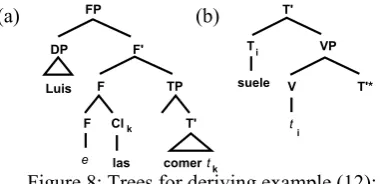
However, as we show here, the tree set for “comer” assumed by Kulick is ruled out under Bleam’s analysis. One of the key aspects of Bleam’s (2000) analysis was that the size of the verb’s tree determined whether the clitic was “loose” (instantiated as a separate tree in the tree set), and thus free to climb. Since the canonical position of the subject is above the position of the clitic, a tree anchored by comer and also having a position for a canonical subject must also contain a dependent clitic, as shown in Fig. 8(a). Thus, example (12), which combines raising and clitic climbing, will require trees as in
Fig. 8, where the raising verb suele adjoins in above the verb but below the clitic.10
[image:8.595.306.498.253.345.2](a) (b)
Figure 8: Trees for deriving example (12): cliting climbing co-occurs with raising.
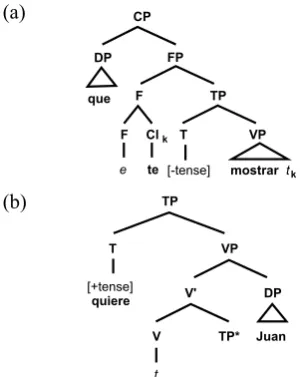
The second type of example, (13), can be handled in a similar way, preserving the traditional TAG analysis of long distance wh -movement in which the verb and its dependent
wh-expression (argument) are stretched apart through adjoining. Assuming that the wh -expression is in the specifier of CP (of the
mostrar tree) and that the clitic is in a projection below CP, we posit a contiguous tree for the
mostrar clause, and its wh-expression and clitic dependents, as in Fig. 9(a).
The matrix clause (quiere) must then adjoin in below the clitic. This requires us to adopt some crucial assumptions about the position of the post- verbal subject in wh-questions in Spanish.11 We assume the canonical pre-verbal position of the subject to be the specifier of FP. However, the (non-canonical) post-verbal subject in wh -questions in Spanish (and Italian) has been argued to be in a lower position than that of canonical subjects (see Rizzi 1982, Torrego 1984, Suñer 1994). Following these standard sources, we posit the auxiliary tree in Fig. 9(b) for the matrix quiere Juan clause. In this tree the verb
10 Note that suele is tensed and that tensed verbs are
standardly assumed to move to T in Spanish; thus, we assume that root and foot nodes for the auxiliary tree for
suele are TP (or T’).
11 Note that the position for the post-verbal subject “Juan” is
assumed to originate in the elementary tree for “quiere” that becomes the matrix clause in this example.
suele
(Luis) comer (las) (Luis) comer (las)
t
T'* T
T'
VP
V suele
i i
e DP
FP
F'
F Luis
Cl
F k
las TP
T'
(a)
[image:9.595.84.235.93.282.2](b)
Figure 9: Trees for deriving example (13): cliting climbing co-occurs with wh-movement.
has moved past the subject, and the subject is a right-branching specifier of VP.12
Consequences of adopting this analysis to account for Kulick’s data are (contra Bleam, 2000), (1) that not all cases of clitic climbing are a result of a “loose” clitic in a tree set; and (2) that not all infinitival verbs are in a pre-clitic position in the elementary tree.13 But note that by adopting these relatively minor changes to the original analysis, the set-local analysis can handle these (apparent counter-) examples. In fact, for the particular examples mentioned here, tree-local MCTAG would be sufficient, but considering similar cases but with clitic climbing from multiple clauses would again require set-locality rather than tree-set-locality. It should be
12 Alternatively, Ordoñez 1998 argues that, in general, VOS
sentences in Spanish are derived via (a) movement of the verb to T, (b) the subject remaining in its base position, specifier of VP (left-branching), and (c) scrambling of the object (in this case a TP) to a position below T but above the in situ subject. This is illustrated below:
13 Trees such as Fig. 8(a) will necessarily require adjoining
of a tensed verb at TP in order to ensure appropriate case-licensing of the nominative subject and to ensure that the clitic has an appropriate verbal host. (In Spanish, clitics precede tensed verbs, but follow untensed verbs.) This can be accomplished via an obligatory adjoining constraint, plausibly as a top and bottom feature mismatch in a TAG system with features.
clear from the main text of the paper that these particular set-local MCTAG derivations are also legal 2-delayed tree-local MCTAG derivations.
References
Judith Aissen and David Perlmutter. 1983. Clause Reduction in Spanish. In D. Perlmutter (ed) Studies in Relational Grammar. (1976)
Tonia Bleam. 2000. Clitic climbing and the power of Tree Adjoining Grammer, In Anne Abeillé and Owen Rambow, eds., Tree adjoining grammars: Formalisms, linguistic analysis, and processing,
193-220. CSLI Publications, Stanford. (1994) David Chiang and Tatjana Scheffler. 2008. Flexible
Composition and Delayed Tree-Locality. In
Proceedings of TAG+9, Tübingen, Germany. Jane Grimshaw. 1991. Extended projection. Ms.,
Brandeis University, Waltham, Massachusetts. Chung-Hye Han, David Potter, and Dennis Ryan
Storoshenko. 2010. Non-local Right Node Raising: an Analysis Using Delayed Tree-Local MC-TAG. In Proceedings of TAG+10, New Haven, USA. Caroline Heycock. 1986. The structure of the
Japanese causative. Technical Report MS-CIS-87-55, University of Pennsylvania.
Aravind K. Joshi, Laura Kallmeyer, and Maribel Romero. 2003. Flexible composition in LTAG: quantifier scope and inverse linking. In H. Bunt and R. Muskens (eds.), Computing Meaning 3. Kluwer.
Seth Kulick. 2000. Constraining Non-Local Dependencies in Tree Adjoining Grammar: Computational and Linguistic Perspectives. PhD dissertation, University of Pennsylvania, Philadelphia, USA.
Francisco Ordoñez. 1998. Post-verbal Asymmetries in Spanish. Natural Language and Linguistic Theory
16, 313-346.
Luigi Rizzi. 1982. Issues in Italian Syntax. Foris. Dennis Ryan Storoshenko and Chung-Hye Han. 2010.
Binding Variables in English: An Analysis using Delayed Tree Locality. In Proceedings of TAG+10, New Haven, USA.
Margarita Suñer. 1994. V-Movement and the Licensing of Argumental Wh-Phrases in Spanish.
Natural Language and Linguistic Theory 12, 335-372.
Esther Torrego. 1984. On Inversion in Spanish and Some of its Effects. Linguistic Inquiry 15, 103-129. David Weir. 1988. Characterizing mildly
context-sensitive grammar formalisms. PhD dissertation, University of Pennsylvania, Philadelphia, USA.
t T
V'
[+tense]
quiere
TP* VP
V TP
DP
Juan
e te
VP TP FP
[-tense]
DP
que CP
F
k T
Cl
F k
t mostrar
t
T TP
[+tense]
k i
quiere VP VP TP*
t
V DP V' Juan