ISSN Online: 2152-7199 ISSN Print: 2152-7180
DOI: 10.4236/psych.2017.811111 Sep. 4, 2017 1679 Psychology
The Vertical and Horizontal Spatial-Temporal
Conceptual Metaphor Representation of
Chinese Temporal Words
Tian Hong
1, Xianyou He
1*, Richard Tillman
2, Xueru Zhao
1, Yumei Deng
31Guangdong Key Laboratory of Mental Health and Cognitive Science, Center for Studies of Psychological Application, School of Psychology, South China Normal University, Guangzhou, China
2Tilburg Center for Cognition and Communication, Tilburg University, Tilburg, Netherlands 3Guangdong Institute of Public Administration, Guangzhou, China
Abstract
People rely on spatial-temporal metaphor when they talk and think about ab-stract temporal concept. The purpose of this study is to further investigate the mechanism of the multi-dimensional spatial-temporal conceptual metaphor in Chinese. Using the spatial cuing paradigm, we examined the cognitive im-pact of the Chinese vertical and horizontal spatial-temporal metaphor, and explored the dominant dimension between the two metaphors in context. The results showed that the processing of temporal concepts for Chinese speakers involved not only the horizontal spatial-temporal metaphor, but also the ver-tical spatial-temporal metaphor. The horizontal dimension was the dominant dimension of spatial-temporal metaphor in the processing of temporal con-cepts in Chinese. The findings demonstrated that representation of time de-pends on representation of space, supporting the Metaphorical Structuring View.
Keywords
Spatial-Temporal Conceptual Metaphor, Metaphorical Structuring View, Spatial Cuing Paradigm, Attentional Orienting
1. Introduction
Due to the non-substantiality and abstractness of temporal concepts, people generally think about these abstract concepts by associating with more concrete concept, such as spatial orientation (Haspelmath, 1997;Radden, 2011). In many languages, the spatial-temporal conceptual metaphor is widely used, e.g., “back How to cite this paper: Hong, T., He, X.
Y., Tillman, R., Zhao, X. R., & Deng, Y. M. (2017). The Vertical and Horizontal Spa-tial-Temporal Conceptual Metaphor Re-presentation of Chinese Temporal Words. Psychology, 8, 1679-1692.
https://doi.org/10.4236/psych.2017.811111
Received: July 27, 2017 Accepted: September 1, 2017 Published: September 4, 2017
Copyright © 2017 by authors and Scientific Research Publishing Inc. This work is licensed under the Creative Commons Attribution International License (CC BY 4.0).
DOI: 10.4236/psych.2017.811111 1680 Psychology
in the 60s”, “in the weeks ahead of us”(Clark, 1973;Lakoff & Johnson, 1980b). The expression of temporal concepts differs across languages. Previous studies have shown that English speakers use the horizontal spatial-temporal metaphor (e.g., “to look back 20 years” to indicate the past). In contrast with English, Chi-nese native speakers express temporal concept by using vertical metaphor (Bo-roditsky, 2011;Boroditsky, Fuhrman, & McCormick, 2011;Fuhrman & Boro-ditsky, 2010;Fuhrman et al., 2011). For example, “shang4 xing1 qi1” (上星期)
indicates “last week” and “xia4 xing1 qi1” (下星期) means “next week”, in which
the Chinese character “shang4” (上) stands for “top or upper”, the character
“xia4” (下) for “bottom or lower”. If linguistic differences affect
conceptualiza-tion of temporal concepts, it is likely that speakers across different languages will have different mechanisms behind the spatial-temporal metaphor. Considering the significant divergence in temporal expressions between English and Chinese, exploring spatial-temporal metaphors in Chinese is necessary. In the present study, we examined the mechanism of multi-dimensional spatial-temporal me-taphors in Chinese speakers.
A number of studies have reported horizontal spatial-temporal metaphor in English (Boroditsky, 2011;Boroditsky et al., 2011;Fuhrman et al., 2011;Ouellet, Santiago, Jesus Funes, & Lupianez, 2010;Torralbo, Santiago, & Lupiáñez, 2006). For example, Torralbo et al. (2006) using space-time congruency effect to ad-dress the existence of mental timeline that runs from left to right. However re-presentations of linguistic notations differ across languages (Hung, Hung, Tzeng, & Wu, 2008). Hung et al. (2008) found that different notations of the same concept have flexible mappings within space, influenced by the dominant contexts. They examined the orientation of the mental number line for different numerical notations (e.g., “1”’, “一”, “壹” all mean one) in Chinese speakers.
Results showed that Arabic numerals are mentally aligned horizontally, while Chinese number words are aligned vertically. If abstract notations, such as nu-merical representation, may have different representations in different cultures, we assume that the concept of time can also be influenced by culture. How these processes interact in non-alphabetic language, like Chinese, remains unclear.
Boroditsky (2001) found that Chinese speakers tended to use vertical spa-tial-temporal metaphor even when they processed temporal concept in English. Participants need to answer some questions about time (e.g. March comes earlier than April.) after processing a horizontal or vertical array of objects. The results showed that Chinese speakers response faster after the priming of vertical arrays. In an additional experiment, native English speakers were trained to talk about time using vertical spatial expressions, then their responses to the temporal be-came closer to those of Chinese speakers. Therefore, the results from Boro-ditsky’s studies supported that Chinese speakers tend to think about time verti-cally, and different languages shape abstract concept differently.
DOI: 10.4236/psych.2017.811111 1681 Psychology
often than vertical metaphors. Chen utilized the Yahoo search engine and Google News Taiwan to estimate the frequencies of using horizontal and vertical spatial metaphors when Chinese people expressed time. Results clearly showed that horizontal spatial metaphors were used more frequently than vertical spatial metaphors in Chinese speakers. This finding was inconsistent with the results of Boroditsky (2001). Therefore, Chen concluded that, compared to the English speakers, Chinese speakers do not think about time in a different way, although Chinese speakers use vertical spatial metaphor to express time.
Different tasks and stimuli might cause these inconsistent results. For exam-ple, Boroditsky (2001)adopted spatial priming paradigm. In this paradigm, the participants were asked to observe the objects in a horizontal or vertical array, and their reaction times to the temporal relationship judgments were recorded. While this paradigm made participants represent spatial concepts before they process the concept of time. Therefore, this paradigm leads participants to use different spatial frame during the temporal relationship processing. It can not clearly prove the relationships between temporal and spatial representations. Furthermore, although Chen (2007) made some changes in the experimental materials, their participants were Chinese-English bilinguals. English expe-riences influence their conceptualization even when they are manipulating Chi-nese. In the present study, though spatial cuing paradigm (Posner, 1980;Posner, Rafal, Choate, & Vaughan, 1985; Ouellet, Santiago, Jesus Funes, & Lupianez, 2010), we were interesting in examining the psychological impact of the Chinese vertical and horizontal spatial-temporal metaphor, and exploring the dominant dimensions between the two metaphors processing under the Chinese context.
In spatial cuing paradigms, attention is cued to one area of the computer screen, and the responses are influenced by the cue stimulus. Centrally and pe-ripherally presented cues can orient attention (Posner & Cohen, 1984). Ouellet et al. (2010) used cuing paradigm to demonstrate that temporal words can orient spatial attention. In the present study, participants needed to finish a localization task. Chinese temporal words were utilized in this study to determine whether these words can orient spatial attention or not.
DOI: 10.4236/psych.2017.811111 1682 Psychology
We also explored the relationship between these two metaphors.
2. Experiment 1
The goal of Experiment 1 was to test whether Chinese temporal reference mod-ulate processing in a concurrent horizontal localization task for speakers of Chi-nese.
2.1. Method
2.1.1. Participants
Twenty-seven young adults (mean age = 21 years; 12 females and 15 males) par-ticipated in Experiment 1. All the participants were right-handed native speakers of Chinese with normal (or corrected) vision and no reports of neurological dis-orders. All the participants had passed the national mandarin proficiency test and attained the certificate of level 2 or above, which means they have a relative-ly high level of Chinese proficiency. As well, all participants gave written in-formed consent in accordance with the guidelines of the Human Subjects Com-mittee of South China University.
2.1.2. Materials and Apparatus
We selected 80 Chinese temporal words from Contemporary Chinese Dictionary (2005). All of the words were dissyllables and none of them contained spatial characters. For example, some temporal words such as “qian2 tian1” (“前天”
means the day before yesterday) was not used because the character “qian2” (“前” means in front of something in Chinese) had the meaning of space. Forty-two
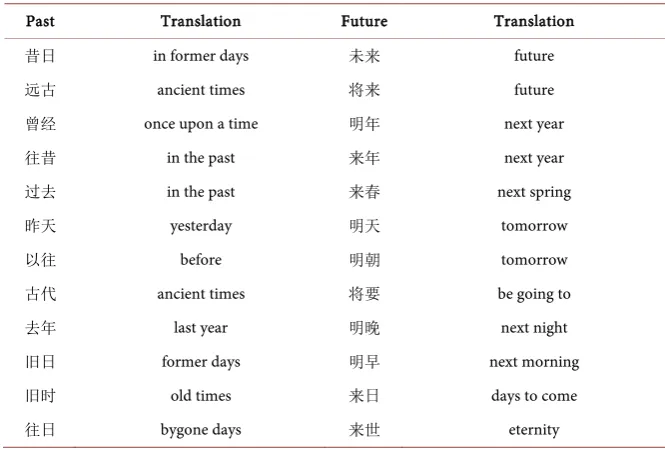
college students rated each word from 1 to 5 (“1” indicated it was highly consis-tent with its meaning, and “5” indicated it was highly inconsisconsis-tent with its meaning) to evaluate its temporal reference. After the evaluation, 48 Chinese temporal words were selected (see Appendix Table A1), Half of the words were past-related (the mean score of the past-related words is 4.60), such as “xi1 ri4” (“昔日” means in past days) and the other half referring to future time (the
mean score of the future-related words is 4.24), such as “ming2 tian1” (“明天”
means tomorrow or in the following days). All the words are located in the Ap-pendix.
All words were presented in 24 pt. Songti font. The task was programmed in E-prime (Schneider, Eschman, & Zuccolotto, 2002) and conducted on a com-puter using an Intel Pentium IV PC 1.70 GHz. Stimuli were presented on a 15 inch (38.1 cm) color monitor. The target was a dot of 5 mm diameter, which appeared in one of two 1.3 × 1.3 cm2 boxes. The boxes were on both side of the
screen (7.39˚ of visual angle; 7.75 cm from the center). All stimuli were presented in white on a black background. The experiment was run in a sound-attenuated, dimly illuminated room.
2.1.3. Procedure and Design
DOI: 10.4236/psych.2017.811111 1683 Psychology
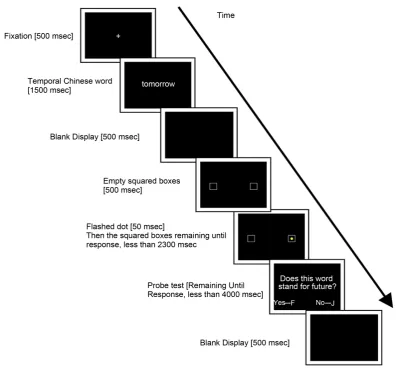
Figure 1. Event sequence of one trial in Experiment 1.
for 500 ms, followed by a centrally presented past-related or future-related Chi-nese word for 1500 ms. Participants were instructed to memorize the temporal reference of the presented words. A blank screen was presented for 500 ms, and two empty square boxes were presented at the left and right positions of the monitor. After 250 ms, a yellow dot flashed for 50 ms in one of the two boxes. The two boxes remained on the screen until the participant responded and timed out at 2300 ms. At this point, participants performed the localization tasks to locate where the dot appeared. The participant should press the “F” key if the dot appeared to the left and the “J” key if it appeared to the right.
DOI: 10.4236/psych.2017.811111 1684 Psychology
The experiment had two blocks, differing in the mapping of “F” and “J” to yes or no responses. The order of blocks was counterbalanced over participants. Within each block, each experimental word was presented four times, paired with targets at either location, and were presented with both final probe ques-tions. Items across different conditions were presented in a random order. Par-ticipants were allowed to take a break between blocks. Each block consisted of 16 practices and 192 experimental trials. The experiment lasted about 45 - 50 mi-nutes.
2.2. Results and Discussion
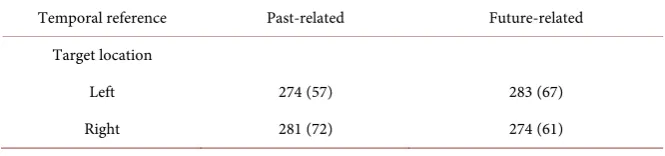
The results of reaction time in different conditions are summarized in Table 1. Localization errors were 0.43% of trials, and memory errors were 6.7% of trials.
The latency data were submitted to a 2 (Temporal Reference: past/future) × 2 (Target Location: left/right) two-way repeated measures ANOVA. In the latency analysis, the main effect of temporal reference was not significant, F(1,26) = 0.23, MSE = 126.49. The main effect of target location was also not significant, F(1,26) = 0.02, MSE = 6.80. However, we found a significant interaction between temporal reference and target location, F(1,26) = 6.50, MSE = 268.23, p = 0.017. The simple effect test revealed that when the targets were on the left side, there was a significant difference between different types of temporal reference, F(1,26) = 6.40, MSE = 173.23, p = 0.018, which indicates that the participants responded faster to the past-related words than the future-related words. When the targets were on the right side, there was no significant difference between different temporal references in the subject analysis, F(1,26) = 2.99, MSE = 221.49, p = 0.096, but there was a trend that participants responded faster to the future-related words than the past-related words from descriptive results.
[image:6.595.206.539.648.726.2]The results in Experiment 1 showed a left-past/right-future (horizontal) faci-litating effect for the targets presented at the location cued by the centrally pre-sented Chinese temporal words. Specifically, when the targets were on the left side, the responses to the past-related words were significantly faster than the future-related words, and vice versa. This suggested that temporal reference is able to orient attention along the horizontal axis in Chinese speakers. Further, consistent with Ouellet et al. (2010), this result supported that Chinese speakers use spatial-temporal metaphor representation in the horizontal axis (i.e., the “left-past/right-future” phenomenon).
Table 1. Means and standard deviations (in Parentheses) of the Latency (ms) per
Condi-tion in Experiment 1 for temporal reference and target locaCondi-tion.
Temporal reference Past-related Future-related
Target location
Left 274 (57) 283 (67)
DOI: 10.4236/psych.2017.811111 1685 Psychology
3. Experiment 2
In Experiment 1, we found evidences that the horizontal spatial-temporal meta-phor exists in Chinese speakers. However, it is still unclear whether this is the only dimension used or not. The purpose of Experiment 2 was to investigate whether there was a vertical dimension that Chinese speakers also use when they represent time.
3.1. Method
3.1.1. Participants
Twenty-eight native Chinese speaking adults (mean age = 23 years; 13 females and 15 males) participated in this experiment.
3.1.2. Materials and Apparatus
The same words in Experiment 1 were used.
3.1.3. Procedure and Design
The procedure in Experiment 2 is similar to Experiment 1. The only difference is that the dimension was vertical rather than horizontal (i.e., the “7” and “n” keys). In order to balance the facilitating effect that right-left hand response to up-down localization may cause, half of the participants used their left hand to press the top key and their right hand to press the bottom key, and vice versa for the other half. Both the order of the responding-key assignment and the hand position were counterbalanced across participants.
Participants were allowed to take a break between blocks. Each block con-sisted of 16 practice and 192 experimental trials. The experiment lasted about 45 to 50 minutes.
3.2. Results and Discussion
Out of the correct trials, 4.36% of trials were outliers (3 SD above or below each participant’s mean) and were discarded from the reaction time analyses. The re-sults are summarized in Table 2.
[image:7.595.206.538.662.724.2]The latency data were conducted to a 2 (temporal reference: past-related/ future) × 2 (target location: top/bottom) two-way repeated measure ANOVA. In the latency analysis, the main effect of temporal reference was not significant, F(1,27) = 0.019, MSE = 256.78. The main effect of target location also was not significant, F(1, 27) = 0.086, MSE = 967.36. However, again we found a signifi-cant interaction between temporal reference and target location, F(1,27) =
Table 2. Means and standard deviations (in Parentheses) of the Latency (ms) per
Condi-tion in Experiment 2 for temporal reference and target locaCondi-tion.
Temporal reference Past-related Future-related
Target location
Top 304 (36) 312 (42)
DOI: 10.4236/psych.2017.811111 1686 Psychology
14.715, MSE = 90.64, p = 0.001.
The simple effect test demonstrated that, when the targets were located on the top, a significant difference between different types of temporal reference was found, F(1,27) = 4.35, MSE = 172.99, p = 0.047, suggesting that the participants responded faster to the past-related words than the future-related words; when the targets were placed at the bottom, there was also a marginally significant dif-ference between different temporal redif-ferences, F(1,27) = 3.39, MSE = 174.48, p = 0.076, suggesting that participants responded faster to the future words than the past words.
The results in Experiment 2 showed a top-past/bottom-future (vertical) facili-tating effect for targets presented at the location cued by the centrally presented Chinese temporal words. Specifically, when the targets were at the top, the res-ponses to the past-related words were significantly faster than that for the fu-ture-related words. When the targets were at the bottom, the responses to the past-related words were significantly slower than that for the future-related words. This indicated that temporal reference was able to orient attention along the vertical axis for Chinese speakers.
4. Experiment 3
The results from Experiment 1 and Experiment 2 demonstrated that Chinese speakers used both vertical and horizontal spatial-temporal metaphors when they represented Chinese temporal words. A further question arises that if Chi-nese speakers use both vertical and horizontal spatial-temporal metaphors, which one would dominate when they processed temporal information? There-fore, Experiment 3 was designed to explore which spatial metaphor was the do-minant factor between the two dimensions.
4.1. Method
4.1.1. Participants
Twenty-eight native Chinese speaking adults (mean age = 22.7 yrs., 10 females and 18 males) participated this experiment.
4.1.2. Materials and Apparatus
The same words as in Experiment 1 and 2 were used.
4.1.3. Procedure and Design
DOI: 10.4236/psych.2017.811111 1687 Psychology time?” The experimenter recorded whether the answer was right or wrong. Then the participants pressed the key “5” to continue the task. Participants were al-lowed to take a break between blocks. Each block consisted of 16 practices and 192 experimental trials.
[image:9.595.208.539.628.727.2]4.2. Results and Discussion
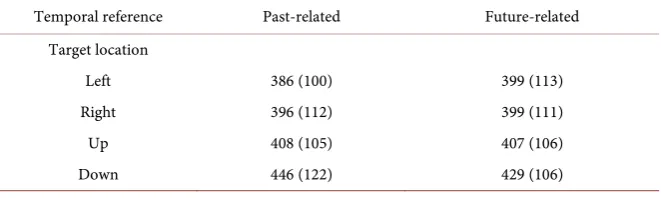
Table 3 showed the mean of the latency data in Experiment 3. The latency data were conducted to a 2 (temporal reference: past/future) × 2 (target dimension: vertical axis/horizontal axis) two-way repeated measure ANOVA. In the latency analysis, the main effect of temporal reference was not significant, F(1,27) = 0.15, MSE = 70.82. The main effect of target dimension was significant, F(1,27) = 12.47, MSE = 1746.57, p = 0.002. More importantly, a significant interaction between temporal reference and target dimension was observed, F(1,27) = 11.00, MSE = 190.56, p = 0.003.
The simple effect test showed that when the temporal words indicate past time, there was a significant difference in the different dimensions, F(1,27) = 20.71, MSE = 902.55, p < 0.001, that is, the participants responded faster to the horizontal dimension than to the vertical dimension. When the temporal words indicated future time, there was also a significant difference for the different di-mensions, F(1,27) = 5.01, MSE = 1034.04, p = 0.034, showing that participants responded faster to the horizontal dimension than to the vertical dimension.
Furthermore, the latency data were also submitted to a 2 (temporal reference: past/future) × 4 (target position: top/bottom/right/left) two-way repeated meas-ure ANOVA. The results showed that the main effect of temporal reference was not significant, F(1,27) = 0.15, MSE = 141.65. The main effect of target position was significant, F(1,27) = 12.04, MSE = 1939.52, p < 0.001. More importantly, we found a significant interaction between temporal reference and target position, F(1,27) = 6.05, MSE = 354.51, p = 0.001.
The simple effect test results showed when the temporal words described past time, there was a significant difference among target positions, F(3,81) = 18.23, MSE = 1075.41, p < 0.001, furthermore, the participants responded faster to the past-related targets on the left than that on the top. When the temporal words described future time, there was also a significant difference among target posi-tions, F(3,81) = 4.84, MSE = 1217.74, p = 0.004, and the participants responded
Table 3. Means and standard deviations (in Parentheses) of the Latency (ms) per
Condi-tion in Experiment 3 for temporal reference and target locaCondi-tion.
Temporal reference Past-related Future-related
Target location
Left 386 (100) 399 (113)
Right 396 (112) 399 (111)
Up 408 (105) 407 (106)
DOI: 10.4236/psych.2017.811111 1688 Psychology
faster to the future-related target on the right than that under the bottom. The results of Experiment 3 showed a facilitating effect for the targets pre-sented at the location cued by past-related and future-related Chinese temporal words. Specifically, when the stimuli were past-related temporal words, the res-ponses to the left were significantly faster than to those at the top. When the stimuli were future temporal words, the responses to the right were significantly faster than at the bottom. This suggested that temporal reference was able to orient attention in Chinese speakers, and that the horizontal dimension was more dominant than the vertical dimension.
5. General Discussion
The results of Experiments 1 and 2 demonstrated that Chinese temporal words induced visuo-spatial attentional orienting for Chinese speakers. Past-related temporal words were able to orient attention to the left or top, and the future temporal words were able to orient attention to the right or bottom. The results of Experiment 3 demonstrated that Chinese speakers tended to respond faster in the horizontal dimension than in the vertical dimension in the processing of Chinese temporal words. This signified that temporal reference is able to orient attention in Chinese speakers and the horizontal axis is the dominant dimension compared to the vertical axis. These findings also demonstrated that the repre-sentation of time depends on the reprerepre-sentation of space, supporting the Meta-phorical Structuring View (Lakoff & Johnson, 1980a).
These results are partially inconsistent with one of the conclusions by Boro-ditsky (2001) which English speakers used horizontal spatial-temporal metaphor to represent time, while Chinese speakers used vertical spatial-temporal meta-phor instead. In Boroditsky’s study, the spatial priming paradigm was used, which prompted the spatial orientation to activate before the time concepts were processed. Therefore, the results could not strongly demonstrate that people represent the concept of time by using spatial concepts. Moreover, all the par-ticipants in that study were Chinese-English bilinguals, and all the materials were in English. The processing of temporal words in Chinese might be influ-enced by English language and their English thinking style (Luna, Ringberg, & Peracchio, 2008). In the current study, the participants processed the time con-cepts and then made the judgment of spatial localizations.
DOI: 10.4236/psych.2017.811111 1689 Psychology
speakers arranged the events from right to left direction. It showed that the res-ponses of English and Hebrew speakers were congruent with their writing direc-tionality. These results suggest that, when people represent the temporal con-cepts, the participants automatically access their cultural specific spatial repre-sentations even when space is implicit to the task.
Based upon these findings, we assumed that the writing direction affects the way of representing time, and the dominant dimension is affected by the Chi-nese right-to-left writing habits. In China, from ancient times until around 1955, vertical direction was the standard orientation of written text, and people can get to these written works in daily life. Therefore, this historical orientation may be one of the factors that influence Chinese speakers to have the vertical spa-tial-temporal metaphor. For contemporary Chinese speakers, the frequency of writing and reading in horizontal direction is much higher than that in vertical direction, though a few reading materials are still written in vertical direction. Therefore, the dominant dimension is the horizontal dimension in most com-mon reading tasks in Chinese, and may be part of the reasoning as to why the horizontal dimension is more pronounced.
The phenomenon that Chinese speakers use the vertical dimension of space concepts to characterize time also can due to linguistic factors, such as the in-fluence from native language, culture, and Chinese history. The vertical tempor-al reference emerged in Chinese literature thousands of years ago. Lan (1999) pointed out that the vertical temporal reference in Chinese was a concept purely based on spatial reference and was found in the earliest known stage of the de-velopment of written Chinese. And this temporal-spatial metaphor could possi-bly be related to the movement of the sun. In addition, it might also have a rela-tionship with the traditional Chinese culture. In ancient China, most people place the ancestors’ name boards on the high desks, and they kneeled down to worship ancestors. Base on these customs, the ancestors in China also are called as /Shang4 Zu3/ (/Shang4/ means “up”, /Zu3/ means “generation”), and the younger generations are called as /Xia4 Bei4/ (/Xia4/ means “down”, /Bei4/ also means “generation”), which contains the spatial reference “up” and “down”.
DOI: 10.4236/psych.2017.811111 1690 Psychology
people use spatial perception to represent time, which also can be found in early developmental stages of children. Furthermore, people have a stronger percep-tion of movement and space, but relatively have a weaker perceppercep-tion of time. Due to the constraints of the physiological basis of this phenomenon, people use spatial perception to represent time.
Because of the spatial-temporal conceptual metaphor, humans can imagine an invisible time event into a cognitive system in reality. Therefore, the studies in this area explored the spatial representation of the metaphor of time to reveal the nature of time thinking and time perception. This exploration can help us to understand the information of the concept of time, and the representation of the time concept model, as well as the effects of language and culture on the repre-sentation of concepts.
Acknowledgements
This research was supported by National Natural Science Foundation of China (31671132) and the MOE Project of Key Research Institute of Humanities and Social Sciences in Universities (15JJD190005).
Contribution
We state that all the authors and co-authors have given substantial contribution for this manuscript.
References
Boroditsky, L. (2000). Metaphoric Structuring: Understanding Time through Spatial Me-taphors. Cognition, 75, 1-28. https://doi.org/10.1016/S0010-0277(99)00073-6
Boroditsky, L. (2001). Does Language Shape Thought?: Chinese and English Speakers' Conceptions of Time. Cognitive Psychology, 43, 1-22.
https://doi.org/10.1006/cogp.2001.0748
Boroditsky, L. (2011). How Language Shapes Thought. Scientific American, 304, 62-65.
https://doi.org/10.1038/scientificamerican0211-62
Boroditsky, L., Fuhrman, O., & McCormick, K. (2011). Do English and Chinese Speakers Think about Time Differently? Cognition, 118, 123-129.
https://doi.org/10.1016/j.cognition.2010.09.010
Bottini, R., & Casasanto, D. (2010). Implicit Spatial Length Modulates Time Estimates, But Not Vice Versa. In C. Hölscher, T. F. Shipley, M. Olivetti Belardinelli, J. A. Bate-man, & N. Newcombe (Eds.), Spatial Cognition VII. International Conference, Spatial Cognition 2010, Mt. Hood/Portland, OR, 15-19 August 2010, 152-162. Berlin Heidel-berg: Springer. https://doi.org/10.1007/978-3-642-14749-4_15
Casasanto, D., & Boroditsky, L. (2008). Time in the Mind: Using Space to Think about Time. Cognition, 106, 579-593. https://doi.org/10.1007/978-3-642-14749-4_15
Casasanto, D., & Bottini, R. (2010). Can Mirror-Reading Reverse the Flow of Time? In C. Hölscher, T. F. Shipley, M. Olivetti Belardinelli, J. A. Bateman, & N. S. Newcombe (Eds.), Spatial Cognition VII. International Conference, Spatial Cognition 2010, Mt. Hood/Portland, OR, 15-19 August 2010, 335-345. Berlin Heidelberg: Springer.
DOI: 10.4236/psych.2017.811111 1691 Psychology
Chen, J. (2007). Do Chinese and English Speakers Think about Time Differently? Failure of Replicating Boroditsky (2001). Cognition, 104, 427-436.
https://doi.org/10.1016/j.cognition.2006.09.012
Clark, H. H. (1973). Space, Time, Semantics, and the Child. Cognitive Development and the Acquisition of Language, 27, 63.
Fuhrman, O., & Boroditsky, L. (2010). Cross-Cultural Differences in Mental Representa-tions of Time: Evidence from an Implicit Nonlinguistic Task. Cognitive Science, 34, 1430-1451. https://doi.org/10.1111/j.1551-6709.2010.01105.x
Fuhrman, O., McCormick, K., Chen, E., Jiang, H., Shu, D., Mao, S., & Boroditsky, L. (2011). How Linguistic and Cultural Forces Shape Conceptions of Time: English and Chinese Time in 3D. Cognitive Science, 35, 1305-1328.
https://doi.org/10.1111/j.1551-6709.2011.01193.x
Gentner, D., Imai, M., & Boroditsky, L. (2002). As Time Goes by: Evidence for Two Sys-tems in Processing Space-Time Metaphors. Language and Cognitive Processes, 17, 537-565. https://doi.org/10.1080/01690960143000317
Haspelmath, M. (1997). From Space to Time: Temporal Adverbials in the World’s Lan-guages. Lincom Europa.
Hung, Y, Hung, D. L., Tzeng, O. J. L., & Wu, D. H. (2008). Flexible Spatial Mapping of Different Notations of Numbers in Chinese Readers. Cognition, 106, 1441-1450. Lakoff, G., & Johnson, M. (1980a). Conceptual Metaphor in Everyday Language. The
Journal of Philosophy, 77, 453-486. https://doi.org/10.2307/2025464
Lakoff, G., & Johnson, M. (1980b). Metaphors We Live by. Chicago: University of Chica-go Press.
Lan, C. (1999). Chinese Spatial Metaphor in Cognitive Aspect. Foreign Language Teach-ing and Research, 4, 7-15. (In Chinese)
Luna, D., Ringberg, T., & Peracchio, L. (2008). One Individual, Two Identities: Frame Switching among Biculturals. Journal of Consumer Research, 35, 279-293.
https://doi.org/10.1086/586914
McGlone, M. S., & Harding, J. L. (1998). Back (or Forward?) to the Future: The Role of Perspective in Temporal Language Comprehension. Journal of Experimental Psychol-ogy-Learning Memory and Cognition, 24, 1211-1223.
https://doi.org/10.1037/0278-7393.24.5.1211
Merritt, D. J., Casasanto, D., & Brannon, E. M. (2010). Do Monkeys Think in Metaphors? Representations of Space and Time in Monkeys and Humans. Cognition, 117, 191-202. Ouellet, M., Santiago, J., Jesus Funes, M., & Lupianez, J. (2010). Thinking about the
Fu-ture Moves Attention to the Right. Journal of Experimental Psychology-Human Per-ception and Performance, 36, 17-24. https://doi.org/10.1037/a0017176
Posner, M. I. (1980). Orienting of Attention. Quarterly Journal of Experimental Psychol-ogy, 32, 3-25. https://doi.org/10.1080/00335558008248231
Posner, M. I., & Cohen, Y. (1984). Components of Visual Orienting. In H. Bouma, & D. Bowhuis (Eds.), Attention and Performance X (pp. 531-556). Hillsdale, NJ: Erlbaum. Posner, M. I., Rafal, R. D., Choate, L. S., & Vaughan, J. (1985). Inhibition of Return:
Neural Basis and Function. Cognitive Neuropsychology, 2, 211-228.
https://doi.org/10.1080/02643298508252866
Radden, G. (2011). Spatial time in the West and the East. Space and Time in Language, 1-40.
DOI: 10.4236/psych.2017.811111 1692 Psychology
Scott, A. (1989). The Vertical Dimension and Time in Chinese. Australian Journal of Linguistics, 9, 295-314. https://doi.org/10.1080/07268608908599424
Torralbo, A., Santiago, J., & Lupiáñez, J. (2006). Flexible Conceptual Projection of Time onto Spatial Frames of Reference. Cognitive Science, 30, 745-757.
https://doi.org/10.1207/s15516709cog0000_67
Tversky, A., & Shafir, E. (2004). Preference, Belief, and Similarity: Selected Writings. Cambridge, MA: MIT Press.
Tversky, B., & Franklin, N. (1994). Spatial Mental Models from Descriptions. Journal of the American Society for Information Science, 45, 656-668.
https://doi.org/10.1002/(SICI)1097-4571(199410)45:9<656::AID-ASI3>3.0.CO;2-1
Tversky, B., Kugelmass, S., & Winter, A. (1991). Cross-Cultural and Developmental Trends in Graphic Productions. Cognitive Psychology, 23, 515-557.
Zhou, R., & Huang, X. (2001). A Study on Children’s Development of the Capacity of Gaining Metaphorical Representation of Time. Psychological Science-SHANGHAI, 24, 606-609. (In Chinese)
[image:14.595.205.538.373.598.2]Appendix
Table A1. Stimulus words with approximate literal translations.
Past Translation Future Translation
昔日 in former days 未来 future
远古 ancient times 将来 future
曾经 once upon a time 明年 next year
往昔 in the past 来年 next year
过去 in the past 来春 next spring
昨天 yesterday 明天 tomorrow
以往 before 明朝 tomorrow
古代 ancient times 将要 be going to
去年 last year 明晚 next night
旧日 former days 明早 next morning
旧时 old times 来日 days to come
Submit or recommend next manuscript to SCIRP and we will provide best service for you:
Accepting pre-submission inquiries through Email, Facebook, LinkedIn, Twitter, etc. A wide selection of journals (inclusive of 9 subjects, more than 200 journals)
Providing 24-hour high-quality service User-friendly online submission system Fair and swift peer-review system
Efficient typesetting and proofreading procedure
Display of the result of downloads and visits, as well as the number of cited articles Maximum dissemination of your research work
Submit your manuscript at: http://papersubmission.scirp.org/