ISSN Online: 2152-7199 ISSN Print: 2152-7180
DOI: 10.4236/psych.2017.811109 Aug. 31, 2017 1657 Psychology
Differences in Ego Functions between Those
with Tendency to Atypical Depression and
Those with Tendency to Melancholic
Depression
Hideki Hayashi
1, Yuko Takei
2, Akihito Fujimori
2, Itsuko Takeuchi
2, Takahiro Hono
21Graduate School of Health and Welfare, Kawasaki University of Medical Welfare, Okayama, Japan 2Kawasaki University of Medical Welfare, Okayama, Japan
Abstract
This study aimed to clarify ego functions of the university students having a tendency to atypical depression by comparing those with other students hav-ing a tendency to melancholic depression and borderline personality disorder. The answers to the questionnaires were obtained from 278 university stu-dents. The results showed that no difference was found in the total scores of ego functions and the scores of the sub-scales such as “synthetic-integrative functioning,” “sense of reality,” “control of impulses,” “objective relation,” “stimulus barrier,” and “autonomous functioning” between the students hav-ing a tendency to atypical depression and those havhav-ing a tendency to melan-cholic depression; while the scores of the “defensive functioning,” one of the ego functions, were significantly higher in the students having a tendency to atypical depression than in those having a tendency to melancholic depres-sion. This suggested that the students having a tendency to atypical depression may have a higher function of protecting their ego from conflicts than those having a tendency to melancholic depression.
Keywords
Tendency to Atypical Depression, Ego Functions, Tendency to Melancholic Depression, Defensive Functioning
1. Introduction
As the percentage of students enrolling in universities has been increasing in Ja-pan, special attention has been paid to the problem of university students’ mala-How to cite this paper: Hayashi, H., Takei,
Y., Fujimori, A., Takeuchi, I., & Hono, T. (2017). Differences in Ego Functions be-tween Those with Tendency to Atypical Depression and Those with Tendency to Melancholic Depression. Psychology, 8, 1657-1668.
https://doi.org/10.4236/psych.2017.811109
Received: July 27, 2017 Accepted: August 28, 2017 Published: August 31, 2017
Copyright © 2017 by authors and Scientific Research Publishing Inc. This work is licensed under the Creative Commons Attribution International License (CC BY 4.0).
DOI: 10.4236/psych.2017.811109 1658 Psychology daptation. In particular, “escape” can be mentioned as one of the behaviors ex-hibited by the maladaptive university students, but may be often mistaken for idleness or dependence (Takehata & Sase, 2015). However, some of the univer-sity students whose behaviors appear to be idle or excessively dependent may actually suffer from certain mental problems.
Atypical depression is one of the mental diseases often mistaken for idleness and dependence. The number of patients with atypical depression has been re-cently increasing, especially among the younger generation. The Diagnostic and Statistical Manual of Mental Disorders (DSM-5; American Psychiatric Associa-tion, 2013) defines the cardinal symptom of atypical depression as “mood reac-tivity.” More specifically, patients with atypical depression usually indicate a de-pressive mood, but brighten the mood in response to actual or potential positive events. For example, the university students with atypical depression indicate a depressive mood in attending a lecture or taking an examination, but they can enjoy dating without indicating a depressive mood. Such clinical pictures of the patients with atypical depression may occasionally be mistaken for the signs of idleness and dependence (Denda, 2009). There is a possibility that not a few university students suffer from maladaptation due to atypical depression among the students appearing idle or dependent. In light of this, it is necessary to take measures for supporting such latent patients in addition to the students slightly indicating the clinical pictures of atypical depression.
Drug therapy with monoamine oxidase inhibitors has been considered to be an effective method for treating the patients with atypical depression. However, this method has the problem of the serious side effect. In the clinical field, therefore, the selective serotonin reuptake inhibitors with fewer side effects are frequently used (Nierenberg, Alpert, Pava, Rosenbaum, & Fava, 1998). However, it is reported that the efficacy of the selective serotonin reuptake inhibitors on the patients with atypical depression is limited (Singh & Williams, 2006). Meanwhile, the patients with atypical depression and those with borderline per-sonality disorder show some similarities in the clinical pictures and the attitudes
(Perugi et al., 1998;Perugi & Akiskal, 2002), which leads to the assumption that atypical depression may stem from the problem of patient’s personality (Fuku-nishi & Fuku(Fuku-nishi, 2013). Understanding of the psychological mechanisms of atypical depression is therefore considered to reveal clues about how to effec-tively support the students having a tendency to atypical depression.
The case studies of psychotherapy become useful means for understanding the psychological mechanisms of the corresponding diseases. The case studies deal-ing with the clinical pictures related to atypical depression are present (e.g., To-kioka, 2015), but the number is not sufficient. In other words, the psychological mechanisms of atypical depression have not yet been fully clarified.
DOI: 10.4236/psych.2017.811109 1659 Psychology results indicate that both the psychoanalysis and the cognitive behavioral thera-py produce the respective effects, but the effect of the psychoanalysis is found to last longer. It is speculated that the reason for this is that the psychoanalysis could bring some changes to the patients’ personality structure (Huber et al., 2012;Fonagy et al., 2015). With the problem of personality in atypical depres-sion being taken into account, it is considered useful to go into the psychological mechanisms of atypical depression from the viewpoint of psychoanalysis.
In the psychoanalysis, great importance has been placed on assessment of the patients’ ego functions (Bellak, Hurvich, & Gediman, 1973). The ego functions mean psychological functions to support individual adaptation, including the capacity of evolving the interpersonal relationships (objective relation), the de-fensive functioning to adjust individual adaptation against conflicts and stresses, the function of testing reality that provides the basis for perceiving the external events and understanding those events correctly, and the like. However, the ego functions of patients with atypical depression have not yet been fully studied. In contrast to this, the ego functions of the patients with melancholic depression and borderline personality disorder have been understood to some extent. In addition, the relations of melancholic depression with atypical depression have been studied (Rodgers et al., 2016), and similarities between borderline perso-nality disorder and atypical depression have been demonstrated (Perugi et al., 1998). In light of the above, studies on melancholic depression and borderline personality disorder should help us understand the ego functions of patients with atypical depression.
DOI: 10.4236/psych.2017.811109 1660 Psychology disorder are assumed to be lower than those of the patients with melancholic depression. However, when compared with the patients with borderline perso-nality disorder, the patients with atypical depression are considered to be able to more properly evaluate the relationships with other people except their therap-ists (Kaiya, 2008), so that the level of their reality testing ability may be higher. For these reasons, it is speculated that the ego functions of the patients with atypical depression may be better than those of the patients with borderline per-sonality disorder. For clarifying the ego functions of the university students having a tendency to atypical depression in this study, we tried to examine the above-mentioned hypotheses by comparing the university students having a tendency to atypical depression with those having tendencies to melancholic de-pression and borderline personality disorder. This study can reveal the ego func-tions of those having a tendency to atypical depression, which have not been fully found out in the past. We therefore believe this study will contribute to-ward discussing how to support the university students with a tendency to atyp-ical depression.
2. Methods
2.1. Sample
We conducted a questionnaire study, targeting Japanese students of a provincial private university. Questionnaires were distributed to the students in a liberal arts class, who belonged to various departments and totaled 278. First, we orally informed the students about what our study consisted of and that participation into this study was optional. Then, we asked the students to fill in the question-naires after obtaining their consent. By excluding the questionquestion-naires not com-pletely filled in, 244 valid responses were received from 77 male students and 167 female students, with the average age of 19.8 (SD = 1.2). This study was conducted after gaining approval from the Ethical Review Committee of Kawa-saki University of Medical Welfare (No. 16-063).
2.2. Measurements
2.2.1. Depression SubtypesDOI: 10.4236/psych.2017.811109 1661 Psychology clinical picture of melancholic depression. The subjects having the total score of −3 or less were assessed to have clinical pictures of atypical depression; and those having the total score of +3 or more, clinical pictures of melancholic de-pression. The reliability and the validity of the GSD have been confirmed by
Fukunishi & Fukunishi (2012).
2.2.2. Borderline Personality Disorder
The Millon Clinical Multiaxial Inventory-II Borderline Scale short version (MCMI-II; Izawa, Ohno, Asai, & Okonogi, 1995) was used for determining the presence of borderline personality disorder on a two-point scale. This scale is shorted through the results of the item analysis of MCMI-II Borderline Scale de-signed by Millon (1987). The MCMI-II consists of 17 items. The subjects having a total score of 10 or more were assessed to have borderline personality disorder. The reliability and validity of the MCMI-II have been repeatedly confirmed by
Izawa et al. (1995), Izawa (1999) and the like.
2.2.3. Ego Functions
The Ego Function Inventory (EFI; Nakanishi & Sakata, 1989) was used for rating ego functions on a five-point scale. The EFI was prepared by revising the Ego Function Inventory (Nakanishi & Furuichi, 1981), which was a short version of the Ego Function Assessment designed by Bellak et al. (1973). The EFI has 42 items, each of which has five response options. The higher the total score, the more smoothly the whole ego functions are considered to work. The ego func-tions consist of seven subscale funcfunc-tions, which can separately be rated by the six items. As the score of each subscale function becomes higher, the condition of the corresponding function is considered to be better. The reliability and validity of the EFI have been confirmed by Nakanishi & Sakata (1989).
3. Results
3.1. Group Classification
DOI: 10.4236/psych.2017.811109 1662 Psychology personality disorder was considered to be too small to be subjected to generali-zation, so that this group was removed from the analysis.
3.2. Differences between the Sexes
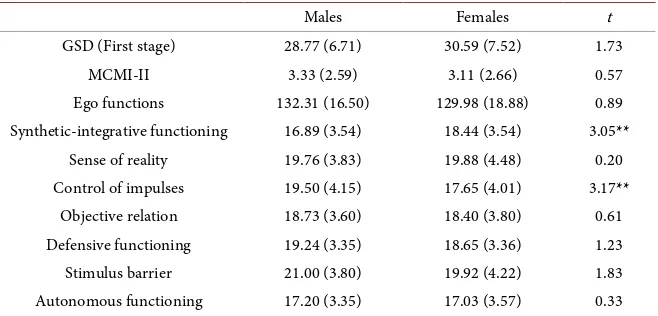
The t-test was used to assess whether the males and the females were different from each other in the results from the above-mentioned scales (Table 1). The males showed significantly lower scores than the females in one of the subscale functions, “synthetic-integrative functioning.” This result was the same as that in
Nakanishi & Sakata (1989). In contrast, the males showed significantly higher scores than the females in another subscale function, “control of impulses.” The function of “control of impulses” is proved to decrease until about thirty and then gradually increase both in males and females (Nakanishi & Sakata, 1989). In addition, the function of “control of impulses” is found to be higher in males than females at lower ages (Nakanishi & Furuichi, 1981). In light of the above, the sexual differences in “synthetic-integrative functioning” and “control of im-pulses” recognized in this study are not considered to be peculiar results.
3.3. Differences in Ego Functions
This study aimed to clarify ego functions of the university students having a tendency to atypical depression by comparing those with other students having a tendency to melancholic depression and borderline personality disorder. How-ever, the number of the students having a tendency to borderline personality disorder was so small that they were excluded from the following analyses. Ac-cordingly, the students having a tendency to atypical depression were compared with those having a tendency to melancholic depression in the analyses to be described later.
[image:6.595.210.539.552.710.2]The one-way analysis of variance (one-way ANOVA) was conducted, with the groups, i.e., the group having a tendency to atypical depression (AD), the group having a tendency to melancholic depression (MD), and the group having no tendency to atypical depression or melancholic depression (ND) being set as the
Table 1. Means (SD) of scores in males and females and results of t-test.
Males Females t
GSD (First stage) 28.77 (6.71) 30.59 (7.52) 1.73
MCMI-II 3.33 (2.59) 3.11 (2.66) 0.57
Ego functions 132.31 (16.50) 129.98 (18.88) 0.89 Synthetic-integrative functioning 16.89 (3.54) 18.44 (3.54) 3.05**
Sense of reality 19.76 (3.83) 19.88 (4.48) 0.20 Control of impulses 19.50 (4.15) 17.65 (4.01) 3.17**
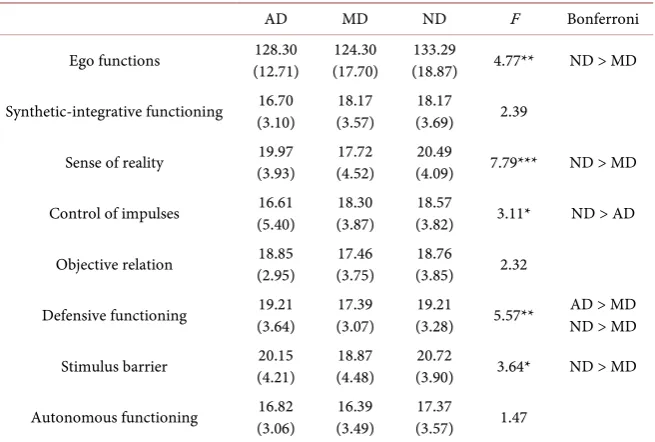
DOI: 10.4236/psych.2017.811109 1663 Psychology independent variables and the means of the total scores of ego functions as the dependent variables. The results showed a significant main effect (F(2, 221) = 4.77, p < 0.01), so that multiple comparison was made according to the Bonfer-roni method. The results showed that the mean total score of the ND was signif-icantly higher than that of the MD (p < 0.05), but no significant difference was found between the AD and the MD, and between the AD and the ND.
[image:7.595.211.539.467.688.2]To examine the ego functions in detail, the one-way ANOVA was conducted, with the groups, i.e., the AD, MD and ND being set as the independent variables and the mean score of each subscale from ego functions as the dependent va-riables. As a result, there was no significant difference in the subscale scores of “synthetic-integrative functioning,” “objective relation” and “autonomous func-tioning” (F(2, 221) = 2.39, ns; F(2, 221) = 2.32, ns; and F(2, 221) = 1.47, ns, re-spectively). On the other hand, there were significant main effects in the subscale scores of “sense of reality,” “control of impulses,” “defensive functioning” and “stimulus barrier” (F(2, 221) = 7.79, p < 0.001; F(2, 221) = 3.11, p < 0.05; F(2, 221) = 5.57, p < 0.01; and F(2, 221) = 3.64, p < 0.05, respectively), so that the multiple comparison was made according to the Bonferroni method. The results showed that the mean score of the AD was significantly lower than that of the ND in “control of impulses (p < 0.05),” and the mean score of the AD was sig-nificantly higher than that of the MD in “defensive functioning (p < 0.05).” As for “sense of reality” and “stimulus barrier,” the mean scores of the ND were significantly higher than those of the MD (p < 0.05), but there was no significant difference in the mean scores between the AD and the MD, and between the AD and the ND. Table 2 shows the mean total scores of ego functions and the mean
Table 2. Mean scores (SD) of three groups and results of one-way ANOVA and multiple
comparison.
AD MD ND F Bonferroni
Ego functions (12.71) 128.30 (17.70) 124.30 (18.87) 133.29 4.77** ND > MD
Synthetic-integrative functioning (3.10) 16.70 (3.57) 18.17 (3.69) 18.17 2.39
Sense of reality (3.93) 19.97 (4.52) 17.72 (4.09) 20.49 7.79*** ND > MD
Control of impulses (5.40) 16.61 (3.87) 18.30 (3.82) 18.57 3.11* ND > AD
Objective relation (2.95) 18.85 (3.75) 17.46 (3.85) 18.76 2.32
Defensive functioning (3.64) 19.21 (3.07) 17.39 (3.28) 19.21 5.57** ND > MD AD > MD
Stimulus barrier (4.21) 20.15 (4.48) 18.87 (3.90) 20.72 3.64* ND > MD
Autonomous functioning (3.06) 16.82 (3.49) 16.39 (3.57) 17.37 1.47
DOI: 10.4236/psych.2017.811109 1664 Psychology subscale scores, with the standard deviations in parentheses; and the results of the one-way ANOVA and the multiple comparison.
4. Discussion
We aimed to clarify the ego functions of university students having a tendency to atypical depression. For this purpose, we compared those students with other students having a tendency to melancholic depression and borderline personali-ty disorder to examine the hypothesis as mentioned above. However, the sub-jects having a tendency to borderline personality disorder were removed from the analysis because the number of the subjects was too small for analysis. Therefore, the discussion shown below is based on the comparison between the group having a tendency to atypical depression (AD) and the group having a tendency to melancholic depression (MD).
Our findings indicate no significant difference in the total score of the ego functions between the AD and the MD. The total score of the ego functions is considered to represent the overall functioning conditions of ego and the indi-vidual’s adaptability as shown in Nakanishi & Sakata (1989). Further in our study, no significant differences were found in the scores of “synthetic-integrative functioning” and “autonomous functioning,” i.e., the subscale items of ego func-tions, between the AD and the MD. As described in Bellak et al. (1973), the “synthetic-integrative functioning” is defined as the capacity to organize the disparate aspects of the personality, including intelligence and emotion into a unified structure; and the “autonomous functioning,” as the competence in op-erating one’s memories and thoughts to control oneself in such a way as one in-tends to do. Both of the above-mentioned functions are considered to form the basis of overall ego functions and support the individual adaptability. In light of this, our findings prove that fundamental and overall ego functions are not sig-nificantly different between the AD and the MD. In other words, the hypothesis built up for this study was not verified.
DOI: 10.4236/psych.2017.811109 1665 Psychology borderline character, so that the organization level of character pathology of the patients with atypical depression is different from that of the patients with bor-derline personality disorder. The hysterical character is regarded as the higher level of organization of character pathology (Kernberg, 1976), which is the same level of the depressive-masochistic character of the patients with melancholic depression, so that the conditions of the ego functions in the patients with atyp-ical depression may not be different from those in the patients with melancholic depression. From the above, we can infer the reasons for our findings that there are no significant differences in the total score of ego functions and the respec-tive scores of “synthetic-integrarespec-tive functioning” and “autonomous functioning” between the AD and the MD.
The results of this study also indicate that there is no significant difference between the AD and the MD in one of the ego functions, “sense of reality.” Bel-lak et al. (1973)defines the “sense of reality” as one of the ego functions that can provide the basis for the ability to feel one’s connection to the world as real and feel a sense of self. According to the diagnostic criteria of DSM-5 (American Psychiatric Association, 2013), atypical depression is characterized by expe-riencing frequent swing in mood, resulting from “mood reactivity,” and having heavy, leaden feelings in arms and legs, that is, “leaden paralysis.” In contrast, the patients diagnosed to have melancholic depression present severe depression in a chronic form, caused by excessive guilt or the like. Anyway, the conditions of the patients with atypical depression and melancholic depression are both considered too severe to fully gain the ability to feel one’s connection to the world as real and feel a sense of self. This is supposed to be the reason why there was no significant difference in the “sense of reality” between the AD and the MD in our findings.
Likewise, as for the subscale ego functions “objective relation” and “stimulus barrier,” the AD and the MD are not significantly different from each other.
DOI: 10.4236/psych.2017.811109 1666 Psychology just showing a tendency to atypical depression, so that they may not reach the stage where the secondary impairments are indicated. This is supposed to be the reason that the AD and the MD are not significantly different from each other in the “objective relation” and the “stimulus barrier.”
As previously discussed, significant differences are not found in many points between the AD and the MD in this study. However, only in the “defensive func-tioning,” there is a significant difference between the AD and the MD. The AD shows higher “defensive functioning” than the MD. As in Bellak et al. (1973), the “defensive functioning” is defined as a function of protecting the ego by coping with conflicts and stresses. That is to say, the AD is considered to have more ability to cope with the conflicts and stresses and protect the ego than the MD. This can be supported by the description that the patients with atypical depres-sion do not show chronic depresdepres-sion unlike the patients with melancholic de-pression (American Psychiatric Association, 2013). However, the AD is sup-posed to have problems in coping with the conflicts and stresses according to a study on the defense mechanisms used for coping with the conflicts and stresses
(Hayashi, Takei, Fujimori, Takeuchi & Hono, in press). The above-mentioned study on the defense mechanisms assumes that the patients with atypical depres-sion mainly use primitive defense mechanisms. The primitive defense mechan-isms are used to promptly find relief from conflicts or stresses by expulsion of the conflicts or stresses (Klein, 1946), and are regarded as the lowest-level de-fense mechanisms, observed in the severe psychotic state (Vaillant, 1986). Con-sequently, the students having a tendency to atypical depression are found to protect the ego from conflicts better than the students having a tendency to me-lancholic depression, but the protecting mechanisms are considerably maladap-tive, which may result in their internal unstableness.
It has been pointed out that the clinical pictures of the patients with atypical depression are considerably different from those of the patients with melanchol-ic depression (Singh & Williams, 2006). As is apparent from our findings, how-ever, there is no significant difference in ego functions between the AD and the MD with the exception of defensive functioning. In light of this, the ego func-tions of the AD may be similar to those of the MD although the clinical pictures are different from each other. More detailed examination into the defensive functioning of the university students having a tendency to atypical depression will be important to understand their psychological mechanisms. It will be ne-cessary to search for a more effective way of supporting those students through the examinations.
References
American Psychiatric Association (2013). Diagnostic and Statistical Manual of Mental Disorders, Fifth Edition. Arlington, MA: American Psychiatric Publication.
https://doi.org/10.1176/appi.books.9780890425596
Neurot-DOI: 10.4236/psych.2017.811109 1667 Psychology ics, Normals. New York: Wiley.
Denda, K. (2009). “Depression” among the Youth: What is “New Type Depression”? Tokyo: Chikumashobo. (In Japanese, translated by the author of this article)
Fonagy, P., Rost, F., Carlyle, J. A., McPherson, S., Thomas, R., Fearon, R. M. P., Goldberg, D., & Taylor, D. (2015). Pragmatic Randomized Controlled Trial of Long-Term Psy-choanalytic Psychotherapy for Treatment-Resistant Depression: The Tavistock Adult Depression Study (TADS). World Psychiatry, 14, 312-321.
https://doi.org/10.1002/wps.20267
Fukunishi, I., & Fukunishi, A. (2012). GSD Global Scale for Depression. Tokyo: Chiba Test Center. (In Japanese)
Fukunishi, I., & Fukunishi, A. (2013). Book to Know about New Type Depression. Tokyo: ASPECT. (In Japanese, translated by the author of this article)
Hayashi, H., Takei, Y. Fujimori, A., Takeuchi, I., & Hono, T. (in press). Characteristics of Parent-Child Relationship, Defense Mechanism and Ego Function of Atypical Depres-sion: Through Analysis Using SemistructuredInterviews with Psychiatrists and Clinical Psychologists. Kawasaki Medical Welfare Journal. (In Japanese with English abstract) Huber, D., Zimmermann, J., Henrich, G., & Klug, G. (2012). Comparison of
Cogni-tive-Behavior Therapy with Psychoanalytic and Psychodynamic Therapy for Depressed Patients: A Three-Year Follow-Up Study. Zeitschriftfür Psychosomatische Medizin und Psychotherapie, 58, 299-316.
Izawa, K. (1999). Persistent Effects of Traumatic Experiences on Borderline Personality Trait. Japanese Journal of Personality, 7, 88-98. (In Japanese with English abstract)
https://doi.org/10.2132/jjpjspp.7.2_88
Izawa, K., Ohno, Y., Asai, M., & Okonogi, K. (1995). Construction of MCMI-II Border-line Scale Short Version and Examination of its Validity and Reliability. Archives of Psychiatric Diagnostics and Clinical Evaluation, 6, 473-483. (In Japanese with English abstract)
Kaiya, H. (2008). Book for Thoroughly Understanding Atypical Depression: Whole As-pect of New Type Depression to be Mistaken for “Capriciousness” and “Selfishness”. Tokyo: Kodansha. (In Japanese, Translated by the Author of This Article)
Kernberg, O. (1976). Object Relations Theory and Clinical Psychoanalysis. Maryland: Ja-son AronJa-son.
Klein, D. F., Gittelman, R., Quitkin, F., & Rifkin, A. (1980). Diagnosis and Drug Treat-ment of Psychiatric Disorders: Adults and Children (2nd ed.). Baltimore: Williams and Wilkins.
Klein, M. (1946). Notes on Some Schizoid Mechanisms. International Journal of Psy-cho-Analysis, 27, 99-110.
Millon, T. (1987). Manual for the MCMI-II (2nd ed.). Minneapolis: National Computer Systems.
Nakanishi, N., & Furuichi, Y. (1981). A Psychological Study of Ego Function: Develop-ment of Ego Function Inventory. Bulletin of the Faculty of Human Sciences, Osaka University, 7, 189-220. (In Japanese with English Abstract)
Nakanishi, N., & Sakata, T. (1989). Development of Ego Functions in Adulthood Ego-Oriented Counseling for Adults: A Study Based on the Result of Ego Functions Inventory (EFI) of Adults. Japanese Journal of Counseling Science, 21, 129-138. (In Japanese with English Abstract)
DOI: 10.4236/psych.2017.811109 1668 Psychology Perugi, G., & Akiskal, H. S. (2002). The Soft Bipolar Spectrum Redefined: Focus on the
Cyclothymic, Anxious-Sensitive, Impulse-Dyscontrol, and Binge-Eating Connection in Bipolar II and Related Conditions. Psychiatric Clinics of North America, 25, 713-737.
https://doi.org/10.1016/S0193-953X(02)00023-0
Perugi, G., Akiskal, H. S., Lattanzi, L., Cecconi, D., Mastrocinque, C., Patronelli, A., Vig-noli, S., & Bemi, E. (1998). The High Prevalence of “Soft” Bipolar (II) Features in Atypical Depression. Comprehensive Psychiatry, 39, 63-71.
https://doi.org/10.1016/S0010-440X(98)90080-3
Rodgers, S., Vandeleur, C. L., Ajdacic-Gross, V., Aleksandrowicz, A. A., Strippoli, M. F., Castelao, E., Glaus, J., Lasserre, A. M., Müller, M., Rössler, W., Angst, J., & Preisi, M. (2016). Tracing the Associations between Sex, the Atypical and the Combined Atypi-cal-Melancholic Depression Subtypes: A Path Analysis. Journal of Affective Disorders, 190, 807-818. https://doi.org/10.1016/j.jad.2015.10.067
Sargant, W. (1962). The Treatment of Anxiety States and Atypical Depression by the Monoamine Oxidase Inhibitor Drugs. Journal of Neuropsychiatry, 3, 96-103.
Singh, T., & Williams, K. (2006). Atypical Depression. Psychiatry, 3, 33-39.
Takehata, Y., & Sase, R. (2015). Maladjustment of University Students: Assessment of Maladjustment and Over-Adaptation. OIU Journal of International Studies, 28, 65-71. (In Japanese with English Abstract)
Tokioka, R. (2015). Essay on Psychotherapy for Apathy and New Type Depression: With Attention Paid to Difficulties of Having Conflicts. Archives of Student Support in Kyoto University General Student Support Center, 45, 83-94. (In Japanese, Translated by the Author of This Article)
Vaillant, G. E. (1986). Vaillant’s Glossary of Defenses. In Vaillant, G. E. (Ed.), Empirical Studies of Ego Mechanisms of Defense (pp. 111-120). Washington DC: American Psy-chiatric Press.
West, E. D., & Dally, P. J. (1959). Effect of Iproniazid in Depression Syndromes. British Medical Journal, 1, 1491-1494. https://doi.org/10.1136/bmj.1.5136.1491
Submit or recommend next manuscript to SCIRP and we will provide best service for you:
Accepting pre-submission inquiries through Email, Facebook, LinkedIn, Twitter, etc. A wide selection of journals (inclusive of 9 subjects, more than 200 journals)
Providing 24-hour high-quality service User-friendly online submission system Fair and swift peer-review system
Efficient typesetting and proofreading procedure
Display of the result of downloads and visits, as well as the number of cited articles Maximum dissemination of your research work