Munich Personal RePEc Archive
Smart city: fact and fiction
De Santis, Roberta and Fasano, Alessandra and Mignolli,
Nadia and Villa, Anna
Istat
March 2014
Smart city: fact and fiction
De Santis R., Fasano A., Mignolli N., Villa A.
Abstract
Transforming a city into a Smart City is a complex and multidimensional process which changes over time since all the involved stakeholders work to achieve more and better results. “To be
smart” affects many aspects of a city including economics, government, people, living, mobility,
environment, energy and services.
This paper aims at critically analysing the main features related to smart cities such as terminological issues, the heterogeneous theoretical background and the methodological limits of the few existing measurement experiences.
JEL Key words: Smart city, urban development, human capital, transport infrastructure, ICTs.
JEL Code: A13, L90, O18, R12
The views expressed in this paper are those of the authors and do not necessarily represent the institutions with which the authors are affiliated. Any error or mistake remains the authors sole responsibility.
1
De Santis Roberta, Istat, [email protected] (corresponding author), Fasano Alessandra, Istat, [email protected], Mignolli Nadia, Istat,
“Smart is more than digital” Ambrosetti (2012)
Introduction
During the last decades, cities have become increasingly central in the economic, environmental, social and development-related processes, representing a real focal point of the political and economic strategies. Within this framework, the strong correspondence between urban environment and Information and Communication Technology (ICT) becomes evident and it is a necessary condition, even if not sufficient, to address local challenges, also in terms of smart sustainable development.
In this framework, since 1990 the term “Smart City” has been spreading in conjunction
with the liberalisation of telecommunications and the development of services provided through the Internet. However, its definition is likely to remain too general and unshared. The term Smart City has recently become synonymous with cities characterised by an extensive and intelligent use of digital technologies that enable an efficient use of information, even if, actually, intelligent cities imply much more than this, as clearly illustrated in the relevant literature.
The process of transforming a city into a Smart City is complex and multidimensional, as is measuring progress towards that goal. The smart city transformation affects many aspects of a city operations, including government, buildings, mobility, energy, environment and services. In addition to the complexity involved in coordinating and connecting all the issues illustrated above, initial goals can change over time as planners and developers work to achieve more and better results.
This paper aims at critically analysing the main features related to Smart Cities such as terminological issues, the heterogeneous theoretical background and the methodological limits of the existing measurement experiences.
3
1 Terminological misinterpretation: what is a Smart City?
The concept of Smart City is considered increasingly strategic to meet the needs related to the irreversible urban agglomeration growth. Created in the nineties in parallel to the liberalisation process of telecommunications and the development of internet services, this expression risks remaining too general and without an operational definition.
At the moment there is not any shared definition of Smart City2 and this concept is used with different meanings in different contexts. In the beginning, the label “smart” was used to describe a digital city; afterwards it is evolved in a social inclusive city or even more extensively in a city offering a better quality of life through the intelligent use of technological innovations.
One of the most used operational definition is that of Giffinger et al. (2007) through which it is possible to evaluate the smartness degree of 70 medium-sized European cities.
Not only digital data and information but also (i) “smart mobility”, (ii) “smart environment”, (iii) “smart governance” (iv) “smart economy”, (v) “smart people”, (vi)
“smart living”. These 6 dimensions, actually, set the concept of Smart City within the neoclassical theory of regional and urban development. Furthermore they have the merit to be the first methodological attempt to measure the degree of smartness underlining the driving forces behind it.
In the related literature the definitions are highly heterogeneous (see Table 1). Dirks and Keeling (2009) consider Smart Cities as an organic integration of IT systems, while Kanter and Litow (2009) assimilate them to an organism with an artificial nervous system, allowing the city to perform in intelligent and coordinated ways. In Harrison et al. (2010),
a Smart City is rich in highly technological tools, allowing the “intelligent” and “interconnected” city to receive and provide data. Interconnection implies that data are
integrated on a platform and communicated in real time to the citizens. The intelligence refers to the presence of processes optimising the use of information. These two characteristics of the city would facilitate the decision-making process especially for business activities.
Toppeta (2010) highlights in smartness the improvement of sustainability and liveable level of the city, while Washburn et al. (2010) identify Smart Cities as a collection of smart technologies applied to some strategic infrastructures and services.
Table 1 - Main definitions of a Smart City
Years Authors Definitions
2000 Hall R. E.
“A city that monitors and integrates conditions of all of its critical infrastructures, including roads, bridges, tunnels, rails, subways, airports, seaports, communications, water, power, even major buildings, can better optimize its resources, plan its preventive maintenance activities, and monitor security aspects while maximizing services to its citizens”.
2007 Giffinger R. et al. “
A city well performing in a forward-looking way in economy, people, governance, mobility, environment, and living, built on the smart combination of endowments and activities of self-decisive, independent and aware citizens”.
2009
EU Strategic Energy Technology Plan (SET)
“[...] a city that makes a conscious effort to innovatively employ information and communication technologies (ICT) to support a more inclusive, diverse and sustainable urban environment”.
Lombardi et al.
“A smart city therefore has smart inhabitants in terms of their educational grade. In addition, the term is referred to the relation between the city government administration and its citizens. Good governance or smart governance is often referred to as the use of new channels of communication for the citizens, e.g. ‘‘e-governance’’ or ‘‘e-democracy”.
2010
Harrison C. et al.
“A city “connecting the physical infrastructure, the IT infrastructure, the social infrastructure, and the business infrastructure to leverage the collective intelligence of the city”.
Toppeta D.
“A city “combining ICT and Web 2.0 technology with other organizational,
design and planning efforts to dematerialize and speed up bureaucratic processes and help to identify new, innovative solutions to city management complexity, in order to improve sustainability and liveability”.
Washburn D. et al.
“The use of Smart Computing technologies to make the critical infrastructure components and services of a city - which include city administration, education, healthcare, public safety, real estate, transportation, and utilities - more intelligent, interconnected, and efficient”.
2011 Nijkamp P. et al.
“… the city is called “smart” when investments in human and social capital and traditional and modern communication infrastructure fuel sustainable economic growth and a high quality of life, with a wise management of natural resources, through participatory governance. Furthermore, cities can become “smart” if universities and industry support government’s investment in the development of such infrastructures.”
2013 Giovannella C.
“A Smart City should be a city well performing in a forward-looking way in six smart characteristics (also called soft factors: smart economy, smart mobility, smart environment, smart people, smart living, smart governance), built on the smart combination of endowments and activities of self-decisive, independent and aware citizens”.
Source: De Santis, Fasano, Mignolli, Villa, 2014
5
More recent studies (Nijkamp et al. 2011), eventually, focus on the interrelationships among the components of Smart Cities (as defined by Giffinger 2007), including human and social relations that link intellectual capital, health and governance through an approach based on the “Triple Helix Model” (Etzkowitz e Lydesdorff 2000; Lombardi et al. 2012).
From another point of view, assuming social innovation as a target, Smart Cities are those that create the conditions of governance, infrastructure and technology to produce Social Innovation, so as to solve social problems related to growth, to inclusion and to quality of life through listening and involving different local actors: citizens, businesses and associations.
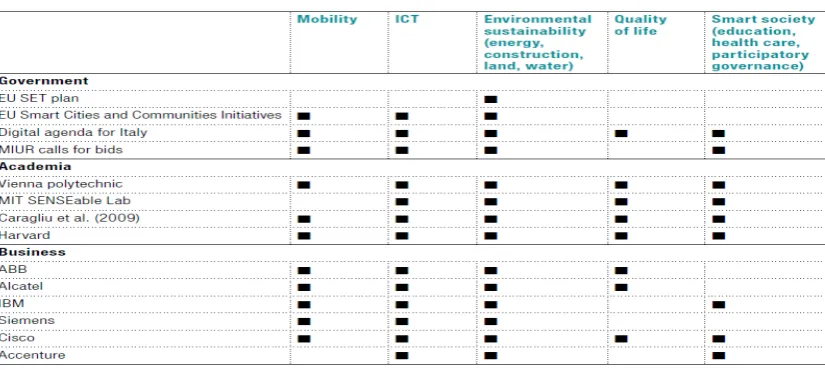
The concept of Smart City has been progressively changing its meaning and the related interconnection with the different dimensions of living. It is also worth underlining that the various definitions can assume different meanings also in relationship with the stakeholders (institutions, academic world, civil society, enterprises, as suggested by the Triple helix theory). On the basis of this idea it is possible to state that (see Figure 1): i. institutions focus on network infrastructures (energy, Mobility and ICT) while Smart
City aspects related to Quality of life play a secondary role;
ii. the academic world is mostly oriented in defining an organic theoretical framework, therefore including all the various dimensions;
[image:6.595.99.512.558.743.2]iii. enterprises as institutions are mainly oriented to network infrastructures and particularly ICT as service/product.
Figure 1: Main definitions of Smart City by stakeholders and areas of interest
Furthermore, Mobility and ICT are cross-sectional and are common items in many different definitions.
Environmental sustainability is also multidimensional and is the only shared factor in all the definitions.
Quality of life and Social inclusion (education, health, etc.) are present almost exclusively in the definitions coming from the academic world.
As explained above, the main actors in a Smart City at macro level are institutions, academic world, civil society, enterprises. However, once this event is analysed at micro level, actors and stakeholders become numerous. In more detail, also the different roles simultaneously assumed by a single actor take on importance (i.e. a citizen can be a student, a parent, a volunteer or a car driver).
The existence of a single definition for Smart Cities can therefore be considered fiction. What is a fact is that the features of a Smart City are very articulated. For this reason, starting from a shared definition becomes a priority in order to keep using this concept.
Smart City is still a fuzzy concept which is not used consistently within the literature. Smart, indeed, is often used interchangeably with intelligent, wired and digital. One of the
main criticisms is “the disjuncture between image and reality [...] the real difference between a city actually being intelligent, and it simply lauding a smart label” (Hollands
2008: 305).
Recently, the only fact that can be detected is a convergence towards some common points in many definitions. For example, the fact that smart is more than digital - despite the cross-sectional role of ICT - or the importance given to environmental sustainability represent elements that put the Smart City issue in a broader vision, including very recent analysis to measure the well-being beyond the GDP.
2 Theoretical background: a possible mainstream
In the past decades, a broad part of the literature on innovation has focused on the very tight connection between innovation and territory.
7
concentration of industries that take performance advantages through collocation, which
refers to agglomeration economies, both of scale or scope”.
In these theories three main factors generating innovation can be identified: i) the concentration of numerous and diverse expertise in various fields of knowledge and production; ii) networks of cooperation among members; iii) the presence of catalysts that facilitate the combination of different skills and units.
In the nineties, the technological paradigm of districts has been replaced by studies looking at macroeconomic factors that influence the processes of technology transfer (Lundvall 1992 and Nelson 1992). At the end of 1990, the focus shifted increasingly to the local dimension, with studies on “Learning Regions”, “Regional Innovation Systems” and
“Local Innovation Systems” (Cooke et al. 2004). In this context it became clear that, although the production of new knowledge is available on a global scale, innovation processes (i.e. the application of that knowledge) are essentially developed on a local scale.
A different attitude has developed after 2000, through the merging of regional innovation and the management of knowledge and information society: the “Intelligent Regions”. This is due to the steady infrastructure dematerialisation, the progressive innovation digitisation, new forms of on line learning and the advent of increasingly more virtual technologies. These are real areas characterised by the presence of strong innovation systems combined with IT infrastructure and digital innovation services.
It is in this context that the model of the “Triple Helix”3 (Etzkowitz and Lydesdorff
2000) and the model of the “Three Ts - Technology, Talent and Tolerance” (Florida 2002) - have been developed. The first identifies the relationship University-Industry-Government as a complex of interdependent institutional spheres that overlap and complement each other along the process that leads to innovation. The second shows that a good supply of Technology and Talent is not enough for innovation and growth, because they should also be accompanied by a significant amount of Tolerance (the so called social cohesion). These models have finally been followed by several contributions, either on the role of creativity in urban development (Gabe 2006; Markusen 2006; Fusco Girard et al. 2009) or on the importance of environmental and social sustainability (Sassen 2006). The
3The concept of the “Triple Helix” of University-Industry-Government relationships initiated in the 1990s by Etzkowitz
theoretical background of the Smart Cities issue is rooted in all these different frameworks.
Taking into account the theoretical and empirical literature specific on Smart Cities, the most recent papers (Shapiro 2003, Glaeser 2005, Glaeser and Berry 2006) focus on the role of human capital that represents the main input for growth and development. In particular, Shapiro (2003) finds a positive correlation between human capital and employment increase in U.S. metropolitan areas during the period from 1940 to 1990, suggesting that a highly educated population generates productivity and then further growth through knowledge spillovers. Focusing mainly on U.S. cities, also Glaeser (2005) highlights that the highest rates of urban growth are present where highly educated workforce is available. In more detail, one of the mechanisms identified by this model is based on the assumption that innovation processes are promoted by entrepreneurs in sectors that require a more skilled and educated workforce. Furthermore, high levels of human capital are also associated with a reduction of corruption and governance improvements in performance. In Glaeser and Redlick (2008), social capital is indicated as the key determinant of urban growth together with human capital.
Caragliu et al. (2009) measure the effect of some relevant variables for urban growth on the GDP of a city, used as a proxy of wealth, by means of data sets derived from Urban Audit. The analysis confirms the existence of a positive correlation between urban welfare and percentage of people employed in the creative sector, the efficiency of the public transport system, the accessibility to services, the level of e-government and, finally, the quality of human capital.
Other studies (Nijkamp et al. 2011) focus on the interrelationships among the components of Smart Cities, including human and social relations that link intellectual capital, health and governance through an approach based on the Triple Helix Model.
9
of the Triple Helix Model, finding a full list of indicators available at urban level, identified and selected from literature review.
In the light of the above, also the existence of a single Smart City theoretical framework can be considered a fiction. As a matter of fact, the theoretical and empirical literature on Smart Cities is scarce, heterogeneous and inconclusive especially from an economic perspective. The only common element in most of the papers is that the Giffinger framework is quite often taken as starting point.
3 Measurement issues: some methodological shortcomings
In order to monitor the convergence of a city towards a Smart City it is first of all necessary to define exactly what is a city and which indicators have to be selected for a
city “to be smart”. A city can be represented by different territorial levels: Province; Metropolitan Area; Travel To Work Areas (TTWA); Provincial Capital; Municipality.
In addition to the question of the territorial level, another element of potential instability is represented by the definition of a precise territorial analysis unit. If, on the one hand, no measurement can be made without it, on the other hand the very nature of Smart Cities as urban areas leads back to more undefined boundaries that are less focalised than the administrative borders of a specific territory. While the measurement-oriented literature focused on the concept of city with the aim of working out an operational definition, in present debates the community is increasingly becoming the main topic of discussion. This concept recalls dialogue, cooperation among actors, interaction among stakeholders, participation in decisional processes; it therefore stretches onto the governance framework of a territory in which smartness refers to the process rather than the result, whereby the expected result is measured in terms of increase in the community well-being levels.
The appeal of smartness applied at the local context is unquestioned and contributed in creating various multidimensional definitions. The measurement issue, however, has not followed the same accelerating path and has remained marginal with respect to the dissemination of many heterogeneous local practices.
The purpose of this paragraph is to compare some of the main experiences for the measurement of smartness at national and international level, identifying common points, differences and limits. This analysis aims at pointing out some methodological shortcomings in order to give suggestions on how implementing and structuring a general monitoring system for smartness.
As noticed above, the first operational definition of a Smart city has been given by
Giffinger et al. (2007): “a smart city is a city well performing in six characteristics, built
on the ‘smart’ combination of endowments and activities of self-decisive, independent and aware citizens” This description extends previous literature results by identifying six
[image:11.595.120.475.416.703.2]dimensions (economics, people, governance, mobility, environment and quality of life), in turn broken down into 31 major factors and 74 indicators in total (see Figure 2).
Figure 2: Characteristics of a Smart City
11
Thanks to this definition a classification of cities according to their level of smartness was carried out for the first time. Although this classification became an important reference in the debate about Smart Cities, by the authors’ own admission (Giffinger and Gudrum 2010) it presents a number of limitations related to, for example, the fact of not being able to measure properly all the indicators, rather than to the fact that a significant number of indicators (35%) were available only at national level.
Furthermore as suggested by Giovannella (2013) “the analysis compared the cities on the basis of the six dimensions that sustain the traditional functionalist models of smart
city: smart economy, smart mobility, smart environment, smart people, smart living, smart
governance. By taking the data and applying a principal component analysis it comes out,
and it is not surprising, that all dimensions except ‘smart environment’ are more or less
correlated with the ‘smart economy’”.
Among the other most relevant measurement experiences, there is that of the American Fast Company in 2012. This company elaborated the Smart City ranking, selecting the 10
European and the 10 North American smartest cities. The Fast Company used “The Smart
City Wheel” as a tool, considering six dimensions of smartness (the same as Giffinger et al. 2007) and three different key factors for each dimension.
The first attempt to measure the smartness of Italian cities was done by FORUM PA in 2012 and 2013, through the “ICityrate”. In this experience the Italian provincial capitals are evaluated on the basis of 6 dimensions and 89 indicators taking into account the Giffinger et al. (2007) framework.
Another important experience at national level is the “Smart City Index” (SCI) developed by the private consultancy firm Between (2012, 2013). SCI’s advantage is to be based on ad hoc surveys carried out at municipal level. Nonetheless the focus of SCI is not
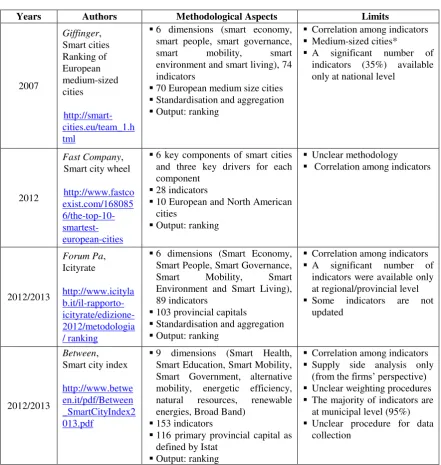
on citizens’ well-being but rather on the measurement of the digital service supply. For this reason, this indicator is not able to capture the primary objective of a Smart City and it can mainly be interpreted as an indicator of technological innovation (see Table 2).
Table 2 - The main Smart City measurement experiences
Years Authors Methodological Aspects Limits
2007 Giffinger, Smart cities Ranking of European medium-sized cities http://smart-cities.eu/team_1.h tml
6 dimensions (smart economy, smart people, smart governance, smart mobility, smart environment and smart living), 74 indicators
70 European medium size cities
Standardisation and aggregation
Output: ranking
Correlation among indicators
Medium-sized cities*
A significant number of indicators (35%) available only at national level
2012
Fast Company, Smart city wheel
http://www.fastco exist.com/168085 6/the-top-10- smartest-european-cities
6 key components of smart cities and three key drivers for each component
28 indicators
10 European and North American cities
Output: ranking
Unclear methodology
Correlation among indicators
2012/2013 Forum Pa, Icityrate http://www.icityla b.it/il-rapporto- icityrate/edizione-2012/metodologia / ranking
6 dimensions (Smart Economy, Smart People, Smart Governance, Smart Mobility, Smart Environment and Smart Living), 89 indicators
103 provincial capitals
Standardisation and aggregation
Output: ranking
Correlation among indicators
A significant number of indicators were available only at regional/provincial level
Some indicators are not updated
2012/2013
Between, Smart city index
http://www.betwe en.it/pdf/Between _SmartCityIndex2 013.pdf
9 dimensions (Smart Health, Smart Education, Smart Mobility, Smart Government, alternative mobility, energetic efficiency, natural resources, renewable energies, Broad Band)
153 indicators
116 primary provincial capital as defined by Istat
Output: ranking
Correlation among indicators
Supply side analysis only
(from the firms’ perspective)
Unclear weighting procedures
The majority of indicators are at municipal level (95%)
Unclear procedure for data collection
* Medium sized cities can be identified as a very special group of cities which are not considered in other rankings or which loose in importance and attention against bigger metropolitan areas which are usually ranked in higher positions.
Source: De Santis, Fasano, Mignolli, Villa, processing different information, 2014
13
From the analysis of the main measurement experiences some limits of the existing methodologies can be derived. Among the others the main are (see Table 2):
i. the existence - with few exceptions - of correlation among indicators of the various dimensions (see Giovannella 2013);
ii. the absence of clear, available4, statistically significant, common weighting and aggregation procedures of the various indicators;
iii. the scarce availability of updated indicators at city level (i.e. most of the indicators are available only at regional or provincial level);
iv. the lack of dynamic analysis. “The dynamics is important not only because it
allows to identify the evolution pattern of a city and the emerging behaviours and critical situations - but also because it allows to provide a more appropriate definition
of smartness” (Giovannella 2013)5;
v. the heterogeneity among the measurement experiences that is an obstacle to enhance comparisons;
vi. the output always presented as a ranking. Nevertheless, some empirical studies in this field (see Fertner et al. 2007) underline that there are some disadvantages to take into consideration when using city rankings for policy advice. With regard to methodological aspects, rankings are often not transparent concerning data collection and processing. Furthermore, the results of rankings depend on the spatial scope and the selected indicators to a high extent;
vii. the lack of a global perspective. International or indicators for (national, international) networks are scarcely represented in most of the measurement experiences;
viii. the “original sin” at the basis of these measurement experiences. This concept is used within this paper to indicate the need to reflect on the correctness of the existence of a rigid, unique system dedicated to the measurement of smartness. Many studies use a traditional approach to the benchmarking of city smartness. The preliminary results, however, show for example that cities in Europe and Italy are characterised by
relevant infrastructural and cultural differences and, therefore, that “no smart city model can be considered universal because local cultures and constraints have a key
role in determining the route toward the development of a smart city” (Giovannella
2013).
4 Final thoughts and open questions
The definition of a measurement system of smartness comparable at territorial and dynamic level it is with no doubt a very complex goal. At present does not even exist an operational, common and empirically testable definition of Smart City/Community.
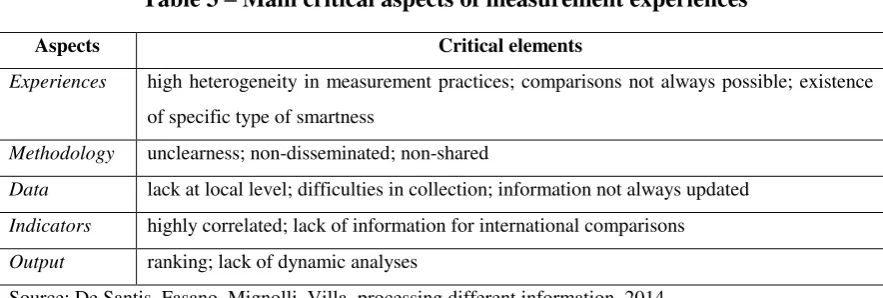
Therefore, despite the unquestionable glamour of this topic, the measurement aspects of smartness are often mistreated in favour of dissemination of best practices and projects at local level (see Table 3).
Until now, with very few exceptions, all the experiments to measure the smartness at local level have used “top-down functionalist models of smart cities in which the space of
representation has an infrastructural origin” (Giovannella 2013). This kind of
[image:15.595.75.517.520.669.2]measurements, in fact, are very useful to produce rankings based on economic, social, environmental and technological soft and hard infrastructure as outputs. They make it, however, very difficult to overcome the purely quantitative data. The inclusion of qualitative indicators (i.e. the quality of infrastructure) is necessary to highlight the originality of the path chosen by each City/Community to become Smart.
Table 3 – Main critical aspects of measurement experiences
Aspects Critical elements
Experiences high heterogeneity in measurement practices; comparisons not always possible; existence
of specific type of smartness
Methodology unclearness; non-disseminated; non-shared
Data lack at local level; difficulties in collection; information not always updated
Indicators highly correlated; lack of information for international comparisons
Output ranking; lack of dynamic analyses
Source: De Santis, Fasano, Mignolli, Villa, processing different information, 2014
15
concepts, practical and economic obstacles in collecting data at city level and the fact that the output is necessarily a ranking.
In more detail, outputs represented by city rankings are often highly heterogeneous regarding methodology and objectives; a more elaborated procedure is therefore necessary for focusing on the specific profile of a city with its strengths and weaknesses.
In this framework, introducing the use of factorial analyses results particularly useful to better identify the indicators that give real contributions to the measurement of smartness.
From this starting point, passing to a cluster analysis is one of the possibility out of a wider range of procedures for investigating rankings in a more robust way.
Clusters, which show specific patterns of cities, are useful to overcome both the superficial aspect indicated by the mere rank obtained and the random comparison between best and worst cities.
For city stakeholders these more substantial findings can allow to focus on the specific strengths and weaknesses of similar cities. It is not reasonable to follow best-practice strategies randomly, but it is necessary to concentrate on cluster membership. In this way best-practice examples of other cities can be interpreted with regard to their specific profiles, which makes them easier to adopt in a more effective way.
Moreover, in this paper a sort of renewed “original sin” is highlighted: it is related to the idea of a too strict “Measurement System” for quantifying smartness at local level (expressed in the different measurement experiences analysed and also in the Italian Law Decree n. 179/2012).
In order to compare the degree of smartness for different local contexts it is necessary to find a convergence towards a shared measurement system. This system, however, has to be implemented so as to be able to include (if necessary) specific territorial aspects. This system cannot ignore the starting situation of single territories, given both the heterogeneity of the different socio-economic frameworks and also certain, detailed features that have to be examined in depth.
Furthermore, on the basis of what explained about communities, this system cannot disregard also the involvement stages of the different actors at micro level and of the specific competences at the various governance levels.
17 References
Ambrosetti (2012), Smart Cities in Italia: un’opportunità nello spirito del Rinascimento per una nuova qualità della vita.
Auci S., Mundula L. (2012), Smart Cities and a Stochastic Frontier Analysis: A Comparison among European Cities, Mimeo.
Bagnasco A., (1977), Tre Italie, Il Mulino, Bologna.
Between (2013), http://www.between.it/pdf/Between_SmartCityIndex2013.pdf
Caragliu, A, Del Bo, C. & Nijkamp, P. (2009). Smart cities in Europe. Series Research Memoranda 0048.
Cooke P., Heidenreich, M., & Braczyk H. (2004), Regional Innovation Systems: The Role of Governance in a Globalized World, New York: Routledge.
Dirks S. and Keeling, M. (2009), A Vision of Smarter Cities: How Cities Can Lead the Way into a Prosperous and Sustainable Future, Somers, NY: IBM Global Business Services.
De Santis R., Fasano A., Mignolli N. e A. Villa, (2014a), “Il fenomeno Smart City”, Rivista Italiana di Economia, Demografia e Statistica vol. LXVIII, issue 1 pp. 143-151.
De Santis R., Fasano A., Mignolli N. e A. Villa, (2014b), “Smart city: la città del futuro?”, Economia & Lavoro issue 1.
Etzkowitz H., Leydesdorff, L. (2000), The dynamics of innovation: from National Systems and “Mode 2” to a Triple Helix of university–industry–government relations, Research Policy: Vol. 29, No. 2, pp. 109-123.
Fast company (2013), http://www.fastcoexist.com/1680856/the-top-10-smartest-european-cities
Fertner, Ch., Giffinger, R., Kramar, H. And Meijers, E.(2007), City ranking of European medium-sized cities, In: IFHP World Congress “Future of Cities” (51st, 2007, Copenhagen). Florida R. (2002), The rise of the creative class: and how it’s transforming work, leisure,
community and everyday life, New York City, New York, Basic Books.
Forum PA (2012), ICity Rate. La classifica delle città intelligenti italiane.
http://www.icitylab.it/il-rapporto-icityrate/edizione-2012/metodologia/ ranking
Fusco, Girad L., Lombardi, P., Nijkamp, P. (2009), Creative Urban Design and Development (special issue), in “International Journal of Services Technology and Management”, Vol. 13, No. 2/3/3, pp.111-115.
Gabe T. M. (2006), Growth of Creative Occupations in U.S. Metropolitan Areas: A Shift-Share Analysis, Growth and Change, 37: 396–415.
Giffinger, R.; Gudrun, H. (2010) Smart cities ranking: an effective instrument for the positioning of the cities?. "ACE: Architecture, City and Environment”, vol. 4, n 12, p. 7-26
Glaeser, E. L. (2005). “Review of Richard Florida’s The rise of the creative class”, Regional Science and Urban Economics, 35 (4): 593-596.
Glaeser E. L. and Redlick C. (2008), Social Capital and Urban Growth, Harvard University, mimeo.
Giovannella C. (2013), Territorial Smartness and Emergent Behaviors in ICSCS, IEEE publisher pp. 170—176
Hall R. E. (2000), The vision of a Smart City, in “Proceedings of the 2nd International Life Extension Technology Workshop”, Paris, France, September 28,
Harrison C. et al. (2010), Foundations for Smarter Cities, in “IBM Journal of Research and Development”, 54(4).
Hollands R.G. (2008), Will the real Smart City please stand up? City, 12(3), 303-320.
Kanter R. M. & Litow S. S. (2009), Informed and interconnected: A manifesto for smarter cities, Harvard Business School General Management Unit Working Paper, 09-141
Lombardi P. et al. (2013), Modelling the smart city performance, Innovation: The European Journal of Social Science Research, Politecnico di Torino, Department of Housing and Cities. Lundvall B.Å. (ed.) (1992), National Systems of Innovation - toward a Theory of Innovation and
Interactive Learning, Pinter Publishers, London, pp. 1-19.
Markusen A. (2006), Urban development and the politics of a creative class: evidence from a study of artists, Environment and Planning A 38(10), pp. 1921 – 1940.
Nelson R. R. (1992), National Innovation Systems: A Retrospective on a Study, Industrial and Corporate Change, no. 2, pp.347-374.
Nijkamp P., Lombardi P., Giordano S., Caragliu A., Del Bo C., Deakin M., Kourtit K. (2011), An Advanced Triple-Helix Network Model for Smart Cities performance, Research Memorandum 2011-45.
Porter M. E. (1990), The Competitive Advantage of Nations, New York: Free Press.
Sassen S. (2006), Why cities matter ( http://www.saskiasassen.com/PDFs/publications/Why-Cities-Matter.pdf)
Shapiro J. M. (2003), “Smart Cities: explaining the relationship between city growth and human capital” (http://ssrn.com/abstract=480172)
Toppeta D. (2010). The Smart City Vision: How Innovation and ICT Can Build Smart, in Livable, “Sustainable Cities. The Innovation Knowledge Foundation” (http://www.thinkinnovation.org/file/research/23/en/Top peta_Report_005_2010.pdf).
19
Helping CIOs Understand "Smart City" Initiatives: Defining the Smart City, Its Drivers, and the Role of the CIO, Cambridge, MA: Forrester Research, Inc.