ExB Text Summarizer
Stefan Thomas, Christian Beutenm¨uller, Xose de la Puente Robert Remus and Stefan Bordag
ExB Research & Development GmbH Seeburgstr. 100
04103 Leipzig, Germany
{thomas, beutenmueller, puente, remus, bordag}@exb.de
Abstract
We present our state of the art multilin-gual text summarizer capable of single as well as multi-document text summa-rization. The algorithm is based on re-peated application of TextRank on a sen-tence similarity graph, a bag of words model for sentence similarity and a num-ber of linguistic pre- and post-processing steps using standard NLP tools. We submitted this algorithm for two differ-ent tasks of the MultiLing 2015 summa-rization challenge: Multilingual Single-document Summarization and Multilin-gual Multi-document Summarization.
1 Introduction
The amount of textual content that is produced and consumed each day all over the world, through news websites, social media, and other informa-tion sources, is constantly growing. This makes the process of selecting the right content to read and quickly recognizing basic facts and topics in texts a core task for making content accessible to the users. Automatic summarization strives to pro-vide a means to this end. This paper describes our automatic summarization system, and its partici-pation in the MultiLing 2015 summarization chal-lenge.
Our focus has been on producing a largely language-independent solution for the MultiLing 2015 challenge that, in contrast to most attempts in this field, requires a strict minimum of language-specific components and uses no language-language-specific materials for the core innovative elements.
Our motivation comes in part from Hong et al. (2014), who compares a number of single lan-guage summarization systems on the same stan-dardized data set and shows that many complex, language-specific, highly optimized and trained
methods do not significantly out-perform simplis-tic algorithms that date back to the first summa-rization competitions in 2004.
Language-independent text summarization is generally based on sentence extractive methods: A subset of sentences in a text are identified and combined to form a summary, rather than perform-ing more complex operations, and the primary task of summarization algorithms is to identify the set of sentences that form the best summary. In this case, algorithms differ mostly in how sentences are selected.
One textual feature that has proven useful in identifying good summary sentences is the relative prominence of specific words in texts when con-trasted to a reference distribution (like frequency in a large general corpus). For example, the “key-ness” metric in El-Haj and Rayson (2013), singu-lar value decomposition on a term-vector matrix (Steinberger, 2013) and neural network-derived transformations of term vectors (K˚ageb¨ack et al., 2014) have all produced significant results. There are also a number of rule-based approaches like Anechitei and Ignat (2013). Hong et al. (2014) provides an overview of various current ap-proaches, ranging from simple baseline algorithms to complex systems with many machine learning and rule-based components of various kinds.
One promising recent approach is graph theory-based schemes which construct sentence similar-ity graphs and use various graph techniques to de-termine the importance of specific sentences as a heuristic to identify good summary sentences (Barth, 2004; Li et al., 2013b; Mihalcea and Ta-rau, 2004).
In this paper, we describe ExB’s graph-based summarization approach and its results in two MultiLing 2015 tasks: Multilingual Single-document SummarizationandMultilingual Multi-document Summarization. ExB’s submissions covered all languages in each task. Furthermore,
we summarize and discuss some unexpected neg-ative experimental results, particularly in light of the problems posed by summarization tasks and their evaluation using ROUGE (Lin, 2004).
2 Process Overview
The procedures used in both tasks start from sim-ilar assumptions and use a generalized framework for language-independent sentence selection-based summarization.
We start from the same basic model as LDA ap-proaches to text analysis: Every document con-tains a mixture of topics that are probabilistically indicative of the tokens present in it. We select sentences in order to generate summaries whose topic mixtures most closely match that of the doc-ument as a whole (Blei et al., 2003).
We construct a graph representation of the text in which each node corresponds to a sentence, and edges are weighted by a similarity metric for com-paring them. We then extract key sentences for use in summaries by applying the PageRank/TextRank algorithm, a well-studied algorithm for measuring graph centrality. This technique has proven to be good model for similar extraction tasks in the past (Mihalcea and Tarau, 2004).
We deliberately chose not to optimize any pa-rameters of our core algorithm for specific lan-guages. Every parameter and design decision ap-plied to all languages equally and was based on cross-linguistic performance. Typically it is possi-ble to increase evaluation performance by 2%-4% through fine tuning, but this tends to produce over-fitting and the gains are lost when applied to any broader set of languages or domains.
Our approach consists of three stages:
1. Preprocessing using common NLP tools. This includes steps like tokenization and sen-tence identification, and in the multilingual summarization case, an extractor for time references like dates and specific times of day. These tools are not entirely language-independent.
2. Sentence graph construction and sentence ranking as described in Sections 2.2 and 2.3 respectively.
3. Post-processing using simple and language-independent rules for selecting the highest ranking sentences up to the desired length of text.
2.1 Preprocessing
Our processing pipeline starts with tokenization and sentence boundary detection. For most lan-guages we employ ExB’s proprietary language-independent rule-based tokenizer. For Chinese, Japanese and Thai tokenization we use language-dependent approaches:
• Chinese is tokenized using a proprietary al-gorithm that relies on a small dictionary, the probability distribution of token lengths in Chinese, and a few handcrafted rules for spe-cial cases.
• For Thai, we use a dictionary containing data from NECTEC (2003) and Satayamas (2014) to calculate the optimal partition of Thai let-ter sequences based on a shortest path algo-rithm in a weighted, directed acyclic charac-ter graph using dictionary charac-terms found in the text.
• For Japanese, we employ the CRF-based MeCab(Kudo et al., 2004; Kudo, 2013) mor-phological analyzer and tokenizer. MeCab is considered state-of-the-art and is currently being used in the construction of annotated reference corpora for Japanese by Maekawa et al. (2014).
Sentence boundary detection is rule-based and uses all sentence separators available in the Uni-code range of the document’s main language, along with an abbreviation list and a few rules to correctly identify expressions like “p.ex.” or “...”
Finally, we use a proprietary SVM-based stem-mer trained for a wide variety of languages on cus-tom corpora.
2.2 Graph construction
Given a set of tokenized sentencesS, we construct a weighted undirected graphG = (V, E), where each vertexVi ∈ V corresponds to a sentence in
S. The weighted edges (Si, Sj, w) of the graph are defined as a subset of S ×S where i 6= j
and (w ← sim(Si, Sj)) ≥ t for a given simi-larity measure simand a given threshold t. We always assume a normalized similarity measure with a scale between0and1.
We compared these vectors using a number of techniques:
• An unweighted bag-of-words model with sentence similarity computed using the Jacquard index.
• Conventional cosine similarity of sentence vectors weighted by term frequency in the sentence.
• TF-IDF weighted cosine similarity, where term frequencies in sentences are normalized with respect to the document collection. • Semantic similarity measured using the
ExB Themissemantic approach described in H¨anig et al. (2015).
We also evaluated different settings for the thresholdt. We did not optimizetseparately for different languages, instead setting a single value for all languages.
Surprisingly, when averaged over all 38 lan-guages in the MSS training set, the simple bag-of-words model with a thresholdt = 0.3 produced the best result using the ROUGE-2 measure. 2.3 Sentence ranking
We then apply to the sentence similarity graph an iterative extension of the PageRank algo-rithm (Brin and Page, 1998) that we have called FairTextRank(FRank) to rank the sentences in the graph. PageRankhas been used as a ranker for an extractive summarizer before in Mihalcea and Ta-rau (2004), who named itTextRankwhen used for this purpose. PageRank constitutes a measure of graph centrality, so intuitively we would expect it to select the most central, topical, and summariz-ing sentences in the text.
Following our assumption that every document constitutes a mix of topics, we further assume that every topic corresponds to a cluster in the sen-tence graph. However, PageRankis not a cluster sensitive algorithm and does not, by itself, ensure coverage of the different clusters present in any graph. Therefore, our FRank algorithm invokes PageRank iteratively on the graph, at each step ranking all the sentences, then removing the top ranking sentence from the graph, and then running PageRankagain to extract the next highest ranking sentence. Because the most central sentence in the entire graph is also, by definition, the most cen-tral sentence in some cluster, removing it weakens
the centrality of the other sentences in that cluster and increases the likelihood that the next sentence selected will be the highest ranking sentence in an-other cluster.
A similar method of removing selected sen-tences is used in theUWB Summarizer by Stein-berger (2013), which was one of the top per-forming systems at MultiLing 2013. However, theUWB Summarizer uses an LSA algorithm on a sentence-term matrix to identify representative sentences, where we have employedPageRank.
The complete algorithm is detailed in Algo-rithm 1. The functionadjreturns the weighted ad-jacency matrix of the sentence graphG. An inner for-loop transforms the weighted adjacency matrix into a column-stochastic matrix where for each columnc, where A[i, c]is the weight of the edge between sentenceiand sentencec, the following expression holds: Pi∈|A|A[i, c] = 1. Informally, each column is normalized at each iteration so that its values sum to1. pris thePageRank-algorithm with the default parameters β = 0.85, a conver-gence threshold of0.001and allowed to run for at most100iterations as implemented in the JUNG API (O’Madadhain et al., 2010).
Algorithm 1FairTextRank 1: functionFRANK(G) 2: R←[]
3: while|G|>0do 4: A←adj(G)
5: for(r, c)← |A|2do 6: Anorm[r, c]← P A[r,c],
i∈|A|A[i,c]
7: rank←pr(Anorm) 8: v←rank[0]
9: R←R+v
10: G←G\v
returnR
2.4 Post-processing
the score of an n-gram based evaluation metric like ROUGE.
3 Single Document Summarizer
TheMultilingual Single-document Summarization (MSS) task consisted of producing summaries for Wikipedia articles in 38 languages. All articles were provided as UTF-8 encoded plain-text files and as XML documents that mark sections and other elements of the text structure. We took ad-vantage of the availability of headers and section boundary information in performing this task.
There was no overlap between the training data and the evaluation data for the MSS task. The released training data consisted of the evaluation data set from MultiLing 2013 as described in Ku-bina et al. (2013). This training data contains 30 articles in each of 40 languages. The MSS task itself at MultiLing 2015 used 30 articles in each of 38 languages, dropping two languages because there were not enough new articles not included in the training data.
In addition to the preprocessing steps described in Section 2.1, for this task we applied a list of sen-tence filters developed specifically for Wikipedia texts:
• Skip all headers.
• Skip every sentence with with less than 2 to-kens (mostly errors in sentence boundary de-tection).
• Skip every sentence that contains double quotes.
We then performed sentence graph construction and ranking as described in Sections 2.2 and 2.3
In the post-processing stage, we sorted the sen-tences selected to go into the summary in order of their position in the original article, before produc-ing a plain text summary by concatenatproduc-ing them. 3.1 Results
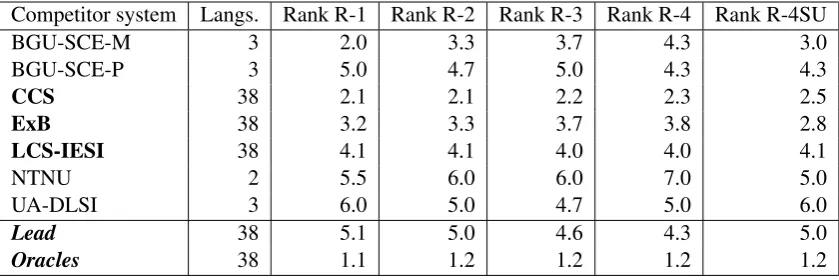
The organizers of the MultiLing 2015 challenge measured the quality of our system’s output using five different versions of the ROUGE score. We provide a summary of the results for all partici-pants in Table 1. It shows the average ranking of each participating system over all the languages on which it was tested, as well as the number of lan-guages on which each system was tested. The sys-tems labelled Lead and Oraclesare special sys-tems. Leadjust uses the beginning of the article
as the summary and represents a very simple base-line.Oracles, on the other hand, is a cheating sys-tem that marks the upper bound for any extractive approach.
Only three submissions highlighted in bold -participated in more than 3 languages. We sub-mitted only one run of our system, defined as a fixed set of parameters that are the same over all languages. One of the other two systems that par-ticipated in all 38 languages submitted five runs. According to the frequently used ROUGE-1 and ROUGE-2 scores, our system achieved an average ranking of 3.2 and 3.3, respectively. This table shows that the CCS system performed better on average than our system, and the LCS-IESI sys-tem performed on average worse.
However, ROUGE-1 only measures match-ing smatch-ingle words, whereas ROUGE-2 measures matching bigrams. More complex combinations of words are more indicative of topic matches be-tween gold standard data and system output. We believe that ROUGE-SU4, which measures bi-grams of words with some gaps as well as uni-grams, would be a better measure of output qual-ity. When manually inspecting the summaries, we have the strong impression that system runs in which our system scored well by ROUGE-SU4 measures, but poorly by ROUGE-2, did pro-duce better summaries with greater readability and topic coverage.
Our system achieves a significantly better overall ranking using ROUGE-SU4 instead of ROUGE-2, even though the system was optimized to produce the highest ROUGE-2 scores. Only two runs of the winning system CCS scored better than our system according to ROUGE-SU4. This underlines the robustness of our system’s under-lying principles, despite the known problems with ROUGE evaluations.
4 Multi Document Summarizer
The Multilingual Multi-document Summarization (MMS) task involves summarizing ten news arti-cles on a single topic in a single language. For each language, the dataset consists of ten to fif-teen topics, and ten languages were covered in all, including and expanding on the data used in the 2013 MMS task described by Li et al. (2013a).
Competitor system Langs. Rank R-1 Rank R-2 Rank R-3 Rank R-4 Rank R-4SU
BGU-SCE-M 3 2.0 3.3 3.7 4.3 3.0
BGU-SCE-P 3 5.0 4.7 5.0 4.3 4.3
CCS 38 2.1 2.1 2.2 2.3 2.5
ExB 38 3.2 3.3 3.7 3.8 2.8
LCS-IESI 38 4.1 4.1 4.0 4.0 4.1
NTNU 2 5.5 6.0 6.0 7.0 5.0
UA-DLSI 3 6.0 5.0 4.7 5.0 6.0
Lead 38 5.1 5.0 4.6 4.3 5.0
[image:5.595.89.509.62.202.2]Oracles 38 1.1 1.2 1.2 1.2 1.2
Table 1: Number of covered languages and average rank for each system in MSS competition for ROUGE-(1,2,3,4,4-SU) measures. In bold, competitors in all available languages. Lead andOracles are two reference systems created by the organizers.
or overlapping in time, then they are likely to describe the same event. We therefore cluster the documents in each collection by the points in time referenced in the text rather than attempt-ing to summarize the concatenation of the doc-uments directly. This approach has the natural advantage that we can present summary informa-tion in chronological order, thereby often improv-ing readability. Unfortunately, this improvement is not measurable using ROUGE-style metrics as employed in evaluating this task.
An official training data set with model sum-maries was released, but too late to inform our submission, which was not trained with any new 2015 data. We did, however, use data from the 2011 MultiLing Pilot including gold standard summaries (Giannakopoulos et al., 2011), which forms a part of the 2015 dataset. We used only the 700 documents and summaries from the 2011 task as training data, and did not use any Chinese, Spanish or Romanian materials in preparing our submission.
Our submission follows broadly the same pro-cedure as for the single document summarization task, as described in Section 2 and Section 3, ex-cept for the final step, which relies on section in-formation not present in the news articles that form the dataset for this task. Instead, a manual exami-nation of the dataset revealed that the news articles all have a fixed structure: the first line is the head-line, the second is the date, and the remaining lines form the main text. We used this underlying struc-ture in preprocessing to identify the dateline of the news article, and we use this date to disambiguate relative time expressions in the text like “yester-day” or “next week”. Articles are also ordered in
time with respect to each other on the basis of the article date.
Furthermore, we remove in preprocessing any sentence that contains only time reference tokens because they are uninformative for summariza-tion.
We then extract temporal references from the text, using ExB’s proprietaryTimeRecframework described in Thomas (2012), which is available for all the languages used in this task. With the set of disambiguated time references in each document, we can provide a “timeframe” for each document that ranges from the earliest time referenced in the text to the latest. Note that this may not include the date of the document itself, if, for example, it is a retrospective article about an event that may have happened years in the past.
4.1 Time information processing
Ng et al. (2014) and Wan (2007) investigate us-ing textural markers of time for multi-document summarization of news articles using very differ-ent algorithms. Our approach is more similar to Ng et al. in constructing a timeline for each doc-ument and for the collection as a whole based on references extracted from texts. Once document timeframes are ordered chronologically, we orga-nize them into groups based on their positions on a time line. We explored two strategies to produce these groups:
in 0.1. The algorithm is a divisive cluster-ing algorithm based on the central time of the documents and the standard deviation. At first the minimal central time of a document collection is subtracted from all other central times, then we compute mean, variance and standard deviation based on days as a unit and normalized by the mean. Afterwards we recursively split the groups with the goal to minimize the variance of both splits until ei-ther a group consists only of one document or the recomputed standard deviation of a group is less than 0.1.
• Overlapping Time Clustering (OTC): Grouping documents together if their time-frames overlap more than a certain amount, which we empirically set to 0.9 after experi-menting with various values. This means that if two texts A and B are grouped together, then either A’s timeframe includes at least 90% of B’s timeframe, or B’s timeframe includes 90% of A’s. This approach proceeds iteratively, with each new addition to a group updating the timeframe of the group as a whole, and any text which overlaps more than 90% with this new interval is then grouped with it in the next iteration.
In addition, we provide two baseline cluster-ings:
• One document per cluster (1PC): Each document is in a cluster by itself.
• All in one cluster (AIO): All documents from one topic are clustered together.
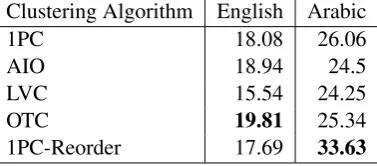
[image:6.595.323.512.642.725.2]In the LVC and OTC cases, clustering is iter-ative and starts with the earliest document as de-termined by a fixed “central” date for each doc-ument. We explored different ways of determin-ing that “central” date: One was usdetermin-ing the dateline found in preprocessing on the second line of each document, another was the median of the time ref-erences in the document. Our best result used the dateline from each article and, as can be seen in Table 2, was produced by the OTC strategy. This is a surprising result, as we expected LVC to perform better since variance is generally a better measure of clustering. However, we found that LVC gen-erally produced more clusters than OTC and we believe that to account for its poor performance.
We experimented with a number of other ordering and clustering approaches, although they do not figure into our submission to the MMS task, but in all cases they failed to out-perform the OTC ap-proach according to the ROUGE-2 recall measure. For all conditions, identical preprocessing was performed using ExB’s proprietary language-specific tokenizer and sentence identifier. ROUGE scores, because they are based on token n-grams, are very sensitive to discrepancies between to-kenizers and stemmers. In English, because most tokenizers perform very similarly, this causes fewer problems in scoring than for Arabic or other languages where tokenizers vary dramatically. We used the results in Table 2 to decide which con-ditions to use in the competition, but we cannot be sure to what degree our results have been influ-enced by these kinds of ROUGE-related problems. After clustering, we perform graph-based sen-tence ranking as described in Sections 2.2 and 2.3 separately for each cluster. We then select sen-tences from each cluster, ensuring that they are all represented in the final summary, so that the en-tire time span of the articles is covered. We also order the selected sentences in the summary based on the temporal ordering of the clusters, so that summary presentation is in event order.
4.2 Experimental results
When experimenting with the challenge data we made several observations:
1. Since the dataset of MMS is composed of news articles, just selecting the headlines and first sentences will produce a strong baseline with very high ROUGE scores. It is difficult to beat this baseline using sentence extraction techniques.
2. The quality of the summaries varies a great deal between languages. Instead of produc-ing fine-tuned configurations for each
lan-Clustering Algorithm English Arabic
1PC 18.08 26.06
AIO 18.94 24.5
LVC 15.54 24.25
OTC 19.81 25.34
1PC-Reorder 17.69 33.63
Language AutoSummENG MeMoG NPowER Rank/Total
Arabic 0.135 0.164 1.717 7/9
Chinese 0.118 0.141 1.654 1/5
Czech 0.188 0.2 1.874 4/7
English 0.167 0.191 1.817 6/10
French 0.2 0.195 1.892 5/8
Greek 0.147 0.17 1.75 5/8
Hebrew 0.115 0.147 1.655 8/9
Hindi 0.123 0.139 1.662 3/7
Romanian 0.168 0.183 1.809 4/6
Spanish 0.193 0.202 1.886 3/6
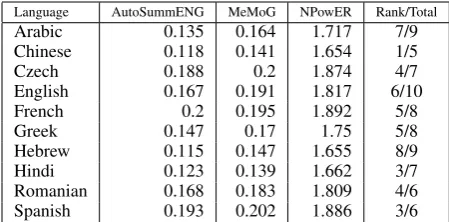
Table 3: Average per-language Score ranked against the best run of each system in MMS com-petition for MeMoG measure.
guage that optimize ROUGE scores, we fo-cused on increasing the performance in En-glish - a language we can read and in which we can qualitatively evaluate the produced summaries.
3. All the results here of the time information processing are at document-level. We also tried to apply the time grouping algorithms per sentence, but we noticed a drop of about
3%ROUGE-2 score on average.
The most important finding is that using tem-poral expressions and chronological information does improve the performance of the summary system, and that the iterative FairTextRank algo-rithm shows a solid performance even for multiple documents.
As can be seen in Table 3, our system gets ranked in middle position in the official scores of the challenge using the NPowER, MeMoG andAutoSummENGmeasures as described in Gi-annakopoulos and Karkaletsis (2013) and Gian-nakopoulos and Karkaletsis (2011). We also note that our system out-performs all other participants in Chinese, a language for which we had no train-ing data.
5 Negative results
We feel that it is important not only to publish positive results, but also negative ones, to counter the strong publication bias identified in many ar-eas in the natural and social sciences (Dickersin et al., 1987; Ioannidis, 2005). Since we conducted a large number of experiments in creating this sys-tem, we inevitably also came across a number of ideas that seemed good, but turned out to not im-prove our algorithm, at least as measured using ROUGE-2.
In another challenge participation we developed a very powerful “semantic text similarity” (STS) toolkit. In SemEval 2015 Task 2 (Agirre et al., 2015), it achieved by far the highest scores for Spanish texts and the second best scores for En-glish. Since our text summarization methodology is based on a sentence similarity graph, our in-tuitive hypothesis was that when using this mod-ule as opposed to simple matching-words strate-gies, performance should increase significantly. Matching-words strategies are used as the baseline in SemEval tasks, and it is easily out-performed by more sophisticated approaches.
Therefore, we tried out our STS module as a replacement for Jacquard and cosine similarity measures when constructing the sentence graph, while keeping all other parameters fixed. Surpris-ingly, it did not improve performance, and low-ered ROUGE-2 scores by2%. We also attempted to useword2vecembeddings precomputed on very large corpora (Mikolov et al., 2013) to represent words and hence compute a much finer-grained sentence similarity, but those results were 4%
worse. It is possible that those systems were, in fact, better, but because ROUGE scoring focuses on word matches, any other improvement cannot be measured directly. We also attempted to in-clude other factors such as sentence length, posi-tion, number of named entities, temporal expres-sions, and physical measurements into the sen-tence similarity score, all without seeing any in-crease in ROUGE scores.
[image:7.595.71.296.63.174.2]sen-tences describing central topics in documents are not strongly correlated with named entity usage.
Another very intuitive assumption is that filter-ing stop words, or down-weightfilter-ing very frequent words, or using a TF-IDF based scheme with a similar effect, would improve the results. How-ever, we did not observe any improvement by us-ing these techniques. Nonetheless, there are strong indications that this is due to the limitations of ROUGE-2 scoring and we cannot conclude that these kinds of techniques are useless for summa-rization. It is easy to achieve very competitive ROUGE-2 scores by just filling the summary with very frequent stop word combinations. A human would immediately recognize the uselessness of such a “summary”, but ROUGE-2 would count many bigram matches with a gold standard sum-mary.
Finally, we considered the hypothesis that the summary system could be helped by explicitly re-moving very similar sentences presenting redun-dant information. Surprisingly, explicitly remov-ing such sentences did not improve the perfor-mance of the system. Manually inspecting a num-ber of summaries, we notice that very similar sen-tences recurring often in texts are rarely selected by the FRank algorithm. We believe this is be-cause our approach is sufficiently robust to dis-count these sentences on its own.
6 Conclusions
In this paper we outline ExB’s largely language-independent system for text summarization based on sentence selection, and show that it supports at least the 38 languages used in this completion without any language-specific fine-tuning. Sen-tences are selected using an iterative extension ofPageRank calculationon a sentence similarity graph. Our results in the MultiLing 2015 chal-lenge have validated this approach by achieving the best scores for several languages and compet-itive scores for most of them, generally surpassed by only one other participating system.
We also show that one basic summarization sys-tem can apply to different domains, different lan-guages, and different tasks without special con-figuration, while retaining state-of-the-art perfor-mance. Furthermore, for multi-document news summarization, we show that extracting temporal expressions is a useful feature for combining arti-cles on the same topic.
Our most relevant conclusion is that both the current evaluation methodology (based on various forms of ROUGE) as well as the current principal approach to language-independent text summa-rization (context-free, sentence selection based) are highly inadequate to model the vague require-ments users associate with a text summarization product.
Participants in MultiLing 2015 did not receive the scripts and parameters used in producing eval-uations. This made it difficult to optimize param-eters and algorithms and has a significant impact on results using ROUGE measures and probably the other measures as well. Hong et al. (2014), for example, notes values between30.8%and39.1%
using ROUGE-1 for one well-known algorithm on one data set by different authors. It is not clear how the vastly different scores obtained for identi-cal summaries using different ROUGE parameters correlate with the objective quality of a given sum-mary. We have no clear indication that ROUGE scores really capture the quality of a given sum-mary at all.
While it is possible to formulate summarization solutions based on sentence selection and even iteratively improve them using ROUGE scores, the actual achievable performance measured using ROUGE is very low. We have noticed that stem-ming, stopword filtering and various tokeniza-tion strategies can have a very large influence on ROUGE scores, especially in morphologically richer languages than English. More modern eval-uation measures like MeMog or NPoweR might solve the problems inherent to ROUGE, however they currently lack widespread adoption in the re-search community.
Nonetheless, even if these issues in evaluation can be addressed, we do not believe that sum-maries based on sentence selection will ever reach a quality where they could be accepted as compa-rable to a human written summary.
References
Daniel Alexandru Anechitei and Eugen Ignat. 2013. Multilingual summarization system based on ana-lyzing the discourse structure at MultiLing 2013.
Proceedings of the Multiling 2013 Workshop on Multilingual Multi-document Summarization, pages 72–76.
Michael Barth. 2004. Extraktion von Textele-menten mittels “spreading activation” f¨ur indikative Textzusammenfassungen. Master’s thesis, Univer-sit¨at Leipzig. Fakult¨at f¨ur Mathematik und Infor-matik. Institut f¨ur InforInfor-matik.
Darina Benikova, Chris Biemann, Max Kisselew, and Sebastian Pad. 2014. GermEval 2014 Named En-tity Recognition Shared Task: Companion Paper. InProceedings of the KONVENS GermEval Shared Task on Named Entity Recognition, pages 104–112, Hildesheim, Germany.
David M. Blei, Andrew Y. Ng, and Michael I. Jordan. 2003. Latent Dirichlet Allocation. J. Mach. Learn. Res., 3:993–1022, March.
Sergey Brin and Lawrence Page. 1998. The Anatomy of a Large-scale Hypertextual Web Search Engine.
Comput. Netw. ISDN Syst., 30(1-7):107–117, April. K. Dickersin, S. Chan, T. C. Chalmers, H. S. Sacks, and Smith. 1987. Publication bias and clinical trials.
Controlled Clinical Trials, 8(4):343–353.
Mahmoud El-Haj and Paul Rayson. 2013. Using a Keyness Metric for Single and Multi Document Summarisation. Proceedings of the Multiling 2013 Workshop on Multilingual Multi-document Summa-rization, pages 64–71.
George Giannakopoulos and Vangelis Karkaletsis. 2011. AutoSummENG and MeMoG in Evaluating Guided Summaries. In TAC 2011 Workshop NIST Gaithersburg, MD, USA.
George Giannakopoulos and Vangelis Karkaletsis. 2013. Summary Evaluation: Together We Stand NPowER-ed. In Alexander Gelbukh, editor, Com-putational Linguistics and Intelligent Text Process-ing, volume 7817 ofLecture Notes in Computer Sci-ence, pages 436–450. Springer Berlin Heidelberg. George Giannakopoulos, Mahmoud El-Haj, Benoit
Favre, Marina Litvak, Josef Steinberger, and Va-sudeva Varma. 2011. TAC2011 MultiLing Pilot Overview. In TAC 2011 Workshop, Gaithersburg, MD, USA. NIST.
Christian H¨anig, Robert Remus, and Xose de la Puente. 2015. ExB Themis: Extensive Feature Extraction from Word Alignments for Semantic Textual Simi-larity. InProceedings of the 9th International Work-shop on Semantic Evaluations, Denver, USA. ACL -to appear.
Kai Hong, John Conroy, Benoit Favre, Alex Kulesza, Hui Lin, and Ani Nenkova. 2014. A Reposi-tory of State of the Art and Competitive Baseline
Summaries for Generic News Summarization. In
Proceedings of the Ninth International Conference on Language Resources and Evaluation (LREC’14), pages 1608–1616, Reykjavik, Iceland, May. Euro-pean Language Resources Association (ELRA).
John P. A. Ioannidis. 2005. Why Most Published Re-search Findings Are False. PLoS Med, 2(8):e124, 08.
Mikael K˚ageb¨ack, Olof Mogren, Nina Tahmasebi, and Devdatt Dubhashi. 2014. Extractive Summariza-tion using Continuous Vector Space Models. In Pro-ceedings of the 2nd Workshop on Continuous Vector Space Models and their Compositionality (CVSC), pages 31–39. ACL.
Jeff Kubina, John Conroy, and Judith Schlesinger. 2013. ACL 2013 MultiLing Pilot Overview. In Pro-ceedings of the MultiLing 2013 Workshop on Multi-lingual Multi-document Summarization, pages 29– 38, Sofia, Bulgaria, August. ACL.
Taku Kudo, Kaoru Yamamoto, and Yuji Matsumoto. 2004. Applying Conditional Random Fields to Japanese Morphological Analysis. InProceedings of EMNLP 2004, pages 230–237. ACL.
Taku Kudo. 2013. MeCab: Yet Another Part-of-Speech and Morphological Analyzer.
http://mecab.googlecode.com/svn/
trunk/mecab/doc/index.html. Accessed:
2015-04-24.
Lei Li, Corina Forascu, Mahmoud El-Haj, and George Giannakopoulos. 2013a. Multi-document multilin-gual summarization corpus preparation, Part 1: Ara-bic, English, Greek, Chinese, Romanian. In Pro-ceedings of the MultiLing 2013 Workshop on Mul-tilingual Multi-document Summarization, pages 1– 12, Sofia, Bulgaria, August. ACL.
Lei Li, Lei Heng, Jia Yu, and Yu Li. 2013b. CIST System Report for ACL MultiLing 2013. Proceed-ings of the Multiling 2013 Workshop on Multilingual Multi-document Summarization, pages 39–44.
Chin-Yew Lin. 2004. ROUGE: A Package for Au-tomatic Evaluation of Summaries. In Stan Sz-pakowicz Marie-Francine Moens, editor,Text Sum-marization Branches Out: Proceedings of the ACL-04 Workshop, pages 74–81, Barcelona, Spain, July. ACL.
Kikuo Maekawa, Makoto Yamazaki, Toshinobu Ogiso, Takehiko Maruyama, Hideki Ogura, Wakako Kashino, Hanae Koiso, Masaya Yamaguchi, Makiro Tanaka, and Yasuharu Den. 2014. Balanced cor-pus of contemporary written Japanese. Language Resources and Evaluation, 48(2):345–371.
Tomas Mikolov, Kai Chen, Greg Corrado, and Jeffrey Dean. 2013. Efficient Estimation of Word Repre-sentations in Vector Space. In Proceedings of the Workshops at ICLR 2013, volume abs/1301.3781. NECTEC. 2003. LEXiTRON. http://
www.nectec.or.th/. An adapted version of LEXiTRON developed by NECTEC.
Jun-Ping Ng, Yan Chen, Min-Yen Kan, and Zhoujun Li. 2014. Exploiting Timelines to Enhance Multi-document Summarization. In Proceedings of the 52nd Annual Meeting of the Association for Com-putational Linguistics, ACL, pages 923–933. Joshua O’Madadhain, Danyel Fisher, and Tom
Nel-son. 2010. JUNG: Java Universal Network/Graph Framework. http://jung.sourceforge. net/.
Gerard Salton. 1989. Automatic Text Processing: The Transformation, Analysis, and Retrieval of Informa-tion by Computer. Addison-Wesley Longman Pub-lishing Co., Inc., Boston, MA, USA.
Vee Satayamas. 2014. thailang4r. https:
//github.com/veer66/thailang4r.
Ac-cessed: 2015-04-24.
Josef Steinberger. 2013. The UWB Summariser at Multiling-2013. Proceedings of the MultiLing 2013 Workshop on Multilingual Multi-document Summa-rization, pages 50–54.
Stefan Thomas. 2012. Verbesserung einer Erkennungs- und Normalisierungsmaschine f¨ur nat¨urlichsprachige Zeitausdr¨ucke. Master thesis, Universit¨at Leipzig. Fakult¨at f¨ur Mathematik und In-formatik. Institut f¨ur InIn-formatik.