Using word embedding for bio-event extraction
Chen Li1, Runqing Song2, Maria Liakata3,Andreas Vlachos4, Stephanie Seneff1, Xiangrong Zhang2,∗
1Massachusetts Institute of Technology, United States 2Xidian University, China
3University of Warwick, United Kingdom 4University College London, United Kingdom
Abstract
Bio-event extraction is an important phase towards the goal of extracting biological networks from the scientific literature. Re-cent advances in word embedding make computation of word distribution more ef-ficient and possible. In this study, we in-vestigate methods bringing distributional characteristics of words in the text into event extraction by using the latest word embedding methods. By using bag-of-words (BOW) features as the baseline, the result has been improved by the introduc-tion of word-embedding features, and is comparable to the state-of-the-art solution. 1 Introduction
Automated extraction of bio-events from the sci-entific literature is an important research stage to-wards extraction of bio-networks, and is the main focus of bio-text-mining [1].
An event represents a biochemical process, e.g. a protein-protein interaction or chemical-protein interaction, within a signalling pathway or a metabolic pathway. An event in text is usually anchored by a word indicating the occurrence of the event, named a trigger, and the other words, which are arguments involved in the reaction. So-lutions of extracting events usually begin with de-tecting trigger words first, and then assemble other detected argument words to a trigger. Some so-lutions consider event extraction as a structured prediction problem and extract triggers with cor-responding arguments at once [2], [3].
BOW is common features of representing to-kens when lexcial information is need for predic-tion, e.g. trigger prediction. However, it has draw-backs of being high dimensional, sparse and dis-crete. While word embedding is a collective name for a set of language modelling and feature learn-ing techniques, by which words in a vocabulary
could by mapped to vectors in a lower dimen-sional space, which is continuous in and relative to the vocabulary size. It is capable of represent-ing a words distributional characteristics [4]. In this way, word embedding model may capture se-mantic and sequential information of a word in text. Meanwhile, a word-embedding feature is continuous, since continuous space language mod-els maps integer vector into continuous space via learned parameters. By training a neural network language model, one obtains not just the model it-self, but also the learned word embedding.
Due to the size of a dictionary word embedding might involve, computation of word distribution could be expensive. Mikolov et al. proposed two model architectures called CBOW and skip-gram for maing computation of word embedding feasi-ble and efficient [5].
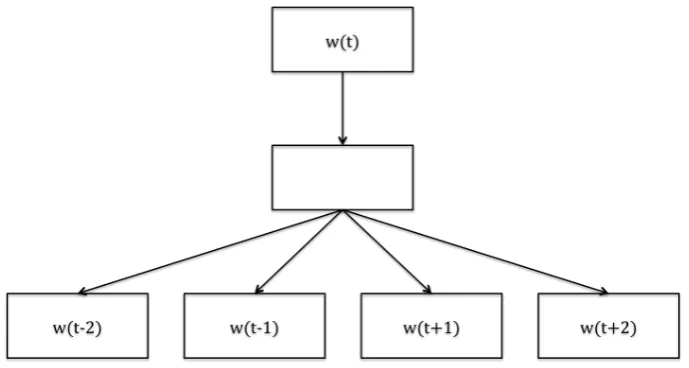
The skip-gram model tries to maximize classi-fication of a word based on another word in the same sentence. Each current word as an input to a log-linear classifier with continuous projection layer, and predict words within a certain range be-fore and after the current word (Figure 2).
Nie et al. utilized word embedding for detecting trigger words [6]. In this paper, we present the ex-periments using word embedding as token features to extract complete events including triggers and their arguments. The skip-gram model is used to obtain word-embedding features and is compared with a baseline model of using BOW features. The result demonstrates that the introduction of word embedding improves the result, and is comparable to the state-of-the-art solution.
2 Methods and results
2.1 BioNLP GENIA task
A series of efforts has been initiated to evaluate the available solutions and investigate potentials in event extraction technologies. Among them, the
BioNLP Shared Tasks (BioNLP-ST) [7] have been consistently conducted since 2009 and attracted community-wide support. BioNLP-ST GENIA task is a core task and had the third edition in 2013. The task gradually increased its difficulties and complexities, for example, by upgrading from abstract-only text to full-text articles and subsum-ing co-reference tasks.
In the latest GENIA 2013 task, EVEX achieves the best performance (F-score: 50.97; recall: 45.44; precision: 58.03) [8]. Our system achieves a comparable result with a higher precision (F-score 47.33; recall: 37.14; precision: 65.21).
2.2 Event extraction model
Except binding events, the event extraction pro-cess consists of two steps in our system. First, triggers are predicted for each token in a sentence. Then, arguments including themes and causes are predicted to be associated with the triggers. The arguments could be either proteins or other events. The events, which may have other events as ar-guments, are called recursive events in this paper. During the prediction, this might lead to cyclic ref-erencing. For example, event A is predicted as event Bs argument, while B is also predicted as As. In our model, the candidate events are tested, and the one has lower confidence score given by SVM classifier would be deleted. This method is also extended to bigger number of events, which are referencing each other in a cyclic manner.
For example, in Figure 1, four trigger words in-dicate four events. After detecting the triggers, the system check proteins one by one to seek the right arguments. The system will start with simple events, the methylation and the gene expression in the example. Then it will check arguments for the triggers of recursive events. This example has two recursive events, a positive regulation and a negative regulation. In the case when a new event is created, the new event has to be tested to see whether it could be an argument of one of the re-cursive events.
A binding event may have more than one theme. The extraction of binding event consists of three steps. The first two steps are similar to the other event extractions. At the third step, the candidate arguments are constructed with argument in pos-sible combinations. Then, the combinations are tested by an SVM classifier, and the one with the highest confidence score will be kept. In the
ex-periments, we use LibSVM as the implementation of SVM.
2.3 Word embedding for trigger and argument detection
Representing a token in right features is crucial in trigger prediction. BOW is a popular solu-tion. However, it is very high dimensional, sparse and discrete. While word embedding features, which are learnt by a neural-network-based lan-guage model called continuous space lanlan-guage model, can represent a words distributional char-acteristics [4]. This, in a way, may capture seman-tic and sequential information of a word in text.
One problem of a word embedding model is that the model only represents the distributional char-acteristics of a word in entire text rather than in a specific context. In another word, the character-istics of an individual word in a sentence cannot be brought into a later prediction model. The lexi-cally same tokens have the same word embedding. This word may indicate different event types in different sentences according to the BioNLP task. Therefore, we also experiment to join word em-bedding features with BOW features.
Events may have multi-token triggers. For ex-ample, mRNA expression is a transcription events trigger in many instances. Meanwhile, expres-sion appears as a gene-expresexpres-sion events trigger in many instances. Biologically, transcription is a more specific process of gene expression. There-fore, for such cases, the system predicts event type as transcription since it is more informative.
In the experiment, training and development data-sets provided in the BioNLP13 are used to obtain word-embedding features in an unsuper-vised manner. A problem of word embedding method is that it represents a words distributional characteristics in the entire text, however loses the words contextual information in a specific sen-tence. Thus, during the training, we also consider
n-gram features of a token.
Figure 1: The model of even extraction. The words in orange are the proteins. The underlined words are the triggers.
Figure 2: The skip-gram model architecture.
2.4 Results
We evaluate three models on the BioNLP 2013 GENIA test dataset. At the moment, only events described within the boundaries of a sentence are considered.
• BOW +n-gram
• Word embedding
• Word embedding +n-gram
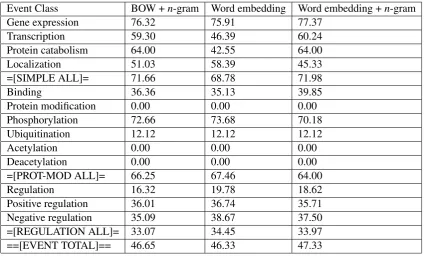
The first model uses BOW and n-gram to rep-resent each token. Then, the model is replaced by another using word embedding only while uti-lizing the exactly same extraction infrastructure, which is a pipeline converging tokenization, pars-ing and other pre-processpars-ing upon Apache UIMA. At last, we jointly use word embedding with n -gram. In Table 1, it could be observed that the joint model achieves the best performance with 47.33 in F-score. The model only using word embedding achieved the lowest, however, still gets 46.33 in F-score. This is because word embedding loses a word’s distributional information in a specific con-text although the distributional characteristics of words are obtained for the entire text.
Table 2 shows that the detail result of the model performing the best, the joint model. Extraction
of simple events achieves an average F-score of 71.98, which is expected, since each simple event contains only one theme and is not recursive. The system achieves 64.00 in F-score for protein mod-ification event. The events are more complicated than simple events since they contain causes be-sides themes in arguments. The F-score for ex-tracting binding events is 39.85. Regulatory events are the most complex ones because each of them has two arguments and is recursive. Extraction of this type of events achieved 33.97 in F-score.
[image:3.595.127.472.163.347.2]ac-Event Class BOW +n-gram Word embedding Word embedding +n-gram
Gene expression 76.32 75.91 77.37
Transcription 59.30 46.39 60.24
Protein catabolism 64.00 42.55 64.00
Localization 51.03 58.39 45.33
=[SIMPLE ALL]= 71.66 68.78 71.98
Binding 36.36 35.13 39.85
Protein modification 0.00 0.00 0.00
Phosphorylation 72.66 73.68 70.18
Ubiquitination 12.12 12.12 12.12
Acetylation 0.00 0.00 0.00
Deacetylation 0.00 0.00 0.00
=[PROT-MOD ALL]= 66.25 67.46 64.00
Regulation 16.32 19.78 18.62
Positive regulation 36.01 36.74 35.71
Negative regulation 35.09 38.67 37.50
=[REGULATION ALL]= 33.07 34.45 33.97
[image:4.595.87.512.92.349.2]==[EVENT TOTAL]== 46.65 46.33 47.33
Table 1: The comparison between the BOW model, the word embedding model and the joint model on the test set of BioNLP 2013. The results are represented in F-scores.
Event Class Gold (match) Answer (match) Recall Precision F-score Gene expression 619 (441) 521 (468) 71.24 84.64 77.37
Transcription 101 (50) 65 (50) 49.50 76.92 60.24
Protein catabolism 14 (8) 11 (8) 57.14 72.73 64.00
Localization 99 (34) 51 (34) 34.34 66.67 45.33
=[SIMPLE ALL]= 833 (533) 648 (533) 63.99 82.25 71.98
Binding 333 (107) 204 (107) 32.13 52.45 39.85
Protein modification 1 (0) 0 (0) 0.00 0.00 0.00
Phosphorylation 160 (102) 131 (102) 63.75 77.86 70.10
Ubiquitination 30 (2) 3 (2) 6.67 66.67 12.12
Acetylation 0 (0) 0 (0) 0.00 0.00 0.00
Deacetylation 0 (0) 0 (0) 0.00 0.00 0.00
=[PROT-MOD ALL]= 191 (104) 134 (104) 54.45 77.61 64.00
Regulation 288 (35) 88 (35) 12.15 39.77 18.62
[image:4.595.92.508.452.709.2]Positive regulation 1130 (291) 500 (291) 25.75 58.20 35.71 Negative regulation 526 (156) 306 (156) 29.66 50.98 37.50 =[REGULATION ALL]= 1944 (482) 894 (482) 24.79 53.91 33.97 ==[EVENT TOTAL]== 3301 (1226) 1880 (1226) 37.14 65.21 47.33
cording to confidence scores (see the section 2.1). Table 3 shows that the performance of dividing Binding events themes extraction in two step is better. Using confidence scores to prune Binding events can improve the performance of Binding events significantly.
3 Conclusion
The paper explores the methods of exploiting dis-tributional characteristics of words in a continuous space into bio-event extraction by using the latest word embedding methods. It is the first system using word embedding to extract complete events from text, and has achieve the result comparable to the state-of-the-art system’s.
The system uses the BOW model as the base-line. When the model only using word embedding to represent tokens, the system achieves slightly lower performance than the BOW model’s. The model jointly using word-embedding achieves the best performance. This is because n-gram effec-tively complements the loss of contextual informa-tion of words, at the same time when the words’ distributional characteristics are introduced by word embedding.
There are various ways we plan to further im-prove the system. The current experiment uses BioNLP dataset, which is relatively small for achieving word vectors in a continuous space. In the following experiments, we would like to train and obtain the word vectors on a bigger cor-pus, e.g. a subset containing related articles from Wikipedia. Furthermore, we would like to create a joint model combining the prediction of trigger and arguments [3].
Acknowledgments
The work also benefited from the discussion with Nigel Collier.
Chen Li is sponsored by Quanta Computer Inc., Taiwan.
References
[1] C. Li, M. Liakata, and D. Rebholz-Schuhmann, “Biological network extraction from scientific literature: State of the art and challenges,”Briefings in bioinformatics, vol. 15, no. 5, pp. 856–877, 2014.
[2] D. McClosky, S. Riedel, M. Surdeanu, A. McCallum, and C. D. Manning, “Combin-ing joint models for biomedical event extrac-tion,”BMC bioinformatics, vol. 13, no. Suppl 11, S9, 2012.
[3] A. Vlachos and M. Craven, “Biomedical event extraction from abstracts and full pa-pers using search-based structured predic-tion,”BMC bioinformatics, vol. 13, no. Suppl 11, S5, 2012.
[4] D. E. Rumelhart, G. E. Hinton, and R. J. Williams, “Learning representations by back-propagating errors,” Cognitive model-ing, vol. 5, 1988.
[5] T. Mikolov, I. Sutskever, K. Chen, G. S. Cor-rado, and J. Dean, “Distributed representa-tions of words and phrases and their com-positionality,” in Advances in Neural
Infor-mation Processing Systems, 2013, pp. 3111–
3119.
[6] Y. Nie, W. Rong, Y. Zhang, Y. Ouyang, and Z. Xiong, “Embedding assisted prediction architecture for event trigger identification,”
Journal of bioinformatics and computational biology, 2015.
[7] C. N´edellec, R. Bossy, J.-D. Kim, J.-J. Kim, T. Ohta, S. Pyysalo, and P. Zweigenbaum, “Overview of bionlp shared task 2013,” in
Proceedings of the BioNLP Shared Task 2013
Workshop, 2013, pp. 1–7.
[8] J.-D. Kim, Y. Wang, and Y. Yasunori, “The genia event extraction shared task, 2013 edition-overview,” in Proceedings of the
BioNLP Shared Task 2013 Workshop, 2013,
Binding event Gold (match) Answer (match) Recall Precision F-score Single prediction 333 (84) 310 (84) 25.23 27.10 26.13 Two-step prediction 333 (64) 148 (64) 19.22 43.24 26.61 Two-step prediction with
confidence scores 333 (101) 242 (101) 30.33 41.74 35.13