The potential and limits of lay post-editing in an online community
Linda Mitchell
CNGL/School of Applied Language and Intercultural Studies Dublin City University
Dublin, Ireland
Abstract
This paper aims at exploring the potential of a lay community as post-editors. It fo-cusses on 15 members of an online tech-nology support forum, native speakers of the target language (TL) and some knowl-edge of the source language (SL) trans-lating content that was machine translated from English into German specific to their own domain. It presents the most predom-inant errors remaining in the post-edited output and the impact of these on the qual-ity of the post-edited output as measured by domain specialists evaluating adequacy and fluency. This paper further explores examples of these errors and possible so-lutions to reducing the occurrence of these and maximising the community’s poten-tial. The targeted post-editing quality was “‘good enough”, as determined in the post-editing guidelines. The PE results demon-strate that there is still room for improve-ment in terms of quality.
1 Introduction
User-Generated Content (UGC) is constantly growing online. With that growth, the demand for translations with fast turnaround times increases, too. Common solutions to meet this demand are MT or a combination of MT and Post-Editing (PE), the correction of automatically translated text. Previous research in thefield of PE has pre-dominantly focussed on professional translators, e.g. de Almeida (2013) who investigates
corre-c
�2015 The authors. This article is licensed under a Creative Commons 3.0 licence, no derivative works, attribution, CC-BY-ND.
lations between translation experience and post-editing quality, Plitt and Masselot (2010) who compare results of traditional Human Translation to post-editing in an industrial setting using the ex-ample of Autodesk, or Guerberof (2009) who com-pares productivity between translation with Trans-lation Memories (TM) to post-editing of MT con-tent. Participants within these experiments have been found to experience adverse feelings towards post-editing (e.g. de Almeida 2013), which is not correlated to their often excellent performance. There have further been studies with translation students as post-editors, e.g. Koponen (2013), who investigates variation in post-editing prefer-ences or Depraetere (2010), who seeks to establish strategies in post-editing behaviour of translation students. Recently, there have been studies inves-tigating individual lay people or communities as post-editors, such as with subjects who have some knowledge of both the SL and the TL but who are untrained in translation (Aranberri et al. 2014) or domain specialists who are untrained in translation and have no knowledge of the SL (Schwartz 2014). While the studies presented above have mostly been of hypothetical nature here, we are tapping into a new pool of potential post-editors by fo-cussing on an already existent and real online com-munity. This community is a technology support forum, the Norton1 Community, a platform
facil-itating discussion on the Norton products among the users of the products in order to solve problems they may be experiencing with additional guidance from Symantec employees. It is a small commu-nity, which sets itself apart from communities dis-cussed in previous translation research, as it is not based on social media, such as Facebook or
ter. In order to determine the potential of lay post-editing, we compare the post-editing behaviour of lay post-editors2to that of professional translators
or any other post-editor types that have been re-ported on. In the following, such studies are pre-sented to facilitate a comparison with the current research.
2 Related Research
De Almeida (2013) investigates the post-editing behaviour of 18 professional translators with vary-ing degrees of experience in translation and in PE for English → French and English → Brazilian
Portuguese. She focusses on essential, preferential changes and newly introduced errors. She finds that her subjects do not only implement essential changes but that they also implement additional preferential changes, e.g. of stylistic or synonymi-cal nature, even though they were instructed not to do so. She uncovers a tendency of professional translators to over-edit the text, which could render the post-editing process less efficient.
Groves and Schmidtke (2009) investigate com-mon edits performed on MT output using the Mi-crosoft Treelet MT engine focussing on EN→DE and EN → FR, employing 3 professional
trans-lators with varying degrees of translation experi-ence and productivity. For both language pairs they identify the insertion and deletion of func-tion words as the most common edit, 42% of which consist of determiners (for German), pre-dominantly the insertion of the determiner die. They further note changes in punctuation as being among the most common edits in their data and point out the frequent deletion of the pronounSie, which is typically inserted by their MT system. They hope to resolve these issues with automatic statistical post-editing. Groves and Schmidtke do not report on any errors that remain in the post-edited output.
Depraetere (2010) focusses on post-editing training of translation students looking at the lan-guage pair English → French. Hypothetically, these students would not have established au-tomised translation routines yet and would be more open to new translation techniques and would be closer to lay post-editors in behaviour than profes-sional translators. She investigates the post-editing results of 10 such students, and how they intu-2We define a lay post-editor as anybody who is not a profes-sional translator or translation student.
itively approach post-editing with the view to cre-ating appropriate post-editing guidelines that focus on the errors ignored. Depraetere finds that, in contrast to professional translators, there are few stylistic or phrasal ordering changes implemented. More importantly, she finds that the students ad-hered strictly to the guidelines, which were to “make sure that the source text and the target text were informationally similar and that the target text was grammatically correct” (Depraetere 2010: 3), i.e. they performed minimal edits. Their be-haviour involved, for example, accepting literal translations by the MT system that are not equiva-lent to the source text. She concludes that there are no clear post-editing strategies present on a micro level, i.e. the types of errors corrected.
It can be concluded that professional translators tend to post-edit more systematically, frequently correcting the same errors (Groves and Schmidtke 2009) and that they tend to over-edit MT output by implementing preferential changes to render the writing style closer to their own (de Almeida 2013). Although the manner of measuring er-rors/changes differs between these studies and the approach taken in this paper, they give an impor-tant indication. Furthermore, translation students seem to under-edit the machine translated output and strictly adhere to the guidelines they are pre-sented with (Depraetere 2010).
Moorkens and O’Brien (2015) also focus on dif-ferences between novice translators and profes-sionals in the frame a post-editing user interface study. They find that professionals are more ef-ficient but that their working habits and attitudes may prevent them from following the structure of the experiment as intended. They conclude that while novices may be the group that is more easily engaged in research, their results cannot be carried over to professionals.
ˇ
PE rules have been addressed on a theoretical level by Rico and Ariano (2014). They seek to es-tablish a framework for developing language de-pendent PE guidelines (English→Spanish) These
were based on an analysis of the MT output and PE patterns that emerged incorporated into afl ex-ible decision tool. While this approach appears to be successful, it is unsuitable for the purpose of the current study. Rico and Ariano do not deal with SMT, nor does their project support German. Their PE guidelines are targeted at professional post-editors or translators and are unsuitable for lay post-editors, as the guidelines require linguistic knowledge to be understood.
The aim of the experiment described in this pa-per was to uncover the post-editing approach taken by lay post-editors and how itfits into the current body of research. Furthermore, this study aims at identifying the potential of a lay community as post-editors of content that is relevant to their do-main. Firstly, we aim to identify the number of er-rors corrected and the number of erer-rors that remain in the post-edited output of the lay post-editors. This paper subsequently sets out to present strate-gies to maximise a lay community’s potential for post-editing.
3 Experimental Design
The participants for this experiment were recruited online in the German Norton Community by means of private messaging and a publicly posted open call for participation. Fifteen native speak-ers of German with some knowledge3 of English,
who post-edited bilingually were considered only, with the aim to eliminate outliers based on their language skills. 4 The participants were members
of the Norton Community and were familiar with the domain of the Norton products. Each partici-pant post-edited 12 tasks.5 The texts for the tasks
were extracted from the English-speaking Norton community. They were machine translated from English into German using the ACCEPT baseline SMT engine, which is based on Moses, as de-scribed in ACCEPT (2012) in the ACCEPT por-tal.6 The language pair English → German was
3‘Some knowledge’ here refers to the categories B1 to C2 as defined in CEDEFOP 2011.
4This work is based on the post-editing and post-editor data collected in a study as described in Mitchell (2015). 5Each ‘task’ contained a subject line, a question and the ac-cepted solution to that question.
6www.accept-portal.eu
chosen here, as it is particularly challenging for MT engines because of the differences in syntax between the languages.
[image:3.595.308.524.164.315.2]Figure 1 displays the (German) post-editing in-terface the lay post-editors used to post-edit the machine translated content.
Figure 1: Post-editing Interface (German)
On the left, the machine translated text is dis-played with the original version of the current ment displayed on the top right and the current seg-ment to be edited below. Of particular importance here is the middle button on the bottom, “Tipps”, which displayed the post-editing guidelines when clicked. These are presented below.
Tips for post-editing:
• Edit the text to make it morefluent and clearer based on your interpretation.
• Try to correct phrasal ordering and spelling, for example, if they make the text hard or im-possible to understand.
• Use words, phrases or punctuation as they are, if they are acceptable.
• If you are working with reference to the orig-inal text, make sure that no information has been added or deleted.
The post-editing results were analysed based on the error categorisation proposed by (de Almeida 2013), which was developed for investigating post-editing behaviour. The error annotation was per-formed by the author of this paper, a native speaker of German. While it may be argued that one an-notator is not sufficient in evaluating the content, it was considered an appropriate solution here, as recent studies have shown that achieving annota-tor agreement is difficult, due to ambiguity of cat-egories, disagreement on whether a construct is an error or not and disagreement on the spans of er-rors (e.g. Lommel 2014). Agreement on spans of errors is particularly important for phrasal or-dering, an error type that was expected to be of significance in this study, due to the language pair English→German. The categories of preferential
and essential changes were dropped, as the partic-ipants were assumed to be untrained in translation and would therefore not have experience of these concepts. The main categories used for this exper-iment were ‘Language’, ‘Accuracy’ and ‘Format’ (based on de Almeida 2013: 95) with the category Language including adjectives, adverbs, capitali-sation, conjunctions, determiners, gender, nouns, number, phrasal ordering, prepositions, pronouns, punctuation, spelling and verb tense; the category Accuracy includes extra information, information missing, untranslated information and mistransla-tion; and Format consists of additional or missing spaces. For the error annotation all machine trans-lated content (322 segments) and 44% of the post-edited content (4 post-post-edited versions per MT seg-ment), approximately 72 segments per post-editor, was randomly selected and evaluated.
4 Results and Analysis
In order to demonstrate the finding that post-editing by a lay community is feasible, the errors corrected by the participants are presented here. The results can be found in Table 1, displaying the Total number of errors corrected, the number of errors in the Language, Accuracy and Format cat-egories in both absolute numbers and percentages, compared to the errors that had been present in the raw MT output.
It is evident that the lay community was able to correct on average 73% of all errors, with the lowest number being 21% (PE13) and the high-est number being 83% (PE8). The average num-ber of errors corrected in the Language category
[image:4.595.307.540.71.243.2]Total % Lang. % Acc. % F. % PE1 199 66 95 61 100 79 -4 -44 PE2 182 69 88 65 88 74 5 63 PE3 215 81 103 80 101 81 4 80 PE4 254 81 133 81 120 90 1 10 PE5 248 78 116 70 114 88 6 75 PE6 231 87 114 84 107 91 2 40 PE7 164 57 69 44 89 75 -1 -33 PE8 223 83 116 85 94 81 6 67 PE9 215 80 107 80 102 84 -2 -40 PE10 213 77 113 74 94 85 0 0 PE11 222 78 114 75 101 86 -1 -25 PE12 234 81 122 84 105 83 -2 -33 PE13 51 21 67 48 -8 -8 -8 -800 PE14 227 71 131 76 97 75 -9 -225 PE15 193 78 98 77 86 82 1 17 Avg. 205 73 106 72 93 76 0 -57
Table 1: Errors corrected (absolute and in %) for the Total number of errors corrected, errors in the Language, Accuracy and Format category (also ab-solute and in %)
are 72% with 48% (PE13) as the lowest and 85% (PE8) as the highest number and 76% on average and -8% (PE13) as the lowest, i.e. 8 errors were in-troduced in the post-edited output, and 91% (PE6) of all errors of the Accuracy category corrected. While none of the post-editors corrected 100% of the errors and there is great variation across the lay post-editors, these results show the potential of lay post-editing, especially with the examples of PE3, PE4, PE6, PE8, PE9, PE12, who correct ≥80% of all errors. It should be noted that even in studies with professional translators acting as post-editors, it is often reported that errors remain in the post-edited output. Furthermore, the guidelines used targeted “good enough” post-editing quality, rather than aiming at the best humanly possible quality. Thus, we did not expect a correction rate of 100% of all errors.
In order to interpret this data, the need to inves-tigate the profile of the lay post-editors arises. This was discussed in Mitchell (2015:166-176); Section 7 focusses on the post-editor profile, i.e. language competence, domain competence and psychomo-tor competence. While the first two were mea-sured by self-reporting, the last was based on key logging data recorded in the ACCEPT portal. We found that there were no correlations between any of these competences and the post-editing qual-ity, represented by both the error annotation and the domain specialist evaluation. Hence, the post-editor background was not deemed to be a helpful variable in the light of this article.
that remain in the post-edited output and how they affect the quality of the same are presented in order to propose strategies for maximising the potential of a lay community as post-editors. Table 2 dis-plays the average number of errors across all post-editors in the MT output they were editing, as well as in the post-edited content. These are ordered by the most frequent errors present in the MT output. It emerges that errors from the Accuracy category were the most common: mistranslation, informa-tion missing and extra informainforma-tion, as well as er-rors that emerge from the differences in syntax be-tween English and German, i.e. phrasal ordering and verb (tense), the latter of which often mani-fests itself as a missing part of the verb, determin-ing the correct tense. Additional sub-categories of Language that contained a considerable number of errors in the content annotated were determiner and pronoun.
Category Errors
(MT) Avg. Errors(PE) Avg. Mistranslation 873 58 162 11 Phrasal ordering 791 53 100 7 Information missing 526 35 161 11 Verb (tense) 271 18 40 3 Extra information 256 17 48 3 Determiner 247 16 50 3
Pronoun 150 10 28 2
[image:5.595.309.537.68.241.2]Untranslated 146 10 40 3
Table 2: Errors present in MT output and after PE in total and on average across all post-editors
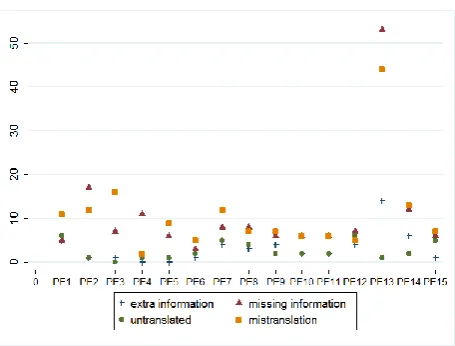
Figure 2 displays the absolute number of errors for the main error category Accuracy for each post-editor, in order to establish how they handled the errors present in the categories extra information, missing information, untranslated and mistransla-tion individually. The most frequent errors, which post-editors failed to correct/introduced, were ei-ther mistranslations or information missing. The number of remaining errors ranged between 3 and 17 for mistranslation and 2 and 13 for the category information missing. Figure 2 also reveals an out-lier in the post-editing behaviour, PE13.
While PE13 accounts for nearly 30% of the er-rors in these two categories, the categories of un-translated and extra information contain numbers of errors that are comparable to those of the other post-editors. The category untranslated informa-tion seems to contain the lowest number of errors mostly, followed by the category of extra informa-tion, predominantly≤10 errors per post-editor.
Compared to the number of Accuracy errors,
[image:5.595.310.524.295.449.2]Figure 2: Errors remaining (absolute) in PE output in Accuracy category
Figure 3: Predominant errors remaining (absolute) in PE output in Language category
as presented in Figure 2, considerably fewer Language errors remained in the MT output, as evident from Figure 3. Phrasal ordering errors, as expected, takes the highest rank of errors remaining in the post-edited output per evaluator. This echoes Depraetere’s (2010) finding that post-editors who are not professional translators leave MT output unedited if the sentence is comprehensible and often leave literal translations untouched even though they may not convey the source text meaning accurately. The ratios of types of errors remaining (phrasal ordering, determiner and pronouns) are similar across all post-editors except for PE12 and PE13.
Examples:
[image:5.595.79.287.337.442.2]the MT output that was mistakenly retained; for phrasal ordering, the post-editor creates an awk-ward construction and did not correct the phrasal ordering; for information missing, the machine translated output was left unedited, which results in the conjunction (a function word) missing.
Mistranslation:
ST: ... I bought a new laptopand7problem was more prevalent.
MT: ... weilich eine neue Laptops und Problem weiter verbreitet wurde.
HT: ... ich kaufte einen neuen Laptopund das Problem wurde noch schlimmer.
PE: ... weil das Problem durch den Kauf eines neuen Laptop schlimmer wurde.
Phrasal ordering:
ST: Purgein progressfor 2-1/2 days... help! MT: Bereinigungin Fortschrittf¨ur 2-1 / 2 Tage... zu helfen!
HT: Bereinigung seit zweieinhalb Tagen in Arbeit...Bitte um Hilfe!
PE: Bereinigung in Arbeit seit zweieinhalb Tagen.... Bitte um Hilfe!
Information missing:
ST: First, make sure Teamviewer is not running. MT: Stellen Sie zuerst sicher TeamViewer wird nicht ausgef¨uhrt.
HT: Stellen Sie zuerst sicher,dassTeamViewer nicht ausgef¨uhrt wird.
PE: Stellen Sie zuerst sicher TeamViewer wird nicht ausgef¨uhrt.
The following example focusses on extra infor-mation that has been accidentally introduced by retaining the verb from the MT output and insert-ing it in the wrong position in the sentence. This shows that the placement of verbs not only poses problems for MT engines but also for human lay post-editors.
Extra information:
ST: In almost all cases, the events are caused by legitimate programs or Windows processes... MT: In fast allen F¨allen verursacht werden, die Ereignisse von legitimen Programmen oder Windows Prozesse...
HT: In fast allen F¨allen werden die Ereignisse von legitimen Programmen oder Windows Prozessen verursacht...
PE: In fast allen F¨allenverursachtwerden diese Ereignisse von legitimen Programmen oder Windows Prozesseverursacht...
In addition to retaining errors from the MT, post-editors produce verbal errors. The next example 7Italics were added in all examples to highlight the translation problem of interest.
requires a complex verb construction, which the post-editor failed to produce. While the post-editor does produce a correct sentence compared to the MT output, it does not accurately reflect the mean-ing of the source text. This may have also been due to insufficient knowledge of the source language.
Verb (tense):
ST: However, NU should not have been deleting this.
MT: Aber NUsollten nicht gel¨oscht wurden. HT: Aber NUh¨attediesenicht l¨oschen sollen. PE: NUsolltediese Elementenicht l¨oschen.
The following two examples involve the chang-ing of function words, i.e. determiners and pro-nouns. While the first one shows that the post-editor discards the correct determiner as suggested by the MT system, the second example shows that the post-editor deemed the sentence comprehensi-ble and left it unedited. In addition, the meaning is completely mistranslated, which was not picked up on by the post-editor.
Determiner:
ST: Check if it runs the scans or detects any threats.
MT: ¨Uberpr¨ufen Sie, ob es f¨uhrtdieScans oder erkennt Bedrohungen.
HT: ¨Uberpr¨ufen Sie, ob die Scans ausgef¨uhrt oder Bedrohungen erkannt werden.
PE: ¨Uberpr¨ufen Sie, ob der Scans ausgef¨uhrt wird oder Bedrohungen erkannt werden.
Pronoun:
ST: AllI care about is thefirst C: drive in this list.
MT:Ichinteressiert, ist das erste Laufwerk C: In dieser Liste enthalten.
HT:Michinteressiert nur das erste Laufwerk, C:, in dieser Liste.
PE:Ichinteressiert, ist das erste Laufwerk C: in dieser Liste enthalten.
The last example shows insufficient knowledge of the source language or the domain. The post-editor left ‘Antivirus License Be’ unedited, possi-bly because they assumed it to be the correct term or were unable to translate it.
Untranslated:
ST: Can Norton AntivirusLicense BeTransferred From One Computer To Another?
MT: Kann Norton Antivirus License Be ¨ubertragen von One Computer So Anderer? HT: Kann ich die Norton AntivirusLizenz auf einen anderen Computer ¨ubertragen?
In summary, errors may be caused by erro-neous source texts, by insufficient knowledge of the source language (or the domain), which leads to mistranslations and retaining errors as intro-duced by the MT output or introintro-duced by the post-editors. Other times errors may be caused by edit-ing hastily and producedit-ing errors that could have been easily avoided. This is not an unexpected sit-uation in a lay editing scenario as lay post-editors are assumed to be untrained in translation and proreading. Furthermore, post-editors of-ten left segments unchanged that needed editing in regards to syntax, e.g. phrasal ordering and verbs. When it comes to insufficient knowledge of the SL, it would be beneficial for the post-editors to have an option to send the segments in ques-tion to another post-editor/professional translator, a solution suggested by Schwartz (2014). Errors stemming from editing too hastily and too little editing could be addressed through revised post-editing guidelines. A factor that may have infl u-enced PE quality negatively is motivation. Re-vised guidelines could increase the post-editors’ knowledge of how to post-edit successfully on a theoretical level. On a practical level, however, they would also need to be motivated to to imple-ment the required changes. We believe that moti-vation is a complex aspect that has an impact on lay post-editing quality. While motivation was not addressed here, it would be beneficial if it were considered in the future. Hence, we developed the following amended post-editing guidelines fo-cussing on German as a target language.8They
fo-cus on the most common errors that remain in the post-edited output and do not include a reference to reusing as much of the MT output as possible (cf. Depraetere 2010). The guidelines were writ-ten in a clearer and a more concise manner. Extra items have been added for the mistakes that were predominant in the post-edited output: verbs, de-terminers, pronouns and mistranslations.
Tips for post-editing:
• Correct spelling, grammar and word order er-rors.
• Pay particular attention to verbs, determiners (e.g. der, die, das)and pronouns(e.g. ich, du, er, mich, dich, sich).
8These could be easily adapted to suit other languages by re-placing the error categories here with ones specific to these languages.
• Correct any mistranslated information in the MT output.
• Ensure that no information has been added or deleted from the original text.
With these guidelines, we hope to point lay post-editors in the right direction without confusing them about the goal of their post-editing. Further-more, they may be a first step in maximising the community’s potential and aiming for post-editing quality that is better than “good enough”, which is the quality that was targeted for the purpose of this experiment. These revised guidelines would only be a successful solution, however, if they were in-terpreted correctly by the post-editors and if they had the motivation required to implement them. It remains to be seen whether additional post-editor training in this regard would be helpful and feasi-ble in an online community with volunteer post-editors.
5 Conclusion
It can be concluded from this sample that lay post-editors correct on average around 74% of errors in total. Furthermore, it was found that the most common errors remaining were all categories as-sociated with Accuracy (mistranslation, informa-tion missing, extra informainforma-tion and untranslated information) and the following categories associ-ated with Language; phrasal ordering, verb, deter-miner and pronoun. Thisfits withfindings by De-praetere (2010), in terms of syntactical changes, and with Groves and Schmidtke (2009) in terms of the changing of function words, mainly determin-ers and pronouns, which occur often in our sample and are not always corrected.
Additionally, the ratios of errors remaining in both the Language and the Accuracy category are quite similar across the post-editors, i.e. they sys-tematically leave some errors uncorrected in the MT output, which corresponds to de Almeida’s findings. However, rather than over-editing the text, they adhere to the guidelines and leave lit-eral translations or awkward sentence structures unedited, as described by Depraetere (2010).
guidelines, here tailored to German as a target lan-guage.
Acknowledgements This research was funded
by the European Community’s Seventh Frame-work Programme as part of the ACCEPT project under grant agreement no. 288769. It was contin-ued in association with CNGL II.
References
ACCEPT Consortium. 2012. Baseline machine translation systems. Deliverable 4.1. Avail-able from: http://www.accept.unige. ch/Products/D_4_1_Baseline_MT_ systems.pdf.
Aranberri, Nora, Gorka Labaka, Arantza Diaz de Ilar-raze and Kepa Sarasola 2014. Comparison of poste-diting productivity between professional translators and lay users. Proceedings of the Third Workshop on Post-editing Technology and Practice, Vancouver, Canada. 20–34.
ˇ
Culo, Oliver, Silke Gutermuth, Silvia Hansen-Schirra and Jean Nitzke 2014. The influence of post-editing on translation strategies. IN: Post-editing of Machine Translation Laura Winther Balling, Michael Carl, Michel Simard, Lucia Specia and Sharon O’Brien (eds.). 200–218.
de Almeida, Giselle 2013. Translating the post-editor: an investigation of post-editing changes and corre-lations with professional experience across two Ro-mance languages PhD thesis, Dublin City Univer-sity.
Depraetere, Ilse 2010. What counts as useful advice in a university post-editing training context? Report on a case study. EAMT 2010: Proceedings of the 14th Annual conference of the European Association for Machine Translation, 27-28 May 2010, Saint-Rapha¨el, France.
Groves, Declan and Dag Schmidtke 2009. Iden-tification and Analysis of Post-Editing Patterns for MT MT Summit XII: Proceedings of the twelfth Ma-chine Translation Summit, August 26-30, 2009. Ot-tawa, Ontario, Canada. 429–436.
Guerberof, Ana 2012. Productivity and quality in the post-editing of outputs from translation memo-ries and machine translation. PhD thesis, Unversitat Rovira.
Koponen, Maarit 2013. This translation is not too bad: an analysis of post-editor choices in a machine trans-lation post-editing task. Proceedings of MT Summit XIV Workshop on Post-editing Technology and Prac-tice (WPTP), 2-6 September. S. O’Brien, M. Simard and L. Specia (eds.). Nice, France, 1–9.
Linguistic Data Consortium. 2005. Linguistic data an-notation specification: assessment offluency and ad-equacy in translations. Revision 1.5. Available from:
http://www.ldc.upenn.edu/Catalog/ docs/LDC2003T17/TransAssess02.pdf [Accessed 3 October 2012].
Lommel, Arle, Maja Popovic and Aljoscha Burchardt 2014. Assessing inter-annotator agreement for trans-lation error annotation.IN: Proceedings of the Ninth International Conference on Language Resources and Evaluation (LREC),26-31 May, Reykjavik, Ice-land.
Mitchell, Linda 2015. Community Post-Editing of Machine-Translated User-Generated Content. PhD thesis, Dublin City University.
Moorkens, Joss and Sharon O’Brien 2015. Post-editing evaluations: trade-offs between novice and professional participantsIN: Proceedings of the 18th annual conference of the European Association for Machine Translation (EAMT 2015), 11-13 May, An-talya, Turkey.
Plitt, Mirko and Franc¸ois Masselot 2010. A productiv-ity test of statistical machine translation post-editing in a typical localisation environment The Prague Bulletin of Mathematical Linguistics, 93, 7–16.
Rico, Celia and Mart´ın Ariano 2014. Defining Lan-guage dependent post-editing guidelines: the case of the language pair English-Spanish IN: Post-editing of Machine Translation Laura Winther Balling, Michael Carl, Michel Simard, Lucia Specia and Sharon O’Brien (eds.). 299–322.
Schwartz, Lane 2014. Monolingual post-editing by a domain expert is highly effective for transla-tion triage. Proceedings of the Third Workshop on Post-editing Technology and Practice, Vancouver, Canada, 34–44.
TAUS. 2010. MT post-editing guidelines.
Available from: https://www.taus.
net/think-tank/best-practices/ postedit-best-practices/