Robust Function-on-Function Regression
Harjit Hullait
STOR-i Centre for Doctoral Training, Lancaster University
and
David S. Leslie
Department of Mathematics and Statistics, Lancaster University
and
Nicos G. Pavlidis
Department of Management Science, Lancaster University
and
Steve King
Rolls Royce PLC
September 2, 2019
Abstract
Functional linear regression is a widely used approach to model functional re-sponses with respect to functional inputs. However, classical functional linear regres-sion models can be severely affected by outliers. We therefore introduce a Fisher-consistent robust functional linear regression model that is able to effectively fit data
in the presence of outliers. The model is built using robust functional principal com-ponent and least squares regression estimators. The performance of the functional linear regression model depends on the number of principal components used. We therefore introduce a consistent robust model selection procedure to choose the num-ber of principal components. Our robust functional linear regression model can be used alongside an outlier detection procedure to effectively identify abnormal func-tional responses. A simulation study shows our method is able to effectively capture the regression behaviour in the presence of outliers, and is able to find the outliers with high accuracy. We demonstrate the usefulness of our method on jet engine sen-sor data. We identify outliers that would not be found if the functional responses were modelled independently of the functional input, or using non-robust methods.
1
Introduction
Functional Linear Regression (FLR) in the function-on-function case (Ramsay and Dalzell,
1991) is a widely used technique for modelling functional responses with respect to
func-tional inputs. The FLR model is able to capture complex dependency structures as it uses
information across time (Morris, 2015). However classical FLR models can be severely
affected by outliers as we will demonstrate via a simulation study in Section 6. We
there-fore develop a robust FLR (RFLR) model, which is able to effectively fit the data in the
presence of outliers. The model is built using the robust Functional Principal Component
model by Bali et al. (2011) and the multivariate Least Trimmed Squares (MLTS) estimator
by Agull´o et al. (2008). The RFLR model can be used to identify abnormal functional
re-sponses, i.e. samples in which the functional behaviour between the predictor and response
curves deviate from normal.
Our study of robust FLR is motivated by the need to identify normal relationships in jet
engine sensor data when we expect outliers to be present. The data is collected during
Pass-Off tests, which are performed on an engine before deployment. In a Pass-Pass-Off test a human
controller performs manoeuvres, which can be defined as various engine accelerations and
decelerations starting and ending at a set idle speed. During the test, data is captured by
sensors measuring engine speed, pressure, temperature and vibration in different parts of
the engine. One of the key manoeuvres in a Pass-Off test is the Vibration Survey (VS). In
this manoeuvre the engine is accelerated slowly to a certain speed then slowly decelerated.
We have 199 VS datasets, which include the turbine pressure ratio (TPR) that measures
the engine speed, and various temperature features including the turbine gas temperature
(TGT). In Figure 1 we have plots of the TPR and TGT for the first 30 VS manoeuvres.
To anonymise the data we have transformed the time index onto the interval [0,1] and the
sensor measurements to the range [0,100].
in the TPR curves as can be seen in Figure 1. This variability will naturally affect the
TGT curves and may mask the unusual behaviour produced by the engine. Our results
in Section 7 support this claim, and show that using a direct outlier detection on the
engine temperature curves fails to identify meaningful outliers. Instead this approach picks
up curves produced by unusual TPR speed profiles. We therefore require a method of
detecting outliers in the presence of the controller induced variability. We expect that the
relationship between the engine speed and engine temperature for different VS manoeuvres
should be the same irrespective of the way the manoeuvre is performed. For example given
a certain engine acceleration we would expect a certain temperature response. If however
the response differs from expectation this could be indicative of an engine issue. In Section
5 we will show how RFLR can be used for outlier detection, which is later applied to the
jet engine data in Section 7, to identify abnormal behaviour.
The paper is organised as follows. In Section 2 we outline the classical FLR model. In
Section 3, we will outline robust Functional Data Analysis (FDA) techniques to obtain a
robust FLR model. We also introduce a robust model selection procedure. In Section 4 we
prove consistency results for the robust FLR model and the robust model selection
proce-dure. In Section 5, we describe an outlier detection method, which acts on the residuals
of the robust FLR model. In Section 6 we perform a simulation study to illustrate the
model fitting and outlier detection capabilities of the robust model. In Section 7 we apply
the robust model on the engine data and highlight unusual observations that can not be
detected by using outlier detection directly on the temperature curves. Finally in Section
8 we provide a conclusion.
2
Classical Functional Data Analysis
In this section we give a brief summary of the FDA tools that we will later apply in our
Figure 1: Plots of the first 30 TPR and TGT time series.
space of square integrable functions on the compact interval I with the inner product
hf, gi=RIf(t)g(t)dt for functionsf, g ∈L2(I).
We will define X(t), Y(t) to be univariate stochastic processes defined on I, with
mean functions µX(t) and µY(t), and covariance functions C
X(s, t) = cov{X(s), X(t)}
and CY(s, t) =cov{Y(s), Y(t)} for alls, t ∈I. We shall define x(t) = [x1(t), ..., xn(t)] and
y(t) = [y1(t), ..., yn(t)] to be n independent and identically distributed realisations of X(t)
and Y(t) respectively.
In practice we observe xi(t) and yi(t) at discrete time points. We shall assume for
simplicity of exposition that observations are made at equally spaced time points t1, ..., tT.
We will outline Functional Linear Regression and Functional Principal Component Analysis
with respect to the underlying functions x(t), y(t). In Section 2.3 we need to use the
discretely observed data to define a suitable model selection criterion.
2.1
Functional Linear Regression
In this section we will introduce the classical FLR model (Ramsay and Dalzell, 1991). In
yi(t) = α(t) +
Z
I
xi(s)β(s, t)ds+i(t), (2.1)
where α(t) is the intercept function, β(s, t) is the regression function andi(t) is the error
process. For a fixed t, we can think of β(s, t) as the relative weight placed on xi(s) to
predict yi(t). As in Chiou et al. (2016) we will assume the mean functions µX(t) = 0 and
µY(t) = 0 which thereby means α(t) = 0. This is a reasonable assumption as in practice
we can calculate the mean functions µX(t) and µY(t) efficiently for dense data and then
pre-process the data by subtracting µX(t) and µY(t) from the observed curves.
FLR in the function-on-function case can be modelled parametrically (Yao et al., 2005;
Chiou et al., 2016) or nonparametrically (Ferraty et al., 2012; Ivanescu et al., 2015; Scheipl
et al., 2015). We use a parametric approach which models the regression matrix in terms
of pre-defined basis functions.
We will representxi(t) andyi(t) in terms of (M, K) pre-chosen basis functionsφXj (t), φYj (t)
respectively:
xi(t) = M
X
m=1
zimφXm(t) and yi(t) = K
X
k=1
wikφYk(t).
where zim, wik ∈R.
We define φX(t) = [φX1 (t), ..., φXM(t)], φY(s) = [φY1(s), ..., φYK(s)], zi = [zi1, ..., ziM] and
wi = [wi1, ..., wiK]. We will then model the regression surface using a double basis expansion
(Ramsay and Silverman, 2005):
β(s, t) =
M X m=1 K X k=1
bmkφXm(s)φ Y
k(t) =φ
X(s)TBφY(t), (2.2)
for an M ×K regression matrix B. We can then write:
Lettingi(t) =qiφY(t) we can reduce Equation (2.3) to:
wi =ziB+qi. (2.4)
This parametrisation of the residual function is also used by Chiou et al. (2016). We
can then estimate B using standard multivariate regression methods typically assuming
Gaussian qi.
2.2
Functional Principal Component Analysis
In this section we describe Functional Principal Component Analysis (FPCA), which we
will use to build data-driven basis functionsφX(t) andφY(t) forx
i(t) andyi(t), respectively.
These basis functions give effective, low-dimensional representations and will be used in
the Functional Linear Regression model described in Section 2.1.
Functional Principal Component Analysis (FPCA) is a method of finding dominant
modes of variance for functional data. These dominant modes of variance are called the
Functional Principal Components (FPCs). FPCA is also used as a dimensionality reduction
tool, as a set of observed curves can be effectively approximated by a linear combination
of a small set of FPCs.
The FPCs, φX
m(t) for m = 1,2, ..., are the eigenfunctions of the covariance function
CX(s, t) with eigenvalues λXm. Note that the eigenfunctions are ordered by the respective
eigenvalues. The Karhunen-Lo´eve theorem (Shang, 2014) shows that xi(t) can be
decom-posed asxi(t) =P
∞
m=1zimφ
X
m(t) where the principal component scorezim=
R
Ixi(t)φ X m(t)dt.
The scores zim are realisations from a random variableξmX.
We can define theM-truncation as
ˆ
xMi (t) =
M
X
m=1
which gives the minimal residual error: 1 n n X i=1
||xi−xˆMi ||
2 = 1 n n X i=1 Z I
[xi(t)−xˆMi (t)]
2
dt. (2.6)
To choose M we will use an information criterion outlined in Section 2.3. An analogous
procedure is used to find K eigenfunctions φY
k(t) for y(t).
2.3
Bayesian Information Criterion for FLR
In the FLR model described in Section 2.1 we need to choose terms M and K. Typically
M and K are chosen independently (Yao et al., 2005), however the estimation of β(s, t)
also depends on M and K and this should be incorporated into the estimation of these
terms. In this section we formulate a Bayesian Information Criterion (BIC) to determine
the basis size M and K, similarly to Matsui (2017).
A component of the BIC is the log likelihood, often expressed as a squared error term.
It is tempting to use the squared error resulting from Equation (2.4). However the objective
is to fit the data yi so we should use a likelihood of this data instead of a squared error
term of basis coefficients.
We have a set of models J ={(M, K)|M = 1, ..., Mmax, K = 1, ..., Kmax}, where Mmax
and Kmax are pre-set maximum number of FPCs that will be considered in the model. Let
vector~yi be the values ofyi(t) evaluated at discrete time points: ~yi = [yi(t1), ..., yi(tT)]. Let
zi(M) be the first M principal scores of xi(t) with respect to the FPCs φX(t) and let φ(K)
be the matrix with (k, i) entry φYk(ti). We assume there exists a true model (M0, K0) with
associated M0×K0 matrix BM0,K0 such that
~ yi = (z
(M0)
i )
TBM0,K0φ(K0)+
i, (2.7)
where the errori = [i(t1), ..., i(tT)] is assumed for simplicity to be sampled fromN(0, v2IT),
For Model (M, K) we defineθM,K = (BM,K, vM,K) and the prediction ˆyM,K
i = (z
(M)
i )TBM,Kφ(K).
We want to identify this true model (M0, K0), which we can use to obtain consistent
esti-mates of θM0,K0.
For Model (M, K) we can define the likelihood for sample i as
f(~yi|θM,K) =
1
(2π)T2(vM,K)T
exp
(
−[~yi−yˆ
M,K
i ]T[~yi−yˆiM,K]
2(vM,K)2
)
, (2.8)
and the log-likelihood l(θM,K) =Pn
i=1log(f(~yi|θM,K)). As in Eilers and Marx (1996)
BICn(M, K) = −2l(ˆθM,K) +w(M, K) log(n) (2.9)
where ˆθM,K is the maximum likelihood estimator and the penalty ω(M, K) =M K+ 1, in
which M K is the number of free parameters in the model and the 1 comes from v. We will
denote (M∗, K∗)n = arg min(M,K)∈JBICn(M, K), which is dependent on the sample size
n.
To summarise, we estimate the FPCs forXandY and solve the FLR model for different
models (M, K). We then choose model (M∗, K∗)n that minimises the BIC criterion. The
robust equivalent of this procedure is given in Algorithm 1.
3
Robust Functional Linear Regression
In Section 2 we have defined the FLR model and have outlined the use of FPCA bases to
estimate parameters of the model. In this section we will introduce robust versions of the
FDA techniques outlined in Section 2. This will allow us to fit a normality model even in
the presence of outliers. We shall also propose a robust BIC procedure for model selection.
We will replace classical FPCA with robust FPCA estimates by Bali et al. (2011) which
ensure that outliers do not unduly affect the FPCA estimates. Note that FPCA minimises
minimise a robust scale estimator, using a projection pursuit approach, which iteratively
performs a weighted least squares till the estimators stabilise.
Analogous to (2.5), the robust FPCs ˜φXm(t) (m= 1, ..., M) and ˜φYk(t) (k = 1, ..., K) are
orthonormal functions such that
xi(t)≈ M
X
m=1
˜
zimφ˜Xm(t), yi(t)≈ K
X
k=1
˜
wikφ˜Yk(t),
are good approximations for xi(t) and yi(t).
We define ˜yi(t) = ˜wiφ˜Y(t) and assume as in (2.4) that i = ˜qiφ˜Y(s). We can now write
the robust counterpart of (2.4) as
˜
wi = ˜ziB˜+ ˜qi. (3.1)
To obtain a robust estimate of the regression matrix ˜B, we will use the Multivariate
Least Trimmed Squares (MLTS) estimator by Agull´o et al. (2008), to mitigate the affect
of outliers with respect to the regression relationship. Given α ∈ [0,1] we can define
r = [αn] as the α proportion of samples rounded to the nearest integer, and the set
S ={S ⊂ {1, ..., n},|S|=r}. The objective of MLTS is to find a subset S such that
S = arg min
S∈S
X
i∈S
||w˜i−z˜iB˜||2.
This is robust as outliers will not be in the subset by definition so shall not affect the model
estimation. We will choose a subset of size r= [0.8n].
3.1
Robust Bayesian Information Criterion for FLR
The BIC model selection method is known to be non-robust (Machado, 1993). In particular
outliers can significantly affect the loglikelihood estimation. We therefore outline a robust
can therefore give good model selection performance in the presence of outliers.
We will define ˜θM,K = ( ˜BM,K,v˜M,K) as robust estimated parameters for model (M, K)
and the robust prediction ˜yM,Ki = (˜zi(M))TB˜M,Kφ˜(K). We define the trimmed likelihood for
model (M, K) and set S as
˜
l(˜θM,K, S) = X
i∈S
[~yi−y˜iM,K]T[~yi−y˜M,Ki ]
(˜vM,K)2
!
+rTlog(2π) + 2rT log(˜vM,K). (3.2)
We will define SM,K = arg min
S∈S˜l(˜θM,K, S), where S = {S ⊂ {1, ..., n},|S| = r} for
r = [0.8n]. Then
RBICn(M, K) = −2 min S∈S
˜
l(˜θM,K, S) +ω(M, K) log(r) (3.3)
=−2˜l(˜θM,K, SM,K) +w(M, K) log(r) (3.4)
We will denote ( ˜M ,K)˜ n= arg min(M,K)∈JRBICn(M, K), and we will assume that this
minimum is unique.
In Algorithm 1 we outline the calculation of the robust FLR model, which incorporates
the RBIC procedure. In the algorithm we estimate the model for different values of (M, K)
and choose the model with the minimum RBIC value. We consider M = 1, . . . , Mmax and
l = 1, ..., Kmax where Mmax, Kmax are chosen to ensure that 99.99% of the variance in the
raw data is captured.
4
Asymptotic Results
In Section 3 we proposed a Robust FLR model for the function-on-function problem. A
minimum criteria for a good model is consistency, i.e. that given an ideal scenario of
Data: Let (xi, yi) be mean-corrected time series of length T fori= 1, ..., n.
1. Estimate {φ˜X
1 (t), ...,φ˜XMmax(t)}, {
˜ φY
1(t), ...,φ˜YKmax(t)} (Bali et al., 2011).
for M = 1, ..., Mmax do
for K = 1, ..., Kmax do
Estimate the regression matrix BM,K using MLTS (Agull´o et al., 2008).
Obtain the RBICn(M, K) = arg min(M,K)∈JRBICn(M, K) value using (3.3) end for
end for
2. Select model ( ˜M ,K)˜ n.
return Regression matrix ˜B from model ( ˜M ,K˜)n and {φ˜X1 (t), ...,φ˜XM˜(t)},
{φ˜Y
1(t), ...,φ˜YK˜(t)}.
Algorithm 1: Robust FLR procedure
section we shall prove consistency and Fisher-consistency for the robust FLR model. We
shall follow a similar approach to Kalogridis and Aelst (2019) who developed a robust FLR
model for the scalar-on-function problem. We shall also prove the consistency of the RBIC
model selection method outlined in Section 2.3.
Definition 1. Let X1, X2, ..., Xn be a sequence of real-valued random variables. An
esti-mator Tn :=T(X1, X2, ..., Xn) of a parameter θ is said to be (asymptotically) consistent
if for all >0
lim
n→∞P(|Tn−θ|> ) = 0.
Definition 2. Let X1, X2, ..., Xn be a sequence of real-valued random variables with an
associated cumulative distribution function Fθ, which depends on an unknown parameterθ.
Let the estimator Tn :=T(Fn) of a parameter θ, be a function of the empirical distribution
function Fn. We say this estimator is Fisher-consistent for the parameter θ if
T(Fθ) = θ
be shown to be the case for iid real multivariate random variables using the Glivenko-Cantelli theorem (Pollard, 2012).
4.1
Consistency of the Robust FLR
To prove Fisher-consistency we need to define appropriate probability measures on the
predictor X(t), response Y(t) and the residual (t). We will then define conditions by
which the robust FPCA and MLTS regression are Fisher-consistent, which will then ensure
the Fisher-consistency of ˜β(s, t). We shall also prove consistency of ˜β(s, t) using Remark
1. Following the ideas set by Kalogridis and Aelst (2019), we make 6 assumptions:
(C1) X has a finite-dimensional Karhunen-Lo´eve decomposition, i.e λX
m = 0 for m > M0.
(C2) Y has a finite-dimensional Karhunen-Lo´eve decomposition, soλY
k = 0 for k > K0.
(C3) The residual (t) = ˜qφ˜Y(t) where ˜q is a Gaussian random variable with mean 0 and
covariance matrix Σ.
(C4) β(s, t) lies in a linear subspace spanned by {φ˜Xm}M0
m=1 and {φ˜Yk} K0
k=1.
(C5) The random variables{ξ˜jX}M0
j=1 are absolutely continuous and have joint densityg1(x)
satisfyingg1(x) =h1(||x||E) forx∈RM0 and some measurable functionh1 :R→R+.
(C6) The random variables{ξ˜Y j }
K0
j=1 are absolutely continuous and have joint densityg2(y)
satisfying g2(y) = h2(||y||E) fory∈RK0 and some measurable function h2 :R→R+.
We define || · ||E as the Euclidean norm.
Let PX be the image measure of X i.e. PX(U) = P(X ∈ U) for a Borel set U, and
FX(a1, ..., aM0) :=PX( ˜ξ
X
1 ≤a1, ...,ξ˜MX0 ≤aM0),
FY(b1, ..., bK0) := PY( ˜ξ
Y
1 ≤b1, ...,ξ˜KY0 ≤bK0).
Let F denote the distribution function of (t), which can be defined in the same way
as FX and FY. We can write the functional of the robust estimator ˜β(s, t) as:
˜
β(F, FX, FY)(s, t) = K0
X
k=1
M0
X
m=1
ˆ
Bkm(F, FX, FY) ˜φmX(FX)(s) ˜φYk(FY)(t). (4.1)
The functional is Fisher-consistent if ˜β(F, FX, FY)(s, t) = β(s, t) for s, t ∈ I, which in
turn follows from ˜Bkm(F, FX, FY) = Bkm, ˆφYk(FY)(t) = φYk(t) and ˆφ X
m(FX)(t) = φXm(s).
Conditions C1-C4 are to ensure the FLR problem can be defined by a finite number of
terms. Kalogridis and Aelst (2019) show that Conditions C5 and C6 are sufficient for the
Fisher-consistency of the robust FPCA estimators by Bali et al. (2011).
Lemma 4.1. Assume C1-C6 holds then β(F˜ , FX, FY)(s, t) is Fisher-consistent.
Proof. Conditions C1-C2 and C5-C6 ensure Fisher-consistency of the robust FPCA esti-mators as shown by Bali et al. (2011), so ˜φY(F
Y)(t) =φY(t) and ˜φX(FX)(t) = φX(t). By
conditions C1-C2 we can write
Y(t) =cφ˜Y(FY)(t), X(t) =Zφ˜X(FX)(t)
Then
Z
I
X(s) ˜β(F, FX, FY)(s, t)ds=
Z
I
Zφ˜X(FX)(s) ˜φX(FX)(s)TB˜(F, FX, FY) ˜φY(FY)(t)ds using C4
Using condition C3 we can write (t) = ˜qφ˜Y(t) therefore
ZB˜(F, FX, FY) ˜φY(FY)(t) +(t) = ZB(F˜ , FX, FY) ˜φY(FY)(t) + ˜qφ˜Y(FY)(t),
multiplying by ˜φY(FY)(t) and integrating overt we obtain
ZB(F˜ , FX, FY) + ˜q.
Agull´o et al. (2008) show that Condition C3 implies the MLTS estimator is Fisher-consistent
so ˜B(F, FX, FY) =B. Therefore ˜β(F, FX, FY)(s, t)ds=β(s, t).
Corollary 4.1. If {x1(t), y1(t)}, ...,{xn(t), yn(t)} are iid samples with cumulative
distribu-tion funcdistribu-tion (FX, FY). Then, assuming C1-C6 holds, β(s, t)˜ is consistent.
Note that xi(t) and yi(t) are defined on a finite number of eigenfunctions, so are
de-fined by finite score vectors. Therefore Corollary 4.1 follows from Lemma 4.1 and Remark
1, which states almost sure convergence of the empirical distribution for iid multivariate
random variables. In this case Fisher-consistency is equivalent to consistency.
4.2
Consistency of RBIC
We defined RBIC for the FLR problem in Section 3.1. In this section we will prove
con-sistency of RBIC for the FLR problem. We will assume there is a true model, which
we previously defined as (M0, K0). We can then define overspecified and underspecified
models in reference to this true model. We make some assumptions on the behaviour
of the likelihood for these two model classes to prove consistency. We also denoted
( ˜M ,K)˜ n= min(M,K)∈JRBICn(M, K), which we will assume is unique.
that include the true model J+ ={(M, K)∈J|M ≥M0 and K ≥K0}and underspecified
models J− =J+c ∩J. Recall thatr = [αn] for some α∈(0,1), and the likelihood ˜l in (3.2)
depends on r terms.
Assumption 1For (M, K)∈J−, there exists some εM,K >0 such that
lim
n→∞P
1 r(˜l(˜θ
M0,K0, SM0,K0)−˜l(˜θM,K, SM,K))> εM,K
= 1.
This is a reasonable assumption as the underspecified models should give a poorer fit toyi
than the true model.
Assumption 2For (M, K)∈J+, there exists some γM,K >0 such that
lim
n→∞P
h
˜
l(˜θM,K, SM,K)−˜l(˜θM0,K0, SM0,K0)> γM,Ki = 0.
This assumption states that the difference in the trimmed loglikelihood is less than a finite
γ. The likelihood for the overspecified models and the true model should be close, given
the true model is contained within the overspecified models, so the difference in the penalty
terms will outweigh the difference in the likelihoods for large enough n.
Note that in Assumption 1 we consider the average difference between the log-likelihoods,
whereas in Assumption 2 we look at the total difference.
Theorem 4.1. Given Assumptions 1 and 2 hold, and the true model (M0, K0) ∈ J then
( ˜M ,K)˜ n is a consistent estimator of (M0, K0).
Proof. For j ∈J−, we will show
lim
By definition we can show that:
lim
n→∞P (RBICn(M, K)−RBICn(M0, K0)>0)
= lim
n→∞P −2
˜
l(˜θM,K, SM,K)−˜l(˜θM0,K0, SM0,K0)
r
!
>−(ω(M, K)−ω(M0, K0)) log(r)
r
!
.
We will labelHr =−2
˜
l(˜θM,K,SM,K)−˜l(˜θM0,K0,SM0,K0)
r
andGr = (ω(M,K)
−ω(M0,K0)) log(r)
r . Using
εM,K from Assumption 1, we can see that−G
r <2εM,K for sufficiently larger. Using this
and Assumption 1 we can show
lim
n→∞P(Hr >−Gr)≥nlim→∞P(Hr >2ε
M,K) = 1.
Therefore limn→∞P (RBICn(M, K)−RBICn(M0, K0)>0) = 1 for (M, K)∈J−.
For (M, K)∈J+\{(M0, K0)}, we know that 12(ω(M, K)−ω(M0, K0)) log(r)>0 and is
monotonically increasing. Therefore there exists N such that for r≥N
1
2(w(M, K)−w(M0, K0)) log(r)> γ
M,K. (4.3)
We can show that
lim
n→∞P(RBICn(M, K)−RBICn(M0, K0)<0)
= lim
n→∞P
[˜l(˜θM,K, SM,K)−˜l(˜θM0,K0, SM0,K0)]> 1
2(ω(M, K)−ω(M0, K0)) log(r)
≤ lim
n→∞P
[˜l(˜θM,K, SM,K)−˜l(˜θM0,K0, SM0,K0)]> γM,K= 0 by Assumption 2.
Note that BIC is a special case of RBIC wherer =n, so is also consistent by Theorem
5
Outlier Detection
There is a rich literature of outlier detection methods for functional data (FD). There
are functional depth based methods such as the thresholding approach by Febrero-Bande
et al. (2008) and the functional boxplot by Sun and Genton (2011). Alternatively we can
use methods based on outlyingness measures such as Arribas-Gil and Romo (2014), and
Dai and Genton (2018). For multivariate FD there exist outlier detection methods such
as Rousseeuw et al. (2018) and Hubert et al. (2015). These methods do not model the
dependency between the functional response and functional input, and may therefore miss
important outliers. This will be shown in the simulation study in Section 6. RFLR can
model this dependency structure, which can improve the detection of outliers. We therefore
suggest an outlier detection algorithm which uses RFLR to model the dependency structure.
Using residuals from the model we can apply standard outlier detection approaches. The
outliers in the residuals will be samples that are not well explained by the model which fits
the majority of the curves.
The RFLR model produces estimates of the responses ˜yi(t) = ˜ziB˜φ˜Y(t) for i= 1, ..., n.
For an outlier we expect the residual curveri(t) = yi(t)−y˜i(t) to deviate in behaviour from
the other residuals. Traditionally, we would use the integrated square error to identify
outliers. However using a functional depth approach (Febrero-Bande et al., 2008) is more
effective in identifying outliers in functional data, in particular shape outliers that are not
unusual if viewed at each time point but are abnormal across the entire trajectory. The
approach assigns a depth value to samples ri(t). Samples with small depth values lie far
away from the other samples.
We will use the h-modal depth (Cuevas et al., 2007) to rank samples ri. For a given
kernel Gh (typically Gaussian with bandwidthh), theh-modal depth ofri with respect to
D(ri|r, h) =E(Gh(||ri−r||))≈
1 n
n
X
l=1
G
||ri−rl||
h
. (5.1)
The h-modal depth has two useful properties. First, it uses a distance metric therefore
samples further away from the centre will be given a smaller depth value. Second, in the
case of multiple “normal” types behaviour, theh-modal depth works effectively as it doesn’t
assume there is one centre.
In the algorithm we need to choose the bandwidth h and a threshold C to identify
outliers. The bandwidth h is taken to be the 15th percentile of the empirical distribution
of {||ri −rj||, i, j = 1, ..., n} (Febrero-Bande et al., 2008). The threshold C is chosen such
that P(D(ri|r, h) ≤C) =δ, where δ is a pre-chosen percentile. To estimate the threshold
C they use a bootstrapping approach, which estimates a value of C for different random
sets of samples and then aggregates these estimates. We describe the outlier detection
algorithm in Algorithm 2.
Data: Centred curves {xi(t), yi(t)} for i= 1, ..., n and percentile δ.
1. Use Algorithm 1 to obtain ˜φY
k(t), ˜zm and ˜B.
2. Calculate residual curves ri(t).
3. Estimate bandwidth h.
4. For each ri(t) calculate D(ri|r, h).
5. Estimate C for given percentileδ. 6. If D(ri|r, h)< C samplei is an outlier.
Algorithm 2: Outlier Detection using robust FLR.
6
Simulation Study
In this section we will provide a simulation study to investigate the finite sample properties
of RBIC and robust FLR (RFLR) in comparison to BIC and classical FLR (CFLR). In the
simulation study we will generate data using a FLR process and corrupt a certain number
of samples, which will be the outliers. The outliers have been designed to be undetectable,
standard functional data outlier detection algorithms such as those discussed in Section 5
will perform poorly.
The main motivation for the RFLR model is to obtain good model fitting in the presence
of outliers. In this simulation study we compare the fitting error (FE) given in (6.1), for the
non-outlier samples using the robust model, which uses RFLR and RBIC with the classical
approach using CFLR and BIC. We define the indicator variable ui = 1 if sample i is an
outlier and 0 otherwise. Letting ˆyi(t) be the estimation of yi(t) and given that proportion
a of the samples have been contaminated then FE is given by:
F E = 1
(1−a)n
n
X
i=1
(1−ui)||yi−yˆi||2. (6.1)
Next we compare the outlier detection capabilities of robust and classical approaches
us-ing the receiver operatus-ing characteristic (ROC) curve to determine the sensitivity/specificity
trade-off for different thresholds. If we have perfect outlier detection for all thresholds then
the area under the curve (AUC) of the ROC curve would be 1. We can therefore use the
AUC value as a measure of outlier detection accuracy regardless of threshold.
FPCA is performed by taking the principal components of a 200 cubic B-spline
rep-resentation of each of the predictor and response curves (Ramsay and Silverman, 2005).
The robust FPCA approach outlined in Section 3 is performed using the CR algorithm
proposed by Croux and Ruiz-Gazen (1996) on the same B-spline coefficients. The MLTS
estimator is calculated using the heuristic given by Agull´o et al. (2008) using different
trimming proportions (1−α) for α∈[0,1].
6.1
Scenarios
We will generate samples x(t) using a FPCA based model with mean function µX(t) =
φX1 =√2 sin(πt), φX2 =√2 sin(7πt), φX3 =√2 cos(7πt).
The principal scores are sampled from Gaussian distributions with mean 0 and variances
40, 10 and 1 for the eigenfunctions respectively. Note that we do not create any outliers
in the FPCA decompositions of the predictor curves. We generate 400 predictor curves
x1(t), ..., x400(t), which are observed atT = 500 equidistant points in the interval [0,1].
The samplesy(t) will have eigenfunctions:
φY1 =√2 sin(12πt), φY2 =√2 sin(5πt), φY3 =√2 cos(2πt),
and mean function µY(t) = 60 exp(−(t−1)2). We will generate β(s, t) = φX(s)TBφY(t)
where B will have random entries between [−3,3]. We generate non-outlier curves:
yi(t) = µY(t) +
Z
I
β(s, t)(xi(s)−µX(s))ds+i(t),
where the residual function i(t) = qiφY(t) + di where qi and di are sampled iid from
N(0,0.1). We will consider three cases when the proportion of outliers are a= 0.1,0.2 and
0.3.
InScenario 1outliers will be generated by replacingB with B1 =B+Rwhere R has
random entries sampled from N(0,0.5) givingβ1(s, t) = φX(s)TB1φY(t). Outliersyi0(t) are
given by
y0i(t) =µY(t) +
Z
I
β1(s, t)(xi(s)−µX(s))ds+i(t).
In Scenario 2we generate outliers by adding a random B-spline function p(t) defined
on an interval of length 1/10. Letting β2(s, t) = φX(s)TB2[φY(t), p(t)], for 3×4 matrix
yi00(t) =µY(t) +
Z
I
β2(s, t)(xi(s)−µX(s))ds+i(t).
Note that the outliers in Scenario 1 affect the regression function across the entire interval
whereas the outliers in Scenario 2 only affect a small interval of the curves.
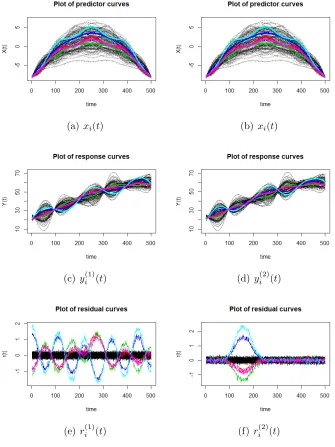
In Figure 2 we have a plot of the predictor curves xi(t) and response curves yi(t) with
outliers from Scenario 1 and Scenario 2. The figure shows the outliers are masked by the
variability in the curves and therefore cannot by identified using standard outlier detection
algorithms. To make the outliers clearer we have plotted the residuals of the response
curves using the true regression function and mean functions. In the bottom row of Figure
2 we can see that the outliers in Scenario 2 are localised to a fixed interval whereas in
Scenario 1 the outliers affect the response curve at all time points.
The RFLR model depends on the proportion of trimming α. To investigate the effect
of the trimming we will consider trimming proportions α = 0.1,0.2 and 0.3. We shall
also investigate the performance using BIC and RBIC with fixed trimmed sample size of
r = [0.8n].
We sample 400 predictor and response curve datasets and generate classical and robust
models to calculate the average FE (6.1). In Tables 1 and 2 we present the results for
Scenario 1 and 2 respectively. The CFLR model gives a smaller FE value in the case of
no-outliers a= 0, however the robust model still gives good model fits. If we compare the
FE using BIC and RBIC, we can see that BIC gives better model choices when a = 0.
This is due to BIC using all the data and in particular using samples in the tails of the
distribution. In the presence of outliers the robust model outperforms the classical model,
and as expected the difference in FE increases as the number of outliers increases. We
should also note that RBIC is giving better model choices than BIC when outliers are
present. Next, we can see using trimming proportion α= 0.1 we obtain significantly large
case of a = 0.3. The outliers generated can have different sizes, therefore in the α = 0.2
robust model only small outliers are present, which only affect the model fitting slightly .
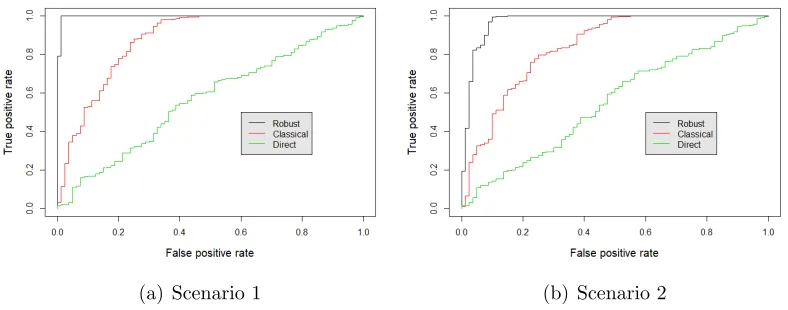
In Figure 3 we have two ROC curves generated for one of the repetitions in Scenario
1 and 2 in which we have contaminated 20% of the samples. In both scenarios the robust
model outperforms the classical model. We also deploy the approach of Febrero-Bande
et al. (2008) to the response curves, disregarding the predictor curves (henceforth called
the Direct approach). The ROC curves show that the robust and classical models are more
effective than the Direct method in identifying the outliers in Scenario 1 and 2. By only
using the specificity and sensitivity for a fixed threshold a lot of information is being lost,
therefore a better comparison would be the area under the curve (AUC). Using the AUC
metric we can understand the model outlier detection capabilities overall, in particular
how well are the outliers separated from the other samples. We have taken the average
AUC values over the 100 iterations performed for Scenario 1, which are shown in Table
3. We have considered the average AUC values for trimming levels α = 0.1,0.2 and 0.3.
The robust models give larger AUC values than the classical model. However the different
trimming levels do not seem to have a significant effect on the AUC values. In Scenario
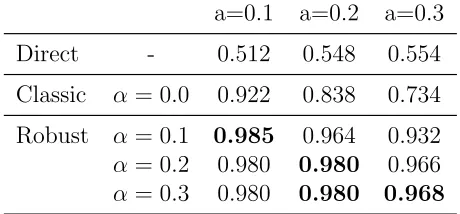
2 we have the results in Table 4. The same patterns appear as in Scenario 1 except the
AUC values are notably smaller. This is to be expected given the outliers in Scenario 2 are
defined on a small time interval.
7
Jet Engine data
The Jet engine dataset contains sensor measurements taken during 199 Vibration Survey
(VS) manoeuvres. This manoeuvre has a distinctive shape with a slow acceleration and a
slow deceleration, with examples shown in Figure 1. We do not have labels for whether
any of the individual engines have outliers but we do have log books from the engine test,
(a) xi(t) (b) xi(t)
(c) yi(1)(t) (d) y(2)i (t)
[image:24.612.133.468.117.564.2](e) r(1)i (t) (f) ri(2)(t)
Figure 2: Left: Plots of the predictor curves xi(t), response curves y
(1)
i (t) and residuals
curves ri(1)(t) for Scenario 1. Right: Plots of the predictor curves xi(t), response curves
y(2)i (t) and residuals curves r(2)i (t) for Scenario 2. The residual curves are generated using the true regression function and mean functions. In each scenario there are 5 outliers each in a distinctive colour. The predictors curves xi(t) are identical for both scenarios, and
Table 1: Average fitting errors (FE) for 100 replications for Scenario 1, using classic FPCA and robust FPCA with different amount of trimming in the MLTS estimator and using models selected by BIC and RBIC.
Trim Model a=0 a=0.1 a=0.2 a=0.3
Classic α = 0.0 BIC 5.326 18.441 48.771 101.320
[image:25.612.141.466.334.466.2]Robust α = 0.1 BIC 8.283 14.166 21.118 33.907 α = 0.1 RBIC 9.285 9.179 10.674 28.393 α = 0.2 BIC 8.288 14.178 15.750 16.623 α = 0.2 RBIC 9.292 9.207 9.535 13.436 α = 0.3 BIC 8.294 14.199 15.815 16.518 α = 0.3 RBIC 9.301 9.214 9.544 12.334
Table 2: Average fitting errors (FE) for 100 replications for Scenario 2, using classic FPCA and robust FPCA with different amount of trimming in the MLTS estimator and using models selected by BIC and RBIC.
Trim Model a=0 a=0.1 a=0.2 a=0.3
Classic α= 0.0 BIC 5.326 17.252 48.906 85.063
Robust α= 0.1 BIC 8.283 15.242 21.524 28.758 α= 0.1 RBIC 9.285 9.074 9.919 18.546 α= 0.2 BIC 8.288 16.745 20.652 21.928 α= 0.2 RBIC 9.292 9.191 8.997 13.628 α= 0.3 BIC 8.294 16.808 20.695 21.750 α= 0.3 RBIC 9.301 9.233 9.018 11.439
(a) Scenario 1 (b) Scenario 2
[image:25.612.104.498.514.669.2]Table 3: Average AUC values over 100 replications for Scenario 1, using proportion of outliers a= 0.1,0.2 and 0.3. Using Direct compared to classic FPCA with BIC, and using robust FPCA with RBIC and trimming levels α = 0.1,0.2 and 0.3.
a=0.1 a=0.2 a=0.3
Direct - 0.532 0.538 0.550
Classic α= 0.0 0.960 0.898 0.797
Robust α= 0.1 0.995 0.991 0.953 α= 0.2 0.996 0.996 0.987 α= 0.3 0.996 0.996 0.990
Table 4: Average AUC values over 100 replications for Scenario 2, using proportion of outliers a= 0.1,0.2 and 0.3. Using Direct compared to classic FPCA with BIC, and using robust FPCA with RBIC and trimming levels α = 0.1,0.2 and 0.3.
a=0.1 a=0.2 a=0.3
Direct - 0.512 0.548 0.554
Classic α= 0.0 0.922 0.838 0.734
[image:26.612.188.418.525.632.2]flags as outliers. There are a number of temperature features measured within an engine
including the TGT, discussed previously. In addition we have four other temperature
readings T25, T30, TCAR and TCAF, from sensors measuring temperature in different
parts of the engine. All the temperature features are shown in Figure 4. The TCAR is
particularly interesting as it has two distinct curve behaviours. It is also worth noting
that the temperature values are distinctively higher at the end of the manoeuvre than at
the beginning even though the engine speeds are the same. This highlights the
trajectory-dependent behaviour that we seek to model. The VS manoeuvres time series are of similar
length. To standardise we have fitted a B-spline basis of 400 basis functions to each to
ensure the time series are well approximated. Then we have taken 1000 equally spaced
points on the B-spline representations to be our inputs xi(t) and yi(t).
We will be applying the outlier detection algorithm described in Algorithm 2, which
uses RFLR. We will compare these outliers with those detected on the temperature curves
directly and using CFLR and BIC in Algorithm 2. We can look at the residuals curves to
determine if the outliers do indeed look abnormal. In particular we want to show that using
functional regression we are able to determine outliers that would otherwise be missed by
investigating the temperature curves directly.
Using the depth based outlier detection (Direct) (Febrero-Bande et al., 2008) directly
on the temperature curves (with a default threshold of δ = 0.01), we obtain the outliers
in Table 5. We can see that the outliers in the TPR are the same as the outliers in
the temperature features. This suggests the outliers being identified are arising from the
controller induced variability. We therefore need to model the dependency between the
control feature (TPR) and the temperature features.
We applied the outlier detection algorithm given in Algorithm 2 using CFLR and BIC
with threshold δ= 0.01. The outliers identified are given in Table 5. The residuals curves
are shown in Figure 5, with the outliers coloured in blue. It is not clear from this plot that
Lastly we applied Algorithm 2 using RFLR and RBIC with threshold δ = 0.01. The
outlier samples are given in Table 5 for each temperature feature. In Figure 6 we have
the residual curves using RFLR. We can see that the RFLR model fits the majority of
the temperature curves well. The outliers that are picked up clearly look abnormal, with
significant deviations from the general behaviour. The RFLR model is therefore able to
identify interesting behaviour, which may otherwise have been undetected. Engineers have
informed us that Sample 24 comes from an engine in which they detected damaged
hard-ware. All the other outliers in the RFLR column of Table 5 were also noted to come from
engines that displayed odd behaviour during the Pass-Off test. This is not the case for the
outliers reported in the CFLR column.
In Figure 4 we have a plot of the temperature parameters with the outliers identified
using the curves directly in green, those using the RFLR model in red and those detected
by both in purple. We can see that the outliers from the RFLR model do not necessarily
appear as abnormal if we look at the temperature curves directly. Sample 106 is identified
as an outlier by multiple temperature features and also when the depth based outlier
detection is used on the temperature curves directly. Comparing the outliers identified
using a classical approach, we can see Sample 24 is identified as an outlier multiple times
using the classical and robust approaches. However most of the outliers from the classical
approaches differ with the outliers identified using the robust approach. We can also see
that the outliers using the RFLR are significantly more distinctive than the outliers using
CFLR.
8
Conclusion
There exist a number of functional regression models for functional inputs and responses,
however these methods are not robust to outliers. We have introduced a robust FLR model
(a) TPR (b) T25
(c) T30 (d) TGT
[image:29.612.130.472.136.604.2](e) TCAR (f) TCAF
(a) T25 (b) T30
(c) TGT (d) TCAR
[image:30.612.133.471.143.609.2](e) TCAF
(a) T25 (b) T30
(c) TGT (d) TCAR
[image:31.612.132.473.138.612.2](e) TCAF
Temp Direct CFLR RFLR
TPR 33, 106, 167 -
-T25 33, 106, 167 24, 182 24, 70, 106
T30 33, 106, 167 24, 182, 192 24, 44, 70, 106, 196 TGT 33, 106, 167 119, 153 44, 70, 106, 117 TCAR 33, 106 36, 91, 106 70, 106
[image:32.612.142.473.66.174.2]TCAF 33, 167 65, 167, 170, 171 24, 70, 106
Table 5: Outliers detected for temperature features (Temp) using outlier detection on the temperature features directly (Direct), and the outliers found using CFLR and RFLR.
FLR model we have also introduced a robust model selection procedure and proven the
consistency of the robust FLR and model selection procedure. Using a simulation study
we have shown the need for a robust approach to obtain good models in the presence of
outliers. The robust FLR model is also effective in identifying global and localised outliers.
Finally using jet engine sensor data as a motivating application for robust FLR we have
identified unusual temperature behaviour. In particular the outliers identified in the jet
engine sensor data would not have been detected if we modelled the response variables
independently of human controlled driving variable.
SUPPLEMENTARY MATERIAL
RobFLR: A zip file of the R code used for simulation study
References
Agull´o, J., C. Croux, and S. Van Aelst (2008). The multivariate least-trimmed squares
estimator. J. Multivar. Anal. 99(3), 311–338.
Arribas-Gil, A. and J. Romo (2014). Shape outlier detection and visualization for functional
Bali, J. L., G. Boente, D. E. Tyler, and J.-L. Wang (2011). Robust functional principal
components: A projection-pursuit approach. Ann. Statist. 39(6), 2852–2882.
Chiou, J.-M., Y.-F. Yang, and Y.-T. Chen (2016). Multivariate functional linear
regres-sion and prediction. Journal of Multivariate Analysis 146, 301 – 312. Special Issue on Statistical Models and Methods for High or Infinite Dimensional Spaces.
Croux, C. and A. Ruiz-Gazen (1996). A fast algorithm for robust principal components
based on projection pursuit. In A. Prat (Ed.), COMPSTAT, Heidelberg, pp. 211–216. Physica-Verlag HD.
Cuevas, A., M. Febrero, and R. Fraiman (2007). Robust estimation and classification for
functional data via projection-based depth notions. Comput. Stat. 22(3), 481–496.
Dai, W. and M. G. Genton (2018). Multivariate functional data visualization and outlier
detection. Journal of Computational and Graphical Statistics 27(4), 923–934.
Eilers, P. H. C. and B. D. Marx (1996). Flexible smoothing with b -splines and penalties.
Statist. Sci. 11(2), 89–121.
Febrero-Bande, M., P. Galeano, and W. Gonz˜alez-Manteiga (2008). Outlier detection in
functional data by depth measures, with application to identify abnormal nox levels. 19, 331 – 345.
Ferraty, F., I. V. Keilegom, and P. Vieu (2012). Regression when both response and
predictor are functions. Journal of Multivariate Analysis 109, 10 – 28.
Hubert, M., P. J. Rousseeuw, and P. Segaert (2015). Multivariate functional outlier
detec-tion. Statistical Methods & Applications 24(2), 177–202.
Ivanescu, A. E., A.-M. Staicu, F. Scheipl, and S. Greven (2015). Penalized
Kalogridis, I. and S. V. Aelst (2019). Robust functional regression based on principal
components. Journal of Multivariate Analysis 173, 393 – 415.
Machado, J. A. F. (1993). Robust model selection and M-estimation. Econometric The-ory 9(3), 478–493.
Matsui, H. (2017). Quadratic regression for functional response models. ArXiv e-prints.
Morris, J. S. (2015). Functional Regression. Annual Review of Statistics and Its Applica-tion 2, 321–359.
Pollard, D. (2012). Convergence of stochastic processes. Springer Science & Business Media.
Ramsay, J. and B. W. Silverman (2005). Functional Data Analysis (Springer Series in Statistics).
Ramsay, J. O. and C. J. Dalzell (1991). Some tools for functional data analysis. Journal of the Royal Statistical Society. Series B (Methodological) 53(3), 539–572.
Rousseeuw, P. J., J. Raymaekers, and M. Hubert (2018). A measure of directional
outlying-ness with applications to image data and video. Journal of Computational and Graphical Statistics 27(2), 345–359.
Scheipl, F., A.-M. Staicu, and S. Greven (2015). Functional additive mixed models. Journal of Computational and Graphical Statistics 24(2), 477–501.
Shang, H. L. (2014). A survey of functional principal component analysis. AStA Advances in Statistical Analysis 98(2), 121–142.
Sun, Y. and M. G. Genton (2011). Functional boxplots. Journal of Computational and Graphical Statistics 20(2), 316–334.
Yao, F., H.-G. M¨uller, and J.-L. Wang (2005). Functional linear regression analysis for