Three Essays on the Economics of
Human Capital Development
Emma Louise Gorman
A thesis submitted in partial fulfilment of the requirements
for the degree Doctor of Philosophy in Economics
Department of Economics
Lancaster University
United Kingdom
Three Essays on the Economics of Human Capital Development
Emma Louise Gorman
A thesis submitted to the University of Lancaster in partial fulfilment of the requirements
of the degree of Doctor of Philosophy in Economics
December 2018
This thesis is concerned with the role of formal schooling in the production of human
capital over the lifecycle.
While many studies have documented an associated between education and cognitive outcomes, less is known about the extent this association iscausal—or the nature of the underlying mechanisms driving any effect. Chapter 1 examines the causal effect of
addi-tional secondary schooling on cognitive function in later life, using new methods in causal
mediation analysis to explore the role of occupation choice as a key channel.
The findings reveal robust evidence that basic education leads to improved working
memory, but detect little support for effects on verbal fluency or numeric abilities.
Stay-ing in school for an additional year increases the probability of enterStay-ing a higher status
occupation, and an analysis of mechanisms finds that up to about one-fifth of schooling’s
effect on cognitive outcomes can be explained by occupation choice. However, the esti-mates are too imprecise to yield firm conclusions.
Chapters 2 and 3 are situated in the school choice literature. The promise of school
choice is to allow parental preference to influence which school their child attends,
weak-ening the link between residential location and school quality. However, choice is typically
constrained—and markets for schools are no exception. Popular schools tend to be
over-subscribed, and inevitably many families miss out on a place at their preferred school.
Chapter 2 traces the consequences of missing out on a place at a preferred secondary
school in England, focusing on long run outcomes, including high-stakes examination
re-sults. The analyses do not find evidence that failing to gain a place at a preferred school leads to poorer academic outcomes—but those who miss out are more likely to engage in
risky behaviours, drop out of secondary school, and have poorer mental health in
adult-hood.
Finally, Chapter 3 assesses the effects of missing out on a place at a preferred primary
school, on cognitive and non-cognitive skill development and parental responses. Little
evidence is revealed for a detrimental effect on skill development, but compared with those
who get into their preferred school, parents whose child misses out on a place are more
This thesis is submitted in partial fulfilment of the requirements for the degree Doctor of
Philosophy in Economics at Lancaster University.
I declare that the thesis has been composed by myself and that the work has not be
sub-mitted for any other degree or professional qualification.
I confirm that appropriate credit has been given within this thesis where reference has been
made to the work of others.
I confirm that the work submitted is my own, except where work which has formed part
of jointly-authored publications has been included. The work presented in Chapter 2 was
conducted jointly with Professor Ian Walker: the study design was conceived, planned and
revised by both the authors, I carried out the data preparation, data analyses and drafted
Spending the last four years teaching and studying economics has been a privilege, and I
am grateful to the Department of Economics at Lancaster and the Economic and Social
Research Council for affording me this opportunity. Many people have extended their
gen-erous support throughout my PhD candidacy. I couldn’t have asked for better supervisors
in Ian Walker and Eugenio Zucchelli, who offered their support, good humour and
guid-ance right from day one. Thanks especially to Ian Walker, for his belief in me, my work
and my capabilities, his practical and academic support, and continued inspiration. The
Department of Economics at Lancaster has provided a collegial and positive environment
to be a PhD student: thanks to Caren Wareing, Themis Pavlidis and Orestis Troumpounis
for their work supporting the PhD students and the PhD programme. I’m grateful for the
friends and colleagues I have met along the way: Ayesha Ali, Christina-Jane
Crossman-Barnes, Shane Murphy, Vincent O’Sullivan, Jennifer Robinson, Simon Spavound,
Wik-toria Tafesse, Mat Weldon, and many others who have made the journey more colourful.
Thanks to my parents, Penny and Peter, for always being there for me—even when I moved
to the other side of the world. Finally, thanks to Alfred: academic cheerleader and partner
Contents
Introduction 13
1 The causal effects of secondary schooling on cognitive function 23
1.1 Introduction . . . 24
1.2 Related literature . . . 28
1.2.1 Schooling and cognition: Potential channels . . . 29
1.3 Data and setting . . . 32
1.3.1 School reforms in England and Wales . . . 32
1.3.2 Data sources. . . 33
1.3.3 Variable construction . . . 34
1.4 Empirical approach . . . 38
1.4.1 Regression Discontinuity Design . . . 38
1.5 Unpacking the black box using mediation analysis . . . 41
1.5.1 “Traditional” regression-based approach . . . 41
1.5.2 Occupation as a mechanism . . . 44
1.6 Findings . . . 49
1.6.1 OLS and RD results . . . 49
1.6.2 Channels . . . 52
1.7 Concluding Remarks . . . 54
1.A Distributions of outcome variables . . . 64
1.B Descriptive analyses . . . 67
CONTENTS CONTENTS
1.D Schooling’s effects on occupation . . . 74
1.E Estimation of direct and indirect treatment effects . . . 76
1.F Causal mediation analysis: Sensitivity to additional covariates . . . 78
1.G Causal mediation analysis: Sensitivity analyses to unmeasured confounding 79 2 The long run effects of missing out on a preferred secondary school 81 2.1 Introduction . . . 82
2.2 Institutional setting . . . 88
2.2.1 School types and curriculum stages . . . 88
2.3 School choice in England . . . 90
2.4 Data . . . 94
2.4.1 Longitudinal Study of Young People in England . . . 94
2.4.2 Outcomes . . . 97
2.5 Empirical strategy . . . 98
2.5.1 OLS and distance matching . . . 99
2.5.2 Channels . . . 102
2.6 Findings . . . 103
2.6.1 OLS and distance matching . . . 103
2.6.2 Channels . . . 105
2.6.3 Heterogeneous treatment effects . . . 105
2.7 Conclusions . . . 106
2.8 Tables . . . 109
2.A Descriptive statistics. . . 120
2.B Timeline of pupil events. . . 121
2.C Heterogeneous treatment effects . . . 122
2.D Longitudinal Study of Young People in England . . . 127
2.E Institutional setting: further detail . . . 133
2.E.1 A brief history school choice and admission in England . . . 133
Human capital formation CONTENTS
3 Primary school preference, child outcomes and parental response 147
3.1 Introduction . . . 148
3.2 Data and setting . . . 151
3.2.1 Primary school admissions in England and Wales . . . 151
3.2.2 Data . . . 152
3.2.3 Variables . . . 153
3.2.4 Covariates . . . 156
3.3 Empirical approach . . . 157
3.3.1 Propensity Score Matching . . . 157
3.3.2 Sensitivity analyses . . . 162
3.4 Findings . . . 163
3.5 Concluding Remarks . . . 165
3.A Matching validity tests . . . 179
3.B Principal components . . . 182
3.C Matching sensitivity . . . 183
Conclusion 185
Introduction
This thesis studies formal schooling and human capital development over the lifecycle.
Since Gary Becker’s seminal work in 1964 (Becker, 1964), economists have studied the production of human capital and skill formation. The remit of this area has now
broad-ened to include investment in health capital and socio-emotional skills—in addition to
traditional measures of cognitive skill. Recent development have highlighted the
impor-tance of a lifecycle perspective: understanding how the efficacy of interventions varies
with age, to inform on the optimal timing of policy intervention. This work focuses on
primary and secondary school periods—stages of life still eminently open to intervention,
with scope for lifetime benefits.
In Chapter 1, I examine the nexus between basic education, occupation choice and
cognitive skills. First, I consider the causal effect of an additional year secondary schooling
on cognitive function in later life (measured at about 60 years). Second, I use new methods
in causal analysis to test the the role of the “use-it-or-lose-it” hypothesis: does working in
a cognitively demanding occupation preserve cognitive function? Chapters 2 and 3 turn
to focus on school choice: does it matter if children attend the school preferred by their
parents? For what outcomes, and when?
We know that cognitive ability is an important determinant of many social, economic
and health outcomes (Heckmanet al.,2006;Wrawet al.,2015). Given there are large so-cioeconomic difference in cognitive outcomes, and trajectories of cognitive development,
how to narrow this gap and intervene to improve life chances is a common policy focus.
Recent studies recognise that the issue is not as simple as “nature vs nurture”, as older
prod-INTRODUCTION
uct of a complex interplay between genetics, early-life experiences and skill investments
(Heckman,2006,1995).
In Chapter 1, I contribute to this area by providing new evidence on whether an
addi-tional year spent in secondary school exerts acausalimpact on cognitive outcomes later
in life. I use data from Understanding Society, a large panel dataset following the lives of
over 40,000 households in the United Kingdom (UK). I use a Regression Discontinuity
Design to exploit a change in school leaving laws, building on a growing literature using
policy experiments to credibly inform on the wider returns to schooling (Glymouret al.,
2008;Banks & Mazzonna,2012). In line with the findings of other studies, the main re-sults show that an additional year of schooling leads to improved working memory in later
life, with large effect sizes ranging from about one third to half of a standard deviation.
However, the findings reveal little evidence for causal impacts on verbal fluency or basic
numeracy skills.
A second key question is then abouthowextra schooling causally could improve
cogni-tive outcomes, and the second contribution of Chapter 1 is to examine the plausibility of a
specific potential channel: occupation choice. Occupation is an commonly studied factor
in preserving our cognitive health—creating resilience to the wear-and-tear on our brain
associated with aging (termed cognitive reserve in the neuroscience literature (Whalley et al., 2004)). This motivates the oft-cited “use-it-or-lose-it” hypothesis: continuing to engage in cognitively stimulated work, or work-like activities, is one way to protect our
cognitive abilities in older ages (Rohwedder & Willis,2010).
An intervention can exert causal effects through many different mechanisms, and
in-creasingly, economists are recognising the important of understanding not justwhetheran
intervention works, but also how. Understanding how an intervention works is key for
as-sessing external validity: whether the policy would be effective in a different setting. The
importance of studying mechanisms is highlighted by Angus Deaton in a discussion the
utility of an average treatment effect, denotedθ(Deaton,2010, p.p. 429):
“[...] there are many possible mechanisms, some of which will work in one
In-Human capital formation
stead, it is precisely the variation inθthat encapsulates the poverty reduction
mechanisms that ought to be the main objects of our enquiry.
One reason the study of mechanisms is relatively scarce is because it is difficult to do
credibly. Studying the role of a post-treatment variable introduces a second endogeneity
problem, in addition to endogeneity of the treatment. A full structural model is one way
to study mechanisms, however this is not without its own stringent data and assumption
requirements. A more common method is to take a data-driven approach and employ an
effect decomposition. Yet, with some exceptions,identificationof mechanisms explaining
treatment effects has not received much attention in the literature, as highlighted byFortin et al. (2011, p.p. 13) in their review of decomposition methods in economics:
“In econometrics, the standard approach is to first discuss identification [...]
and then introduce estimation procedures to recover the object we want to
identify. In the decomposition literature, most papers jump directly to the
estimation issues (i.e., discuss procedures) without first addressing the
iden-tification problem.”
I confront this concern directly by applying newly developed methods in the causal
mediation analysis literature. This is an area of study which has developed recently, in the
econometrics and statistics literature, to formally disentangle causal mechanisms driving
treatment effects. An important point of difference in this literature is to make explicit
the identification assumptions required to decompose average treatment effects into their
constituentcausalchannels, and indeed to highlight the inherent difficulty of this task (see
Huberet al. (2016),Keele et al. (2015),Imaiet al. (2011) andHuber(2016) for useful overviews of identification and estimation of direct and indirect treatment effects).
Applied examples of these methods in the economics literature include:Huber(2015), who uses inverse probability weighting to disentangle the role of occupation choice in
ex-plaining wage gaps;Huberet al. (2017a), who deploy instrumental variables to study the
causal mechanisms driving the education-income gradient; Huber et al. (2017b), who
INTRODUCTION
market programs and increased employment; andDeuchert et al. (2018), who quantify
causal channels shaping the effects of the Vietnam draft in a difference-in-difference
set-ting.
In the Understanding Society data, I observe the occupation chosen both immediately
after leaving school, as well in toward the end of working life. I use two classifications of
occupation type. The first classification splits occupations up from the most routine tasks
up to professional and managerial tasks, which tend to offer both more autonomy as well as
safer working environments. Second, I classify the occupations based on how
cognitively-intensive they are—the extent to which they rely on “STEM”-type skills, technical skill,
critical analysis and so on.
I apply the methods for causal mediation analysis developed in Yamamoto (2014);
Keeleet al. (2015);Park & Kürüm(2018), which decompose a Local Average Treatment Effect (LATE) into a direct and indirect effect. This approach exploits the raising of the
school leaving age as an instrument for endogenous schooling. In the absence of a
cred-ible instrument, I rely on a type of conditional independence assumption to handle the
endogeneity of occupation choice. This is paired with a sensitivity analysis to assess the
robustness to deviations from this assumption.
The analyses of mechanisms shows that staying on for an extra year of school increases
the probability of entering a higher status job after leaving school. Second, it shows that
occupation type could explain up to 18% of the total effect of schooling on memory
(de-pending on which measure is used), a similar figure to that found in other studies. However,
the figures are very imprecisely estimated, and not statistically significant at conventional
levels. Given the imprecision of the estimates, I remain agnostic about the role of
occupa-tion, but conclude that basic education causally improves working memory—an important
component of cognitive function in older ages.
Evidently, quantity of schooling matters for some important outcomes. But what about
school quality? Chapters 2 and 3 assess the effects ofwhichschool a child attends.
Human capital formation
is most preferred by parents in England. These chapters contribute to the debate around
“school choice”. School choice policies are policies which allow parental preferences to
influence which school their child will attend (Cantillon, 2017). Despite the innocuous-sounding definition, school choice has been hotly debated and politicised issue both in
England and internationally. In England, features of parental choice and a “quasi-market”
in compulsory schooling were introduced largely from 1988, in the 1988 School Reform
Act. Indeed many education systems around the world feature some aspect of parental
choice, and today the policy discussion is as much abouthow to organise school choice
and admissions, as about whether to have parental choice at all.
The central problem in designing a school choice system is allocating pupils to schools,
accounting for parental preferences, school capacities and wider policy objectives (e.g.
di-versity in schools, or social mobility). One motivation for school choice focuses on
recog-nising heterogeneity of parental preferences, by allowing families to express preferences
over a diversity of school types. A second, and perhaps more commonly cited, motivation,
and not necessarily implied by the first, is to induce competition between schools, with the
aim of improving academic standards. Both of these rationales have been referenced by
different UK Governments in relation to school choice policy.
Understanding how parents value schools, and the effects of attending a preferred
school, are important for at least two reasons. First, understanding what parents value
in schools is important for meeting to stated aims of a school choice policy. For example,
if governments value academic performance in schools, but parents value something else
(e.g., proximity to home, anti-bullying policies), a policy of parental choice will not have
the desired effect of raising standards via increased competition on academic performance.
Second, if attending a preferred school matters for life chances, then from an equity
per-spective it matterswhogets in. Presently, there is substantial variation in rates of preferred
school attendance by region, by ethnicity and by socio-economic status—understanding
why this variation exists and the possibly heterogeneous consequences is important for
developing policy.
INTRODUCTION
families live and the quality of the school they attend. The limitation of the traditional
approach—allocating children to their local school—amplifies the social stratification
as-sociated with Tiebout sorting: that is, affluent neighborhoods tend to enjoy higher quality
public amenities (Tiebout, 1956). However choice is seldom unconstrained, and schools are no exception. Schools perceived to be good tend to be oversubscribed, such that not
all pupils can attend their preferred school. Each year, about 16% of families miss out on
a place at their preferred secondary schools, and about 6% miss out on a place at their
pre-ferred primary school. Whilst attracting much ire from the media and dissatisfied parents,
there is little evidence about the consequences of missing out. Hence, Chapters 2 and 3 in
this thesis are specifically concerned witheffects of missing out on a place at a preferred
school.
Internationally, various incarnations of school choice policies are common, and a
grow-ing literature aims to characterise the nature of parental preferences over schools and the
consequences of gaining a place at a school preferred by parents (Pop-Eleches & Urquiola,
2013;Cullen et al., 2006;Dobbie & Fryer, 2014, 2015;Abdulkadiroglu et al., 2017b,
2014). The research on preferences report much heterogeneity. In the USA, recent
re-search has shown that parents often valuepeer mix (i.e., wealthy white peers) rather than
school effectiveness (i.e., a causal improvement in test scores) (Abdulkadiroglu et al. ,
2017a).
Indeed, comparisons of the outcomes of pupils who just get into a prestigious school,
with those who just miss out reveal no impact on short run test scores, despite large
dis-continuity in peer mix and school prestige (Abdulkadiroglu et al. , 2014). With some exceptions, this finding is common across many settings: gaining a place a parents’
pre-ferred school does not appear to causally influence short run test scoresAbdulkadiroglu et al. (2014);Dobbie & Fryer(2014). There is some evidence of improvements in broader outcomes, such as risky behaviours and truancy (Dudovitzet al.,2018), later employment rates, and timing of childbearing (Jackson & Beuermann,2018).
In Chapter 2, a jointly authored study with Ian Walker, we use data from the
ad-Human capital formation
ministrative data on school attributes and educational outcomes (National Pupil Database)
to assess the effects of missing out on a preferred secondary school on a range of
high-stakes outcomes. The central challenge is to compare families who had similar chances
of admission to a school and similar preferences over schools, yet one gains a place and
one misses out. For those who miss out on their preferred school, we do not have data on
the counterfactual school they would have preferred to attend, and this must be estimated
from the data.
We employ a selection-on-observed variables strategy, informed by the nature of the
institutional setting (to account for admissions probability) and literature on parental
pref-erences (to account for prefpref-erences) and information on the local population and school
type (to account for variation in choice sets). We use a combination of matching and
re-gression to compare outcomes of children with similar values of the variables shaping
ad-missions probability, similar variables which shape preferences, a similar feasible choice
set of schools, and similar prior ability and socio-economic status.
While preferred schools have higher headline measures of attainment (e.g., GCSE
re-sults), our analysis fails to detect convincing evidence for effects of missing out a preferred
school on test scores and university attendance. However, we do find consistent evidence of
increased high school drop-out after the age of compulsory schooling, and increased
uni-versity drop-out among pupils who miss out on a preferred school. These effects persist
to age 25 years, where we find long-lasting negative effects on mental health and income.
Pupils who miss out show increased patterns of early engagement in risky behaviours,
representing a potential mechanism driving the increased drop-out rates. While we do
not find strong evidence for gender differences, the negative consequences of missing out
are more pronounced in local areas which used a more manipulable mechanism
(‘first-preference first’) for allocating school places. Pupils exposed to the first-(‘first-preference
mech-anism who miss out end up commuting further to school than their counterparts exposed
to a Deferred Acceptance mechanism, possibly indicating much poorer school matches.
Overall, our findings highlight that which school a child attends can have consequences
INTRODUCTION
ensuring children attend a school which is right for them.
Chapter 3 moves to look at the consequences of not attending a preferred primary
school, tracing pupil’s cognitive and non-cognitive skill development and the dynamics of
parental behavioural responses. I employ data from the Millennium Cohort Study (MCS),
a cohort study following the lives of around 18,000 children born in during the years 2000
and 2001. Primary school admissions are governed by similar admissions rules to
sec-ondary schools, and I use an analogous identification strategy to that used in Chapter
2—i.e., a selection-on-observed variables strategy implemented using propensity score
matching.
In contrast to the LSYPE, the MCS directly elicits parents’ preferences over schools.
Specifically, it asks about the identity counterfactual school by asking: if your current
school was not your first choice school, which school was your first choice? From this
ques-tion, we can compute the distance from a family’s home address to their current school,
and crucially, the distance to their preferred school (if they were not offered a place at
their first-choice school). As a matching variable, distance to preferred school is
espe-cially informative because it capture both admission probability, as well as preferences—a
family’s willingness-to-travel for a preferred school.
The results do not reveal any effects of missing out on a first choice school on cognitive
development. In terms of parental responses, there are small (but statistically insignificant)
increases in the probability of parental investment activities at ages 7—including helping
with homework and paying for private tuition. At age 11 years, parents of children who
miss out are significantly more likely to pay for extra lessons. This work does not detect
any evidence that attending a non-preferred parental primary school has any lasting effects
on the skill development of children. However, the findings show that parental responses
are important when considering policy impacts.
Taken together, this thesis reports on new research assessing the role of schools in
pro-moting the development of human capital. Using modern methods of policy evaluation,
I explore the consequences of two key aspects of education: (1) how many years a child
Human capital formation
school preferred by parents. Increasingly, education and skills are the key to getting on in
life, in terms of both labour market success and wider life outcomes. In the face of a
fun-damentally changing economy, understanding the role of the school system in promoting
human capital development remains an essential area of study for effective policy design.
Chapter 1
The causal effects of secondary
schooling on cognitive function
This work was funded by the an ESRC PhD studentship “The long-term effect of education on health: New
evidence from the United Kingdom”. I am grateful for helpful discussions and comments from my
super-visors Ian Walker and Eugenio Zucchelli, and participants at: the North West Doctoral Training Economics PhD Conference 2016; American Society for Health Economists Biennial Conference 2016; IZA Summer
School in Labor Economics 2017; NWSSDTP PhD Conference in Economics 2017; International Health
1.1. INTRODUCTION CHAPTER 1. SCHOOLING AND COGNITION
1.1
Introduction
Cognitive performance shapes economic, social and health outcomes over the lifecycle
(Heckman et al. , 2006; Wraw et al. , 2015). While the efficacy of early intervention in improving cognitive performance is well studied, less is known about whether these
outcomes are malleable outside of early childhood (Heckman,2006). This study assesses whether secondary schooling has lasting causal effects on cognitive function—measured
four decades after leaving school—and explores the role of occupation type in shaping
these effects.
In later life, cognitive performance becomes an important component of healthy ageing
and continued independent functioning (Beardet al.,2015). Among healthy individuals— free of clinical cognitive impairment—age-related reductions in cognitive performance
can impede the ability to carry out daily activities (Tucker-Drob,2011;Boyleet al.,2012) and manage financial planning decisions (Hsu & Willis,2013). This has important impli-cations for continued labor market engagement and retirement planning, as state pension
ages rise and supporting continued labour market participation is a central policy focus
(OECD,2006;Department for Work and Pensions,2013).
Declining cognitive performance is also a risk factor for morbidity and mortality. One
example is dementia, for which declines in cognitive function, especially memory, are a
precursor. Estimates from 2016 showed that 800,000 people suffered from dementia in
the United Kingdom, with a total cost of 26 billion pounds per year—largely comprising
informal care costs (Prince et al. , 2014). Even after accounting for the observed and projected reductions in age-specific incidence rates, the prevalence of dementia is forecast
to increase to 1.2 million by 2040, representing a vast increase in both human and economic
costs (Ahmadi-Abhariet al.,2017).
Yet cognitive impairment is not an inevitable consequences of ageing, and a large body
of work has sought to uncover modifiable risk factors across the lifecourse. Basic
educa-tion is one promising candidate in improving cognitive outcomes. Based on observaeduca-tional
evidence,The Lancet’s recent dementia Commission concluded that 8% of dementia cases
Human capital formation 1.1. INTRODUCTION
same vein, age-specific rates of incident dementia are falling (Ahmadi-Abhariet al.,2017), predominantly among those with at least a high school diploma (Chêneet al.,2016).
Although causal evidence is sparse, these findings are consistent with the
hypothe-sis that increased population levels of education could reduce the growth in burden of
cognition-related disease, and support economic adjustment to a changing demographic
structure. With this in mind, the objectives of this study are two-fold. First, to provide new
evidence on the extent to which schooling shapes cognitive function in later life. Second,
to conduct a formal analysis exploring the channels driving these effects, paying particular
attention to the role of occupation type and complexity.
Despite extensive observational research demonstrating that schooling is a correlate
of cognitive outcomes throughout the lifecycle (Plassmanet al.,1995), fewer studies are able to attach a causal to this association or the hypothesised underlying mechanisms.
One approach, leveraged in this paper, is to exploit the substantial investments in
pub-licly provided education occurring over the last century, notably the successive increases
in the minimum age at which students can leave secondary school. These increases in
the minimum schooling leaving age represent plausibly exogenous changes in schooling,
and are widely employed to quantify both pecuniary and non-pecuniary returns to
educa-tion (Harmon & Walker,1995; Oreopoulos & Salvanes, 2011). The cohorts affected by these reforms are now ageing, providing an opportunity to explore whether the effects of
schooling persist into later life.
The United Kingdom (UK) provides an especially informative laboratory to examine
the causal effects of schooling. Two changes to the secondary school leaving age were
enacted during the 20th century: in 1947 the minimum school leaving age was raised
from 14 years to 15 years, and 1972 it was raised again to 16 years. These changes affected
relatively large shares of the relevant cohorts. For example, the corresponding changes in
the United States exerted a causal effect on only about five percent of the student cohort,
compared with about one half and one third for the 1947 and 1972 reforms in the UK,
respectively. Yet, the evidence base on schooling and cognitive function in the United
1.1. INTRODUCTION CHAPTER 1. SCHOOLING AND COGNITION
these long-run effects.
For England and Wales,Banks & Mazzonna(2012) established positive effects of an additional year of schooling on aspects of cognitive function among the cohorts affected
by the 1947 raising of the school leaving age. The findings are large in magnitude, raising
the possibility that increased population education could function as a policy tool in
fos-tering healthy ageing. Given the large total effect size, the protective effect of education
of cognition is unlikely to be wholly a direct effect. More plausibly, education influences
cognition indirectly, through the wider set of opportunities that education affords.
How-ever, the cohorts exposed to the 1947 reform grew up in unstable economic and political
circumstances; their choice set and constraints they faced were vastly different from more
recent cohorts. Whether the channels through which that reform operated are still relevant
in the current policy context, despite the changing nature of the work tasks, labour market
participation, and health technology, remains unclear.
The first contribution of this study is to provide new evidence on the causal effect basic
education on cognitive outcomes, using a Fuzzy Regression Discontinuity design to exploit
the raising of the secondary school leaving age in 1972. This reform increased the
mini-mum school leaving age from 15 to 16 years in England and Wales. The data employed
is from Understanding Society (U.S.)—the largest household panel study in the United
Kingdom. This data contains granular information on month-year of birth, allowing exact
identification of exposure to the reform. Comparing the outcomes of observationally
sim-ilar individuals exposed and unexposed to the reform—born only months apart—yields
credible estimates of the causal effects of the additional year of schooling.
One threat to the validity of this approach is confounding from secular trends in longevity
and cognition: cohort-specific cognitive performance has been steadily increasing over the
20th-century (Flynn,1987). This so-calledFlynn effectmay be influenced not only by in-vestments in mass education during this time, but the changing nature of job-tasks to be
more cognitively stimulating, improvements in nutrition, and the increasing proportion of
women entering the labour force, which act as confounding factors (Skirbekket al.,2013;
Human capital formation 1.1. INTRODUCTION
for birth cohort trends, and uses a small sample window—of just under three years either
side of the reform date—to enhance the comparability of the treatment and control units.
Additionally, sensitivity analyses are conducted using different covariates sets and sample
window choices.
The second contribution is to explore the role of occupation choice as a key
mecha-nism driving the effect of education on cognition. Despite many theories, less is known
empirically about the channels which drive the education-cognition gradient. A number
of hypotheses highlight the role of occupation type, especially with regard to occupational
complexity, and the commonly cited “use-it-or-lose-it” hypothesis. This framework
sug-gests mental stimulation may sustain brain function, supporting the idea that more
cogni-tively stimulating activities stave off cognitive decline (Rohwedder & Willis, 2010). In a similar vein, proponents of the so-called “cognitive reserve” theories in neuropsychology
have put forward education and occupation as key factors in increasing mental resilience,
reducing the clinical manifestations of brain ageing (Stern,2002).
This paper applies methods from the causal mediation analysis literature to explore the
role of occupation type as a key mechanism (Keeleet al. , 2015). To allow for potential endogeneity of occupation type—despite the absence of a credible second instrument—
the approach used relies on a type of conditional independence assumption for occupation
choice (Yamamoto, 2014; Park & Kürüm, 2018). While fundamentally untestable, this assumption is arguably plausible in this application. Sensitivity analyses are conducted to
provide support for this assumption, by relaxing the conditional independence assumption
and assessing how this impacts the findings, and testing the stability of the effects to the
addition of further covariates.
The key findings include a local average treatment effect (LATE) of one additional year of
schooling on working memory, ranging from one- to two-thirds of a standard deviation,
depending on the sample and model specification employed. This effect is significant at at
least the 10% level across a range of reasonable specifications, and is in excess of the
Ordi-nary Least Squares (OLS) estimate of 0.15 standard deviations. While the OLS estimates
1.2. RELATED LITERATURE CHAPTER 1. SCHOOLING AND COGNITION
there is negligible evidence for a causal effect on these outcomes.
Second, the effect size from the analyses of mechanisms indicate occupation type could
explain up to 18% of the total effect of schooling on memory, depending on the measure of
occupation used, and the model specification. However, the figures are very imprecisely
estimated, and not statistically significant at conventional levels. Given the imprecision
of the estimates, I remain agnostic about the role of occupation, but conclude that
ba-sic education causally improves working memory—an important component of cognitive
function in older ages. Increasing population levels of education may be an effective tool
in reducing growth in burden of cognition-related disease, and supporting economic
ad-justment to an ageing population.
1.2
Related literature
A recent empirical literature has used changes in compulsory schooling laws (CSLs) to
examine the lasting health and mortality effects of education, including mortality,
self-assessed health, disability and health behaviours (recent reviews includeLochner (2011) andMazumder(2012)). Fewer studies in this area have focused on cognitive outcomes. The first paper to exploit changes in the minimum school leaving age to explore
cogni-tion and mental outcomes wasGlymour et al. (2008), who used state-level variation in the United States to obtain instrumental variable estimates of the effect of schooling on
working memory and mental status among cohorts born between 1900 and 1947. These
changes in mandated schooling yielded large improvements in performance on memory
tests in old age, although no effects were detected for mental status.
Evidence from England and Wales exploited the 1947 school reform, which increased
the minimum school leaving age from 14 to 15,Banks & Mazzonna(2012) found a pos-itive effect of an extra year of schooling on the memory and executive function of older
men. A number of studies have exploited both time-series and geographical variation in
school leaving ages across Europe, using the Survey of Health, Ageing and Retirement
Human capital formation 1.2. RELATED LITERATURE
education on memory, and used the panel aspect to reveal evidence of a protective effect
against declines in verbal fluency with age. In addition to increased memory scores among
older men,Mazzonna(2014) also found reduced probabilities of depression and improved self-reported health. Analyses of potential mechanisms suggested an important role for
working conditions in explaining these effects. These patterns are not limited to Europe
and the U.S.: Huang et al. (2013) leveraged educational differences in primary school completion due to China’s Great Famine, during 1959-1961, to assess education effects
on cognitive outcomes in older ages. The results revealed a protective effect of cognition,
especially episodic memory, of up to 20%.
Generally, the results of these studies find Local Average Treatment Effects estimates
in excess of the OLS estimates. Crespoet al. (2014) use the SHARElife data—the third wave of the SHARE panel study which contains retrospective life history data—to shed
light on the early-life characteristics of those individuals whose behaviour was altered by
the implementations of the CSLs, and who may have different returns to schooling than
the wider population. The authors find larger effects of the reforms on years of education
for those with lower socio-economic status (measured by reports of living in a dwelling
with two or fewer rooms), and those reporting better childhood health status. Overall, their
results show large, positive effects of extra schooling on memory and depression.
Strati-fiying the sample by early-life characteristics revealed some variation in point estimates of
the causal effect of education, although these differences were not statistically significant.
1.2.1
Schooling and cognition: Potential channels
Given the large total effect size found in many studies, the protective effect of education
of cognition is unlikely to be wholly a direct effect. More plausibly, education influences
cognition indirectly, through the wider set of opportunities that education affords. The
set of plausible channels through which protective effects of schooling on later-life
func-tioning could operate. A recent review of empirical studies identified self-reported health,
biomarkers of physiological health (e.g., inflammation), cardiovascular disease and its risk
age-1.2. RELATED LITERATURE CHAPTER 1. SCHOOLING AND COGNITION
associated cognitive decline (Deary et al. , 2009). Certainly a number of channels are likely to operate, for instance income effects, health behaviours and social connections.
The empirical evidence for a causal effect of education on health outcomes and behaviours
is mixed; many, but not all, credible studies fail to detect any effect (seeClark & Royer
(2013);Lochner(2011)). Although the present study focuses on occupation and education, many other factors also play an important role.
This paper aims to test the role of occupation type and labour market engagement.
The “cognitive reserve" is a key framework from the neurological literature (Stern,2002), relating education, occupation and cognitive outcomes. Cognitive reserve is a
hypothet-ical construct used to explain how, facing similar neurodegenerative changes, substantial
variation is observed in cognitive ageing, and diagnosed cognitive impairment, across
in-dividuals. In other words, individuals do not experience the same declines in everyday
cognitive functioning for a given decline in brain health. Cognitive reserve is the concept
which is proposed to explain this resilience. Education and occupational complexity are
often cited as important proxies for cognitive reserve, in addition to other “lifestyle factors”
such as dietary habits and physical exercise. The hypothesis suggests that, for individual
with a greater level of cognitive reserve, a greater level of pathology may be required to
result in clinical manifestations of any diagnosable impairment.
Second, in the economics literature, a relevant framework is the dynamic model of
the demand for good health proposed inGrossman(1972). This model describes the life-cycle accumulation and decumulation of a health stock, and how this relates to choices
of occupation, activity and consumption. The implications of this framework can be
ex-tended more generally to a stock of cognitive capital: cognitive function in older ages is a
component of health, which can be augmented by health investment and cognitive repair
inputs, and depreciates with age. The role for education in the seminal Grossman model is
to increase the efficiency of health production: those with more education enjoy a higher
marginal productivity of a given health input. For example, correct adherance to a
med-ical regimen among more educated individuals. However, evidence for this “productive
Human capital formation 1.2. RELATED LITERATURE
Extending this framework,Muurinen(1982) and thenCase & Deaton(2005) proposed an augmented model, in which education indirectly reduces the rate of depreciation of
the health stock via (a heavily constrained) choice of occupation, activity and
consump-tion. This explanation is more consistent with the wider epidemiological literature on the
fundamental causes health inequalities, compared with the “reduced health productivity”
argument (Muurinen & Grand,1985).
In this model, individuals are endowed at birth with stocks of health capital, human
capital and financial capital, which are partially substitutable in producing earnings and
utility. Those with less human capital will be restricted—via a constrained optimal choice—
to occupations which rely more on manual effort or repetitive routine tasks, rather than
cognitive skills, to produce earnings. The consequence of this choice is a increased rate of
decline in functioning across the lifecycle. Second, a similar effect can be derived through
consumption choices. Rather than trading health for earnings through the labour market,
one can augment the utility function such that individuals gain utility directly from
un-healthy behaviours, again the price for which is paid for directly through a higher rate of
health depreciation.
One implication of the model is that the correlation between cognition and education
is partly spurious. This framework predicts a higher health stock for a lower rate of time
preference and higher initial stock of cognitive or financial assets. This is consistent with
empirical regularity that at least 50% of variation in cognitive ability in old age (measured
at about 80 years) is explained by cognitive ability in childhood Deary et al. (2009). This implication highlights the importance of addressing potential endogenity of education
choices.
Focussing specifically on cognitive capital,Mazzonna & Peracchi(2012,2014) extend this framework to analyse the age-profile of cognitive performance and how this changes
after retirement. Empirical tests of the theory show cognitive function generally declines
after retirement, as the monetary incentive to invest in this stock is reduced. However this
effect importantly depends on occupation type: those employed in physically demanding
1.3. DATA AND SETTING CHAPTER 1. SCHOOLING AND COGNITION
education is found to shape heterogeneity in both the level and age-related decline of
cog-nitive function. Together these findings highlight the potential for occupation type as a
mechanism in explaining variation in later-life cognitive function.
The characteristics of higher status occupations entered into through education may
not only reduce physical wear and tear, but may also aid in sustaining mental outcomes
and cognitive performance—for example, work tasks may be more cognitively demanding
and have greater autonomy. These frameworks have motivated a large empirical literature
in neuro-epidemiology, exploring associations between many lifestyle factors and
cogni-tive ageing (Dearyet al.,2009). One robust predictor of age-related cognitive decline is cardiovascular health. Current smoking status and physical activity are also commonly
identified as important predictors—likely through their effects on cardiovascular health.
Smoking may be especially promising, as it has also been identified in the economics
liter-ature as as an outcome which is causally affected by education (de Walque,2007;Grimard & Parent, 2007), and as a potential mechanism underlying the education-health gradient (Brunelloet al.,2015).
1.3
Data and setting
1.3.1
School reforms in England and Wales
Many studies have leveraged the 1972 raising of the school leave to study the returns to
education (e.g.,Oreopoulos(2008);Clark & Royer(2013);Dickson et al. (2016)). The 1944 Education Act increased the minimum age pupils can leave secondary school from
14 to 15 years, enacted from April 1st 1947; this Act also conferred powers to raise the
minimum school leaving age again to 16 years. In March 1972, it was decided that the
minimum school leaving age would be raised to 16 years for school cohorts beginning on
the 1st of September 1972 (Woodinet al.,2012). This change to 16 years affected birth cohorts of pupils born from the 1st of September, 1957, onward. The 1972 change, aside
from being more recent, was enacted in less unstable times—the cohorts exposed to the
Human capital formation 1.3. DATA AND SETTING
the World War. The second, 1972, school reform is exploited in this paper. Considering
this more recent reform may shed light on whether the results from previous studies using
the 1947 change are generalisable, given the particularities of the context faced by those
earlier cohorts.
In addition to an extra year of school completed, the 1972 change led to greater rates of
completion of formal qualifications; many more students stayed until the end of their 16th
school year to obtain “O-level" qualifications. This increase in the probability of gaining a
qualification is important. Dickson & Smith(2011) exploit the Easter Leaving Rule—an institutional rule providing exogenous variation in qualification attainment—confirming
that some of the observed wages returns to an extra year of schooling in 1972 were due to
the increase in qualifications, rather than solely the length of time in school.1
1.3.2
Data sources
The dataset employed is Understanding Society (US), a panel study of households in the
United Kingdom (McFall, 2013b; Institute for Social and Economic Research & Nat-Cen Social Research, 2015), the successor study to the British Household Panel Survey (BHPS). It commenced in 2009 as a representative probability sample of approximately
40,000 households. Participants are interviewed annually, but each wave of data collection
spans 24 months (therefore the survey waves are overlapping and comprise approximately
two years of data collection). The “total sample” comprises multiple subsample
com-ponents: the main General Population Sample (GPS), continuing BHPS members, and
the Ethnic Minority Boost (EMB) subsample. Wave 3, beginning on 7th January 2011
and ending on the 12th July 2013, included a Cognitive Ability module which measured
self-rated memory, performance on tests of word recall, numeric ability and verbal fluency
measures (McFall,2013a). Wave 3 has a cross-sectional response rate of 61.3%. Through-out the analyses the survey weights provided with the data were employed, to allow for the
possibility of endogenous sampling design and response probabilities. The weights
ad-1In this work, I have also endeavoured to exploit the Easter Leaving Rule as an instrument to disentangle
1.3. DATA AND SETTING CHAPTER 1. SCHOOLING AND COGNITION
just for the complex survey design, and combined probabilities of being selected into the
BHPS, GPS and EMB and continuing to Wave 3 of the survey.
1.3.3
Variable construction
Years of schooling and cognitive outcomes
The measure of schooling employed is the report of years of secondary schooling
com-pleted. This is derived from the schooling question asking “How old were you when you
left school?”. Then years of schooling is constructed as the age the respondent reports
leaving school minus five.
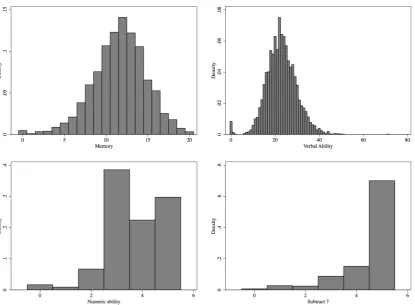
Episodic memory—retrieving memories associated with specific events—was
mea-sured by performance on an immediate and delayed word recall test. Memory is an
im-portant early indicator of potential cognitive impairment, and word recall tests are used in
cognitive impairment screening tests (Kimet al.,2014). A list of 10 words are read aloud by the computer, the respondent is to repeat these words in any order and the number
cor-rectly recalled is recorded by the interviewer. This procedure is repeated (about 5 minutes)
later in the module to measure delayed recall. Immediate and delayed word recall scores
are highly correlated with clinical dementia diagnoses (Wu et al. , 2013). The number of words correctly recalled in each test were summed, to create a variable (Word Recall)
ranging from 0 to 20.
The Serial 7 Subtraction test is a component of clinical screening instruments for
cog-nitive impairment (i.e,., the Mini Mental State Examination (Crumet al., 1993) and the Cambridge Mental Disorders of the Elderly Examination (Rothet al.,1986)). In the Serial 7 test, respondents are asked to begin at 100 and subtract 7, five times. After each
subtrac-tion, the respondent is again prompted by the interview to “take 7 away from that?”. The
number of correct answers was summed to create a variable ranging from 0 to 5.
The Verbal Fluency test asked respondents to name as many animals as possible in
one minute. In addition to testing semantic memory, this tests also executive function as,
to perform well, it requires some level of abstract thinking and mental flexibility within a
Human capital formation 1.3. DATA AND SETTING
Disorders of the Elderly Examination, an interview procedure for the diagnosis and
mea-surement of dementia in the elderly (Roth et al. ,1986), and has been successfully been employed in extensions of the MMSE (Kimet al. ,2014). The number of animals listed ranges from 0 to 71.
The Numeric Ability test assessed ability to solve “every day” numerical problems.
The Numeric Ability test asks the respondent five questions of increasing complexity, for
example, the first question is as follows: “In a sale, a shop is selling all items at half price.
Before the sale, a sofa costs £300. How much will it cost in the sale?". The number of
questions correctly answered was summed to have a range of 0 to 5.
The distributions of the raw scores are presented in Appendix2.A. The continuous measures, Word Recall and Verbal Fluency, were standardised by subtracting the sample
mean and dividing by the sample standard deviation, to faciliate interpretation and
compa-rability with previous studies. The Serial 7 Subtraction and the Numeric Ability tests were
dichotomised to create a binary variables. Subtractiontakes the value 1 for respondents
with 5 correct answers to the Serial 7 Subtraction, and zero otherwise. Numeracy takes
the value 1 for respondents with 4 or 5 correct answers to the Numeric Ability test, and
zero otherwise.
Occupation variables
The mechanisms underlying the education gradient in cognitive function are inevitably
complex and interacting. This paper aims to test one specific hypothesis suggested by
theory, namely the role of occupation type and labour market participation patterns. in
explaining the effect of schooling on cognitive performance, rather than aiming to
exhaus-tively model all the channels which may be involved.
The first measure employed is the five-class National Statistics Socio-economic
Classi-fication (NS-SEC) occupational classiClassi-fication. The five-class NS-SEC groups occupations
defined by the Standard Occupation Classification into five categories: 1) Semi-routine;
routine; never-worked and long-term unemployed; 2) Lower supervisory and technical
oc-cupations; 3) Small employers and own account workers; 4) Intermediate ococ-cupations; 5)
1.3. DATA AND SETTING CHAPTER 1. SCHOOLING AND COGNITION
The NS-SEC is available for both the first job chosen after leaving secondary school,
and the current job (or previous job, if the respondent is currently out of the work). The
chief focus is on the current, or most recent, occupation, which will capture effects
associ-ated with the so-called “use-it-or-lose-it" hypothesis: continuing to engage in a stimulating
occupation maintains cognitive reserve and stave off cognitive decline. As an additional
measure, the first job is of interest as mechanism because the activity chosen immediately
after secondary school is especially amenable to policy intervention. For instance, in the
UK context, a current policy development has increased the minimum “participation age”,
for which young people must remain in education or training, from 16 years to 18 years.
This initial start may have longer run implications for labour market trajectories.
Previous occupation was disproportionately missing among those reporting they were
long-term sick or disabled, or unemployed. For this group, information from the US
em-ployment history module was used to ascertain their activity. Respondents to the US report
an employment history of their economic activity status (e.g., full-time work, part-time,
unemployed, receiving government benefits, etc.) from when they first left full-time
edu-cation until their current spell. For those who did not report a current or previous labour
market status, individuals who also reported being out of the paid work for at least 50%
of their potential working life were coded as NS-SEC category 1 (Semi-routine; routine;
never-worked and long-term unemployed).
In addition to the occupation type of first and current job, a final measure of occupation
type relates directly to the usage of specific skill types, employing occupational skills
pro-files developed byDickersonet al. (2012). Dickersonet al. (2012) have matched the UK SOC 2010 codes with the US Occupational Information Network (O*NET), a database
characterising the skills, abilities, work characteristics of occupations. The O*NET
ques-tionnaire is completed by workers and external job analysts. Over 250 questions are asked
about job characteristics, ordescriptors, arranged into the following domains: education
and training, knowledge, skills, abilities, work activities, work context and work style. For
each descriptor, both the level and importance of that item are elicited. The individual
Human capital formation 1.3. DATA AND SETTING
necessarily reflect the skills actually used in a job.
The literature on occupation, education and cognitive outcomes has raised the
hypoth-esis that especially demanding or complex mental tasks may play an important role in
maintaining cognitive performance (Fisheret al. , 2014). One specific example of these types of complex skills (chosen partly due to data availability) are those used in what are
commonly characterised as STEM occupations. These roles require substantively
com-plex, technical expertise—involving logic, reasoning and numeracy. Examining the role
of these specific types of skills contributes to the literature assessing the role of skills type
in determining cognitive ageing, and provides a useful complement to the occupation type
measures described above.
The measure of STEM-skill usage, henceforth termed technical skill, uses variables
from the Abilities and Skills from the matched O*NET data (the questions in the Ability
and Skill domains were filled out by external job analysts, rather than the job incumbents
themselves). This measure was matched to the occupation of first job after leaving school.2
The Abilities items used are: deductive reasoning; information ordering; mathematical
reasoning; number facility. The Skills items are: mathematics; science; technology
de-sign; programming. For each item, there is a variable rating the level of each decriptor used
in the job, and its importance. The average of the level and importance variables across the
Skills and Abilities items identified above are used as a simple continuous measure, where
a higher value indicates greater usage of these skills—on average—in an occupation.
Analytical sample
All three subsamples of the US were employed: the General Population Sample,
con-tinuing BHPS participants, and the Ethnic Minority Boost sample. Survey weights were
employed throughout the analyses, which weights adjust for unit non-response—the
com-bined probabilities of being selected into the BHPS, GPS and EMB and continuing to
Wave 3 of the survey—and the complex survey design.
Since the location of school was not available among the cohorts considered, it was not
2At the time of writing, the current occupation variable in the US was coded as SOC2000. Only when
1.4. EMPIRICAL APPROACH CHAPTER 1. SCHOOLING AND COGNITION
possible to ascertain whether respondents completed their schooling in England or Wales,
rather than Scotland or Northern Ireland. In order to restrict the sample to individuals who
completed their schooling in areas exposed to the reform as best as possible, those who
were born in England or Wales were selected for analyses. Observations which had missing
or unavailable information on place of birth were assumed not to be born in England or
Wales.
The preliminary descriptive statistics use a sample of respondents born with a window
of 5 years either side of date determining exposure to the school reform (01, September,
1957). The sample for the OLS and RD estimation uses a smaller window, determined by
an optimal bandwidth-selection procedure.
1.4
Empirical approach
1.4.1
Regression Discontinuity Design
A Fuzzy Regression Discontinuity (FRD) design (Imbens & Lemieux, 2008) was
em-ployed to exploit variation in schooling induced by the reform. RD is predicated on
treat-ment, for individualsi = 1, .., N, being assigned by the value of a continuous covariate,
Ri, falling on either side of a fixed cutoffc. In this applicationcis the pivotal birth cohort
of 01, September, 1957. This cutoff induces a discontinuity in the conditional probability
of receiving the treatment givenRi—but not necessarily a jump from 0 to 1. LetZi
de-note exposure to the reform, (Zi = 1[Ri ≥ c]), where1(.)is the indicator function, and
the treatment is an additional year of schooling. LetYi(1)andYi(0)denote the potential
cognitive outcomes experienced in the presence and absence of the treatment respectively.
The FRD estimand of interest is the following:
τF RD =
E[Yi(1)|Ri =c]−E[Yi(0)|Ri =c]
E[Di(1)|Ri =c]−E[Di(0)|Ri =c]
(1.1)
Assuming the reform only changes behaviour in one direction (monotonicity), then the
Human capital formation 1.4. EMPIRICAL APPROACH
of compliers (i.e., those who were causally induced to take an extra year of schooling,
which otherwise they would not have taken). In this case, the FRD treatment effect is
the ratio of the sharp RD effect and the average effect of the reform on treatment, as in
Equation (1.2) (Hahnet al.,2001).
τF RD =
limr↓cE[Yi|Ri =c]−limr↑cE[Yi|Ri =c]
limr↓cE[Di|Ri =c]−limr↑cE[Di|Ri =c]
(1.2)
This framework also extends to the case of a multi-valued measure of years of
school-ing, in which the compliers are defined as those induced to take at leastdyears of schooling
when otherwise they would have taken fewer than d (Angrist & Imbens, 1995)). In that case, the effects computed are an average of the per-year treatment effects associated with
each additional year of schooling, weighted by the proportions of compliers at each level of
schooling. However, in this application there is little weight placed on the schooling levels
above 16—the treatment effect is mainly informed by differences in outcomes on the 15
to 16 years margin. The main analyses presented in this paper are for a binary treatment,
equal to zero if pupils left school at age 15 years, and one if they left at 16 years of age, and
missing for those who stayed on to 17 years or older. This is also to facilitate the
compu-tation and interprecompu-tation of the analyses of mechanisms in the subsequent section, which
is more straightforward with a binary treatment. Results with a continuous treatment are
presented in Appendix2.E.
Using a uniform kernel, and the same bandwidth h for the outcome and treatment
equations, leads to a numerical equivalence between the FRD estimator and the Two-Stage
Least Squares (2SLS) estimator (Hahnet al.,2001). Taking this approach, the parameters of the equations described in Equations (1.3) and (1.4) were estimated using 2SLS. LetYi
denote the cognitive outcome observed for individuali. f(Ri−c)comprises the centred
running variable, interacted with the reform dummy. The vectorXiincludes pre-treatment
covariates, anduiandvi are idiosyncratic errors.
The estimating equations are described as follows:
1.4. EMPIRICAL APPROACH CHAPTER 1. SCHOOLING AND COGNITION
Di =γo+γ1Zi+g(Ri−c) +Xi0γ+vi (1.4)
To select a data-driven optimal bandwidth, the implementation of the MSE-optimal
bandwidth developed in Calonico et al. (2016) was employed, which accounts for the
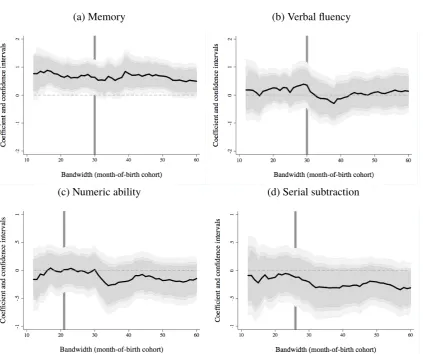
fuzzy design and clustering of the data due to the discrete running variable (Bartalotti & Brummet,2016). This was combined with a sensitivity analyses through a consideration of a range of bandwidths. The running variable is month-year of birth. This allows a
comparison of units very close to the treatment cut-off. However this measurement is still
a discretisation compared, as a more granular measurement of assignment (e.g.,
day-of-birth) was not available in the data. The standard errors were clustered by month-year of
birth to account for group-level variation induced by the discrete nature of the running
variable. This relies on a model in which the fitted function, through the discrete running
variable, approximates the true continuous function, and the consequent specification
er-rors are random and identical (Lee & Card,2008;Cattaneoet al.,2017a).3
In very small sample windows around the reform date it is more credible that the
re-form, as a local instrumental variable, is plausibly exogenous without conditioning on
further covariates. Other discontinuities exactly coincident with the RoSLA are unlikely.
In this case, the purpose of including the covariates is to increase the precision of the
esti-mates by reducing residual variation. In larger sample windows, the concern remains that
there may be confounding of education level and cognitive function based on unobservable
functions of birth cohort. For example later cohorts, exposed to the reform, may have
ex-perienced more favourable conditions in early childhood, and have more educated parents,
than the earlier pre-reform cohorts. Although these trends are unlikely to be discontinuous
at the treatment cut-off, they may still be picked up in larger sample windows. Therefore,
this concern motivates adjustment for potential confounding variables which may capture
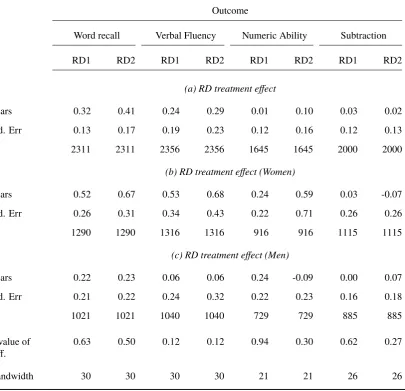
any such effects. The covariates included in the RD models presented in Table 1.3 are: a quadratic term in age, dummy variables indicating gender, interview month, interview
3I considered examining a wider sample window (5 years either side of the cut-off), in conjunction with a
Human capital formation 1.5. MEDIATION
year (because the US survey waves span approximately two years).
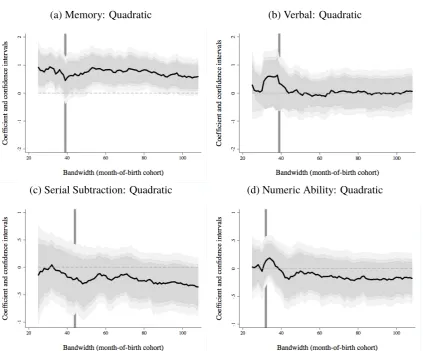
In further sensitivity analyses (Appendix2.E), month-of-birth dummies were added as covariates. The rationale for considering month-of-birth is to capture any seasonality
effects: systematic variation in month-of-birth by family background which could also be
related to later education, health and cognitive outcomes (Buckles & Hungerman,2013;
Crawford et al., 2011). Additionally, since the implementation of the 1972 reform co-incides with the start of the school term, exposure to the reform will coincide with any
age-in-grade effects, and therefore be correlated with schooling and, potentially, cognitive
outcomes.
1.5
Unpacking the black box using mediation analysis
Mediation analysis is one way to quantitatively assess the pathways through which a cause
affects an outcome. Mediation analyses offers a principled approach to test economic (and
other social science) theory without employing a full structural model. A key motivation
is to understandinghowa policy intervention, or RCT, works (e.g., seeHeckman & Pinto
(2015) for an application of mediation to an RT in economics). Although randomised stud-ies provide an internally valid estimate of the treatment effect, their underlying workings
often remain a black box. Analysis of mechanisms can refine the workings of an
inter-vention. Can we better target the primary mechanism, or eliminate costly and ineffective
components of an intervention? We might also want to understanding why an intervention
failed.
1.5.1
“Traditional” regression-based approach
Mediation analyses has its origins in the early structural economics literature—Haavelmo
(1943) andGoldberger(1972)—however until recently, most studies in the social sciences followed the approach outlined in a seminal article by Baron & Kenny (1986), who de-fined mediation analysis as“generative mechanisms through which the focal independent