Optimizing the spin reversal transform on the D-Wave 2000Q
Elijah Pelofske Georg Hahn Hristo Djidjev
Los Alamos National Laboratory
Abstract
Commercial quantum annealers from D-Wave Systems make it possible to obtain approx-imate solutions of high quality for certain NP-hard problems in nearly constant time. Before solving a problem on D-Wave, several preprocessing methods can be applied, one of them being the so-called spin reversal or gauge transform. The spin reversal transform flips the sign of selected variables and coefficients of the Ising or QUBO (quadratic unconstrained binary opti-mization) representation of the problem that D-Wave minimizes. The spin reversal transform leaves the ground state of the Ising model invariant, but can average out the biases induced through analog and systematic errors on the device, thus improving the quality of the solution that D-Wave returns. This work investigates the effectiveness of the spin reversal transform for D-Wave 2000Q. We consider two important NP-hard problems, the Maximum Clique and the Minimum Vertex Cover problems, and show on a variety of input problem graphs that using the spin reversal transform can yield substantial improvements in solution quality. In contrast to the native spin reversal built into D-Wave, we consider more general ways to reverse individual spins and we investigate the dependence on the problem type, on the spin reversal probability, and possible advantages of carrying out reversals on the qubit instead of the chain level. Most importantly, for a given individual problem, we use our findings to optimize the spin reversal transform using a genetic optimization algorithm.
1
Introduction
Commercial quantum computers from D-Wave Systems Inc. D-Wave Systems (2000) are designed to approximately solve NP-hard optimization problems that can be expressed as the minimization of a QUBO (quadratic unconstrained binary optimization) or an Ising problem, given by
H(x1, . . . , xn) = n X
i=1
aixi+ X
i<j
aijxixj, (1)
using a process calledquantum annealing. In (1), the coefficientsai ∈Rare the linear weights, and aij ∈R are the quadratic couplers defining the problem for i, j ∈ {1, . . . , n}. If xi ∈ {0,1}, (1) is called a QUBO problem. If xi ∈ {−1,+1}, (1) is called an Ising problem. Both the QUBO and Ising formulations are equivalent Djidjev et al. (2016). Many important NP-hard problems can be expressed as the minimization of a quadratic function of the form (1), see Lucas (2014). We denote the number of variables in the Ising model as nthroughout the remainder of the article.
When submitting a problem of the form (1) to the D-Wave annealer, it is preprocessed in two ways. First, the qubits are arranged on the quantum annealer in a particular graph structure, called the Chimera graph, consisting of a lattice of bipartite cells on the physical chip Chapuis et al. (2017). However, the connectivity structure of a QUBO or Ising model, that is its nonzero couplers in (1), does not necessarily match the Chimera graph. In order to alleviate this issue, a
minor embedding of the QUBO or Ising connectivity to the Chimera graph can be computed. In such an embedding, several physical qubits are identified to act as one logical qubit in (1), often severely limiting the number of available qubits. The set of physical qubits on the chip representing a logical qubit (problem variable) is called a chain. Second, although ai, aij ∈R can be arbitrary, they are rescaled toai∈[−2,2] andaij ∈[−1,1] and subsequently converted to analog currents on the chip using an 8-bit digital-to-analog converter.
During the annealing, leakage on the physical chip from the coupler aij (i, j∈ {1, . . . , n}) can alter the linear weights ai and aj Systems (2019). This effect is reported to be often more serious for chained qubits. Moreover, during the process of digital-to-analog conversion, the linear weights ai will not be perfectly mapped to currents on the chip, and thus biased to the above or below.
The so-called spin reversal orgauge transform is a simple way to alleviate this issue for Ising problems. The spin reversal is based on the observation that, although theoretically quantum annealing is invariant under a gauge transformation, the calibration of the D-Wave device is not perfect and breaks the gauge symmetry. This implies that, indeed, spin reversed Ising systems realize slightly different systems on the annealer, yielding different results which can be averaged. To apply the spin reversal, we flip the sign of an arbitrary number of variables and coefficients of the Ising problem, thus resulting in a reinterpretation of an up as a down spin and vice versa. This leaves the ground state of (1) invariant, but has the potential to reduce analog and systematic errors on the device as described earlier (by averaging them out), thus improving the quality of the solution.
In particular, to transform the qubit xi from −1 to +1, we define a new function H0 with a0i → −ai as well as a0ij → −aij and a0ji → −aji for all j ∈ {1, . . . , n}. We observe that the ground state energies of H and H0 are identical, and that the minimum of H0 is the minimum of H with the i-th variable having a flipped sign. As reported in Systems (2019), reversing too few spins leaves the Ising model almost unchanged, whereas applying the spin reversal transform to too many qubits likely results in many pairs of connected qubits being transformed, thus effectively leaving the corresponding quadratic couplers unchanged. In both cases, the spin reversal transform might only have little effect.
It is important to note that the spin reversal transform can be applied on two different levels: After embedding the Ising model to be solved onto the D-Wave architecture, the actual embedded problem that D-Wave solves is read and the spin reversal is applied to any qubit independently – this is referred to in the remainder of the article as spin reversal on the qubit level. Second, we can apply the spin reversal in such a way that the physical qubits in a chain (representing one logical qubit) are all either spin reversed or all left unchanged – we refer to this technique in the remainder of the article asspin reversal on the chain level.
The SAPI interface of D-Wave allows us to apply a built-in (simple) form of the spin reversal transform. It is controlled through the parameter num spin reversal transforms (= Ns) in the functionsolve ising. In connection with the parameternum reads (=Nr) which specifies the total number of anneal readouts, D-Wave will generateNsspin reversed Ising problems and obtainNr/Ns readouts for each. The spin reserved Ising models are obtained by flipping each qubit independently with probability 0.5.
Second, we aim to use our findings to optimize the spin reversal transform in practice. For this we employ a genetic optimization algorithm which, for a given problem instance given as an Ising model, finds the set of qubits on which the spin reversal transform is most effective. For this we consider a separate binary indicator for each qubit (reversed or not reversed), and optimize over all nindicators to find the best configuration.
In this article, we provide a rigorous assessment of the effectiveness of the spin reversal trans-form, which to the best of our knowledge has not been presented in the literature previously. Existing work published in the literature does employ spin reversals, yet only as a tool to possibly enhance solutions, and only using the in-built D-Wave implementation. In King et al. (2015) the authors define a new metric, the time-to-target metric, as the time needed by classical solvers to match the results of a quantum annealer: for their experiments, the authors employ D-Wave’s native gauge transform, but it is left unclear what the contribution of the transform to the solution quality is. In Pudenz (2016), the author primarily evaluates several techniques to allocate weights to chains of qubits, as well as two ways of determining the final value of a chain. The effect of four spin reversals is also considered briefly, however no further statement is made on the spin reversal transform apart from the fact that it shows a slight performance gain on certain systems. In King and McGeoch (2014), the authors conclude that gauge transformations are more effective on difficult problems. However, in Boixo et al. (2014), the authors demonstrate that significant correlations exist between different gauge transforms.
The article is structured as follows. Section 2 describes the spin reversal transform in detail, and presents a genetic algorithm to attempt to solve the optimization over all possible spin reversal transformations. Section 3 presents simulation results for the Erd˝os-R´enyi graph family, both as a function of the input graph density as well as of the probability of the spin reversal transform, and for two NP-hard graph problems. We also present results highlighting the dependence of the genetic optimization algorithm on its parameters, and show how the effectiveness of the spin reversal transform can be considerably increased in comparison to the D-Wave transformation over the course of only a few ’genetic’ generations. The article concludes with a discussion in Section 4.
2
The Gauge Transform
This section describes the setup we employ to apply the spin reversal transform.
2.1 Spin reversal on the qubit level
Given an input Ising model of type (1), we embed it onto the D-Wave Chimera graph first. Before starting the annealing process, however, we read the embedded Ising model from the D-Wave connectivity graph. The embedded problem typically consists of more variables, precisely the physical chain qubits representing the logical qubits.
Given the embedded Ising model on the D-Wave chip with n qubits, we can reverse spins in the following way. Select a set I ⊆ {1, . . . , n} of qubit indices to be switched. In our experiments, we will generate the set I by adding each index in {1, . . . , n} to it independently with a given probability ps.
We then sequentially select one i ∈ I at a time, and set a0i := −ai. Furthermore, we set a0ij :=−aij and aji:=−aji for allj∈ {1, . . . , n}. After having applied this procedure for alli∈I, we use the new sets of linear weights{a0i}and quadratic couplers{a0ij}to form a new Ising problem H0.
Algorithm 1:Genetic algorithm for spin reversal tuning
input :H,N,pspin,pmat pmut,R,Na;
output:final population of spin reversal vectors;
1 n← number of variables inH;
2 S ← {s1, . . . , sN :si ∈Bpnspin};
3 repeat R times
4 fors∈S do
5 H0← reverse spins sinH;
6 RequestNa anneals for H0 on D-Wave and store minimal energy among those in es;
7 end
8 E← {es:s∈S};
9 E0← proportion pmat of lowest energies in E;
10 S0← {s∈S :es∈E0};
11 S1← ∅;
12 repeatN times
13 Draw two random s1, s2 ∈S0 and combine bits randomly with probability 0.5, store
result in S1;
14 end
15 S2← ∅;
16 fors∈S1 do
17 Flip each bit insindependently with probability pmut and store mutatedsinS2;
18 end
19 S←S2;
20 end
21 return S;
2.2 Spin reversal on the chain level
Another way of applying the spin reversal is at the chain level. In contrast to Section 2.1, we read the embedded problem and switch the signs of either all physical qubits in a chain that encode one logical qubit, or of none of them.
2.3 Optimizing the spin reversal transform
Algorithm 1 presents the genetic algorithm we use to optimize the spin reversal transform for the D-Wave annealer. Let an input Ising modelH withnvariables be given which we aim to solve on D-Wave. In the following, we characterize a spin reversal through a boolean vector of length n, where eachTrue entry encodes that the corresponding variable is reversed.
Using Algorithm 1, we aim to find the spin reversal transform among all 2n possible binary vectors that yields the minimal average energy on D-Wave (within a pre-specified number of Na anneals).
Algorithm 1 works as follows: We use a genetic algorithm to optimize over generations of boolean vectors (or bitstrings) of lengthnwhich are interpreted as spin reversals in the aforementioned sense. First, in line 2, we drawN random boolean vectors fromBpnspin, the set of all bitstrings of lengthn generated with a probability of pspin for an entryTrue. Those are stored in a set S.
s∈ S, resulting in a new Ising model H0, perform Na anneals for H0 on D-Wave, and record the minimal energyes obtained in this way fors. All those energies are stored in a setE. Afterwards, we compute a subset E0 of E corresponding to the proportion pmat of lowest energies (those are
thefittest individuals of the current population). We store the boolean strings that correspond to the energies inE0 in a setS0.
Next, we carry out a crossover operation on the population in line 12. For this, we take two arbitrary s1, s2 ∈ S0 and combine them into a new boolean vector s3 by choosing the entries of
s3 independently from s1 and s2 with probability 0.5. The new s3 is added to a set S1 which was
initialized as S1 = ∅. This is repeated N times in order to leave the population size invariant in
each generation.
Finally, a mutation step is applied in line 16. We flip the entries of each s∈S1 independently
with a low probability pmut and store the resulting s in a setS2 (likewise initialized with S2=∅).
After mutations have been applied to all s∈S1, we restart the fitness evaluation on the updated
set S2.
We create R generations in this way.
After termination of Algorithm 1, we are left with the last population of boolean vectors which encode different spin reversals. In order to choose the optimal spin reversal for the Ising model H, we evaluate their fitness one last time: We can apply each toH (resulting in a newH0 as before), record the lowest minimal energy forH0 inNa anneals on D-Wave, and choose the boolean vector among the entire population yielding the minimum energy solution.
3
Experiments on D-Wave
3.1 Evaluation of the spin reversal transform
In the following two subsections, we evaluate the spin reversal transform on both the qubit and the chain level.
The test graphs we employ are G(|V|, pG) Erd˝os–R´enyi graphs with|V|= 65 vertices and edge probability pG∈ {0.1,0.3,0.5,0.7,0.9}. The reason for using|V|= 65 vertices stems from the fact that this is the largest size of an arbitrary graph that can be embedded onto D-Wave 2000Q, see Pelofske et al. (2019a,b).
In order to generate an Ising model to solve for each test graph, we consider two NP-hard graph problems: the Maximum Clique problem, which asks for a maximum fully-connected set of vertices of a graph, and the Minimum Vertex Cover problem, which asks for a minimum set of vertices in a graph such that each edge is incident to at least one vertex from that set. The QUBO/Ising formulations of those two problems in the form of (1) can be found in Lucas (2014).
The spin reversal transform requires the index set I which specifies the qubits to be spin-reversed, see Section 2.1. In the simulations of this section we generate the index sets with varying probabilities ps ∈ {0.01,0.05,0.1,0.2, . . . ,0.8,0.9,0.95,0.99}, that is for each element in {1, . . . , n} we decide with an independent Bernoulli trial of probabilityps whether it should be included in I or not (where nis the number of variables in the Ising model, see (1)).
0.0 0.2 0.4 0.6 0.8 1.0 probability p
600 500 400 300 200 100 0 100
mean energy difference
0.0 0.2 0.4 0.6 0.8 1.0 probability p
600 500 400 300 200 100 0 100
[image:6.612.77.538.80.211.2]mean energy difference
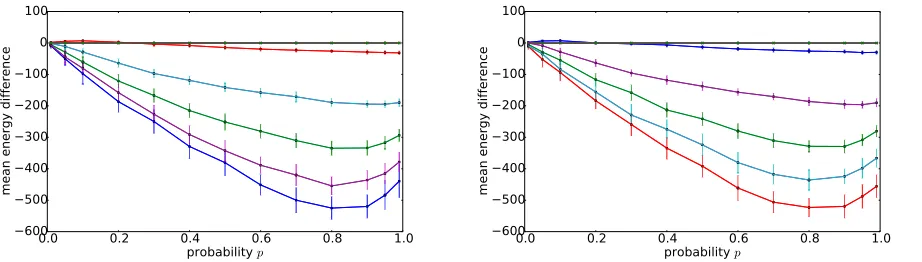
Figure 1: Mean energy difference of the spin reversal on qubit level of Section 2.1 to D-Wave’s native spin reversal (black line) as a function of ps. Test graphs generated with edge probabilities 0.1 (blue), 0.3 (green), 0.5 (cyan), 0.7 (magenta) and 0.9 (red). Maximum Clique (left) and Minimum Vertex Cover (right) problems.
on D-Wave. This is to report a more robust measurement than merely recording the best solution found.
In this subsection, all lines in the figures are averages over 50 repetitions. For each repetition, we regenerate both the input graph, the Ising model, and its embedding on D-Wave.
3.1.1 Results for spin reversal on the qubit level
Figure 1 shows experimental results for a comparison of D-Wave’s native spin reversal (black line) to the more general approach of Section 2.1 as a function of the spin reversal probability ps (x -axis). We use test graphs of varying density (blue to red) applied to the Maximum Clique (left) and Minimum Vertex Cover (right) problems. The two plots display the mean energy difference to D-Wave’s native spin reversal on the y-axis. We display error bars of one standard deviation for each measurement.
The figure shows that for both the Maximum Clique and the Minimum Vertex Cover problem, the approach of Section 2.1 almost always yields a solution of higher energy (worse quality) than the one using D-Wave’s native spin reversal. For the Maximum Clique problem, applying the spin reversal transform with a low probability ps (roughlyps ∈[0.1,0.5]) yields marginally better solutions for high density graphs only (red line).
For the Minimum Vertex Cover problem, as being related to the complement of the Maximum Clique problem, the situation is reversed: Only for low density graphs (blue line), using a custom spin reversal probability ofps ∈[0.1,0.5] marginally outperforms D-Wave’s native spin reversal.
The curves in Figure 1 exhibit a minimum (which happens to occur around p = 0.8): Such a minimum is to be expected, since both very low and very high probabilities leave an Ising problem essentially unchanged (see Section 1).
3.1.2 Results for spin reversal on the chain level
0.0 0.2 0.4 0.6 0.8 1.0 probability p
500 400 300 200 100 0 100
mean energy difference
0.0 0.2 0.4 0.6 0.8 1.0 probability p
500 400 300 200 100 0 100
[image:7.612.77.535.80.212.2]mean energy difference
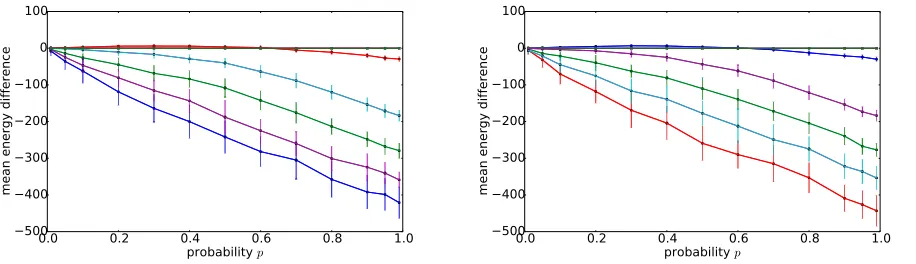
Figure 2: Mean energy difference of the spin reversal on chain level of Section 2.2 to D-Wave’s native spin reversal (black line) as a function of ps. Test graphs generated with edge probabilities 0.1 (blue), 0.3 (green), 0.5 (cyan), 0.7 (magenta) and 0.9 (red). Maximum Clique (left) and Minimum Vertex Cover (right) problems.
graphs (Vertex Cover problem, right) in connection with a spin reversal probability ps of around 0.1 to 0.6.
3.2 Results for our genetic algorithm
This section starts by assessing the dependence of the performance of Algorithm 1 on its parameters. For this, we first define a base set of parameters: N = 30,pspin= 0.5,pmat= 0.5, andpmut= 0.01.
When varying each of those four parameters, we keep the others fixed at their base values.
Figure 3 shows results for graphs of density 0.5 applied to the Ising model of the Maximum Clique problem. The generated graph and the embedding of the Maximum Clique Ising model onto the D-Wave architecture were kept fixed. Algorithm 1 was always run over R = 50 generations. The spin reversal was applied at the chain level. We assess the dependence onN ∈ {10,30,50}(top left),pspin∈ {0.1,0.5,0.9}(top right),pmat∈ {0.1,0.5,0.9}(bottom left) andpmut ∈ {0.01,0.1,0.5}
(bottom right). In all subplots of Figure 3, the green lines consistently indicate the smallest value of the three investigated ones for each parameter, red indicates the medium value and blue the largest one.
Figure 3 shows that, as expected, larger values of N result in more diverse populations, which increases the probability of creating fit population members (in our case, those are the bitstrings indicating which qubits need to be spin reversed) resulting in spin transforms with a low energy. Likewise, the spin reversal probabilitypspin (used to create the initial population) should be rather
low, although high values of pspin eventually result in the same low energy solution given enough
generations are created. The mutation probability should likewise be chosen small, since large values have a tendency to add too much noise to good solutions. The rate pmat specifying the
proportion of fittest population members that are used in the crossover stage should similarly be small in order to only pass on the best candidates to the next generation.
Note that in Figure 3 (top right) assessing the dependence on the spin reversal probabilitypspin,
in contrast to the other three plots the blue, red and green lines do not start in the same point in generation zero. This can be explained as follows: Only the parameterspspin and N appear in the
initialization in line 2 of Algorithm 1. Whereas for large enoughN, the lowest energy solution of the initial population stays roughly the same, the spin reversal probability pspin affects the population
and its overall fitness as a whole in generation zero.
0 10 20 30 40 50 generations
2700 2650 2600 2550 2500 2450 2400 2350 2300 2250
energy
0 10 20 30 40 50 generations
2700 2600 2500 2400 2300 2200 2100 2000
energy
0 10 20 30 40 50 generations
2700 2650 2600 2550 2500 2450 2400 2350 2300 2250
energy
0 10 20 30 40 50 generations
2700 2650 2600 2550 2500 2450 2400 2350 2300 2250
energy
Figure 3: Dependence of Algorithm 1 on its parameters N ∈ {10,30,50} (top left), pspin ∈ {0.1,0.5,0.9} (top right), pmat ∈ {0.1,0.5,0.9} (bottom left) and pmut ∈ {0.01,0.1,0.5} (bottom
[image:8.612.79.536.233.503.2]0 10 20 30 40 50 generations
2700 2600 2500 2400 2300 2200
energy
0 10 20 30 40 50 generations
2700 2600 2500 2400 2300 2200
[image:9.612.78.538.77.213.2]energy
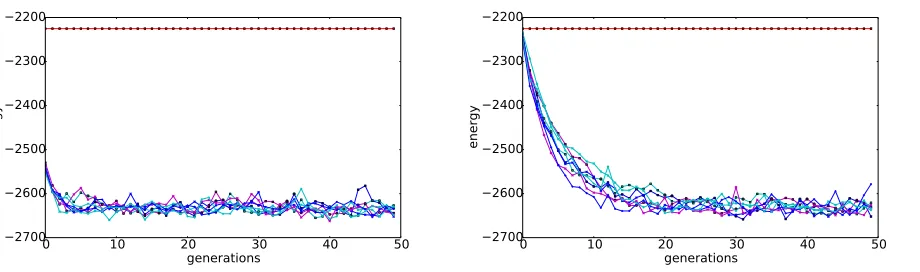
Figure 4: Comparison of D-Wave’s native spin reversal (red line) to Algorithm 1 with parameters given in (2), except for pspin = 0.1 (left) and pspin = 0.5 (right). Ising model created by applying
the Maximum Clique problem to a graph of 65 vertices and graph density 0.5.
minimum energy for the best parameter choice, which is to be expected for a good optimization scheme.
Based on Figure 3, we will use Algorithm 1 in the remainder of the article with parameters
N = 50, pspin= 0.1, pmat= 0.1, pmut= 0.01. (2)
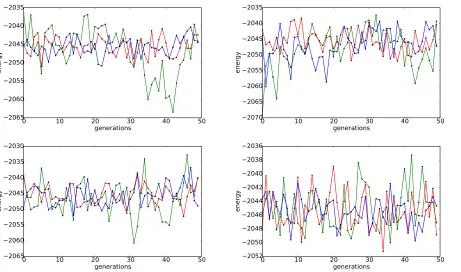
When using Algorithm 1 in connection with spin reversal at the qubit level, results are not as clear, see Figure 6 in Appendix A.
Using the parameters given in (2), we are able to employ Algorithm 1 to determine a (reasonably) good set of variables to be spin-reversed (with the aim of creating an equivalent Ising model, which yields lower minimal energies during annealing).
Figure 4 shows simulation results for D-Wave’s native spin reversal (red constant line) and 8 different realizations of Algorithm 1 over 50 generations. For each datapoint of the genetic algorithm, we plot the lowest 10% mean energy obtained when applying the current best set of variables to be spin reversed to the Maximum Clique Ising model.
We observe that for the set of parameters given in (2), after only a handful of generations (around R = 5), Algorithm 1 has found a combination of variables in the Ising model, which, after spin reversal has been applied to them, yield a modified (but equivalent) Ising model with substantially lower energies during annealing forpspin= 0.1. Forpspin= 0.5, we observe a slower rate with which
our genetic algorithm reaches the minimum. However, both values cause Algorithm 1 to converge to roughly the same minimum.
In the run of Algorithm 1 depicted in Figure 4 (left), the initial population of spin reversal vectors happens to already yield lower energies than D-Wave’s native spin reversal. However, Figure 4 (right) shows that even when using an initial population containing spin reversal vectors which yield energies after annealing that are comparable to D-Wave’s native spin reversal, our genetic algorithm is capable of considerably improving upon D-Wave’s spin reversal within only a few generations.
3.3 Spatial correlation of spin reversed qubits on the D-Wave chip
It is of interest to investigate if there is a spatial correlation between those qubits for which Algo-rithm 1 determines that a spin reversal improves the solution quality.
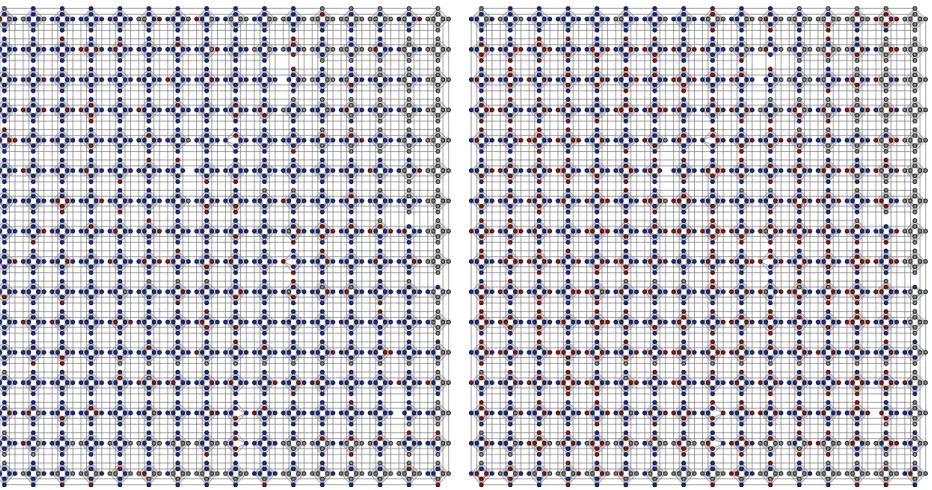
Figure 5: Qubit connectivity graph (the Chimera graph) of D-Wave 2000Q. Spin reversed qubits in red, non-reversed qubits in blue, and unused qubits in gray for the single current best solution of Algorithm 1 at initialization (left) and after 49 generations (right).
Figure 5 shows the qubit connectivity graph (the Chimera graph) of D-Wave 2000Q, where we color single current best solution of spin reversed qubits with red (qubit is reversed) and blue (qubit is not reversed). The gray qubits are unused.
Figure 5 shows that at initialization (left), the assignment is random. After 49 generations, the distribution of spin reversed qubits has changed: First, we observe that the proportion of spin reversed qubits has increased. Second, we observe that often, spin reversed qubits are adjacent to each other in a cell of the Chimera graph, or in adjacent cells facing each other. Though this finding was expected, the precise reason behind this can only be speculated. One explanation could be that qubits which are physically adjacent on the chip suffer from leakage (see Section 1), thus since the sign of all couplers Jij related to a particular spin i are flipped, it is sensible to assume that such a manipulation of an Ising model also affects the other qubitj.
4
Conclusions
This paper investigated the spin reversal on the D-Wave 2000Q quantum annealer. In particular, we applied our own approach of a spin reversal which, in contrast to the native one built into D-Wave 2000Q, allows us to specify the probability with which spins are reversed, and we apply the spin reversal to the qubit and chain level. Importantly, we present a genetic algorithm to select the individual qubits which, if spin reversed, yield a modified Ising model that is easier to minimize (resulting in a minimum of better quality).
We summarize our findings as follows:
case except for rare instances involving very dense (for the Maximum Clique problem) or very sparse (for the Minimum Vertex Cover problem) graphs and spin reversal probabilities of ps≤0.5.
2. We show using a genetic algorithm that learns the specific spins to be reversed is much more beneficial, and considerably improves upon D-Wave’s native spin reversal. Importantly, we show that typically only a handful of generations (around R = 5) is sufficient to arrive at a combination of individual chained qubits which, if reversed, yield Ising models with solutions of substantially better quality. Therefore, increasing the computational effort (the number of anneals) by a constant factor (around R = 5 generations with a population size ofN ≤ 50 each) can yield substantially better solutions.
3. We empirically show that those qubits which our algorithm suggests for spin reversal are also physically adjacent on the D-Wave architecture.
The genetic algorithm we employ to optimize the spin reversal transform is a rather basic version, and much more sophisticated approaches exist in the literature. Future work includes the implementation and tuning of such advanced methods, with which we hope to find even better bitstrings of qubits to be spin reversed, and to decrease the required population size and number of generations, thus resulting in a reduced overhead when optimizing the spin transform.
Moreover, we are interested in investigating further if the shape of the curves in Figure 2, which is consistent even though the two Ising models and the input graphs they were applied to are different, can be explained by some intrinsic property of the Ising model.
References
Boixo, S., Rønnow, T. F., Isakov, S. V., Wang, Z., Wecker, D., Lidar, D. A., Martinis, J. M., and Troyer, M. (2014). Evidence for quantum annealing with more than one hundred qubits. Nature Phys, 10:218–224.
Chapuis, G., Djidjev, H., Hahn, G., and Rizk, G. (2017). Finding Maximum Cliques on the D-Wave Quantum Annealer. Proceedings of the 2017 ACM International Conference on Computing Frontiers (CF’17), pages 1–8.
D-Wave Systems (2000). Quantum Computing for the Real World Today.
Djidjev, H., Chapuis, G., Hahn, G., and Rizk, G. (2016). Efficient Combinatorial Optimization Using Quantum Annealing. LA-UR-16-27928. arXiv:1801.08653.
King, A. D. and McGeoch, C. C. (2014). Algorithm engineering for a quantum annealing platform.
CoRR, abs/1410.2628.
King, J., Yarkoni, S., Nevisi, M. M., Hilton, J. P., and McGeoch, C. C. (2015). Benchmarking a quantum annealing processor with the time-to-target metric. arXiv:1508.05087, pages 1–29.
Lucas, A. (2014). Ising formulations of many NP problems. Front Phys, 2(5):1–27.
Pelofske, E., Hahn, G., and Djidjev, H. (2019a). Solving large maximum clique problems on a quantum annealer. LA-UR-18-30973. arXiv:1901.07657.
0 10 20 30 40 50 generations
2065 2060 2055 2050 2045 2040 2035
energy
0 10 20 30 40 50 generations
2070 2065 2060 2055 2050 2045 2040 2035
energy
0 10 20 30 40 50 generations
2065 2060 2055 2050 2045 2040 2035 2030
energy
0 10 20 30 40 50 generations
2052 2050 2048 2046 2044 2042 2040 2038 2036
energy
Figure 6: Dependence of Algorithm 1 on its parameters N ∈ {10,30,50} (top left), pspin ∈ {0.1,0.5,0.9} (top right), pmat ∈ {0.1,0.5,0.9} (bottom left) and pmut ∈ {0.01,0.1,0.5} (bottom
right) when applied to spin reversal at qubit level. We consistently use green for the smallest value, red for the medium value, and blue for the largest value in all subplots.
Pudenz, K. L. (2016). Parameter setting for quantum annealers. In2016 IEEE High Performance Extreme Computing Conference (HPEC), pages 1–6.
Systems, D.-W. (2019). D-Wave System Documentation.
A
Further assessments of Algorithm 1 on qubit level
We repeat the assessments of Algorithm 1 in Section 3.2 for the spin reversal applied at qubit level. As in Section 3.2, we evaluate the dependence of the genetic algorithm on its parametersN,pspin,
pmat, andpmut while keeping those parameters which are not being varied at their values given in
Section 3.2.
[image:12.612.77.538.78.350.2]