Applying surface-based DNA computing for solving the
dominating set problem
Hassan Taghipour1*, Mahdi Rezaei2, Heydar Ali Esmaili1
1Department of Pathology, Tabriz University of Medical Sciences, Tabriz, Iran 2Department of Theoretical Physics and Astrophysics, Tabriz University, Tabriz, Iran
Email: *[email protected]
Received 19 May 2012; revised 4 June 2012; accepted 25 June 2012
ABSTRACT
The surface-based DNA computing is one of the me- thods of DNA computing which uses DNA strands immobilized on a solid surface. In this paper, we ap-plied surface-based DNA computing for solving the dominating set problem. At first step, surface-based DNA solution space was constructed by using appro-priate DNA strands. Then, by application of a DNA parallel algorithm, dominating set problem was re-solved in polynomial time.
Keywords: Parallel Computing; Surface-Based DNA
Computers; Dominating Set Problem; NP-Complete Problem
1. INTRODUCTION
DNA molecules are genetic materials of organisms which are located in the cell nucleus. The unique and specific structure of DNA makes it one of the favorite candidates for computing purposes. In comparison with traditional electronics-based computers, DNA computers have mas-sively parallel nature. While, a single DNA molecule can only carry out computation slowly, DNA computers can perform a very large and staggering number of calcula-tions simultaneously. A DNA computer can perform 10^9
calculations per mL of DNA per second.
DNA computing was initially developed by Leonard Adleman in 1994 [1]. Adleman succeeded in solving seven-point Hamiltonian path problem solely by ma-nipulating DNA molecules and suggested that DNA could be used to solve complex mathematical problems.
Surface-based DNA computing was introduced by Liu et al. in 1996 [2]. This model uses DNA molecules at-tached to a solid surface, instead of DNA molecules floating in a solution. This method greatly reduces losses of DNA molecules during different steps of computation.
In this paper, we applied the surface-based model for
solving the dominating set problem which is one of the NP-complete problems. Dominating set problem is widely used in network routing, city planning, designing and construction of health services in appropriate places.
The paper is organized as follows. Section 2 intro-duces the DNA structure and various DNA computing models and discuss about surface-based DNA computing and biological operations which are used in surface- based model. Section 3 introduces a DNA based algo-rithm for solving the dominating set problem in sur-face-based model.
2. BASICS OF DNA COMPUTING
2.1. Structure of DNA and DNA Computing Models
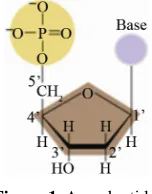
DNA consists of two long polymers of simple units called nucleotides. Nucleotides are building blocks of DNA and each of them contains three components: sugar, phosphate group and nitrogenous base. There are four different nitrogenous bases which contribute in DNA structure: Thymine(T) and Cytosine(C) which are called pyrimidines; Adenine(A) and Guanine(G) which are called purines. The nucleotides are link together by phosphor- diester bonds and form single stranded DNA (ssDNA). Two ssDNA molecules join together to form double stranded DNA (DsDNA) based on complementary rule: “A” always pairs with “T”, and likewise “C” pairs with “G”. In Figure 1, a schematic picture of nucleotide is
[image:1.595.385.461.631.728.2]shown.
Figure 1. A nucleotide.
DNA computing was initially developed by Leonard Adleman in 1994 [1]. Adleman resolved an instance of Hamiltonian path problem just by handling the DNA molecules. In 1995, Lipton [3] presented a method for solving the satisfiability (SAT) problem. Adleman-Lip- ton model can be used to solve different NP-complete problems. In Adleman-Lipton model, DNA splints are used for construction of solution space. Adleman [4,5] also presented a molecular algorithm for solving the 3-coloring problem. Chang and Guo [6-8] showed that the DNA operations in Adelman-Lipton model could be used for developing DNA algorithms to resolve the dominating set problem, the vertex cover problem, the maximal clique problem and independent set problem.
The surface-based model was introduced by Liu et al. in 1996 [2]. This model uses DNA molecules attached to a solid surface, instead of DNA molecules floating in a solution. Liu et al. also proposed a surface-based DNA algorithm for solving the satisfiability problem.
In 1996, Roweis et al. [9] introduced the Sticker based DNA computing model and applied it in solving the Minimal Set Cover problem. Perez-Jimenez and Sancho- caparrini [10] used Sticker based DNA computing to resolve knapsack problem, and this model also were ap-plied for breaking the Data Encryption Standard (DES) [11,12]. In our previous work, we also applied sticker model for solving the independent set problem [13].
Other than Adleman-Lipton, surface-based and Sticker based models, other various models are also proposed in DNA computing by researchers. Quyang et al. [14] solved the maximal clique problem using DNA molecules and Restriction endonuclease enzymes. Amos et al. [15,16] described a DNA computation model using restriction endonuclease enzymes instead of successive cycles of separation by DNA hybridization, which can reduce the error-rate of computation. Hagiya et al. [17] proposed a new method of DNA computing that involves a self- acting DNA molecule containing both the input, program, and working memory. In this method, a single-stranded DNA molecule consists of an input segment on the 5’-end, followed by a formula (program) segment, fol-lowed by a spacer, and finally with a “head” on the 3’-end that moves and performs the computation. An-other method for DNA computation is “computation by self-assembly”. Eric winfree et al. [18-20] introduced a linear and 2-dimentional self-assembly model.
The computing by blocking was introduced by Rozen- berg et al. [21] This model uses a novel approach to filter the DNA molecules: Instead of separating the DNA strands to distinct tubes, or destroy and removing the DNA molecules that does not contribute to finding a so-lution, it blocks (inactivates) them in a way that the blocked strands can be considered as non-existent during the subsequent steps of computation.
2.2. Surface-Based DNA Computation
2.2.1. General Aspects of Surface-Based Model
The surface-based model was introduced by Liu et al. in 1996 [2]. This model uses DNA molecules attached to a solid surface, instead of DNA molecules floating in a solution. The solution set of DNA strands is initially at-tached to a surface (glass, silicon, gold, for example). The immobilized DNA strands are then subjected to bio-logical operations such as hybridization or exonuclease degradation, in order to extract the desired DNA strands. This model greatly reduces losses of DNA molecules during different steps of computation. Briefly, the basic operations in surface-based model are as follows: selec-tively mark strands, destroy either marked or unmarked strands, and unmark all marked strands. Another feature of surface-based model is the use of single-base mis-match discrimination in hybridization as a basis for se-lectively marking DNA strands, which allows obtaining a high density of information per nucleotide.
2.2.2. Biological Operations in Surface-Based Model
For simplicity, let’s consider that the solution space be the set S of binary strands of length n. The following
operations may be performed on S [2].
1) Mark(i, b): this marks all strings in which the ith
bit has value b. This operation is performed by annealing specific probes to desired DNA strands.
2) Mark((i1, b1), (i2, b2), ··, (ik, bk)): this is an
exten-sion of mark (i, b) which marks a desired string based on the values of multiple bits. This operation is also per-formed by annealing specific probes to desired DNA strands.
3) Destroy-marked: removes all marked strands (dou-
ble stranded DNA molecules) from solution space. This is performed by specific enzymes which selectively de-stroy double stranded DNA molecules.
4) Destroy-unmarked: removes all unmarked strands
(single stranded DNA molecules) from solution space. This is performed by specific enzymes which selectively destroy single stranded DNA molecules.
5) Unmark: this unmarks all marked strands in
solu-tion space (dissociate probes from immobilized DNA strands and converts double stranded molecules to single stranded DNA molecules).
6) Test-if-empty: this operation determines whether
the set S is empty or not. It is usually executed at the end
of computation.
2.2.3. Designing of Appropriate DNA Strands and Construction of Solution Space
molecule is synthesized nucleotide by nucleotide on a support particle in sequential coupling steps. By applica-tion of this method, we can produce combinatorial sets of molecules by using mixture of nucleotides at each cou-pling step. For example, if two nucleotides are used to-gether in four coupling steps, 16 different DNA strands will be produced on solid support.
In this article, we use one base to represent one bit of the binary strings, while keeping the GC content of the string constant (about 50%). For example, we can use A or T in half of the positions to represent 0 and 1 respec-tively, and G or C in the remaining positions to represent 0 and 1 respectively. This is an important rule in design-ing of DNA strands, because GC content has a very strong effect on DNA hybridization reactions. In addition, all DNA strands immobilized on solid surface have markers at each end; these will be used as binding sites for primers of PCR reaction. The length of binding sites of primers is about 20 nucleotides. PCR reactions will be used for amplifying the desired DNA molecules.
2.2.4. In Vitro Implementation of Operations
We now describe how each of the operations of surface- based model can be performed on surfaces.
Mark (i, b): in order to marking the DNA strands
which represent binary strings in which the ith bit is b,
first, the DNA probes that are complementary to the mentioned strands are synthesized. Then, each of these probes hybridizes to its complement DNA strand on the surface. Thus, the marked DNA strands will be double- stranded whereas unmarked strands remain single- stranded.
In this method, single-base mismatch is used for dis-crimination of marked and unmarked strands, and it was determined that excellent discrimination based on single- base mismatch is obtained using 15 mer sequences.
Destroy-marked, destroy-unmarked: Either marked
(double-stranded) or unmarked (single-stranded) DNA molecules may be selectively destroyed by using exonu-clease enzymes.
Unmark: This operation is performed simply by
washing the surface in distilled water. Distilled water is low tonic solution which denature double-stranded DNA molecules and leads probes to dissociate from immobi-lized DNA strings and are washed away, leaving only the original single-stranded DNA attached to the surface.
Test-if-empty: As mentioned before, this operation is
usually executed at the end of computation. In final step, the remaining DNA molecules may be marked (double- stranded) or unmarked (single-stranded). If remaining DNA molecules are unmarked (single-stranded), we can cleave them from the surface, and amplify them by using PCR and detect if there is any product as a result. But, if the remaining DNA molecules on the surface are marked
(double-stranded), we should convert them to unmarked strands by removing complementary probes from immo-bilized DNA strands, and then, cleave them from the surface, amplify by using PCR and detect if there is any product as result.
3. SOLVING THE DOMINATING SET
PROBLEM BY SURFACE-BASED DNA
COMPUTERS
3.1. Definition of the Dominating Set Problem
In graph theory, a dominating set of a graph G = (V, E), where V is the set of the vertices and E is the set of the edges, is a subset V1 V such that for all u V − V1
there is a v V1 for which (u, v) E. The size of a
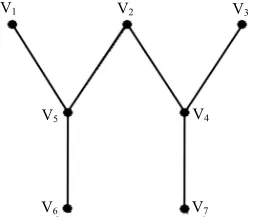
dominating set is the number of vertices it contains. The dominating set problem is to find a minimum size domi-nating set in G. The dominating set problem has been proved to be a NP—complete problem. For example, the graph in Figure 2 includes 7 vertices and 6 edges.
It is clear that the minimum size dominating set for our graph is {V4, V5}, furthermore, the size of the
domi-nating set problem in our graph is 2.
3.2. Construction of the Surface-Based Solution Space for Dominating Set Problem
First of all, it is essential to generate the surface-based DNA solution space of our problem. Then, basic bio-logical operations will be used to select legal strands and remove illegal strands from the solution space. It is ob-vious that a graph with N vertices has 2N subset of verti-ces or 2N possible dominating sets. Furthermore, each possible dominating set can be represented by an N-digit binary number. Also suppose that V1 is a dominating set
of G. If the ith bit in an N-digit binary number is set to 1,
it represents that the ith vertex is in V1 but is not in V-V1.
If the ith bit in an N-digit binary number is set to 0, it
represents that the ith vertex is not in V1 but is found in V
−V1.
Our graph has 7 vertices and 128 possible dominating sets. Furthermore, the solution space has 128 distinct molecules, which have designed and synthesized as
[image:3.595.361.489.609.719.2]V1
Figure 2. The graph of our problem.
V2 V3
V4
V5
shown in Figure 3. The length of these DNA molecules
is 55 nucleotides, consisting of a unique 20 nucleotides sequence at each end (binding sites for PCR primers), and a 15 nucleotides hybridization sequence in the mid-dle. As discussed before, excellent specificity and dis-crimination based on single-base mismatch is obtained using 15 mer sequences, for this reason, we considered 15 nucleotides for hybridization sequence. The graph of our problem have 7 vertices, thus, the 7 central nucleo-tides in the 15 mer hybridization sequence were synthe-sized as a combinatorial set with two possibilities at each position: (G + C) (G + C) (G + C) (G + C) (A + T) (A + T) (A + T), representing 27 = 128 distinct molecules in
solution space. The adjacent 4 nucleotides at the two ends of the hybridization sequence have unique and con-stant sequences in order to limit the size of the solution space to 128 molecules.
1) Prepare solution space by designing and synthesis of appropriate DNA strands which are immobilized on a surface.
3.3. DNA Algorithm for Solving the Dominating Set Problem
The following algorithm is proposed for solving the do- minating set problem:
2) For i = 1 to n, where n is the number of vertices in the graph G.
a) Mark (i, 1);
b) For each vertex Vj which have adjacency to Vi; c) Mark (j, 1);
d) Destroy-unmarked; e) Unmark.
3) Cleave remaining immobilized DNA strings from surface.
4) Amplify by PCR.
5) Input DNA molecules to tube T0.
6) For i = 0 to n – 1 For j = i down to 0
Separate (Tj, i + 1) → (T(j+1)’, Tj)
Combine (Tj+1, Tj+1, T(j+1)’)
7) Read T1; else if it was empty then:
Read T2; else if it was empty then:
Read T3; else if it was empty then:
. . .
Read Tn–1; else if it was empty then:
Read Tn.
According to the steps in the algorithm, the
dominat-ing set problem can be resolved by surface-based DNA computation in polynomial time.
Step 2 of the algorithm is executed n times (n is 7 in our graph). Step 2a, marks the DNA strands which con-tain the vertex Vi and the DNA strands which do not contain the vertex Vi remain unmark. From the definition of dominating set, the unmarked DNA strands represent sets V −V1, which do not contain the vertex Vi. If there is
no vertex adjacent to Vi, then step 2d will destroy the unmarked DNA strands. Otherwise, step 2c will be exe-cuted z times, where z is the number of vertices adjacent (directly connected by an edge) to Vi. Each time step 2c is executed, it marks DNA strands which contain Vj (subsets which contain vertices that have adjacency to Vi). Furthermore, the remaining unmarked DNA strands con-sist of all of the strands which do not contain Vi and Vj, or we can say it contains vertices which do not have ad-jacency to Vi. Thus, the unmarked DNA strands are ille-gal strands and should be destroyed. For all vertices, similar processing is also performed, therefore, at the end of step 2, illegal strands will be destroyed and only legal strands (representing dominating sets) will be remain in solution space.
During steps 3 to 5, legal DNA strands which remain on surface at the end of step 2, are cleaved from surface, amplified by using PCR, and finally, all of them are transferred to tube T0.
In step 6 of the algorithm, we applied 2 operations: separation and combination. Here, we briefly discuss about these operations:
Separate (Ta, i) (Tb, Tc), this operation creates two
new tubes Tb and Tc,
Tb contains the DNA molecules having the ith bit value
1 (Tb = +(Ta, i)) and Tc contains the DNA molecules
having the ith bit value 0 (T
c = –(Ta,i)).
Combine (Ta, Tb, Tc): the DNA molecules from the
tubes Tb and Tc are combined to form a new tube Ta,
sim-ply the contents of Tb and Tc are poured to tube Ta. (Ta=
Tb∪Tc).
By the execution of step 6, the DNA strands which represent the subset are placed in tube T0, the DNA
strands represent the subsets which contain only one ver-tex are placed in tube T1, the DNA strands represent the
subsets which contain two vertices are placed in tube T2,
the DNA strands represent the subsets which contain 3 vertices are placed in tube T3, and so on.
In step 7, all of the tubes (from T1 to Tn) are evaluated
for presence of DNA strands , and the first tube which is not empty and contains DNA strands represent minimum
size dominating set. In our example, tube T1 is empty and
devoid of any DNA strands. The first tube which con-tains DNA molecules is tube T2 which represent the
sub-set {V4, V5}. Hence, the minimum size dominating set in
our graph is 2.
4. CONCLUSIONS
In this paper, the surface-based DNA computing was used for solving the dominating set problem. This method could be used for solving other NP-complete problems.
The loss of DNA molecules is one of the major prob-lems in Adleman-Lipton and sticker models, but the sur-face-based model greatly reduces losses of DNA mole-cules during different steps of computation. One of the major limitations of this model is that the length of hy-bridization sequence is restricted to 15 nucleotides, be-cause selectively marking DNA strands is based on sin-gle-base mismatch discrimination in hybridization. For solving the large scale NP-complete problems, it is es-sential to design the oligos larger than 15 nucleotides.
Finally, for improving the efficiency and capabilities of surface-based model, other operations should be added to this model.
REFERENCES
[1] Adleman, L.M. (1994) Molecular computation of solu-tions to combinatorial problems. Science, 266, 1021-1024. doi:10.1126/science.7973651
[2] Liu, Q., et al. (1996) A surface-based approach to DNA computation. Proceedings of the 2nd Annual Meeting on DNA Based Computers.
[3] Lipton, R.J. (1995) DNA solution of hard computational problems. Science, 268, 542-545.
doi:10.1126/science.7725098
[4] Adleman, L.M. (1995) On constructing a molecular computer. Manuscript. University of Southern California. [5] Adleman, L.M. (1996) On constructing a molecular
computer. DNA Based Computers, 1-22.
[6] Chang,W.-L. and Guo, M. (2002) Solving the dominat-ing-set problem in Adleman-Lipton’s model. The Third International Conference on Parallel and Distributed Computing, Applications and Technologies, Kanazawa, 4-6 September 2002, 167-172.
[7] Chang, W.-L. and Guo, M. (2002) Solving the clique pro- blem and the vertex cover problem in Adleman-Lipton’s model. IASTED International Conference on Networks,
Parallel and Distributed Processing, and Applications,
Tsukuba, 2-4 October 2002, 431-436.
[8] Chang, W.-L. and Guo, M. (2002) Solving NP-complete problem in the Adleman-Lipton model. The Proceedings of 2002 International Conference on Computer and In-formation Technology, 11-13 September 2002, 157-162. [9] Roweis, S., et al. (1999) A sticker based model for DNA
computation. In: Landweber, L., Baum, E., Eds., Second Annual Workshop on DNA Computing, Princeton Univer-sity, 1-29.
[10] Perez-Jimenez, M.J., Sancho-Caparrini, F. (2001) Solving knapsack problems in a sticker based model. Lecture Notes in Computer Science, 2340, 161-171.
[11] Adleman, L., Rothemund, P., Roweis, S. and Winfree, E. (1999) On applying molecular computation to the data encryption standard. The 2nd Annual Workshop on DNA Computing, Princeton University, 31-44.
[12] Boneh, D., Dunworth, C. and Lipton, R. (1996) Breaking DES using a molecular computer.
[13] Taghipour, H., Taghipour, A., Rezaei, M. and Esmaili, H. (2012) Solving the independent set problem by sticker based DNA computers. American Journal of Molecular Biology, 2, 153-158. doi:10.4236/ajmb.2012.22017 [14] Quyang, Q., Kaplan, P.D., Liu, S. and Libchaber, A.
(1997) DNA solution of the maximal clique problem.
Science, 278, 446-449. doi:10.1126/science.278.5337.446 [15] Amos, M., Gibbons, A. and Hodgson, D. (1996) Error-
resistant implementation of DNA computations. Pro-ceedings of the 2nd DIMACS Workshop on DNA Based Computers, 87-101.
[16] Amos, M., Gibbons, A. and Hodgson, D. (1996) A new model of DNA computation. 12th British Colloquium on Theoretical Computer Science, 1-4.
[17] Hagiya, M., Arita, M., Kiga, D., Sakamoto, K. and Yo-koyama, S. (1999) Towards parallel evaluation and learning of boolean μ-formulas with molecules. DIMACS Series in Discrete Mathematics and Theoretical Com-puter Science, 48, 57-72.
[18] Winfree, E. (1998) Simulations of computing by self- assembly. Fourth International Meeting on DNA Based Computers, 213-239.
[19] Winfree, E., Liu, F.L., Wenzler, L.A. and Seeman, N.C. (1998) Design and self-assembly of two-dimensional DNA crystals. Nature, 394, 539-544. doi:10.1038/28998 [20] Winfree, E., Yang, X. and Seeman, N.C. (1996)
Univer-sal computation via self-assembly of DNA: Some theory and experiments. Proceedings of the 2nd DIMACS Work- shop on DNA Based Computers.