Construct the Community of IT Education and Break
the Bottleneck of Rural School Educational
Informationization
Dehua Kong
Shanxi Normal University, Linfen, China Email: [email protected]
Received May 1,2012; revised June 19, 2012; accepted July 21, 2012
ABSTRACT
Based on the current situation of rural educational informationization, my study found that the boost of rural elementary and secondary school’s educational informationization needed the cooperation of higher normal universities and local education administrative department. The construction of “IT education community” is the key to step off the predica- ment. The practice application and effect in Gaoping City further proved that the cooperation project broke the bottle- neck of rural elementary and secondary school’s educational informationization.
Keywords: IT Education Community; Informationization Education; Education Development Service Area
1. Introduction
It is the requirement of education reform and important strategic action for the achievement of education mod- ernization to drive to education modernization by educa- tion informationization, which helps to achieve the great-leap-forward development of basic education. Since 2000, governments at all levels and the education administrative department generally put their emphasis on basic education informatization. They have popular- ized the information technology education and fully im- plemented “The school passes project”. In September 2003, the state council of the national education work conference held by the state council on further strength- ening the rural education work put forward the decision: “the implementation of modern distance education in rural primary and secondary schools in urban and rural areas, promote the quality education project resources sharing”. Then equipped the rural schools with the corre- sponding information teaching equipment, let the eco- nomic weakness, the shortage of capital and primitive conditions of the rural primary and middle schools of education information construction get preliminary im- provement. Relevant statistics show that by November 2007, the government of “modern distance education in rural primary and secondary schools project” a total in- vestment of RMB11.1 billion yuan, and equipped with teaching equipment more than 440,000 sets of CD, cov- ering 360,000 rural elementary school in the Midwest [1]. The “The school passes project” poured into nearly 100
billion in the education informationization. The imple- mentation of the two countries project was a powerful impetus to the development of education in primary and middle school information, but in the process, the actual achievement and the desired objectives exist great gap. Why huge education information investment can’t meet the expected benefits?
ity is not limited, so their courseware is quality less and unavailable. Furthermore, school funds are seriously in shortages, leadership in improper understanding. There- fore, primary and secondary school education informati- zation is related to the education system of each level, and requires a collective cooperation, to get out of the plight of rural primary and secondary school education at present, we must joint external strength, constructing “IT (information technology) education community”, to break through the bottleneck of rural school education informa- tization.
2. Connotation of IT Education Community
Social scientists endowed “community” with a connota- tion, “for specific purpose, people live together in a life group, organization or team”. This concept was trans- planted into education field in the report titled “basic school, learning community” by Ernest L. Boyer, pub- lished in 1995. The report puts forward “school is the community of study”. At present, the “learning commu- nity” “practice community” has become the focused topic in the education field at home and abroad, generally researchers coalescing group behavior theory, teachers’ professional development theory and cooperation to its connotation [2].
Based on the situation of promoting the rural schools’ education informationization and construction of teach- ers’ professionalization, IT education community is mainly is made of the joint cooperation of university and pri- mary and secondary schools community. IT education community refers to teachers (including network IT ex- perts), normal school students (including IT education masters) and the primary and secondary school teachers in the normal colleges or universities with normal nature of the college acquire the common development in teach- ing, learning and research as a carrier. At the same time, governments at all levels and education administrative department should jointly establish “education develop- ment service area”, to provide a powerful system support for the construction of IT community education.
IT education community is essential to promote the quality education and the curriculum reform and is the needs of the change of the time which can effectively promote the process of basic education informationiza- tion.
3. The Theory Model and Interpretation of
“IT Education Community”
After years of survey data analysis, in rural primary and secondary school education informatization is key to the development of informatization basic environment con- struction including hardware, network and software con- struction, digital teaching resource construction and teach-
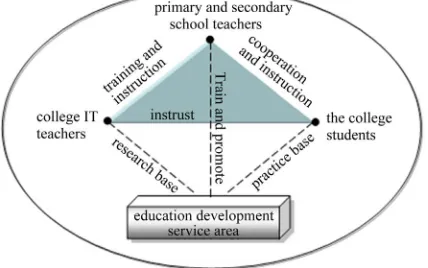
ers’ professional development, namely that the teacher has and curriculum integration necessary skills. For these props, strength comes from “education development ser- vice area”, IT teachers of normal universities and stu- dents, primary and secondary school teachers. The force source each has a different role. If each act is own way, it is helpless to promote education informatization for its deep advance. But if they can cooperate with each other, take the strength of each side and work unitarily, they can produce great overall efficiency. Therefore, I con- struct “IT education community”, which will organize the four powers, as shown in Figure 1 below.
In this IT education community, with the support of “education development service area” by government at all levels and administrative department of education, the three main body—the college students, IT teachers, pri- mary and secondary school teachers constitute a stable triangle through guide and cooperation. The main char- acteristics of the community are:
3.1. Cooperative Consensus
IT education community construction aims to promote rural education informationization, to promote of bal- anced development of basic education, and to promote teacher’s professional development of information tech- nology. Namely, combine the theory research with rich practice of education in middle and primary schools, start with the needs and problems solving of the two parties. Preference to any side will stop the good operation and sufficient work of “IT education community”. Normal colleges and local education administrative department are responsible to the promotion of rural basic education informatization and development of professional devel- opment of teachers’ information technology.
3.2. Cooperation Project
[image:2.595.317.531.584.718.2]The construction of IT education community broke the boundaries between university and primary and secon- dary schools, to get all aspects, such as college IT teachers
and students, primary and secondary school teachers and education administrative department together in the form of alliance, to construct cooperative framework with the support of government, to set up cooperation institution, to found cooperative project and implement cooperative action. Considering substantive cooperation and close cooperation as signs, it aims at construction of valuable cooperation projects.
Following the guideline of “getting familiar with basic education, researching basis education, education, giving service to basic education and leading basic education”, in November of 2006, our school started the project “substituted practice—exchange training”, then succes- sively signed training contracts with several cities and counties like Linfen, Yuncheng, Jincheng, Changzhi Lv- liang etc. and established stable long-term cooperative teaching, learning and research base. In accordance with the agreement, our school is responsible for selecting and sending good normal school graduates to the base every semester, and providing the latest scientific research re- sults and the information resources of teaching, selecting good teachers and related experts to the base to guide teaching and scientific research. At the same time a number of primary and secondary school teachers from the base schools would be replaced for four months of professional training and study in universities, the base schools are in charge of the training fees and students’ practice post and accommodation, and regularly to or- ganize college teachers and primary and secondary school teachers to carry out scientific research activities.
In the past five years, the project implementation has engaged in more than 280 rural primary and secondary schools, and has chosen 2554 students in ten batches to base schools, and 1088 teachers from primary and sec- ondary school have been replaced with training study, at the same time, in summer and winter vacations all kinds of primary and secondary school teachers, principals have been organized for short-term training classes, in- cluding 4095 primary and secondary school teachers.
3.3. Cooperation and Multi-Benefits
Community formation takes reciprocal cooperation, com- mon development, equality and mutual benefit, mutual complementary as principle of cooperation. By con- structing the IT education community, under the strong support of “education development service area”, the college IT teachers won the ongoing study bases, the primary and secondary school teachers won sustainable development and powerful guidance of theories, normal school students find education practice base. As a result, higher normal colleges could change the fact that pre- service practical professional training is away from basic education and post-service training is lack of scientific profound and prospective theories.
In the process of cooperation, university IT teachers and normal school students take the latest information technology theories and informationization teaching re- sources to the bases, and find new research points in the basic education schools during the practice information technology teaching; Primary and secondary school teachers come to colleges to accept the frontier knowl- edge training and bring various problems to universities, and study together with university teachers. Education technology is the hot spot of the teachers to learn. Pri- mary and secondary school teachers are in urgent need of it, especially how to apply information technology effec- tively to teaching and how to improve the classroom teaching efficiency. Through the practice-training-prac- tice, primary and secondary school teachers improve their professional quality of information technology. In the past five years, the constant training in rotation, al- most every teacher has been in training study, and equipped with certain amount of information teaching ideas and information technology skills. After training, teacher have been back to school, and put many idle in- formationization teaching equipment into use effectively.
4. The Application Case of “IT Education
Community”—Taking Gaoping as a Case
Study
Since the past five years of the application of “substituted practice—exchange training”, seven groups of students take turns to Gaoping for education practice, of each trainee teachers sent more than 70, distributed to 20 mid- dle schools, including 3 urban middle schools, 4 town- ship high school, 13 rural middle schools. Gaoping is a relatively developed district, 85% of high school have multimedia classroom, computer room, campus network, but the source is not too high with seldom use. Only when it comes to open classes or deal with inspections, they are used. There are scarcely information technology classes, in which the students usually play computer games, and not have no much teaching and learning, let alone the use of information technology to improve the students’ practice ability and innovation ability. Digital instructional resources are only scattered optical disc resources, which almost can not directly put into use in teaching. The teachers are lack of redevelopment ability in information technology teaching courseware, which not only seriously hindered teachers’ teaching in the im- plementation of the information, but also influenced the growth of the students.
4.1. Carry Out Project Research and Promote the School Teaching Informationization
tive system, financially aiding teachers in information teaching research, or cooperate with the college teachers, for example how to use digital resources to optimize the classroom teaching, and how to integrate the information technology and curriculum, and so on. There are two projects aid every year, to improve the teachers’ teaching research ability and at the same time promote the school teaching’s informationization.
4.2. Pre-Service and Post-Service Training for the Teachers’ Information Accomplishment Promotion
In addition to the compulsory courses like “college basic computer theory”, “multimedia courseware production”, there are some new teaching curricula such as the inte- gration of information technology theory with practice of the teaching in the course of three weeks of pre-job training, which primarily have the ability to carry out information teaching. The substituted teachers” also have the education technology course in a four months of train- ing, including basic knowledge of IT, the use of office software, the search of network resources, to make mul- timedia courseware, the integration of information tech- nology and curriculum, teaching research of information technology. This part accounts for a quarter of the con- tent in the training. By training and study, primary and secondary school teachers are expected to grasp the basic teaching skills and information teaching research ability.
What’s more, we also organized primary and secon- dary school teachers training and school principals train- ing five times, and successively invited experts to Gaop- ing to attend lectures listening, teaching assessing, con- ducting teaching research team activities. After five years implementation, primary and secondary school teachers’ teaching idea gradually changed, and began to try the integration of information technology with curriculum teaching reform. Almost every school held the multime- dia teaching public class once or twice a week and teachers began to learn to make teaching courseware. By the organization of courseware competition, the school also improved teachers’ study enthusiasm and operation ability, thus aroused their application of information technology in the classroom. In the process, some normal school students established the campus network and teaching resource database for the base. Through appli- cation practice, the advantages of various elements in the community have been developed, and organic coopera- tion contributed to target reaching.
4.3. Tele-Collaborative Communication, Improve the Lifelong Learning Ability
Directing at the problem that college IT teachers can’t guide teaching at any time and place, we established a
B-learning teacher training platform. We organized sub- ject experts and network experts to establish information teaching resource database, which help primary and sec- ondary school teachers and students get access to the information technology teaching easily and quickly. Plat- form also provides interactive Blackboard function, to promote the teachers lifelong learning ability through the online chat rooms, online discussion by posting reading materials, exchange, and development of teaching re- sources by collective cooperation. According to the sur- vey, by the year 2011, March 27, 169 people registered in the platform, 3092 logs published, 2912 comments article issued.
5. Implementation Effect of “IT Education
Community”
On the basis of “IT education community”, the rural primary and secondary school education informatization development has achieved substantial progress in the past five years.
5.1. To Promote the Information Infrastructure Construction
In the past five years, some good condition middle schools in Gaoping equipped every teacher with a laptop com- puter, and computer rooms are updated. They constructed group class preparation room, and gave students’ com- puter room a network for information search on the Internet. In the construction of the school information infrastructure, “education development service area” played a very important role.
5.2. Improve the Primary and Secondary School Teachers’ Teaching and Application Ability
Before the project was conducted, many teachers in Gao- ping have classes with a textbook, a piece of chalk, a blackboard. But now everyone can use multimedia way in classroom teaching, with more than 95% utilization rate. Since the establishment of B-learning teachers’ training platform, teachers actively participate in online research, communicate with other teachers, even expose their own teaching courseware to Internet to share. By mutual re-exchange, re-share, reflective activities, teach- ers obtain sustainable development and theory progress, thus teachers’ professional ability obtained and im- proved.
5.3. Promote the Transformation from “Novice Teachers” to “Mature Teachers”
and training, the information technology teaching skills haven’t been exercised. In IT education community, through observation and imitation the experts’ methods problems solving, they gradually make progress and be- come “mature teachers”.
5.4. The College Teachers Got Ongoing Study Base
For today’s teachers and education, a universal problem is: the disjointedness of pre-service training and post- service training, disjointedness of higher education and basic education. Higher college teachers with advanced education concept are used to researching in their book- room, but due to the misunderstanding of the primary and secondary school teachers and their works, theory can’t meet the need of practice. However, in IT educa- tion community, university teachers through the practice, the instruction and the test of new education theory, ac- quire the theory promotion and academic growing point based on their basic practice.
6. Summary and Prospect
Five years of practice show that the use of the “IT educa- tion community” can greatly promote the construction of the informatization in rural primary and secondary school education, such as information infrastructure improve- ment, and information resources perfection, teachers’
teaching ability improvement, teachers’ professional level, get a powerful impetus to the development of rural pri- mary and secondary school education information. The rural education informatization development needs sup- port from government and education administrative de- partment at all levels as “education development service area” to go further.
7. Acknowledgements
This research was supported by “Eleventh Five-Year Plan” of Shanxi Education and Science under Grant No. GH-09201, and Research Fund projects of Shanxi Nor- mal University under Grant No. YJ09009, and Education Reform Project of Shanxi Normal University under Grant No. SD2009YBKT-15.
REFERENCES
[1] The Modern Tele-Education Project Office in Rural Pri- mary and Secondary Schools, “Set Up the Bridge— China’s Modern Tele-Education Project in Rural Ele- mentary and Middle Schools,” People’s Education Press, Beijing, 2007.