RESEARCH ARTICLE
OPTIMIZATION OF SUN-DRIED
Moringa olifera
INCORPORATED CHAPPATHI USING RESPONSE SURFACE METHODOLOGY
Nazni, P
*and Gracia, J
Department of Food Science, Periyar University, Salem, TamilNadu, India.
ARTICLE INFO ABSTRACT
Wheat is one of the staple foods of the majority of Indian population. Whole wheat flour is mainly used for preparation of
various medicinal properties
contain powerful antibiotic pterygospermin which has fungicidal properties. Hence the present study is undertaken to process drumstick flower into powder and analyzing the physiochemical properties and nutr
and determine the optimal levels of wheat flour and sun dried drumstick flower powder (SD-DFP) using
Chappathi considering
overall acceptability as a response variables
Surface Methodology (RSM) was applied for optimization, the multiple regression was used to get optimum levels and it was found that desirable values of diameter (15.24cm), cooking tim
time (4.20 min) and overall acceptability (7.72) was obtained for the corresponding optimum condition of wheat flour (95gm) and sun dried drumstick flower powder (5gm). Hence it is concluded that RSM was used success optimize the level of wheat flour and sun dried drumstick flower powder for the development of value added chapathi.
INTRODUCTION
Wheat is one of the staple foods of the majority of Indian population. Of the total wheat produced, 75% get processed into whole wheat flour in the Chakki mill and the remaining 8-12% is processed in the roller mill for suji/rawa and refined wheat flour/ maida. Whole wheat flour is mainly used for preparation of chappathi and other traditional indigenous products of wheat floue origin are poories, naans, kulchas, bathuras and so on (Sidhu and Scribel, 1998). Plant foods play an important role in the diet as they provide essential micronutrients
and minerals. Among the various parts of the plant, vegetable flowers play an important role with good
*Corresponding author:[email protected]
nutrients and therapeutic values by acting as a
tonic, diuretic and cholagogue (Jayabal, 2003).
Moringa oleifera
"Moringa" is the most widely cultivated species of the genus
Moringaceae (Quattrocchi, Um
is world widely famous for its medicinal properties. Drumstick plants grow very rapidly and are loaded with number of nutritional benefits.
drumstick tonic helps in providing important nutrients like calcium, vitamins and iron to expectant mothers (dietihub.com
treating cold and anaemia and report to contain powerful antibiotic pterygospermin which has
properties (Sreenivasan and Jyotsna, 2000).
ISSN: 0975-833X
International Journal of Current Research
Vol.9, pp.050-057, October
Key words:
Moringa olifera flower
Chappathi Optimization
Response Surface Methodology
Article History:
Received 13th July, 2010
Received in revised form 17th August, 2010
Accepted 23rd September, 2010
Published online 1st October, 2010
© Copy Right,
ARTICLE
Moringa olifera
FLOWER POWDER
INCORPORATED CHAPPATHI USING RESPONSE SURFACE METHODOLOGY
and Gracia, J
Department of Food Science, Periyar University, Salem, TamilNadu, India.
Wheat is one of the staple foods of the majority of Indian population. Whole wheat flour is mainly used for preparation of Chappathi. Drumstick flower has various medicinal properties like used to treat cold and anaemia and report to contain powerful antibiotic pterygospermin which has fungicidal properties. he present study is undertaken to process drumstick flower into powder and analyzing the physiochemical properties and nutritive value of the powder and determine the optimal levels of wheat flour and sun dried drumstick flower DFP) using Response Surface Methodology (RSM) for acceptable considering diameter, cooking time, weight, kneading time and acceptability as a response variables. Results revealed that, Response Surface Methodology (RSM) was applied for optimization, the multiple regression was used to get optimum levels and it was found that desirable values of diameter (15.24cm), cooking time (1.45min), weight (95.49gm), kneading time (4.20 min) and overall acceptability (7.72) was obtained for the corresponding optimum condition of wheat flour (95gm) and sun dried drumstick flower powder (5gm). Hence it is concluded that RSM was used successfully to optimize the level of wheat flour and sun dried drumstick flower powder for the development of value added chapathi.
nutrients and therapeutic values by acting as a stimulant, tonic, diuretic and cholagogue (Jayabal, 2003).
Moringa oleifera, commonly referred to simply as
"Moringa" is the most widely cultivated species of the genus Moringa, which is the only genus in the family Moringaceae (Quattrocchi, Umberto, 2000). Drumstick is world widely famous for its medicinal properties. Drumstick plants grow very rapidly and are loaded with number of nutritional benefits.Regular consumption of drumstick tonic helps in providing important nutrients like calcium, vitamins and iron to expectant mothers
dietihub.com, 2010). Drumstick flowers were used in treating cold and anaemia and report to contain powerful antibiotic pterygospermin which has fungicidal properties (Sreenivasan and Jyotsna, 2000).
ternational Journal of Current Research October, 2010
INTERNATIONAL JOURNAL
OF CURRENT RESEARCH
Vegetable flowers are highly perishable and some of them are usually available in particular season of the year. Vegetable flowers come in plenty during glut seasons and excess get spoilt. Inorder to minimize wastage, vegetables can be processed and preserved by simple traditional methods like sun drying, salting, smoking, pickling and advanced method like canning, dehydration and freeze drying. Among the various types of processing techniques dehydration is considered to be an inexpensive method and imparts properties that are unmatched by any other preservation technique (Lakshmi and Radha, 2004). The present study was undertaken with the objective to process drumstick flower into powder and analyzing the physiochemical properties of the powder and determine the optimal levels of wheat flour and sun dried drumstick flower powder(SD-DFP) for acceptable Chappathi.
MATERIALS AND METHODS
Sources of materials
Wheat flour and salt were purchased from the local market in Salem, Tamil Nadu, India and checked for its purity. The drumstick flowers were collected freshly. It was blanched in just enough boiling water for 2–3 minutes, removed immediately and spread on muslin cloth/trays for drying. Then the drumstick flowers were dried for 2 days under the sunlight until they were fully dried or crisp. The drumstick flowers were turned frequently to ensure uniform drying. The daytime
temperature ranges from 36 to 38ºC. The Sun Dried –Drumstick Flower Powder (SD-DFP) was packed
in low density polyethylene bag and stored in the refrigerator until required.
Analysis of physiochemical properties of selected SD-DFP
Physical properties such as the drying ratio and rehydration ratio were calculated by the method of Ranganna, 1986. The water absorption capacity and oil absorption capacity was determined by the method of Sathe et al, 1982 and the bulk density of the SD-DFP as determined using Ige, 1984. The chemical properties such as moisture, total ash and fibre were determined using AOAC method. The carbohydrate was assessed using Anthrone method and the total carotene was determined using spectrophotometer. All the estimations were done in triplicates. The anti-nutritional substances suspected to be present in vegetables namely tannin was analyzed using Folin Denis Method.
Experimental design for optimization SD-DFP
incorporated Chappathi
Response surface methodology was applied to the experimental data using a commercial statistical package
(Design expert, Trial version 6.0, State Ease Inc., Minneapolis, IN statistical software) for the generation of response surface plot and optimization of process variables. The experiments were conducted according to Central Composite Rotatable Design (CCRD) (Khuri and Cornell, 1997). A 32 factorial experiment was used to
study the effects of wheat flour (X) and sun dried drumstick flower powder (X2) on the diameter (Y1),
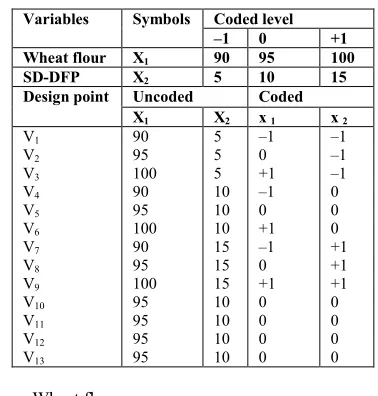
[image:2.504.268.457.205.403.2]cooking time (Y2), weight (Y3), kneading time (Y4) and overall acceptability (Y5) on Table 1 of the developed Chappathi.
Table 1. Process variables, their levels and Experimental design
Variables Symbols Coded level
–1 0 +1
Wheat flour X1 90 95 100
SD-DFP X2 5 10 15
Design point Uncoded Coded X1 X2 x 1 x 2
V1
V2
V3
V4
V5
V6
V7
V8
V9
V10
V11
V12
V13
90 95 100 90 95 100 90 95 100 95 95 95 95
5 5 5 10 10 10 15 15 15 10 10 10 10
–1 0 +1 –1 0 +1 –1 0 +1 0 0 0 0
–1 –1 –1 0 0 0 +1 +1 +1 0 0 0 0
X1 → Wheat flour
x → Coded value
X2 → Sun dried drumstick flower powder
X→ Uncoded value
Each design point consists of three replicates. For the statistical analysis the numerical levels are standardized to –1, 0, and 1. The experiments were carried out in randomized order (Gacula and Singh, 1984).
The relationship between standardized variables values is given as follows.
X1= Wheat flour – 95
5
X2= Sun dried drumstick flower powder – 10
5
experimental data of each dependent variable as given. The model proposed to each response of Y was
Where, β0, βi, βij are intercepts, quadratic regression
coefficient terms. Xi and Xj are independent variables.
The model permitted evaluation of quadratic terms of the independent variables on the dependent variable. The response surface and contour plot were generated for different interactions of any two independent variables, check holding the value of third variables as constant at the central level. The optimization of the process was aimed at finding the optimum values of independent variables (diameter, cooking time, weight and kneading time) to achieve the maximum (appearance, colour, flavour, taste, texture and overall acceptability). The optimum values of the selected variables were obtained by solving the regression equation (Parmjit, 2009).
Sensory Evaluation
The sensory quality is the different senses of preparation and eating food. All the developed products were evaluated for their acceptability by a semi trained panel of ten judges. Chappathi was evaluated for sensory quality on the basis of appearance, colour, flavour, taste, texture and overall acceptability using a 9 point Hedonic scale score card with scores ranging from 9 to 1, where score 9 and 1 represented like extremely respectively used for evaluating the development products and analyzed statistically using Duncan’s multiple range test.
Analysis of physical properties of SD-DFP
incorporated Chappathi
The variable parameters like diameter, cooking time, weight and kneading time were assessed for the determination of physical properties of Chappathi. Weight of the products was measured in grams using weighing balance. The time taken for complete cooking of the product was noted in minutes. Diameter and width of the products was measured in cm using scale.
Chemical analysis of SD-DFP incorporated chappathi
The moisture and fibre were determined using AOAC method. Carbohydrate content was assessed using Anthrone method and the total carotene was determined using spectrophotometer.
Statistical Analysis
The statistical significance of the regression coefficients was determined by student’s t test and second order
model equation was determined by Fisher’s test. The relative effect of each process parameter on individual response was compared from the value corresponding of those parameters by ANOVA and Duncan’s Multiple Range Tests.
FINDINGS
Physical characteristics
[image:3.504.284.446.180.238.2]Drying ratio and rehydration ratio of SD-DFP
Table 2. Drying ratio and rehydration of SD-DFP
Physical Parameters
Quantity(g/100g)
Drying ratio Rehydration ratio
21 15.40
Table 2 shows that the final yield of SD-DFP for 100g after 2 days drying was found to be 21g with the moisture of 8.5%. Regarding rehydration ratio 5g of the SD-DFP was found to be 15.4g respectively. Similar results was defined by Jayaraman et al (1991) and Uadal Singh et al. (2006) who reported that oven drying (1:5) is the best when compared to sun drying (1:16.5) and shade drying respected of drying and dehydration ratio.
Bulk density, water absorption and oil absorption ratio of SD-DFP
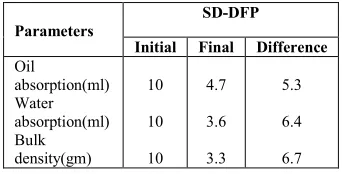
[image:3.504.279.450.520.607.2]The oil absorption and bulk density of SD-DFP is 5.3 and 6.7 ml respectively. The bulk density of SD-DFP is 6.7gm. Similar to our study, Fagbemi (2006) reported that the water absorption capacity of the flour is increased when compared to that of fresh product. Healso (2001) reported that boiling enhanced oil absorption capacity. Similar observations were reported by Padmashree et al. (1987) and Abby and Ibeh (1988) for cowpea, Giami and Bekebain (1992) for fluted pumpkin and Del Rosarrio and Flores (1981) for mung bean.
Table. 3 Bulk density, water absorption and oil absorption ratio of SD-DFP
Parameters
SD-DFP
Initial Final Difference Oil
absorption(ml) Water absorption(ml) Bulk density(gm)
10
10
10 4.7
3.6
3.3
5.3
6.4
6.7
3 3 3
Y= β0 + Σβi Xi + Σ βii Xi2 + Σβij Xi Xj
i=1 i=1 i<j=1
Chemical analysis of SD-DFP
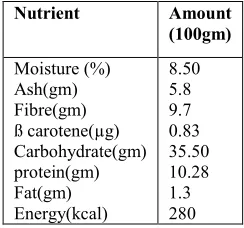
[image:4.504.78.200.188.302.2]The nutrient content of SD-DFP is reported as moisture 8.50%, ash 5.8gm, fibre 9.7gm, carotene 0.83µg and carbohydrate 35.50gm respectively.The moisture content of the powder was low enough for its longer shelf life. Similar to our study, Lakshmi (2005) reported that the nutrient content of SD-DFP were 4.5g moisture, 9.0g ash, 28.4g carbohydrate and 4.12mg of carotene (Table 4).
Table 4. Nutrient composition of SD-DFP
Nutrient Amount (100gm)
Moisture (%) Ash(gm) Fibre(gm) ß carotene(µg) Carbohydrate(gm) protein(gm) Fat(gm) Energy(kcal)
8.50 5.8 9.7 0.83 35.50 10.28 1.3 280
Anti-nutritional factor
The anti-nutritional factor in the SD-DFP such as tannin may be about 1.175g/100g respectively. According to Lakshmi and Radha (2005), the tannin content of dehydrated drumstick flower was 1.8g/100g.
Optimization of Sun Dried Drumstick Flower Chappathi
The Chappathi prepared with the help of wheat flour and SD-DFP was characterized for its physiochemical and organoleptic characteristics. The diameter (Y1), cooking time (Y2), weight (Y3), kneading time (Y4) and overall acceptability (Y5) were measured for response variables. Table 5 shows that the diameter of chapatti may be ranged from 14. 9 to 15.4cm, cooking time 1.42 to 1.54 minutes, weight 95.2 to 97.8gm, kneading time 4.15 to 4.50 minutes and overall acceptability may range from 4 to 8 respectively.
Diagnostic checking of fitted model and surface plot for various responses
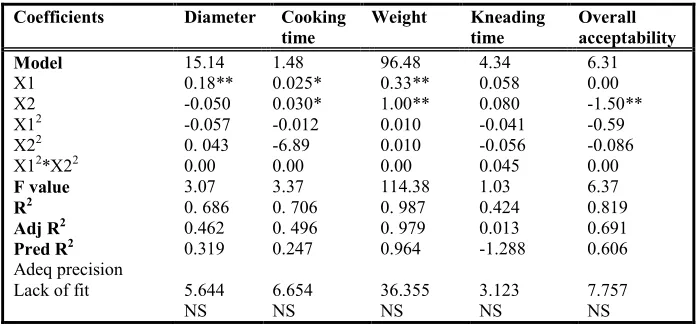
Regression analysis indicated that the fitted quadratic model accounted for more than 80% for weight and overall acceptability (significant at P>0.05) and 68% for diameter, 70% for cooking time, 42% for kneeding time (significant at P>0.05) respectively. Multiple regression equation was generated relating responses to both coded
and uncoded form (levels) of process variables. The values of regression coefficients, sum of squares, F values and P values for coded form of process variables are presented in Table 6.
Diameter
The diameter of sun dried drumstick flower incorporated chappathi varied from 14. 9 to 15.4cm for the samples treated under different incorporation levels. The coefficient of determination R2 was 0.686 for the regression model predicting the diameter, which shows 68% variability in the data. Adequate precision of 5.644 indicated about the adequacy of the model (Table 6). The F value for the model as 3.07 and the lack of fit is not found to be significant.
Cooking time and Kneading time
The cooking time and kneading time of the sun dried drumstick flower incorporated chappathi was 1.42 to 1.54 and 4.15 to 4.50 respectively. The minimum kneading time of 4.15min was obtained when the cooking time is 1.42min respectively. The coefficient of determination, R2 was 70% for the regression model
predicting the cooking time and 42% predicting the kneading time. The data also indicated that the lack of fit is not significant.
Weight
Theweight of the chappathi varied from 95.2 to 97.8g. The coefficient of determination R2 was 99% for the regression model predicting the weight. The F value of the model is 114 and lack of fit is found to be not significant.
Overall acceptability
The maximum overall acceptability is found to be 8 and it varied from 4 to 8. The coefficient of determination R2 was 82% for the regression model predicting the overall acceptability. The F value of the model is 6.37 and lack of fit is not significant.
Effect of variables on responses
Response surface methodology optimization result Mathematical model
Mathematical relationship generated using Multiple Linear Regression Analysis for the response variable for coded and uncoded values are expressed in equation 1 to 5.
Coded value
Y1=15.14+0.18X1-0050X2
-0.057X1 2
+0.043X2 2
+0.00X1*X2 ……… (1a)
Y2=1.48+0.025X1+0.030X2-0.012X12
-6.897X22+0.00X1*X2 ……… (2a)
Y3=96.48+0.33X1+1.00X2+0.010X12
+0.010X2 2
+0.00X1*X2 ……… (3a)
Y4=4.34+0.058X1+0.080X2-0.041X12
-0.056X2 2
+0.045X1*X2 ……… (4a)
Y5=6.31+0.00AX1-1.50X2-0.591X12-0.086X22
[image:5.504.66.435.83.266.2]-0.00X1*X2 ………. (5a)
Table 5. Physical and sensory properties of SD-DFP incorporated Chappathi
Variables
Uncoded value
Diameter (cm)
Cooking time (minutes)
Weight (kg)
Kneading time (minutes)
Overall acceptability X1 X2
V1
V2
V3
V4
V5
V6
V7
V8
V9
V10
V11
V12
V13
90 95 100
90 95 100
90 95 100
95 95 95 95
5 5 5 10 10 10 15 15 15 10 10 10 10
15 15.2 15.4 14.9 15 15.2 14. 9 15.1 15.3 15.1 15.1 15.2 15.4
1.42 1.44 1.46 1.43 1.47 1.5 1.48
1.5 1.52 1.54 1.48 1.47 1.48
95.2 95.5 95.8 96.1 96.6 96.9 97.2 97.5 97.8 96.3 96.5 96.4 96.6
4.15 4.18 4.19 4.17 4.19 4.26 4.28 4.22 4.5 4.32 4.33 4.5 4.5
7 8 7 6 5 6 4 5 4 6 7 7 6
X1 – Wheat flour; X2 – Sun dried drumstick flower powder
Table.6. Regression coefficient for the response variables
Coefficients Diameter Cooking time
Weight Kneading time
Overall acceptability Model
X1 X2 X12 X22 X12*X22 F value R2 Adj R2 Pred R2
Adeq precision Lack of fit
15.14 0.18** -0.050 -0.057 0. 043 0.00 3.07 0. 686 0.462 0.319
5.644 NS
1.48 0.025* 0.030* -0.012 -6.89 0.00 3.37 0. 706 0. 496 0.247
6.654 NS
96.48 0.33** 1.00** 0.010 0.010 0.00 114.38 0. 987 0. 979 0.964
36.355 NS
4.34 0.058 0.080 -0.041 -0.056 0.045 1.03 0.424 0.013 -1.288
3.123 NS
6.31 0.00 -1.50** -0.59 -0.086 0.00 6.37 0.819 0.691 0.606
7.757 NS
** → 1% level of significance; X1 → Wheat flour
* → 5% level of significance; X2 → Sun dried drumstick flower powder
[image:5.504.78.428.301.464.2]The negative coefficient for X1 in equation 4a and
5a indicates that linear effect of SD-DFP decreases the diameter, kneading time and overall acceptability
Uncoded value
Y1=8.607+0.469X1-0.044X2
-2.26X12+1.724X22+4.54X1*X2 ……… (1b)
Y2=-3.372+0.095X1+0.011X2-4.759X12
-2.758X2 2
+1.138X1*X2 ………...… (2b)
Y3= 91.
925-0.0119X1+0.192X2+4.138X1 2
+4.138X2 2
+8.648X1*X2
…………. (3b)
Y4=-10.071+0.302X1-0.111X2-1.621X1 2
-2.221X22+1.80X1*X2 ……… (4b)
Y5=-202.65+4.455X1-0.231X2-0.023X1 2
-3.448X22+6.661X1*X2 ……… (5b)
X1 → Wheat flour
X2 → Sun dried drumstick flower powder
The negative coefficient for X1 in equation 3b (weight)
and for X2 in equation 1b, 4b and 5b indicates that linear
effect of SD-DFP decreases the diameter, kneading time and overall acceptability.
Diagnostic checking of fitted model and surface plot for various responses
The diameter and cooking time decreased with decreased wheat flour and drumstick flower powder. The minimum diameter and cooking time were observed with 90gm wheat flour and 5gm SD-DFP incorporated chappathi however with further increase in wheat flour, increased drumstick flower powder also increased cooking time of the developed chappathi (Fig.1and 2).
Fig.1. Effect of wheat flour and SD-DFP on diameter
The effect of maximum amount of SD-DFP (15gm) indicated that the increase in weight up to maximum amount that 97.2 to 97.8gm. The minimum amount of SD-DFP range of 5 to 10gm showed minimum time for kneading the dough and also maximum levels of overall acceptability which is shown in Fig 3, 4 & 5
Fig. 2. Effect of wheat flour and SD-DFP on cooking time
Fig.3. Effect of wheat flour and SD-DFP on weight
Fig.4. Effect of wheat flour and SD-DFP on kneading time
Fig.5. Effect of wheat flour and SD-DFP on weight overall acceptability
Design-Expert® Software cooking time
Design points above predicted value
Design points below predicted value
1.54 1.42
X1 = A: wheat flour X2 = B: drumstick
90.00 92.00
94.00 96.00
98.00 100.00
5.00 7.00 9.00 11.00 13.00 15.00
1.4 1.42 1.44 1.46 1.48 1.5 1.52 1.54
cook
ing
t
im
e
A: wheat flour B: drumstick
Design-Expert® Software diameter
Design points above predicted value
Design points below predicted value
15.4
14.9
X1 = A: wheat flour X2 = B: drumstick
90.00 92.00
94.00 96.00
98.00 100.00
5.00 7.00 9.00 11.00 13.00 15.00 14.8 14.9 15 15.1 15.2 15.3 15.4
d
ia
m
e
te
r
A: wheat flour B: drumstick
Design-Expert® Software weight
Design points above predicted value
Design points below predicted value
97.8 95.2
X1 = A: wheat flour X2 = B: drumstick
90.00 92.00
94.00 96.00
98.00 100.00
5.00 7.00 9.00 11.00 13.00 15.00
95 95.5 96 96.5 97 97.5 98
w
eigh
t
A: wheat flour B: drumstick
Design-Expert® Software kneeding time
Design points above predicted value
Design points below predicted value
4.5 4.15
X1 = A: wheat flour X2 = B: drumstick
90.00 92.00
94.00 96.00
98.00 100.00
5.00 7.00 9.00 11.00 13.00 15.00
4.1 4.2 4.3 4.4 4.5
knee
ding
t
ime
A: wheat flour B: drumstick
Design-Expert® Software overall acceptability
Design points above predicted value
Design points below predicted value
8 4
X1 = A: wheat flour X2 = B: drumstick
90.00 92.00
94.00 96.00
98.00 100.00
5.00 7.00 9.00 11.00 13.00 15.00
4 5 6 7 8
o
ver
a
ll
acc
ep
ta
bili
ty
Criteria of optimum value for the responses
For the optimization variables, the responses, that is diameter, cooking time, weight, kneading time and overall acceptability were selected on the basis that these responses had direct effect on the acceptability and quality of Chappathi. To consider all the responses simultaneously for optimization, the multiple regression was used to get compromise optimum conditions and it has found that the scores were 15.237, 1.448, 95.493, 4.200 and 7.724 for diameter (cm), cooking time (min), weight (g), kneading time (min) and overall acceptability respectively, corresponding to the optimum condition of wheat flour 95gm as X1 and sun dried drumstick flower
[image:7.504.35.243.241.315.2]powder 5gm as X2.
Table 7. Criteria of optimum value for the responses
Process variable
Optimum value Response Optimum
value Uncoded Coded
Wheat flour SD-DFP 95 5 -1 +1 Diameter Cooking time Weight Kneading Time Over all acceptability 15.237 1.448 5.493 4.200 7.724
Physical evaluation of the SD-DFP incorporated Chappathi
Among the thirteen variations of chappathi, V3 has got
the highest score of 15.36 and the least score 14.82 is obtained by V7 for the diameter. For the cooking
time, the highest score V10 is obtained by variation 1.532
Table 8. Physical properties of the developed SD-DFP chappathi Variables Diameter (cms) Cooking time (minutes) Weight (kg) Kneading time (minutes) V1 V2 V3 V4 V5 V6 V7 V8 V9 V10 V11 V12 V13 F value P value 15.02±0.083b 15.12±0.083bc d 15.36±0.547g
14.90±0.707 a
15.08±0.083bc
15.16±0.055cd
14.82±0.084 a
15.10±0.071bc d 15.26±0.055ef 15.06±0.055bc 15.02±0.084b 15.20±0.071de 15.32±0.084fg 22.585 0.00** 1.412±0.008a 1.432±0.008b 1.452±0.008c 1.426±0.005b 1.460±0.100cd 1.500±0.007f 1.478±0.084e 1.502±0.008fg 1.512±0.008g 1.532±0.008h 1.478±0.008e 1.470±0.007e 1.472±0.008de 93.295 0.00**
95.140±0.089 a
95.420±0.084b 95.70±0.071c 96.12±0.084d 96.52±0.837f 96.82±0.837g 97.12±0.084h 97.50±0.071i 97.78±0.084j 96.32±0.084e 96.44±0.089f 96.32±0.083e 96.50±0.083f 408.909 0.00**
4.14±0.008 a
4.17±0.009b 4.18±0.010b 4.17±0.008b 4.18±0.008b 4.25±0.010d 4.28±0.008e 4.21±0.011c 4.49±0.012g 4.32±0.008f 4.33±0.013f 4.50±0.010gh 4.50±0.011h 882.473 0.00**
**-Significant at 0.01% level; *-Significant at 0.05% level; NS-No significant
(Values with different superscripts are significantly different from each other on application of Duncan multiple Range test)
which is followed by V9 with a score of 0.512 and the
least score 1.412 is obtained by the variation V1.
Regarding the weight attribute, the highest score 97.78 is obtained by the variation V9 which is followed by the
variation V8 with a score of 97.50 and the least score
95.14 is obtained by the variation V1. For the kneading
time attribute the highest score 4.50 is obtained by the
variation V12 and V13. It is followed by the variation V9
with a score of 4.49 and the least score 4.14 is obtained by the variation V1. Results of the Duncan’s test reveal
that there was significant difference for the variations.
[image:7.504.57.444.360.520.2]
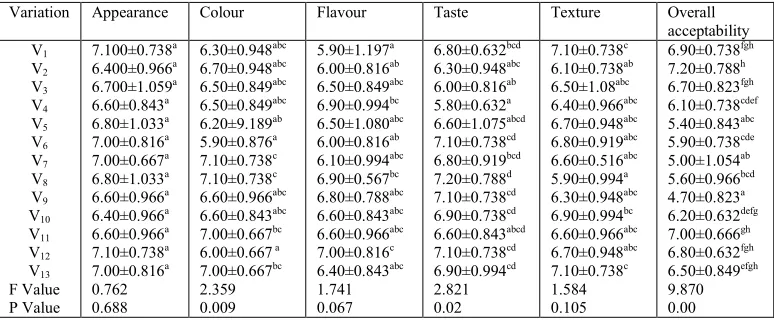
Table 9. Mean organoleptic evaluation of SD-DFP incorporated Chappathi
Variation Appearance Colour Flavour Taste Texture Overall
acceptability V1 V2 V3 V4 V5 V6 V7 V8 V9 V10 V11 V12 V13 F Value P Value 7.100±0.738a 6.400±0.966a 6.700±1.059a 6.60±0.843a 6.80±1.033a 7.00±0.816a 7.00±0.667a 6.80±1.033a 6.60±0.966a 6.40±0.966a 6.60±0.966a 7.10±0.738a 7.00±0.816a 0.762 0.688 6.30±0.948abc 6.70±0.948abc 6.50±0.849abc 6.50±0.849abc 6.20±9.189ab 5.90±0.876a 7.10±0.738c 7.10±0.738c 6.60±0.966abc 6.60±0.843abc 7.00±0.667bc
6.00±0.667 a
7.00±0.667bc 2.359 0.009 5.90±1.197a 6.00±0.816ab 6.50±0.849abc 6.90±0.994bc 6.50±1.080abc 6.00±0.816ab 6.10±0.994abc 6.90±0.567bc 6.80±0.788abc 6.60±0.843abc 6.60±0.966abc 7.00±0.816c 6.40±0.843abc 1.741 0.067 6.80±0.632bcd 6.30±0.948abc 6.00±0.816ab 5.80±0.632a 6.60±1.075abcd 7.10±0.738cd 6.80±0.919bcd 7.20±0.788d 7.10±0.738cd 6.90±0.738cd 6.60±0.843abcd 7.10±0.738cd 6.90±0.994cd 2.821 0.02 7.10±0.738c 6.10±0.738ab 6.50±1.08abc 6.40±0.966abc 6.70±0.948abc 6.80±0.919abc 6.60±0.516abc 5.90±0.994a 6.30±0.948abc 6.90±0.994bc 6.60±0.966abc 6.70±0.948abc 7.10±0.738c 1.584 0.105 6.90±0.738fgh 7.20±0.788h 6.70±0.823fgh 6.10±0.738cdef 5.40±0.843abc 5.90±0.738cde 5.00±1.054ab 5.60±0.966bcd 4.70±0.823a 6.20±0.632defg 7.00±0.666gh 6.80±0.632fgh 6.50±0.849efgh 9.870 0.00
**-Significant at 0.01% level; *-Significant at 0.05% level; NS-No significant
Organoleptic evaluation of SD-DFP chappathi using Duncan’s multiple range test
Among 13 variables of chappathi, V1 and V2 have scored
which is the highest for appearance attribute followed by V2 and V11 with a score of 6.40 which is the least score.
For the colour attribute, the highest score 7.10 obtained by the variation V7 and V8 which is followed by V11 and
V13 with a score of 7.00 and the least score 6.00 is
obtained by the variation V12. Regarding he flavor
attribute, the highest score 7.00 is obtained by the variation V12 which is followed by the variation V9 with
a score of 6.80 and the least score 6.40 is obtained by the variation V13. For the taste attribute, the height score
7.20 is obtained by the variation V8 and is followed by
the variation V6, V9 and V12 with a score of 7.10 and the
least score of 6.00 is obtained by the variation V3.
Regarding the texture attribute, the highest score 7.10 is obtained by the variation V1 and V13 which is followed
by the variation V10 with a score of 6.90 and the least
score 6.10 is obtained by the variation V2. Regarding
overall acceptability attribute, the highest score 7.20 is obtained by the variation V11 which is followed by the
variation V1 with a score of 6.90 and the least score 5.40
is obtained by the variation V5. Results of the Duncan’s test revealed that there was significant difference for all the variations V3, V13, V9, and V12 for diameter.
Conclusion
It is concluded that RSM was used successfully to optimize the level of wheat flour and SD-DFP for the development of chappathi. The overall acceptable chappathi with less kneading time, cooking time and more diameter and weight of the chappathi can be prepared using the combination of wheat flour 95g and SD-DFP 5g.
REFERENCE
Abbey BW and Ibey GO, 1988. Functional properties of raw and heat processed cowpea (Vigna unguiculate walp) flour.
J Food Science, 53:1775-1777.
AOAC, 1995. Official methods of analysis. 15nd edn.
Association of Official Analytical Chemists, Washington DC.
Asiedu M, Lied E, Nilsen R and Sndnes K, 1993. Effect of processing (sprouting and fermentation) on sorghum and maize. Biological utilization of maize protein. Food
Chemistry, 48:201-204.
Fagbemi TN, Oshodi AA and Ipinmoroti KO, 2006. Effects of processing on the functional properties of full fat and defatted fluted pumpkin (Telfairia occidentalis) seed flour J. Food Technology, 4:70-79.
Gacula Jr MC and Singh J, 1984. Statistical methods in food consumer research, New York; Academic Press, Inc., 214-272.
Giami SY and Bekebain DA, 1992. Proximate composition and processed full fat fluted pumpkin (Telfairia occidenalis) seed flour, J. Sci. Food Agric., 59:321-325.
Ige MT, 1984. Measurement of some parameters affecting the handling losses of some varieties of cowpea. Agric Eng Res, 22:127-133.
Jayabal, 2003.Sidha Medicine, Herbal Research Institute, Pondicherry, 18-38.
Jayaraman, 2003. Sidha medicine, Herbal Research Institute, Pondicherry, 18-38.
Khuri AL and Cornell JA, 1987. Response Surfaces Design and Analysis, Marcel Dekker Inc, New York.
Klay Pradit and Huang, 2008. Fish oil encapsulation with chitosan using ultrasonic atomizer. Food Science and
Technology, 41:1133-1139.
Lakshmi and Radha Priya D, 2004. Dept. of Food Science and Nutrition, Avinashilingam Deeemed University, Comibatore. Lakshmi and Radha, 2005. Incorporation of dehydrated plantain
and drumstick flowers into recipes and their acceptability,
The Ind. J. Nutr. Dietet, 42; 300.
Padmashree TS, Vijayalakshmi L and Puttaraj S, 1987. Effect of traditional processing on the functional properties of cowpeas (vigna catjang) flour. J. Food Si Technology, 24:221-226. Parmijit S Panesar, 2009. Application of response surface
methodology in the optimization of process parameters for the production of Kinnow wine, Natural Product Radince, 8(4): 366-373.
Quattrocchi, Umberto, 2000. CRC world dictionary of plant names: common names, scientific names, eponyms, synonyms, and etymology, Volume 3. CRC Press. pp. 1731. Ranganna, 1986. Handbook of analysis and quality control for
fruit and vegetable products. 2nd edn, Tata McGraw Hill Publ
Co, New Delhi.
Sidhu and Scribel, 1998. Effect of flour milling conditions on the quality of Indian unleavened flat bread (Chappathi)
J.Food Science, 53; 1563-1565.
Sreenivasan and Jyotsna, 2000.The Drumstick Tree a Natural Multivitamin.
Wanasaundara and Shahidi, 1996. Optimization of hexametaphosphate assisted extraction of flaxseed proteins using response surface methodology. J. Food Sci., 61.