HALITOSIS: A REVIEW ARTICLE
*Dr. Reyaz Ahmad Mir, Dr. Munaza Shafi, Dr. Prabhati Gupta, Dr. Mirza Umair Yousuf and
Baghimehtab,
ARTICLE INFO ABSTRACT
Halitosis or bad breath is an oral health condition characterized by unpleasant odors emanating consistently from the oral cavity. For the majority of patients with halitosis, it causes embarrassment and affects their social communication and life. Moreove
diseases. In general, intraoral conditions, like poor dental hygiene, periodontitis or tongue coating are considered to be the most important cause (85%) for halitosis. In addition, ear
(10%) or gastrointestinal/endocrinological (5%) disorders may contribute to the problem.
majority of oral malodor is of oral origin, there are multiple other systemic causes that have to be addressed while we diagnose and treat this condition.
line professionals to be confronted with this problem. Proteolytic activity by microorganisms residing on the tongue and teeth results in foul
malodor.
sulphide, methyl mercaptan and organic acids, which produce a stream of foul air that is gravely offensive to the people in their vicinity Management may include simple m
planing, good oral hygiene, tongue cleaning, and mouth rinsing.
Copyright © Dr. Reyaz Ahmad Mir, et al., This is an open access article distributed under the Creative Commons Attribution License, which permits unrestricted use, distribution, and reproduction in any medium, provided the original work is properly cited.
INTRODUCTION
Halitosis is a general term denoting unpleasant breath arising from physiological and pathological causes from oral and systematic sources. The term is derived from the Latin “Halitus” meaning breath and Greek suffix “osis” meaning abnormal (Prinz in 1930). The other terms, which are
synonyms for Halitosis are, oral malodour, Fetor
ex-ore, Bromopnea or more commonly used by common man is “Bad breath”. Some authorities make a distinction between the term Halitosis and Fetor oris. Bad breath not arising in the mouth is Halitosis, whereas Odours that are caused orally are Fetor Ex oris. According to Grant this distinction does not seem to be important and the term Halitosis is used for any kind of bad breath. Under normal conditions our breath is free of offensive Odours but it does have a characte
sweetish odour, sometimes termed the” Human odour”. young the breath is usually not only sweet but also pleasant, however with advancing age it becomes more intense and definite but not unpleasant Jenkins (Crispian Scully and John Greenman, 2008. Halitosis is one of society’s oldest and most troublesome social maladies. It has been recorded in literature for thousands of years. It has been mentioned in the Bible and was also described by the Jews, Romans, Greeks, Chinese, Arabs etc., but modern literature was published only in 19 century by Home.
*Corresponding author: Dr. Reyaz Ahmad Mir,
Baghimehtab, Gousia Colony, H. No. 28. Pin. 190019, Srinagar, J&K
ISSN: 0975-833X
Vol.
Article History:
Received 11th September, 2013
Received in revised form
07th October, 2013
Accepted 04th November, 2013
Published online 02nd December, 2013
Key words:
Halitosis, Treatment, Bad breath,
Gas Chromatography, Mouthwashes
RESEARCH ARTICLE
HALITOSIS: A REVIEW ARTICLE
Dr. Reyaz Ahmad Mir, Dr. Munaza Shafi, Dr. Prabhati Gupta, Dr. Mirza Umair Yousuf and
Dr. Arif Daing
Baghimehtab, Gousia Colony, H. No. 28. Pin. 190019, Srinagar, J&K
ABSTRACT
Halitosis or bad breath is an oral health condition characterized by unpleasant odors emanating consistently from the oral cavity. For the majority of patients with halitosis, it causes embarrassment and affects their social communication and life. Moreover, halitosis can be indicative of underlying diseases. In general, intraoral conditions, like poor dental hygiene, periodontitis or tongue coating are considered to be the most important cause (85%) for halitosis. In addition, ear
0%) or gastrointestinal/endocrinological (5%) disorders may contribute to the problem.
majority of oral malodor is of oral origin, there are multiple other systemic causes that have to be addressed while we diagnose and treat this condition. Therefore, dentists/ periodontists are the first line professionals to be confronted with this problem. Proteolytic activity by microorganisms residing on the tongue and teeth results in foul-smelling compounds, and is the most common cause of oral malodor. The mouth air of chronic malodor sufferers is tainted with compounds such as hydrogen sulphide, methyl mercaptan and organic acids, which produce a stream of foul air that is gravely offensive to the people in their vicinity Management may include simple m
planing, good oral hygiene, tongue cleaning, and mouth rinsing.
This is an open access article distributed under the Creative Commons Attribution License, which permits unrestricted use, distribution, and reproduction in any medium, provided the original work is properly cited.
denoting unpleasant breath arising from physiological and pathological causes from oral and systematic sources. The term is derived from the Latin “Halitus” meaning breath and Greek suffix “osis” meaning abnormal (Prinz in 1930). The other terms, which are used, as synonyms for Halitosis are, oral malodour, Fetor-oris, Fetor Bromopnea or more commonly used by common man is “Bad breath”. Some authorities make a distinction between the term Halitosis and Fetor oris. Bad breath not arising in the h is Halitosis, whereas Odours that are caused orally are According to Grant this distinction does not seem to be important and the term Halitosis is used for any Under normal conditions our breath is free have a characteristic slightly, sometimes termed the” Human odour”. In the young the breath is usually not only sweet but also pleasant, however with advancing age it becomes more intense and Crispian Scully and John Halitosis is one of society’s oldest and most troublesome social maladies. It has been recorded in literature for thousands of years. It has been mentioned in the Bible and ans, Greeks, Chinese, Arabs etc., but modern literature was published only in 19th
Baghimehtab, Gousia Colony, H. No. 28. Pin. 190019, Srinagar, J&K
At least 50% of the population suffers from chronic halitosis and approximately half of these individuals experience a severe problem that creates a personal discomfort and social embarrassment. An important clinical feature of Halitosis is that patients are unaware of their own bad breath. Inability to smell own oral malodour has been attributed to a sensory phenomenon known as Adaptation
Decreased ability to smell unpleasant odour can be related to specialized olfactory bipolar ne
occupied with an otherwise offensive substance, making the patients insensitive to odour.
Conversely many others suffer from Halitophobia, a highly exaggerated fear that they suffer from bad breath. In extreme cases people with Halitophobia are driven to social isolation, may have their teeth extracted
suicide. Fear of offending by bad breath is a powerful motivating force driving people to seek dental attention, perhaps third in importance after cosmetic c
pain. Since bad breath usually comes from the mouth itself dentists should be the first professional whom individuals turn for help .Patients with complain of Halitosis may present a diverse range of oral, systematic and psychiatric
may be of diagnostic importance Halitosis has a multi factorial etiology
Halitosis may produce distinctly different smells
smell, which each disease produces, may offer some help in differentiating the etiology of various factors causing this conditions. Halitosis may result from oral, local or systematic
International Journal of Current Research Vol. 5, Issue, 12, pp. 3758-3762, December,2013
INTERNATIONAL
Dr. Reyaz Ahmad Mir, Dr. Munaza Shafi, Dr. Prabhati Gupta, Dr. Mirza Umair Yousuf and
J&K
Halitosis or bad breath is an oral health condition characterized by unpleasant odors emanating consistently from the oral cavity. For the majority of patients with halitosis, it causes embarrassment r, halitosis can be indicative of underlying diseases. In general, intraoral conditions, like poor dental hygiene, periodontitis or tongue coating are considered to be the most important cause (85%) for halitosis. In addition, ear-nose-throat-associated
0%) or gastrointestinal/endocrinological (5%) disorders may contribute to the problem. Even though
majority of oral malodor is of oral origin, there are multiple other systemic causes that have to be
erefore, dentists/ periodontists are the first-line professionals to be confronted with this problem. Proteolytic activity by microorganisms residing
smelling compounds, and is the most common cause of oral The mouth air of chronic malodor sufferers is tainted with compounds such as hydrogen sulphide, methyl mercaptan and organic acids, which produce a stream of foul air that is gravely offensive to the people in their vicinity Management may include simple measures such as scaling and
This is an open access article distributed under the Creative Commons Attribution License, which permits unrestricted
At least 50% of the population suffers from chronic halitosis and approximately half of these individuals experience a severe problem that creates a personal discomfort and social embarrassment. An important clinical feature of Halitosis is re unaware of their own bad breath. Inability to smell own oral malodour has been attributed to a sensory phenomenon known as Adaptation (Miyozaki et al., 1995).
Decreased ability to smell unpleasant odour can be related to specialized olfactory bipolar neutrons being constantly occupied with an otherwise offensive substance, making the
Conversely many others suffer from Halitophobia, a highly exaggerated fear that they suffer from bad breath. In extreme alitophobia are driven to social isolation, may have their teeth extracted and occasionally commit by bad breath is a powerful motivating force driving people to seek dental attention, perhaps third in importance after cosmetic consideration and lly comes from the mouth itself, the dentists should be the first professional whom individuals turn for help .Patients with complain of Halitosis may present a diverse range of oral, systematic and psychiatric disorders and may be of diagnostic importance (Miyozaki et al., 1995). factorial etiology. Diseases which cause uce distinctly different smells. The distinct smell, which each disease produces, may offer some help in differentiating the etiology of various factors causing this conditions. Halitosis may result from oral, local or systematic
conditions and can be either psychological or pathological. An accurate diagnosis of Halitosis depends on analysis of data collected from patient’s history, physical examination and interpretation of lab tests. Self-diagnosis of bad breath is a subject of considerable public interest. Many methods are described by which people can attempt to diagnose their own malodor. In most cases bad breath can be ameliorated by proper dental care, oral hygiene, deep tongue cleaning and if necessary rinsing with an effective mouth wash. If the problem persists, the patients should be referred promptly for appropriate medical care. With the growing interest of dental practitioner in bad breath, diagnosis and treatment, there has
been associated increase in research activity in this field.
Table1. Classification of halitosis
Classification Treatment need Descriptive
Genuine halitosis Obvious malodour with
intensity beyond socially
acceptable level, is
perceived. Physiologic
halitosis oral
TN-1 Malodour arise through
putrefactive process within the oral cavity. Neither
specific diseases nor
pathologic condition that could cause halitosis is found. origin is mainly the doroposterior region of the tongue. Temporary halitosis due to dietary factors (e.g garlic) should be excluded. Pathologic
halitosis Oral
TN-1 and TN-2 Halitosis caused by disease,
pathologic conditions or malfunction of oral tissue. Halitosis is derived from tongue coating modified by pathologic conditions (e.g
periodontal diseases
xerostomia) is included in this subdivision.
Pathological halitosis Extra-oral
TN-1 and TN-3 Malodor orginates from
nasal, paranasal and/or
laryngeal regions. Malodour orginates from pulmonary tract or upper digestive tract. Malodour orginates from disorders anywhere in the body where by the odour is blood borne and emitted via the lungs (e.g diabibetes, hepatic cirrhosis, uremia, internal bleeding.
pseudohalitosis TN-1 and TN-4 Obvious malodour is not
perceived by other although
the patient having
complains of halitosis.
condition is improved by counselling (using literature
support, education and
explanation of examination results) and simple oral hygiene measures.
Halitophobia TN-1 and TN- 5 After treatment for genuine
halitosis or pseudohalitosis, the patients persists in believing that he/she has halitosis.
Classification of Halitosis
1) Glickman 1894
i) Local causes (pathologic, non-pathologic) ii) Systematic causes
2) DOMINIC et al. 1982: Based on etiology i) Local factors of pathological origin ii) Local factors of non-pathological origin iii) Systematic factors of non-pathological origin iv) Systematic factors of pathological origin.
3) Dayan et al. 1982
i) Odour emanating with oral cavity
ii) Odour emanating from regions immediately adjacent to oral cavity (Odour emanating from lungs)
4) BOGDASARIAN 1986 based on causes I) Normal breath and physiologic mouth odour ii) Odours from oral conditions
iii) Odours from nasopharynx, pharynx and lungs Odours excreted via the lungs.
5) Iwakura et al. 1994 classified the patients with halitosis with primary and secondary halitosis.
i) Primary Halitosis: Patients do not actually have halitosis but suffer from imaginary halitosis
ii) Secondary Halitosis: Patients have actual halitosis
6) Classification of Halitosis with corresponding treatment needs (Miyazaki et al., 1999)
Measurement of Halitosis
Measurement of oral malodour is complicated by variety of parameters including complexity of gaseous molecular species, sampling difficulties, temperature variation, and choice of suitable subject population and lack of agreement on reference standards. Since oral malodour is a perceived olfactory stimulus, direct sampling and assessment by human judges may be the most logical measurement approach. Some shortcomings in this method have lead several investigators to propose quantitative approaches based on measurements of volatile sulphur compounds.
Direct measurement of oral malodour
Subjective measurement of oral malodour (Rosenberg, 1996): The most simple and commonly used approach to sample and measure oral malodour is direct nasal sniffing of expelled mouth air. This is often referred to as organoleptic or hedonic assessment (Dae-Jung Kim et al., 2009; Hideo Miyazaki et al., 1995). Taking a short, rapid sniff as patient breathes out, nasal air should be organoleptically measured. For performing organoleptic assessment odour judges are selected with the help of general olfactory tests available on how judges should be selected. To reduce inter examination variation a panel consisting of several judges is employed and level of malodour is based on mean score. The intensity of oral malodour observed by human judges is usually graded on scale (organoleptic scoring scales (Rosenberg, 1996)) category description by Rosenberg (1991) o: Absence of odor1: questionable odor3: slight malodor4: strong malodor5: severe malodor
Instrumental analysis of oral malodour (quantitative method): Importance of quantitative parameters to measure level of bad breath
b) It expresses upon patient that the dentists’ assessment is not an ambiguous one, but rather based on an objective scientific measurement.
c) It can also provide useful information to the dental practitioner concerning his own oral emission levels
GAS CHROMATOGRAPHY Two methods are commonly employed7
Gas chromatography employing Flame Ionization Delectation (FID): This method identifies methanol, ethanol and acetone, but none of these emanate a putrescent odour.
Gas chromatography coupled with flame photometric detection: This method was developed by Tonzetich and co-workers. This system was very sensitive and capable of detecting sub nanogram levels of sulphur and hence was used to quantify volatile sulphur compounds of mouth air. The method established the presence of 3 sulphur containing compounds i.e, methyl mercaptan, hydrogen sulphide and dimethyl sulphur.
Advantages: Separation and quantitative measurement of individual gases, Ability to measure extremely low concentration of gases. Disadvantages: Relatively high cost, Need for skilled personnel, Cumbersome and lack of portability, Time required for detection and measurement
Mass spectrometry: It suggests a possible presence of sulphur compounds, but the concentration was too low to permit positive identification.
Industrial sulfide monitor also called Halimeter given by Mel Rosenberg et al. (1991), Lee et al., 2007; Lee and Kho 2003.
Measurement using the monitor has been shown to be more reproducible than organoleptic measurements and more sensitive to reduction in oral malodour brought about by rinsing.
Advantage: Lower cost, Can be operated by non-skilled personnel, Portability, Rapid turnaround time between measurements, Simplicity in collecting samples, Noninvasive with no likelihood of cross infection.
Disadvantages: Inability to distinguish between individual sulfphides, Measurements can’t be made in presence of high levels of ethanol, essential oils, precluding assessment of mouth wash efficacy until these components have dissipated, Instrument may show a slight loss of sensitivity with time and necessitates periodic recalibrations, Compounds other than volatile sulphur compounds which causes halitosis cannot be measured.
Zinc oxide thin film semi-conductor sensor: Shimura and company in 1996 devised this device, which is used to diagnose halitosis in the clinics. The results obtained by this device correlated with the values of total volatile sulphur compounds measured by gas chromatography and also with the organoleptic scores given by the judges (Smirnoff et al., 1977).
Advantages: Small size, Simple to handle, Responds specifically to several volatile sulfides and volatile sulphur
compounds in mouth air, Highly sensitive, Can measure halitosis due to non-volatile sulphur compounds, Could be used for diagnosis of diabetes as measures acetone in mouth.
Ora test: This test was developed by Rosenberg et al. (1989) It provides a quantitative assessment on the level of microbial activity in the oral cavity. The test involves oral rinsing with a sterile milk sample, followed by expectoration into a test tube containing an oxidation: reduction indicator (methylene blue). The higher the level of microorganisms, faster the colour changes from the blue (aerobic condition) to white (anaerobic condition) at the bottom of test tube. In addition to correlation with microbial counts, the oratest exhibits significant correlation with plaque and gingival indices
Indirect Measurement of oral malodour
Due to the variability of oral malodour measurements and difficulties in assessing oral malodour directly from oral cavity, investigators have employed indirect methods.
a) The approach, which has been most widely exploited, is the measurement of malodour and volatile sulphide in putrefying saliva samples where as some extrapolations between the odour of putrefied saliva and oral malodour may be acceptable, caution should be exercised since odour of Putrefied saliva usually differs appreciably from directly sampled oral malodour.
b) BANA test: It is an enzyme based assay. It is helpful in detecting halitosis by detecting the bacteria viz. Porphyromonas gingivalis, Treponema denticola and bacteria producers in forsythus which are considered active hydrogen sulphide producers in vitro (Smirnoff et al., 1977). In this technique detecting trypsin like protease, which is produced mainly by these bacteria, identifies bacteria. This protease hydrolyses Benzyl DL. Arginina 2 Napthylamine (BANA) substrate. Commercially available chair side test kit system is perioscan (oral B laboratories) (Kozlovsky et al., 1996).
Advantages: Rapid and inexpensive, Provides visual results, which can be shown to patients and related to the site from which they were obtained.
Disadvantages: Lack of quantitative data, Inability to determine which of the three bacteria are responsible for enzyme production, Does not include inhibitor of host protease, which could contaminate the plaque sample from saliva, GCF that also, cleanses substrate. (c) less frequently employed method is the measurement of sulphide and malodour from bacterial isolates and pure cultures
Treatment of Halitosis
The best way to treat bad breath is to motivate patients to practice good oral hygiene and to ensure that their dentition is properly maintained.
Tooth brushing
Brushing with toothpaste may reduce malodour for as long as 2 hours. Sodium bicarbonate dentifrice appears to be superior to fluoride dentifrice for the reduction of volatile sulphur compound levels (Lee et al., 2007; Goldberg et al., 1994).
Flossing
It is one of the most effective day to day home treatments that do not involve antimicrobial agents. However the level of patient compliance in daily flossing is low but once the connection is made between flossing and fresh breath, compliance improves having patient smell the floss after each use is a good way to illustrate the importance of regular flossing in improving breath odour.
Tongue cleaning
Gentle but effective deep tongue cleaning should become a part of the daily hygiene routine. To prevent tongue odour, the tongue should be cleaned in a gentle thorough manner. The posterior portion of the tongue is the least accessible but usually smells the worst (Goldberg et al., 1994; Rnbergos et
al., 1991) (3). CHEMICAL METHODS –MOUTH RINSING
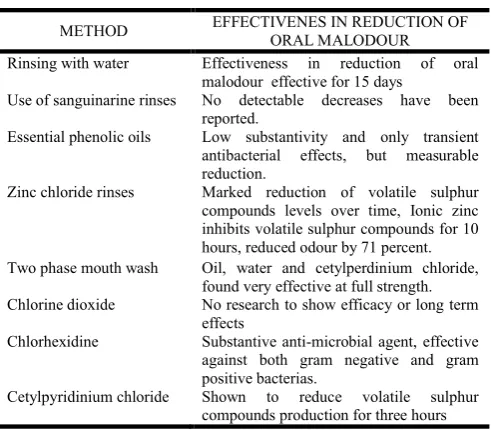
Mouth rinses may be indicated in those patients who even after maintaining good oral hygiene continue to have malodour. Many commercially available mouth rinses claim to effectively eliminate malodour, but most of them use a masking approach. Other products have antibacterial mechanisms, but many of these rinses have insufficient strength to control odour for longer than several hours.
[image:4.595.325.537.70.170.2]Effectiveness of rinses used for the reduction of oral malodou (Roldens and Herra, 2005; Yaegaki and suetaka, 1989).
Table 2. Effectiveness of rinses used for the reduction of oral
malodour
METHOD EFFECTIVENES IN REDUCTION OF
ORAL MALODOUR
Rinsing with water Effectiveness in reduction of oral
malodour effective for 15 days
Use of sanguinarine rinses No detectable decreases have been
reported.
Essential phenolic oils Low substantivity and only transient
antibacterial effects, but measurable
reduction.
Zinc chloride rinses Marked reduction of volatile sulphur
compounds levels over time, Ionic zinc inhibits volatile sulphur compounds for 10 hours, reduced odour by 71 percent.
Two phase mouth wash Oil, water and cetylperdinium chloride,
found very effective at full strength.
Chlorine dioxide No research to show efficacy or long term
effects
Chlorhexidine Substantive anti-microbial agent, effective
against both gram negative and gram positive bacterias.
Cetylpyridinium chloride Shown to reduce volatile sulphur
compounds production for three hours
Miyazakiet (1988) has given classification of treatment needs for halitosis according to corresponding types of halitosis (Rosenberg, 1992).
[image:4.595.41.287.473.688.2]Treatment of Genuine Halitosis (Rosenberg et al., 1991; Rosenberg et al., 1992)
Table 3. Treatment need for Halitosis
Category Description
TN1 Explanation of halitosis and instruction of
oral hygiene
TN2 Oral prophylaxis, professional cleaning and
treatment for oral diseases
TN3 Referral to a physician or medical specialist
TN4 Explanation of examination data, further
professional instruction and reassurance
TN5 Referral to a clinical psychologist, a
psychiatrist or other psychology specialist
A). Physiologic halitosis (TN1):
1. Patient education: Take regular meals, Eat fibrous vegetables, Avoidance of odoriferous foods, habits, health (e.g smoking), Drink ample amount of water
2. Oral hygiene instructions: Brushing and flossing, Mouthwash and toothpaste, Periodical dental examination and scaling
B) Oral pathological halitosis (TN1 & TN2): Periodontal treatment, Dental treatment (root canal, restoration), Oral surgical and medical treatment extraction, ulcer treatment and xerostomia.
C) Others (Extra pathologic halitosis (TN1 & TN3): If some underlying systematic condition is present, patient is referred to a medical practitioner.
D) Pseudo-halitosis and Halitophobia (TN1 & TN4): Counseling, Referral to a clinical psychologist, a psychiatrist or other psychology specialist.
A new 2-phase oil: Water mouth wash (Yaegaki and Sanada, 1992) has been developed. A large proportion of oral microorganisms adhere to the oil droplets formed during the rinsing procedure and are subsequently expectorated from the mouth. This in turn, enhances the ability of the mouthwash to physically remove oral microorganism in addition to inhibiting those that remain behind
DISCUSSION
Morita M et al in 2001observed that both organoleptic rating and Volatile Sulphur Compounds (VCS) significantly correlated with the bleeding index. Oral malodour may provide a window for diagnosis of periodontal diseases. An accurate diagnosis of Halitosis depends on analysis of data collected from patient’s history, physical examination and interpretation of lab tests. Oral malodour measurement by organoleptic method has been inferred to be” gold standard” for bad breath measurement The nasal sniffing is the most simple and commonly used approach to directly sample expelled mouth air. On the other hand quantative measurement of gas chromatography has advantage in that it offers consistent results.
A Simple and rapid technique for measurement of halitosis related sulphide using a portable industrial sulphide monitor with objective reading is highly effective in clinical use (Shimura et al., 1996). However these detectors are found to be unreliable in comparison with the results obtained by gas chromatography (Yaegaki and Sanada, 1992). Recently a small hand held monitor (Tanita, Japan) was introduced for the measurement of volatile sulphur compound in mouthair. The portable monitor provided a subjective reading which favours the organoleptic assessment. There are various treatment modalities for halitosis; the best way to treat is to motivate patients to practice good oral hygiene and to ensure that their detention is properly maintained. Oral hygiene maintenance includes. Periodic professional oral hygiene maintenance, Mechanical methods like Tooth brushing, Flossing Tongue cleaning and Chemical methods comprising of various mouth rinses like Rinsing with water, Use of sanguinarine rinses, Essential phenolic oils, Zinc chloride rinses, chlorhexidine etc. Breath mints, lozenges, drops, sprays, chewing gums etc. On their own are typically not the most effective means by which to improve one’s breath.
Acknowledgement: Not applicable (NIL)
REFERENCES
Crispian Scully and John Greenman: Halitosis (breath odor) Periodontology 2000, 48:66 and 2008.
Dae-Jung Kim, Jeong-Yun Lee, Hong-Seop Kho, Jin-Woo Chung, Hee-Kyung Park and Young-Ku Kim: A New Organoleptic Testing Method for Evaluating Halitosis. Journal of periodontology Jan 2009: 80(1): 93-97
Dominic and Allentow. Halitosis an etiologic classification a treatment approach and preventive oralsurg.oralmed.oral pathol.1982:54(5) 521-526.
Goldberg et al: Cadaverine as a putative component of oral malodor J. Dent. Res 1994:73(6):1168-1172
Gupta. Priyavermagupta Dental disease:differential diagnosis by Japee publications page no 203.
Hideo Miyazaki et al. Correlation between Volatile Sulphur Compounds and Certain Oral Health Measurements in the General Population. Journal of periodontology 1995: 66 (8) Pages 679-684
Iwakura et al. Clinical characteristics of halitosis:difference in 2 patient groups with primary and secondary complains of halitosis. J. Dent Res 1994.73(9).1568-1574.
Kozlovsky et al: Efficacy of a 2 phase oil: Water mouth rinse in controlling oral malodor, gingivitis and plaque. J.
Periodontal 1996:67:577-582.
Lee CH, Kho HS: The relationship between volatile sulphur compounds and major halitosis inducing factors’ Periodontal 2003; 74:32-37.
Lee SS, Zhang WU, LI Update: A review of causes, diagnosis, and treatment .J Can Dent Assoc 2007:259-268.
McNamara TF, Alexander JF. The role of microorganisms in the production of oral malodour. Oral surg oral med oral pathol 1972; 34; 41-48.
Miyazaki H, Arao M, Okamura K, Kawaguchi Y, Toyofuku A, Hoshi K et al Tentati. Classification of halitosis and its treatment needs. Niigata DENT j 1999; 32:7-11
Miyazaki, H., Arao, M., Okamura, K, Kawaguchi, Y., Toyofuku, A., Hoshi, K, Yaegaki, K. (2000). Tentative classification of halitosis and its treatment needs. Niigata Dent J 1999;32:7-11.
Miyozaki et al: correlation between volatile sulphur compounds and certain oral health measurements in the general population. j. periodontal;1995:66:679-684. Morita M, Musinski DL, Wang HL. Assessment of newly
developed tongue sulfide probe for detecting oral malodor. J Clin Periodontal 2001;28:494-6.
Prinz H. Offensive breath, its causes and its prevention. Dent. Cosmos. 1930;72:700-7.
Rnbergos et al: Halitosis measurement by an industrial sulfide monitors j. periodontal 1991:62:487-489.
Roldens S, Herra: A combined therapeutic approach to manage oral halitosis: a 3 month prospective case series’ Periodontal 2005: 76:1025-1033.
Rosenberg et al: Day long reduction of oral malodour by 2 phase oil: Water mouth rinse as compared to Chlorhexidine and placebo rinse periodontal 1992:63:39-43.
Rosenberg et al: Reproducibility and sensitivity of oral malodour measurements with a portable sulphide monitor j. Dent Res 1991:70: 1436-1440.
Rosenberg, Barki and Giddberg: Antimicrobial effect of mouth rinsing as measured using”ora test” J.Dent Res 1989:68:661(Abst 65).
Rosenberg: Clinical assessment of bad breaths: current concepts JADA 1911996:127(4):475-482.
Rosenberg: First international workshop on oral malodour. j. Dent Res .1994:73(3):586-588.
Rosenberg: Measurement of oral malodor: current methods and future proprospsects j. periodontal 1992:63:776-782. Shimura et al: A new monitor with a zno thin film semi
conductor for measurement of volatile sulphur compounds in mouth air. j. periodontal 1996:67:396-402.
Smirnoff et al: Biochemical profile of uremic breath. New Eng. j. Med 1977:247:132-135.
Tonzetich J & Kestenbaum R C: Odour productionby human salivary fractions and plaque. ArchOralBiol 14: 815–827 (1969).
Yaegaki and Sanada: Volatile sulphur compounds in mouth air from clinically healthy subjects and patients with periodontal disease. periodontal 1992:27:133-238.
Yaegaki and Sanada: Volatile sulphur compounds in mouth air from clinically healthy subjects and patients with periodontal disease. periodontal 1992:27:133-238.
Yaegaki and suetaka: Fractionation of salivary cellular elements by percoll density gradient centrifugation and distribution of oral malodour precursors. shigaku 1989; 77:269-275.