© 2016, IRJET | Impact Factor value: 4.45 | ISO 9001:2008 Certified Journal
| Page 1028
LTE Efficient Scheduling with Different Loads
KaminiVerma and Maninder Singh
Kamini verma is a student of M.Tech. in ECE, HEC, Jagadhari
Maninder Singh is Assistant Professor in ECE Department, HEC, Jagadhari
ABSTRACT:
Existing Call Admission Control (CAC) mechanism in IEEE 802.16 Broadband Wireless Access (BWA) Wimax standard gives priority for VoIP calls in busy hour. The mechanism analyses the performance of UGS service without considering the arrival of non-UGS services. This leads to lack of fairness since the usage of video streaming is also increasing day by day. However the proposed Enhanced Call Admission Control (ECAC) mechanism analyses the performance of non-UGS services with UGS arrival kept constant, thereby ensuring fairness to some extent. The Enhanced Call Admission Control mechanism is proposed and existing method is analyzed for the Grade of Service for various arrival rates of non-UGS services for the same arrival rate of non-UGS services. This gives an overview of when to reserve a bandwidth for UGS services without fully blocking the non-UGS services. So, introduce new suitable scheduling protocol so as to improve the results in order to satisfy the QoS requirements.1. INTRODUCTION
Throughout history and across boundaries, time has shown the human race that resources are of limited amount and quantity. From basic resources like: Air, water and electricity to materials and petroleum, there has always been a desire to consume as little as possible and an attempt to save as much as possible, yet without lowering the outcome performance. Therefore it has come to a matter of great importance to manage resources in an effective and efficient way in order to be able to maximize benefits, either toward some specific target or in general in the long‐run. On the other hand, there is the concept of Quality that a user experiences during the course of a service being offered. On the contrary, this is where resources are being used to satisfy the desired quality, rather than saving them. The above mentioned general idea of resource management and service provisioning is also valid for wireless communications. In this case, system bandwidth and Subscriber Station (SS) utilized power could be presented as examples of radio system resources. In wireless communication the task of taking care of resources being utilized falls into Radio Resource
Management (RRM) theme, where it was first appeared in [1]. RRM, in
general, is responsible for the improvement of efficiency and reliability of radio links [2], but in
particular some of which are Rate Control, Power Control, Channel Assignment, Subcarrier Permutation and Scheduling System.
Rate Control
To be capable of utilizing the bandwidth more efficiently and maintain the quality of the radio links Adaptive Modulation and Coding (AMC) technique is used in wireless communication.
POWER CONTROL
Dynamic power control presented as a power management scheme can reduce the unnecessary power consumed, especially at terminal mobile nodes where battery power is considered a scarce resource.
Channel Assignment
Mapping the most efficient subcarriers to their corresponding symbol times is done with the help of the information provided through RRM.
2. SUBCARRIER PERMUTATION
Mainly there are two types of subcarrier permutation: Distributed Subcarrier Permutation:where
frequency subcarriers are spread along the whole allocated transmission band pseudo‐randomly. This in return averages out the inter cell and carrier interference as it also promotes frequency diversity [2].
Adjacent Subcarrier Permutation: where frequency subcarriers are assigned to subscriber stations in bundles rather than spreading them pseudo‐randomly. In this way multiuser diversity could be exploited since each subscriber station is assigned the best possible bunch of carrier [3].
3. SCHEDULING SYSTEM
© 2016, IRJET | Impact Factor value: 4.45 | ISO 9001:2008 Certified Journal
| Page 1029
sharing the bandwidth. Therefore, has a significant effecton:
Delay (Latency): The time taken by a packet to travel from one OSI (Open System Interconnection) stack layer to its corresponding peer layer.
Jitter: The inter‐packet arrival time difference. Packet Loss: The amount of packet being dropped
on both the Uplink (UL) and Downlink (DL).
Throughput: The number of successful bits/packets per second arriving at the receiver.
All of the above mentioned scheduling consequences present the preliminaries to a concept called Quality of Service (QoS). This means to guarantee a minimum level of service performance at all times, whether the system is running under normal or subnormal conditions [4].
3. QoS Technical Challenges
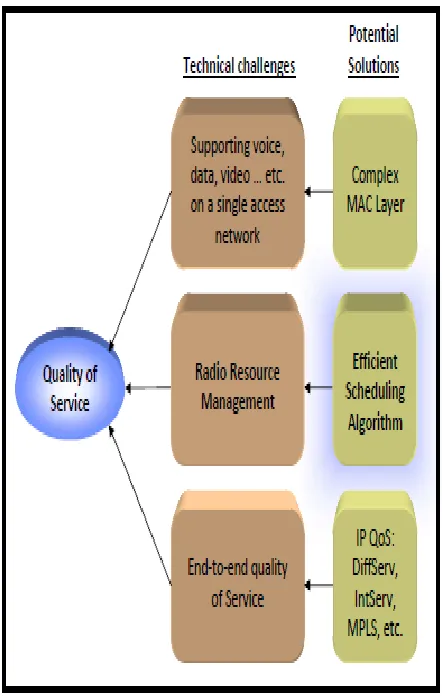
The IEEE 802.16e [6] standard based Mobile WiMAX (Worldwide Interoperability for Microwave Access) system will be investigated for the purpose of Quality of Service provisioning. As a technical challenge, radio resource management will be primarily considered. Having in mind the costly spectrum and the increasingly more demanding applications with ever growing number of subscribers, main consideration of this thesis have been given to benefit from the reduced amount of spectrum consumed for the same number of users. Supported by the fact that the standard does not emphasize a specific scheduling algorithm for polling services, and then a well thought out algorithm will be of great contribution to the area under investigation. For the sake of clarification, Figure 1.1 is drawn to show the technical challenges accompanied by providing Quality of Service with their corresponding potential solution [3].
Note from Figure 1.1 that there are two other challenges to comprehensively provide QoS: Supporting multimedia (voice, data, video … etc.) on a single access network and end‐to‐end quality of service.
4. IEEE 802.16E Overview
[image:2.612.340.561.102.451.2]In year 1998, the Institute of Electrical and Electronics Engineers (IEEE) formed a group to work on the new “IEEE 802.16” Standard. In the standard, WirelessMAN™ air interface specifications were described for Wireless Metropolitan Area Networks (MAN). In the beginning all the studies were about to deliver high data rate broadband connections to remote regions.
Figure 1:QoS Technical Challenges and Potential Solutions.
Those regions were usually business places where optical fiber infrastructure was not available yet to carry the desired high data rate internet connections [3]. So making use of the wireless medium was presenting a good solution, since the reduction is offered in terms of cost, as well as making fast internet access connections available at very hard‐to‐reach places.
© 2016, IRJET | Impact Factor value: 4.45 | ISO 9001:2008 Certified Journal
| Page 1030
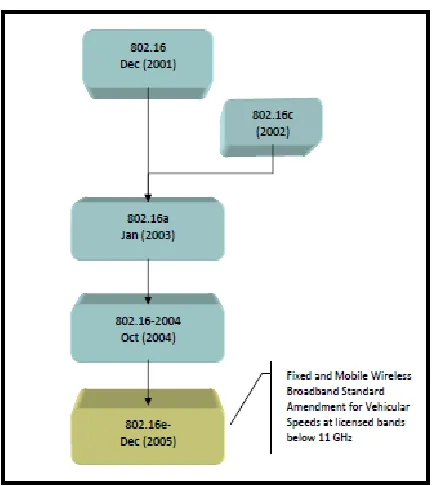
Figure 2: IEEE 802.16e Standard Development.Thus, it was put forward to extend the standard to be operable in the license‐exempt frequencies that lie between 2 to 11 GHz. Hence this would also enable the usage of Non Line of Sight (NLOS) deployment and lower the cost of the terminal devices [3]. In 2003, with the combination of a further amendment, IEEE 802.16c, the IEEE 802.16a amendment was produced to modify the initial standard to exploit the Orthogonal Frequency Division Multiplexing (OFDM) which was considered the best choice to fight multipath affect for wireless communications. This facilitated the operation in a NLOS mode in the frequencies range of 2 – 11 GHz [7] [3]. Later on, the revision of the IEEE 802.16a version led to the new IEEE 802.16‐2004 or IEEE 802.16d Standard [8]. This standard was approved in 2004 and hence the name. Meanwhile, there was ongoing research to modify the standard to support mobility, which afterwards, in December 2005, gave rise to the latest IEEE 802.16e‐ 2005 or IEEE 802.16e amendment [3]. Figure 1.2 illustrates the standard development till it reaches the IEEE 802.16e.
5. Service Provisioning in WiMAX
The WiMAX MAC utilizes a connection oriented protocol to manage the subscriber stations under its coverage. That is each traffic flow possesses its own connection. Thus it converts the network layer unreliable Internet protocol (IP) communication to a reliable
communication. This is central to the concept of providing QoS.
Bandwidth Allocation
The bandwidth allocation is key to the QoS provisioning process and it mainly depends on the type of the scheduling service used. WiMAX scheduling services are explained in the next section. Basically the Bandwidth Request/Grant procedure is as follows:
1)
The SS shall get a bandwidth request opportunity. This could be in two ways: Either the BS sends a broadcast polling message to all the subscriber stations and listens to the subscribers who respond to the message.
An SS can use the uplink contention period to contend for a bandwidth request opportunity. In case of contention the binary exponential back off algorithm is used.
2)
BS replies to the bandwidth requesting subscriber stations with a bandwidth request response message.3)
The SS transmits its bandwidth request message,which contains the bandwidth request size.
4)
On approval the BS allocates the required radio resources to the SS and sends the bandwidth grant message.Actually, the bandwidth request/grant mechanism is analogous to the way of booking a table at a restaurant. This is explained as follows: Tom’s family (SS) want to go to a restaurant (BS). Tom calls the restaurant several times but the line is busy (contention). So he waits a while and tries again after some time (back off contention resolution algorithm). Luckily this time the manager answers, and asks for the total members of the family (bandwidth request response). Tom answers: Five (Bandwidth request size). Then the waiter goes and checks out whether they have a table for five people (admission control). The manager confirms the booking and tells Tom about the booked time and table number (UL‐MAP).
Scheduling Services Types
A scheduling service is a mechanism which determines the procedure by which bandwidth is allocated to the subscribers. There are five scheduling services.
Unsolicited Grant Service (UGS) Real Time Polling Service (rtPS)
Enhanced Real Time Polling Service (ertPS) Non Real Time Polling Service (nrtPS) Best Effort (BE)
As the QoS Metrics in Mobile WiMAX are:
© 2016, IRJET | Impact Factor value: 4.45 | ISO 9001:2008 Certified Journal
| Page 1031
Latency: Delay Jitter: means variation in latency
6. Scheduling Services Types
The process is of service provisioning is briefly enumerated as follows: First a service flow is added then bandwidth is granted per packet for each connection. The below procedure is mixing them both together. Each SS trying to communicate to the BS will be
allocated a basic duplex communication channel with a specific Connection Identifier (CID) number. Packets possessing the same CID number but
different QoS parameters are classified into Service Flows (SF). Since there may be more than one SF then each SF is assigned a Service flow Identifier (SFID). The classification of packets into different service flows is done on the basis of Type of Service (ToS) region of each particular IP packet. This classification is done in the MAC CS sublayer.
The required bandwidth, or the bandwidth request message, is then sent to the BS to allocate uplink resources for the sending SS. The Admission Control Unit (ACU) handles the bandwidth granting task. This is done by simply reducing the total available system bandwidth by the current bandwidth request size. If the result of the operation is greater than or equal to zero, then bandwidth is granted. Otherwise the SS is rejected.
Then the request is put into 5 different classes of queues to be scheduled. Each queue representing a scheduling service type. In other words, bandwidth request messages a classified according to their scheduling service types, and hence the associated QoS parameters.
The scheduling procedure is determined by the embedded scheduling algorithm.
Afterwards, the scheduled packets are used to construct the UL‐MAP message.
An UL‐MAP message is broadcasted in the beginning of each OFDMA frame back to the subscriber stations. This was shown in Figure 2‐5.
All subscriber stations listen to the broadcasted MAP message. If a SS found its CID addressed in the UL‐ MAP then this means that SS can now send its information in slot mentioned in the UL‐MAP.
Noting from the above enumerated list of events, from the quality of service point of view, the scheduling algorithm is the most critical part of the procedure. This is so since the scheduler is the only entity to decide which packet to be written into the UL‐MAP. Therefore, designing a scheduling algorithm that takes care of all
the queues’ QoS constraints at the same time is of great essence. This has also been clearly indicated by J. Andrews et al. in [3]. The Automatic Repeat Request (ARQ), Hybrid ARQ (HARQ) and Multi Input Multi Output (MIMO) techniques will be neglected as they don’t have direct influence on the subject of the study. Moreover, ignoring the above mentioned topics helps in the scheduling algorithms’ analysis by specifically identify the scheduling related effects of the algorithm. Abdul Haseeb et al (2011) in the paper entitled “QoS Performance Analysis for VoIP Traffic in Heterogeneous Networks with WiMAX Access” present a heterogeneous network including systems providing different QoS, such as the emerging WiMAX, is a difficult task. The integration of a WiMAX access system with Differentiated Services (DiffServ) enhances the overall performance of the network. This paper investigates the interworking between WiMAX and DiffServ networks, by measuring one-way delay, jitter and packet drop rate of VoIP traffic from WiMAX users in a test-bed scenario with and without DiffServ. It is shown that DiffServ in the core network solves the congestion problem in efficient way by providing service priority to delay-sensitive traffic.
Chun Chuan Yang et al (2008) in the paper entitled “Design of the cross-layer QoS framework for the IEEE 802.16 PMP networks” examine one of the promising techniques in Broadband Wire- less Access (BWA), IEEE 802.16 also namely WiMax provides wide-area, high-speed, and non-line-of-sight wireless transmission to support multi- media services. Four service types are defined in the specification of IEEE 802.16 for QoS support. In order to achieve end-to-end multimedia ser- vices, 802.16 QoS must be well integrated with IP QoS. In this paper, we propose a framework of cross-layer QoS support in the IEEE 802.16 net- work. Two novel mechanisms are proposed in the framework for perfor- mance improvement: Fragment Control and Remapping. Fragment Control handles the data frames that belong to the same IP datagram in an atomic manner to reduce useless transmission. Remapping is concerned with the mapping rules from IP QoS to 802.16 QoS and is designed to reduce the impact of traffic burstiness on buffer management.
© 2016, IRJET | Impact Factor value: 4.45 | ISO 9001:2008 Certified Journal
| Page 1032
networks with IEEE802.16e segments. A complete QoSmodel has been specified, defining the traffic descriptors, the QoS parameters and the resource management functions for networks with WiMAX access. This QoS model has been applied to the next step in signalling (NSIS) protocol suite and its impact has been evaluated on end-to-end QoS when heterogeneous network domains are involved.
YushengJi et al (2008) in the paper entitled “Simple Proportional Fairness Scheduling for OFDMA Frame-Based Wireless Systems” propose a packet scheduling scheme called OFDMA frame-based proportional fairness (OFPF) for a frame- based OFDMA wireless system. OFPF aims to maximize system throughput as well as maintain fairness between users. We define the scheduling resources as slots of fixed duration per OFDMA subchannel. Furthermore, we assume a realistic traffic pattern in which the user queues are not always backlogged. We suggest a simple method to update the average data rate in the PF ratio. In addition, we introduce an uncomplicated approach to schedule user data using matrix-based calculation.
Fundamental Scheduling Algorithm
In the coming subsections the fundamental scheduling algorithms will be briefly described. These basic algorithms make up the foundation of target scheduling algorithm of the thesis, the RR (RR). Afterwards, a detailed investigation of RR will be carried out, emphasizing the modifications made to adjust the algorithm.
Round Robin (RR)
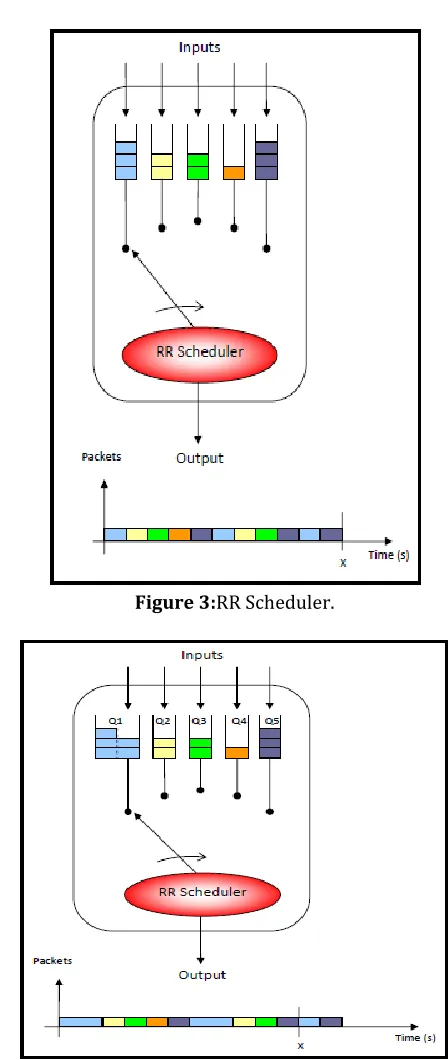
[image:5.612.333.557.90.620.2]RR as a scheduling algorithm is considered the most basic and the least complex scheduling algorithm. It has a complexity value of O (1) [13]. Basically the algorithm services the backlogged queues in a RR fashion. Each time the scheduler pointer stop at a particular queue, one packet is dequeued from that queue and then the scheduler pointer goes to the next queue. This is shown in Figure 3.1. Note that in this case all packets are of same length. However, for instance an MPEG video application may have variable size packet lengths. This case is shown in Figure 3.2.
Figure 3:RR Scheduler.
Figure 4:RR Scheduler: Variable Packet Size.
It is assumed that queues Q2‐Q5 have constant packet size of 50 bytes and Q1 have a packet size of 100 bytes. Note that in Figure 3.4, unlike Figure 3.3, Q1 has superior throughput than the other queues.
© 2016, IRJET | Impact Factor value: 4.45 | ISO 9001:2008 Certified Journal
| Page 1033
Now Q1 is transmitting 2x100 bytes per X interval =200 bytes/X interval
This was caused by transmitting longer packet lengths. Hence, we can deduce that the GA scheduling algorithm does not convey fairness in systems with variable packet lengths, since RR tends to serve flows with longer packets more.
Weighted GA (WRR)
Weighted RR[15] was designed to differentiate flows or queues to enable various service rates. It operates on the same bases of RR scheduling. However, unlike RR, WRR assigns a weight to each queue. The weight of an individual queue is equal to the relative share of the available system bandwidth. This means that, the number of packets de queued from a queue varies according to the weight assigned to that queue. Consequently, this differentiation enables prioritization among the queues, and thus the SSes [16]. Nevertheless, the downside of a WRR scheduler, just like an RR scheduler is that, different packet lengths being used by SSes would lead to the loss of its fairness criterion.
Deficit GA (DRR)
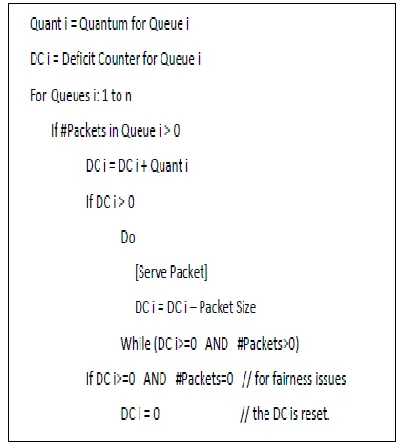
The DRR [17] scheduling algorithm was designed to overcome the unfairness characteristic of the previous RR and WRR algorithms. Besides it retains the hereditary per packet complexity value of O (1) from the RR scheduling. In DRR scheduling, every queue is accompanied by a deficit counter which is initially set to the quantum of the queue. A quantum is a configurable amount of credits (in bits/bytes) given to a queue whenever it is served. Quantum should represent the idle amount of bits/bytes a queue may require. Adding quantum is proportional to assigning weight to a queue [18]. The deficit counter is increased by one quantum on every visit of the scheduler, except when the queue is empty; the deficit counter is deducted by the amount of information being served on each pass of the scheduler to the queue. Queues are served only if the amount of quantum added to the remaining deficit counter amount from previous RR is greater than zero. Otherwise, the quantum is added only and that particular queue is held till it is served in the next RR.
[image:6.612.349.549.103.327.2]1) On the other hand, when packets of a backlog queue are completely served then any remaining credit in the deficit counter will be set to zero, as the accumulation of credit without being utilized will result in unfairness [19]. The DRR scheduling algorithm is as shown in Figure 3.3:
Figure 5: DRR Scheduling Algorithm.
Modified Deficit RR (MDRR)
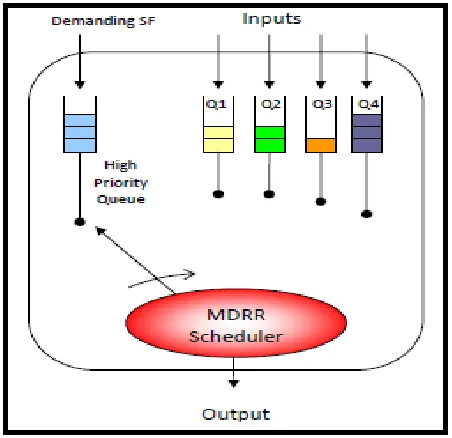
MDRR scheduling is an extension of the previously mentioned DRR scheduling scheme. There may be different modifications of the DRR scheme and yet share the name is MDRR. Nevertheless, MDRR is mainly used as a scheduling scheme for the 12000 Cisco routers [19]. The algorithm depends on the DRR scheduling fundaments to a great extent, however, in MDRR the quantum value given to the queues is based on the weight associated with them, as indicated in equation.
Quantum = MTU + 512 * Weight
Maximum Transmission Unit (MTU) is the maximum packet size that a queue may deliver. Note that, since the MTU is a constant number for a given system, quantum value and weight are therefore directly proportional and hereafter could be used interchangeably. The reason of including the MTU parameter in equation is to ensure that the quantum to be delivered to the intended queue at least enables the queue to
transmit one packet. This also helps in maintaining the per packet complexity of O(1), since if no packet was transmitted in a GA this results in the increase of the operational complexity. Except cases where the deficit counter is below zero.
© 2016, IRJET | Impact Factor value: 4.45 | ISO 9001:2008 Certified Journal
| Page 1034
The weight assigned according to the equation above is the relative portion of the total system bandwidth that the MS is promised to be delivering.
[image:7.612.59.285.257.476.2]The Cisco MDRR scheduling scheme adds a Priority Queue (PQ) into consideration with DRR. A Priority Queuing scheme isolates high demanding flows from the rest of the other flows for the reason of better quality of service provisioning. This is illustrated as shown in Figure 3.4.
Figure 6: MDRR Scheduling Algorithm.
According to the mode of serving the Priority Queue, there are mainly two types of MDRR schemes [20]: Alternate Mode: In this mode the high priority
queue is serviced in between every other queue. For instance the scheduling sequence may be as follows: {PQ, Q1, PQ, Q2, PQ, Q3, PQ, and Q4}.
Strict Priority Mode: here the high priority queue is served whenever there is backlog. After completely transmitting all its packets then the other queues are served. However, as soon as packets are backlogged again in the high priority queue, the scheduler transmits the packet currently being served and moves back to the high priority queue.
Conclusion
Designing a scheduler that is less complex, more efficient and provides a superior Quality of Service is of great importance to mobile WiMAX systems. In this dissertation, a comprehensive, yet brief, introduction was given for the IEEE 802.16e commercially known as Mobile WiMAX Systems. RR scheduling algorithm has been studied in depth. After that it was attempted to enhance the throughput of the system with regard to the channel quality if the subscriber stations while taking fairness into consideration. Throughput was not affected by the weights that were assigned, since the polling process might have had the upper hand in controlling the mobile stations and the times for them to be polled, and thus affecting the throughput. The delay values gotten from intensive simulation shows that the scheduler is also capable of handling voice traffic. However, further simulations must be done to assure that the scheduler will also able to provide the QoS constraints with a larger number of subscriber stations with respect to the QoS constraints that were achieved in this work by using Artificial Intelligence( AI).
References
1) Abdul Hasseeb and BelioTralli, “QoS Performance Analysis for VoIP Traffic in Heterogeneous Networks with WiMAX Access” IEEE International Conference on Advanced Communications Technology, Feb. 13-16, 2011.
2) C. So-In, R. Jain, and A. Al-Tamimi, “Capacity Estimations in IEEE 802.16e Mobile WiMAX networks,” Submitted for publication, IEEE Wireless Communication Magazine., April 2008.
3) C. So-In, R. Jain, and A. Al-Tamimi, “eOCSA: An Algorithm for Burst Mapping with Strict QoS Requirements in IEEE 802.16e Mobile WiMAX Networks,” Submitted for publication, IEEE Wireless Communication and Networking Conference, 2008.
4) WiMAX Forum, “WiMAX System Evaluation Methodology V2.1,” Jul. 2008, 230 pp.
© 2016, IRJET | Impact Factor value: 4.45 | ISO 9001:2008 Certified Journal
| Page 1035
6) S. Sengupta, M. Chatterjee, and S. Ganguly,“Improving Quality of VoIP Streams over WiMAX,” IEEE Transaction on Computers, vol. 57, pp 145- 156, Feb. 2008.
7) C. So-In, R. Jain, and A. Al-Tamimi, “Generalized Weighted Fairness and its support in Deficit GA with Fragmentation in IEEE 802.16 WiMAX,” Submitted for publication, IEEE Sarnoff Symposium, 2009, Dec. 2008.
8) T. Wand, H. Feng, and B. Hu, “Two-Dimensional Resource Allocation for OFDMA System,” in Proc. IEEE International Conference Communications Workshop., Beijing, China, 2008, pp. 1-5.
9) B. Chang and C. Chou, “Analytical Modeling of Contention-Based Bandwidth Request Mechanism in IEEE 802.16 Wireless Network,” IEEE Transaction Vehicular Technology, vol. 57, pp 3094-3107, Sept. 2008.
10) Sayenko, O. Alanen, and T. Hamaainen, “Scheduling solution for the IEEE 802.16 base station,” Int. Journal of Computer and Telecommunications Networking, vol. 52, pp. 96-115, Jan. 2008.
11) J. Borin and N. Fonseca, “Scheduler for IEEE 802.16 Networks,” IEEE Communication Letter, vol. 12, pp. 274-276, April 2008.
12) Y. Wang, S. Chan, M. Zukerman, and R.J. Harris, “Priority-Based fair Scheduling for Multimedia WiMAX Uplink Traffic,” in Processing IEEE International Conference Communications, Beijing, China, 2008, pp. 301-305.
13) W. Lilei and X. Huimin, “A new management strategy of service flow in IEEE 802.16 systems,” in Processing IEEE Conference Industrial Electronics and Applications, Harbin, China, 2008, pp 1716-1719.
14) Z. Kong, Y. Kwok, and J. Wang, “On the Impact of Selfish Behaviors in Wireless Packet Scheduling,” in Processing IEEE International Conference Communications, Beijing, China, 2008, pp. 3253-3257.
15) N. Ruangchaijatupon and Y. Ji, “Simple Proportional Fairness Scheduling for OFDMA Frame-Based Wireless Systems,” in Processing IEEE Wireless
Communication and Networking Conference, Las Vegas, NV, 2008, pp. 1593-1597.