© 2016, IRJET | Impact Factor value: 4.45 | ISO 9001:2008 Certified Journal
| Page 1142
PERFORMANCE AND SPEED CONTROL OF CYCLOCONVERTER FED SPLIT
PHASE INDUCTION MOTOR
Y. PRUDVI SAI KRISHNA GOWDA
1, GUTTULA HEMA
2, SEEPANA DURGA PRASAD
3VATTIKUTI VILASITHA
41
final year student,Department of EEE,Pragati engineering college,surampalem
2final year student,Department of EEE,Pragati engineering college,surampalem
3final year student,Department of EEE,Pragati engineering college,surampalem
4final year student,Department of EEE,Pragati engineering college,surampalem
---***---Abstract -This paper gives comprehensive review of the
cycloconverter fed induction motor drive. The cycloconverter converts ac supply of one frequency into ac supply of different frequency without any dc stage in between. Cycloconverter functions by means of phase commutation, without auxiliary forced commutation circuits. The power circuit is more compact, eliminating circuit losses associated with forced commutation. The speed control is achieved by means of step-down cycloconverter because this advantage. The simulation based on MATLAB/ Simulink is shown with performance results for single phase step-down cycloconverter fed induction motor. As the AC supply frequency cannot be changed, this project uses a TRIAC controlled cycloconverter which enables the control of speed in steps for an induction motor. The microcontroller used in this project is AT89S52, switches are provided to select the desired speed range (F, F/2 and F/3) of operation of the induction motor.
Key Words: Speed control, induction motor,TRIAC
cycloconverter, simulink, MATLAB.
I.INTRODUCTION
In this paper cycloconverter is introduced as a type of power controller, where an alternating voltage at supply frequency is converted directly to an alternating voltage at load frequency (normally lower), without any intermediate dc stage. These new approaches need a simple method of control for ac motors [1]. Control of ac motors become very popular because it is possible to obtain the characteristics of dc motors by improving control techniques. Initially, the basic principle of operation used in a cycloconverter is discussed. Then the circuit of a single phase to single cycloconverter of a single-phase to using TRIAC is presented [2]. This is followed by describing the operation of the cycloconverter circuit, along with waveform.
II.
OPERATING PRINCIPLE OF SINGLE PHASE CYCLO-
CONVERTER
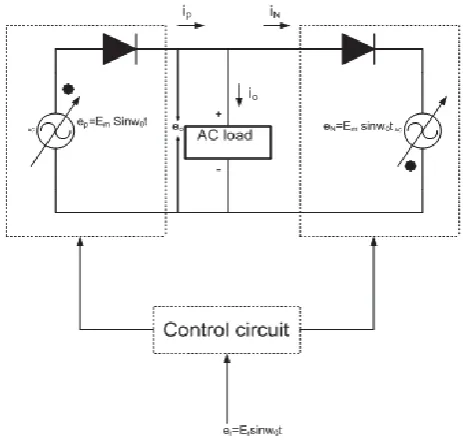
The basic principle of operation of a cycloconverter is explained with reference to an equivalent circuit shown in Fig.1 [3].Each two-quadrant converter is represented as an alt ernat ing voltage s o u rc e , w h i c h corresponds to the fundamental voltage component obtained at its output terminals.
[image:1.595.313.545.511.731.2]The diodes connected in series with each voltage source, show the unidirectional conduction of each converter, whose output voltage can be either positive or negative, being a two-quadrant one, but the direction of current is in the direction as shown in the circuit, as only thyristors unidirectional switching devices, are used in the two converters. Normally, the ripple content in the output voltage is neglected.
© 2016, IRJET | Impact Factor value: 4.45 | ISO 9001:2008 Certified Journal
| Page 1143
The control principle used in an ideal cycloconverter is tocontinuously modulate the firing angles of the individual converters, so that each produces the same sinusoidal (ac) voltage at its output terminals. Thus, the voltages of the two generators have the same amplitude, frequency and phase, and the voltage of the cycloconverter is equal to the voltage of either of these generators [4]
The circuit of a single-phase to single-phase cyclo- converter is shown in Fig.2. Two full-wave fully controlled bridge converter circuits, using four thyristors for each bridge, are connected in opposite direction (back to back), with both bridges being fed from ac supply.
[image:2.595.310.552.235.455.2]Bridge 1 (P – positive) supplies load current in the positive half of the output cycle, while bridge 2 (N – negative) supplies load current in the negative half. The two bridges should not conduct together as this will produce short-circuit at the input. In this case, two thyristors come in series with each voltage source. When the load current is positive, the firing pulses to the thyristors of bridge 2 are inhibited, while the thyristors of bridge 1 are triggered by giving pulses at their gates at that time. Similarly, when the load current is negative, the thyristors of bridge 2 are triggered by giving pulses at their gates, while the firing pulses to the thyristor of bridge 1 are inhibited at that time.
Fig -2.2: Single phase to single phase cycloconverter
This is circulating current free mode of operation. Thus, the firing angle control scheme must be such that only one converter conduct at a time, and the changeover of firing pulses from one converter to the other, should be periodic according to the output frequency [5].
When a cycloconverter operates in the non- circulating current mode, the control scheme is complicated, if the load current is discontinuous. The control is somewhat simplified, if some amount of circulating current is allowed to flow between them. In this case, a circulating current
limiting reactor is connected between the positive and negative converters, as is the case with dual converter, i.e. two fully controlled bridge converters connected back to back, in circulating-current mode[6]. This circulating current by itself keeps both converters in virtually continuous conduction over the whole control range. This type of operation is termed as the circulating-current mode of operation.
[image:2.595.43.259.457.599.2]III.
HARDWARE IMPLEMENTATION
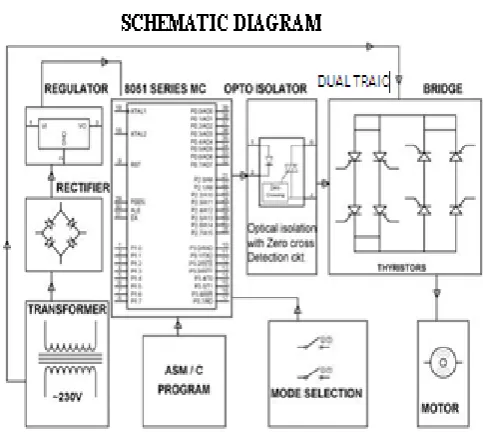
Fig -3.1: Block diagram of cycloconverter using TRIACS
3.1 Description and Working
:
Single phase 230 V Power supply is given the transformer for step down the voltage from 230v AC to 12V AC. The 12v AC is then fed to the bridge rectifier. The rectifier converts 12V ac to 12VDC. Output of the rectifier is fed to the Voltage regulator 7805 it gives the output of 5V DC. The 5V DC is given to Vcc of the micro controller 8051.The micro controller has been programmed i.e. ASM/C program to give output to optical isolation with zero cross detection circuit. It compares two signals in order to get zero crossing whenever the zero crossing occurs it gives an output. . A microcontroller programme is developed to control the firing pulses of gate driving circuit, these firing pulses are controlled by DIACs. The output of the cychloconverter is fed to the induction motor to control the speed at different frequencies.
© 2016, IRJET | Impact Factor value: 4.45 | ISO 9001:2008 Certified Journal
| Page 1144
When the switch 2 closed the time period ofconduction for the 1st bridge takes place for 30ms and then other bridge for 30ms.so the total time period of AC cycle is 60ms 16.66 Hz i.e. F/3. This supply is given to the motor by using F/2 and F/3 supply we can control the speed of the AC motor
[image:3.595.327.552.168.274.2]3.2 HARDWARE CIRCUIT
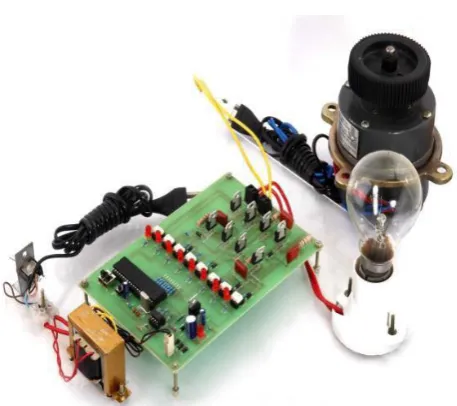
Fig -3.2: Picture of the cycloconverter using traics
IV. SIMULATION OF CYCLOCONVERTER
The objective of this work is to analyses the speed of single phase induction motor performance for various output frequency of the 1-phase cycloconverter [7].
Fig -
4.1:
Simulation model of single phase to single phase cycloconverteThe simulation starts with the generation of 50 Hz reference sine wave. It should be noted that all the simulations were made for Zero Load Torque, and firing angle After applying the control strategy
Fig-4.2:Speed Vs time output of single phase induction motor at f=50 HZ
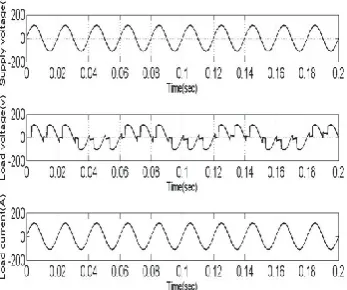
In order to get a better understanding of the control system and to verify the control techniques, Fig 3.4, Fig 4.4 shows output waveform of cycloconverter for input frequency, which is 2,3and times the output frequency of the 1-phase cycloconverter.
Fig-4.3: Waveform shows the input frequency is 2 times the output frequency
[image:3.595.45.274.232.435.2]The input and output waveforms are shown in above figure. It is clearly indicates that the input frequency 50 Hz is reduced to 25 Hz (1/2) at the output.
Fig-4.4 :
Speed Vs time output of single phase induction [image:3.595.41.284.551.731.2] [image:3.595.331.550.634.724.2]© 2016, IRJET | Impact Factor value: 4.45 | ISO 9001:2008 Certified Journal
| Page 1145
Fig- 4.5: Waveform shows the input frequency is 3 times the output frequency
[image:4.595.49.270.382.485.2]The input and output waveforms are shown in above figure. It is clearly indicates that the input frequency 50 Hz is reduced to 16.66 Hz (1/3) at the output.
Fig-4.5: Speed V/S time output of single phase induction motor at f=16.66 Hz (fi/3)
4.1 SIMULATION RESULTS
The result obtained using MATLAB for single phase cycloconverter coupled induction motor as follows
TABLE :1 SIMULATION DATA
Supply frequency (Hz)
Output Frequency (Hz)
Speed of induction motor (rpm)
50 50 1434
50 25 762
50 16.66 500
V.CONCLUSION
The cycloconverter circuit is simulated and desired results obtained. The single phase cycloconverter used for control of speed of single phase induction motor by supplying desired variable frequency. This single phase cycloconverter circuit can be extended further for three phase application.
REFERENCES
[1] Ronilson Rocha, Luiz de Siqueira Martins Filho “A Speed Control for Variable-Speed Single-Phase Induction
Motor Drives”, Dubrovnik, Croatia, IEEE (ISIE), June
20-23, 2005
[2] Mr. Aung Zaw Latt ,Dr. Ni Ni Win,“Variable Speed Drive of Single Phase Induction Motor Using Frequency Control
Method”, from International Conference on Education
Technology and Computer, IEEE 2009
[3] M. H. Rashid, Power Electronics Circuits, Devices and Application 6th edition, Copy right 2009, Prentice Hall, Inc Upper Saddle River, NJ.
[4] Atul M.Gajare, Nitin R. Bhasme. “A Review on Speed
Control Techniques of Single Phase Induction Motor”,
from International Journal of Computer Technology and Electronics Engineering (IJCTEE) Volume 2, Issue 5, IJCTEE 2012
[5] Samir k. datta,“A Static Variable-Frequency Three-Phase Source Using the Cycloconverter Principle for the Speed Control of an Induction Motor”, IEEE Transactions On Industry Applications, vol IA-8, NO.5,IEEE1972
[6] At Sandeep Pande, Hashit Dalvi “Simulation Of Cycloconverter Based Three Phase Induction Motor” International Journal of Advances in Engineering & Technology (IJAET), July 2011.
ISSN: 2231-1963
[7] Hamad S. H; S. M. Bashi, I. Aris and N.F.Marlah “Speed
Drive of Single-phase Induction Motor” National Power
& Energy Conference 2004 Proceedings, Kuala Lumpur, Malaysia, 0~7803~8724, IEEE 2004FLEXChip
Signal Processor (MC68175/D), Motorola, 1996.
© 2016, IRJET | Impact Factor value: 4.45 | ISO 9001:2008 Certified Journal
| Page 1146
[9] J Zhang, “Single phase input cycloconverters driving aninduction motor” Ph.D. thesis, University of Technology, Sydney,
[10] G. L. Arsov, “Improvements in microcomputer-based digital control of cycloconverters”, IEEE Trans. Ind. Appl., vol. IA-30, no. 3, pp. 585-588, May/June 1994. [11] J. Zhang, G.P. Hunter and V.S. Ramsden, "A single phase input cycloconverter driving a three phase motor", 5th European Conference on Power Electronics, EPE'93,
Brighton, UK, 14-17 September 1993 [12] V.S. Ramsden, G.P. Hunter and J. Zhang "Impact on
the power system of single phase input cyclo converter motor drives” IEE Proc.-Electr. Power Appl., Vol. 142 No. 3, May 1995, pp 176-182
BIOGRAPHIES
Y Prudhvi Sai Krishna Gowda pursing B.Tech in Electrical and Electronics Engineering at Pragati Engineering College, Surampalem, East Godavari District Andhrapradesh. His areas of intrests are Power Electronics, Electrical drives
Guttula Hema pursing B.Tech in Electrical and Electronics Engineering at Pragati Engineering College, Surampalem, East Godavari District Andhrapradesh. Her areas of intrests are Power Electronics, Electrical Drives.
Seepana Durga Prasad pursing B.Tech inElectrical and Electronics Engineering at Pragati Engineering College, Surampalem, East Godavari District Andhrapradesh. His areas of intrests are Power Electronics, Electrical Machines.