© 2016, IRJET | Impact Factor value: 4.45 | ISO 9001:2008 Certified Journal | Page 1
A comprehensive study on Applications of Vedic Multipliers in
signal processing
1
Mrs Beena Mohan ,
2Mrs Ishani Mishra
12Assistant Professor, Department of ECE, New Horizon College of Engineering, Bangalore
---Abstract: Digital Signal Processing (DSP)
operations are very important part of engineering as well as medical discipline. Designing of DSP operations have many approaches. For the designing of DSP operations, multiplication plays an important role to perform signal processing operations such as convolution and correlation. The new approach of this implementation is easy to calculate DSP operations for small length of sequences. In this paper a fast method for DSP operations based on ancient Vedic mathematics is contemplated. The implementation of high speed DSP UrdhavaTriyagbhayam Sutra operations of two finite length sequences using Vedic Urdhava-Triyagbhayam Multiplication Sutra (approach/method) is done. It is very efficient multiplication formula applicable for all types of multiplication. This algorithm is implemented in MATLAB and all the operation is performed in single Graphical User Interface (GUI) window. Vedic mathematics based DSP operations reduce the processing time as compared to inbuilt function of MATLAB. It reduces the 40-60% time from inbuilt function and this algorithm operates in concept of Vedic multiplier on is the heart of the mobile communication and satellite communication system.
Keywords: Vedic sutras, Vedic Multipliers
1. Introduction
Convolution plays a preciously role in digital signal Processing and image Processing. It is used for designing of digital filter and correlation application. The linear convolution effectively can be designed by using simple Vedic multipliers. Convolution is basic concept to design the finite impulse response filter, discrete Fourier Transform (DFT) and fast Fourier Transform (FFT) [1]. Linear convolution of two finite length sequence normally computed by using the application of Discrete Fourier Transform [2,3] .Design of all DSP operations with the help of high speed Vedic multipliers which increase the efficiency of system and reduces the processing time. This DSP implementation can be designed in Matlab with GUI, which is user friendly and easy to use.
2. VEDIC MATHEMATICS
© 2016, IRJET | Impact Factor value: 4.45 | ISO 9001:2008 Certified Journal | Page 521 algebra, geometry, arithmetics . Modern mathematics
is an integral part of the technical education in most of the engineering system designand is based on the various mathematical approaches. The necessity for expeditious processing speed used following Vedic mathematics algorithm.
2.1 VEDIC SUTRAS
The Vedic multiplier is based on the Vedic multiplication formulae (Sutras). These Sutras have been traditionally used for the multiplication of two numbers in the decimal number system. The same ideas can be used to the binary number system too.
2.2 URDHVA TIRYAKBHYAM SUTRA
UrdhvaTiryakbhyam (Vertically and Crosswise), deals with the multiplication of numbers. This Sutra has been traditionally used for the multiplication of two numbers in the decimal number system. In this paper, we apply the same idea to the binary number system to make it compatible with the digital hardware. Let us first illustrate this Sutra with the help of an example in which two decimal numbers are multiplied.
Example: 234 *316 --- 61724 1222---carry --- 73944 Steps:
1) 4 X 6 = 24: 2, the carried over digit is placed below the
second digit.
2) (3 X 6) + (4 x 1) = 18 + 4 = 22; 2, the carried over digit is
placed below third digit.
3) (2 X 6) + (3 X 1) + (4 X 3) = 12 + 3 + 12 = 27; 2, the carried over digit is placed below fourth digit.
4) (2 X 1) + (3 X 3) = 2 + 9 = 11; 1, the carried over digit is
placed below fifth digit. 5) (2X3) =6
6) Respective digits are added
Line diagram for the multiplication of two numbers (234× 316) is shown in Fig. 1. The digits on the two ends of the line are multiplied and the result is added with the previous carry. When there are more lines in one step, all the results are added to the previous carry. The least significant digit of the number thus obtained acts as one of the result
Figure 2.1
3. Usage of Vedic multiplier in convolution
© 2016, IRJET | Impact Factor value: 4.45 | ISO 9001:2008 Certified Journal | Page 522
3.1. Convolution
It is a mathematical way of combining two signals to form a third signal [5]. For two finite discrete sequences of length Nx and Nh, the linear or a periodic convolution sum takes on a slightly different form.
3.2 Implementation of sutra in convolution
i)The power and area for this design can be evaluated after designing original convolution algorithm using conventional multiplier and adder units.
ii)The original design can be redesigned to reduce the number of multiplier needed using cyclic data flow and the power, and area for this design can be evaluated
iv) The original design can be redesigned to reduce the number of adder needed using cyclic dataflow and power and area for this design can be evaluated.. v)By redesigning the original design with pipeline structure by incorporating latches in critical path, power and area for this design can be evaluated..[6,7]
3.3. Usage of Vedic multiplier in convolution operation
Type I
Figure:3.1
In this architecture 9 multipliers each of 4 bits, 4 adders of 8bits and 9 bits are used respectively
Type II
In this architecture pipeline approach has been implemented and latches have been used. Latches are used to stabilize the initial state Type III
Figure :3.2
In this architecture 1 multiplier is used as compared to 9multipliers in type I and II respectively.
A multiplier is a very important element in any processor design and a processor spends considerable amount of time in
© 2016, IRJET | Impact Factor value: 4.45 | ISO 9001:2008 Certified Journal | Page 523 improvement in multiplication speed by using new
techniques can greatly improve system performance.
4 .Fast Fourier Transform(FFT)
Digital signal processing is an area of science and engineering that has developed rapidly over the past 30 years. The digital computers and associated digital hardware of three decades ago were relatively large and expensive and, as a consequence, their use was limited to general-purpose non-real-time (off-line) scientific computations and business applications. These inexpensive and relatively fast digital circuits have made it possible to construct highly sophisticated digital systems capable of performing complex digital signal processing functions and tasks, which are usually too difficult and/or too expensive to be performed by analog circuitry or analog signal processing systems. Hence many of the signal processing tasks that were conventionally performed by analog means are realized today by less expensive and often more reliable digital hardware. 4x4 Urdhva Tiryakbhayam multiplier can be used in computation of
FFT.
4.1 Usage of vedic multiplier in FFT
The Reversible 4X4 Urdhva Tiryakbhayam Multiplier design emanates from the 2X2 multiplier. The block diagram of the 4X4 Vedic Multiplier is presented in the figure 4. It consists of four 2X2 Multipliers each of which procures four bits as inputs; two bits from the multiplicand and two bits from the multiplier. The lower two bits of the output of the first 2X2 multiplier are entrapped as the lowest two bits of the final result of multiplication. Two zeros are concatenated with the upper two bits and given as input to the ripple carry adder and obtained from the second 2X2 multiplier. Likewise the outputs of the third and the terminal 2X2 multipliers are given as inputs to the second four bit ripple carry adder. The outputs of these four bit ripple carry adders are in 5 bit each which need to be summed up. [8]
Figure 4.1
5. MAC unit
Today in digital technology the ever increasing demand in enhancing the ability of processors to handle the complex and challenging processes has resulted in the integration of a number of processor cores into one chip. Still the load on the processor is not less in generic system. This load is reduced by supplementing the main processor with Co-Processors, which are designed to work upon specific type of functions like numeric computation, Signal Processing, Graphics etc. in which MAC Unit is most dominant Co-Processor and work as heart of digital signal processors. Faster Operations are of extreme importance in MAC Unit. The speed of MAC Unit depends greatly on the multiplier; after deep study and analysis it was found that the efficiency of
Urdhva Triyakbhyam-Vedic method for
© 2016, IRJET | Impact Factor value: 4.45 | ISO 9001:2008 Certified Journal | Page 524 itself. It enables parallel generation of in termed
Urdhvaiate products
5.1 Design of MAC unit using vedic multipliers
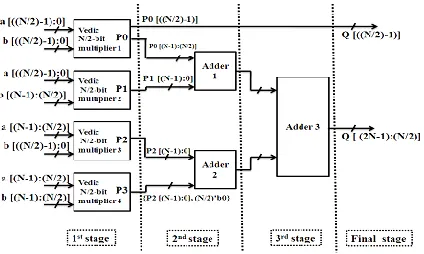
[image:5.612.39.251.333.460.2]A combination of Urdhva Triyakbhyam sutra with unique addition tree structure similar to Wallace for multiplication can be used. Conventional Vedic multiplier for design of 2x2 bit multiplier and for higher level multiplier [9] can replace the Conventional Adder which is required during the Partial Product generation with unique addition tree structure similar to Wallace addition tree structure It can be found that this design is better than conventional Vedic multiplication hardware in terms of speed[10]
Figure 5.1: NxN bit Vedic multiplier architecture
6. Conclusion
In this paper, we have analyzed
and discussed the importance of vedic
multipliers in various signal processing
applications. Vedic multiplication procedures are
quite simple and efficient
compared to the conventional multiplications.
Many vedic sutras can be
implemented in such applications which
in turn will be very much cost effective
and will be useful in designing high speed
processors.
References
1. Abdelgawad, A.; Sch. of Eng. & Technol., Central Michigan Univ., Mount Pleasant, MI, USA, “Low power multiply accumulate unit (MAC) for future Wireless Sensor Networks ”,Sensors Applications Symposium (SAS), 2013 IEEE.
2. Jagadeesh, P. ; VIT University, Vellore, India ; Ravi, S. ; Mallikarjun, Kittur Harish , “Design of high performance 64 bit MAC unit ”, Circuits, Power and Computing Technologies (ICCPCT), 2013.
3. K.Kalaiselvi, H. Mangalam, PhD., “ Area Efficient High Speed and Low Power MAC Unit ”, International Journal of Computer Applications (0975 – 8887) Volume 67– No.23, April 2013.
4. Abhishek Gupta, et.al. “Design of speed energy and power efficient reversible logic based vedic ALU for Digital Processors”, NuiCONE, Nirma University International Conference (IEEE), 2013.
5. Deepak, S. ; Kailath, B.J.,”Optimized MAC unit design ”, Electron Devices and Solid State Circuit (EDSSC), 2012 IEEE.
6. Umesh Akare, T. V. More, R. S. Lonkar,” Performance Evaluation and Synthesis of Vedic Multiplier”, National Conference on Innovative Paradigms in Engineering & Technology (NCIPET-2012) Proceedings published by International Journal of Computer Applications® (IJCA)
7. waraj, R.M. ; Arun, K.K. ; Srinivas, R.K., “Reversible implementation of novel multiply accumulate (MAC) unit ”, Communication, Information & Computing Technology (ICCICT), 2012.
8. Naveen Kumar, et.al., “ VLSI Architecture of Pipelined Booth Wallace MAC Unit ”, International Journal of Computer
Applications (0975 – 8887) Volume 57– No.11, November 2012.
9. M.Jeevitha, R.Muthaiah, P.Swaminathan, “Review Article: Efficient Multiplier Architecture in VLSI Design” Journal of Theoretical and Applied Information Technology, vol. 38, no. 2, April 2012.
© 2016, IRJET | Impact Factor value: 4.45 | ISO 9001:2008 Certified Journal | Page 525