N A N O R E V I E W
Open Access
Numerical study of instability of nanofluids: the
coagulation effect and sedimentation effect
Yu Ni, JianRen Fan
*, YaCai Hu
Abstract
This study is a numerical study on the coagulation as well as the sedimentation effect of nanofluids using the Brownian dynamics method. Three cases are simulated, focusing on the effects of the sizes, volume fraction, and ζpotentials of nano-particles on the formation of coagulation and sedimentation of nanofluids. The rms fluctuation of the particle number concentration, as well as the flatness factor of it, is employed to study the formation and variation of the coagulation process. The results indicate a superposition of coagulation and sedimentation effect of small nano-particles. Moreover, it is stable of nanofluids with the volume fraction of particles below the limit of “resolution”of the fluids. In addition, the effect ofζpotentials is against the formation of coagulation and positive to the stability of nanofluids.
Introduction
The nanofluid is characterized by the fluid with nan-ometer-sized solid particles dispersed in solution [1], which can increase the heat transfer coefficient [2-6], enhance the critical heat flux in boiling heat transfer [7-9], reduce the wall friction force [10], improve the optical characteristics [11], etc. Nano-sized particles are utilized because of its better stability than the sion of micro-sized particles. For a badly stable suspen-sion, sedimentation or coagulation (agglomeration) may occur. It compromises the above-mentioned advantages of the nano-suspension.
As is well known [12], the occurrences of coagulation and sedimentation are the two main factors for the instability of nanofluid. The phenomenon of coagulation is characterized by the formation of particle clusters, i.e., particles are in contact with each other and the cohe-sion takes place. Then, the clusters grow up. Many researchers investigated the coagulation effect of parti-cles by the Brownian dynamics simulation, focusing on the formation of gelation [13], coagulation rates [14], particle network [15], etc. For example, Hütter [14] identified the characteristic coagulation time scales in colloidal suspensions, and measured their dependencies on the solid content and potential interaction para-meters. He also deduced different cluster-cluster
bonding mechanisms in the presence of an energy bar-rier, etc. Besides, the sedimentation always occurs after a big particle cluster is established, i.e., the particles within the cluster sediment flow downward because of the increased effect of the gravity of the cluster over the buoyancy force of it, and reduced the effect of Brownian motion to the big cluster. Many researches were devoted to the sedimentation [16-18] using the Brownian dynamics simulation too. For example, Soppe and Jannsen [17] studied the sediment formation of colloidal particle by a process of irreversible single-particle accre-tion. They used the algorithm of Ermak and McCammon, incorporating the inter-particle forces and hydrodynamic interaction on the two-particle level, and analyzed the effect of two-particle hydrodynamic interactions on the sediment structure, etc. They found that the process of sediment formation by colloidal particle is the result of a delicate balance of sediment field strength, DLVO inter-actions, and hydrodynamic interactions.
However, there is an important issue about which few researches have been concerned: the interaction between the coagulation and sedimentation for the instability of nanofluids. For example, the processing of coagulation causes the particle clusters to grow up, and then the large clusters are more prone to sedimentation than that of small clusters because of the intensive gravity effect. In other words, the coagulation effect is able to augment the sedimentation effect. Thus, this study is intended to carry out some research on this issue, exploring the * Correspondence: [email protected]
State Key Laboratory of Clean Energy Utilization, Zhejiang University, Hangzhou 310027, P. R. China
complex interaction as well as the close relation between the coagulation and the sedimentation phenomena.
Numerical model
Governing equation
In this study, the Brownian dynamics technique is employed to investigate the motion of nanoparticles. The governing equation is the so-called Langevin equa-tion, which is formulated as follows [19]:
r r D F
k T t R t
i i
ij j
i j
= 0+
∑
Δ + Δ0 0
B
( ) (1)
where the superscript 0 indicates that the variable is corresponding to the beginning of the time step Δt; riis
the ith component of the position vector of particle;Dij
is the element of the diffusion tensor indexed by (i,j);Fj
is the force experienced by the jth particle; kB is the
Boltzmann constant; andT denotes the temperature.
The displacementRi(Δt) is a random displacement of a
Gaussian distribution with a zero expectation and a
(2D0ijΔt) covariance (〈Ri(Δt R) (j Δ 〉 =t) 2Dij0Δt). In this study, the Rotne-Prager tensor [20] is utilized as approx-imations to the hydrodynamic interaction:
D k T
a i j
D k T
r I r r ij ij ij ij ij = = + B B
on the same particle 6 8 , , iij ij ij ij ij ij r a r I r r r 2 2 2 2 2 1 3 ⎛ ⎝ ⎜ ⎜ ⎞ ⎠ ⎟ ⎟+ − ⎛ ⎝ ⎜ ⎜ ⎞ ⎠ ⎟ ⎟ ⎡ ⎣ ⎢ ⎢ ⎤ ⎦ ⎥ ⎥ ⎧ ⎨ ⎪ ⎪ ⎩ ⎪⎪ ⎪ (2)
wherehis the viscosity,ais the particle radius,δijis the
Kronecker delta, rij is the vector from the center of
parti-cleito the center of particlej, and I is the unit tensor. Moreover, three forces, i.e., the attractive Van der Walls force, fv, the repulsive electrostatic force by the
electric double layer,fe, and the gravity forcefgare
con-sidered as the forces experienced by any particle, which are formulated as follows [12]:
Fj= fV + fe+ fg (3)
f Ad r d
r r d
ij
ij ij
V = − ⋅
− −
(
)
2 4 4
3 2 2 2
3
0 5.
(4)
f d e
e r d
r d
ij
ij
e = ⎛ ⋅
⎝⎜ ⎞ ⎠⎟ ⋅ + − − − − 2 2 1 2 ( )
( ) (5)
fg = ⎛ d f g
⎝⎜ ⎞ ⎠⎟
(
−)
1 6 3 (6)
where A,d, ε, , ζ,rf,r, and g are the Hamaker
con-stant, the particle diameter, the electric permittivity of the fluid, the inverse of the double-layer thickness, the zeta potential of the suspension, the density of the fluid, the density of the particle, and the gravity acceleration, respectively.
It is noted in Equation (4) that the results forrij- d =
0 is meaningless when the contact between the two par-ticles occur, and they will adhere to each other or rebound back. Thus, we treat the condition with
=(rijd−d)<
0 as the situation when the two particles
are separated, so that Equation (4) works. Otherwise, it results in coalescence between the two particles. Once the coalescence between colliding particles takes place, the clusters start growing up.
Simulation conditions
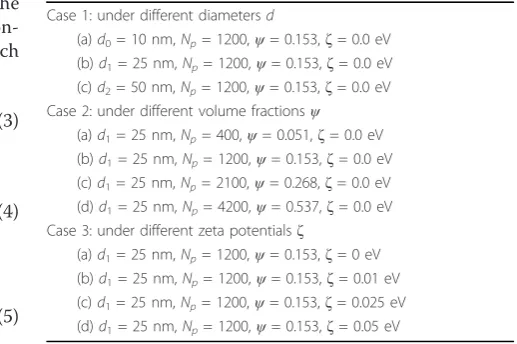
In this study, three cases with different diameters of par-ticles (Case 1), different volume fractions (Case 2), and different zeta potentials (Case 3) are simulated, respec-tively (Table 1). For these cases, the parameters of the material, as well as other relevant parameters, are illu-strated in Table 2.
[image:2.595.281.540.552.724.2]In this simulation, the boundary conditions in thex andydirections (Table 2) in the horizontal plane are both periodic, whereas the top and bottom walls of the simulation domain in thez-direction are treated as adhe-sive walls to which the particles adhere immediately once they come into contact with them. It is reasonable to conclude thus, since the agglomerated particle clusters always adhere to the bottom walls or the top interfaces.
Table 1 Three cases with different diameters of particles, volume fractions, and zeta potentials
Case 1: under different diametersd
(a)d0= 10 nm,Np= 1200,ψ= 0.153,ζ= 0.0 eV (b)d1= 25 nm,Np= 1200,ψ= 0.153,ζ= 0.0 eV (c)d2= 50 nm,Np= 1200,ψ= 0.153,ζ= 0.0 eV Case 2: under different volume fractionsψ
(a)d1= 25 nm,Np= 400,ψ= 0.051,ζ= 0.0 eV (b)d1= 25 nm,Np= 1200,ψ= 0.153,ζ= 0.0 eV (c)d1= 25 nm,Np= 2100,ψ= 0.268,ζ= 0.0 eV (d)d1= 25 nm,Np= 4200,ψ= 0.537,ζ= 0.0 eV Case 3: under different zeta potentialsζ
Initially, a random distribution is given to the cles. As time advances, the possible movements of parti-cles are computed through solution of the governing equations.
Simulation results
Case 1: effect of particle sizes
[image:3.595.304.539.83.691.2]This section deals with the effect of particle sizes on the coagulation and sedimentation. Figure 1 shows the simula-tion results att= 0, 5, 10, and 50μs for Case 1 due to the effects of different sizes of particles. Figure 1a, b, c, d shows the results ofd= 10 nm att= 0, 5, 10, and 50μs, respec-tively. Similarly, Figure 1e, f, g, h shows the results ford= 25 nm, whereas Figure 1i, j, k, l shows them ford= 50 nm. It is seen that the coagulation takes place the most intensively and rapidly for the smallest size of particles (Fig-ure 1a, b, c, d), moderately for the intermediate size of par-ticles (Figure 1e, f, g, h), and weakly and slowly for the largest size of particles (Figure 1e, f, g, h, i, j, k, l). More importantly, the results of the intermediate sizes are due to coagulation but with weak sedimentation, whereas the results of the smallest sizes are due to both the effects of coagulation and sedimentation. For the largest size of the particles, it is neither due to coagulation nor sedimentation. It looks complicated. As is known, the larger particles bear the major effect of gravity, and they are the most prone to sedimentation. However, it is only true of the single particle without coagulation. With the superposition of the coagula-tion effect, it can amplify or augment the trend of sedimen-tation through coagulation. Owing to the increasing agglomeration of the particles, the gravity effect may play an important and even a dominant role, which causes pos-sible sedimentation of the whole agglomeration (the upper part of the agglomeration in Figure 1d is due to the adhe-sive boundary on the upper wall). In other words, there exists a balance between the sedimentation effect of the large-sized individual particles and the sedimentation effect of small-sized aggregated particles. The former is caused solely by the gravity effect, whereas the latter is caused by the superposition of the coagulation and the gravity effects, i.e., the amplification and augmentation of the gravity effects of the aggregated particles due to coagulation.
Table 2 Parameters used in this simulation
Simulation domains (Lx,Ly,Lz) (4d, 4d, 256d) Mesh sizes (δx,δy,δz) (4d, 4d, 4d)
TemperatureT(°C) 25
Hamaker constantA(J) 2 × 10-20 Diameters of particle (d0,d1,d2), (nm) (10, 25, 50) Density of fluidrf(kg/m3) 0.993 × 10³ Density of particle (rp) (kg/m3) 6.4 × 10³ Viscosity of fluidh(Pa s) 1.0 × 10⁻³ Simulation time stepΔt(ns) 10
Figure 1Snapshots of simulation results. (Case 1 ford= 10 nm
(a-d),d= 25 nm(e-h),d= 50 nm(i-l)att= 0, 5, 10, and 50μs
[image:3.595.57.294.98.211.2]It is necessary to mention that Figure 1i, j, k, l does not indicate the stability of the nanofluids. Alternatively, it indicates a relatively stable characteristic compared to Figure 1a, b, c, d. After the evolution over a long time, possible coagulation or sedimentation may also occur.
In order quantify the degree of coagulation, we need to define some functions. Let us divide the simulation domain Lx×Ly ×LzbyNx ×Ny×Nzcubic meshes by
the cell volume (δx ×δy×δz). The mean number
con-centration c of particles is the mean number of parti-cles within each mesh volume (δx×δy×δz). Then, the
rms value of the particle concentrationR1 and the
flat-ness factor of the number concentrationR4 are
formu-lated as follows:
R1= −
⎛ ⎝
⎜ ⎞
⎠ ⎟
∫
1 2
1 2
Lz ( ( , , )c x y z c) dz
/
(7)
R
R1
4
4
4
1 1
=⎛ ⎝
⎜ ⎞
⎠
⎟ L
∫
c x y z −c dz z( ( , , ) ) (8)
[image:4.595.304.539.86.579.2]The rms of concentration means the fluctuation of the number concentration of particles, and it is closely related to the formation of particle clusters due to coagulation. The flatness factor means the intensity of fluctuation of the number concentration, thereby indicating the intensity of coagulation. Thus, these two functions are helpful in enabling the quantification of particle coagulation.
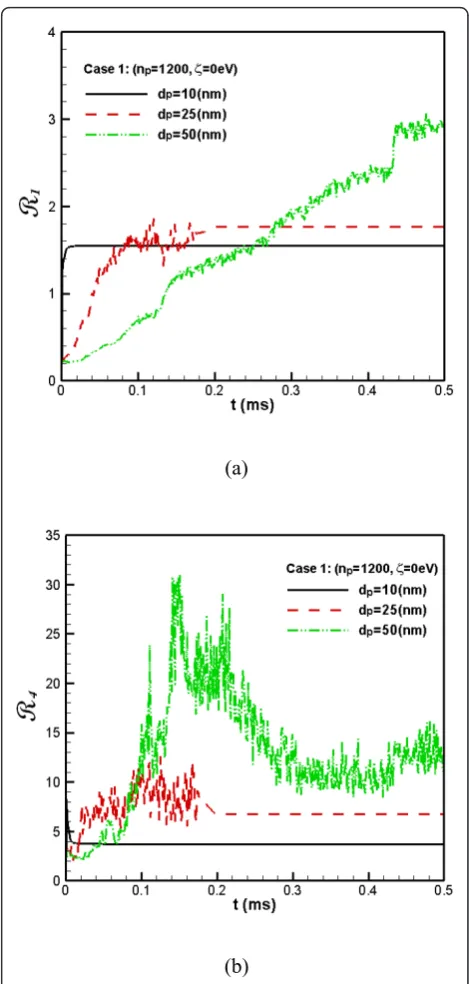
Figure 2a, b shows theR1andR4for Case 1. It is seen
from Figure 2a, b that the coagulation of the small parti-cles is the fastest. They become almost totally coagulated immediately even at the beginning. Comparatively, the coagulation of the larger particles takes place slowly and increasing steadily. However, the final level of coagula-tion of the larger particles is greater than that of smaller particles. In addition, the degree as well as the rapidity of the coagulation of the intermediate particles is intermedi-ate between that of the smaller and the larger particles.
Case 2: effects of volume fractions
In this section, the effect of volume fraction, i.e., the concentration of particles, is studied. As aforemen-tioned, the smaller particles are more prone to coagulate than the larger particles, under the same condition of the volume fractions. However, the process of coagula-tion is also closely related to the number of particles contained in it.
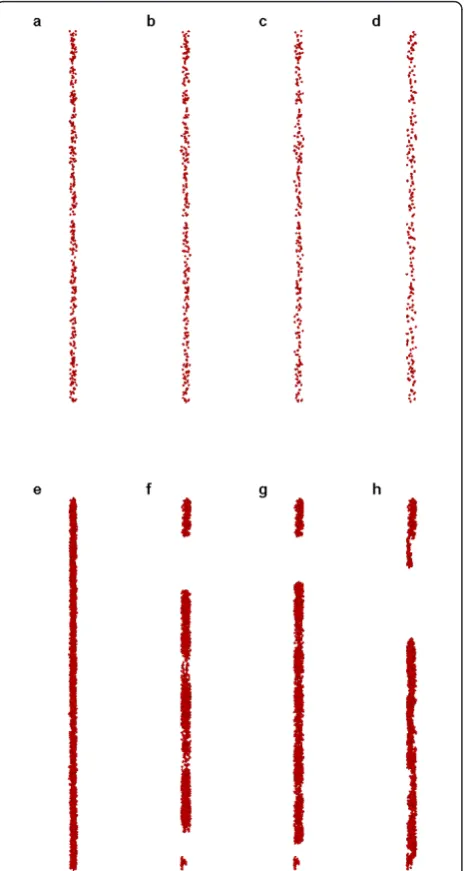
For example, Figure 3a, b, c, d shows one of the results of Case 2 where only np = 400 particles are
simulated. Compared to Figure 1a, b, c, d, it is seen that the coagulation does not takes place att= 50μs. It says that the coagulation is to be regarded appropriately as a
process with an excess of particle content. When the particle numbers go beyond the superior limit of the resolvent, then the coagulation will certainly take place. Thus, when thenp= 4200 particles are simulated, more
intensive coagulations are observed correspondingly (Figure 3e, f, g, h).
In addition, Figure 4a, b shows theR1andR4of Case 2.
It is seen from Figure 4 that theR1andR4fornp= 400
are always relatively of small value, indicating a stable
(a)
(b)
Figure 2The flatness factor of the concentration distribution
status almost without coagulation and sedimentation, althoughR4is slightly fluctuated whent< 0.06.
More-over, compared tonp= 1200, it is seen that the
concen-tration fluctuationR1and flatness factor of concentration
R4fornp= 400 are relatively of lower values. It validates
the conclusions derived from the observation of Figure 3a, b, c, d, in comparison with Figure 1e, f, g, h.
With the increased number of particles, it is seen that the R1 and R4 are increased too (np= 1200 and 2100,
respectively, Figure 4). However, when the particle num-ber is extremely large, all the spaces are almost stuffed with particles, leading to a homogeneous distribution and a low fluctuation in the number concentration (np= 4200, in Figure 4).
Case 3: effects ofζpotentials
The previous sections showed the results withζ= 0 eV. As seen from Equation (5), no repulsive effect has been considered between the particles sincefe= 0. Thus, this
section will focus on the effect of the repulsive effect by varying theζpotentials.
[image:5.595.299.538.84.593.2]Comparing with Figure 1e, f, g, h, it is seen that the degree of coagulation withζ = 0.01 eV is attenuated
Figure 3Snapshots of simulation results. (Case 2 fornp= 400
(a-d)andnp= 4200(e-h)att= 0, 5, 10, and 50μs respectively).
(a)
(b)
Figure 4The flatness factor of the concentration distribution
[image:5.595.59.295.89.525.2](Figure 5a, b, c, d), and it almost disappears withζ= 0.05 eV (Figure 5e, f, g, h). It indicates that the repulsive effect induced by theζpotentials is beneficial to the stability of nanofluids, since it acts against the coagulation process.
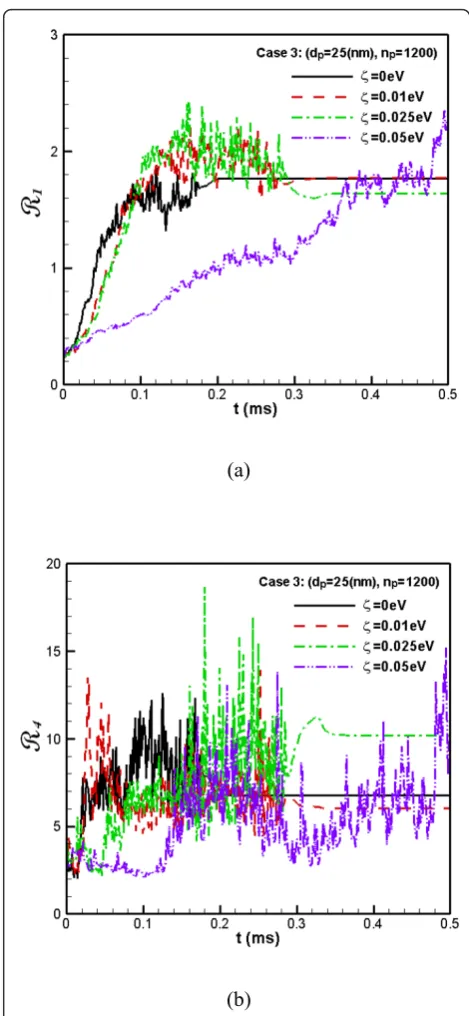
This conclusion is also validated by the variations of R1andR4 (Figure 6a, b, respectively). It is seen that the
fluctuation of the number concentration of particles withζ= 0.05 eV increases much more slowly than the cases with smaller ζ. Although the R1 and R4 for ζ =
0.05 eV are still increasing with time, which indicates that the coagulation process may still take place after a fairly long time, their effects against the formation of coagulation are very clear. In other words, it is positively beneficial for the stability of nanofluids.
Conclusions
The findings of this study are briefly summed up as follows:
[image:6.595.303.538.85.594.2]1. A complicated superposition of the coagulation and sedimentation effects for small particle is observed. The mechanisms of sedimentation for the larger and the smaller particles are different. The former is caused mainly by the great gravity effect of
Figure 5Snapshots of simulation results. (Case 3 forζ= 0.01 eV
(a-d)andζ= 0.05 eV(e-h)att= 0, 5, 10, and 50μs, respectively).
(a)
(b)
Figure 6The flatness factor of the concentration distribution
[image:6.595.57.289.258.706.2]any individual particle, whereas the latter is mainly due to the coagulation process, and the superposi-tion of coagulasuperposi-tion causes the sedimentasuperposi-tion of the whole agglomeration of particles.
2. There exists a superior limit of the fluid for parti-cle content. When the volume fraction is below the limit, it is hard for the coagulation to occur. In con-trast, the coagulation will certainly take place when the concentration of nanoparticles is beyond the capacity of“resolution”of the fluids.
3. The effect ofζ potentials is beneficial for the sta-bility of nanofluid, since it resists the formation of coagulation. In other words, increase in the value of ζpotentials is helpful to make the nanofluid more stable.
Acknowledgements
This study is supported by the National High Technology Research and Development of China 863 Program (2007AA05Z254), for which the authors are grateful.
Authors’contributions
All authors contributed equally.
Competing interests
The authors declare that they have no competing interests.
Received: 26 September 2010 Accepted: 28 February 2011 Published: 28 February 2011
References
1. Choi SUS:Enhancing thermal conductivity of fluids with nanoparticle. ASME FED1995,231:99-105.
2. Wang X, Xu X, Choi SUS:Thermal conductivity of nanoparticle fluid mixture.J Thermophys Heat Transfer1999,13:474-480.
3. Lee SP, Choi SUS, Li S, Eastman JA:Measuring thermal conductivity of fluids containing oxide nanoparticles.Trans ASME1999,121:280-289. 4. Keblinski P, Eastman JA, Cahill DG:Nanofluids for thermal transport.Mater
Today2005,8:36-44.
5. Eastman JA, Phillpot SR, Choi SUS, Keblinski P:Thermal transport in nanofluids.Annu Rev Mater Res2004,34:219-246.
6. Yu W, France DM, Routbort JL:Review and comparison of nanofluid thermal conductivity and heat transfer enhancements.Heat Transfer Eng 2008,29:432-460.
7. You MS, Kim JH:Effect of nanoparticles on critical heat flux of water in pool boiling heat transfer.Appl Phys Lett2003,83:3374-3376.
8. Xue HS, Fan JR, Hong RH, Hu YC:Characteristic boiling curve of carbon nanotube nanofluid as determined by the transient calorimeter technique.Appl Phys Lett2007,90:184107.
9. Kim H, Buongiorno J, Hu LW, McKrell T:Nanoparticle deposition effects on the minimum heat flux point and quench front speed during quenching in water-based alumina nanofluids.Int J Heat Mass Transfer2010, 53:1542-1553.
10. Hu ZS, Dong JX:Study on antiwear and reducing friction additive of nanometer titanium oxide.Wear1998,216:92-96.
11. Zhang ZK, Cui ZL:Nano-Technology and Nano-MaterialBeijing: National Defense Industry Press; 2001.
12. Dobias B, Qiu X, Rybinski WV:Solid-Liquid DispersionsNew York: Marcel Dekker, Inc; 1999.
13. Whittle M, Dickinson E:Brownian dynamics simulation of gelation in soft sphere systems with irreversible bond formation.Mol Phys1997, 90:739-757.
14. Hütter M:Coagulation rates in concentrated colloidal suspensions studied by Brownian dynamics simulation.Phys Chem Chem Phys1999, 1:4429-4436.
15. Hütter M:Local structure evolution in particle network formation studied by Brownian dynamics.J Colloid Interface Sci2000,231:337-350. 16. Ansell GC, Dickinson E:Sediment formation by Brownian dynamics
simulation: effect of colloidal and hydrodynamic interactions on the sediment structure.J Chem Phys1986,85:4079-4086.
17. Soppe WY, Jannsen GJM:Brownian dynamics simulation of sediment formation of colloidal particles.J Chem Phys1992,96:6996-7004. 18. Nuesser W, Versmold H:Brownian dynamics simulation of sedimented
colloidal suspensions.Mol Phys1999,96:893-903.
19. Ermak DL, McCammon JA:Brownian dynamics with hydrodynamic interactions.J Chem Phys1978,69:1352.
20. Rotne J, Prager S:Variational treatment of hydrodynamic interaction in polymers.J Chem Phys1969,50:4831.
doi:10.1186/1556-276X-6-183
Cite this article as:Niet al.:Numerical study of instability of nanofluids: the coagulation effect and sedimentation effect.Nanoscale Research Letters20116:183.
Submit your manuscript to a
journal and benefi t from:
7Convenient online submission
7Rigorous peer review
7Immediate publication on acceptance
7Open access: articles freely available online
7High visibility within the fi eld
7Retaining the copyright to your article