BIROn - Birkbeck Institutional Research Online
Athreye, S. and Kapur, Sandeep (2015) Capital and technology flows:
changing technology-acquisition strategies in developing countries. Working
Paper. Birkbeck College, University of London, London, UK.
Downloaded from:
Usage Guidelines:
Please refer to usage guidelines at or alternatively
ISSN 1745-8587
Department of Economics, Mathematics and Statistics
BWPEF 1511
Capital and Technology Flows:
changing technology-acquisition
strategies in developing countries
Suma Athreye
Brunel University
Sandeep Kapur
Birkbeck, University of London
May 2015
B
ir
kb
ec
k
W
or
ki
ng
P
a
per
s
in
E
co
n
om
ics
&
Fi
n
a
nc
Capital and Technology Flows: changing technology-
acquisition strategies in developing countries
Suma Athreye
Brunel University
Sandeep Kapur
Birkbeck, University of London
May 2015
Given the imperfections in markets for technology, foreign direct investment (FDI) has been regarded as a channel for the transfer of technologies from developed to developing countries. FDI was expected to generate technological spillovers through vertical linkages with host-country firms and through involuntary leakages. Evidence suggests that inward FDI was a weak channel for technology transfer. with only limited spillovers in developing countries. With the wave of globalization that started in the 1980s, trade in disembodied technology has boomed. Some large firms in developing countries have also acquired technology through outward foreign investment, typically through acquisitions of firms with a portfolio of technology products. Reinforcing these channels for technology acquisition by developing country firms merits active policy interventions.
1.
Traditional modes of technology acquisition
Acquisition of technology is a vital element of the competitive business strategy of firms in developing countries. Technology acquisition can reduce the productivity gap between developed and developing countries, and even more so if acquired technologies diffuse into wider use within developing countries. To the extent that the income gap across countries is sensitive to the technology gap, understanding the channels for technology flow are of great policy relevance.
Acquisition of technology involves transfer of knowledge. This transfer might be in embodied forms, with technology incorporated in plant and machinery, or even embodied in the form of technical personnel. Alternatively, the transfer could be in disembodied forms, such as the provision of intangible technical services. While some elements of technology are codifiable in blueprints and designs, or articulated in patents, other crucial elements may be ‘tacit’, captured only in the general know-how and experience of those who operate the technology. These different types of technological knowledge lend themselves in varying extents to conventional market exchange. Technology embodied in plant and machinery or that codified into a patent may be acquired quite readily through arms-length market transactions. However, where technology takes the form of tacit knowledge or general know-how, market transactions are poor channels for technology transfer.
There are well-known reasons why markets for technology do not always work well. One, to the extent that technology represents knowledge, sometimes the mere description of an idea, or sale of an object that incorporates that idea, amounts to a complete transfer of that knowledge itself. Arrow termed this as the ‘paradox of disclosure’. This characteristic can interfere with conventional market transactions unless supported by the enunciation of intellectual property rights (IPR). Even then, not all elements of technology can be protected, and even when patent protection is used, it may be hard to enforce it. Two, and partially as a corollary of the above, those hoping to acquire technology might have only a poor idea of which out of a competing set of technologies will meet their needs and/or where it might be available. Think of this as the problem of ignorance. A third problem comes from the non-rival nature of information – that its use by one person does not diminish the amount available for others to use. The ability of others to copy or duplicate technology makes it hard to prevent the resale of transferred technology: this problem of appropriability may inhibit the initial transfer of technology. Lastly, there is the problem of absorptive capacity, in that even those who acquire technologies may struggle to deploy it productively. All these features limit the extent to which technology can be transferred across firms and countries through arms-length market transactions.
manufacturing facility in a developing country. This direct investment might circumvent the problems of disclosure and ignorance, but the transfer would remain vulnerable to the risk of imitation from local rivals. If the host-country institutional environment afforded greater protection for intellectual property rights, so that leakage is restrained, an MNE parent would be more willing to transfer more technology to its overseas subsidiary. A porous regime would reduce the incentive to transfer the most valuable technologies, even though there is greater diffusion of that which is transferred.
Thus, conventional wisdom suggested two major channels for the acquisition of technologies of developing countries. In some situations, and for some forms of technology, there might be scope for outright arms-length technology acquisition, through purchase of technology licenses or capital that embodies technology. Where this is not a viable channel, a developing country eager to acquire technology could adopt a more permissive attitude to inward foreign investment, and especially in technology-intensive sectors.
The traditional view is well encapsulated in Archibugi and Pietrobelli (2003) who distinguish between three sources of global technology generation (and potentially technology acquisition) for developing countries. Developing country firms could participate in the international exploitation of nationally produced technology such as occurred in the case of Korean component manufacturers and Japanese cars or Indian software producers and US firms. Both would involve some sort of international licensing activity as well as production on contract for the foreign firm. Alternatively, they could participate in the global generation of innovation (by MNEs) by providing tax incentives for their location and an amenable infrastructure for knowledge-based work. Lastly, developing countries could increase their share of global technological collaborations. They argue that globalization provided huge opportunities for participation by developing country firms in all three forms of technology generation (by developed economy firms). In turn, such participation could provide fertile ground for technology acquisition activities by developing country firms.
2.
Limitations of technology acquisition through licensing and FDI
an effort to invest in technology (e.g. through internal R&D) were better able to learn and master acquired technologies but some saw acquired technology as a substitute for their own R&D (Bell and Pavitt 1997, Archibugi and Pietrobelli 2003). As a result, successful technology transfer was limited to firms and countries with not too dissimilar technological capabilities, or at least where the technology gap was not too large relative to the absorptive capacity of the firms acquiring the technology. Where the technology gap was large, licensing failed as a mode of technology acquisition in the developing world.
Of course, international labour mobility may well have aided the transfer of technology. Historical evidence for an earlier era, namely the Inter-War years, documents the role played by the movement of scientific personnel as carriers of know-how and tacit knowledge in the transfer of technology from Europe to the USA (Mowery and Rosenberg 1989; Athreye and Godley 2009). These studies revealed that the informal aspects of technology transfer, such as knowledge and networks that were associated with particular people, were as important as the formal elements. Reduced mobility of scientists in the post-War period made this type of people-embedded technology transfer less common, especially to developing countries.1 To some extent, international joint ventures and strategic technology partnering could have filled this gap. Narula and Sadowski (2002) analyse data on technological collaborations to find that developing countries accounted for only 6.9% of all technology agreements in 1997 and that over 90% of these agreements involved only developed economy firms.
In principle, the mobility of capital could help transfer technology even in the face of low labour mobility. Where developing countries acquire new technologies through inward FDI, the parent MNE would have standard ownership incentives to ensure the effective transfer of technology and essential know-how to their overseas venture. Thus technology-imbued FDI could transfer technology where arms-length transfers were weak. Although it is now commonplace to see developing countries embrace FDI, attitudes to foreign capital were somewhat ambivalent in the immediate post-War period. A long history of colonial stifling of indigenous industrialization had left newly-independent developing countries with a reflexive suspicion of foreign capital. MNEs were seen as foreign monopolies that would foreclose investment opportunities for domestic industry and, at the macroeconomic level, repatriation of profits would strain precarious foreign exchange balances.
Economic policy in India epitomized this approach: Athreye and Kapur (2001) discuss the vicissitudes of FDI policy that tried to restrain foreign ownership even as it sought to enhance the arms-length technology acquisition necessary for establishing a
domestic industrial base. However, such attempts to disentangle technology transfer from foreign ownership failed. As policy makers found that foreign firms would not transfer advanced technologies without large ownership shares, a more permissive regime for MNEs came to be regarded as a vital compromise to enable technological catch-up. With the growing realization that previous restrictions of foreign investment had choked off access to technology and also stifled competition in many sectors, the earlier ambivalence had been discarded by the late 1980s. Increasingly, developing countries came to the view that the presence of MNEs would expose local firms to advanced technologies and production processes through demonstration effects, leading to spillovers that could boost the productivity of firms in their proximity, be it proximate in a geographic sense or industrial sense.
Blomström and Kokko (1998) identified three channels for information and knowledge transfer between foreign MNEs and domestic firms. One, the inevitable mobility of domestic workers from more productive foreign firms to host-country firms would generate technological spillovers (Fosfuri, Motta, and Rønde 2001; Glass and Saggi 2002; Görg and Strobl 2005). Two, vertical linkages whereby domestic firms competed to supply inputs to foreign firms can raise the productivity and technological capabilities of domestic suppliers (Barba Navaretti and Venables 2004; Crespo and Fontoura 2007; Smarzynska Javorcik and Spatareanu 2008; Giroud, Jindra and Marek 2012). Automobile manufacture provided a classic example of this second channel, as the manufacture of ancillary automobile components is usually sub-contracted to local firms. Zanfei (2012) identifies pecuniary externalities where increased demand for output of a particular firm can generate scale-related productivity advantages for the local industry. Three, there may be demonstration effects and imitative behaviour through reverse engineering, when domestic firms observing a superior management practice or technology at work may be induced to adopt it themselves: this represents the purest externality effect of foreign presence.
For these reasons, the expected gains of FDI-induced technology acquisition turned out to be over-optimistic. Notably, the factors that inhibit technology transfer associated with FDI are not dissimilar to the factors that inhibited technology transfer through licensing in the post-War decades. Where the technological gap between foreign and domestic firms was large relative to the absorptive capacity of domestic firms, technology acquisition was weak, whether through licensing or through anticipated spill-overs from foreign firms. Low technology capability and inadequate technological infrastructure are common features of firms located in countries behind the technology frontier: the very outcome that inward FDI and technology licensing hoped to change. In some cases, large technology gaps created fertile conditions for the emergence of foreign-owned monopolies, which were likely to be more unpopular than domestic monopolies.
That both licensing and foreign direct investment turned out to be poor channels for technology transfer is not surprising if we consider the motivation of foreign firms involved in the process. Many of these firms viewed the licensing of technology as a strategy to ‘enter’ overseas markets, alongside foreign direct investment or simply exporting their product (Telesio 1979, Calvet 1981, Porter 1986). Licensing and direct investment were not always substitutes; sometimes they complemented each other with common factors driving both. For instance, the difficulty of operating production facilities in remote developing countries might generate a preference for licensing but some accompanying equity participation may be necessary to protect proprietary technology from the risk of leakage. Host-country intellectual property regimes also influenced this choice: in countries where IPR protection was considered to be weak, MNEs preferred to establish subsidiaries rather than license their technology (Contractor 1981).
3.
Changes in modes of technology acquisition in the 1990s
Amidst the general pessimism about difficulties of technology acquisition by developing countries, the 1990s saw two new trends. First, there was an increase in the global volume of trade in technology services, with much greater involvement of developing countries as buyers and sellers. Second, more surprising, was the emergence of outward FDI from developing countries to developed countries – the latter especially has offered a new channel for technology acquisition by developing countries. Both of these developments represent a departure from the traditional modes of technology acquisition. We explore these trends in this section, relying on some case studies.
The increase in cross-border technology trade
know-how; transfer of designs; services with a technical content, including technical assistance; and industrial R&D. Not all of this trade is amenable to measurement. The volume of royalty and license fees (RLF) associated with technology trade has been reported on a regular cross-country basis since 1996, as these transfers are reported in balance-of-payments data. The use of these data as a proxy for trade in technology requires caveats. The value of RLF payments, especially intra-firm transactions, is distorted by transfer-pricing that aims to minimize the global tax liability of MNEs.2
[image:9.595.76.521.279.536.2]Figure 1 shows how cross-border RLF flows have accelerated since 1990, after a relatively flat trajectory in the post-War decades.
Figure 1: Growth in international royalty and licensing payments and receipts (1950-2009), in billions of US dollars
0 50 100 150 200 250 19 50 19 53 19 56 19 59 19 62 19 65 19 68 19 71 19 74 19 77 19 80 19 83 19 86 19 89 19 92 19 95 19 98 20 01 20 04 20 07
Payments (world values)
Receipts (world values)
Sources: For the period 1950-70, we consulted The IMF Balance of Payments Yearbook (various years), which reports royalty and licensing fees in current USD by country. From 1970-2001, we used the World Development Indicators database which collates royalty and licensing revenues in current USD separately for each country (http://www.worldbank.org/data/onlinedatabases/onlinedatabases.html)
Over the period 1990-2009, computations using World Development Indicators (WDI) data show that global royalty and licensing receipts and payments grew at an average rate of 9.9% per annum. To put this surge into perspective, this is higher than the rate of growth for world merchandise exports during 1992-2009, which at 7% per annum
2
(WTO, 2010) in nominal terms, is regarded as evidence of increased globalization.3 And this growth was quite universal: WIPO (2011) found that in almost all countries for which data are available, transactions involving royalties and license fees grew faster than their gross domestic product (GDP). While some of the rise in RLF flows may be overstated due to under-reporting or measurement issues in the pre-1990 period, even for the more recent period since 1999, global flows have risen at an average of 7.7% per annum in real terms. For the Russian Federation, China and India, international flows of royalties increased by more than 20% per annum between 1997 and 2009.
[image:10.595.71.513.394.623.2]The list of countries participating in this trade also grew. In 1990, 62 countries made licensing payments but by 2007, this number had increased to 147 countries. Similarly, in 1990, only 43 countries received any international royalty or license fees, but by 2007, this number had increased to 143 countries. This suggests the gradual emergence of a large market in international licensing, perhaps facilitated by the growth of new industrializing economies of the BRICS and also the harmonization of IPR systems/regimes due to agreements like the Trade-Related Intellectual Property Rights (TRIPS).
Table 1: Royalty and License Fees (RLF) – receipts and payments by country groups in billions of US dollars; shares in global totals and average annual rates of growth
Country Group 1999 2009 Share in 1999 Share in 2009
Avg annual growth rate 1999-2009
All countries
RLF receipts 72.7 153.2 7.7%
RLF payment 77.4 153.1 7.1%
High income countries
RLF receipt values 72.0 151.1 98.97 98.65 7.7% RLF payment values 70.4 135.2 90.95 88.26 6.7%
Middle income countries
RLF receipt values 0.7 2.1 1.01 1.34 10.8%
RLF payment values 6.9 17.9 8.96 11.72 10.0%
Low income countries
RLF receipt values .01 .015 0. 02 0. 01 1.0% RLF payment values .07 .033 0. 09 0. 02 -7.3%
Source: Authors’ computations, using World Development Indicators database. Notes: (1) Values deflated using GDP deflator provided in the WDI. (2) Country groups used are World Bank categories.
3Data from International Monetary Fund and World Development Indicators suggest that world exports
Table 1 offers a more disaggregated picture, categorizing country by income groups. High-income countries are involved in the bulk of these flows, accounting for over 98% of all RLF receipts and over 90% of payments. The share of middle-income countries remains quite small but is rising briskly, at around 10% per annum for both receipts and payments. Although not reported here, within the middle-income group, the so-called transition economies show higher growth of RLF receipts (20% per annum in nominal terms) relative to payments (13% per annum); the BRIC countries collectively show a higher rate of growth of RLF payments (21% per annum) relative to that of receipts (16%).4 The data also show that low-income countries are largely excluded from such trade in technology.
Looking more closely at the countries that increased their share of international RLF payments between 2005 and 2009, we find Ireland and China increased their share by 4.9% and 2.1%. Other new countries gaining shares in international licensing payments are the BRIC economies, and former East European nations like Hungary and Poland. Many of the BRIC countries also increased their shares in international licensing receipts, but large gains in exporting shares were made by European countries and South Korea.
The evidence on increased RLF flows matches up quite well with findings on national R&D expenditures which may be seen as an indicator of national investment in technological capability. WIPO (2011) finds worldwide R&D spending is skewed towards high-income countries which still account for around 70 percent of the world total although their share dropped by 13 percentage points between 1993 and 2009. The share of middle- and low-income countries more than doubled between 1993 and 2008; the most spectacular increase in the share of world R&D has been that of China, now the second largest R&D spender in the world. Other middle income countries that registered an increase in R&D spending include Brazil, Russia and South Korea. Recalling our earlier discussion, as firms in countries become technologically more able, they are also better able to search for technologies that can be licensed to their advantage.
Nevertheless, the growth in international licensing was confined to a few industrial sectors in almost every country. Data on industrial composition for this trade are hard to come by and researchers have instead looked at data from technology agreements of firms. The Thompson Financials SDC Platinum database covers over 6,235 technology licensing agreements involving 7,006 firms between 1976 and 2009, and provides detail of the industrial sector, contract details (e.g., extent of exclusivity, lump-sum versus fee
4These rates of growth are for nominal values. Whilst we have used the GDP deflator in reporting real
elements) and information on pairs of licensor-licensee pairs, details not found in aggregate data.5
Gambardella and Torrisi (2010) provide some detail on the sectoral composition of licensing trade. They find that the majority of the licensing contracts in their sample occurred in IT-semiconductors-electronics, chemicals-pharmaceuticals-biotech and engineering technological classes. They also show that licensing tends to correspond to the country’s technology specialization indices as computed from patent databases. The sectors of licensing activity that emerge from the firm database are quite remarkably congruent and similar to those from previous studies on licensing (Caves, Crookell, and Killing 1983, Anand and Khanna 1996). The theoretical literature suggests that such concentration in particular sectors occurs when horizontal contracts prevail. This can happen when the technology is general purpose and applicable in different uses.
Gambardella and Torrisi (2010) also use these data to shed light on the technology flows between sectors and this information is presented in Table 2. As can be seen from Table 2, the largest flows of technology through licensing are, in fact, within the same technological sectors, although related sectors (such as chemicals and drugs and computers and electronic equipment sectors) benefit from licensing arrangements. In addition, sectors like instrumentation and the knowledge-intensive business services (KIBS) sell to a range of other sectors.
Table 2: Licensing flows across industrial sectors (percentage of total number of agreements)
Licensor Licensee
Drugs Chem
ic al s Co m puter s Elec tr ic al eq ui pm ent T ran sp ort Ins tru m ent
s KIBS Num
ber of ag reem ent s
Drugs 64.8 3.7 0.4 0.2 0.1 4.6 11.7 1343
Chemicals 16.9 42.8 1.9 3.3 2.5 4.4 9.4 362
Computers 0.2 1.6 27.1 22.4 3.1 5.6 27.7 613
Electrical equipment 0.8 2.1 17.0 46.4 1.0 4.9 20.5 800
Transport 2.0 6.9 7.8 12.8 27.5 5.9 24.5 102
Instruments 19.0 2.8 6.4 10.6 1.7 29.9 14.0 358
Knowledge-Intensive Business Services
(KIBS) 10.6 2.4 9.8 10.4 1.2 2.7 45.6 1620
Source: Based on Gambardella and Torrisi (2010), Table 4 and Table B.1
5 The data draws upon voluntary disclosure by firms of their technology agreements, which may also be
Outward FDI and technology acquisition
A surprising feature of more recent globalization since the 1990s has been the emergence of outward FDI from many developing countries, especially Brazil, Russia, India and China (BRIC, for short). By 2010 these countries accounted for 9% of global outward FDI flows: Figure 2 plots the trends in outward investments for these BRIC countries, with data drawn from the UNCTAD database. While outflows are not large in absolute terms, they display a growing trend, which for China and Russia persists even after the onset of the financial crisis.
Figure 2: Value of outward FDI from BRIC countries, billions of US dollars
Source for Figures 2 and 3: Authors’ computations from the UNCTAD Statistics website (http://unctadstat.unctad.org/EN/Index.html)
Figure 3: Form of outward FDI from BRIC countries during 2000-2008 (US$ billion): Greenfield investment vs mergers and acquisitions (M&A)
If uphill flows are to serve as a channel for technology acquisition, technology must flow in a direction opposite to that of capital. In well-functioning technology markets, such opposing flows of technology and financial resources could simply be an outcome of arms-length technology trade, in the form of licenses and royalty payments. In less-than-perfect technology markets where technology-seeking firms lack the ability to identify the technological assets they need, or where the assets exist in tacit form, firms from developing countries must resort to the outright acquisition of technology-rich firms overseas. In acquiring these assets, firms gain access not only to a body of knowledge codified as patents, but also the human capital in established R&D facilities or networks, or simply embodied in production facilities or processes that cannot be easily replicated. Amighini, Rebellotti, and Sanfilipo (2010) survey the empirical evidence that OFDI has become a channel for technological catch-up.
Where overseas investment is motivated by technology acquisition, it should be evident in the form and characteristics of the investment. One, if the aim is to acquire quick access to production or research facilities or associated human capital, investment will take the form of acquisition rather than the organic growth of a kind associated with greenfield investment. Furthermore, technology acquisition as a motivation for OFDI makes commercial sense only if the acquiring firm has significant interests in the relevant (or a related) industrial sector, either in the form of existing production capacity or the desire to set up new production capacity. Three, the outward investment must be in firms typically in regions which are seen to have a significant technological edge.
Child and Rodrigues (2005) assess the extent to which desire to acquire strategic assets motivates the physical and organizational expansion of Chinese firms in overseas locations. While much of Chinese OFDI aims to secure access to raw materials, and some merely to improve access to overseas markets, they argue that at least one strand of such investment aims to correct for the competitive disadvantages of ‘late development’, notably the need to catch up with technology and know-how if they are to become global players. While joint ventures with foreign partners provided Chinese original equipment manufacturers with access to technology, including some tacit knowledge, typically these left the Chinese collaborators as the junior partners in the venture.6 Foreign acquisitions have allowed Chinese firms to get improved access to technology. For instance, in 2001 China’s Holly Group, which had previously specialized in the production of energy meter equipment, acquired from Philips Semiconductors in the US, its operational assets for CDMA handset reference designs used in mobile telephony. This acquisition gave Holly access to know-how and intellectual property rights, including an exclusive license for the CDMA software protocol. In 2004, the Chinese state-owned Shanghai Automotive Industry Corporation acquired the rights to engine and transmission technology from the UK’s MG Rover Group, although it later
6Van Reenan and Yeuh (2012) argue that Chinese joint-venture policy was a huge success as it conferred
held off from outright acquisition of the group. The Chinese firm Quianjiang acquired a motor cycle manufacturer, Benelli, in Italy, mostly for its R&D facilities. Lenovo’s acquisition of IBM’s PC division in 2005 gave it control over a key brand for marketing purposes, but also provided access to its technological assets. It then built on its earlier acquisition to make a bid for the IBM x86-server business: not only did this give Lenovo access to IBM’s servers and associated software, it also gave them control over a workforce of 7500 employees based in the US and other locations.
India’s OFDI provides similar examples. Pradhan and Singh (2009) study the overseas investment of Indian firms in the automotive sector. Consider, for example the acquisition by the Tata Group of UK-based Jaguar Land Rover in 2008. Tata Motors, as part of the Tata Group, had been manufacturing automobiles in India since 1945. Its early focus was on commercial vehicles but in the 1990s it entered the market for passenger cars and light commercial vehicles by developing indigenous designs. These had only limited success but established the infrastructure for engineering design and development. In 2003 Tata announced a project to produce the Nano, an ultra-low-cost car based on domestic design and engineering. But crucially, this project was accompanied by what Bruche (2010) calls complementary upstream internationalization. It set up the Tata Motors European Technical Centre (TMETC) in Coventry, UK to work on what Tata identified as ‘critical gap’ areas, and did so in close cooperation with Tata Motors’ own research facilities in India.7 At the same time, one of the Tata subsidiaries that focused on automotive design-engineering acquired UK-based design services company INCAT International: this is a provider of engineering services to the automotive and aerospace industry, with 3000 employees in North America, Germany and India. Both entities were closely involved with Tata’s indigenous technological efforts, which included 37 patent applications in India. These technological precursors were followed by the purchase of UK’s Jaguar Land Rover (JLR) from the Ford Group in 2008. This acquisition represented a diversification into the market for premium vehicles but had a clear technological dimension, in the form of Jaguar’s two engineering design centres in the UK.
Similar initiatives by Indian firms to acquire technology were evident in other sectors. Pradhan (2008) reports evidence on overseas acquisitions by Indian pharmaceuticals in their quest for technology. Historically, the domestic innovation activity of Indian pharmaceutical firms was limited to cost-effective process development rather than product development. Accordingly, a significant fraction of early Indian OFDI in this sector went to developing countries, especially Africa, largely to extend and secure markets. Since 2000, OFDI has been used to acquire strategic assets in the developed world, most notably in the US and UK. For instance, Ranbaxy Laboratories has made
7As the managing director of Tata Motors Ltd (TML) put it, TMETC provided a window on advanced
technologies allowing “TML to plug into the expertise that is available in Britain and be in onthe key developments in automobile manufacturing.”
significant investments in Europe, Japan and the US: not all of this was in the generic drug segments, long regarded as the strength of Indian firms. Another large pharmaceutical firm from India, Dr Reddy’s Laboratories, has made large investments in the UK and Germany. Clearly, acquisitions have had a variety of motivations, from pure market capture to improved ability to engage with host country drug-approval regimes through acquired proxies. Nonetheless, the technology-acquisition motivation is quite evident in contemporary corporate announcements.8
Nayyar (2008) cites the acquisition of Hansen Transmissions International (a Belgium-based manufacturer of turbine gearboxes) by Suzlon Energy from India, motivated by the desire to extend its capabilities in the manufacture of wind turbines,9 and other acquisitions in the telecommunications sector. Niosi and Tschang (2009) point to the importance of overseas acquisitions in the early development of software firms from India and China.
While these case studies provide robust examples of technology acquisition through OFDI from developing countries, the salience of this motivation must not be overstated. Clearly, technology is an important consideration in many overseas acquisitions, but realistically it is not the only one, and in many cases not even the primary one. Buckley et al. (2007) found that the annual patent registration of the host countries – as a proxy for their technological intensity – was not a significant determinant of the level and direction of Chinese FDI outflows over the period 1990 to 2001. A lot of the investment had more direct and immediate objectives, such as securing access to key raw materials (oil, gas or minerals) or simply acquiring market shares. One could speculate on whether the motivation for internationalization evolved in more recent years – with the technology objective acquiring greater primacy – but it is quite likely that resource-seeking or market-resource-seeking flows swamp the few investments in search of technology
However, the picture may be somewhat nuanced. Even when technology was not the primary motivation for acquisition, ex post it may have delivered technological dividends. For instance, in Lenovo’s acquisition of IBM personal computer segments, its established market brand was a major consideration, as it allowed it to convert its
8 For instance, as Pradhan (2008) cites, the corporate announcement at Reddy’s acquisition of
Dowpharma UK noted: “The proprietary chiral and bio-catalysis technology at the Cambridge site and the scale-up capability in the Mirfield site will add significant value to the company. This acquisition will also bring strengths in industrial synthesis of complex prostaglandins and carbohydrate chemistry. These newer capabilities will add to our existing R&D and commercial infrastructure.”
9The corporate statement at that acquisition offered the following motivation: “The acquisition of Hansen
existing manufacturing capacity into a larger market share. But even here, while it may not have been the initial objective, access to IBM’s production facilities served as a bridge to intellectual property rights in the server segment, and Lenovo control over its technology-rich work-force.
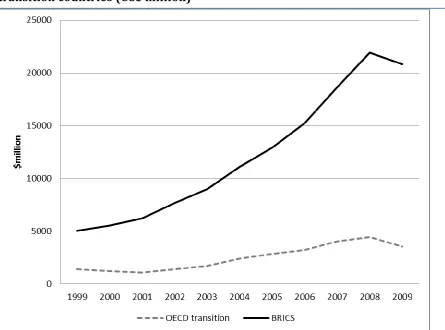
[image:18.595.74.520.279.609.2]Aggregate data show a close relation between the pace of outward investments and the hunger for technology through international licensing. Figure 4 plots the rise in licensing payments from the BRIC countries and compares it with the rise in technology payments by EU transition economies which globalized (albeit less aggressively than the BRIC countries). From 1999-2009 the share of international licensing payments of the BRIC countries increased from 4.2% to 10.2%. In the same period OECD transition economies increased their share of international licensing payments from 1.5 to 2%.
Figure 4: Value of arms-length technology purchases, BRICS vs OECD transition countries (US$ million)
Source: As for Figure 1.
4. Impact of globalization on technology acquisition strategies
contributed to both trends. Globalization saw a marked increase in the mobility of labor and capital, and the revolution in communications technologies served to reduce the knowledge gap across countries. By the 1990s, decades of post-War development had increased the technological capabilities and absorptive capacity of many firms in developing countries, also reflected in the increased R&D spending by these firms (WIPO, 2011). Globalization offered an array of opportunities for the more able firms that were already actively looking for technology.
Some writers have drawn comparisons between the globalization of the 1980s and the globalization that occurred a century earlier, starting in the 1880s. This previous globalization saw the economic emergence of the Atlantic economies, particularly the United States. While Rosenberg (1976) and Standage (1998) have highlighted the importance of technological changes -- the growth of the railway, emergence of machine tools and mechanical engineering -- in enhancing productivity growth, O’Rourke and Williamson (1999) place far more emphasis on the impact of falling trade barriers which led to an exceptional mobility of capital and labor. As we noted earlier, the free movement of people was an important mechanism for technology transfer in the pre-War period and this technology transfer directly contributed to productivity increases.
One could seek similar gains from the globalization of the late 1980s, which went hand-in-hand with the spectacular growth of information flows, especially via the internet. The internet had a dramatic impact on shrinking distance, making information more widely available and in enabling the globalization of ideas. When scarcities in human capital threatened the pace of technological progress in the emerging technological sectors, many developed countries lowered the barriers to the immigration of highly-skilled professionals (reminiscent of the way the repeal of Corn Laws enabled the availability of cheaper grain to support workers during the Industrial Revolution). These freer flows of information and skilled workers facilitated technology transfer to an extent unimaginable in the immediate post-War decades.
Many of the skilled workers who filled the emerging gaps in human capital for the technology-intensive sectors came from middle-income countries such as India, China, Ireland, Israel and Taiwan. Arora and Gambardella (2005) show that these countries, having invested in human capital in excess of that warranted by the growth of their domestic economies, were typically the ones at the forefront of the nascent software industry in emerging countries. These migrant workers created diasporic populations in technology clusters, while still retaining close ties to their countries of origin. Saxenian (1994, 2006) argues that those who gravitated to technology clusters such as Silicon Valley in California were able to export the model of technology entrepreneurship to satellite cities around the world, especially in India, China, Taiwan and Israel.
developing countries to search for and pick the right technologies for their purposes. It was hard to acquire when buyers did not know which technologies were available, the best source from which to acquire their chosen technology, and when they lacked the tacit knowledge – the absorptive capacity -- to deploy acquired technologies. The information gap across international borders was bridged through increased mobility of labor, a dramatic reduction in telecommunication costs, and global expansion of the internet as a communication tool. Increased investment in domestic R&D by developing country firms, along with internationalization of R&D, enhanced the absorptive capacity allowing firms to adapt foreign technology. Examples include Tata, Reliance who built two petrochemical complexes in India with licensed technology and Hyundai who manufactured their first car with licensed automotive technology from the UK.
Case studies of technology entrepreneurship offer insights into the use of knowledge networks. Consider, for instance, the case of Suntec, a Chinese company that produces solar panels. Its founder was exposed, as a student in Australia, to cutting-edge technology for photovoltaic cells. His start-up firm then licensed technology from Australia and the US in order to produce solar panels in China. Entrepreneurship in technology-intensive sectors often involved the use of proprietary technology accessed through licensing, but even that access relied on the emergence of formal and informal networks.
There were other elements of globalization in the 1990s that may explain the rising trend in international licensing. First, during the mid-1990s, the rapid expansion of global trade had led to multilateral reforms such as the harmonization of TRIPS. This agreement forced countries to strengthen their IPR regimes, increasing the willingness of technology suppliers to license more valuable technology across countries. Branstetter, Fisman, and Foley (2006) show that moving to stronger IPR regimes was associated with greater intra-MNE technology transfers across nineteen IP-reforming countries; however, they could not discern any effect of strong IP regimes on trade between independent parties. Kanwar (2012) exploits the changes in the different components of the IP index to show that developing countries received greater imports of technology following stronger IP protection, mainly as a result of an expansion in the sectors of economy that were covered due to stronger IP.
5. Summary and policy implications
Traditional thinking on technology transfer identified technology licensing and inward FDI as the two main channels for technology acquisition by developing-country firms. Empirical evidence suggests that the extent of technology transferred through these channels was limited. In the presence of the well-known asymmetries of information and other imperfections in the market for technology, licensing remained a weak channel. FDI from developed to developing economies could have strengthened technology transfer, but the precise technologies transferred were not the most appropriate for developing country needs, especially as developing countries were relatively passive recipients of technology transfer. In many ways both channels were adversely affected by similar factors: for instance weak IPR regimes in developing countries made owners of technology reluctant to transfer, whether through licensing or through FDI.
In recent decades, firms in middle- and low-income developing countries have increased their technological capability and have become active seekers of the technology they need. A broader appreciation of technologies on offer and complementary investments in domestic R&D to better absorb acquired technologies, has made licensing a more viable channel than it used to be. With the wave of globalization that started in the late 1980s, trade in disembodied technology has boomed: more countries are now involved in cross-border licensing arrangements with increasing participation from developing regions.
More recently, some large firms from developing countries have acquired technology through OFDI, typically via acquisitions of firms with a portfolio of technology products. Technology-motivated corporate acquisitions involve active search for the right technologies – firms must carefully select their acquisition targets, invest resources to integrate acquired technologies into their domestic operation. As such, OFDI is likely to prove a more promising channel for technology acquisition than the relatively passive inflow of technologies that accompany inward FDI.
What are the policy implications of these new channels for technology acquisition? Developing-country governments must recognize the new modes of technology transfer and devise policies that enable their firms to take advantage of them.
typical license contract forms, lowering the costs of transactions in technology markets. For instance, the Chinese government has actively sponsored international joint ventures to improve technology transfer. Chinese experience in this field merits academic scrutiny: key policy insights into how the Chinese were able to persuade joint venture partners to transfer technology would be invaluable to other countries.
Policy should also be informed by a better understanding of the link between capital flows and technology acquisition. Where inward FDI has failed to transfer significant or appropriate technologies, there may be a case of dismantling fiscal regimes that encourage such FDI for its technology transfer. There may well be a case for encouraging inward FDI for other reasons, such as promoting competition in domestic markets, but that case should not be overstated to include the gains from technology transfer that may not materialize. In some cases, it may be more productive to encourage or even subsidize OFDI through sovereign guarantees. In many cases this might only involve the leveling of the fiscal regime between outward and inward FDI, correcting the inherited policy bias in favor of inward FDI.
There are policy lessons for developed countries too. Policy makers in these countries have campaigned hard in international fora for the reinforcement of IPR regimes. This is often motivated by support for national technology champions rather than to improve the functioning of technology markets. Better-functioning markets for technology are especially desirable in ‘green technologies’ where the global environmental benefits of faster technological diffusion should trump any narrow national calculus of cost and benefit. Similar maturity may be necessary in the pharmaceuticals sector to reconcile the conflict between preserving incentives for R&D in discovering new drugs and to offer access to life-saving generics for poor developing countries.
REFERENCES
Amighini, Alessia, Roberta Rebellotti and Marco Sanfilipo. 2010. “Outward FDI from Developing Country MNEs as a Channel for Technological Catch-Up.” Seoul Journal of
Economics, 23(2):239-261.
Anand, B.N., and T. Khanna. 1996. Intellectual property rights and contract structure, WP 97-016, Harvard Business School.
Archibugi, Daniele, and Carlo Pietrobelli. 2003 “The globalisation of technology and its implications for developing countries: Windows of opportunity or further burden?” Arora, Ashish, and Alfonso Gambardella. 2005. From Underdogs to Tigers: The Rise and
Growth of the Software Industry in Brazil, China, India, Ireland, and Israel. Oxford, UK:
Oxford University Press.
Athreye, Suma, and A. Godley. 2009. “Internationalization and Technological Leapfrogging in the Pharmaceutical Industry.” Industrial and Corporate Change, 18(2): 295–323.
Athreye, Suma, and Sandeep Kapur. 2001. “Private Foreign Investment in India: Pain or Panacea?” The World Economy, 24(3): 399–424.
Athreye, Suma, and Sandeep Kapur. 2009. “Internationalization of Firms from China and India: An Introduction.” Industrial and Corporate Change, 18(2): 209–221.
Barba Navaretti, G., and A.J. Venables. 2004. Multinational Firms in the World Economy.
Princeton: Princeton University Press
Bell, Martin, and Keith Pavitt. 1997. “Technological Accumulation and Industrial Growth: Contrasts between Developed and Developing Countries.” In Technology,
Globalisation and Economic Performance, edited by Daniele Archibugi, and Jonathan
Michie, 83–137. Cambridge, UK: Cambridge University Press.
Blomström, Magnus, and Ari Kokko. 1998. “Multinational Corporations and Spillovers.”
Journal of Economic Surveys, 12(3): 247-277.
Branstetter, L., R. Fisman, and C.F. Foley. 2006. “Do Stronger Intellectual Property Rights increase International Technology Transfer? Empirical Evidence from U. S. Firm-Level Panel Data.” Quarterly Journal of Economics, 121(1): 321–349.
Bruche, G. 2010. Tata Motor’s Transformational Resource Acquisition Path. Working Paper 55, IMB Institute of Management, Berlin.
Buckley, P., J. Clegg, A. Cross, X. Liu, H. Voss and P. Zheng. 2007. “The Determinants of Chinese Outward Foreign Direct Investment.” Journal of International Business Studies,
38(4), 499-518.
Calvet, A. L. 1981. “A Synthesis of Foreign Direct Investment Theories and Theories of the Multinational Firm.” Journal of International Business Studies, 12(1): 43–59.
Caves, R. E., H. Crookell, and J. P. Killing. 1983. “The Imperfect Market for Technological License.” Oxford Bulletin of Economics and Statistics, 45(3): 249–267.
Contractor, F. 1981. Foreign Licensing Agreements; Technology Transfer; Cost
Effectiveness. Lexington, MA: Lexington Books.
Crespo, N., and M.P. Fontoura. 2007. “Determinant Factors of FDI Spillovers – What do we really know.” World Development, 35(3): 410-425.
Dahlman, C. J. 1978. From technological dependence to technological development: The case of the Usiminas Steel Plant in Brazil, Working paper N° 21, IDB/ECLA Research Programme in Science and Technology. UN Economic Commission for Latin America, Buenos Aires.
Fosfuri, A., M. Motta, and T. Rønde. 2001. “Foreign Direct Investment and Spillovers through Workers’ Mobility.” Journal of International Economics, 53: 205–222.
Fransman, Martin. 1985. "Conceptualizing Technical Change in the Third World in the 1980s: An Interpretative Survey. Journal of Development Studies, July: 572–652.
Gambardella, Alfonso, and Salvatore Torrisi. 2010. “Heterogeneity of technology licensing patterns across Europe”. Working Paper, GlobInn Project EC FP7 Cooperation Work Programme.
Giroud, A., B. Jindra, and P, Marek. 2012. “Heterogeneous FDI in Transition Economies – A Novel Approach to Assess the Development Impact of Backward Linkages.” World
Development, 40(11), 2206-2220.
Glass, Amy J., and Kamal Saggi. 2002. "Multinational Firms and Technology Transfer."
Scandinavian Journal of Economics, 104(4): 495–513.
Glass, Amy J., and Kamal Saggi. 2008. “International Technology Transfer: The Role of Foreign Direct Investment.” In International Handbook of Development Economics, edited by Amitava Krishna Dutt, and Jaime Ros. Volume 2, 1371–1449. Cheltenham, UK: Edward Elgar.
Görg, Holger and Eric Strobl. 2005. "Spillovers from Foreign Firms through Worker Mobility: An Empirical Investigation." Scandinavian Journal of Economics, 107(4): 693– 709.
Hassan, E., O. Yaqub, and S. Diepeveen. 2010. “Intellectual Property and Developing Countries – A Review of the Literature.” Cambridge, UK: Rand Corporation.
Kanwar, S. 2012. “Intellectual Property Protection and Technology Licensing: The Case of Developing Countries.” Journal of Law and Economics, 55(3): 539–564.
Lall, Sanjaya. 1983. “Determinants of R&D in an LDC: The Indian Engineering Industry.”
Economics Letters, 13(4): 379–383.
Madeuf, B. 1984. “International Technology Transfers and International Technology Payments: Definitions, Measurement and Firms' Behaviour.” Research Policy, 13(3): 125–140.
Mowery, David, and Nathan Rosenberg. 1989. Technology and the Pursuit of Growth. Cambridge: Cambridge University Press.
Narula, Rajneesh, and Bert Sadowski. 2002. “Technological Catch-Up and Strategic Technology Partnering in Developing Countries.” International Journal of Technology
Nayyar, D. 2008. ”The Internationalization of Firms from India: Investment, Mergers and Acquisitions.” Oxford Development Studies, 36(1): 111–131.
Niosi, Jorge, and Ted Tschang. 2009. "The Strategies of Chinese and Indian Software Multinationals: Implications for Internationalisation Theory." Industrial and Corporate
Change, 18(2): 269–294.
O’Rourke, Kevin, and Jeffery Williamson. 1999. Globalisation and History: The Evolution
of a Nineteenth Century Atlantic Economy. Cambridge, MA: MIT Press.
OECD. 1995. Industry and Technology: Scoreboard of Indicators 1995. Paris: OECD. OECD. 2011. OECD Science, Technology and Industry Scoreboard 2011. Paris: OECD. Porter, M. E. 1986. Competition in World Industries. Cambridge, MA: Harvard.
Pradhan, Jaya Prakash. 2008. Overcoming Innovation Limits through Outward FDI: The Overseas Acquisition Strategy of Indian Pharmaceutical Firms, Munich Personal Research Archive Paper number 12362, http://mpra.ub.uni-muenchen.de/12362/
Pradhan, Jaya Prakash, and Neelam Singh. 2009. “Outward FDI and Knowledge Flows: A Study of the Indian Automotive Sector.” International Journal of Institutions and
Economies, 1(1): 156–187.
Rosenberg, Nathan. 1976. Perspectives on Technology. Cambridge, MA: Cambridge University Press.
Saxenian, A. 1994. Regional Advantage: Culture and Competition in Silicon Valley and
Route 128. Cambridge, MA: Harvard University Press.
Saxenian, A. 2006. The New Argonauts: Regional Advantage in a Global Economy. Cambridge, MA: Harvard University Press.
Smarzynska Javorcik, Beata, and M. Spatareanu. 2008. "To Share or Not to Share: Does Local Participation Matter for Spillovers from FDI?" Journal of Development Economics, 85(1-2):194–217.
Standage, T. (1998). The Victorian Internet. New York: Berkley Publishing Group.
Telesio, P. 1979. Technology Licensing and Multinational Enterprises. New York: Praeger. UNCTAD. 2013. The Rise of BRICS FDI and Africa. Global Investment Trends Monitor. Geneva: UNCTAD.
Van Reenan, J., and L. Yeuh. 2012 “Why has China Grown So Fast? The Role of International Technology Transfer.” CEP discussion paper 1121, London School of Economics.
Westphal, Larry E., Linsu Kim, and Carl Dahlman. 1985. "Reflections on Korea's Acquisition of Technological Capability." In International Technology Transfer: Concepts,
Measures and Comparisons, edited by Nathan Rosenberg and Claudio Frischtak,167-221.
New York: Praeger.
WIPO. 2011. The Changing Face of Innovation. Geneva: World Intellectual Property Organisation.
WTO. 2010. Market Access for Products and Services of Export Interest to Least
Yang, Shu-Fei, Kun-Ming Chen, Tai-Hsin Huang. 2013. “Outward Foreign Direct Investment and Technical Efficiency: Evidence from Taiwan's Manufacturing Firms.”
Journal of Asian Economics, 27: 7–17.