R E S E A R C H
Open Access
Heme arginate improves reperfusion patterns
after ischemia: a randomized, placebo-controlled
trial in healthy male subjects
Martin Andreas
1,2, Albrecht Ingo Schmid
1,3, Daniel Doberer
1, Kiril Schewzow
3, Stefan Weisshaar
1, Georg Heinze
4,
Martin Bilban
5, Ewald Moser
3and Michael Wolzt
1*Abstract
Background:Heme arginate can induce heme oxygenase-1 to protect tissue against ischemia-reperfusion injury. Blood oxygen level dependent (BOLD) functional magnetic resonance imaging measures changes in tissue oxygenation with a high spatial and temporal resolution. BOLD imaging was applied to test the effect of heme arginate on experimental ischemia reperfusion injury in the calf muscles.
Methods:A two period, controlled, observer blinded, crossover trial was performed in 12 healthy male subjects. Heme arginate (1 mg/kg body weight) or placebo were infused 24 h prior to a 20 min leg ischemia induced by a thigh cuff. 3 Tesla BOLD-imaging of the calf was performed and signal time courses from soleus, gastrocnemius and tibialis anterior muscle were available from 11 participants for technical reasons.
Results:Peak reactive hyperemia signal of the musculature was significantly increased and occurred earlier after heme arginate compared to placebo (106.2±0.6% at 175±16s vs. 104.5±0.6% at 221±19s; p = 0.025 for peak reperfusion and p = 0.012 for time to peak).
Conclusions:A single high dose of heme arginate improves reperfusion patterns during ischemia reperfusion injury in humans. BOLD sensitive, functional MRI is applicable for the assessment of experimental ischemia reperfusion injury in skeletal muscle.
Trial registration
ClinicalTrials: NCT01461512 EudraCT: 2008-006967-35
Background
Rapid reperfusion is essential for ischemic muscle. How-ever, reperfusion itself can result in additional damage to ischemic tissue [1,2]. One of the key mechanisms is the rise of free oxygen radicals, thereby exceeding the cellu-lar antioxidant capacity and damaging cellucellu-lar proteins and membranes [3]. In a second step, neutrophil activa-tion and tissue invasion is part of the deleterious cascade of ischemia-reperfusion injury (IRI) [4].
Several strategies to alleviate IRI have been tested in various experimental settings, including mechanical preconditioning and postconditioning, pharmacologic
preconditioning, administration of antioxidant substances and treatment with endothelin receptor antagonists [5-10]. As a new therapeutic approach in humans, the induc-tion of the enzyme heme oxygenase 1 (HO-1) may be employed to mitigate IRI [10,11]. HO-1 is the rate-limiting enzyme for the degradation of heme b [12]. Thereby, it produces biliverdin, carbon monoxide (CO) and iron. Recently, the role of HO-1 as a protective enzyme was proposed due to its anti-inflammatory, antioxidant, anti-apoptotic and antiproliferative actions [11,13]. HO-1 is expressed in several organs including endothelial and smooth muscle cells in response to cellu-lar stress conditions [14-16].
IRI may be attenuated by pharmacological HO-1 induction with heme arginate (HA) as shown in a rodent hemorrhagic shock model [11,17-19]. Previous data have * Correspondence:[email protected]
1
Department of Clinical Pharmacology, Medical University of Vienna, Vienna, Austria
Full list of author information is available at the end of the article
confirmed dose-dependent induction of HO-1 mRNA and protein by HA in venous blood of healthy subjects [20,21].
In this therapeutic exploratory study, we aimed to evaluate the effects of HA on skeletal muscle IRI in healthy humans. Blood oxygen level dependent (BOLD) functional magnetic resonance imaging (fMRI) was used to measure alterations in tissue oxygenation with a high spatial and temporal resolution [22,23]. fMRI has previ-ously been used to assess perfusion of the calf muscles in elderly people and patients with peripheral arterial oc-clusive disease after ischemia reperfusion experiments [24-26]. Further, we could measure an effect of ischemic preconditioning in healthy subjects on BOLD fMRI peak signal during reperfusion [27].
Methods
A two period placebo controlled, observer blinded, ran-domized crossover trial was performed in 12 healthy male subjects between 18 and 46 years (age [mean ± standard deviation] 28±6 years, body mass index 22.6
±2.1 kg/m2). Functional MRI signals could not be
ana-lysed in one participant for technical reasons. There-fore, data are shown for 11 subjects. The study protocol was approved by the Ethics Committee of the Medical University of Vienna. All participants gave written informed consent prior to inclusion. One screening visit and two study periods with a washout time of at least 10 days in-between were scheduled for each participant. Physical examination and medical his-tory, routine blood works including blood count,
clinical chemistry, urine analysis and a 12-lead electro-cardiogram were performed at the screening visit one week prior to the first study day. Subjects did not take any medication throughout the study and abstained from alcohol, stimulating beverages containing xanthine derivatives (tea, coffee) and heavy physical exercise 48 hours before drug infusion and fMRI. Subjects were fasted on study days. After the last treatment a final follow-up examination was performed.
A single dose of 1 mg/kg heme arginate or placebo (sodium chloride) was administered as an intravenous infusion in the alternate study periods. Heme arginate was diluted to 110 ml with 0.9% NaCl. The infusion was administered within 15 minutes at an infusion rate of
440 ml/h using an infusomat (IP 85–2, Döring, Munich,
Germany). A post-treatment infusion of 250 ml 0.9% NaCl was administered to rinse perfusion lines.
Each study period consisted of three days. On the first day, placebo or heme arginate were administered. On the second day, the fMRI and ischemia reperfusion protocol was performed. On the third day, a blood draw for analysis of creatine kinase, lactate dehydrogenase,
total protein, blood iron and C – reactive proteine as
well as a physical examination were done.
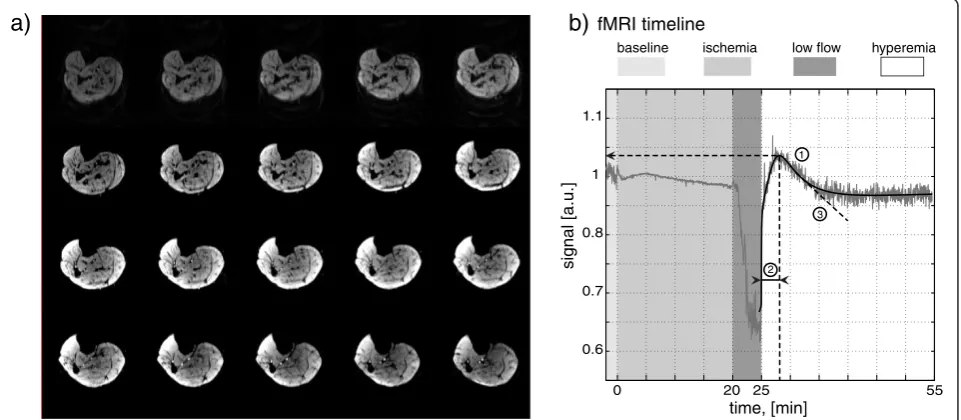
Ischemia was administered to the right lower leg for 20 minutes using a cuff inflated to 200 mmHg on the thigh (Figure 1b). The cuff was deflated to 30 mmHg below systolic pressure for five minutes for slow reperfu-sion, mimicking impaired blood perfusion through the femoral artery. This setting has been validated previously [27]. A blood draw for NO2/NO3analysis was performed
a)
b)
fMRI timelineischemia low flow
baseline hyperemia
1
2 3 1
1.1
0.8
0.7
0.6
signal [a.u.]
0 20 25 55
time, [min]
Figure 1Experimental setup. a) EPI images for every 4thminute during the experiment;b) fMRI timeline, a sample data set and description of
before heme arginate infusion as well as prior to and 15 minutes after ischemia.
MR operators were blinded to the randomization se-quence. A Siemens Tim Trio (Siemens Medical Solu-tions, Erlangen, Germany) was used for scanning. Anatomical images were acquired at the beginning of the MR examination. BOLD-imaging (EPI) had the fol-lowing parameters: 128 x 128 matrix, twenty 5 mm axial slices, 1,42 mm in-plane resolution, TR= 2 s, TE= 28 ms.
1700 EPI stacks were acquired every TR. Imaging started
two minutes before ischemia and continued for at least 25 minutes after reperfusion (Figure 1a + b). Regions of interest (ROI) were drawn around the soleus, gastrocne-mius and tibialis anterior muscle for signal analysis. The BOLD signals in the ROIs as well as from all voxels were summed to achieve a single time course for each individ-ual muscle and the complete calf respectively. The start-ing point of reperfusion was determined manually in all individual data sets.
To describe the BOLD response in calf muscle during reperfusion, the intensity time courses were fitted against a similar function as is used in DCE first pass perfusion measurements using Matlab (Mathworks, Natick, MA, USA) using the Curve Fitting Toolbox (Schewzow et al., submitted):
f tð Þ ¼g tð Þ þs tð Þ þl tð Þ ð1Þ is the sum of gamma variate functiong(t)
g tð Þ ¼g0ðtt0Þgleg2ðtt0Þ ð2Þ
and a sigmoid functions(t)
s tð Þ ¼s0 1
1þesIðtt0tIÞ ð3Þ
A linear function l(t) was also added to take into ac-count a possible drift of the signal during the experiment
l tð Þ ¼l0þllðtt0Þ ð4Þ
The values of peak BOLD signal, time to peak and tan-gent slope were determined numerically from the fitted curves f(t) (Figure 1b).
The effect of heme arginate infusion on nitric oxide
synthase was measured by NO2 and NO3 plasma
con-centration prior to heme arginate administration as well as prior to and 15 minutes after ischemia as previously described [28].
Descriptive statistics were used for outcome and safety parameters. To detect a treatment effect in a continuous outcome parameter of one standard deviation by a pairedt-test with a two-sided significance level of 5%, 12 subjects had to be recruited to achieve a power of ap-proximately 90%. With a maximum of two subjects
dropping out (16.7%), power is still at 80%. The fitted measures time to peak, peak BOLD signal and slope of reperfusion signal decline of each muscle of interest were analyzed as dependent variables using a general lin-ear mixed model, including the fixed factors ‘treatment
day’ (placebo or administration of heme arginate) and
muscle (soleus, gastrocnemius and tibialis anterior), and the random factor ‘subject’. An interaction of treatment day and muscle was evaluated and dropped from the model if not significant. Pairwise post-hoc comparisons between muscles were corrected for multiple testing using the Fisher’s least significant difference procedure. A two-sided p-value lower than 0.05 was considered indicating statistical significance. PASW 18.0 (SPSS Inc., Chicago, Illinois, USA) was used for statistical computations.
Results
HA was tolerated well without adverse reaction. No sig-nificant difference of vital signs or safety blood para-meters could be detected between study periods (Table 1). An increased creatine kinase serum concentra-tion of up to 490 U/l occurred 24 hours after ischemia in two different subjects (one receiving HA, one receiv-ing placebo) but resolved spontaneously.
[image:3.595.304.539.547.725.2]Heme arginate administration 24 hours prior to ische-mia increased peak BOLD reperfusion signal from 104.5 ±0.6% to 106.2±0.6% compared to placebo (Figure 2d; p = 0.025). Furthermore, the time to peak reperfusion was reduced from 221±19 seconds to 175±16 seconds versus placebo (p = 0.012). The calculated slope of reper-fusion signal decline after peak was significantly steeper after heme arginate compared to control condition (−2.8*10-4±0.2*10-4 vs. -2.1*10-4±0.2*10-4; p = 0.002). There was no significant effect of heme arginate on the BOLD signal during ischemia.
Table 1 Vital signs in treatment periods with placebo or heme arginate
Placebo Heme arginate
Systolic blood pressure pre ischemia (mmHg) 115±10 114±8
Diastolic blood pressure pre ischemia (mmHg) 80±8 77±8
Heart rate pre ischemia (bpm) 73±4 72±4
Systolic blood pressure post ischemia (mmHg) 116±10 115±9
Diastolic blood pressure post ischemia (mmHg) 81±7 80±10
Heart rate post ischemia (bpm) 71±2 70±3
Blood iron (μg/dl) 110±41 100±38
Protein (g/l) 76.0±3.8 75.9±2.3
Lactate dehydrogenase (U/l) 152±28 154±28
Creatine kinase (U/l) 148±114 146±87
C–reactive protein (mg/dl) 0.06±0.05 0.08±0.09
Reperfusion parameters for single muscle groups are depicted in Figure 2a-c and summarized in Table 2. Peak reperfusion signal after placebo was highest in the soleus muscle and lowest in the gastrocnemius muscle (106.5
±0.7% vs. 102.6±0.8%, p = 0.019). A similar reaction across calf muscles to heme arginate could be confirmed by statistical analysis.
Plasma concentrations of NO2 and NO3 were 2.7
±1.4 μmol/l and 13.1±8.3 μmol/l 24 hours after heme
arginate administration compared to 3.5±1.8μmol/l and
12.4±8.3 μmol/l after placebo, respectively (p = not sig-nificant). Plasma concentrations of NO2and NO3before
heme arginate administration and after ischemia were also unchanged.
Discussion
This study demonstrates beneficial effects of HA pre-treatment on endothelial function and reperfusion pat-terns after IRI in healthy humans. Full reperfusion signal occurred earlier, was higher and declined faster com-pared to placebo. We have previously reported that BOLD fMRI is able to characterize reperfusion patterns and the protective effects of ischemic preconditioning in IRI experiments [27]. Furthermore, we have shown the ability of HA to induce heme oxygenase-1 mRNA and protein in humans [21]. The induction of HO-1 proved beneficial in several ischemia reperfusion models in ani-mal studies [11,17,19]. However, the application of HA against IRI in humans has not been reported yet.
[image:4.595.57.540.90.363.2]We propose a stronger and earlier peak BOLD signal during reperfusion as the healthy response. This Table 2 BOLD signal of calf muscles after
ischemia-reperfusion injury
All muscles TTP (s) PEAK (%) slope (1/s)
placebo 221±19 104.5±0.6 −2.1*10-4±0.2*10-4
HA 175±16 106.2±0.6 −2.8*10-4±0.2*10-4
p-value 0.012 0.025 0.002
gastrocnemius
placebo 250±36 102.6±0.8 −1.6*10-4±0.2*10-4
HA 198±11 104.0±0.6 −2.2*10-4±0.2*10-4
soleus
Placebo 244±31 106.5±0.7 −2.6*10-4±0.4*10-4
HA 182±8 107.8±0.8 −3.2*10-4±0.4*10-4
Tibialis ant.
Placebo 169±28 104.3±1.2 −2.0*10-4±0.3*10-4
HA 152±13 106.9±1.5 −3.0*10-4±0.4*10-4
Heme arginate or placebo were administered 24 hours prior to ischemia. Data are mean±SD, n = 11; p-value was calculated using a general linear mixed model and applies to all comparisons, since interaction analysis suggested homogeneity of the treatment effect across muscles.TTP: time to peak;PEAK: peak reperfusion signal; slope: slope of the tangent at the inflection point of the BOLD signal curve after the peak;HA: heme arginate.
25 30 35 40 45 50 55
0.9 0.92 0.94 0.96 0.98 1 1.02 1.04 1.06 1.08
time, [min]
normalized signal, [a.u.]
All three muscles
verum placebo
25 30 35 40 45 50 55
0.94 0.96 0.98 1 1.02 1.04 1.06 1.08
time, [min]
normalized signal, [a.u.]
Tibialis anterior
verum placebo
25 30 35 40 45 50 55
0.85 0.9 0.95 1 1.05
1.1
time, [min]
normalized signal, [a.u.]
Soleus
verum placebo
25 30 35 40 45 50 55
0.9 0.92 0.94 0.96 0.98 1 1.02 1.04
time, [min]
normalized signal, [a.u.]
Gastrocnemius
verum placebo
a)
b)
[image:4.595.56.291.503.682.2]c)
d)
hypothesis is supported by two prior trials showing a decreased BOLD fMRI signal in elderly subjects [25,26]. Furthermore, subjects with overt peripheral artery occlu-sive disease presented with decreased and delayed peak BOLD signal during reperfusion [24]. HA increased the peak reperfusion signal by 38% compared to the increase over baseline after placebo administration. This is in line with one report showing a 44% higher peak signal in healthy subjects compared to the BOLD signal increase during reperfusion in elderly subjects [26]. We could furthermore demonstrate a faster decline of the reactive hyperemia signal after the peak in the HA period, indi-cated by a steeper decline of the slope in the infliction point of the reperfusion signal curve.
The BOLD fMRI signal is determined by a combined influence of perfusion, vascular microarchitecture and oxygen saturation of hemoglobin and myoglobin. Unfor-tunately, the individual contributions of each of these factors to the finally observed signal cannot be sepa-rated. Regions of interest were drawn around muscles to exclude confounding signal influences from main ves-sels, fatty tissue and bones. The soleus muscle, a slow-twitch fibre muscle, is known to show a high capillary density [29]. It showed the highest peak reperfusion value, as also reported in previous trials [26,27]. Vaso-dilation of muscular capillaries may therefore be a strong contributor to the BOLD signal. Since this trial had a crossover design and results were analysed with a repeated measurement model, an influence of vessel architecture to the different peak signals is unlikely. Improved perfusion may therefore be the major con-tributor to the peak BOLD signal. However, muscular metabolism may also influence oxygen extraction and hemoglobin saturation during reperfusion [27]. There-fore, the BOLD signal cannot be directly compared to reperfusion patterns measured by flow-mediated dilation or strain gauge plethysmography [30]. It seems plausible that a protected endothelial cell function is responsible for faster and increased maximal reperfusion, leading also to more rapid and increased oxygen saturation in the muscles under study. The faster normalization of the reperfusion signal after peak may be an additional sign of protected endothelial cell function and adequate early reperfusion of muscular tissue. This protection may be mediated by decreased heme toxicity and increased anti-oxidative capacity due to HO-1 induction and the action of its enzymatic products biliverdin/bilirubin and carbon monoxide [11]. Ischemia leads to a stasis of red blood cells in the ischemic tissue. Red blood cells are subject-ive to reactsubject-ive oxygen radicals which are increasingly produced during ischemia and early reperfusion [31,32].
A limitation of this trial is the short period of ische-mia. An increased ischemic period may reveal greater tissue injury and alter the protective effects of HA
administration but is not feasible due to ethical con-cerns. Further, we have not measured HO-1 mRNA and protein levels in this trial. Clinical studies in patients with acute ischemic events are mandatory to validate these experiments accordingly. To draw more general conclusions, a female group and subjects with different underlying diseases should be included in future studies.
Arginine, the substrate of nitric oxide synthase, may exert systemic vasodilator effects mediated by nitric oxide [33]. To analyse a possible contribution of increased nitric oxide synthase activity induced by heme
arginate, NO2and NO3levels were measured in plasma.
The lack of changes in systemic nitric oxide metabolites argues against major vascular nitric oxide stimulation as a confounder of our results.
Our interpretation has to be discussed with caution in the context of previously published results. We reported an increased phosphocreatine overshoot and a decreased peak BOLD signal after ischemic preconditioning four hours prior to 20 minutes of ischemia. The phospho-creatine overshoot indicated an improved mitochondrial function by ischemic preconditioning, which may ex-plain the increased oxygen demand leading to a decreased peak BOLD signal after ischemic precondi-tioning. Therefore, we suggest that the protecting effects of HA are different from the effects of ischemic precon-ditioning. The induction of HO-1 seems to be down-stream in the cascade of ischemic preconditioning [34,35]. Therefore, different patterns in fMRI time series of these two protecting interventions as demonstrated by fMRI so far are reasonable. Furthermore, the fMRI measurement parameters were not identical in all stud-ies. We increased the number of slices and decreased the slice gap for reduced artefacts from through-plane motion at the cost of reduced temporal resolution and shorter echo time. This enabled better signal-to-noise ratio but showed a slightly different contrast. Therefore, a direct, numerical comparison with our previous study is not possible [27].
Conclusions
In conclusion, application of heme arginate improves reperfusion patterns during IRI and may protect endo-thelial cells and skeletal muscle against IRI in humans. The potential clinical applications of this intervention have to be addressed in further trials.
Competing interests
The authors declare that they have no competing interests.
Authors' contributions
interpretation of endpoint measures. MA and MW wrote the final draft. All authors have read and approved submission of the final draft.
Acknowledgements
This work has been funded by the Vienna Science and Technology Fund (WWTF) through project LS07-031.
Author details 1
Department of Clinical Pharmacology, Medical University of Vienna, Vienna, Austria.2Department of Cardiac Surgery, Medical University of Vienna,
Vienna, Austria.3MR Center of Excellence, Center for Biomedical Engineering and Physics, Medical University of Vienna, Vienna, Austria.4Center for Medical
Statistics, Informatics and Intelligent Systems, Medical University of Vienna, Vienna, Austria.5Department of Laboratory Medicine, Medical University of
Vienna, Vienna, Austria.
Received: 29 October 2011 Accepted: 9 July 2012 Published: 2 August 2012
References
1. Matsumura K, Jeremy RW, Schaper J, Becker LC:Progression of myocardial necrosis during reperfusion of ischemic myocardium.Circulation1998, 97:795–804.
2. Eefting F, Rensing B, Wigman J, Pannekoek WJ, Liu WM, Cramer MJ, Lips DJ, Doevendans PA:Role of apoptosis in reperfusion injury.Cardiovasc Res 2004,61:414–426.
3. Zweier JL, Talukder MA:The role of oxidants and free radicals in reperfusion injury.Cardiovasc Res2006,70:181–190.
4. Vinten-Johansen J:Involvement of neutrophils in the pathogenesis of lethal myocardial reperfusion injury.Cardiovasc Res2004,61:481–497. 5. Zhao ZQ, Vinten-Johansen J:Postconditioning: reduction of
reperfusion-induced injury.Cardiovasc Res2006,70:200–211.
6. Pleiner J, Schaller G, Mittermayer F, Bayerle-Eder M, Roden M, Wolzt M: FFA-induced endothelial dysfunction can be corrected by vitamin C.J Clin Endocrinol Metab2002,87:2913–2917.
7. Bayerle-Eder M, Pleiner J, Mittermayer F, Schaller G, Roden M, Waldhausl W, Bieglmayer C, Wolzt M:Effect of systemic vitamin C on free fatty acid-induced lipid peroxidation.Diabetes Metab2004,30:433–439.
8. Murry CE, Jennings RB, Reimer KA:Preconditioning with ischemia: a delay of lethal cell injury in ischemic myocardium.Circulation1986,74:1124–1136. 9. Kharbanda RK, Peters M, Walton B, Kattenhorn M, Mullen M, Klein N,
Vallance P, Deanfield J, MacAllister R:Ischemic preconditioning prevents endothelial injury and systemic neutrophil activation during ischemia-reperfusion in humans in vivo.Circulation2001,103:1624–1630. 10. Gori T, Dragoni S, Di Stolfo G, Sicuro S, Liuni A, Luca MC, Thomas G, Oelze
M, Daiber A, Parker JD:Tolerance to nitroglycerin-induced
preconditioning of the endothelium: a human in vivo study.Am J Physiol Heart Circ Physiol2010,298:H340–H345.
11. Ryter SW, Alam J, Choi AM:Heme oxygenase-1/carbon monoxide: from basic science to therapeutic applications.Physiol Rev2006,86:583–650. 12. Tenhunen R, Marver HS, Schmid R:The enzymatic conversion of heme to
bilirubin by microsomal heme oxygenase.Proc Natl Acad Sci USA1968, 61:748–755.
13. Vitek L, Schwertner HA:The heme catabolic pathway and its protective effects on oxidative stress-mediated diseases.Adv Clin Chem2007,43:1–57. 14. Terry CM, Clikeman JA, Hoidal JR, Callahan KS:TNF-alpha and IL-1alpha
induce heme oxygenase-1 via protein kinase C, Ca2+, and phospholipase A2 in endothelial cells.Am J Physiol1999,276:H1493–H1501.
15. Kawamura K, Ishikawa K, Wada Y, Kimura S, Matsumoto H, Kohro T, Itabe H, Kodama T, Maruyama Y:Bilirubin from heme oxygenase-1 attenuates vascular endothelial activation and dysfunction.Arterioscler Thromb Vasc Biol2005,25:155–160.
16. Otterbein LE, Soares MP, Yamashita K, Bach FH:Heme oxygenase-1: unleashing the protective properties of heme.Trends Immunol2003, 24:449–455.
17. Ferenbach DA, Nkejabega NC, McKay J, Choudhary AK, Vernon MA, Beesley MF, Clay S, Conway BC, Marson LP, Kluth DC, Hughes J:The induction of macrophage hemeoxygenase-1 is protective during acute kidney injury in aging mice.Kidney Int2011,79:966–976.
18. Maeshima K, Takahashi T, Uehara K, Shimizu H, Omori E, Yokoyama M, Tani T, Akagi R, Morita K:Prevention of hemorrhagic shock-induced lung
injury by heme arginate treatment in rats.Biochem Pharmacol2005, 69:1667–1680.
19. Sasaki T, Takahashi T, Maeshima K, Shimizu H, Toda Y, Morimatsu H, Takeuchi M, Yokoyama M, Akagi R, Morita K:Heme arginate pretreatment attenuates pulmonary NF-kappaB and AP-1 activation induced by hemorrhagic shock via heme oxygenase-1 induction.Med Chem2006, 2:271–274.
20. Bharucha AE, Kulkarni A, Choi KM, Camilleri M, Lempke M, Brunn GJ, Gibbons SJ, Zinsmeister AR, Farrugia G:First-in-human study demonstrating pharmacological activation of heme oxygenase-1 in humans.Clin Pharmacol Ther2010,87:187–190.
21. Doberer D, Haschemi A, Andreas M, Zapf TC, Clive B, Jeitler M, Heinzl H, Wagner O, Wolzt M, Bilban M:Haem arginate infusion stimulates haem oxygenase-1 expression in healthy subjects.Br J Pharmacol2010, 161:1751–1762.
22. Meyerspeer M, Kemp GJ, Mlynarik V, Krssak M, Szendroedi J, Nowotny P, Roden M, Moser E:Direct noninvasive quantification of lactate and high energy phosphates simultaneously in exercising human skeletal muscle by localized magnetic resonance spectroscopy.Magn Reson Med2007, 57:654–660.
23. Meyerspeer M, Krssak M, Kemp GJ, Roden M, Moser E:Dynamic interleaved 1 H/31P STEAM MRS at 3 Tesla using a pneumatic force-controlled plantar flexion exercise rig.MAGMA2005,18:257–262.
24. Ledermann HP, Schulte AC, Heidecker HG, Aschwanden M, Jager KA, Scheffler K, Steinbrich W, Bilecen D:Blood oxygenation level-dependent magnetic resonance imaging of the skeletal muscle in patients with peripheral arterial occlusive disease.Circulation2006,113:2929–2935. 25. Kos S, Klarhofer M, Aschwanden M, Scheffler K, Jacob AL, Bilecen D:
Simultaneous dynamic blood oxygen level-dependent magnetic resonance imaging of foot and calf muscles: aging effects at ischemia and postocclusive hyperemia in healthy volunteers.Invest Radiol2009, 44:741–747.
26. Schulte AC, Aschwanden M, Bilecen D:Calf muscles at blood oxygen level-dependent MR imaging: aging effects at postocclusive reactive hyperemia.Radiology2008,247:482–489.
27. Andreas M, Schmid AI, Keilani M, Doberer D, Bartko J, Crevenna R, Moser E, Wolzt M:Effect of ischemic preconditioning in skeletal muscle measured by functional magnetic resonance imaging and spectroscopy: a randomized crossover trial.J Cardiovasc Magn Reson2011,13:32. 28. Schmidt HH, Warner TD, Nakane M, Forstermann U, Murad F:Regulation
and subcellular location of nitrogen oxide synthases in RAW264.7 macrophages.Mol Pharmacol1992,41:615–624.
29. Noseworthy MD, Bulte DP, Alfonsi J:BOLD magnetic resonance imaging of skeletal muscle.Semin Musculoskelet Radiol2003,7:307–315.
30. Utz W, Jordan J, Niendorf T, Stoffels M, Luft FC, Dietz R, Friedrich MG:Blood oxygen level-dependent MRI of tissue oxygenation: relation to endothelium-dependent and endothelium-independent blood flow changes.Arterioscler Thromb Vasc Biol2005,25:1408–1413.
31. Tsuchihashi S, Fondevila C, Kupiec-Weglinski JW:Heme oxygenase system in ischemia and reperfusion injury.Ann Transplant2004,9:84–87. 32. Wagener FA, Volk HD, Willis D, Abraham NG, Soares MP, Adema GJ, Figdor
CG:Different faces of the heme-heme oxygenase system in inflammation.Pharmacol Rev2003,55:551–571.
33. Wolzt M, Schmetterer L, Ferber W, Artner E, Mensik C, Eichler HG, Krejcy K: Effect of nitric oxide synthase inhibition on renal hemodynamics in humans: reversal by L-arginine.Am J Physiol1997,272:F178–F182. 34. Franco-Gou R, Rosello-Catafau J, Casillas-Ramirez A, Massip-Salcedo M,
Rimola A, Calvo N, Bartrons R, Peralta C:How ischaemic preconditioning protects small liver grafts.J Pathol2006,208:62–73.
35. Park MK, Kang YJ, Lee HS, Kim HJ, Seo HG, Lee JH, Chang KC:The obligatory role of COX-2 expression for induction of HO-1 in ischemic preconditioned rat brain.Biochem Biophys Res Commun2008,377:1191–1194.
doi:10.1186/1532-429X-14-55