© 2018, IRJET | Impact Factor value: 6.171 | ISO 9001:2008 Certified Journal | Page 2271
Artificial Intelligence Based Smart Traffic Management System Using
Video Processing
Abhijeet Choudhary
1, Akash Gupta
2, Akshay Dhuri
3, Prof. Nilima Nikam
41,2,3 Final Year student, Department of Computer Engineering 4 Assistant Professor, Department of Computer Engineering
Y.T.I.E.T., Karjat, Maharashtra, India
---***---Abstract -
Due to increasing number of vehicles traffic jams are becoming a common scenario in the whole country as well as in the world. These frequent traffic jams at major junctions kill a lot of man hours. Thus it creates a need for an efficient traffic management system. So here we are going to implement a smart traffic control system which is based on the measurement of traffic density using real time video processing technique. Through this paper we tried to present a progress in the existing manual traffic control systemKey Words: Gaussian mixture model, Shortest Job
First, Initialize Foreground Detector, Detect Cars in an Initial Video Frame, Threshold, Traffic Density.
1. INTRODUCTION
As the population of the modern cities is increasing day by day due to which vehicular travel is increasing which lead to congestion problem. We used video processing technique caused by using this we can easily calculated density of traffic present on road. The system will detect vehicles through images instead of using electronic sensors embedded in the pavement. A camera will be installed alongside the traffic light. It will capture image sequences. Image processing is a better technique to control the state change of the traffic light.
In our proposed system there we will be four cameras in one intersection for a four way road. A CPU will be connected with these cameras which will be responsible for video processing. This processing unit take picture from camera and compare all picture and take count the vehicle present on the road. After comparison allocated time first on that road where vehicle count in more, this process happened again and again and reduced the traffic conjunction.
Advantages
1. Heavy traffic jam reduced. 2. Decreased the pollution.
3. save human time which waste in traffic. 4. Save fuel and money.
1.1 Literature Survey
Traffic is a critical issue of transportation system in most of all the cities of Countries. This is especially true for countries where population is increasing at higher rate. There is phenomenal growth in vehicle population in recent years. As a result, many of the arterial roads and intersections are operating over the capacity and average journey speeds on some of the key roads in the central areas are lower than 10 Km/h at the peak hour. In some of the main challenges are management of more than 36,00,000 vehicles, annual growth of 7–10% in traffic, roads operating at higher capacity ranging from 1 to 4, travel speed less than 10 Km/h at some central areas in peak hours. It involves a manual analysis of data by the traffic management team to determine the traffic light duration in each of the junction. It will communicate the same to the local police officers for the necessary actions.[1]
Reinforcement learning for traffic light control has first been studied by Thorpe He used a traffic light-based value function, and we used a car based one. Thorpe used a neural network for the traffic-light based value function which predicts the waiting time for all cars standing at the junction. Furthermore, Thorpe used a somewhat other form of RL, SARSA (State- Action, Reward-State Action) with eligibility traces [2]. Roozemond describes an intelligent agent architecture for traffic light control intelligent traffic signaling agents (ITSAs) and Road Segment Agents (RSAs) try to perform their own tasks, and try to achieve local optimality. One or more Authority Agents can communicate with groups of ITSAs and RSAs for global performance. All agents act upon beliefs, desires, and capabilities. No results were presented [3].
© 2018, IRJET | Impact Factor value: 6.171 | ISO 9001:2008 Certified Journal | Page 2272 1.2 Problem definition
All of the traffic light system used is the traditional system. These systems encounter many limitations i.e. timing is not based on number of vehicles due to this we have the following drawbacks.
1. Heavy traffic jams. 2. Violation of traffic rules. 3. Wastage of man hours daily.
4. Increase in pollution in the consistent area. 5. Green Light for an empty road.
6. No traffic, but the pedestrians still need to wait. 7. Loss of Fuel and Money.
2. Proposed System
System is based on the measurement of traffic density using real time video processing technique. The computed traffic density is compared with other parts of the traffic in order to control the traffic signal smartly. In this model, there will be four cameras in one intersection for a four way road. The hardware's that we will be using are: HD Camera, CPU (For video processing), (we can install n number of cameras to resolve the congestion problem for n number of roads).
A High definition camera placed on poles will observe the vehicular traffic flow continuously on a road then using frame by frame Real-time video analysis through our developed algorithm, we can detect how much cars are present on the road.
Depending on the number of detected vehicles we have developed and implemented a sequential traffic timer system. Micro controller will detect the signal from CPU and start the sequential traffic light. While the light phase goes from green to red, our micro controller or Arduino will send a signal to CPU.
The HD camera will be installed in the traffic light post at a height of 19-25 feet (for practical implementation) above the road. This camera will take the live video footage of the road and send it to a computer where video analysis will be done.
For a 4 way intersection, CPU will detect each and every car and will count the vehicle number in the road by using our developed algorithm. It will also do the same thing with other road by using another camera.
CPU then compares vehicle number of both roads. The road which has more vehicles will get the preference and green light for that road will be on and red signal will be shown automatically to the other road.
2.1 Algorithm
Gaussian mixture model is a probabilistic model for representing the presence of sub-populations within an overall population, without requiring that an observed data set should identify the sub-population to which an individual observation belongs.
A Gaussian mixture model is a distribution assembled from weighted multivariate Gaussian* distributions. Weighting factors assign each distribution different levels of importance. The resulting model is a super-position (i.e. an overlapping) of bell-shaped curves.
The Basic Formula for GMM is
© 2018, IRJET | Impact Factor value: 6.171 | ISO 9001:2008 Certified Journal | Page 2273 Shortest Job First
Shortest job first (SJF) or shortest job next, is a scheduling policy that selects the waiting process with the smallest execution time to execute next. SJN is a non-preemptive algorithm.
Shortest Job first has the advantage of having minimum average waiting time among all scheduling algorithms. It is a Greedy Algorithm.
It may cause starvation if shorter processes keep coming. This problem can be solved using the concept of aging. It is practically in feasible as Operating System may not know burst time and therefore may not sort them. While it is not possible to predict execution time, several methods can be used to estimate the execution time for a job, such as a weighted average of previous execution times. SJF can be used in specialized environments where accurate estimates of running time are available.
3. Implementation detail
Implementation of Smart Traffic system mainly consists of 2 parts. 1st part is image processing part and second is signal controlling part. Front end of the system is Matlab. Matlab will process all the video processing work and lest controlling of the signal will be carried out by controller or arduino.
3.1 Video Processing Using Matlab :-
Step 1 - Get Video and Initialize Foreground Detector
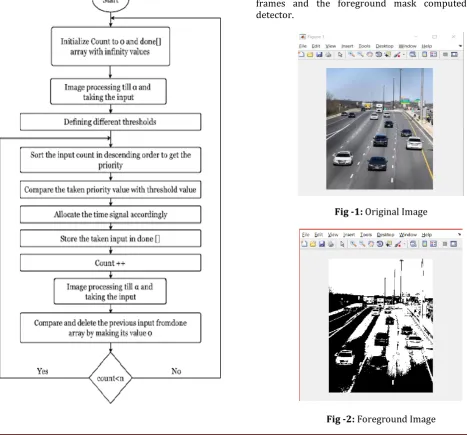
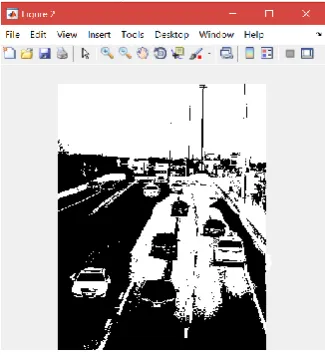
Rather than immediately processing the entire video, the example starts by obtaining an initial video frame in which the moving objects are segmented from the background. This helps to gradually introduce the steps used to process the video. The foreground detector requires a certain number of video frames in order to initialize the Gaussian mixture model. After the training, the detector begins to output more reliable segmentation results. The two figures below show one of the video frames and the foreground mask computed by the detector.
[image:3.595.52.283.325.741.2]
Fig -1: Original Image
[image:3.595.52.520.341.776.2]© 2018, IRJET | Impact Factor value: 6.171 | ISO 9001:2008 Certified Journal | Page 2274 Step 2 - Detect Cars in an Initial Video Frame
The foreground segmentation process is not perfect and often includes undesirable noise. The example uses morphological opening to remove the noise and to fill gaps in the detected objects.
[image:4.595.307.566.99.303.2]Noise Removed Image
Fig -3: Clean Foreground
Next, we find bounding boxes of each connected component corresponding to a moving car by using vision. Blob Analysis object. To highlight the detected cars, we draw green boxes around them.
The number of bounding boxes corresponds to the number of cars found in the video frame.
Fig -4: Detected Cars
Step 3 - Process the Rest of Video Frames and send count to controller.
[image:4.595.79.242.172.350.2]In this step we will process the rest of the video and send the car count to the controller.
Fig -5: Different Thresholds
Fig -6: GUI of the project
In matlab we make above GUI for project. In that we make four windows of four different cameras video input. There detect the every vehicle on road and increased the number of count of vehicles. After some interval time it will arranged in descending order and allocated signal for that road on which more number of cars are present. This process happened again and again and we reduced the traffic.
[image:4.595.327.555.442.554.2]
Fig -7: Signal allocated on different roads
[image:4.595.69.256.475.676.2]© 2018, IRJET | Impact Factor value: 6.171 | ISO 9001:2008 Certified Journal | Page 2275 4. System Antiquation
4.1 Hardware:
PC & Cameras: A PC is used as a central device for various image processing operations and Cameras to capture the video to execute the project.
4.2 Software:
MATLAB: It is used in the entire processing for signal as well as image processing.
5. CONCLUSION
Video detection technology became a new frontier in case of vehicle tracking because of its dependability. Each area needs to be exclusively programmed and the RFID equipping and maintenance is somewhat costly. Unlike any other system, our system confirms high accuracy and we are confident about its success and feasibility. However, further research and development in this management system could bring that extra edge. So far we’ve made this system to ease the traffic law enforcement agencies. Knowing about the traffic pressure of the adjacent node would make the system more artificially intelligent. We hope these methods will be adopted as soon as possible so that the limitations we are experiencing with present method can be overcome.
6. ACKNOWLEDGEMENT
It gives us immense pleasure to express our deepest sense of gratitude and sincere thanks to our highly respected and esteemed guide Prof. Nilima Nikam, Department of Computer Engineering Y.T.I.E.T., Karjat , for her valuable guidance, encouragement and help for completing this work. Their useful suggestions for this whole work and co-operative behavior are sincerely acknowledged.
I also wish to express my gratitude to Prof. Harish Barapatre (Computer Department) for his kind hearted support. I also wish to express my indebtedness to my parents as well as my family members whose blessings and support always helped me to face the challenges ahead. At the end I would like to express my sincere thanks to all my friends and others who helped me directly or indirectly during this project work.
7. REFERENCES
[1] Rajeshwari Sundar, Santhoshs Hebbar, and Varaprasad Golla “Implementing Intelligent Traffic Control System” Sensor Journal, IEEE(Volume:15, Issue :2)
[2] Ms. Sarika B. Kale and Prof. Gajanan P. Dhok “Design of intelligent traffic light controller using embedded system” Second International Conference on
Emerging Trends in Engineering and Technology, ICETET-09.
[3] Xia and Shao, “Modelling of traffic flow and air pollutions ion with application to Hong Kong Island”, Journal of Environmental Modelling & Software. Vol. 20, 2005. pp 1175-1188.
[4] G.Sathya, Fathima Shameema S, Jyothi MolSebastian, Jemsya K S“Automatic Rescue System for Ambulance and Authoritative Vehicles, Vol.2 -Issue 4 April.