© 2018, IRJET | Impact Factor value: 6.171 | ISO 9001:2008 Certified Journal | Page 3661
Experimental Investigation on Effect of Self-Curing Agents on
Mechanical Properties of High Performance Concrete
Gopika Gopi
1, Sreerath S.
2, Vaisakh G.
31
M.Tech Student, Dept. of Civil Engineering,
Federal Institute of Science and Technology, Angamaly, Kerala, India.
2
Assistant Professor, Dept. of civil Engineering, Federal Institute of Science and Technology, Angamaly,
Kerala, India
3
Assistant Professor, Dept. of civil Engineering, College of Engineering Pathanapuram, Kerala, India
---***---Abstract
-
Typical High-performance concrete (HPC)mixtures are characterized by low water-cementitious material ratio, high cement content, and the incorporation of admixtures. In spite of its superior properties in the hardened state, HPC suffers from many practical difficulties such as its sensitivity to early-age cracking. In this context, conventional curing procedures are not sufficiently effective to address these limitations. In order to overcome this issue, three strategies, which are based on the use of internal reservoirs of water, have been recently developed. One of these strategies is based on the use of Light Weight Aggregates (LWA), second one is based on the use of Super Absorbent Polymers (SAP) while the other one is based on the use of Shrinkage Reducing Admixtures (SRA). In this study SRA, Polyethylene Glycol is used as the self–curing agent. The main objective of the current study is to identify the suitable self-curing compound on the selected agents with optimum dosage for High performance concrete. It is also aimed to investigate the strength characteristics of HPC. For the study three self-curing agents namely Polyethylene Glycol (PEG) 300,400 and 600 with varying percentages are to be investigated. A comparison was made considering three curing conditions such as no external and internal curing, wet curing and self-curing. By selecting appropriate materials and controlling their amount, size, and porosity, highly efficient internal water curing can be ensured.
Key Words
:
High-performance concrete, Self-curing, Shrinkage Reducing Admixture, Polyethylene Glycol (PEG), Silica fume.1. INTRODUCTION
HPC has become popular due to its superior mechanical and durability properties [1-2]. HPC significantly reduces maintenance costs and enhances service life [3]. Enhanced durability of HPC makes its use attractive in the environments where ordinary concrete would not suffice. The HPC has constantly growing number of applications: marine construction, high-rise buildings, bridge decks and piers, thin wall shells, airport pavements and many others. However, HPC advancement is hindered by its early-age cracking sensitivity. HPC made with extremely low w/c ratios is prone to self-desiccation that results in autogenous shrinkage [4–7]. Autogenous shrinkage restrained internally by aggregates and externally by neighboring structural members leads to cracking and even failure [8-9]. Obviously, cracked concrete has reduced mechanical properties and
defective durability, which is of particular importance. In order to reduce autogenous shrinkage of HPC and to prevent its early-age cracking it was suggested to introduce into HPC mix pre-saturated LWA [10-12]. Saturated LWA serves as internal water reservoir that supplies internal curing water to counteract self-desiccation [13-16]. This approach was called Internal Curing (IC). Concrete incorporating self-curing agents will represent a new trend in the concrete construction in the new millennium, due to the increased use of high-performance concrete. Several techniques may potentially, be used for incorporation of internal curing water in concrete. Several researchers have proposed the use of saturated LWA to provide ‘‘internal’’ curing for concrete. On the other hand, other researchers used poly-glycol products in concrete mixes as self-curing agent.
Most HPC’s contain insufficient mix water in order to maintain the water-filled coarse capillaries needed to sustain cement hydration and pozzolanic reactions. For this reason, it is generally accepted that methods based on water addition (internal water-supply) are more effective for this type of concrete. Since the internal curing water is a part of the system and it is finely dispersed, it can overcome the problems of low permeability and low w/c ratio, which harmfully affect the efficiency of traditional external curing methods. By this means, use of internal water supplies can be considered as the most effective method for reducing autogenous shrinkage, since it straight forwardly affects self-desiccation (Japan Concrete Institute 1998).
According to the ACI 308 committee, ‘‘internal curing refers to the process by which the hydration of cement occurs because of the availability of additional internal water that is not part of the mixing water’’ [9-10]. A number of natural or artificial materials that possess a significant internal porosity may be used as reservoirs for internal curing water.
The benefits of internal curing are numerous and include, increased hydration process and strength development, reduced autogenous shrinkage and cracking, reduced permeability, and increased durability [11-12].
2. MECHANISM OF SELF CURING CONCRETE:
© 2018, IRJET | Impact Factor value: 6.171 | ISO 9001:2008 Certified Journal | Page 3662 the molecules which in turn reduces the vapour pressure,
thus reducing the rate of evaporation from the surface
2.1. SIGNIFICANCE OF SELF CURING:
When the mineral admixtures react completely in a blended cement system, their demand for curing water (external or internal) can be much greater than that in a conventional ordinary Portland cement concrete. When this water is not readily available, significant autogenous deformation and (early-age) cracking may result. Due to the chemical shrinkage occurring during cement hydration, empty pores are created within the cement paste, leading to a reduction in its internal relative humidity and also to shrinkage which may cause early-age cracking.
2.3. POTENTIAL MATERIALS FOR SELF CURING:
The following materials can provide internal water reservoirs:
a) Light weight Aggregate (natural and synthetic, expanded shale)
b) Light Weight Sand
c) Super-absorbent Polymers (SAP)
d) SRA (Shrinkage Reducing Admixture) (propylene glycol type i.e. polyethylene glycol/ Polyvinyl alcohol)
e) Wood powder.
3. RESEARCH SIGNIFICANCE
A comprehensive experimental investigation has been undertaken to study the effects of self-curing agents such as, polyethylene glycol 300,400 and 600. The principle aim of the study was to evaluate the effect of consecutive self-curing agents on the 7th day and 28th day compressive and
tensile strength of concrete. A comparison was made between specimens subjected to no external and internal curing, conventional curing and those cured with self-curing compounds. It is also aimed to overcome the limitations of traditional methods of curing which cannot eliminate autogenous shrinkage due to self- desiccation.
4. EXPERIMENTAL PROGRAMME
In the current study, an experimental work was carried out to establish the suitability of a curing compound and its dosage in HPC. In this study, three types of hydrophilic compounds (PEG 300, PEG 400 & PEG 600), four dosages of hydrophilic compounds (0.5%, 1%, 1.5% & 2% by mass of cement) and three curing conditions (no external and internal curing, curing by conventional water immersion and self –curing) are considered as the parameters of this investigation. A comparison was made between specimens subjected to conventional wet curing with those cured with hydrophilic compounds i.e. various self-curing compounds.
4.1 MATERIALS
4.1.1 Cement
53-grade Ordinary Portland cement confirming to IS 8112:1989 was used in this investigation. Cement test was done as per IS 4031:1988 and the test results are analyzed according to IS 8112:1989. It has a specific gravity of 3.125, standard consistency of 32.5% and initial and final setting times were 70 min and 348 min respectively.
4.1.2 Fine aggregate
The fine aggregate type used in the study was manufactured sand confirming to zone-II. Tests on fine aggregates are conducted confirming to IS 2386: 1963(part I and part III) and the results are analysed according to IS 383:1970. The specific gravity of M-sand were 2.605.
4.1.3 Coarse Aggregate
Natural coarse aggregate with a maximum nominal size of 20mm is used for the study. Tests on coarse aggregate is done confirming to IS 2386:1963 (part I and III) and the results are analysed according to IS 383:1970. The specific gravity, fineness modulus and water absorption of coarse aggregate were 2.65, 6.19 and 0.44 respectively.
4.1.4 Silica Fume
Silica fume is a by-product of the manufacturing process of silicon and ferrosilicon alloys. The major purpose of introducing silica fume to the concrete mix is to achieve high strength and durability. The micro silica has a specific gravity of 2.2.
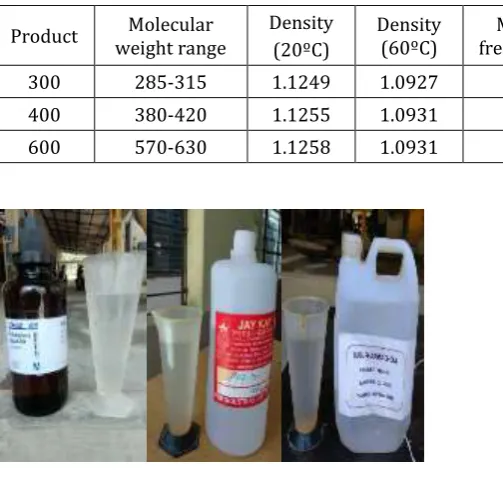
4.1.5 Hydrophilic chemicals
© 2018, IRJET | Impact Factor value: 6.171 | ISO 9001:2008 Certified Journal | Page 3663 Table 1: Physical properties the PEG compounds
Fig 1. (a)PEG300, (b) PEG400, (c) PEG600
4.1.6 Super Plasticizer
Ceraplast 300 is a high-grade superplasticizer based on Naphthalene, highly recommended for increased workability and high early and ultimate strengths of concrete.
4.1.8 Mix proportions
In order to obtain out the required control mix M60 with high workability different trials and adjustments were done, the water cement ratios and the dosage of Ceraplast-300 were adjusted and the final design mix adopted was shown in Table 2.
Table 2: Details of Control Mix
Details of mix Grade –M60
Mix proportion 1:1.03:2.04:0.29
Cement content 543.44kg/m3
Micro silica content 27.172kg/m3
Fine aggregate content 557.83kg/m3
Coarse aggregate content; 1141.779kg/m3
Water-cement ratio 0.29
Amount of water 157.8litre
Slump 137
Workability High
4.1.9 Nomenclature of specimens
[image:3.595.306.560.297.462.2]The nomenclature of specimens used in this work is given below in Table 3. Nomenclature is done for the purpose of identification of specimens during casting program.
Table 3: Specimen Nomenclature
Specimen Description
N00C Specimen with no external and internal curing C00M Specimen with external water curing
T05,F05,S05 Specimen with 0.5% PEG 300,400&600 respectively
T10,F10,S10 Specimen with 1% PEG 300,400&600 respectively
T15,F15,S15 Specimen with 1.5% PEG 300,400&600 respectively
T20,F20,S20 Specimen with 2% PEG 300,400&600 respectively
4.1.10 Experimental procedure
Mixing of concrete components was achieved by using a horizontal mixer. All the dry constituents were placed in the mixer and mixed for 2 min to ensure uniformity of the mix. Half of the mixing water was added gradually during mixing and followed by the remaining water with SP. Finally, in the case of self-curing concrete, self-curing agent such as Polyethylene-glycol was added gradually during mixing. Mixing of all ingredients continued for a period of 2 min. The content of SP was adjusted for each mix to ensure that no segregation would occur and to achieve the required workability.
After mixing, the mixture was cast into 150×150×150 mm cubic molds and cylindrical molds with internal diameter 150mm and height 300mm at three equal layers, each layer was compacted by hand tamping and on mechanical vibrator table. After the molds had been filled of concrete, the surface of concrete in molds was leveled and they were kept in the laboratory conditions for 24h then, the specimens were demolded and exposed to curing regimes. Compressive strength were carried out on cubic specimens and split tensile strength was performed cylindrical specimen. Product weight range Molecular Density
(20ºC)
Density
(60ºC) freezing range Melting or Solubility in water at 20ºC% by wt Viscosity at 100ºC
300 285-315 1.1249 1.0927 -15to-8 Complete 5.8
400 380-420 1.1255 1.0931 4to8 Complete 7.3
[image:3.595.45.280.546.732.2]© 2018, IRJET | Impact Factor value: 6.171 | ISO 9001:2008 Certified Journal | Page 3664 Fig 2. Test Specimens Cast
5. RESULTS AND DISCUSSIONS
5.1. Compressive strength
Fig.4 & 5 reveals that, Compressive strength systematically increases when self-curing agents used in concrete, which may be attributed to the continuation of the hydration process, which leads to, lower voids and pores, and greater bond force between the cement paste and aggregates as stated by Bentz et al., Cusson et al. and Jensen et al.
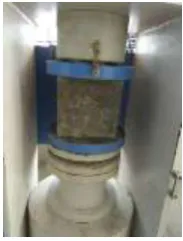
Fig 3. Compression testing specimen
From the experimental investigation it is revealed that, compressive strength of concrete with no external or internal curing is less as when compared to concrete which undergone the process of curing. It is inferred that the optimum dosage of PEG 300 for M60 concrete is 1%, and at this dosage the concrete acquires more strength and the percentage increase in compressive strength was found to be 4.11% compared to conventionally cured concrete. The compressive strength of self- cured concrete with SRA of PEG 300 is more than that of conventionally cured concrete at 1% and 1.5% of PEG 300.
For PEG 400 optimum dosage for M60 concrete is 1.5% and at this dosage the concrete acquires more strength and the percentage increase in compressive strength was found to be 5.69% compared to conventionally cured concrete. The compressive strength of self-cured concrete with SRA of PEG 400 is more than that of conventionally cured concrete at 1%, 1.5% and 2% of PEG 400.
As in the case of self-curing agent PEG 600 optimum dosage for M60 concrete is obtained at 1.5% and at this dosage the concrete acquires more strength. The percentage increase in compressive strength was found to be 8.42% compared to conventionally cured concrete. The compressive strength of self- cured concrete with SRA of PEG 400 is more than that of conventionally cured concrete at 1%, 1.5% and 2% of PEG 600.
[image:4.595.308.561.251.421.2]When non cured specimen is compared with externally cured specimen the percentage increase of compressive strength of cured specimen is found to be 13.327%. Also it is inferred that compressive strength significantly increases with higher molecular weights of PEG.
Fig 4. Effect of self-curing agents on 7th day Compressive
Strength of concrete
Fig 5. Effect of self-curing agents on 28th day Compressive
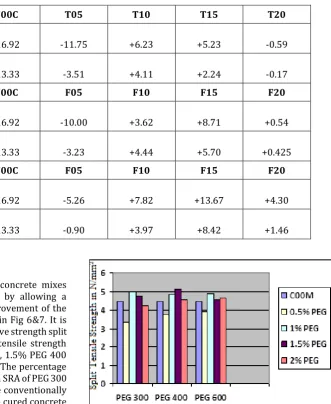
[image:4.595.115.207.371.492.2] [image:4.595.308.555.459.649.2]© 2018, IRJET | Impact Factor value: 6.171 | ISO 9001:2008 Certified Journal | Page 3665 Table 4.Percentage variation in compressive strength of different curing regime concretes compared to
conventionally cured concrete
5.1. Split tensile strength
The use of SRA with different ratios in concrete mixes provide internal curing for the concrete by allowing a continuous hydration, which leads to improvement of the tensile strength of the concrete as shown in Fig 6&7. It is inferred that with the increase in compressive strength split tensile strength was also increases. Split tensile strength reaches maximum value at 1% of PEG 300, 1.5% PEG 400 and 1.5% PEG 600 in M60 grade concrete. The percentage increase in split tensile strength of HPC with SRA of PEG 300 was found to be 6.46% as compared to the conventionally cured concrete. The tensile strength of self- cured concrete with PEG 300 is more than that of the conventionally cured concrete at 1% and 1.5% of PEG 300.
For PEG 400 the percentage increase in split tensile strength was found to be 7.06%, when compared with conventionally cured concrete. The tensile strength of PEG 400 is more than that of the conventional cured concrete at 1% and 1.5% of PEG 400.
As in the case of PEG 600 the percentage increase in split tensile strength was found to be 16.80%, when compared to the conventionally cured concrete. The tensile strength of self- cured concrete with PEG 600 is more than that of conventionally cured concrete at 1%, 1.5% and 2% of PEG 600.
[image:5.595.310.560.565.731.2]When non cured specimen is compared with externally cured specimen the percentage increase in tensile strength of cured specimen is found to be 17.44%.
Fig 6. Effect of self-curing agents on 7th day Split
Tensile strength of concrete
Fig 6. Effect of self-curing agents on 28th day Split
Tensile strength of concrete
SPECIMEN PEG 300 N00C T05 T10 T15 T20
% Variation in 7th day
compressive strength -16.92 -11.75 +6.23 +5.23 -0.59
% Variation in 28th day
compressive strength -13.33 -3.51 +4.11 +2.24 -0.17
Specimen PEG 400 N00C F05 F10 F15 F20
% Variation in 7th day
compressive strength -16.92 -10.00 +3.62 +8.71 +0.54
% Variation in 28th day
compressive strength -13.33 -3.23 +4.44 +5.70 +0.425
SPECIMEN PEG 600 N00C F05 F10 F15 F20
% Variation in 7th day
compressive strength -16.92 -5.26 +7.82 +13.67 +4.30
% Variation 28th day
© 2018, IRJET | Impact Factor value: 6.171 | ISO 9001:2008 Certified Journal | Page 3666
Table 5. Percentage variation in Tensile strength of different curing regime concretes compared to conventionally cured concrete
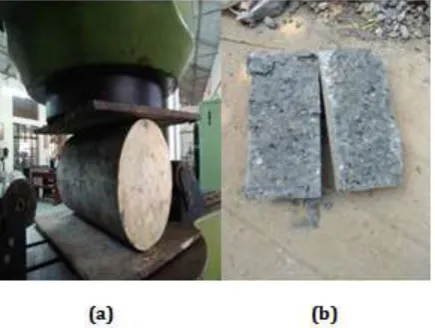
Fig 6 (a) Split tensile test (b) Test specimen
6. CONCLUSION
In this research, a series of experiments have been performed to investigate the behaviour and the properties of specimen subjected to no external and internal curing, conventional wet curing and those cured with self–curing compounds in High Performance Concrete. The principle aim of the study was to find out the suitable SRA among PEG 300, PEG 400 and PEG 600 and its optimum dosage on M60 grade concrete. Also the study was aimed to evaluate the effect of these agents on the mechanical properties of HPC. Based on the experimental results presented in this study, the following conclusions could be drawn as follows:
1. Compressive strength and tensile strength of all the concrete studied increases with time in different rates under different curing conditions. Compressive strength systematically increases with SRA of PEG compounds, which may attributed by the continuation of hydration process.
2. At the age of 28 days, SRA added concrete is found to be show better compressive and tensile strength characteristics
than conventionally cured concrete. For PEG 300, the optimum dosage was found to be 1%. Whereas, PEG 400 and PEG 600 has shown optimum values at 1.5%.
3. Percentage increase in compressive strength on addition with PEG 300, 400 and 600 were found to be 4.11%, 5.69% and 8.42% respectively, when compared to the conventionally cured concrete. Compressive strength of conventionally cured specimen is significantly higher than specimen with no external and internal curing and the percentage increase was found to be 13.33%.
4. Percentage increase in tensile strength was found to be higher while incorporating PEG 300, 400 and 600 to HPC and the increment was about 4.11% for PEG 300, 5.69% for PEG 400 and 8.42% PEG 600 than the conventionally cured concrete. Tensile strength of conventionally cured specimen is higher than those with no external and internal curing and the percentage increase was found to be 17.44%.
5. Mechanical properties of self-cured HPC was superior while using SRA of PEG 600. Also increasing the amount SRA can lead to a reduction of strength for all type of PEG studied.
6. Self-curing concrete resulted in better hydration with time under drying condition compared to conventional concrete.
RECOMMENDATIONS FOR FUTURE SCOPE OF
WORK
1. Self- Curing concrete is an alternative to conventional concrete in desert regions where scarcity of water is a major problem. It should be necessary to check the temperature effect in desert regions.
2. SRA, PEGs are available in average molecular weight ranging from 200 to 8000. Studies can also extended to the rest of the agents.
Specimen PEG 300 N00C T05 T10 T15 T20
% Variation in 7th day Split tensile strength -17.44 -13.66 +10.06 +6.19 -5.14
% Variation in 28th day Split tensile strength -15.71 -6.56 +6.46 +3.01 -4.49
Specimen PEG 400 N00C F05 F10 F15 F20
% Variation in 7th day tensile strength -17.44 -15.43 +11.83 +12.35 +2.40
% Variation in 28th day tensile strength -15.71 -11.91 +4.92 +7.06 -1.89
Specimen PEG 600 N00C F05 F10 F15 F20
[image:6.595.42.260.312.476.2]© 2018, IRJET | Impact Factor value: 6.171 | ISO 9001:2008 Certified Journal | Page 3667 3. HPC is often used just because of its superior durability.
So it is absolutely necessary to conduct durability studies on these specimens.
ACKNOWLEDGEMENT
The authors wish to gratefully acknowledge the support from the management and staff from CIVIL Department of Federal Institute of Science and Technology, Angamaly.
REFERENCES
[1] Semion Zhutovsky, Konstantin Kovler, “Effect of internal curing on durability-related properties of high performance concrete”, Cement and Concrete Research 42 (2012) 20–26
[2] Magda I. Mousa , Mohamed G. Mahdy , Ahmed H. Abdel-Reheem, Akram Z. Yehia, “Self-curing concrete types; water retention and durability, Alexandria Engineering Journal” (2015) 54, 565–575
[3] Magda I. Mousa , Mohamed G. Mahdy , Ahmed H. Abdel-Reheem, Akram Z. Yehia, “Physical properties of self-curing concrete (SCUC)”, HBRC Journal (2015) 11, 167–175.
[4] Magda I. Mousa , Mohamed G. Mahdy , Ahmed H. Abdel-Reheem, Akram Z. Yehia, “Mechanical properties of self-curing concrete (SCUC)”, HBRC Journal (2015) 11, 311–320
[5] Semion Zhutovsky, Konstantin Kovler, “Influence of water to cement ratio on the efficiency of internal curing of high performance concrete”, Construction and Building Materials 144 (2017) 311–316
[6] A.S. El-Dieb, “Self-curing concrete: water retention, hydration and moisture transport”, Constr. Build. Mater. 21 (2007) 1282– 1287.
[7] B. Mather, “Self-curing concrete”, Concr Int. 23 (1) (2001) 46–47.
[8] J. Castro, L. Keiser, M. Golias, J. Weiss, “Absorption and desorption properties of fine lightweight aggregate for application to internally cured concrete mixtures”, Cement Concr. Compos. 33 (2011) 1001–1008.
[9] Bentz, D. P., Lura, P., & Roberts, J. W. (2005). Mixture proportioning for internal curing. Concrete International, 27(2), 35–40.
[10] Kohler K., & Jensen O. M. (2007). Internal curing of concrete, state-of-the-art Report of RILEM Technical Committee 196-ICC. RILEM Publications S.A.R.L., RILEM REPORT 41, Lausanne, Switzerland
[11] Cusson, D., & Hoogeven, T. (2008). Internal curing of highperformance concrete with pre-soaked fine lightweight aggregate for prevention of autogenous shrinkage cracking. Cement and Concrete Research, 38, 757–765.
[12] Jensen, O. M., & Hansen, P. F. (2002). Water-entrained cementbased materials—II. Experimental observations. Cement and Concrete Research, 32, 973–978.
[13] IS 4031-1996 Part I, “Methods of Physical Tests for Hydraulic Cement” Bureau of Indian Standards New Delhi
[14] IS: 12269- 1987, “Specification for 53 Grade Ordinary Portland Cement, Bureau of Indian Standards New Delhi, India, 1989.
[15] IS 4031-1988 Part 6, “Methods of Test for Aggregates for Concrete” Bureau of Indian Standards New Delhi
[16] IS 2386-1963 Part I, “Methods of Test for Aggregates for Concrete” Bureau of Indian Standards New Delhi
[17] IS 2386-1963 Part III “Methods of Test for Aggregates for Concrete” Bureau of Indian Standards New Delhi
[18] IS 10262-2009, “Guidelines for Concrete Mix Design Proportioning” Bureau of Indian Standards New Delhi
[19] IS 516-1959, “Methods of Tests for Strength of Concrete”, Bureau of Indian Standards New Delhi
[20] IS 5816-1999, “Split Tensile Strength of Concrete - Method of Test”, Bureau of Indian Standards New Delhi