© 2016, IRJET | Impact Factor value: 4.45 | ISO 9001:2008 Certified Journal
| Page 454
PLC BASED CHANGE DISPENSING VENDING MACHINE USING IMAGE
PROCESSING TECHNIQUE FOR IDENTIFYING AND VERIFYING
CURRENCY
Dimple Thakwani, Dr. N Tripathi
M.Tech scholar, Deptt. Of Electrical Engg ,BIT, Durg,C.G. India
Associate Professor, Deptt. Of Electrical Engg ,BIT, Durg,C.G. India
---***---Abstract
-
Change dispensing vending machines are used toprovide change to the user as per the denomination of note given to the machine by the user. Change dispensing vending machine using PLC can be implemented using various devices or techniques such as transistors, transducers, sensors and image processing technique. In this research paper image processing technique is used with PLC for change dispensing machine. Counterfeit currency is the major problem associated with change dispenser machine. To detect the counterfeit note and to identify its denomination image processing technique is used. The output of the image processing is given to the PLC and the operation of PLC is programmed using ladder logic in this paper.
Key Words:
Currency, PLC, Sensor, Image processing technique, Change dispensing (vending) machine.
1. INTRODUCTION
A change dispensing vending machine is a machine which is used to dispense change to the user as per the value of the currency inserted in the machine .Once the currency is inserted in the machine image processing technique is used to check its denomination, counterfeit note and sensor is used to check availability of stock however the above process would not be time consuming at all and it also reduces the counterfeiter. The user will get all the details on the screen necessary for the valid transaction. Image processing technique is used for validation and identification of note. Along with it a strain gauge based load sensor can be used for checking the availability of stock in the machine
.
2. OBJECTIVE
To design a change dispenser which will accept currency (note) of denomination 10 rupees and 20 rupee and will dispense 5 rupee coin. So, when the user inserts 10 rupee note he/she would get 2Nos 5 of 5 rupee coins and 4Nosof
-5 rupee coins for the 20 rupee note after validation, identification of note and availability of stock.
3. LITERATURE REVIEW
3.1 In 2013 Vipin Kumar Jain and Dr. Ritu Vijay propose method for identifying denomination of currency using image processing technique. First the ROI is extracted than by pattern recognition and Neural Network matching technique is used to match or find the currency.
3.2 In 2014 S.Surya and G.Thilambal propose method to recognize currencies from different countries based on features that is color, texture, size in image processing using filters and Sobel operator.
3.3 In 2014 Binod Prasad Yadav, C.S Patil, R.R Karhe , P.H Patil propose method counterfeit currency detection using MATLAB and feature extraction with HSV color space and other application of image processing technique.
4.
FEATURES OF 10 AND 20 RUPEES CURRENCY
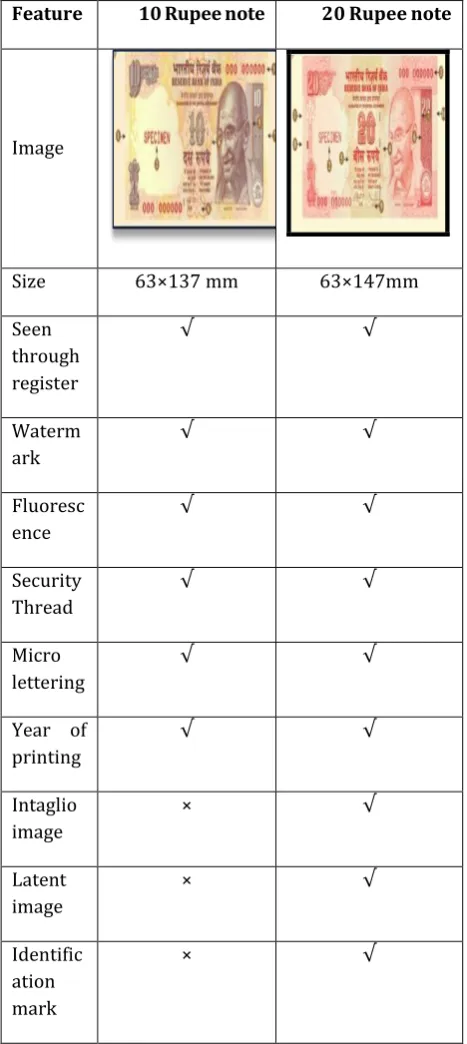
Every Indian currency issued by RBI has some special security features.
© 2016, IRJET | Impact Factor value: 4.45 | ISO 9001:2008 Certified Journal
| Page 455
Table -1:
Features of 10 and 20 rupees note
Feature 10 Rupee note 20 Rupee note
Image
Size 63×137 mm 63×147mm
Seen through register
√ √
Waterm ark
√ √
Fluoresc ence
√ √
Security Thread
√ √
Micro lettering
√ √
Year of printing
√ √
Intaglio image
× √
Latent image
× √
Identific ation mark
× √
TABLE-2
: Main demarcation of 10 and 20
rupees note
Feature 10 rupee note
20 rupee note
Size
63×137 mm
63×147 mm
Identification mark × √
Intaglio image × √
5.
HARDWARE REQUIRED
PLC, Camera or Sensor, currency, coin
6. METHODOLOGY
6.1 IMAGE ACQUIT ION-
Image acquisition is the first step for identifying denomination and counterfeit currency as image processing technique processes the acquired image. Image can be acquire using scanner or camera. The image captured/ scanned are stored in .jpeg format
6.2 IMAGE PREPROCESSING
The main purpose for preprocessing is to remove noise from the acquired image and to improve its visual appearance. It includes resizing image, removing noise , separating channels, denoising each channels and then restoring channels.
6.3 FEATURE EXTRACTION
It includes the following steps such as-
6.3.1 COLOR FEATURE-
[image:2.595.315.553.141.266.2]© 2016, IRJET | Impact Factor value: 4.45 | ISO 9001:2008 Certified Journal
| Page 456
6.3.2 EDGE FEATURE
In edge detecting feature rgb color space is converted into ycbr color space then y component is extracted , sobel mask is applied and edges are detected.
6.3.3 CONTRAST ENHANCE THE GRAY IMAGE-
After gray scale conversion the image contrast is enhanced to emphasize dark lines in lighter background.6.4 SEGMENTS
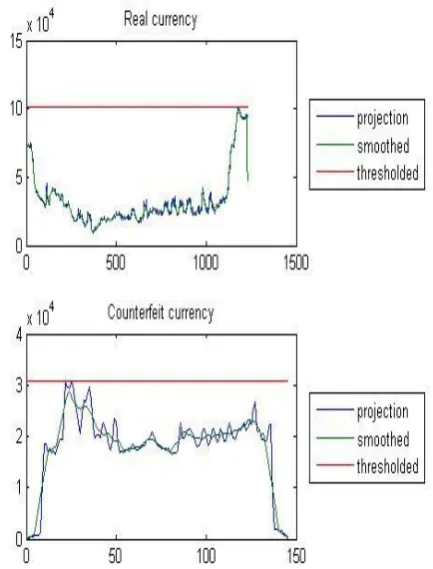
The number of segments obtained depends on currency for real currency there is only one segment while for counterfeit currency there are many segments as shown in figure 1.
7. CHECKING COUNTERFEIT CURRENCY AND
DENOMINATION OF CURRENCY
Flowchart for identifying denomination and counterfeit currency is shown in figure 1
Image Acquistion
Image Preprocessing
Remove noise
Feature extraction
Color feature
Edge feature
Texture feature
Image comparison
Output for denomination
Contrast enhance the gray image
Difference image
Threshold image
Get no of segments
Real or counterfeit currency
FIGURE 1
. Flow chart for identifying and
verifying currency using image processing
7.1 OUTPUT FOR DENOMINATION OF
CURRENCY
The acquired image is compared with the stored image and accordingly output for denomination is identified if the image matches with the stored image it will shows the denomination otherwise it will show invalid currency.
7.2 OUTPUT FOR REAL OR COUNTERFEIT
CURRENCY
[image:3.595.329.546.291.576.2]The graph obtained for real and counterfeit currency is shown in figure 2.
FIGURE 2.
Graph for real and counterfeit currency
© 2016, IRJET | Impact Factor value: 4.45 | ISO 9001:2008 Certified Journal
| Page 457
TABLE-3:
Features of real and counterfeit
currency graph
Real
Counterfeit
Threshold value 10*104 3*104
projected value at 0
7.5 0
Projected-smoothened
0 .5
Difference
between projected value
Very small
Small
8. IMPLEMENTATION
The flowchart of vending machine using PLC is shown in figure 3
No No
Yes
No
Yes
Verification and identification of note
Is note valid
Check stock
If available
Set counter
Dispense change
[image:4.595.305.584.158.338.2]Stop
FIGURE 3. Implementation of change
dispensing machine using PLC
9. PLC LADDER DIAGRAM
The above flow chart is programmed in PLC as shown in ladder diagram in figure 4
Rung 1 Scan image Proceed image in image processing technique
Rung 2 I1 I2 I3 Q1 dispense 2no of 5 rupees
coin
Rung 3 I1 I4 I3 Q2 dispense 4no of 5 rupees
coin
Rung 4 I1 I2 I4 Q3 displays fake note
Rung 5 I1 I2 I3 Q4 display insufficient stock
I4
FIGURE4. Ladder diagram of PLC based
change dispensing machine
Here,
I1,I2,I3 and I4 are normally open.
Q1,Q2,Q3 and Q4 are coils.
I1- input given to PLC
I2- 10 rupee note is identified and verified in Image
Processing .
I3 – sufficient stock available.
I4- 20 rupee note is identified and verified in Image
Processing.
Q1- Dispenses 2 no of 5 rupee coin.
Q2- Dispenses 4 no of 5 rupee coin.
Q3- Displays fake note.
Q4- Displays insufficient stock.
10. WORKING
[image:4.595.114.279.404.675.2]© 2016, IRJET | Impact Factor value: 4.45 | ISO 9001:2008 Certified Journal
| Page 458
10.2 RUNG 2- When input is given to machine, Image processing identify and verify 10 rupee note and check for sufficient stock in machine then machine dispenses 2 no of 5 rupees coin.
10.3RUNG 3- When input is given to machine, Image Processing identify and verify 20 rupee note and sufficient stock is available then machine dispenses 4 no of 5 rupees coin.
10.4 RUNG 4- When input is given to machine and the Image Processing does not identify the inserted note as 10 or 20 rupee note then machine displays fake note.
10.5 RUNG 5- When input is given to machine, Image Processing identify and verify either 10 rupee or 20 rupee note and there is insufficient stock then machine displays insufficient stock.
11. RESULT
The designed machine successfully give two coins of 5 rupees whenever a currency of Rs 10 is inserted in the machine only after verifying it`s correctness and availability of stock in the machine. This machine also gives four 5 rupees coin for Rs 20 as input as explained above.
12. CONCLUSION
It is observed that image processing technique used for identification and verification of currency is faster than sensor in PLC based vending machine.
REFERENCES
1. Biplab Roy, and Biswarup Mukherjee , “design of a coffee vending machine using single electron devices” in 2010 International Symposium on Electronic System Design pp-38-43.
2. Caruso, Michael J.; C.H. Smith; T. Bratland; R. Schneider. "A New Perspective on Magnetic Field Sensing" (PDF). Plymouth, MN and Eden Prairie, MN: Honeywell SSEC and Nonvolatile Electronics: 14–15.
3. Vipin Kumar Jain, Dr. Ritu Vijay, “Indian Currency Denomination Identification Using Image Processing Technique” in 2013 International Journal of Computer Science and Information Technologies, Volume 4(1)
4. S.Surya, G.Thailambal,”Comparative Study on Currency Recognition System Using Image Processing: in 2014 International Journal of Engineering And Computer Science” volume(3) pp-(7723-7726)
5. User manual / guidelines from RBI (2005), Counterfeit money detection, 10 Indian rupees note.
6. User manual / guidelines from RBI (2005), Counterfeit money detection, 20 Indian rupees note 7. Comelinus.T Leondes, Image Processing and pattern Recognition , Elseiver 1998 publish,volume(5) of neural Network Systems Techniques and applications.