© 2017, IRJET | Impact Factor value: 5.181 | ISO 9001:2008 Certified Journal
| Page 2583
“
A STUDY ON MECHANICAL PROPERTIES OF LIGHT WEIGHT CONCRETE
OBTAINED BY PARTIAL REPLACEMENT OF CEMENT WITH FLYASH, GROUND
GRANULATED BLAST FURNACE SLAG AND COARSE AGGREGATE WITH BRICK
BATS
”
K DIVYA TEJA
1,P CHAMANTHI
2,P BALA KRISHNA
31
M Tech in structural engineering,Department of Civil Engineering,KMM Institute of technology,Tirupathi. Andhra
Pradesh.
2
Assistant professor,Department of Civil Engineering, KMM Institute of technology,Tirupathi. Andhra Pradesh.
3Assistant professor and Head of Department of Civil Engineering, KMM Institute of technology,Tirupathi. Andhra
Pradesh.
---***---ABSTRACTConcrete is a durable and versatile construction material. It is not only strong, economical and takes the shape of the form in which it is placed, but it is also aesthetically satisfying. Brick Bats are considered as the key factor which had been used as an replacement of Coarse Aggregate. Among the waste or by-product materials, Fly Ash (FA) and Ground Granulated Blast Furnace Slag (GGBS) are the most potential source. The objective of this project is to study the effect of class F fly ash (FA) and Ground Granulated Blast Furnace Slag (GGBS) on the mechanical properties of Brick Bats at different replacement levels. In the present investigation it is proposed to study the mechanical properties viz. Compressive strength at 3, 7, 28 and 90 days, Flexural strength at 7, 28 and 90 days, Rapid Chloride Permeability Test (RCPT) at 90 days and Scanning Electron Microscopy (SEM) and Energy Dispersive X-Ray Analysis (EDX) tests at 3 and 28 days for M 25 mix at ambient room temperature curing. From the results, it is concluded that the decreased percentage level of FA and GGBS increased the Compressive strength, Flexural strength and Durability at all curing periods. Results revealed that FA and GGBS blended have attained enhanced mechanical properties at all curing periods with the low cost materials. SEM and EDX results showed the changes in chemical properties of the cement at 3 and 28 days. Almost the strength attained by these combinations is very nearer to the Conventional Concrete mix .
Key Words: fly ash, ground granulated blast furnace slag coarse aggregate with brick bats.
INTRODUCTION:
Very likely to other methods of concrete mix design, guidelines recommended by bureau of Indian standards for concrete mix design is based on certain empirical
relations established through vast number of experiments conducted upon materials used in Indian conditions. IS: 10262 is the specified code to serve the purpose. This code came to being in the year 1982. So IS: 10262-1982 had been evolved to guide the concreting technology being followed at that period. But at present due to demand in high strength concrete and for economic production, use of supplementary materials has become essential. With the advanced technology a number of additives have been identified and are being used extensively now-a-days. These additives are not only enhancing the quality of concreting but also make the process economic and eco-friendly too However, Normal Weight Concrete (NWC) can cause issues during design, as its natural density is high in relation to its strength, meaning a greater dead weight when compared to other building materials. This can be addressed in a number of ways, depending upon the required properties of the concrete and its end use.
One of the disadvantages of conventional concrete is the high self-weight of concrete. Density of normal concrete is in the order of 2200 to 2600 kg/m3.
However, using Light Weight Aggregates (LWAs) in place of dense aggregates can also reduce the concrete weight. Use of Brick Bats is one such light weight aggregate, used in certain places where natural aggregates are not available or costly. Where ever brick bats aggregates are used the aggregates are made from slightly over burnt bricks. This will be hard & absorb less water.
REVIEW OF LITERATURE:
© 2017, IRJET | Impact Factor value: 5.181 | ISO 9001:2008 Certified Journal
| Page 2584
method making a light weight concrete and Pumice is themost widely used light aggregate in Turkey for light weight structural concretes and also stated that a reduced concrete density generally results in a lower strength, it is not difficult to obtain light weight structural concretes which have a characteristic compressive strength of 20 MPa rising in some cases to 30 MPa by using concrete made with pumice aggregate. Brown BJ, Skinner M reported that Pumice aggregate combined with Portland cement and water produces a light weight thermal and sound insulating, fire-resistant light weight concrete for roof decks, light weight floor fills, insulating structural floor decks, curtain wall system, either prefabricated or insitu, pumice aggregate masonary blocks and a variety of other permanent insulating applications. As per Euro code No. Design of Concrete structures part-1, Although structural light weight concrete is usually defined as a concrete with an oven dry density of not greater than 2000 Kg/m3, there
are variations in certain parts of the world.
ACI 304.5R (1991) recommend the use of unsoaked light weight aggregate to avoid absorption of the additives into the light weight aggregate. Delayed addition of super plasticizers will also reduce the problem.
T.Ashworth, E.Ashworth detailed that warm conductivity of solid increments with expanding dampness content. Since water has conductivity around 25 times that of air, plainly when the air in the pores has been halfway dislodged by water or dampness, the solid must have more prominent conductivity.
MATERIALS
Cement
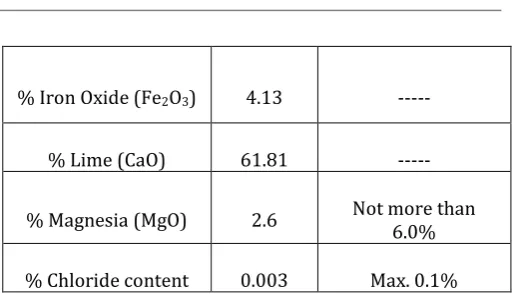
[image:2.595.309.568.78.225.2]Ordinary Portland Cement of grade 43 was used in the present experimental investigation. All the tests are carried out in accordance with procedures described in IS: 4031-1968 and find the physical properties of the cement. The chemical properties of the cement as obtained from the manufacturer are presented in the Table 4.1.
Table 4.1 Chemical Composition of cement
PARTICULARS RESULT TEST
REQUIREMENTS AS PER
IS:12269-1987
% Silica (SiO2) 20.65 ---
% Alumina (Al2O3) 5.67 ---
% Iron Oxide (Fe2O3) 4.13 ---
% Lime (CaO) 61.81 ---
% Magnesia (MgO) 2.6 Not more than 6.0%
% Chloride content 0.003 Max. 0.1%
Table 4.2 Physical Properties of Cement
PHYSICAL PROPERTIE
S
TEST RESUL
T
TEST METHOD/ REMARKS
REQUIREMEN T AS PER
IS:12269-1987
Specific
gravity 3.15 IS:4031(Part II) -1988 ---
Fineness
(m2/Kg) 311.5
Manufacture
r data Min. 225 m2/kg
Normal
consistency 30% IS:4031(Part IV ) -1988 ---
Initial setting time
(min) 90
IS:4031(Part
V ) -1988 Min. 30 min
Final setting
time (min) 220 IS:4031(Part V ) -1988 Max. 600 min
Soundness Lechatlier Expansion
(mm)
Autoclave Expansion
0.8
0.01
IS:4031(Part III ) -1988
Max. 10 mm
Max. 0.8%
Fly Ash (FA)
[image:2.595.306.566.248.708.2]© 2017, IRJET | Impact Factor value: 5.181 | ISO 9001:2008 Certified Journal
| Page 2585
present in the Fly ash. The classified Fly ashes are Class F(low-calcium) and Class C (high-calcium). In the Present investigation Class F flyash produced from Rayalaseema Thermal Power Plant (RTPP), Muddanur, A.P was used.
[image:3.595.365.513.180.284.2]Ground Granulated Blast Furnace Slag (GGBS)
Fig Ground Granulated Blast Furnace Slag
Similarly as fly ash remains is utilized as an admixture in making concrete in comparable way ground granulated blast furnace slag famously referred to as GGBS is likewise utilized as an admixture in cement. In different nations its utilization as an admixture is more regular than its utilization as slag cement. Presently in India since it is accessible independently as Ground granulated blast furnace slag (GGBS), its utilization as an admixture is more normal. With the developing notoriety of RMC, the extension for utilizing GGBS turns out to be more famous.
Coarse Aggregate
Coarse aggregate is also one of the important constituent of conventional concrete. It gives strength to the concrete. The aggregate occupy 70-80 percent of the volume of the concrete. Generally aggregate can be classified on the basis of the size as coarse aggregate and fine aggregate.
Two types of coarse aggregate are used in the present investigation.
1. Hard broken granite (HBG) 2. Brick Bat (Fresh and Debris)
Hard Broken Granite (HBG)
Crushed granite stone of size 20 mm and 10 mm is used as coarse aggregate. The specific gravity in oven dry condition and water absorption of the coarse aggregate as per IS: 2386 (part III)-1963 are observed as 2.65 and 0.5% respectively.
Brick Bats
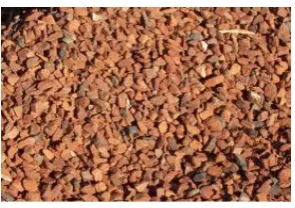
The Fresh and Debris Brick Bats are collected locally and then broken into pieces of required sizes related to coarse aggregate and sieved through 4.75mm sieve to remove the finer particles.
Fig. Brick Bats
Fine Aggregate
The sand utilized all through the experimental work was acquired from the river Swarnamukhi, Chandragiri,and Chittoor (Dist). The bulk specific gravity in dry condition and water absorption of the sand according to Seems to be: 2386 (Part III) - 1963 are 2.58 and 1% individually. Fineness modulus of sand is gotten from sieve analysis. The gradation of the sand was determined by sieve analysis according to IS: 383 - 1970.
Water
In this present investigation normal water is used for making concrete.
[image:3.595.111.242.181.283.2]SELECTION OF COMBINATIONS
Table Selection of combinations
sl
no C F G
CA
Fi M
H B
1 100 ---- ---- 100 0 100 CCM
2 100 ---- ---- 50 50 100 R – 1
3 100 ---- ---- 50 50 100 R – 2
4 85 15 ---- 50 50 100 M - 1
5 80 20 ---- 50 50 100 M - 2
[image:3.595.317.552.540.776.2]© 2017, IRJET | Impact Factor value: 5.181 | ISO 9001:2008 Certified Journal
| Page 2586
7 70 30 ---- 50 50 100 M - 48 85 ---- 15 50 50 100 M - 5
9 80 ---- 20 50 50 100 M - 6
10 75 ---- 25 50 50 100 M - 7
C-cement % ; F-fly ash % ;G-GGBS% ; CA-coarse aggregate ; H-HBG ; B-brick bats ; Fi- fine aggregates ; M-mix.
RESULTS AND DISCUSSIONS:
COMPRESSIVE STRENGTH
The compressive strength of the matrix was determined by conducting compression test on the cubes of size 150 mm x 150 mm x 150 mm. The 3 days, 7 days, 28 days and 90 days compressive strength of the cube were obtained and the results are shown in table below. If the variation of compressive strength of mix under consideration is observed to be more than 10% with reference mix, it is considered significant, if it is less than 10% it is considered insignificant.
Type of Mix
Compressive Strength (MPa)
3
days days 7 days 28 90 days
Conventi onal Concrete
mix
14.52 19.48 32.89 35.70
R – 1 9.93 15.78 22.81 23.19
R – 2 9.70 14.67 17.19 18.30
M - 1 8.74 11.78 19.41 20.59
M - 2 7.85 10.07 16.89 18.07
M - 3 7.04 9.78 13.93 14.67
M - 4 6.89 9.26 13.85 14.07
M - 5 8.74 12.44 21.33 21.48
M - 6 7.78 11.78 19.56 20.07
M - 7 6.96 11.63 19.11 19.70
Compressive Strength at different age
Variation of compressive strength of different mixes at different ages
FLEXURE STRENGTH
The flexure strength of the matrix was determined by conducting flexure test on the prisms of size 150 mm x 150 mm x 700 mm. The 7 days, 28 days and 90 days flexure strength of the prism was obtained and the results are shown in table below. If the variation of flexure strength of mix under consideration is observed to be more than 10% with reference mix, it is considered
14.52 19.48
32.89 35.7
9.93
15.78
22.81 23.19
9.7
14.67 17.19 18.3
8.74 11.78
19.41
20.59
0 5 10 15 20 25 30 35 40
3 days 7 days 28 days 90 days
Com
p
re
ssi
ve
str
en
gt
h
(M
P
a)
Age
Compressive strength at different
age
Conventional Concrete mix
R – 1
R – 2
M - 1
M - 2
M - 3
M - 4
© 2017, IRJET | Impact Factor value: 5.181 | ISO 9001:2008 Certified Journal
| Page 2587
significant, if it is less than 10% it is consideredinsignificant.
Flexure strength of different Mixes at 90 days
Type of Mix Flexure strength in MPa (90 days)
Conventional
Concrete mix 3.46
R – 1 2.93
M - 1 2.11
M - 2 2.01
M - 3 1.95
M - 4 1.94
M - 5 2.15
M - 6 2.06
M - 7 1.86
Variation of Flexure strength of mixes at 90 days
RAPID CHLORIDE PERMEABILITY TEST (RCPT)
The permeability of the matrix was determined by conducting RCPT on the cylinders of size 100 mm x 200 mm. The 90 days permeability of the cylinder was obtained and the results are shown in table below. If the variation of permeability of mix under consideration is observed to be more than 10% with reference mix, it is considered significant, if it is less than 10% it is considered insignificant.
Permeability of different Mixes at 90 days
Type of Mix Charges in
COULOMBS Permeability
Conventional
Concrete mix 925.2
Significant / Insignificant
R – 1 1844.1 Insignificant
M – 1 1642.5 Insignificant
M – 2 1349.1 Insignificant
M – 3 2448.9 Significant
M – 4 1259.1 Insignificant
M - 5 892.8 Insignificant
M - 6 2342.1 Significant
M - 7 945.9 Insignificant 3.46
2.93
2.11 2.01 1.95 1.94 2.15 2.06 1.86
0 0.5 1 1.5 2 2.5 3 3.5 4
CC mix
R – 1
M -1
M -2
M -3
M -4
M -5
M -6
M -7
F
lex
ure
st
re
ng
th (
M
P
a
)
Type of mix
Flexure strength for 90 days
© 2017, IRJET | Impact Factor value: 5.181 | ISO 9001:2008 Certified Journal
| Page 2588
SCANNING ELECTRON MICROSCOPY (SEM) AND ENERGY DISPERSIVE X-RAY ANALYSIS (EDX):
SEM & EDS results of M-7 mix for 3 & 28 days
El e m en t Stand ard
3 Days 28 Days
Wei ght % At o m ic % Wei ght
% Atomic%
O
K SiO2 54.19 72
.4 4
53.
77 62.43
Al
K Al2O3 3.04 41 2. 0.53 0.36
Si
K SiO2 10.23 79 7. 36.26 23.98
Ca K Wolla stonit e 32.5 3 17 .3 6 1.2
8 0.59
C
K CaCO3 --- --- 8.17 12.64 To
tal s
100.
00 100.00
CONCLUSIONS:
1. Compressive Strength
The compressive strength at 28 days for the M 25 design mix concrete using normal coarse aggregate, fine aggregate and cement is obtained as 32.89 MPa. The compressive strength at 28 days for 50% Fresh Brick Bats replacement in coarse aggregate is observed as 22.81 MPa. Further the compressive strength at 28 days for 50% Fresh Brick Bats replacement in coarse aggregate and 15% replacement of Flyash in cement is observed as 19.41MPa. The compressive strength at 28 days for 50% Fresh Brick Bats replacement in coarse aggregate and 15% replacement of GGBS in cement is observed as 21.33MPa.
2. Flexure Strength
The Flexure strength at 28 days for the M 25 design mix concrete using coarse aggregate, fine aggregate and cement is obtained as 3.44 MPa. The Flexure strength at 28 days for 50% Fresh Brick Bats replacement in coarse aggregate is observed as 2.75 MPa. The Flexure strength at 28 days for 50% Fresh Brick Bats replacement in coarse aggregate and 15% replacement of Flyash in cement is observed as 2.09 MPa. The Flexure strength at 28 days for 50% Fresh Brick Bats replacement in coarse aggregate and 15% replacement of GGBS in cement is observed as 2.07 MPa.
3. Rapid Chloride Permeability Test (RCPT)
The permeability at 90 days for the M 25 design mix concrete using Coarse Aggregate, Fine Aggregate and Cement is obtained as 925.25 coulombs. The permeability at 90 days for 50% Fresh Brick Bats replacement in normal coarse aggregate is observed as 1844.1 coulombs. The permeability at 90 days for 25% Fly ash replacement in Cement is observed as 2448.9 coulombs and 20% Ground Granulated Blast Furnace Slag replacement in Cement is observed as 2342.1 coulombs.
4. Scanning Electron Microscopy (SEM) and Energy Dispersive X-ray analysis (EDX)
In Conventional Concrete mix, we can observe that the elements CaCO3, MAD-10 Feldspar had occurred in 28
925.2 1844.1 1642.5 1349.1 2448.9 1259.1 892.8 2342.1 945.9 0 500 1000 1500 2000 2500 3000 C C m ix R – 1 M - 1 M - 2 M - 3 M - 4 M - 5 M - 6 M - 7 Cha rg
es in CO
UL
O
M
B
S
Type of mix
Permeability for 90 days
© 2017, IRJET | Impact Factor value: 5.181 | ISO 9001:2008 Certified Journal
| Page 2589
days, when compared with 3 days. The percentageweight of remaining elements had also been increased lightly.
In M-7 mix, we can observe that the element CaCO3 had
occurred in 28 days. The percentage weight of remaining elements had also been increased.
REFEERNCES:
1. Weigler, H and Karl, S.Stahlleichtbeton detailed that air entraining agents can be utilized with Light weight Aggregate Concrete.
2. As per FIP State of Art Report and A. Short, W. Kinniburg warm conductivity of solid increments with expanding dampness content. 3. As per Euro code No. Design of Concrete
structures part-1.
4. ACI 304.5R (1991) recommend the use of unsoaked light weight aggregate to avoid absorption of the additives into the light weight aggregate
5. Curcio, F., Galeota, D., Gallo, A., Giammatteo, M., shown that the Norwegian design code, NS 3473 (1998) reduces the tensile strength of light weight aggregate concrete.
6. Alduaij et al. studied light weight concrete using different unit weight aggregate including light weight crushed bricks, light weight expanded clay and normal weight gravel without the use of natural fine aggregate (no-fines concrete). 7. N. Haque and H. Al-Khaiyat has reported that
LWCs have certain properties that are distinctly different from normal weight concrete.