© 2017, IRJET | Impact Factor value: 5.181 | ISO 9001:2008 Certified Journal
| Page 1875
Experimental study on Variation of Compaction characteristics of a Lime
Stabilized Solina, Soil Srinagar-J&K.
¹Syed Irfan Simnani,²Peerzada Uzair
1
B.Tech ,Civil Engg. ,NIT Srinagar.
2Civil engineer PP13 Riyadh Saudi Arabia
---***---
ABSTRACT: When lime is added to clay soils, calcium ions are combined initially with or adsorbed by clay minerals which lead to an improvement in soil workability, that is, to an increase in the plastic limit of the clay and generally to a decrease in its liquid limit. The optimum lime additive for maximum increase of the plastic limit of the soil is referred to as the lime fixation point. Lime added in excess of the fixation point is utilized in the cementation process and gives rise to an increase in soil strength. The initial increase in strength has been attributed to the formation of poorly ordered reaction products which surround the clay materials. However, the development of long-term strength appears to be due to the gradual crystallization of structurally-ordered new minerals from the initial disordered reaction products. Thus, this paper presents the detailed investigation on some physical and mechanical properties of soil samples collected from Solina Site Srinagar. In this study, high quality samples from construction site were tested in their undisturbed and reconstituted states. Laboratory tests involved determination of physical properties, compaction characteristics and shear strength parameters of the soil in the insitu state. The test results showed that the soil mainly consists of high plasticity silty clay/sandy silt. The test results indicate that in-situ state of soil is not suitable for using construction site either as foundation medium or as a construction material.Therefore, effects of lime on compaction characteristics i.e OMC and MDD of the were evaluated. Test results indicate that lime
can effectively improve some engineering properties of soil under consideration.
Key Words: Soft soil, Physical properties, Mechanical properties, lime, Stabilization, compaction .
INTRODUCTION
The Srinagar city is the summer capital of Jammu and Kashmir (J&K) – known as Kashmir, the “Paradise on Earth” and crown of India. It is the largest district of the state, which lies in the extreme North of the country and is located between 34°5′24″ North 8latitude and 74°47′24″ East longitude at 1585m above MSL. When lime is added to clay soils, calcium ions are combined initially with or adsorbed by clay minerals which lead to an improvement in soil workability, that is, to an increase in the plastic limit of the clay and generally to a decrease in its liquid limit. The optimum lime additive for maximum increase of the plastic limit of the soil is referred to as the lime fixation point. Lime added in excess of the fixation point is utilized in the cementation process and gives rise to an increase in soil strength. The initial increase in strength has been attributed to the formation of poorly ordered reaction products which surround the clay materials. However, the development of long-term strength appears to be due to the gradual crystallization of structurally-ordered new minerals from the initial disordered reaction products. In Srinagar city, in most of the cases, there exists a top layer of filled material comprising of soft to very soft clay/silty clay of varying depth along with alluvium deposits along river Jhelum.
© 2017, IRJET | Impact Factor value: 5.181 | ISO 9001:2008 Certified Journal
| Page 1876
improve clayey soils before construction for heavy structures such as bridges, flyovers, multi-storey buildings is undertaken on or above them. Therefore, this paper presents the detailed investigation of some physical and mechanical properties of soil samples collected from Solina Site Srinagar. The physical properties of clay are of extreme importance in soil engineering and are largely controlled by reactions in which clay plays a leading part. Mechanical properties are normally measured as resistance to shear in terms of the internal friction and cohesion of the soil .In this paper, high quality samples were tested in their undisturbed and reconstituted states to study the properties of soil samples procured from construction site. Laboratory tests involved determination of physical properties, compaction characteristics, and shear strength parameters. The test results showed that the soil mainly consists of high plasticity clay-silt. The test results indicate that in-situ state of soil is not suitable for using construction site either as foundation medium or as a
construction material. Therefore, effects of lime on compaction characteristics of soil were evaluated. Test mixtures were
prepared at optimum water content and 0.95γd obtained from standard Proctor compaction test. Test results indicate that
lime can effectively strengthen the compaction characteristics i. e the OMC and MDD of soil under consideration. Thus, the aim
of this study is to establish some elementary characteristics of this soil treated with lime under monotonic loading.
MATERIALS USED
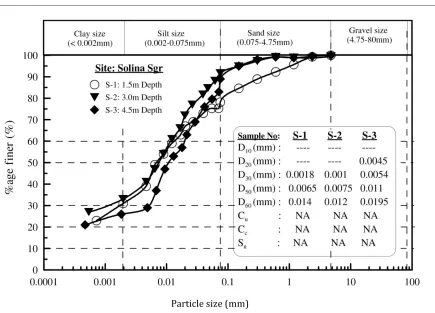
[image:2.612.105.513.386.635.2]For the present study, clayey soil from Solina Srinagar was collected at different depths (1.5m to 4.5m). Disturbed and undisturbed soil samples were also collected from the site for conduct of various field and lab. tests. Naturally available commercial quick lime CaO was used as an additive to stabilize the clayey soil. All the tests were carried out as per the relevant Standards (ASTM). The physical properties of the soil used in this investigation are listed in Table 1. The particle size distributions curves of these materials are shown in Fig. 1.
Table 1 – Physical properties of materials used
Particle size distribution analysis revealed that the Solina soil contained about 47%, 59% and 63% highly plastic silt at 1.5m, 3m and 4.5m depth along with 31%, 33% and 26% clay content respectively (Table 1 above). The particle size distribution curves gives, at a glance, the nature of size gradation, range of particle sizes, and a comparison of different soils. The particle size curve is used to know the susceptibility of a soil to frost action, required for the design of drainage filters, an index to the coefficient of permeability and the shear strength of the soil. The suitability of a backfill material also depends on the gradation. As per test results, the soil is classified poorly graded high plastic clayey silt with clean fine sand content.
Property Locations
S-1 (1.5m) S-2 (3m) S-3 (4.5m)
Fine Sand Size (%) 22 08 11
Silt Size (%) 47 59 63
Clay Size (%) 31 33 26
Specific gravity, G 2.67 2.68 2.65
Liquid Limit (%) 53.6 55.3 47.1
Plastic Limit (%) 29.4 30.5 27.6
Plasticity Index (%) 24.2 24.8 19.5
Shrinkage limit (%) 15.2 13.1 16.2
Classification MH MH MI
Free Swell Index (%) 0.8 1.2 0
Optimum Moisture Content (%) 17.8 15.6 16.7
© 2017, IRJET | Impact Factor value: 5.181 | ISO 9001:2008 Certified Journal
| Page 1877
Particle size (mm)Fig. 1. Particle size distribution curves for Solina soils
EXPERIMENTAL PROGRAMME
The soil samples from site location and Lime were mixed in the dry state and the percentage of lime varies from 0 to 9% with 3% increments. The soil was dried and passed through ASTM sieve No. 40 (425 micron IS sieve) before being used in this investigation. Index properties, Standard Proctor Compaction tests and strength tests were carried out on the so obtained soil
specimens. All the samples were prepared as per ASTM codal procedures and compacted at 0.95 γdmaxand corresponding
water content on the dry side of optimum.
RESULTS AND DISCUSSIONS
Mechanisms of Lime Stabilization
A number of explanations have been proposed as mechanisms of lime stabilization. They include:
(a). Drying out by absorption and evaporation. The reduction in the moisture content of the soil can be substantial and occurs immediately the lime and soil are mixed.
(b). Rapid physio-chemical reactions between the lime and clay minerals produce immediate changes in soil plasticity and workability. This is known as soil improvement or modification.
(c). Long term soil-lime pozzolanic reactions result in the formation of cementing agents, which increase strength and durability. This is known as lime stabilization.
Lime stabilization and its effect on soils
© 2017, IRJET | Impact Factor value: 5.181 | ISO 9001:2008 Certified Journal
| Page 1878
traffic. The addition of lime changed the “PL” so that the moisture content of the soil is below “PL” which would greatly enhance the workability and trafficability of this soil.There are many types of lime available but only quicklime is considered suitable for lime stabilisation in the pavement construction industry and general field construction activities. Quicklime is calcium oxide (CaO) supplied commercially in a dry powder form. Agriculture Lime is a calcium carbonate (CaC03) and not suitable for pavement construction. Hydrated Lime is calcium hydroxide (Ca(OH)2) often used in the laboratory for lime saturation testing, not generally used on site for pavement construction.
Hydrated lime (calcium hydroxide), is produced by reacting water with quicklime (calcium oxide). CaO + H2O => Ca(OH)2. When calculated using the atomic weights, this converts practically to 5t Quicklime + 3t Water => 7t Hydrated lime + 1t Water Evapouration.
The pozzolanic reaction between lime with water and the silica and alumina in clay results in an ionic exchange, which permanently realigns the clay particles forming friable conglomerates. The new alignment of the particles provides less ability for the clay to absorb water around the particles. This makes the clay more waterproof, less expansive and therefore reduces the plasticity and linear shrinkage. The PI is often more than ½ and the shrinkage is often 10% of what it was. Practically this results in improved permeability less shrinkage cracking providing less chance of piping failure and seepage.
In a lime saturated environment (typically 3% to 4% quicklime), the clay-alumina and clay-silica become available to react with the free calcium to form calcium aluminates or silicates. The pozzolanic reaction is illustrated by the following equations:
Ca2+ + OH- + Available Clay Aluminium Calcium Aluminate Hydrate (CAH)
Ca2+ + OH- + Available Clay Silica Calcium Silicate Hydrate (CSH)
. Thus, this makes it possible to improve soils prone to movement by settlement or swelling so that they can be utilized in structural applications.
Effect of Lime stabilization on compaction characteristics
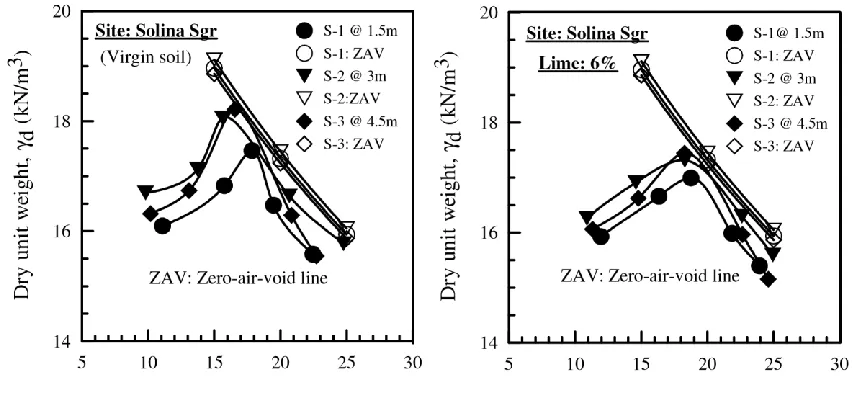
The density of soils is an important parameter since it controls its strength, compressibility and permeability. Compaction of lime stabilized soils is more tolerant than those stabilized with cement. The compaction curves for untreated soil and soil lime mixes are shown in Fig. 2. From Fig. 2, it is observed that lime treatment flattens the compaction curve, which makes moisture control less critical and reduces the variability of the unit weight produced. This will also ensure that a given percentage of the prescribed density can be achieved over a much wider range of moisture contents, so that relaxed moisture control specifications are possible. Also the addition of lime increases optimum moisture content due to fine nature of lime, enabling soils in wetter than original condition to be compacted satisfactorily. Low unit weight of soil-lime mixes will result in lower earth pressure leading to savings.
[image:4.612.90.516.493.692.2]Water content, w (%)Water content, w (%)
© 2017, IRJET | Impact Factor value: 5.181 | ISO 9001:2008 Certified Journal
| Page 1879
CONCLUSIONSOn the basis of this investigation, it has been observed that Solina soil is composed of clayey silt of high plasticity. The index and engineering properties of this soil are significantly altered by addition of lime. It has been observed that 6.5% of lime is the optimum amount required to be used for stabilization of this material. As the percentage of lime increased, the percentage reduction of the maximum density also increased. The optimum moisture content increased with increasing lime content due to hydration of calcium cations. The compacted density of soil-lime mixes is low compared to soil alone due to fine nature of lime, which will be beneficial since a lower density will result in lower earth pressure leading to savings. Hence there are significant changes in the soil’s engineering properties by addition of lime, which is useful for improving problematic fine-grained
REFERENCES
(1.)Sabry, M.M.A. and Parcher, J.V., (19790, ‟Engineering Properties of Soil-Lime Mixes”, Transportation Engineering Journal, TEI, pp. 59-70.
(2.) Thompson, M.R., (1966), ‟Lime Reactivity of Illinois Soils”, Journal of the Soil Mechanics and Foundations Division, Proceeding of the ASCE., pp. 67-91.
(3.)Thompson, M.R., (1989), ‟Stabilization Application in Horizontal Construction
(4.) .ASTM D 422–63 (1995). “Standard test method for particle size analysis of soils.”Annual Book of ASTM standards,
American society for testing and materials, Philadelphia, United States, www.astm.org.
(5.).ASTM D 2487 – (2006). “Standard Practice for Classification of Soils for Engineering Purposes (USCS).”Annual Book of
ASTM standards, American society for testing and materials, Philadelphia, United States, www.astm.org.
(6) .ASTM D 854-92. “Standard Test method for specific gravity of soils.”Annual Book of ASTM Standards, American Society for
Testing and Materials, Philadelphia, United States, www.astm.org.
(7.) ASTM D4318-98. “Standard test methods for liquid limit, plastic limit, and plasticity index of soils.” Annual Book of ASTM
standards, American society for testing and materials, Philadelphia, United States, www.astm.org.
(8. )ASTM D698-91. “Standard test methods for laboratory compaction characteristics of soil using standard effort.”Annual
Book of ASTM standards, American society for testing and materials, Philadelphia, United States, www.astm.org.
(9.). Bell, F. G. (1989). “Lime Stabilization of Clay Soils.”Bulletin of Engineering Geology and the Environment, 39(1), pp. 67-74.
(10).Bell, F.G. (1996). “Lime stabilization of clay minerals and soils.”Jl of Engineering Geology, Elsevier, 42, pp. 223-237.
(11)Dunlop, R. J. (1977). “Lime stabilization foe New Zealand Roads. Road Res.” Unit Tech. Recomm.TR/2, National Roads
Board, Wellington.
(12.)Mc Dowell, U, C. (1959). “Stabilization of soils with lime, lime-fly ash and other lime reactive materials.”High. Res. Board,