ScholarWorks @ Georgia State University
ScholarWorks @ Georgia State University
Mathematics Dissertations Department of Mathematics and Statistics
Summer 8-12-2014
Union Closed Set Conjecture and Maximum Dicut in Connected
Union Closed Set Conjecture and Maximum Dicut in Connected
Digraph
Digraph
Nana Li
Follow this and additional works at: https://scholarworks.gsu.edu/math_diss
Recommended Citation Recommended Citation
Li, Nana, "Union Closed Set Conjecture and Maximum Dicut in Connected Digraph." Dissertation, Georgia State University, 2014.
https://scholarworks.gsu.edu/math_diss/19
CONNECTED DIGRAPH
by
NANA LI
Under the Direction of Dr. Guantao Chen
ABSTRACT
In this dissertation, we study the following two topics, i.e., the union closed set
conjec-ture and the maximum edges cut in connected digraphs.
The union-closed-set-conjecture-topic goes as follows. A finite family of finite sets is
union closed if it contains the union of any two sets in it. Let XF = ∪F∈FF. A union
closed family of sets is separating if for any two distinct elements in F, there is a set in
inclusion as the partial order relation. A separating union closed family F is irreducible
(normalized) if |XF| is the minimum (maximum, resp.) with respect to the poset structure
of F. In the part of dissertation related to this topic, we develop algorithms to transfer any
given separating union closed family to a/an normalized/irreducible family without changing
its poset structure. We also study properties of these two extremal union closed families in
connection with theUnion Closed Sets Conjectureof Frankl. Our result may lead to potential
full proof of the union closed set conjecture and several other conjectures.
The part of the dissertation related to the maximum edge cuts in connected digraphs
goes as follows. In a given digraphD, a setF of edges is defined to be adirected cutif there
is a nontrivial partition (X, Y) of V(D) such that F consists of all the directed edges from
X to Y. The maximum size of a directed cut in a given digraphD is denoted by Λ(D), and
we letD(1,1) be the set of all digraphs Dsuch that d+(v) = 1 or d−(v) = 1 for every vertex
v inD. In this part of dissertation, we prove that Λ(D)≥ 3
8(|E(D)| −1) for any connected digraph D∈ D(1,1), which provides a positive answer to a problem of Lehel, Maffray, and
Preissmann. Additionally, we consider triangle-free digraphs in D(1,1) and answer their
another question.
DIGRAPH
by
NANA LI
A Dissertation Submitted in Partial Fulfillment of the Requirements for the Degree of
Doctor of Philosophy
in the College of Arts and Sciences
Georgia State University
CONNECTED DIGRAPH
by
NANA LI
Committee Chair: Guantao Chen
Committee: Hendricus van der Holst (Co-chair)
Yi Zhao
Christian Avart
Electronic Version Approved:
Office of Graduate Studies
College of Arts and Sciences
Georgia State University
DEDICATION
ACKNOWLEDGMENTS
I would like to start this acknowledgments with my deepest gratitude to all of those
people who have supported and helped me during my Ph.D study. Their generous kindness
goes a long way.
First of all, I am greatly thankful to my advisor, Dr. Guantao Chen, for his inspiration
and guidance. Dr Chen always has a knee intuition regarding many difficult mathematical
problems. The discussion of my research work with him is always thought-provoking and
rewarding. On the other hand, with tremendous interest of myself into researching on
math-ematical problems, Dr. Chen has given me the greatest tolerance about writing down our
results.
I would like to thank my committee members, Dr. Hendricus van der Holst, Dr. Yi
Zhao, and Dr. Christian Avart. Dr. Hendricus van der Holst, as my another academic
advisor, is very knowledgeable, intelligent and diligent. He is always willing to help with my
graduate study and to share his new research ideas on our research work. He also teaches me
how to write down an academic math article using his own and his Ph.D advisor’s examples.
I took most of my core courses in my graduate study from Dr. Yi Zhao, who gives me lots of
help and support through the classes. Moreover, Dr. Yi Zhao sets up a very good model to
me in the department as an academic researcher. Dr. Christian Avart gives me invaluable
help and encouragement while him and I teach one three thousand level course together.
Also, I would like to specially thank him for bringing the union closed set conjecture to me.
I would like to express my special thankfulness to Dr. Alexandr V. Kostochka from
UIUC for the helpful and enthusiastic discussion about the union closed set conjecture while
he visit my advisor. The first topic of my dissertation would not have been possible without
the sincere encouragements from him.
I also would like to thank the professors and staffs at our department and computer
Yongwei Yao and Dr. Florian Enescu for their rigorous and enthusiastic teaching attitude,
Dr. Suil O for the graph theory problem discussions, Dr. John Sinkovic for his kind support
in department seminar, Dr. Donald Gregory Harden for his great help and understanding
while working in MAC, Dr. Zhongshan Li, Ms. Sandra Ms. Earnersten, and Ms. Yvonne
Pierce for their patient help, Dr. Raj Sunderraman, for his help and encouragements on
my classes taking in computer science department, Dr. Alex Zelikovsky, and Dr. Sushil k.
Prasad, for their strict attitude and enthusiasm in teaching the courses I took from them.
I would like to express my great appreciation to Prof. Zhiquan Hu and Prof. Shuchao
Li who brought me into graph theory community and always encouraged me to advance
further in the research world.
Special thanks go to my group members, fellow students, and friends at Georgia State
University, Xue Wang, Kun Zhao, Dr Suil O, Amy Yates, Songling Shan, Ping Yang, Jie
Han, Clara Zang, Leslie Julianna Meadows, Harrison Stalvey, Reimbay Reimbayev, Sandi
Gum, Dhara Shah, Rupei Xu, Jing Wang, Tingli Xing, Martin Alexander Crowe, Jie Zhang,
Xiuxiu He, and Shouling Ji who provided me invaluable suggestions and help besides on
research. Great thanks go to all of my friends.
Last but not least, I would like to express the deepest gratitude to my siblings, my
parents, and my grandparents, for their continuous support, understanding, and help. That
TABLE OF CONTENTS
ACKNOWLEDGMENTS . . . v
LIST OF FIGURES . . . viii
PART 1 INTRODUCTION . . . 1
1.1 Union Closed Set Conjecture . . . 1
1.2 Maximum Directed Cut in Connected Digraph . . . 2
PART 2 UNION CLOSED SET CONJECTURE . . . 3
2.1 Elementary facts and notations . . . 3
2.2 Historical development of the conjecture . . . 5
2.3 Our results. . . 8
2.3.1 Normalization and reduction algorithms . . . 8
2.3.1.1 bijection . . . 9
2.3.1.2 Duals . . . 12
PART 3 MAXIMUM DIRECTED CUT IN GIVEN CONNECTED DIGRAHS . . . 16
3.1 Introduction . . . 16
3.2 Preliminary Results . . . 19
3.3 Theorem 3.1.1. . . 25
3.4 Problem 2 . . . 40
PART 4 CONCLUSIONS . . . 43
LIST OF FIGURES
Figure 3.1 H1 . . . 18
Figure 3.2 one version of H2 . . . 18
Figure 3.3 another version of H2 . . . 19
Figure 3.4 . . . 21
Figure 3.5 . . . 22
Figure 3.6 H1 . . . 22
Figure 3.7 . . . 22
Figure 3.8 V(H∗)∪V(H∗∗) induces a subgraph of the above digraph. . . 23
Figure 3.9 V(H∗)∪V(H∗∗) induces a subgraph of the above digraph. . . 23
Figure 3.10 A situation for subcase (a) . . . 27
Figure 3.11 A situation for subcase (b) . . . 27
Figure 3.12 A situation for subcase (c) . . . 28
Figure 3.13 A situation for subcase (d) . . . 28
Figure 3.14 y0 and z are the same vertex. . . 30
Figure 3.15 y0 and z are different vertices. . . 31
Figure 3.16 An isolated H1-component in D0 . . . 32
Figure 3.17 x /∈D+ . . . . 36
Figure 3.19 The three graphs D,D0 and D∗ . . . 38
Figure 3.20 . . . 41
Figure 3.21 . . . 41
PART 1
INTRODUCTION
This dissertation mainly include the following two topics.
1.1 Union Closed Set Conjecture
A family of finite setsF isunion closedif it contains the union of any two sets in it. Let XF =∪A∈FA. Here in this dissertation, we always assume that |XF|is finite, which implies
that |F | ≤2|XF| is also finite. It is commenly believed1 that Frankl in late 1979 formulated
the following conjecture.
Conjecture 1.1.1. [11] For any union closed family F of finite sets, in which at least one
set is non-empty, there is an element x∈XF contained in at least half of the sets in F.
Being simply formulated and hence fantastically interesting as it is, this conjecture has
been known to be notoriously difficult and has been widely open for a long time. Closely
related to lattice theory, extremal set theory and graph theory, many people from different
mathematical areas have made various contributions during the course to attack it. In this
part of dissertation, we will present our structural distributions which could potentially fully
solve this conjecture and several other related conjectures.
There is a great survey paper about the union closed set conjecture by Bruhn, et al [4].
So, we do not aim to give a complete review of the literature on the conjecture. The focus
of this part of the dissertation is on the methods employed to attack the conjecture which
interest us and the exploration of our contributions. Our selection of the literature is thus
not even.
1.2 Maximum Directed Cut in Connected Digraph
In a given digraph D, a set F of edges is defined to be a directed cut if there is a
nontrivial partition (X, Y) of V(D) such thatF consists of all the directed edges fromX to
Y. The maximum size of a directed cut in a given digraph D is denoted by Λ(D), and we
letD(1,1) be the set of all digraphs D such that d+(v) = 1 or d−(v) = 1 for every vertex v in D. In this part of dissertation, we prove that Λ(D) ≥ 3
8(|E(D)| −1) for any connected digraph D∈ D(1,1), which provides a positive answer to a problem of Lehel, Maffray, and Preissmann. Additionally, we consider triangle-free digraphs in D(1,1) and answer their another question2.
2This part of dissertation has already been published on Journal of Graph Theory with all copy rights
PART 2
UNION CLOSED SET CONJECTURE
2.1 Elementary facts and notations
In this section, we briefly state some notations and elementary facts.
For two distinct familiesF andH, we denote by H ⊆ F the fact thatH is a sub-family of F, i.e., each set from H is also contained in F. For any union closed family F and any sub-family S of F, we denote by ∪S the union of all the sets in S, we denote by ∩S the intersection of all the sets in S, and we denote by F − S the family of all the sets inF not contained inS. For any familyS and any setA(eitherA∈ S or not), we denote byS − {A}
the family of all the sets in S except the set A, we denote by S +{A} the family of all the sets in S and the set A, and we denote by |S| the number of sets in S. For any two sets A and B in F, if either A⊆B or B ⊆A, we denote it by A ∼B. Otherwise, we denote it by AB.
For a given union closed family F and a given set Y in F, we denote by Y ∩ F the family of all the sets obtained by the intersection of the set Y and all the sets from F, i.e., Y ∩ F = {Y ∩A|A ∈ F } and we denote by 2Y the power family of the set Y, i.e., 2Y ={A|A⊆Y}, and we denote by X
F the underlying set in F, i.e., XF =∪F.
For two distinct sets A and B in a given union closed family F, A is a parent of B if B ( A and for any C ∈ F with B ⊆ C ⊆ A, either B = C or A = C. B is a child of A if A is a parent of B. A set A is called a single-parent-set if A has only one parent in
F with at most one child. Given a family of sets B in F, we denote by < B > the union closed family generated by B, i.e., < B >= {A|A = ∪C for some C ⊆ B}. Here, < B > does not necessarily contain∅. Moreover, for any set Ain a given union closed familyF, we define C(A) = {B|B ∈ SPF(F), B ⊇ A and no single-parent-sets exist between B and A}
to be the cover family ofA. Noting that all the second maximal sets in a given union closed
family F has only one parent XF in F, C(A) always exists for any given setA in F −XF.
Moreover, it follows readily that C(A) = {A} if A ∈ SPF(F). Later in the proof, XF has
the similar role as single-parent-sets of F. Thus, we assumeC(XF) = {XF}.
Following Poonen in [16], the union closed set conjecture does not hold if the union
closed family F is allowed to have an infinite number of sets, i.e., if |F | is allowed to be infinite. Indeed, the union closed family of sets {i+ 1, i+ 2, i+ 3,· · · } for every positive integeriserves as a counterexample. Consequently, we assume that every union closed family
considered in the following contains only finitely many sets.
For a given union closed familyF and a given elementx, we denote byFx¯ the family of all the sets inF not containing elementx, i.e., Fx¯ ={A|A∈ F and x /∈A} and we denote byFx the family of all the sets inF containing elementx, i.e.,Fx ={A|A∈ F and x∈A}.
For a given union closed familyF with a set AinF, we denote by F⊆Athe family of all the
sets in F contained in A.
For any given union closed family F which does not contain ∅, F +{∅} is also union closed. Clearly, it suffices to consider union closed family which contains∅. Note that every family is a poset with the set inclusion as the partial order relation. Moreover, for a given
union closed family F, whether ∅ ∈ F or not plays an important role in the partial order relation characterization. This calls for the following definition of lattice.
Note that a lattice is a poset in which every pair of elements has a unique minimal
common upper bound and a unique maximal common lower bound; see [11]. For two given
A∨B = A∪B and A∧B = ∪C⊆A∩BC, i.e., A∪B is the unique minimal common upper
bound and ∪C⊆A∩BC is the unique maximal common lower bound. Hence, with the set
inclusion as a partial order relation, any union closed family which contains∅ is a lattice. In this case, for any subfamily S of F, we denote by ∧FS the unique maximal common lower
bound of all the sets from S and we denote by ∨FS the unique minimal common upper
bound of all the sets fromS. On the other hand, if∅∈ F/ , then∨FS is the same as∨F+{∅}S,
while ∧FS may not exist. Note that if∅∈ F/ and ∧FS exists for a given family S, then the
union closed property of F implies that ∧FS is also unique. In the following, we will omit
the subscript F unless ambiguity occurs.
Generally, two partially ordered sets are isomorphic if they have analogous “structures”.
Formally, (L,≤) and (K,≤0) are isomorphic to each other if there is a bijective function f
from L to K, such that x1 ≤x2 if and only if f(x1)≤0 f(x2). In this case, we sayL and K have the same poset structure.
A union closed family F isseparating if Fx 6=Fy for any two distinct elements x and y
in XF and Fi 6= F for any i ∈XF. If Fx =Fy for two distinct elements in XF or Fi =F,
then xand y or the elementi are redundantand one of them can be removed to simplifyF. That is the initial intuition to consider separating families. Now, a separating union closed
family F is irreducible (normalized) if |XF| is the minimum (maximum, resp.) with respect
to the poset structure of F.
2.2 Historical development of the conjecture
In this section, we will address the historical development of the conjecture and related
results. Recall that the conjecture starts with Frankl in 1979.
Conjecture 2.2.1 (Union Closed Set Conjecture [11]). For any union closed family F of
finite sets, in which at least one set is non-empty, there is an element x∈XF contained in
at least half of all sets in F.
from various mathematical researchers. In 1990, Poonen [16] proved the conjecture for any
union closed family F with |XF| ≤ 7 or |F | ≤ 28. More importantly, he also made the
following three conjectures, which are rephrased here.
Conjecture 2.2.2. [16] Let F be a union closed family with Fx 6=Fy for any two distinct
elements x and y in XF. If F is not a power family, then there exists an element x ∈XF,
with |Fx|> |F |
2 .
Conjecture 2.2.3. [16] For any union closed familyF, if there is only one element x with
|Fx| ≥ |F |
2 , then x is in every nonempty set of F.
Conjecture 2.2.4. [16] For any union closed familyF, if there is only one elementxinXF
with |Fx| ≥ |F |
2 , then F = {{x}} or F ={∅}+ ({{x}}∪¯ 2
XF−x). Here, {{x}}∪¯ 2XF−x := {S∪T |S ∈ {{x}}, T ∈2XF−x} and X
F −x is the set of all the elements in XF except the
element x.
In the same year, W´ojcik [19] proposed the following another conjecture.
Conjecture 2.2.5. [19] In any union closed family F, either there is an element which is
contained in more than half of all the sets in F, or each element is contained in exactly half of all the sets in F.
Note that it follows readily that Conjecture 2.2.2 implies Conjecture 2.2.5. In 1993,
Knill [13]1 observed that ifY is defined to be the minimal subset ofX
F such that Y ∩A6=∅
for any A ∈ F − {∅}, then Y ∩(F − {∅}) := {Y ∩ A|A ∈ F } = 2Y − {∅}. Based on this, he deduced that for any union closed family F, there is some element contained in at least log|F |
2|F | members of F. This is until now the best known result of the union closed set
conjecture with respect to magnitude.
Then, four years later, Johunson and Vaughan [12] introduced the dual of a given
union closed family F which contains ∅, and proved that the union closed set conjecture is true either for F or for the dual of F. In 1999, W´ojcik [20] improved Knill’s result by a
multiplicative constant. Moreover, he defined a given union closed familyF to benormalized if Fx 6= Fy for any two distinct elements x and y in XF, ∅ ∈ F and |XF| =|F | −1, 2 and
proved the equivalence of the following conjecture and the union closed set conjecture.
Conjecture 2.2.6. [20] In any normalized union closed family F, there is a generator G
in F with |G| ≥ |F |2 .
Shifting or compression is a common technique in extremal combinatorics. In 2003,
Reimer [17] used the up compression method to prove that the average set size of any union
closed familyF is at least log2|F |
2 , i.e, for any union closed family F, 1
|F | P
A∈F|A| ≥
log2|F |
2 .
Here, the interesting part is the up compression method, which goes as follows. For a fixed
element i in XF, let fi(A) = A+i if A+i /∈ F and fi(A) = A otherwise for every A ∈ F.
It turns out that this up-compressed family fi(F) := {fi(A)|A ∈ F } is also union closed.
Moreover, it has a “good” property, i.e., for any A ∈ F with i /∈ A, A∪ {i} ∈ F. Note that a given family F with an underlying set XF is an up set, if for any given set A in F,
all the sets between A and XF are also in F. Then, after all the elements in XF has been
up compressed, the family obtained in the end of this process is an up set. Let us look at
the following excerpt from [4], “...Compression subjects the given initial object (the
union-closed family), to small incremental changes until a simpler object is reached (an up-set),
while maintaining the essential properties of the initial object...” Being able to maintain the
essential properties of the initial object, this up compression method has played an important
role in the potential full proof for the union closed set conjecture.
In 2010, Roberts and Simpson [18] showed that if F is a counterexample with |XF|
minimum, then |F | ≥ 4|XF| −1. One year later, Falgas-Ravry [10] improved Reimer’s
bound by showing that the average set size is at least (
|XF |
2 )
|F | .
In 2013, Bruhn et al [6] showed that Frankl’s conjecture is equivalent to the conjecture
that in a finite non-trivial bipartite graph there are two adjacent vertices each belonging to
at most half of the maximal stable sets. Soon after that, Bruhn and Schaudt [5] showed that
for every fixed edge-probability, almost every random bipartite graph almost surely satisfies
Frankl’s conjecture. At the same year, Balla et al [2] determined the minimum possible
average size of a set among all union closed families of a given size precisely, characterized
their corresponding structures, and verified the union closed set conjecture for any union
closed familyF with|F | ≥ 2 32
|XF|. After that, in [9], Eccles proved that the union closed set
conjecture holds for families F with |F | ≥ (23 −c)2|XF| for a positive constant c. We refer
to Bruhn and Schaudt [4] for literatures and recent developments for the union closed set
conjecture.
2.3 Our results
Our main contribution to the union closed set conjecture is the following theorem, which
implies that the irreducible family and the normalized family essentially share the same poset
structure.
Theorem 2.3.1. Any separating family F can be normalized to a normalized family FN
which has the same poset structure as F. On the other hand, any separating family F can be reduced to an irreducible family FI which has the same poset structure as F.
2.3.1 Normalization and reduction algorithms
In this section, we give characterizations of normalized union closed family based on a
bijective function and the duality of a given union closed family. Then the corresponding
normalization and reduction algorithms are developed, and the properties of irreducible
family and normalized family are investigated. We have reasons to believe that both of them
play a very important role in the potential proof for the union closed set conjecture.
Let us get started with the following definitions and lemmas. Recall that a union closed
family F is separating if Fx 6=Fy for any two distinct elements x and y in F, and Fi 6=F
for anyi∈XF. A separating union closed familyF isirreducible (normalized)if |XF| is the
union closed familyF is called asingle-parent-set ifAhas only one parent in F. We denote by SPF(F) the family of all single-parent-sets in F.
Lemma 2.3.1. [20] In a given union closed family F with a given element x, there is a
unique maximal set in F not containing element x.
Proof. Indeed, recall thatFx is the family of all sets in F not containingx for any x∈XF.
Then, Fi 6=F for anyi∈XF implies that Fx is not empty. Combining with F being union
closed, we know that∪Fx¯ serves as the maximal set in F not containing elementx.
Lemma 2.3.2. In a given union closed family F, if A has only one parent B in F, then
for any element x∈B−A, A is the maximal set in F not containing element x.
Proof. Indeed, choosex∈B−Aand letAx be the maximal set inF not containing element
x, i.e., Ax =∪Fx¯. We claim that A = Ax. Suppose, to the contrary, that A 6=Ax. Then,
x /∈ A implies that A ( Ax. Combining this with x ∈B and B is a parent of A, we know
thatB Ax. Now, choose a setC ∈ F such that (i): A⊂C ⊆Ax; and (ii): Cis as minimal
as possible with respect to (i). The minimality ofC implies readily that C is a parent of A.
Combining this with B being a parent of A and B 6=C, a contradiction to the fact that A has only one parent in F follows.
2.3.1.1 bijection Before we get started, for all the union closed family F in the
following, we always assume thatFi 6=F for anyi∈XF. In this subsection, a normalization
and a reduction algorithm are given to settle Theorem 2.3.1 based on the following defined
injective function.
For any separating familyF and any elementx∈ F, denote byfF the function fromXF
toF − {XF} such that fF(x) is the maximal set in F not containing x. Lemma 2.3.1 gives
us that fF is well-defined. The following lemma characterizes separating family in terms of
fF.
Proof. We first show the necessity of the above lemma. Indeed, for any i6=j ∈XF, we have
Fi 6=Fj, i.e., there is a set A ∈ F such that i ∈A and j /∈A or j ∈ A and i /∈A. Hence,
A*fF(i) andA ⊆fF(j) or A *fF(j) and A⊆fF(i), which implies thatfF(i)6=fF(j).
On the other hand, the sufficiency of the above lemma goes as follows. Since fF is
injective, fF(x) 6= fF(y) for any pair of distinct elements x and y in XF. Noting that
fF(x) = ∪Fx, we have Fx¯ =6 F¯y for any given pair of distinct elements x and y in XF, i.e.,
F is a separating family.
Lemma 2.3.4. In any separating family F, with a set A∈ F such that A6=fF(x) for any
x∈XF and an element y /∈XF, define a function g from F, such that g(B) =B if B ⊆A
and g(B) = B ∪ {y} otherwise. Then, g(F) is separating union closed, sharing the same poset structure with F.
Proof. Note that for any two setsB and C inF, we have g(B)∪g(C) = B∪C =g(B∪C) if B∪C ⊆ A and g(B)∪g(C) =B ∪C∪ {y}=g(B∪C) otherwise. Hence, g(F) is union closed. Since y /∈ A and the assumption that Fi 6= F for any element i ∈ XF, lemma *
implies readily that fg(F) is well-defined.
Noting the definition of fF(x) = ∪F¯x for any element x ∈ XF, we have readily that
fg(F)(x) =fF(x) ifx=6 y and fg(F)(y) =A otherwise. Then, fF being injective implies that
fg(F) is injective, indicating that g(F) is separating.
Then, it suffices to prove that g is injective from F tog(F). Indeed, suppose not, then there are two distinct sets B and C inF such thatg(B) = g(C). Hence,B and C has only one element difference, i.e., either B =C∪ {y}orC =B∪ {y}. In either case,y ∈XF and
a contradiction thus follows.
Combining this with the definition of normalized family, we have the following corollary.
Corollary 2.3.1. [20] A separating family F is normalized if and only if fF is bijective.
Lemma 2.3.5. |SPF(F)| ≤ |XF| ≤ |F | −1 for any separating family F 3.
Proof. Lemma 2.3.2 gives us that SPF(F) ⊆ fF(XF). On the other hand, fF being an
injective function defined on F − {XF} implies that |fF(XF)| = |XF| and |fF(XF)| ≤
|F | −1.
Then, based on Lemma 2.3.4 and Corollary 2.3.1, we have the following first
normal-ization algorithm.
Algorithm 1:
• for anyiwith 1≤i≤ |XF|, find the maximal set inF not containingiand label this
set as Ai. Here, we assume that XF is the unique maximal set in F not containing
|XF|+ 1 by our construction;
• k ← |XF|+ 2;
• while (there is an unlabelled set in F)
• choose an unlabelled set A and label it asAk
• add an elementkto each set inF which is not contained inAk(we are adding elements
to make Ak the maximal set in F not containing element k);
• update XF to be XF ∪ {k};
• k ←k+ 1;
• end while.
Remark 1: Recall that in [20], W´ojcik defined a union closed family to be normalized if
|XF|=|F | −1,∅ ∈ F and Fx 6=Fy for any two distinct elements x andy inXF. We define
a separating union closed family to be “normalized” if|XF|is the maximum with respect to
the lattice structure of F. Indeed, his definition is equivalent to ours.
Remark 2: Recall that for any two distinct sets A and B in F, we denote by A B if A
1. fF(i)fF(j) if and only ifi∈fF(j) and j ∈fF(i);
2. fF(i)⊆fF(j) if and only ifj /∈fF(i).
Remark 3: In the following, for any separating family F and any element x ∈ XF, we
denote the set fF(x) by Ax, i.e., Ax is the maximal set in F not containing element x for
any x∈XF.
Remark 4: Lemma 2.3.5 and the definition of irreducible family implies that fF(XF) =
SPF(F). On the other hand, corollary 2.3.1 and the definition of normalized family imply that fF(XF) = F − {XF}.
Then, the reduction part of Theorem 2 comes readily from the following lemma. Here,
for a given set A and any element x∈ A, we denote by A−x the set obtained by deleting the element x fromA.
Lemma 2.3.6. Let F be a separating union closed family with an element y ∈ XF. If
fF(y)∈/SPF(F), thenFy−:={A−y|A∈ F }is a separating family sharing the same poset
structure with F.
Proof. It suffices to prove that |Fy−|=|F |. Indeed, suppose, to the contrary, that |Fy−| 6=
|F |. Then, there are two distinct sets A and B in F with B = A∪ {y}. Note that y /∈ A. Then, we consider the following two cases. If A=Ay, i.e., if A is the maximal set in F not
containing elementy, then every set inF containingAmust containA∪ {y}. Thus, A∪ {y}
is the only parent if Ay inF, contradicting to Ay ∈/ SPF(F). On the other hand, if A6=Ay,
then B∪Ay =A∪ {y} ∪Ay =Ay∪ {y} ∈ F, reducing to the previous case.
2.3.1.2 Duals In this subsection, we explore the normalization and reduction
algo-rithm based on the duality of a given separating family.
In [12], Johnson et al introduced the dual of a given separating family which contains
i.e., < B={∪C | C ⊆ B} >. For a separating family F with an element x ∈XF ∪ {n+ 1},
4 we denote f
F(x) by Ax, i.e., Ax is the maximal set in F not containing element x for any
x∈XF∪ {n+ 1}. Then, we define the subscript of the setAx to be x. Now, for a subfamily
S of F, let IS be the subscript set of S, i.e., IS = {i|i is the subscript of some set in S}.
Note that |IF| = |XF|+ 1 for any given separating family F. Recall that Fx is the family
of all sets in F containing x for any x ∈ XF. For any separating union closed family F,
let F∗ =< I
Fx, x ∈ XF ∪{n+1} >, i.e., F
∗ is the union closed family generated by {I
Fx, x ∈
XF ∪ {n+ 1}}, which is called the dual family of F.
Recall thatC(A) = {B|B ∈SPF(F), B ⊇A and no single-parent-sets exist between B and A} is the cover family of A for any setA in a given separating union closed family F. The following two lemmas express the relation between a set and its cover family.
Lemma 2.3.7. For any set A in a given irreducible family F, we have A=∩C(A).
Proof. If A ∈ SPF(F) or A = XF, then the lemma follows readily. So, we always assume
in the following that A /∈ SPF(F) and A =6 XF. Clearly, A ⊆ ∩C(A) holds. So, we only
need to show A ⊇ ∩C(A). Suppose, to the contrary, this is not true. Then, there is an element x ∈ ∩C(A)− A. Combining with A /∈ SPF(F), A ( Ax. F being irreducible
implies that Ax ∈ SPF(F). The definition of cover family implies that Ax 6⊂ B for any
B ∈ C(A). Combining again with x∈ ∩C(A), we have Ax B for any B ∈ C(A), implying that Ax ∈ C(A). A contradiction thus follows. So, ∩C(A)⊆A. Noting that A⊆ ∩C(A), the
proof is then finished.
Lemma 2.3.8. For any set A in a given union closed family F, A=∧C(A).
Proof. Note that A ⊆ ∧C(A). Thus, ∧C(A) always exists. Let Z = ∧C(A). Denote by FI
the irreducible family obtained from reducingF, denote byAI the set inFI corresponding to
Aand denote byCFI(AI) the cover family ofAI inFI. The previous lemma implies thatA∩ ISPF(F) =Z ∩ISPF(F)=∩CFI(AI). Combining with the one to one correspondence between
4Here,n+ 1∈/X
the sets from F and the sets from FI, we know that C∩I
SPF(F) completely determines the
setC for any C ∈ F. Hence,A=Z.
Next, the following lemma gives us an alternative characterization for normalized union
closed family. Recall here that G(F) is the family of all generators in F.
Lemma 2.3.9. Let F be a separating family which contains ∅. Then, the following
state-ments are equivalent:
1. F is normalized with ∅ ∈ F.
2. {IFx, x∈XF} is union closed.
3. {IG(F)x, x∈XF} is union closed.
Proof. 1 =⇒ 2: F being normalized implies that fF is bijective. Since ∅ ∈ F, F with the
set inclusion as a partial ordered relation is a lattice. For any two distinct elements i and
j in XF, let fF(k) = fF(i)∧fF(j). Then, it follows that F⊆fF(k) = F⊆fF(i) ∩ F⊆fF(j), i.e.,
(IFk)
c= (I
Fi)
c∩(I Fj)
c. Hence, I
Fk =IFi∪IFj.
2 ⇐⇒ 3: This follows from the fact that for any three distinct elements i, j and k in XF,
IFi∪IFj =IFk if and only ifIG(F)i ∪IG(F)j =IG(F)k.
2 =⇒ 1: It suffices to show that fF is bijective. Indeed, for any given set A in F − {XF},
lemma 2.3.7 and {IFx, x ∈ XF} being union closed imply that there is an element z ∈ XF withIFz =∪x∈fF−1(C(A))IFx, i.e., any set inF containsz if and only if this set has a non-empty intersection with fF−1(C(A)). This is the same to say, any set inF does not contain z if and only if this set does not contain any element from fF−1(C(A)). Taking a maximal to both sides of the above equivalence relation and combining with A = ∧C(A), A is the maximal set in F not containing element z. Hence, fF is bijective.
Here, based on the previous lemma, we have the following an alternative normalization
algorithm.
• while (family{IG(F)x, x∈XF} is not union closed)
• choose IG(F)a and IG(F)b from{IG(F)x, x∈XF}, such that IG(F)a
∪IG(F)b ∈ {/ IG(F)x, x∈XF}
• add a new element cto all the sets in G(F) whose indices are in IG(F)a∪IG(F)b
• end while
• update the family F to be < IG(F)x, x∈XF >+{∅}.
We define a familyS to be almost union closed if<S >=S+{X<S>}. Then, we have
the following another lemma.
Lemma 2.3.10. Let F be a separating family which contains∅. Then, the following
state-ments are equivalent:
1. F is normalized with ∅ ∈ F
2. {IFx, x∈XF} is almost union closed.
3. {IG(F)x, x∈XF} is almost union closed.
Proof. 1 =⇒ 2: F being normalized implies that fF is bijective. For any two distinct
elements i and j in XF, if fF(i) ∧fF(j) exists, then the proof follows similarly as the
previous lemma. Otherwise, if {F(i)∧fF(j) does not exist, then every set in F contains
either element ior element j, i.e., IFi∪IFj =IF =∪{IFx, x∈XF}.
2 ⇐⇒ 3: This follows from the fact that for any three distinct elements i, j and k in XF,
IFi∪IFj =IFk if and only ifIG(F)i ∪IG(F)j =IG(F)k.
2 =⇒ 1: Let x be a new element which is not contained in any set of F. Now, consider
F+x:={A+x|A∈ F }, and then add∅to this new family. Denote the obtained family by
F0. Then {I
Fx, x∈XF} is union closed. By the previous lemma, F
0 is a normalized family
which contains ∅. Noting the relation betweenF and F0, the claim thus follows readily.
Remark: From the above discussion, it follows readily that for every normalized familyF,
PART 3
MAXIMUM DIRECTED CUT IN GIVEN CONNECTED DIGRAHS
Remark: This part of dissertation has already been published on Journal of Graph
Theory with all copy rights reserved, see [7].
3.1 Introduction
In this part of dissertation, all graphs and digraphs are finite with no loops and no
parallel edges. LetDbe a digraph with vertex setV(D) and edge setE(D). For convenience,
we let m = |E(D)| throughout this part. We denote by xy the directed edge from x to y instead of the more cumbersome notation−xy→. For eachv ∈V, we denote byd(v),d+(v), and d−(v) the degree, outdegree, and indegree ofv (that is, the number of edges incident withv,
leaving from v, and heading to v), respectively. A set F of edges in a digraph D is called a
dicut(directed cut) if there exists a nontrivial partition (X, Y) ofV(D) such thatF consists
of all directed edges from X toY. Clearly, the edge connectivity λ(D) is the minimum size
of a dicut in D. However, for this this part of dissertation, we consider the maximum size
of a dicut in D and denote it by Λ(D).
It is well known that an undirected graph withm edges contains an edge-cut with more
than m/2 edges. Yannakakis [15] showed that determining the maximum size of edge cuts
for undirected graphs is an NP-hard problem, even with restriction to triangle-free cubic
graphs. Bondy and Locke [3] provided a polynomial time algorithm to find an edge cut for
anytriangle-free subcubicundirected graphGwith at least 45m edges. Xu and Yu [21] proved
that there are precisely seven triangle-free subcubic undirected graphs whose maximum edge
cuts are exactly 4m5 , which was originally conjectured by Bondy and Locke [3]. Noting that,
in a cubic digraph D, either d+(v) ≤1 or d−(v)≤ 1 for each vertex v ∈ V(D), Cropper et
`, we denote by D(k, `) the set of digraphs D such that d+(v) ≤ k or d−(v) ≤ ` for each
vertex v in D. Clearly, every subcubic digraph belongs to D(1,1). Alon et al.[1] proved that Λ(D) ≥ m
3 for any D ∈ D(1,1) and that Λ(D) ≥ 2m
5 for any acyclic D ∈ D(1,1). In a recent paper [22], Xu and Yu characterized the acyclic digraphs in D(1,1) with m edges such that Λ(D) = 25m. In an earlier published this part of dissertation, Lehel et al. [14]
proved that Λ(D) ≥ 2m−t
5 if D ∈ D(1,1) and contains at most t pairwise disjoint directed triangles. Moreover, without counting the number of disjoint triangles, they showed that
Λ(D) ≥ 7m
20 for every connected digraph D ∈ D(1,1). In the same paper, they proposed a few open problems, including the following two.
Problem 3.1.1 (Lehel, Maffray, and Preissmann [14]). For everyε >0, there is a constant
M such that Λ(D)>(38 −ε)m for every connected digraph D∈ D(1,1) with m > M edges.
Problem 3.1.2 (Lehel, Maffray, and Preissmann [14]). If a connected digraph D∈ D(1,1)
withmedges contains no directed triangles and has svertices with zero indegree or outdegree,
then Λ(D)≥ 2m+s
5 .
We will provide a positive answer for Problem 3.1.1 and will show that Problem 3.1.2
is true for trees, i.e., when the underlying undirected graph of D is a tree.
Theorem 3.1.1. If D ∈ D(1,1) is a connected digraph with m edges, then Λ(D)≥ 3m−1
8 .
Theorem 3.1.2. If the underlying undirected graph of D ∈ D(1,1) is a tree with m edges
and D has s vertices with zero indegree or outdegree, then Λ(D)≥ b2m+s
5 c.
We introduce two types of graphs, H1 (see Figure 1) and H2 (see Figures 2 and 3),
which will be used heavily in our proof. Throughout this this part of dissertation, when
we mention that a graph is isomorphic to either H1 or H2 without labeling the vertices,
we always assume that its vertices are labeled as in Figure 1, Figure 2 or Figure 3 unless
otherwise specified. We say that D contains an F-component if D contains a component
For two disjoint vertex setsXandY of a digraphD, letED(X, Y) and
−→
ED(X, Y) denote
the set of edges between X and Y and directed from X toY, respectively. Let eD(X, Y) =
|ED(X, Y)| and −e→D(X, Y) =|
−→
ED(X, Y)|. Clearly, eD(X, Y) =e−→D(X, Y) +−e→D(Y, X).
Let H be an induced subgraph of a digraph D and v ∈ V(H). If eD(V(H), V(D)−
V(H)) = 1, thenH is called anedge-suspended subgraph of D with suspended edgee, where
{e} = ED(V(H), V(D)−V(H)). If eD(V(H)− {v}, V(D)−V(H)) = 0, then H is called
a vertex-suspended subgraph of D with suspended vertex v. In particular, if H ∼= H1 and
{e} = ED(V(H), V(D)−V(H)), then H is called an e-edge-suspended-H1 (or an e-ES-H1 for short). If H ∼=H2 andeD(V(H)− {b7}, V(D)−V(H)) = 0, thenH is called ab7
-vertex-suspended-H2 (or a b7-VS-H2 for short). Note that if D=∼H2, then D is a b7-VS-H2 itself. We denote by I(H) the set of all vertices inH with both indegree and outdegree at least 1.
Clearly,I(H) =V(H) if H ∼=H1, andI(H) =V(H)− {v7} ifH ∼=H2. In the following, for the clarity, we let dD(H) = eD(I(H), V(D)−V(H)) if either H ∼=H1 orH ∼=H2. Clearly, H is an edge-suspended-H1 if and only ifdD(H) = 1, andH is a vertex-suspended-H2 if and
only if dD(H) = 0.
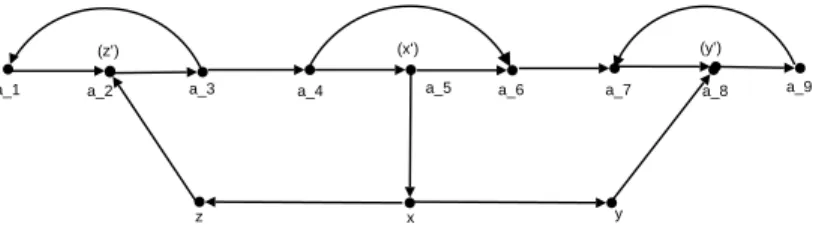
a _ 1 a _ 2 a _ 3 a _ 4 a _ 5 a _ 6 a _ 7 a _ 8 a _ 9
Figure 3.1 H1
b_1 b_2 b_3 b_4 b_5 b_6 b_7
Figure 3.2 one version of H2
Note that Λ(H1) = 4 = 3
·|E(H1)|−1
8 and Λ(H2) = 3 =
3·|E(H2)|
8 , soH1 shows that Theorem
b_1 b_2 b_3 b_4 b_5 b_6 b_7
Figure 3.3 another version of H2
the bound in Theorem 3 is tight: taking k copies of H2 in Figure 2 or Figure 3 and one
copy of H1, we create a digraph D with |E(D)| = 8k+ 11 and Λ(D) = 3k+ 4 = 3m8−1 by identifyingb7 in each copy ofH2 with any vertex not in that copy ofH2, as long as it satisfies
either d+(v)≤1 or d−(v)≤1 for anyv ∈V(D) (see Figure 22).
For any S ⊆ E(D), let D−S denote the graph obtained from D by removing all the edges inS andthe resulting isolated vertices(if any). We denote byA∼=B if digraphsAand B are isomorphic. Theinverse digraph of a digraphDis obtained by reversing the direction
of each edge in D. We denote by −C→3 and
− →
P3 the directed triangle and the directed path on
three vertices, respectively.
3.2 Preliminary Results
Starting this section with the following two theorems from [14], we present a few results
which will be used in the proof of Theorem 3.
Theorem 3.2.1 (Lehel, Maffray, and Preissmann[14]). If D ∈ D(1,1) has m edges and
contains at most t pairwise disjoint directed triangles, then Λ(D)≥ 2m−t
5 .
Theorem 3.2.2 (Lehel, Maffray, and Preissmann[14]). If a connected digraph D ∈ D(1,1)
has m edges, then Λ(D)≥ 7m
20 unless D∼=
−→
C3.
The following definition was given in [14]. A pair (A, B) of disjoint edge sets of a
digraph D is called a reducing pair if any −→P3 with one edge in A has the other edge in B; equivalently, if A contains an edge xy then B contains all edges of D in the form of vx and
Lemma 3.2.1. Let (A, B) be a reducing pair of a digraph D, then Λ(D) ≥ Λ(D−(A∪
B)) +|A|. Moreover, if K is a dicut of D−(A∪B), then there exists a dicut K∗ in D with K∗ ⊇K∪A.
Let F ⊂ E(D) andD[F] be the subgraph induced by F. A vertex x ∈ D[F] is called F-saturated if d+D[F](x)d−D[F](x)≥ 1 and F-unsaturated otherwise. An edge xy ∈F is called F-saturatedif at least one ofxand yisF-saturated andunsaturated if at least one of xand
y is F-unsaturated. Clearly, xy is both saturated and unsaturated if and only if one of the
x and y isF-saturated and the other one is F-unsaturated. We callF saturated if all edges
in F are F-saturated. We denote byF0 the set of all unsaturated edges in F. Clearly, ifF
is saturated, then F0 is the set of edges which are both F-saturated and F-unsaturated.
Lemma 3.2.2. Let D ∈ D(1,1), F ⊆ E(D) be saturated, and H(1), H(2), H(3), · · · , H(t) be t induced subgraphs of D−F such that each of them is isomorphic to either H1 or H2. If I(H(i))∩I(H(j)) =∅ for 1≤i6=j ≤t, then
t X
i=1
dD(H(i))− |F0| ≤ t X
i=1
dD−F(H(i)).
Proof. SinceD ∈ D(1,1) and F is saturated, F ∩E(H(i)) =∅ for each 1≤i≤t. Moreover, the following two properties hold.
• For each 1≤i≤t, E(I(H(i)), V(D)−V(H(i)))∩F ⊆F0.
• For each pair 1≤i < j ≤t, E(I(H(i)), I(H(j)))∩F =∅.
SodD−F(H(i))≥dD(H(i))− |F0∩E(I(H(i), V(D)− ∪tj=1V(H(j)))| for each 1≤i≤t, which in turn gives Lemma 3.2.2.
Lemma 3.2.3. Let D∈ D(1,1) be a connected digraph and let H∗ and H∗∗ be two two
dis-tinct ES-H1. If V(H∗)∩V(H∗∗)6=∅, then D=H∗∪H∗∗. Moreover, Dis isomorphic to the
digraph depicted in Figure 4, its inverse, or the digraph depicted in Figure 5. Consequently,
Proof. Denote by e∗ and e∗∗ the suspended edge of H∗ and H∗∗, respectively. If V(D)−
V(H∗∪H∗∗)=6 ∅, we may assumee∗is the edge betweenV(H∗∪H∗∗) andV(D)−V(H∗∪H∗∗). Hence H∗ is not a component of D−e∗, so a contradiction follows. Thus, V(D) =V(H∗∪
H∗∗), which in turn implies D=H∗∪H∗∗ and the second result.
Lemma 3.2.4. Let D∈ D(1,1)and let H∗ andH∗∗ be two two distinct VS-H2. If V(H∗)∩
V(H∗∗)6=∅, then D ∼=H1 (see Figure 6), or is isomorphic to the digraph in Figure 3.7, or
containsV(H∗)∪V(H∗∗)as an induced subgraph withV(H∗)∩V(H∗∗) ={b7}(see Figure 3.8
or Figure 3.9 where b7 is the same as b∗7 or b
∗∗
7 ). Moreover, if I(H
∗)∩I(H∗∗) 6= ∅, then
D∼=H1.
Proof. We denote by b∗7 and b∗∗7 the suspended vertex of H∗ and H∗∗ , respectively. Since
H∗ and H∗∗ are two distinct VS-H2, V(H∗) ∩ V(H∗∗) 6= ∅ and D ∈ D(1,1), we have
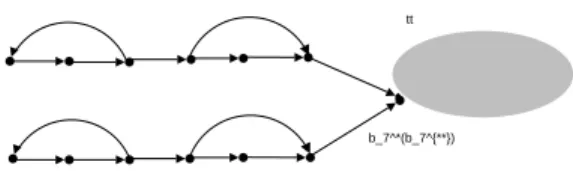
{b∗7, b∗∗7 } ⊂V(H∗)∩V(H∗∗) and|V(H∗)∩V(H∗∗)|= 1,2 or 5. If|V(H∗)∩V(H∗∗)|= 5, then D∼=H1(see Figure 3.6). If|V(H∗)∩V(H∗∗)|= 2, thenV(H∗)∩V(H∗∗) ={b∗7, b∗∗7 }and that is the digraph depicted in Figure 3.7. If|V(H∗)∩V(H∗∗)|= 1, thenb7∗=b∗∗7 =V(H∗)∩V(H∗∗), and that is exactly the digraph depicted in Figure 3.8 or Figure 3.9.
a_3 T
Figure 3.4
Lemma 3.2.5. Let D∈ D(1,1)and H be an e-ES-H1 in D. If a subgraph H∗ is ab7-VS-H2
in D−E(H), then it is also a b7-VS-H2 in D.
x
y T
Figure 3.5
b_7^* b_7^{**}
Figure 3.6 H1
Lemma 3.2.6. Let D ∈ D(1,1) and H be either an ES-H1 or a b7-VS-H2 in D. If T is a
directed triangle with V(T)*I(H), then V(T)∩I(H) =∅.
Proof. SinceV(T)*I(H),|V(T)∩I(H)| ≤2. If H is an ES-H1, thenI(H) = V(H). Since in this case, e(V(H), V(D)−V(H)) = 1, we have V(T)∩I(H) = ∅. If H is a b7-VS-H2, then V(T)∩V(H)⊆ {b7}. Therefore, V(T)∩I(H) =∅.
Lemma 3.2.7. LetD∈ D(1,1). If there is a directed triangleT which is contained in every
VS-H2 of D, then D contains at most one VS-H2.
Proof. Suppose, to the contrary, D contains two distinct VS-H2, say H∗ and H∗∗. Since
I(H∗)∩I(H∗∗)⊇V(T)6=∅, by Lemma 10,D∼=H1. ButH1 contains exactly two copies of H2, which do not share a common directed triangle. A contradiction thus follows.
b_7^{**}
b_7^{*}
b_7^*(b_7^{**}) tt
Figure 3.8 V(H∗)∪V(H∗∗) induces a subgraph of the above digraph.
b_7^*(b_7^{**}) tt
Figure 3.9 V(H∗)∪V(H∗∗) induces a subgraph of the above digraph.
Lemma 3.2.8. Let D ∈ D(1,1), F ⊂ E(D) be saturated with |F0| ≤ 3 and D0 = D−F.
Suppose D0 contains no H1-components, dD(H) ≥ 3 for any induced H1-subgraph H of D
and dD(H)≥2 for any induced H2-subgraph H of D. Then D0 contains at most one ES-H1
or at most one VS-H2, but not both.
Proof. We may assume that D0 contains an ES-H1 or a VS-H2 since the result follows
immediately otherwise. Accordingly, the proof is divided into two cases.
Case 1: D0 contains an ES-H1.
LetH∗ be an ES-H1 in D0. We will show that H∗ is the unique ES-H1 and Ddoes not
contain any VS-H2. Suppose that D0 contains another ES-H1 subgraph H∗∗. If V(H∗)∩ V(H∗∗) = ∅, by Lemma 8,
3 = 2×3−3≤dD(H∗) +dD(H∗∗)− |F0| ≤dD0(H∗) +dD0(H∗∗)≤2.
A contradiction thus follows. Hence, V(H∗)∩V(H∗∗) 6= ∅. By Lemma 9, D0 = H∗∪H∗∗ is isomorphic to the digraph in Figure 4, its inverse, or Figure 5. Considering D0 = D−F and |F0| ≤ 3, we conclude that D contains either a VS-H
2, or an induced H2-subgraph
contradiction.
We next claim that D0 −E(H∗) contains no VS-H2. Indeed, suppose H∗∗ is a VS-H2 inD0−E(H∗). ThenI(H∗)∩I(H∗∗) = ∅. Applying Lemma 8 and Lemma 11, we obtain
2 = 2 + 3−3≤dD(H∗) +dD(H∗∗)− |F0| ≤dD0(H∗) +dD0(H∗∗)≤1,
a contradiction.
Case 2: D0 does not contain any ES-H1.
In this case, we claim thatD0 contains at most one VS-H2. Indeed, assumeH∗ and H∗∗
are two distinct VS-H2 in D0. If I(H∗)∩I(H∗∗) = ∅, Lemma 8 implies that
1≤dD(H∗) +dD(H∗∗)− |F0| ≤dD0(H∗) +dD0(H∗∗) = 0,
a contradiction. Hence,I(H∗)∩I(H∗∗)6=∅. Then, by Lemma 10, the only possible situation for D0 is an H1-component (see Figure 6), contradicting the assumption.
The following result was implicitly given in Lehel et al [14]. For the completeness, we
give the outline of proof here.
Lemma 3.2.9. If a digraph D∈ D(1,1) is not a union of vertex-disjoint directed triangles,
then D contains a reducing pair (A, B) with |A||A+||B| ≥ 2 5.
Proof. LetD+ be the subgraph of D induced by V+ ={v ∈V(D) | d+(v)
≥ 2}; and let D− be the subgraph of D induced by V− = {v ∈ V(D) | d−(v) ≥ 2}. Let V0 = V(D)−(V+∪V−). Suppose D contains no reducing pair (A, B) with |A||+A||B| ≥ 2
5.
Then, we can show that the following claims stated in the proof of Theorem 1 in [14] hold
by the same arguments there:
Claim 2: V+ ∪V− 6= ∅. (here, the condition that D is not a union of disjoint directed
Claim 3: Each of D+ and D− is a disjoint union of directed cycles. Furthermore, every
vertex in D+ or D− is incident with exactly one edge of D−(D+∪D−).
Claim 4: All directed cycles in D+ and D− have odd length.
Claim 5: There is no edge betweenV0 and V+∪V−.
Claim 6: Let M be the loopless bipartite multigraph obtained from the subgraph of D
induced by V+ ∪V− by contracting every directed cycle into one vertex. Then, M is a
simple graph.
Applying the six claims listed above and following the same arguments in [14] , we get
a desired reducing pair (A, B) with |A||A+||B| ≥ 2
5. A contradiction thus follows.
3.3 Theorem 3.1.1
We first show that Theorem 3.1.1 is a consequence of the following result, whose proof
will be given later.
Theorem 3.3.1. Let D ∈ D(1,1) with D C−→3 and D H1. If D satisfies one of the
following three properties, then Λ(D)≥ 3m
8 .
(i) D contains a unique ES-H1, say H, and D−E(H) does not contain any VS-H2.
(ii) D contains a unique VS-H2 and does not contain any ES-H1.
(iii) D contains neither an ES-H1 nor a VS-H2.
Theorem 3.3.1 implies Theorem 3.1.1:
Proof. We may assume that D is connected since we could consider each component of D
otherwise. Theorem 3.1.1 is trivial for m = 1,2,3. For all the m satisfying 4 ≤ m ≤
If D contains an ES-H1 subgraph H, then let ED(V(H), D−V(H)) ={xy}. Assume,
without loss of generality, y ∈ V(H). Since d+H
1(a3) = 2, d
−
H1(a3) = 1 and D ∈ D(1,1),
y6=a3. Similarly, y6=a4. Let
A =
{a3a1, a4a5, a4a6, a7a8}, if y =a8,
{a3a1, a4a5, a4a6, a8a9}, Otherwise,
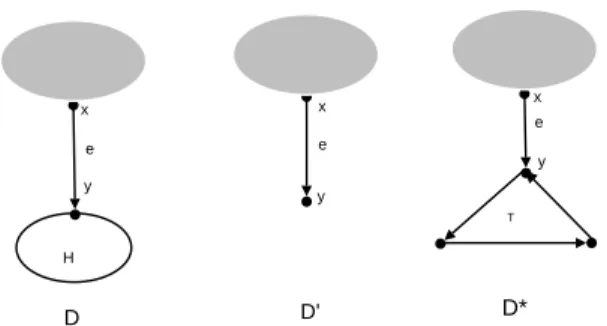
and B = E(H)−A. Clearly, (A, B) is a reducing pair. Let D0 =D−(A∪B), that is, D0 is obtained from D by deleting all vertices of H except y; let D∗ be obtained from D0 by
attaching a directed triangle T to y. Applying the induction hypothesis to the connected
graph D∗, Λ(D∗) ≥ 3|E(D8∗)|−1. Since each dicut of D∗ contains at most one edge of T, Λ(D)≥(Λ(D∗)−1) +|A| ≥ 3m−1
8 .
If D contains a VS-H2, say H, then one can find a reducing pair (A,B) with A∪B = E(H) and |A| = 3. Let D0 = D−(A ∪B). Applying the induction hypothesis to the connected graph D0, Λ(D0)≥ 3|E(D80)|−1. Therefore, Λ(D)≥Λ(D0) +|A| ≥ 3m−1
8 .
If D contains neither an ES-H1 nor a VS-H2, then we have Λ(D) ≥ 3m8 ≥ 3m8−1 by Theorem 3.3.1.
We will use induction on the size of D to attack Theorem 3.3.1. In the proof, an
appropriate reducing pair will be found and removed from D which might disconnect D.
The possible situations will be handled by a case-by-case analysis corresponding to the
above properties (i),(ii) and (iii).
Proof of Theorem 16:
By Theorem 3.2.2, Λ(D) ≥ 7m
20
≥ 3m
8 for m = 1,2, ...,10. So Theorem 16 holds for
m= 1,2, . . . ,10. Suppose that m >10 and it holds for all digraphs with less thanm edges.
The proof will be divided into three cases according to the properties (i), (ii) and (iii).
Case 1: D satisfies property (iii), i.e., Dcontains neither an ES-H1 nor a VS-H2.
Case 1.1: There is an induced H1-subgraph H with dD(H) = 2.
according to the endvertices of e1 and e2 inH.
(a) e1 and e2 are attached with the same directed triangle in H;
(b) e1 and e2 are attached with distinct directed triangles in H;
(c) exactly one of e1 and e2 is attached to a directed triangle in H;
(d) neithere1 nor e2 is attached with directed triangles inH.
For all the four subcases, it is not difficult to show that there is a reducing pair (A,B) of D
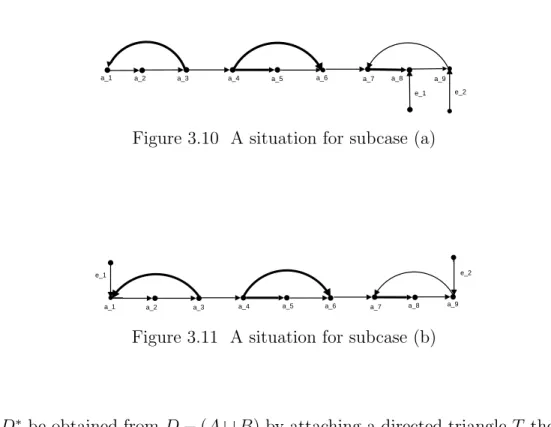
with A∪B =E(H) and|A|= 4. For example, in the following four depicted situations, we may take (A, B) = ({a3a1, a4a5, a4a6, a7a8},{a2a3,
a1a2, a3a4, a5a6, a6a7, a8a9, a9a7}) as the reducing pair for each situation (see Figures 3.10 -3.13, where the edges in A are depicted in thicker lines).
a_1 a_2 a_3 a_4 a_5 a_6 a_7 a_8 a_9 e_1 e_2
Figure 3.10 A situation for subcase (a)
a_1 a_2 a_3 a_4 a_5 a_6 a_7 a_8 a_9
e_1 e_2
Figure 3.11 A situation for subcase (b)
LetD∗ be obtained fromD−(A∪B) by attaching a directed triangleT the ends of e1 ande2 inH according to the following rules: if the endvertices ofe1 ande2 inH are distinct,
we identify them to distinct vertices inT; otherwise, we identify the endvertices of e1 and e2
a_1 a_2 a_3 a_4 a_5 a_6 a_7 a_8 a_9
e_1 e_2
Figure 3.12 A situation for subcase (c)
a_1 a_2 a_3 a_4 a_5 a_6 a_7 a_8 a_9 e_1
e_2
Figure 3.13 A situation for subcase (d)
Clearly, D∗ −C→3. Since inH1 each of two directed triangles is connected to the remaining graph through a single edge,D∗ H1.
We claim that D∗ contains no VS-H2. Otherwise, let H∗ be a VS-H2 in D∗. Since
eD∗(V(T), V(D∗)−V(T)) = 2, V(T)* V(H∗). Thus, by Lemma 12, V(T)∩(I(H∗)) =∅.
Because D can be obtained from D∗ by replacing T with H, H∗ is also a b7-VS-H2 in D,
contradicting the assumption of Case 1.
We claim that D∗ contains no ES-H1. Otherwise, suppose H∗ is an ES-H1 in D∗. By
Lemma 3.2.6, either V(T) ⊆ V(H∗) or V(T)∩V(H∗) = ∅. If V(T) ⊆ V(H∗), then H∗ is either an e1-ES-H1 ore2-ES-H1. Thus,H∗−E(T) is a VS-H2 in D. If V(T)∩V(H∗) =∅, then neither e1 ∈ H∗ nor e2 ∈ H∗, which implies H∗ is an ES-H1 in D. In either case, a contradiction to the assumption of Case 1 follows.
Therefore, D∗ satisfies property (iii). Applying the induction hypothesis to the
con-nected graph D∗, Λ(D∗)≥ 3|E(8D∗)|. Hence, Λ(D)≥ 3(m8−8) + 3 = 38m follows easily.
Case 1.2: There is an induced H2-subgraph H with dD(H) = 1.
Note that Dcontains neither an ES-H1, nor a VS-H2. Then, it can be reduced to Case
1.1 if there is an induced H1-subgraph H in D with dD(H) = 2. Thus, we may assume
Since D does not contain an ES-H1, D0 =D−E(H) contains neither
−→
C3-components
nor H1-components. Since H ∼= H2 and dD(H) = 1, there is a reducing pair (A,B) with
A ∪B = E(H) and |A| = 3. It is easy to see that |(A∪ B)0|=1. Thus, from Lemma 8, dD0(H∗) ≥ dD(H∗) − 1 ≥ 2 for any induced H1-subgraph H∗ in D0 and dD0(H∗) ≥
dD(H∗)−1≥0 for any inducedH2-subgraphH∗ inD0, which implies that D0 may contain a VS-H2, but no ES-H1. Moreover, if H∗ and H∗∗ are two distinct VS-H2 in D0, then Lemma
8 implies I(H∗)∩I(H∗∗) 6= ∅. So, if D0 contains more than one VS-H2, then D0 ∼= H1 by Lemma 10. Note that there is no vertices of degree 1 in H1, contradicting the fact that
dD(H) = 1 and D0 =D−E(H). Hence, D0 contains at most one VS-H2.
Note that D0 satisfies either property (ii) or property (iii). Applying the induction
hypothesis to each component of D0, Λ(D0)≥ 3(m8−8). Therefore, Λ(D)≥Λ(D0) +|A| ≥ 3m
8 .
Case 1.3: There is an induced H2-subgraph H with dD(H)≥2.
In this case, we assume, without loss of generality, H is the graph shown in Figure 2,
in particular, d+H(b4) = 2.
If dD(H∗) = 2 for an induced H1-subgraph H∗ or dD(H∗) = 1 for an induced H2
-subgraph H∗ in D, then it is reduced to either Case 1.1 or Case 1.2. Hence, we may assume
dD(H∗)≥3 for any inducedH1-subgraph H∗ and dD(H∗)≥2 for any inducedH2-subgraph H∗ inD.
Starting with the vertex v0 := b4 in H, let P = v0v1v2,· · · , vl be a maximal directed
path such that d+D(vj)≥2 for j = 0,1, ..., l. Since D∈ D(1,1), V(P)∩ {b1, b2, b3}=∅. Let x:=vl andx0 :=xl−1 ifl ≥1 andx0 :=b3 otherwise, and letxy andxz be two edges leaving x. Since P is maximal, d+D(y) ≤ 1 and d+D(z) ≤ 1. Denote by yy0 (resp. zz0) the possible edge leaving y (resp. z).
Case 1.3.1: x6=b4, i.e.,l > 0.
Case 1.3.1.a: Either yy0 ∈E(D) and y0 =z orzz0 ∈E(D) and z0 =y.
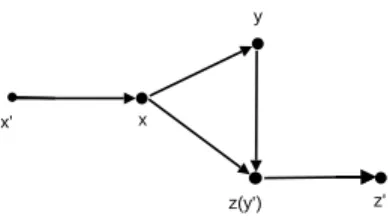
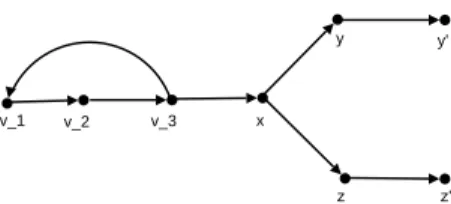
x’ x
y
z(y’) z’
Figure 3.14 y0 and z are the same vertex.
B =
{x0x, yy0, zz0}, if zz0 exists,
{x0x, yy0}, otherwise,
and D0 =D−(A∪B).
It is readily seen that A∪B is saturated, and either (A∪B)0 ={x0x, zz0} if zz0 exists or (A∪B)0 = {x0x, yz, xz} if zz0 does not exist. By Lemma 14, D0 contains at most one
ES-H1 or one VS-H2, but not both of them, which implies thatD0 satisfies one of the three
properties (i), (ii) or (iii).
We first consider the case thatD0does not contain anH1-component. By the maximality
ofP,D0 contains at most one−C→3-component which is attached withA∪B by only the vertex z0. If this is the case, let the directed triangle beT andV(T)−z0 ={u1, u2}. Assume, without loss of generality, E(T) = {z0u1, u1u2, u2z0}. Let A0 ={xy, xz, u1u2} and
B0 =
{x0x, yy0, zz0, u2z0, z0u1} if zz0 exists.
{x0x, yy0, u2z, zu1} otherwise.
Easy to see that (A0, B0) is a reducing pair. Obviously, the resulting graph D∗ = D −
(A0∪B0) contains no −C→3-components. Recall thatdD(H)≥3 for any induced H1-subgraph H in D∗, dD(H) ≥ 2 for any induced H2-subgraph H in D∗, and |(A0 ∪B0)0| = 1. It is readily seen that A0 ∪ B0 is saturated. By Lemma 8, D∗ contains neither an ES-H1 nor a VS-H2. Applying the induction hypothesis to each component of D∗, Λ(D∗) ≥
3(m−8) 8 .
D0. Then, applying induction hypothesis to each component ofD0, Λ(D0)≥ 3|E(8D0)| = 3(m8−5). Therefore, Λ(D)≥Λ(D0) +|A|> 38m.
We now assume that D0 contains an H1-component H∗. Since every vertex in H∗ is
saturated, V(H∗)∩V(D[A∪B]) is a subset of the unsaturated vertex set in A∪B. Since dD(H∗)≥3, edge zz0 does not exist and V(H∗)∩V(D[A∪B]) = {x0, z =y0}. Recall that
D ∈ D(1,1). Then, all edges between D[A∪B]∪H∗ and the remaining vertices of D are incident to either x and y. We assume, without loss of generality, H∗ is the one shown in
Figure 1. Sinced+D(x)≥2 anddD+(y) = 1, there is a reducing pair (A0, B0) such thatA0 is the union of {xy, xz, a4a5, a4a6} and two edges from each directed triangle of H∗, respectively, while B0 = (A∪B)∪E(H∗)−A0. Clearly, |A0|/(|A0|+|B0|) = 6/15>3/8. Similarly to the previous case, we can show that Λ(D)≥ 3m
8 .
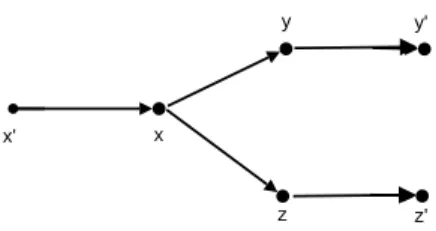
Case 1.3.1.b: yy0 ∈E(D),zz0 ∈E(D), and y, y0, z and z0 are 4 distinct vertices (see Figure 3.15).
x’ x
y
z
y’
z’
Figure 3.15 y0 and z are different vertices.
Let D0 =D− {A∪B} with A ={xy, xz} and B ={x0x, yy0, zz0}. Then, D0 contains at most two −C→3-components which are attached to y0 and z0, respectively.
is a reducing pair, where
A∗ = {xy, xz, a2a3, a4a5, a4a6, a7a8},
B∗ = {x0x, yy0, zz0, a1a2, a3a1, a3a4, a5a6, a6a7, a8a9, a9a7}.
Let D∗ =D−(A∗∪B∗). Clearly, (A∗ ∪B∗)0 =∅. Consequently, A∗∪B∗ is saturated and
D∗ contains no −C→3-components. By Lemma 8, D∗ contains neither an ES-H1 nor a VS-H2. Applying the induction hypothesis to each component of D∗, Λ(D∗) ≥ 3|E(8D∗)| = 3(m8−16). Therefore, Λ(D)≥Λ(D∗) +|A0|= 38m.
a_1 a_2 a_3 a_4 a_5 a_6 a_7 a_8 a_9
z x y
(x’) (y’)
(z’)
Figure 3.16 An isolatedH1-component in D0
Thus, in the following, we may assume D0 contains no H1-components.
Case 1.3.1.b.1: D0 contains no −C→3-components.
In this case, D0 contains neither −C→3-components nor H1-components. Lemma 14 im-plies that D0 satisfies one of the three properties (i), (ii) and (iii). Applying the induction
hypothesis to each component of D0, Λ(D)≥Λ(D0) +|A|= 3(m8−5) + 2> 38m.
Case 1.3.1.b.2: D0 contains a unique −C→3-component T.
In this case, T is attached with either y0 or z0. Suppose, without loss of generality, T
is attached with y0. Similar to the Case 1.3.1.a, by adding one edge of T into A and the
other two edges into B, we get a new reducing pair (A0, B0). Let D∗ = D −(A0 ∪B0). SinceD∈ D(1,1) and T is the unique C−→3-component inD0,D∗ contains no
−→
C3-components.
Moreover, D∗ contains at most one ES-H1 or one VS-H2, but not both of them by Lemma
hypothesis to each component of D∗, Λ(D)≥Λ(D∗) +|A0| ≥ 3m
8 .
Case 1.3.1.b.3: D0 contains two −C→3-components.
In this case, one triangle, say T1, is attached with vertex y0 and the other one, say T2,
attached withz0. Let E(T1) = {v1v2, v2v3, v3v1}and E(T2) ={v4v5, v5v6, v6v4}, withv1 =y0 and v4 =z0. The following two situations are considered.
If d−D0(y)d−D0(z) = 0 (assume, without loss of generality, d−D0(y) = 0), then (A0, B0) =
({v2v3, yy0},{xy, v1v2, v3v1}) is a reducing pair. Let D∗ =D−(A0 ∪B0). Clearly, A0∪B0 is a saturated pair and (A0 ∪B0)0 =xy. Since d+
D(z) = 1, D
∗ does not have a −C→
3-component.
We also claim that D∗ does not have a H1-component. Otherwise, that H1-component in
D∗ is an xy-ES-H1 inD, contradicting the assumption of Case 1. Since |(A0∪B0)0|= 1, by Lemma 8, D∗ satisfies property (iii). Applying the induction hypothesis to each component
of D∗, Λ(D)≥Λ(D∗) +|A0| ≥ 3(m8−5) + 2> 38m. So, we may assume d−D0(y)d
−
D0(z) 6= 0. Then, let A0 = {xy, xz, v2v3, v5v6}, and B0 =
{x0x, yy0, zz0, v1v2, v3v1, v4v5, v6v4}. RemoveA0 andB0fromD, and attach a directed triangle T toy to get a new graph D∗.
We claim that D∗ contains no H1-components (no ES-H1). Indeed, let H∗ be an H1
-component (an ES-H1) in D∗, i.e., dD∗(H∗) ≤ 1. By Lemma 12, we have either V(T)∩
V(H∗) = ∅ or V(T) ⊆ V(H∗). Recall that dD(H) ≥ 3 for any induced H1-subgraph H of D, dD(H) ≥ 2 for any induced H2-subgraph H of D and |(A0 ∪ B0)0| = |x0x| = 1. If V(T)∩V(H∗) = ∅, Lemma 8 gives dD(H∗) ≤ 2. A contradiction thus follows. If
V(T) ⊆ V(H∗), then H∗ − E(T) is a y-VS-H2 in D (induced H2-subgraph in D with dD(H∗ −E(T)) = 1), contradicting to Case 1 (reducing to Case 1.2). After that, we claim
there is at most one VS-H2 in D∗. Indeed, if T is contained in every VS-H2 of D∗, then
D∗ contains at most one VS-H2 by Lemma 13. On the other hand, if there is one VS-H2 in
D∗, say H∗∗, such that T " H∗∗. Then, by Lemma 8, dD(H∗∗) ≤ 1. A contradiction thus
follows.
3|E(D∗)|
8 =
3(m−8)
8 , which implies Λ(D
∗ − E(T)) ≥ 3(m−8)
8 − 1. Therefore, Λ(D) ≥ Λ(D∗−E(T)) +|A0|= 38m.
Case 1.3.1.c: There are no edges leaving y orz.
Let A = {xy, xz}, B = {x0x} and D0 = D−(A∪B). Since d+D(y) = 0, d+D(z) = 0, and x0 belongs to the chosen vertex sequence, D0 contains no −C→3-components. Because each H1-component in D0 is an x0x-ES-H1 inD and D does not contain any ES-H1, D0 contains
noH1-components.
Note thatdD(H)≥3 for any inducedH1-subgraphH inD0,dD(H)≥2 for any induced
H2-subgraphH inD0, and onlyx0 could possibly be in the inducedH1-subgraph or induced
H2-subgraph ofD0. Hence, by Lemma 8,D0 does not contain any ES-H1 or VS-H2. Applying
induction hypothesis to each component of D0, Λ(D)≥Λ(D0) +|A|> 38m.
Case 1.3.2: x=b4, i.e.,b4 is the final vertex in the sequence which has outdegree more than
one. It is readily seen that in this case (A, B) is a reducing pair, whereA={b4b5, b4b6} and B ={b3b4, b5b6, b6b7}. LetD0 =D−(A∪B). Clearly A∪B is saturated and|(A∪B)0|= 2. Consequently, D0 contains at most two −C→3-components.
Case 1.3.2.a: D0 contains two −C→3-components.
Let the two −C→3-components of D0 be T1 and T2 with V(T1) = {b1, b2, b3} and V(T2) = {b7, b8, b9}. Then, D contains an induced H1-subgraph, say H, whose vertex set is {b1, b2, b3, b4, b5, b6, b7, b8, b9}. Since D ∈ D(1,1) and d+D(x) ≤ 1 for every b4x ∈ E(D), d−D0(b4) = dD+0(b5) = d+D0(b6) = 0, and dD(H) ≥ 3. Let D00 = D− E(H). Then, either
d+D00(b4)≥1, or d−D00(b5)≥1, ord−D00(b6)≥1. Suppose, without loss of generality,d+D00(b4)≥1 and attach a directed triangleT tob4 inD00. Denote the resulting graph byD∗. Clearly, D∗
contains no −C→3-components.
We claim that D∗ contains no H1-components (ES-H1). Indeed, let H∗ be an H1
-component (ES-H1) in D∗. If V(T) * V(H∗), then V(T)∩V(H∗) = ∅, which implies H∗ is an H1-component (an ES-H1) in D00. Note that |H0| = 0 and D00 = D−E(H). Thus, by Lemma 8, H∗ is also an H1-component (ES-H1) in D, which is a contradiction to the