Georgia State University Georgia State University
ScholarWorks @ Georgia State University
ScholarWorks @ Georgia State University
Public Health Theses School of Public Health
Summer 8-6-2010
Injection Safety in Central Asia
Injection Safety in Central Asia
Omer Khan
Georgia State University
Follow this and additional works at: https://scholarworks.gsu.edu/iph_theses
Recommended Citation Recommended Citation
Khan, Omer, "Injection Safety in Central Asia." Thesis, Georgia State University, 2010. https://scholarworks.gsu.edu/iph_theses/137
INJECTION SAFETY IN CENTRAL ASIA
by
OMER M. KHAN
M. S. INTERNATIONAL AFFAIRS, GEORGIA INSTITUTE OF TECHNOLOGY, 2005
B.S. INTERNATIONAL AFFAIRS, GEORGIA INSTITUTE OF TECHNOLOGY, 2003
B.S. MANAGEMENT, GEORGIA INSTITUTE OF TECHNOLOGY, 2003
A Capstone Project Submitted to the Graduate Faculty of George State University in Partial Fulfillment
of the
Requirements for the Degree
MASTER OF PUBLIC HEALTH
2 Injections are one of the most common health care procedures. According to
WHO data, there are 16 billion medical injections performed annually in developing and
transitional countries. In countries where unnecessary injections are common, the average
number of injections per person has been estimated to be 3.7 per year and half of them
are estimated to be unsafe injections (Hauri AM et al., 2003).
Each year, reuse or unsafe practice of injection devices may cause 20 million
infections with hepatitis B virus (HBV), 2 million infections with hepatitis C virus
(HCV), and 250,000 infections with human immunodeficiency virus (HIV) worldwide.
Like many developing countries, unsafe injection practices are a significant issue for
Central Asian countries of Kazakhstan, Kyrgyzstan, Tajikistan, Turkmenistan, and
Uzbekistan. In addition to unsafe injections, overuse of transfusions of blood and blood
products, reuse of single use medical equipment, inadequate sterilization, improper
disposal of sharps (e.g., needles, scalpel blades, etc.) are also major cause of concern in
Central Asia.
The term “injection safety” was initially used when it was recognized that
injections—which are typically thought of as being intramuscular—may be an important
mode of transmission of HIV or hepatitis viruses. More recently, the term has been
broadened to include other means of parenteral injection of substances (intravenously),
withdrawing of blood (phlebotomy) or for intravenous/intra-arterial access (catheters in
veins or arteries).
WHO’s definition of safe injections is: A safe injection, phlebotomy, lancet
3 the provider to any avoidable risk and does not result in any waste that is dangerous for
other people.”
The HIV epidemic in Central Asian Republics of Kazakhstan, Kyrgyzstan,
Tajikistan, Turkmenistan, and Uzbekistan is primarily driven by injecting drug users
(IDUs), however, Ministries of Health (MoHs) estimate that anywhere between 2-15% of
the HIV transmissions occur due to nosocomial infections. However, lack of proper
monitoring and evaluation systems in the region have led many to believe that a larger
proportion of HIV transmission is caused by nosocomial infection in Central Asia.
The first HIV outbreak in the region occurred in 2006 when more than 130
children were infected with HIV in Shymkent, Kazakhstan. Outbreak investigation
conducted by the Centers for Disease Control and Prevention (CDC) cited intravenous
route of medication, subclavian vein catherization, and use of blood or blood products as
the main risk factors for HIV transmission.
In early 2007, another HIV outbreak was reported in Osh, Kyrgyzstan, where
initially it was reported that at least 26 people, mostly children, acquired HIV infection in
two local hospitals. CDC was asked again to conduct an investigation and estimated that
the number of children infected exceeded 100. The results of the investigation cited
intramuscular and intravenous injections to be the primary risk factor for HIV
transmission as well. Data from the CDC outbreak investigation is presented below.
Also in 2007, HIV outbreak was reported in Andijan, Uzbekistan among 7
children; however, the government never confirmed the outbreak. Although no evidence
4 Subsequently, in November 2008, BBC reported that more than 40 children were
infected with HIV in Namangan, Uzbekistan. Uzbek government did not request CDC to
investigate the outbreak, however, a team of UN agencies, including UNAIDS, UNICEF,
and WHO, visited Namangan on a fact finding mission. UN agencies reported unsafe
injection practices to be the primary risk factor for HIV transmission among children.
Then, in March 2010, an Uzbek documentary was leaked to the media that claimed more
than 147 children were infected with HIV between 2007 and 2008 in Namangan alone.
After each of the outbreak that CDC investigated, CDC provided training to
physicians and healthcare workers on proper injecting techniques, however, it was
evident that localized trainings or interventions would not prevent HIV outbreaks
elsewhere in the region. Thus, CDC and Central Asia AIDS Project (CAAP), a regional
entity, started to exchange ideas on how best to provide assistance to MoHs.
CAAP and CDC already had a collaborative relationship. Working jointly, CAAP and
CDC initiated HIV sentinel surveillance in Central Asian Republics of Kazakhstan,
Kyrgyzstan, Tajikistan, and Uzbekistan. In addition to sentinel surveillance, CAAP and
CDC also collaborated on laboratory issues in the region.
CDC/Central Asia Regional Office (CAR), based in Kazakhstan, has a long history
of working in the region. It was initially established in 1997 and has been actively
engaged in providing technical assistance to MoHs on HIV/AIDS since 2002. CAAP was
established in 2005 through funding by World Bank and Department for International
Development (DFID). Its main purpose is to control the spread of HIV/AIDS in the
region by engaging stakeholders in the region and by building capacity of local NGOs.
5 CAAP and because of a history of collaborative efforts between the two entities, both
entities decided to collaborate in area of injection safety as well.
During the discussions between two entities, it was agreed that the Central Asian
countries needed a strategic plan to prevent nosocomial infection. However, the strategy
and implementation plan would be based on country specific needs and in order to better
understand the conditions in individual countries, it was agreed that additional data was
needed.
The first attempt to compile data was using MoHs resources, however, MoHs in
the region have a very weak monitoring and evaluating system. Consequently, the type of
data that was needed did not exist in most of the countries. It was then decided that there
were only two options to gather the necessary data – 1) to conduct rapid assessment in
select sites of each of the country or 2) to conduct national baseline assessment.
During discussions with several other stakeholders, a concern was noted that by
limiting data collection to a specific region of a given country, it may not accurately
represent a national picture. Most of the countries in the region are diverse – their
economic development, infrastructure, and other social phenomenon all vary
considerably. Another concern which was noted that by limiting any assessment to a
specific geographic area, CAAP and CDC may expose healthcare facilities and workers
of those geographic area to national government scrutiny, which may jeopardize the
intent of the assessment. Central Asia has a history of penalizing healthcare workers that
may unintentionally expose patients to risks. Rather than dealing with the root of the
problem, such as in-service/pre-service training of physicians, many countries have
6 2010 a law was passed by the President holding healthcare workers criminally
responsible for spreading HIV in medical facilities. Such laws have rarely resulted in
reduction of nosocomial infection, instead it generally results in resistance by physicians
to diagnose patients with to avoid criminal penalties. Thus, to circumvent both of the
issues, it was decided that data should be collected at the national level. Furthermore, it
was decided that CAAP would provide the funding for the assessments, whereas, CDC
will provide the technical expertise.
The goal identified for the assessment was to collect baseline data in each country
to assess the injection practices in hospitals and lower level health care facilities. It was
agreed that the baseline assessment will be used to identify gaps in the healthcare system
so recommendations could be made to host government on implementation of appropriate
interventions.
Consequently, CAAP and CDC followed-up with each of the Central Asian
Republics, except Turkmenistan. Although no HIV outbreak had been reported in
Turkmenistan, CAAP and CDC wanted to conduct national assessment in Turkmenistan
as well. Officially, the government of Turkmenistan has reported only 2 HIV cases and
does not acknowledge the existence of HIV in their country, which poses significant
challenge in operating there. Despite documentation that other infectious diseases can be
transmitted due to unsafe injection practices, the government of Turkmenistan gave no
response, thus were excluded from this activity.
The MoHs initially only agreed to hold conferences in each country to highlight
and familiarize lead physicians and related public health workers to proper injecting
7 conference will be to introduce international guidelines involving injection safety and
related infection prevention and control practices (IPC). Consequently, in June 2009, two
national conferences were conducted in Tajikistan and in Uzbekistan each, and by
September 2009, another two conferences were conducted in Kyrgyzstan and Kazakhstan
each. The conferences were attended by senior representatives of MoHs and included
participants from each oblast (province) of each country. As a result of the conferences
and discussions that took place during the conference, resolutions by the Ministry of
Health were signed that granted CAAP and CDC approval to conduct national
assessments with the goal to improve regulatory documents and national standards.
As the first step towards developing an assessment tool, CDC/Central Asia
Regional office (CDC/CAR) based in Almaty, Kazakhstan took the lead in developing a
protocol and assessment tool for the national assessment in each country. CDC/CAR used
the WHO developed injection safety assessment toolkit as a basis of structuring the
assessment and adapted it to fit the needs of Central Asia. WHO had initially developed a
tool for injection assessment in 2001 (Tool for the assessment of injection safety.
Department of vaccines and biologicals. WHO, Geneva, 2001), but it was revised in 2007
to include all vascular access points, such as intramuscular, subcutaneous and intradermal
practice injections, phlebotomies, intravascular access devices, and procedures with a
lancet (Tool for the assessment of Injection Safety and the Safety of Phlebotomy, Lancet
Procedures, Intravenous Injections and Infusions. SIGN/WHO/Essential Health
Technologies. 16 July, 2007).
Drafts of protocol and assessment tool were shared with the MoHs at various
8 lingua franca in the region is Russian, the protocol and all the questionnaires were written
in English and translated into Russian when shared with the MoHs for their feedback.
The Russian protocol and questionnaires were also translated back into English and
compared to the original English transcribed protocol and questionnaires to verify
accuracy of translation.
The toolkit was also piloted at a few hospitals to gain feedback from target
audients and participants. The pilot resulted in a few modifications of the questionnaires
to accurately pose the question during the assessment. Once the final changes to the
protocol and toolkit were made, they were submitted to MoHs for their final approval.
MoH approval was received within a few week of the submission, after which it was
submitted to CDC IRB for their approval.
Once IRB approval is received, CDC will hold a two-day training for data
collectors/assessors in each of the country. Data collectors will be trained in a classroom
setting with an introduction to Injection safety and waste management concepts. This
training will include a detailed review of the entire questionnaire including all
instructions and steps. Practice sessions will be held at a local hospital and lower level
facility which are not included in the sample. This will provide an opportunity to
standardize the approach to data collection, to provide feedback on the performance of
data collectors, and to field test the questionnaires in the local context. In the first few
days of the actual data collection, data collectors will receive close support from technical
advisors and hired supervisors to ensure good quality data and to help address any issues
9 supervisors; they will be provided with contact information to have immediate access to a
supervisor as needed during data collection.
The report will be written based on the results of the database analysis. It will be
prepared by appropriate CDC staff, and will undergo technical review to ensure the
overall quality of the report. The report will follow the general outline provided to the
analyst and will cover the different topics mentioned in the analysis plan.
The final country-specific survey report will be shared with MoH. MoH will
decide the sharing mechanism with other counterparts. Results may also be presented at
conferences as lessons learned in the following areas (1) need for changing the behavior
of health care workers to ensure safe injection practices through capacity building,
behavior change and communications, and policy interventions; (2) ensuring the
availability of safe injection equipment and supplies through procurement and logistics
interventions; and (3) managing health care waste safely and appropriately; (4)
reduction/elimination of unnecessary injections
The results and the assessment will be presented as a report combined with
information from other countries at a regional workshop for all countries of CAR. This
workshop will include national decision makers, the survey team, directors of large
facilities where assessments were conducted and other national or international agencies
with an interest in the results. Results to be presented will be shown as aggregated results
by CAR region, district or by type of facility (such as grouping all hospitals together, for
example). Data from individual countries will be presented only if there is preceding
approval from the MoH of each country, and even then the name of the country will not
10 It is hoped that once the data gained from the assessment will serve as advocacy
tool that can be used to engage host governments in taking actions to prevent nosocomial
infections in the region. The results of the assessment will also guide MoH, CAAP, CDC,
and all stakeholders in developing a strategy that can be implemented in each country to
11 REFERENCES
1. Hauri AM, Armstrong GL, Hutin YJF. Contaminated injections in health care settings. In: Ezzati M, Lopez AD, Rodgers A, Murray CJL, editors. Comparative quantification of health risks: global and regional burden of disease attributable to selected major risk factors. Geneva: World Health Organization; 2003.
2. Tool for the assessment of injection safety. Department of vaccines and biologicals. World health Organization. Geneva, 2001
3. Tool for the assessment of Injection Safety and the Safety of Phlebotomy, Lancet Procedures, Intravenous Injections and Infusions. SIGN/WHO/essential Health Technologies. 16 July 2007
12
Injection Practices: A National Assessment of the
Healthcare Facilities in Central Asian Countries of
Kazakhstan, Kyrgyzstan, Uzbekistan and
Tajikistan
Ministry of Health of the Republic of Kazakhstan Ministry of Health of the Kyrgyz Republic Ministry of Health of the Republic of Uzbekistan
Ministry of Health of the Republic of Tajikistan Centers for Disease Control and Prevention, USA
Central Asian AIDS Project
13 DISCLAIMER
This procotol was submitted to CDC for review and approval by IRB, however, at the time of submission to GSU, the protocol had not been approved by CDC. Conssequently, the procol may undergo further changes before the assessment
14 ABBREVIATION AND SYMBOLS USED
AIDS – Acquired Immunodeficiency Syndrome CAR – Central Asia Region
CDC – Centers for Disease Control and Prevention, USA
CDC/CAR - Centers for Disease Control and Prevention, Office in the Central Asia
CAAP – Central Asian AIDS Project CVC – Central venous catheter CV – Curriculum vitae
EPI – Extended Program for Immunization GAP – Global AIDS Program
HCF – Healthcare facility HCW – Healthcare worker
HIV - Human Immunodeficiency Virus HBV - Hepatitis B Virus
HCV – Hepatitis C virus ICU – Intensive Care Unit
IRB – Institutional Review Board IS- Injection Safety
MOH – Ministry of Health
PEP – Post-Exposure Prophylaxis RC AIDS – Republican AIDS Center
RSES – Republican Sanitarian – Epidemiological Station SIGN – Safe Injection Global Network
TOR – Terms of Reference
15
This assessment is funded by the Central Asian AIDS Project and is conducted under the technical assistance of U.S. Centers for Disease Control and
Prevention in cooperation with the Ministries of Health of Kazakhstan, Kyrgyzstan, Uzbekistan and Tajikistan.
Investigators/Collaborators:
Ministry of Health of Kazakhstan
Republican Sanitarian Epidemiological Station of Kazakhstan
Ministry of Health of Kyrgyzstan
Department of State Sanitarian-Epidemiological Surveillance of Kyrgyzstan
Ministry of Health of Uzbekistan
Department of State Sanitarian-Epidemiological Surveillance of Uzbekistan
Ministry of Health of Tajikistan:
Department of State Sanitarian-Epidemiological Surveillance of Tajikistan
16 1. INTRODUCTION
1.1. Literature review
Injections are one of the most common health care procedures. According to WHO data, there are 16 billion medical injections performed annually in
developing and transitional countries. In countries where unnecessary injections are common, the average number of health care injections per person has been estimated to be 3.7 per year (Hauri AM et al., 2003). Half of them are unsafe injections (see definition, below). The vast majority of injections, about 95%, are given in curative care
(http://www.who.int/injection_safety/toolbox/en/InjectionFactSheet2002.pdf).
WHO definition of safe medical procedures involving injections or other
parenteral procedures: A safe injection, phlebotomy, lancet procedure or intravenous device insertion does not harm
the recipient, does not expose the provider to any avoidable risk and does not result in any waste that is dangerous for other people.”
(http://www.who.int/injection_safety/Injection_safety_final-web.pdf).
The term “injection safety” was initially used when it was recognized that injections—which are typically thought of as being intramuscular—may be an important mode of transmission of HIV or hepatitis viruses. More recently, the term has been broadened to include other means of parenteral injection of substances (intravenously), withdrawing of blood (phlebotomy) or for
intravenous/intra-arterial access (catheters in veins or arteries). Thus, although the term used in this protocol is “injection safety,” the safety of additional medical procedures involving intravascular injection/access will be studied. Injection safety includes practices intended to prevent transmission of infectious diseases between one patient and another, or between a patient and healthcare provider, and also to prevent harms such as needle stick injuries (Joseph F. Perz et al., 2010).
Injection safety is an important problem around the world. While there is disagreement among experts over the precise contribution of unsafe injection practices to global incidence of selected infections, each year, reuse or unsafe practice of injection devices may cause 20 million infections with hepatitis B virus (HBV), 2 million infections with hepatitis C virus (HCV), and 250 000 infections with human immunodeficiency virus (HIV) worldwide, accounting for 30%, 41% and 5% of new infections in 2000, respectively (Hauri AM et al., 2003). The probability of transmission of HBV via blood traces on syringes/needles may be as much as 20-40% in Health Care Facilities (HCF); on average, 6% of needle-stick injuries involving HCV-infected patients has led to infection; and
17
reported to be a potential source of infections in 19 studies (L. Simonsen A. et al., 1999).
Environmental contamination within the HCF is a potential source of infection. For instance, HBV persists for up to seven days on surfaces (CDC.
Recommendations for preventing transmission of infection among chronic
hemodialysis patients. MMWR, 2001). In Romania, a review of injection practices revealed that HBV transmission was probably related to the preparation of
injections in contaminated environments (Sautter RL et al., 1984).
There are multiple poor injection practices which could lead to infections. An example is swabbing of vial tops or ampoules with an antiseptic or disinfectant when the disinfecting substances have been stored inappropriately (Nakashima AK et al., 1987; Reiss I et al., 2000). Needle-stick injuries to healthcare workers when administering injections are usually attributable to the brusque movements of patients (Jagger J et al., 1998; Haiduven DJ et al., 1992), and ensuring little movement of the patient or limb is partially preventable. A high proportion of needle-stick injuries are due to the two-handed recapping technique (Jagger et al., 1998), a very preventable practice, and unsafe sharps waste collection causes between 5% and 28% of needle-stick injuries (Khuri-Bulos NA et al., 1997).
A major concern that places both patient and HCW at risk is unnecessary
injections. Two studies from the United Republic of Tanzania, one of which was a survey of 66 clinics, concluded that 70% of all curative injections given were unnecessary (Gumodoka B et al., 1996). An Indonesian survey calculated that 82% of curative injections were unnecessary (Hogeboom van Buggenum et al., 1993). In India, a study founded that 96% of all injections given by private doctors were for antibiotics, vitamins and analgesics (Greenhalgh T. et al., 1987). Two studies in Moscow, Russia concluded that 85% and 99% of injections given to hospitalized children were unnecessary (Loukina TN et al., 1993; Stekolschikova IA et al., 1993).
Unsafe injections and vascular access practices are a notable problem for all CAR countries. All findings mentioned above suggest that unsafe medical practices remain a significant health threat in Central Asia today. Among them are unnecessary injections, overuse of transfusions of blood and blood products, reuse of single use medical equipment, inadequate sterilization, improper
disposal of sharps (e.g., needles, scalpel blades, etc.). An example of a
documented nosocomial HBV and HCV transmission in the region is a CDC/CAR study of HBV and HCV infection in a TB dispensary in 2002 which found that 10% of HBV susceptible persons seroconvert within three months of beginning treatment at the dispensary. The seroconversion rate for HCV was similar.
18
Kazakhstan oblast (oblasts are the equivalent of States in America) in May 2006. An epidemiological investigation conducted by CDC/CAR found that the main risk factors for HIV infection among children during the outbreak were a history of blood transfusion and certain invasive procedures (subclavian line insertion). A similar HIV outbreak was reported in the southern part of Kyrgyzstan in 2007. Also Uzbekistan and Tajikistan have registered cases of nosocomial HIV infection. Unfortunately, there are no systematically-collected evidence-based data on injection practices in four of the CAR countries.
WHO developed a tool for the assessment of injection safety in 2001 (Tool for the assessment of injection safety. Department of vaccines and biologicals. WHO, Geneva, 2001). Since then, this tool was used in over 90 national injection safety assessments; results were used to establish national standards for
injection safety. A revised tool has been developed, which includes the
assessment of intramuscular, subcutaneous and intradermal practice injections, also covers phlebotomies, intravascular access devices, and procedures with a lancet (Tool for the assessment of Injection Safety and the Safety of Phlebotomy, Lancet Procedures, Intravenous Injections and Infusions. SIGN/WHO/Essential Health Technologies. 16 July, 2007).
MOH of have expressed concern about the contribution of hospital acquired (nosocomial) blood borne infections among registered HIV cases in children in three of the five Republics. At the present time, MOH of four countries have expressed the need and willingness to conduct an assessment of injection practices at the national level with the aim of receiving evidence-based data to then make decision with the goal of improving national standards and practices.
Last year, CDC and CAAP discussed the best approach with which to provide technical assistance to each MOH and decided to conduct national conferences in four Central Asian countries. By June 2009, two national conferences were conducted, one in Tajikistan and one in Uzbekistan; by September 2009, another two conferences were conducted, in Kyrgyzstan and Kazakhstan. As a result of the conferences and discussions in working groups, resolutions by the Ministry of Health were signed. With the resolution, MOH of all four countries announced the need for national assessments of injection practices with the aim of using data from the assessments to improve regulatory documents and national standards (Prikazes).
1.2. Justification for the assessment
19
require a comprehensive approach toward using the data acquired and applying them to solving the problems likely to be encountered in the surveys.
1.3. Intended/Potential use of the study
The information collected during this study will provide baseline data on IS and waste management practices in countries of CAR (Kazakhstan, Kyrgyzstan, Uzbekistan and Tajikistan). The results of the baseline assessment will allow to MOHs to improve injection policies and establish an intervention strategy with the goal of reducing unnecessary injections and improving safe injection practices. A repeat assessment after implementation and completion of activities for
improvement of injection practices is then anticipated; this study is statistically powered to allow such an assessment.
2. OBJECTIVES
2.1. Goal and general objectives of the assessment
The goal is to conduct a baseline assessment of injection practices. The assessment will look for gaps in safe injection practices in hospitals and lower level HCFs. These identified gaps will be used for improvement of national policies in injection safety and healthcare waste management, and for the establishment of educational curricula for pre- and in-service trainings (the development of training to be also used as a capacity building exercise for MOH in how to train HCWs, including injection providers and waste handlers).
The general objectives of the assessment include:
1. Assessing the availability of injection equipment/materials.
2. Describing the conditions and practices for administering injections and other related procedures.
3. Assessing the availability of equipment/materials for the collection, transport and elimination of waste, as well as the procedures and practices relative to managing waste from injection and other injection-related procedures and activities.
4. Assessing the existence of reference documents (national policy, standards, and guidelines) in health facilities for injections and other injection related procedures.
5. Assessing the number of accidental needle sticks among health care providers and waste handlers reported in the last 6 months.
6. Assessing the barriers to reporting accidental needles sticks among health care providers.
7. Assessing the knowledge of health care workers about infections transmitted through unsafe injections and accidental needle sticks. 8. Assessing the vaccination status of the health care providers and waste
20 2.2. Specific Objectives and Key Indicators
The survey will seek to answer the following specific questions:
• For each injection given, were the needle and syringe taken from a sterile pack?
• For each phlebotomy, were the needle and syringe taken from a sterile pack or was a new phlebotomy set used?
• For each catheter inserted, were the catheter and stylet taken from a sterile pack?
• For cases where the needle and syringe were NOT taken from a sterile pack: Was there evidence that a used needle and/or syringe were being re-used on the same or a different patient without re-processing?
• After the completion of the injection and other injection related procedure, was the used syringe/device recapped with two hands?
• After each injection and other injection related procedure observed, did the provider immediately dispose of the used needles and syringes in an appropriate sharps container or use a needle remover?
Key indicators to assess safe injection practices have been designed to reflect the goals of the study:
• Key indicators to assess safe intramuscular injection practices • Use of new sterile devices for injections: “Proportion of intramuscular
injections given with a new syringe and needle”
• Prevention of the risk of needle stick injuries among providers by eliminating recapping: “proportion of intramuscular injections given by HCWs who dispose of used sharps involving needles without recapping them”
• Prevention of the risk for needle stick injuries among HCWs: “Proportion of intramuscular injections given by HCWs who dispose of used sharps in a safety box or puncture-proof, leak-proof sharps container (or use a needle remover) immediately after injection/injection related procedure” • Key indicators to assess safe intravenous injection practices • Use of new sterile devices for injections: “Proportion of intravenous
injections given with a new syringe and needle”
• Prevention of the risk of needle stick injuries among providers by eliminating recapping: “proportion of intravenous injections given by HCWs who dispose of used sharps involving needles without recapping them”
• Prevention of the risk for needle stick injuries among HCWs: “Proportion of intravenous injections given by HCWs who dispose of used sharps in a safety box or puncture-proof, leak-proof sharps container (or use a needle remover) immediately after injection/injection related procedure”
• Key indicators to assess safe phlebotomy practices
21
• Prevention of the risk of needle stick injuries among providers by eliminating recapping: “proportion of phlebotomies given by HCWs who dispose of used sharps involving needles without recapping them” • Prevention of the risk for needle stick injuries among HCWs: “Proportion
of phlebotomies given by HCWs who dispose of used sharps in a safety box or puncture-proof, leak-proof sharps container (or use a needle remover) immediately after injection/injection related procedure”
• Key indicators to assess safe IV procedures through CVC and PVC: • Use of new sterile devices for phlebotomies: “Proportion of phlebotomies
given with a new syringe and needle”
• Prevention of the risk of needle stick injuries among providers by eliminating recapping: “proportion of phlebotomies given by HCWs who dispose of used sharps involving needles without recapping them” • Prevention of the risk for needle stick injuries among HCWs: “Proportion
of phlebotomies given by HCWs who dispose of used sharps in a safety box or puncture-proof, leak-proof sharps container (or use a needle remover) immediately after injection/injection related procedure”
3. EXPECTED TYPES OF RESULTS
The results expected at the end of the baseline assessment are listed below:
3.1. In the area of managing injection equipment and waste management products, data will be collected on:
• The length of time that injection commodities or equipment or safety boxes are out of stock
• The appropriate amount of injection equipment and safety boxes available in the inventory by type and by size
3.2. In the area of injection administration, data will be collected on:
• Packaging of the injection equipment (new and sterile package) • The reconstitution of medications/ vaccines
• Cleaning or use of an antiseptic at the injection site prior to administration • The practice of ‘‘re-capping’’ needles after injection
• The use of safety boxes to collect used injection equipment (syringes/needles) (see appendix 3, section 1, Q 1.07) • The use of needle removers on used injection equipment • Training on injection safety
3.3. In the area of infection prevention and control, data will be collected on:
• The hygienic conditions of injection preparation and administration (see appendix 3, Section 3, Q 3.1.)
22
• The number of accidental needle sticks among health care providers and waste handlers reported in the last 6 months
• The knowledge of health care workers of infections transmitted through unsafe injections and accidental needle sticks
• The vaccination status of the health care providers and waste handlers (hepatitis B)
3.4. In the area of estimating needs relative to injection safety, data will be collected on:
• The existence of reference documents on injection safety (national policy, standards and guidelines)
• Forecasting adequacy-the regularity of the supply of products, injection equipment and waste management materials
• The adequacy of the amounts on-site of injectable products, injection equipment, waste management material
3.5. In the area of medical waste management, data will be collected on:
• Medical waste-final disposal methods
• Method of eliminating ashes following incineration (if there is an incinerator)
• Maintenance of the incinerator (if there is an incinerator) • Problems encountered relative to final medical waste disposal • Vaccination status of the health workers responsible for waste
management (hepatitis B)
• Type of protective equipment available and used • Training in medical waste management
4. MATERIALS AND METHODS
4. 1. Type and Duration of the Survey
All assessments are cross-sectional surveys. The assessments in Kazakhstan and Kyrgyzstan are being performed with HCF’s that will be randomly selected, while the assessments in Tajikistan and Uzbekistan will be done in preselected HCFs (lists of HCFs are provided by MOHs). Data will be gathered via interviews with facility staff, facility-based observations, and review of stock and inventories of materials in the visited HCFs.
The total duration of the assessment starting with training for assessors and finishing with the production of the final report is described in Appendix 1.
23
The unit and target populations of the injection safety assessment include the following:
• Survey Units
The sample will be stratified by facility type to include the following (tailored as appropriate to the country work plan and expansion plan):
• Oblast-level and city-level hospitals, and polyclinics
• Adult hospitals: intensive care, theraputical, surgical, obstetrics, outpatient and laboratory
• Pediatric hospitals: intensive care, theraputical, surgical, outpatient and laboratory
• Rayon-level hospitals (no separate hospitals for adult and pediatric services)
• Departments: intensive care, therapeutical, surgical, obstetrics, pediatric, outpatient and laboratory.
• Public health centers, health posts in the rayon level villages (primary health care services).
• Tertiary hospitals (specific for Uzbekistan, as provided by MoH).
• Target Populations
The target populations are selected staff and patients of the following types: • Staff administering injections and phlebotomy
• Supervisors of the staff responsible for administering injections and phlebotomy
• Staff in charge of medical waste management • Patients of observed departments/facilities
4.3. Sample Size Calculations
This is proposed study protocol for four countries of CAR and thus sample size calculations presented here are country-specific.
[image:24.612.91.529.619.722.2]Nevertheless, types of procedures and types of HCFs will be same for all countries (table 1).
Table 1. Health care services included in assessment and types of procedures.
Service Procedures
Outpatient Services:
All diagnostic, curative and preventive
1. Injections – IM, IV 2. IV infusions 3. Phlebotomies Hospitals:
Theraputical, surgical, obstetric-gynecological, pediatric, laboratory,
1. IM injections 2. IV Injections
24
ICU, outpatient departments through CVC and PVC 4. Phlebotomies
LL HCFs:
Both curative and vaccination
1. IM/SC 2. IV injections
Kazakhstan and Kyrgyzstan
The objective of the study, as stated above in Section 2, is to assess injection practices in hospitals as well as lower-level facilities in the country. Statistical testing is planned for the comparisons of data acquired from the baseline assessment, listed in Section 4.4.
The sampling unit is the HCF. Two-stage, cluster-sampling self method through choice in which clusters are selected using probability proportional to population size and equal numbers of sampling units within each cluster. As clusters, rayons and cities were selected. There are a finite number of HCFs in the clusters
covered by this survey. Ten HCFs per cluster were selected, including 2 oblast level HCFs to which rayon belongs. We are going to observe four types of injections and related procedures: phlebotomies, IV and IM injections, IV
infusions, including these through CVC and PVC. We assume a design effect of 2.0, beta of 0.80 and alpha of 0.05 and calculated the sample sizes as described below using the Power and Sample Size (PASS) software package
For the four types of procedures, we assume (in the absence of data) that 15% of each procedure is unsafe. We assume that our intervention will decrease the proportion of unsafe procedures to 5% after intervention. We calculate a sample size of 320 observations for each procedure. We estimate that two injections (2 curative and 2 immunization) will be observed in each lower-level facility and eight procedures 2 IM, 2 IV, 2 phlebotomies, 2 IV infusions, including these through CVC and PVC, in each of up to seven (7) departments of each of the selected hospitals. These injection observations will be used to evaluate key indicators (table 2a and 2b).
25
The allocated number of injection observations for each of the four procedures by rayon will, unlike for CVC, far exceed the calculated sample size. Given this, injection practices may be analyzed and then presented by higher-level facility (hospital) and lower-level facilities (medical post), provided there are enough cases in each for this level of analysis but such a comparison is not a primary intent of our study.
Uzbekistan and Tajikistan
As it was mentioned above, the MOHs of both countries chose not to use random sampling and, instead, provided CAAP and CDC with preselected list of HCFs. We believe that the assessment of practices using the lists provided by MOHs will provide valuable information.
The sampling unit is the HCF. These HCFs include oblast hospitals, rayon hospitals, city level hospitals/District hospitals (which are lower-level hospitals) and outpatient clinics or LL HCFs (Medical posts) as well. For Uzbekistan, MOH also selected tertiary hospitals.
For Uzbekistan, in which we used 75 HCFs given to us by the country, we have no good way of knowing how representative they are of all HCFs. But, every oblast is represented in the sample with at least one HCF and a range of types of HCFs is included, i.e., oblast level, rayon-level and lower level.
For Tajikistan, in which we used sample of 106 HCFs given to us, all oblast- and rayon-level hospitals were included, as were a variety of lower-level facilities. To attempt to obtain a representative “picture” of practices, a sample will be drawn from across the study area. It is estimated that four injections (2 curative and 2 immunization) will be observed in each lower-level facility and six (2 IM, 2 IV and 2 phlebotomies) in each one of up to seven (7) departments of each of the selected hospitals. These injection observations will be used to evaluate key indicators (table 2c and 2d).
4.4. Sampling Techniques in Health Districts and Health Facilities
Kazakhstan and Kyrgyzstan
The sampling of health facilities assessed will be obtained through a combination of purposeful and random selection. In each cluster to be assessed, the following approach will be used:
• Oblasts are listed haphazardly (using a listing provided by Ministry, which was not alphabetical and Ministry did not know the intent of use of the list) with all their rayons. .
26
• Purposeful selection will be used for selecting oblast hospitals, rayon hospitals, and lower-level hospitals (so that oblast level, rayon level, and lower-level hospitals are included). There are 1-2 oblast hospitals, 1 (occasionally 2) rayon-level hospitals, and generally lower-level hospitals. All will be included, because it is in hospitals that injections or catheters are used. Selecting lower-level primary HCFs (see next bullet) runs the risk of identifying a HCF but in which there may be no procedures being done the day of the visit.
• Random sampling will then be used for selecting lower-level primary HCFs, using a computer-generated random number selection. Nine is generally considered to be a reasonable number of facilities in an assessment of this type and we shall select 10. Each unit of analysis should have this number of facilities at a minimum.
• The second rayon is then selected by PPS and the above process repeats. The sampling interval was the entire population of the country divided by 8. We applied the sampling interval to the cumulative
population in the Excel sheet (as described in the first bullet) to select the next rayon. We then repeated the process just described. Our goal was to get 80 HCFs, and to always have the oblast-level, rayon-level, and lower-level hospitals and, then, primary care HCFs.
• Attached (Appendix 8 KZ sampling.doc and Appendix 9 KG sampling.xls) are files that contain the sampling schemes.
Observations or syringe use for injections and phlebotomy will be conducted in the hospital service areas where the majority of syringes and needles are used. In Central Asia health care facilities perform procedures such as phlebotomy, injection and catheter insertion in special areas. These include: ICU, medical department, pediatrics, gynecology-obstetrics, outpatient care, the phlebotomy area of the laboratory, and surgical ward1, as well as stock room of each department. It is important to note that not all hospitals will have all seven departments. The survey will include all of the areas listed above that exist at each facility.2
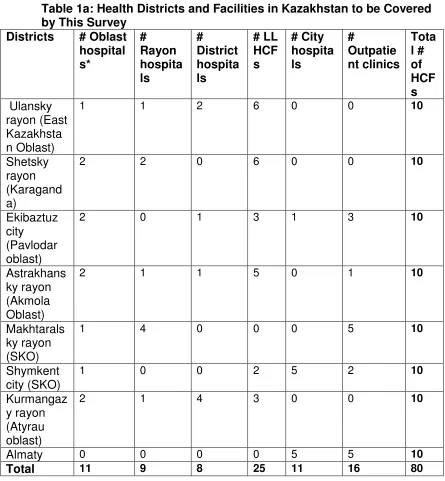
The assessment will be carried out in the health districts and numbers of facilities in Kazakhstan and Kyrgyzstan is shown in Table 1a and b.
1
Surgical department is listed as an area but it should be noted that this refers to pre-operative procedures and post-operative procedures. Data collectors will not attempt to observe actual surgeries.
2
27 Uzbekistan and Tajikistan
[image:28.612.84.529.220.701.2]Assessment will be done in preselected HCFs. Observations of needle/syringe use for injections and phlebotomy will be conducted in the seven departments where the majority of syringes and needles are used. These include: ICU, medical department, pediatrics, gynecology-obstetrics, outpatient care, the phlebotomy area of the laboratory, and surgical, as well as stock room of each department. It is important to note that not all hospitals will have all seven departments. The survey will include all of the areas listed above that exist at each facility.
Table 1a: Health Districts and Facilities in Kazakhstan to be Covered by This Survey
Districts # Oblast hospital s* # Rayon hospita ls # District hospita ls # LL HCF s # City hospita ls # Outpatie nt clinics Tota l # of HCF s Ulansky rayon (East Kazakhsta n Oblast)
1 1 2 6 0 0 10
Shetsky rayon (Karagand a)
2 2 0 6 0 0 10
Ekibaztuz city
(Pavlodar oblast)
2 0 1 3 1 3 10
Astrakhans ky rayon (Akmola Oblast)
2 1 1 5 0 1 10
Makhtarals ky rayon (SKO)
1 4 0 0 0 5 10
Shymkent city (SKO)
1 0 0 2 5 2 10
Kurmangaz y rayon (Atyrau oblast)
2 1 4 3 0 0 10
Almaty 0 0 0 0 5 5 10
28
[image:29.612.88.529.150.474.2]* For each oblast it can have 1 or 2 oblast hospitals; no oblast has more than 2 hospitals.
Table 1b: Health Districts and Facilities in Kyrgyzstan to be Covered by This Survey
Districts # Oblast hospital s* # Rayon hospita ls # District hospita ls # LL HCF s # City hospita ls # Outpatie nt clinics Tota l # of HCF s Sokoluk (Chu oblast)
1 1 2 5 0 1 10
Batken (Kadamjay)
2 2 5 0 0 2 11
Talas (Karabura)
1 1 0 6 0 2 10
Aravan (Osh)
2 3 0 4 0 1 10
Nookat (Osh)
0 8 0 0 0 2 10
Jalalabat (Bazarkurga n)
1 1 0 7 0 1 10
Issyk-Kul 1 0 0 4 2 2 9
Bishkek 0 0 0 0 3 7 10
Total 8 16 7 26 5 18 80
* For each oblast it can have 1 or 2 oblast hospitals; no oblast has more than 2 hospitals.
The lists of HCFs for Kazakhstan, Kyrgyzstan, Uzbekistan and Tajikistan are presented in Appendix 2.
4.5. Study Populations / Areas
A description of data to be collected from each study population/area can be found below. Details for can be found in Table 3 at the end of this section.
4.5.1 Inventory / Stock Rooms
29
rooms per hospital (or, if fewer, if there are fewer than 7 departments) and 1 stock room per LLF will be assessed.
4.5.2 Observation of departments and entire HCFs
The observations are conducted in and around the facility and compiled onto 1 questionnaire. Observations outside the facility are limited to the facility grounds. A total of 1 set of observations covering the entire hospital and 1 set of observations per lower-level facility will be completed. These observations will be analyzed by department with a total of 7 sets of
observations per hospital and 1 per lower-level facility in each country.
Thus, 7 departments or fewer will be observed per hospital. One department of each type (general, ICU, surgical, obstetric, pediatric, laboratory and outpatient) well be assessed. If, however, a hospital has 3 departments of one type, only one department will be chosen randomly for assessment. If there are more than two departments of one type, the number of these departments will be placed into “a hat” and randomly draw one from the hat; if there are two, assessors will flip a coin.
4.5.3 Injections Observed
The observations are conducted where the injections are given (patient bedside, injection room, etc). Usually, these services are concentrated in one or two rooms in lower level facilities. Data will be collected in both inpatient and outpatient settings. In hospitals, observations will be conducted in the departments listed in Section 4.4. If more than one HCW is providing procedures during observations, all HCWs will be
observed. Although four injection observations are planned for each lower-level facility and eight injection observations per each department of each hospital, there will be fewer observations if not all hospitals have all 7 departments or if some lower-level facilities or hospital departments have fewer than 4 injections taking place during the time of the data collection visit.
Kazakhstan
A sampling of injections observed will be devised in the following manner:
• Hospitals: 8 injections and related procedures per service
30
• City outpatient clinics: 8 injections per service area
(department), that is,8 in laboratoryand 8 injections where patients receive treatment (8 injections per service area x 2 service areas x 16 HCFs). Total 256 injections will be observed.
• Lower-level health facilities: 4injections per facility of which 2 should be a vaccination, 2 curative3. Note that the goal is to observe 4 injections. Data collectors should observe no more than 2 immunizations and 2 curative injections. (4 injections per
[image:31.612.84.530.310.425.2]facility x 25 HCFs). Total: 100 injections will be observed (see Table 2).
Table 2a: Total number of procedures to be observed in HCFs, Kazakhstan.
HCFs # of
HCFs
# of
departments # of
procedures per
department
Total # of procedures
Hospitals 39 7 8 2184
City outpatient clinics 16 2 8 256 Lower level HCFs 25 1 4 100
Total 80 2540
Kyrgyzstan
A sampling of injections observed will be devised in the following manner:
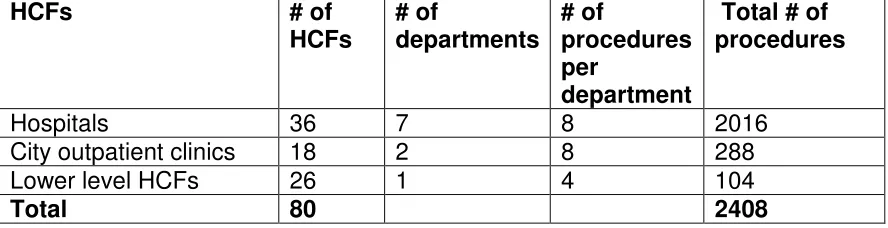
• Hospitals: 8 injections per service area (department), that is, 8 in medicine, 8 in pediatrics, 8 in gynecology-obstetrics, 8 in surgical , 8 in the laboratory, 8 in ICU and 8 in the outpatient department (8 injections per service area x 7 service areas x 36 hospitals). Total 2016 injections will be observed.
• City outpatient clinics: 8 injections per service area
(department), that is,8 in laboratoryand 8 in s where patients receive treatment (8 injections per service area x 2 service areas x 18 HCFs). Total 288 injections will be observed.
• Lower-level health facilities: 4injections per facility of which 2 should be a vaccination, 2 curative. Note that the goal is to
3
31
observe 4 injections. Data collectors should observe no more than 2 immunizations and 2 curative injections. (4 injections per
[image:32.612.85.529.184.298.2]facility x 26 HCFs). Total 104 injections will be observed (see Table 2b).
Table 2b: Total number of procedures to be observed in HCFs, Kyrgyzstan.
HCFs # of
HCFs
# of
departments # of
procedures per
department
Total # of procedures
Hospitals 36 7 8 2016
City outpatient clinics 18 2 8 288 Lower level HCFs 26 1 4 104
Total 80 2408
Uzbekistan
A sampling of injections observed will be devised in the following manner:
• Hospitals: 8 injections per service area (department), that is, 8 in medicine, 8 in pediatrics, 8 in gynecology-obstetrics, 8 in surgical , 8 in the laboratory, 8 in ICU and 8 in the outpatient department (8 injections per service area x 7 service areas x 65 hospitals). Total 3640 injections will be observed.
• City outpatient clinics: 8 injections per service area
(department), that is,6 in laboratoryand 6 in s where patients receive treatment (8 injections per service area x 2 service areas x 4HCFs). Total 64 injections will be observed.
• Lower-level health facilities: 4injections per facility of which 2 should be a vaccination, 2 curative. Note that the goal is to observe 4 injections. Data collectors should observe no more than 2 immunizations and 2 curative injections. (4 injections per
facility x 6 HCFs). Total 24 injections will be observed (see Table 2c).
Table 2c: Total number of procedures to be observed in HCFs, Uzbekistan.
HCFs # of
HCFs
# of
departments # of
procedures per
department
32
Hospitals 65 7 8 3640
City outpatient clinics 4 2 8 64 Lower level HCFs 6 1 4 24
Total 75 3728
Tajikistan
A sampling of injections observed will be devised in the following manner:
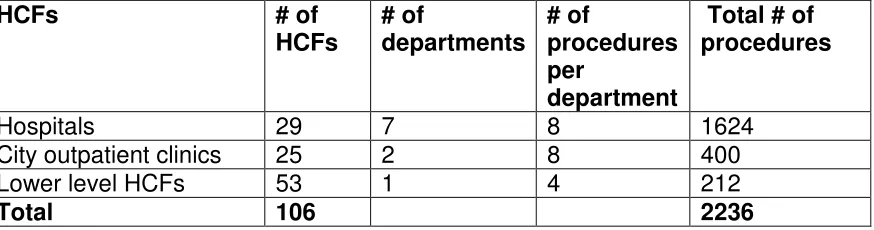
• Hospitals: 8 injections per service area (department), that is, 8 in medicine, 8 in pediatrics, 8 in gynecology-obstetrics, 8 in surgical , 8 in the laboratory, 8 in ICU and 8 in the outpatient department (8 injections per service area x 7 service areas x 28 hospitals). Total 1624 injections will be observed.
• City outpatient clinics: 8 injections per service area
(department), that is,8 in laboratoryand 8 in s where patients receive treatment (8 injections per service area x 8 service areas x 25HCFs). Total 400 injections will be observed.
• Lower-level health facilities: 4injections per facility of which 2 should be a vaccination, 2 curative. Note that the goal is to observe 4 injections. Data collectors should observe no more than 2 immunizations and 2 curative injections. (4 injections per
[image:33.612.85.530.71.132.2]facility x 53 HCFs). Total 212 injections will be observed (see Table 2d).
Table 2d: Total number of procedures to be observed in HCFs, Tajikistan.
HCFs # of
HCFs
# of
departments # of
procedures per
department
Total # of procedures
Hospitals 29 7 8 1624
City outpatient clinics 25 2 8 400 Lower level HCFs 53 1 4 212
Total 106 2236
4.5.4 Injection Administrators
[image:33.612.92.529.491.606.2]33
of injections being observed on the day of data collection in each facility (or, in the case of the laboratories, the one who uses the largest numbers of devices to draw blood). Usually, this will be the treatment room nurse in each department or the laboratory technician responsible for blood
drawing.
Kazakhstan:
Injection providers will be sampled according to the following breakdown:
• Hospitals: 1 participant per service area: 1 in the medical
department, 1 in pediatrics, 1 in gynecology-obstetrics, 1 in surgical , 1 in ICU , 1 in the laboratory, and 1 in the outpatient department. (7 participants x 39hospitals). Total 273 participants.
• City outpatient clinics:1 participant per service area: 1 in the laboratory and 1 in for treatment. (2 participants x 16 HCFs). Total 32 participants.
• Lower-level facilities4: 1participant per facility (1 participant x 25 facilities). Total 25 participants.
Kyrgyzstan:
Injection providers will be sampled according to the following breakdown:
• Hospitals: 1 participant per service area: 1 in the medical
department, 1 in pediatrics, 1 in gynecology-obstetrics, 1 in surgical , 1 in ICU , 1 in the laboratory, and 1 in the outpatient department. (7 participants x 36 hospitals). Total 252 participants.
• City outpatient clinics:1 participant per service area: 1 in the laboratory and 1 in department for treatment. (2 participants x 18 HCFs). Total 36 participants.
• Lower-level facilities: 1participant per facility (1 participant x 26 facilities). Total 26 participants.
4
34 Uzbekistan
Injection providers will be sampled according to the following breakdown:
• Hospitals: 1 participant per service area: 1 in the medical
department, 1 in pediatrics, 1 in gynecology-obstetrics, 1 in surgical department, 1 in ICU , 1 in the laboratory, and 1 in the outpatient department. (7 participants x 65 hospitals). Total 455 participants.
• City outpatient clinics:1 participant per service area: 1 in the
laboratory and 1 in department for treatment. (2 participants x 4 HCFs). Total 8 participants.
• Lower-level facilities: 1participant per facility (1 participant x 6 facilities). Total 6 participants.
Tajikistan
Injection providers will be sampled according to the following breakdown:
• Hospitals: 1 participant per service area: 1 in the medical
department, 1 in pediatrics, 1 in gynecology-obstetrics, 1 in surgical department, 1 in ICU , 1 in the laboratory, and 1 in the outpatient department. (7 participants x 28 hospitals). Total 196 participants.
• City outpatient clinics:1 participant per service area: 1 in the
laboratory and 1 in department for treatment. (2 participants x 25 HCFs). Total 50 participants.
• Lower-level facilities: 1participant per facility (1 participant x 53 facilities). Total 53 participants.
4.5.5 Supervisors of injection providers
Kazakhstan
35
• Hospitals:1participant per service area: 1 supervisor in the medical department, 1 in pediatrics, 1 gynecology-obstetrics, 1 in surgical department, 1 in ICU, 1 in the laboratory, and 1 in the outpatient department (7 participants x 39 hospitals). Total 273 participants.
• City outpatient clinics: 1 participant per service area: 1 supervisor in the laboratory and 1 in department where treatment is provided. (2 participants x 16 HCFs). Total 32 participants
• Lower-level facilities: 1participant per facility (1 participant x 25 facilities). Total 25 participants.
Kyrgyzstan
Supervisors of the staff responsible for administering injections or blood draws will be selected according to the following breakdown:
• Hospitals:1participant per service area: 1 supervisor in the medical department, 1 in pediatrics, 1 gynecology-obstetrics, 1 in surgical , 1 in ICU, 1 in the laboratory, and 1 in the outpatient department (7
participants x 36 hospitals). Total 252participants.
• City outpatient clinics: 1 participant per service area: 1 supervisor in the laboratory and 1 in department where treatment is provided. (2 participants x 18 HCFs). Total 36 participants
• Lower-level facilities: 1participant per facility (1 participant x 26 facilities). Total 26 participants.
Uzbekistan
Supervisors of the staff responsible for administering injections or blood draws will be selected according to the following breakdown:
• Hospitals:1participant per service area: 1 supervisor in the medical department, 1 in pediatrics, 1 gynecology-obstetrics, 1 in surgical department, 1 in ICU, 1 in the laboratory, and 1 in the outpatient department (7 participants x 65 hospitals). Total 455 participants.
• City outpatient clinics: 1 participant per service area: 1 supervisor in the laboratory and 1 in department, where treatment is provided. (2 participants x 4 HCFs). Total 8 participants
36 Tajikistan
Supervisors of the staff responsible for administering injections or blood draws will be selected according to the following breakdown:
• Hospitals:1participant per service area: 1 supervisor in the medical department, 1 in pediatrics, 1 gynecology-obstetrics, 1 in surgical department, 1 in ICU, 1 in the laboratory, and 1 in the outpatient department (7 participants x 28 hospitals). Total 196 participants.
• City outpatient clinics: 1 participant per service area: 1 supervisor in the laboratory and 1 in department, where treatment is provided. (2 participants x 25 HCFs). Total 50 participants
• Lower-level facilities: 1participant per facility (1 participant x 53 facilities). Total 53 participants.
4.5.6 Staff in charge of waste management
Kazakhstan and Kyrgyzstan
Among staff responsible for waste management, only the main person responsible for waste management will be interviewed. So, 1 participant per hospital and 1participant per lower-level facility will be selected for interview. Total: 80 participants per country will be selected for interview.
Uzbekistan and Tajikistan
Among staff responsible for waste management, only main person
responsible for waste management will be interviewed. So, 1 participant per hospital and 1participant per lower-level facility will be selected for interview. Total: 75 participants in Uzbekistan and 106 participants in Tajikistan will be interviewed.
4.5.7 Patients, hospitalized in the observed departments
Kazakhstan
Patients receiving medical care in these healthcare facilities will be selected for interview according following breakdown.
• Hospitals: 4 participants per service area: 4 patients in the medical department, 4 parents in pediatrics, 4 patients in
37
patients in laboratory, excluding ICU (4 participants x 6 departments x 36 hospitals). Total 864 participants.
• City outpatient clinics: 4 participants per service area: 4 patients in the laboratory and 4 in department, where treatment is provided. (8 participants x 16 HCFs). Total 128 participants
• Lower-level facilities: 2participants per facility (2 participant x 25 facilities). Total 50 participants.
Kyrgyzstan
Patients receiving medical care in these healthcare facilities will be selected for interview according following breakdown.
• Hospitals:4participants per service area: 4 patients in the medical department, 4 parents in pediatrics, 4 patients in
gynecology-obstetrics, 4 patients in surgical department, 4 patients in outpatient department and 4 patients in laboratory, excluding ICU (4 participants x 6 departments x 36 hospitals). Total 864 participants.
• City outpatient clinics: 4 participants per service area: 4 patients in the laboratory and 4 in department, where treatment is provided. (8 participants x 18 HCFs). Total 144 participants
• Lower-level facilities: 2participants per facility (2 participant x 25 facilities). Total 52 participants.
Uzbekistan
Patients receiving medical care in these healthcare facilities will be selected for interview according following breakdown.
• Hospitals:4participants per service area: 4 patients in the medical department, 4 parents in pediatrics, 4 gynecology-obstetrics, 4 in surgical department, 4 patients in outpatient department and 4 patients in laboratory, excluding ICU (4 participants x 6departments x 65
hospitals). Total 1560 participants.
• City outpatient clinics: 4 participants per service area: 4 patients in the laboratory and 4 in department, where treatment is provided. (8 participants x 4 HCFs). Total 32 participants
• Lower-level facilities: 2participants per facility (2 participant x 6 facilities). Total 12 participants.
38 Patients receiving medical care in these healthcare facilities will be
selected for interview according following breakdown.
• Hospitals:4participants per service area: 4 patients in the medical department, 4 parents in pediatrics, 4 patients in
gynecology-obstetrics, 4 patients in surgical department, 4 patients in outpatient department and 4 patients in laboratory, excluding ICU (4 participants x 6 departments x 28 hospitals). Total 672 participants.
• City outpatient clinics: 4 participants per service area: 4 patients in the laboratory and 4 in department, where treatment is provided. (8 participants x 25 HCFs). Total 200 participants
• Lower-level facilities: 2participants per facility (2 participant x 53 facilities). Total 106 participants.
Table 3a: Target Population Sample for Kazakhstan
# Target Population
Sample size Hospitals City
outpatient
LL HCFs Total
1 Stock room inventory 273 32 25 329
2 HCF observations 39 16 25 80
3 Observations of injections or phlebotomy 2184 256 100 2540 4 Injection administrator interviews 273 32 25 330 5 Interviews with supervisors of injection
administrators
273 32 25 330
6 Waste management interviews 39 16 25 80
[image:39.612.47.570.507.667.2]7 Patients 864 128 50 1042
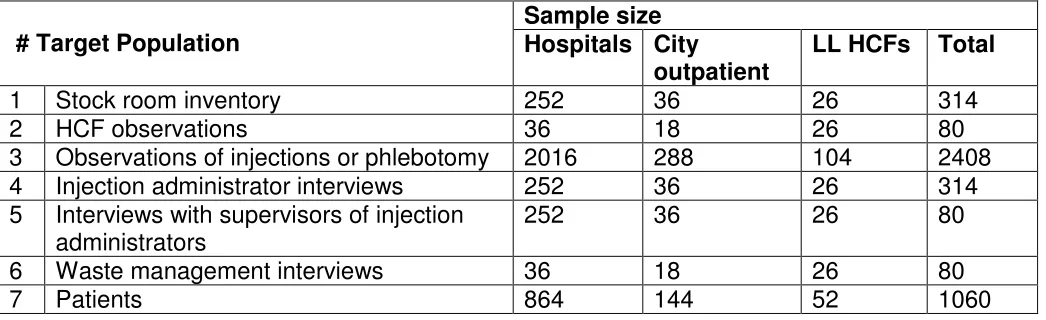
Table 3b: Target Population Sample for Kyrgyzstan
# Target Population
Sample size Hospitals City
outpatient
LL HCFs Total
1 Stock room inventory 252 36 26 314
2 HCF observations 36 18 26 80
3 Observations of injections or phlebotomy 2016 288 104 2408 4 Injection administrator interviews 252 36 26 314 5 Interviews with supervisors of injection
administrators
252 36 26 80
6 Waste management interviews 36 18 26 80
7 Patients 864 144 52 1060
39 # Target Population
Sample size Hospitals City
outpatient
LL HCFs Total
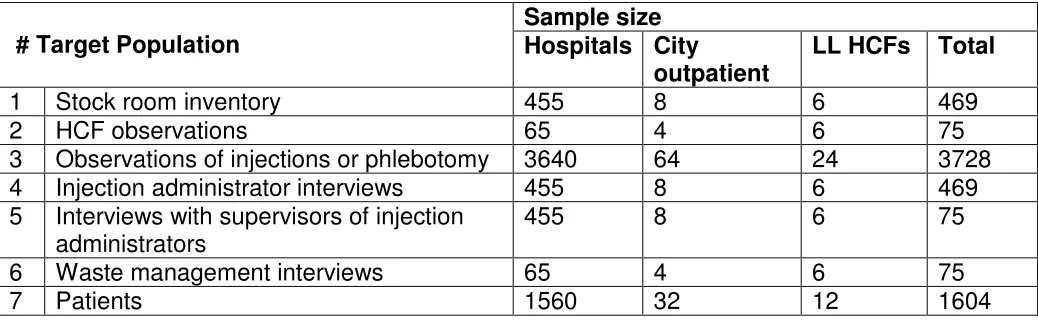
1 Stock room inventory 455 8 6 469
2 HCF observations 65 4 6 75
3 Observations of injections or phlebotomy 3640 64 24 3728 4 Injection administrator interviews 455 8 6 469 5 Interviews with supervisors of injection
administrators
455 8 6 75
6 Waste management interviews 65 4 6 75
[image:40.612.47.566.71.231.2]7 Patients 1560 32 12 1604
Table 3d: Target Population Sample for Tajikistan
# Target Population
Sample size Hospitals City
outpatient
LL HCFs Total
1 Stock room inventory 196 50 53 299
2 HCF observations 28 25 53 106
3 Observations of injections or phlebotomy 1624 400 212 2236 4 Injection administrator interviews 196 50 53 299 5 Interviews with supervisors of injection
administrators
196 50 53 299
6 Waste management interviews 28 25 53 106
7 Patients 672 200 106 978
4.6. Data Collection
Teams will visit an average of 1 hospital or 2 lower-level facilities per day. The estimated number of days for data collection in the field for each country is as follows:
This activity will be carried out using the assessment tools adapted to the context of the health system. The assessment tools are questionnaires with 6
components or ‘‘Sections’’ that relate to specific intervention areas of injection safety. (See Appendices 3 under separate cover.) These sections are:
• Inventory/stock rooms: Section 1
• Observations of health facilities and waste management: Section 2 • Observations of injection practices: Section 3
• Interviews of injection providers: Section 4