International Journal of Emerging Technology and Advanced Engineering
Website: www.ijetae.com (ISSN 2250-2459, Volume 2, Issue 6, June 2012)136
Enhanced Uniform Distributed Clustering Algorithm (UDCA) In
Wireless Sensor Network
Rajnish Kansal
1Department Of Computer Science & Engineering, Lovely Professional University, Jalandhar, Punjab
Abstract—The use of wireless sensor networks increased in applications such as intrusion detection, forest fire detection, disaster management and battle field. As sensor nodes are generally battery-powered devices, the critical aspects to face concern how to reduce the energy consumption of nodes, so that the network lifetime can be extended to reasonable times [1]. Node clustering is one of the most promising techniques for energy conservation. This paper presents an ENHANCED UDCA (Uniformly Distributed Clustering Algorithm) which maximizes the network lifetime by reducing the number of communication among sensor nodes and base station. This algorithm also includes new distributed cluster formation technique that enables self-organization of large number of nodes, algorithm for maintaining constant number of clusters by prior selection of cluster head and rotating the role of cluster head to distribute the energy load among all sensor nodes.
Keywords— cluster head, clustering algorithm, Energy consumption, wireless sensor network, sensor node.
I. INTRODUCTION
Wireless sensor network means that the network which is wireless and deals with sensors. A Wireless Sensor Networks (WSN)[1][2] consists of spatially distributed
autonomous sensors to cooperatively monitor physical or
environmental conditions, such as temperature, sound, vibration, pressure, motion or pollutants. WSN contains a large number of nodes with a limited energy supply. A wireless sensor Network consists of nodes that can communicate with each other via wireless links. Sensors are be remotely deployed in large numbers and operates autonomously in unattended environments. A wireless sensor network is composed of a large number of sensor nodes that are densely deployed either inside the environment or close to it. The position of sensor nodes need not be engineered or predetermined. This allows
random deployment in inaccessible hazardous
environments. Some of the most important application areas of sensor networks include military, natural calamities, health, and home. When compared to traditional ad hoc networks, the most noticeable point about sensor networks is that, they are limited in power, computational capacities, and memory.
Hence optimizing the energy consumption in wireless sensor networks has recently become the most important performance objective. Sensors are energy constrained and their batteries cannot be recharged/replaced in such environments. Therefore energy conservation is commonly recognized as the key challenging [3] factor in the design and the operation of large scale WSNs, consisting of hundreds or even thousands of sensor nodes. Therefore, designing energy-aware algorithms becomes an important factor for extending the lifetime of sensors.
The main task of a sensor node in a sensor network is to monitor events, i.e., collect data, perform quick local data aggregation, and then transmit the data. Sensor nodes have limited battery power. Sensor nodes of WSN have the capability of self organizing the network.
Sensor node consists of four main components: (i) A sensing subsystem including one or more sensors (with
associated analog-to-digital converters) for data
acquisition; (ii) A processing subsystem including a micro-controller and memory for local data processing (iii) A radio subsystem for wireless data communication.(iv)A Power supply unit.
International Journal of Emerging Technology and Advanced Engineering
Website: www.ijetae.com (ISSN 2250-2459, Volume 2, Issue 6, June 2012)137
II. RELATED WORK
Energy efficiency is the primary challenge of WSNs. Clustering schemes helps to reduce power consumption in order to increase the network lifetime. In literature, a number of clustering algorithms have been specifically designed for WSN. These proposed clustering techniques widely vary depending on the node deployment.
UDCA [7] is one of the clustering algorithms which maximizes the network lifetime by reducing the number of communication among sensor nodes. This approach also includes new distributed cluster formation technique that enables self-organization of large number of nodes, algorithm for maintaining constant number of clusters by prior selection of cluster head and rotating the role of cluster head to evenly distribute the energy load among all sensor nodes. In this Uniform Distributed Clustering Algorithm is used.
UDCA combines the system parameters such as cluster size, transmission power [10], and energy level of nodes and maintain constant number of clusters throughout the lifetime of the network. In this proposed algorithm, only nodes with higher energy are selected are selected as CHs, while those with low energy extend their lifetime by performing sensing tasks that require low energy. Further, each cluster member nodes sense the similar data, which are aggregated by the CH, limiting the amount of data that needs to be sent to the BS. The main activities of this algorithm are broken up into rounds, where each round begins with a cluster setup phase, followed by a steady state round. They are i) Central cluster setup round, ii) Steady state round, and iii) Distributed cluster setup round.
1) Central cluster setup round
In this round, clusters and CHs selection is initiated at the time of system activation by the central BS.
Step I: Node information
1. BS broadcast REQ signal into the network
requesting location, node ID, and energy level of each node.
2. In response to the REQ signal, all the nodes in the
network send LOC_ID_EL message, which consist
of location information, node ID, and energy level to the BS.
Step II: Cluster Head selection
1. BS selects fixed number (m) of energy abundant nodes as CHs for the network.
2. If more than one nodes have same energy level, the BS uses smallest/largest node ID to break the tie.
3. The BS broadcast CH_ID message signal, which
contains CHs node ID into the network.
Step III: CH Announcement
1. Each node extracts node ID from the message. If the ID matches with the node ID, the node becomes CH, otherwise the node will wait for the cluster
head advertisement message (CH_ADV) signal
from other nodes.
2. CH node broadcast a CH_ADV message to the non
cluster head nodes. This is a short message which contains cluster head node ID, message header (used to differentiate messages) and unique direct sequence spread spectrum code, which is used to avoid the inter cluster interference.
3. Based on the received CH_ADV signal strength,
each of the non cluster head node bases its decision whether it would like to join the cluster or not by
sending the JOIN_CH message which includes its
energy level and node ID to the desired cluster head.
4. All CH nodes receive the JOIN_CH messages from
the member nodes, and the CH node selects the
probable cluster head (CH prob) for the next round.
2) Steady state round
The CH node receives all the messages from the nodes that would likely to be included in the cluster. The CH node creates time schedule and initiates the data transmission.
Step I: Schedule creation
1. After deciding the CH prob, the CH node creates
TDMA time slot for all the nodes.
2. The CH node sends out CHPROB_SCH message
into the network. This message contains CH prob node ID and time slot telling when it can transmit the data.
Step II: Data reporting
1. The radio of each of the member nodes can be turned off until the nodes allocated TDMA slot, thus Min. the energy in these nodes. The CH nodes must keep their receiver on to receive all the member nodes data. 2. After receiving data from all member nodes, the cluster
heads performs data aggregation. The aggregated data is send to the BS by using multihop communication through intermediate CHs.
3) Distributed cluster setup round
International Journal of Emerging Technology and Advanced Engineering
Website: www.ijetae.com (ISSN 2250-2459, Volume 2, Issue 6, June 2012)138
This is initiated by the CH prob nodes, which was selected by the CHs of previous round. This begins with the announcement round as described in the step III of central cluster setup round. The network operation then continues with the Steady state round followed by Distributed cluster setup round and continues.
III. PROPOSED ALGORITHM
Many literatures are concentrated on energy efficiency in wireless sensor network. Various clustering algorithms are going on. But we are working on uniform distributed clustering algorithm (UDCA). Overall performance of UDCA is good. But it has some limitations in terms of energy efficiency. Basically UDCA work in three rounds. In very first round energy consumption is very high. So ,proposed work is focus to reduce the communication energy and time between BS and CHs. We have done some changes into the first step of UDCA. Initially, there was a broadcast communication between the base station and nodes. But into this modified algorithm, we are using multicast communication between the base station and nodes. In first round of UDCA, base station sends cluster head message to all nodes by broadcast medium, but it is energy consuming process. Because, all member nodes will check that message to match their node ids. But in enhanced UDCA we are using multicast medium. Base station will send cluster head id message to that particular nodes, which are selected as cluster heads. Now all member nodes will not check CH-ID message and their energy will be conserved.
Proposed Algorithm for enhanced UDCA
1. Central cluster setup round: Step 1:
BS-base station broadcasting the req signal; BS-req-(all nodes)
All nodes (LOC_ID_EL) - to BS
Step II: Cluster Head selection by fcm
En- Find E > (all NE) If no. of En > 1 Find (node_id (En)) If E2 (node_id) > (En (all)) Make CH –E2
BS-(MULTICAST)-CH-ID (E2)
Step III: CH Announcement
N1=node1; Extract (CH-ID) If
ID (N1) == Extract (CH-ID) ;
(N1==E2); N1=CH_HEAD;
Send-(All NON-CH- NODES)-CH_ADV Else
Wait for
CH_ADV (from other Nodes) End
N2 (non cluster head node) N2-get (CH_ADV);
N2-Send-JOIN_CH (message to join)+ID(N2)—CH(N1) When CH (N1)-RECIVE (ALL JOIN_CH)
Then JOIN MEMBERS (N2...)
MAKE CH_PROBE (probable cluster head) 2 Steady state round:
Step I: Schedule creation
CHPROB_SCH- (TDMA+CHprob NODE_ID) CH_N1-send (CHPROB_SCH)to ALL
Step II: Data reporting
DATA-CH_N1-get_data- NODES (TDMA); CH_N1-AGGREGATE (DATA);
CH_N1-send (DATA)-BS; 3 Distributed cluster setup round: N3 (CHprob)-BECOME-CH- CH-N3-NEXT ROUND
IV. RESULTS
The simulation work has been done on Matlab simulation tool. We have taken 100 sensors in the area of 100 X 100 meters. The cluster head is selected by the technique of FCM. We have taken two scenarios: one is in the case of broadcasting and other is the case of
multicasting.
Scenario1. Base station is broadcasting the message to all nodes
International Journal of Emerging Technology and Advanced Engineering
Website: www.ijetae.com (ISSN 2250-2459, Volume 2, Issue 6, June 2012)139
In this figure energy consumed is10.029J for broadcasts the cluster head id message to all the nodes. And check whether their id is matching or not. So all node will lose their energy for confirming, that they are cluster head. To avoid this unnecessary checking, we work on multicast communication between the nodes and member nodes
[image:4.612.77.260.222.397.2]2. Base station is multicasting the message to all nodes.
Figure 2: base station multicasts message
In this figure energy consumed is 0.231jule, for multicast the message to those nodes which are selected as cluster head. In this way energy consumed is very less than broadcast medium.
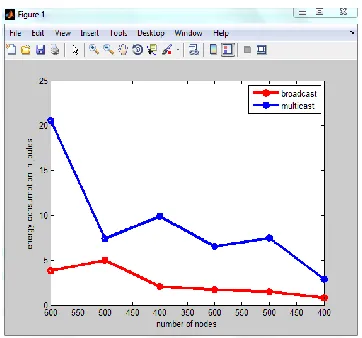
3. Graphical comparison between broadcast and multicast communication.
Figure 3: comparison of broadcast and multicast
The simulation results direct us that multicasting in UDCA is efficient than broadcasting in UDCA.
V. CONCLUSION
This work presents an improved clustering algorithm UDCA that effectively combines some system parameters to organize the nodes into non overlapping clusters. Improved UDCA attempts to minimize the energy consumption by creating constant number of clusters and by selecting the probable cluster head for the next round in advance. Energy cost is more during the first round, since all the nodes needs to communicate with the BS. But in improved UDCA, in first round Base station communicates with their member node by multicast medium. Results shows that multicast is more efficient and power conservation method, in the comparison of broadcast medium .For subsequent rounds, energy cost is very much reduced due to probable cluster head selection in advance for the next subsequent round.
VI. FUTURE SCOPE
In future scope this simulated work can be implemented in real environment, with the help of real sensor nodes. Clustering technique is a wide open research area in field of wireless sensor network and furthermore improved algorithms can be proposed in future.
REFERENCES
[1 ] Giuseppe Anastasi, Marco Conti#, Mario Di Francesco, Andrea Passarella:, July 2008. ―Energy Conservation in Wireless Sensor Networks‖.
[2 ] I. F. Akyildiz, T. Melodia, K.R. Chowdhury, March 14, 2007. ―A Survey on Wireless Multimedia Sensor Networks‖, Computer Networks, Vol. 51, Issue 4, pp. 921-960.
[3 ] D.G.Anand1, Dr.H.G.Chandrakanth and Dr.M.N.Giriprasad, (2011). ―Challenges in maximizing the life of Wireless Sensor Network‖ Int. J. Advanced Networking and Applications Volume: 03, Issue: 01, Pages:999-1005 .
[4 ] B. Krishnamachari, D. Estrin, S. Wicker, "Modeling Data Centric Routing in Wireless Sensor Networks, June 2002" in the Proceedings of IEEE INFOCOM, New York, NY,.
[5 ] V.S.Anita Sofia , Dr.S.Arockiasamy ―A Generalize Framework for Energy Conservation in Wireless Sensor Network, January 2011‖ IJCSI International Journal of Computer Science Issues, Vol. 8, Issue 1.
[image:4.612.78.259.480.649.2]International Journal of Emerging Technology and Advanced Engineering
Website: www.ijetae.com (ISSN 2250-2459, Volume 2, Issue 6, June 2012)140
[7 ] Boregowda S.B., Hemanth Kumar A.R. Babu N.V, Puttamadappa C., And H.S Mruthyunjaya, 2010 ―UDCA: An Energy Efficient Clustering Algorithm for Wireless Sensor Network‖, World Academy of Science, Engineering and Technology.
[8 ] S.V.Manisekaran,Dr.R.Venkatesan,―Energy efficient hierarchical clustring for sensor network’’,2010 Second International conference on Computing,Communication and Networking technologies. [9 ] Kirtika Goyal, July 2011 ―Energy Conservation Of WSNS Through
Different Clustering Algorithms‖, journal of global research in computer science,Volume 2, No. 7.
[10 ]Andhe Dharani, Member, IAENG, Vijayalakshmi M. N, Vijay Singh,
Sumithra Devi K.A, July 6 - 8, 2011 ―Power Optimization in Ad hoc Sensor Networks using Clustering Approach‖ Proceedings of the World Congress on Engineering 2011 Vol II WCE 2011, , London, U.K.