Journal of Chemical and Pharmaceutical Research, 2014, 6(7):1483-1487
Research Article
CODEN(USA) : JCPRC5
ISSN : 0975-7384
The optimization of emergency resource-mobilization based on
harmony search algorithm
Lie Xiong Da
School of Mathematics and Computer Science, Shaanxi University of Technology, Hanzhong Shaanxi, China
______________________________________________________________________________
ABSTRACT
This paper establishes an optimization model of emergency resource-mobilization based on the principle of the shortest time and minimum cost, which is an objective function. In order to calculate this optimization problem, harmony search algorithmic is used to solve the problem. Experimental results show our proposed method is effective and efficient for solving the multi-objective optimization problem.
Key words: harmony search; multi-objective optimization; emergency resources mobilization
______________________________________________________________________________
INTRODUCTION
Emergency resource-mobilization composes of many kinds of emergency resources and emergency units. And the distribution of various emergency units is independent and irregular. Emergency resources of all emergency units are limited. The distance between emergency units and point is different. Therefore, speed and cost of resource-mobilization affect the schemes directly.
At present, research on resource scheduling is mostly limited to the constraints of scheduling model and route choice, and for large scale problems, there is less solving algorithm of many cases. In case of emergency points less, exhaustive method can generally obtain the optimal solution of the problem. However, when more emergency resources participate, exhaustive method solves this kind of problems hopeless. So we employ the heuristic optimization algorithm to solve this problem.
Harmony search algorithm [8] is a new heuristic search algorithm and has successfully been applied to the structure optimization design, traffic path planning and the slope stability analysis, etc. Research shows that the algorithm in discrete optimization problems is better than the ant colony algorithm, genetic algorithm performance. The experimental results show that harmony search algorithm has better performance in solving such problems.
ESTABLISH THE OBJECTIVE FUNCTION
Let S1,S2,… ,and Sn are alternative resource supply point, xi j is the jth( j = 1,2,…,m) effective rescue resources
of Si. (i= 1,2,…,n ).
Assuming that , in a mobilization of resources, the demand value of jth is aj,and j
n
i
a
≥
∑
=1 ij
x
,From then availableresources to provide emergency resourcesinselected j pj (pj<= n ) resourcepoints involved in raising,
And meet the "raisethe shortest time"and"to raise the cost ofat least"two goals.
If the time fromraiseresources point Si to placeA is ti (t i > 0),and t1< t2 < < tn. According to "raisethe shortest
' 1
1,2,... n
min ( )
max( )
ii
f
T x
t
=
=
=
,
If we considerthe cost of raisingresources,namely,raise theneed anotherkey objective conditions: rescue resourcesto raisethe minimum cost.From the resourcespointset Si to raiseemergency resource j to reach
theunit cost of the rally pointArequired for cij,the lowest costj kind ofrescueresources spentat the:
∑
==
n n ij ij jc
y
C
1
"The objective function is to meet the minimum fee" for the:
' 2
1
(
)
n
j ij ij
n
f
MIN C
MIN
c y
=
=
=
∑
In the solving process, according to "raise the minimum cost" of this goal, can be converted to "raise the minimum" problem, in order to meet the various emergency resource mobilization of resources, making out at least some.
HARMONY SEARCH ALGORITHM
Harmony search (Harmony Search, HS[8-12]) algorithm is a new intelligent algorithm in 2001 of a South Korean scholar Geem Z proposed by W et al. The three main parameters of the algorithm, namely the harmony memory considering probability HMCR (Harmony memory considering rate), PAR (Pitch adjusting rate trimming probability), the pitch adjusting bandwidth BW (band width) .The basic steps of harmony search algorithm is as follows:
Step1: Setting of parameters
① The number of variables : N; ② Range of each variable; ③ Maximum iterations: Tmax; ④ Size of harmony memory : HMS;
⑤ Harmony memory consideration rate: HMCR; ⑥ Pitch adjusting rate: PAR;
⑦ Bandwidth: bw.
Step2: Initializing the harmony memory (HM) randomly, the HM is as follows,
Step 3: improvising the new Harmony.
The generation of new harmony,
x
'=
( ,
x x
1' '2,
L
,
x
N')
,the new harmony ' ix
(i=1,2,…,N) can create through thefollowing three kinds of mechanism: ①The learning and memory; ②the tone tuning;③the random selection
of tone. That is:
1
1 1 1 1 1
1 2
2
2 2
2 2 2
1 2 2 1
(
)
(
)
(
)
(
)
(
)
(
)
N NH M S H M S
H M S H M S H M S H M S N
x
x
f x
x
x
f x
x
x
x
x
f x
f x
H M
x
x
x
f x
x
f x
=
=
L
L
L
M
M
M
M
M
M
L
' 1 2
'
( ,
,
)
HMS
i i i i
x
x x
x
x
∈
Where in rand1 represents a random uniform distribution on [0, 1], PAR as the pitch adjust probability, BW is tone tuning bandwidth.
Step 4: Update memory
Evaluation of the new generation of harmony, if new harmony is better than the worst in the harmony memory harmony, harmony will be updated to the new harmony memory. For example, to find the optimal path, i.e.: If '
1,2, ,
( )
(
worst)
max
(
j),
j HMSf x
f x
f x
=
<
=
L then
' worst
x
=
x
Step 5: if the termination condition is reached, output the optimal solution. Otherwise, go to Step 3.
EXPERIMENTAL SECTION
EXPERIMENTAL SIMULATION Problem description
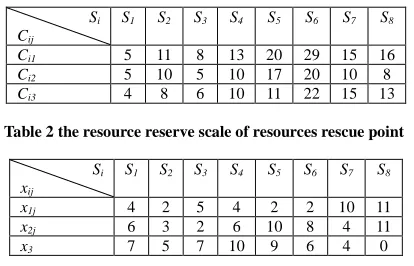
Assume that d1 (=21), d2 (=29), d 3 (=36) are three essential resources in the rescue process, there are 8 resources
rescue point (S1, S2… S8). The per cost that jth rescue resources is transport to the accident point A is Ci1. All cost
of resource rescue point is shown in table 1; Reserves of jth resources rescue point for the xij, is shown in Table 2.
The shortest time ti of arriving accident location from resources rescue point is shown in table 3.
Table 1 the cost from resources rescue point to the location of the accident
Si
Cij
S1 S2 S3 S4 S5 S6 S7 S8
Ci1 5 11 8 13 20 29 15 16
Ci2 5 10 5 10 17 20 10 8
[image:3.595.203.410.387.520.2]Ci3 4 8 6 10 11 22 15 13
Table 2 the resource reserve scale of resources rescue point
Si
xij
S1 S2 S3 S4 S5 S6 S7 S8
x1j 4 2 5 4 2 2 10 11
x2j 6 3 2 6 10 8 4 11
x3 7 5 7 10 9 6 4 0
Table 3 the shortest time that arrive accident location from resources rescue point
Si
ti
S1 S2 S3 S4 S5 S6 S7 S8
ti 2 4 4 8 26 28 12 18
Solving the problem by HS algorithm
According to table 1, table 2, and table 3, multi target applications to set up to raise model, we employ HS algorithm to solve the emergency resource-mobilization. The HS algorithm is initially applied to solve continuous optimization problems, in solving combinatorial optimization problems, and is used to generate a new post. There may be illegal solutions, resulting in HS algorithm cannot be used, therefore, the application of HS algorithm in combination optimization problems, must realize its discretization.
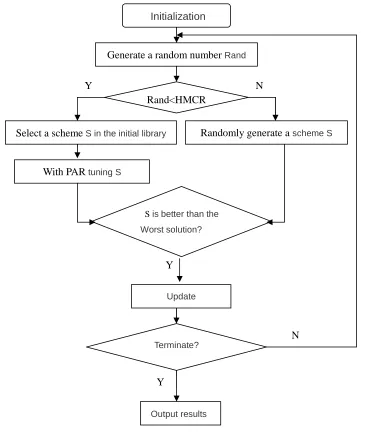
In the solution process, the key parameters: the probability HMCR=0.8, pitch adjusting probability PAR=0.2, number of maximum iterations MAXITER=1000, tone tuning bandwidth of BW=0.1, and the memory size of HMS=5, solving process as shown in figure 1:
If rand1<PAR (
Continuous type
)If rand1<PAR (
Discrete type
)i=1,2,
…
,N
'
'
'
1 *
(
),
{ 1,1}
,
;
i
i i
i
x
ra n d
b w
x
x k
m
m
x o th erw ise
+
=
+
∈ −
Fig.1 flow char of harmony search algorithm
[image:4.595.125.494.76.509.2]The results is obtained by using the MATLAB 7 programming algorithm to solve the problems mentioned above, the experimental results are as follows:
Table 4 resource mobilization scheme
Ci1
xi/Ci1
S1 S2 S3 S4 S5 S6 S7 S8
x1/Ci1 4/5 2/11 5/8 4/13 0/0 0/0 6/15 0/0
x2/Ci2 6/5 0/0 2/5 6/10 0/0 0/0 4/10 11/8
x3/Ci3 7/4 5/8 7/6 10/10 7/11 0/0 0/0 0/0
According to the following table raising scheme, three kinds of resources can be obtained by raising scheme, it as follows,
The scheme for resource d1: {(S1, 4), (S2, 2), (S3, 5), (S4, 4), (S7, 6)};
The scheme for resource d2: {(S1, 6), (S3, 2), (S4, 6), (S7, 4), (S8, 11)};
Initialization
Generate a random number Rand
Rand<HMCR
Y
N
Select a scheme S in the initiallibrary
With PAR tuning S
Randomly generate a scheme S
S isbetter thanthe Worstsolution?
Update
Terminate?
Y
Output results
4×5+2 ×11+5×8+4 ×13+6×15=224 (unit cost);
The shortest time of resource d2 is 18 (unit time), the lowest cost of d2 is 228 (unit cost).
The shortest time of resource d3 is 26(unit time), the lowest cost of d3 is 287 (unit cost).
Therefore, in the rescue process, the earliest start time of the emergency rescue should be the maximum response time of three resources, it is 26 (unit time).
CONCLUSION
This paper adopts the harmony search algorithm to solve the problem of emergency resources. The experimental results show that the harmony search algorithm has advantages of fast convergence speed, which is simple and intuitive, less parameters, easy to implement. The method is effective and feasible to solve emergency resources mobilization.
Acknowledgement
This paper is supported by the fund project of Shaanxi Province Education Office (2013JK1161); Shaanxi University of Technology foundation project (slgky13-27)
REFERENCES
[1] Ali H Sefchango, Transportation Research Part a Policy and Practice, 1996, 30(2):231-250. [2] George F. List, IEEE Transactions On Engineering Management, 1998, 45(2): 141-152. [3] Fiedrich F, Gehbauer F and Rickers U, Safety Science, 2000.35 (1):41-57.
[4] Meixia Li;Haitao Che, Operations Research and Management Science, 2011, 20 (3): 72-76. [5] Guoqiang Wei;Lin Jing , Statistics & Decision 2010, 02:10-12.
[6] Jie Zhang;Zhiyong Wang, Computer Engineering and Applications, 2011, 47 (31): 220-223. [7] Jingui Jiang;Jingguo Liang, Statistics & Decision ,2009, 2:53-54.
[8] Geem ZW;Kim JH;Loganathan GV, Simulation ,2001, 76(2):60−68. [9] Shouheng Tuo;Fangan Deng, Computer science, 2012, 09:240-243+246.
[10] Tuo Shouheng;Longquan Yong and Tao Zhou. Mathematical Problems in Engineering 2013,
http://dx.doi.org/10.1155/2013/413565