The Effects of Aerobics Exercise Programmes on Body
Composition and Some Physical Parameters for the
Pre-obese Class 1 Obese Students at
High School Aged 15-17
Gökyürek, B.
*, Sökmen T., Usta, A.
Faculty of Physical Education and Sports, Gazi University, Turkey
Copyright©2016 by authors, all rights reserved. Authors agree that this article remains permanently open access under the terms of the Creative Commons Attribution License 4.0 international License.
Abstract
Today, it is known that adult obesity is a result of child and adolescent obesity. For this reason, to prevent obesity in adulthood, obesity must be controlled through organising exercise habits of adolescents in addition to organising other habits. Taking the importance of physical beauty in psychology of puberty period into consideration, the effects of aerobics exercise on the obese and fighting against obesity through exercise form the basis for our study to fight against obesity through the habit of exercise. Our study was conducted on 22 male, 27 female of high school level students through 12 weeks aerobics exercise programme, 3 days a week at least, approximately 60 minutes, interval training model. This study focuses on measurements of age, weight, gender characteristics, physical composition as anthropometric measurement (subcutaneous fat, peripheral and diametric measurement), stretching test (sit-reach test), strength test (hand dynamometer), standing long jump, vertical jump, sit-up and push-up.Keywords
Obesity, Exercise, Body Composition1. Introduction
People need self-confidence to live a healthy, peaceful and happy life. When the people are healthy and fit their self-confidence increases. Being aesthetically and physically fit makes people happy. (38)
Puberty is defined as a transitional period between childhood and adulthood accompanied by personal development of all dimensions, and changes in social context. In this period, the physical changes of adolescent, who is having changes in many aspects, is much faster than other development periods except from babyhood. (39).
Adolescence is a period in which the individual has anatomic and physiological changes and developments at maximum level, and sometimes has some problems in adapting to these changes (6).
WHO (World Health Organisation) consider adults between Body Mass Index of 18,50 and 24,99; children and adolescents between Body Mass Index of 15 and 85 percentile as normal weighed. Body Mass Index (BMI) is the weight-for-height which is commonly used for over-weight and obese classification of adults. The weight-for-height is calculated through dividing the weight in kilograms by the square meter of the height (kg/m2). According to BMI definition of WHO, the ones with the BMI of 25 and more are overweight, and the ones with BMI of 30 and more are obese. As BMI is the same for adults of all age groups and both gender, appraised in population-level, BMI provides the most practical measurement of overweight and obesity (36).
“Overweight” is defined by World Health Organisation (WHO) as abnormal or excessive fat accumulation that presents a risk to health. Obesity is considered as the condition of excessive overweight that may impair health. Body fat measurement, weight, BMI (Body mass index), height, skinfold thickness, and waist-hip measurement, muscle-mass measurement plays an important role in clinical examination of obesity. According to the criterion of WHO; for adults, waist measure of over 102 for males, over 82 for females poses a risk. (5) For over 15 years now, the population having a BMI> 30 kg/m2 has increased with 50%, and still on increase. (23)
individuals of this period (6).
Obesity trends have been at the alarming rate for over years. International Obesity Commission stated in its 2003 report that the incidence of obesity and overweight focuses on the ages 5-17 worldwide (15). 53% of the adult population in EU countries is overweight, and 16.7% of them are obese. In 17 of 26 EU countries, obese and overweight prelevance is over 50%. These percentages are very low in France, Italy, and Switzerland. However, it is on heavy increase (27).
According to the preliminary study report of “Turkiye Nutrition and Health Research”, which was conducted by Hacettepe University Health Sciences Faculty Department of Nutrition and Dietetics, and Ankara Numune Training and Research Hospital in 2009, the obesity rate was found out as 8.2 % ( erkek 9%, kız 7.3 % ) between the ages 6-18 (34).
Yet, according to the data of 2013 Health Statistics Yearbook 2013, among the individuals over the age of 15 in Turkiye, overweight rate is 39% in males and 30% in females; and overweight prelevance is 17.2% (32).
The studies to decrease the Obesity Prelevance in Turkiye have started with Ministry of Health Fighting Against Obesity Campaign.
Exercise is an important means in treatment of obesity (39). Exercise is a subset of physical activity that is planned, structured, repetitive (11) and purposeful in the sense that improvement or maintenance of physical fitness is the objective (33).
The purpose of exercise is to regulate distribution of oxygen, and metabolic process, developing strength and endurance, decreasing body fat and improving muscle-joint movements. All these benefits are necessary for good health, and everyone should include a routine exercise programme to daily life (25). The benefit of exercise programme on health is the weight- loss (30).
“Exercise can be the most effective solution for weight loss. The weight- loss of the ones trying to lose weight only through diet is 28% fat-free body mass and it is only 13% fat-free body mass for the ones who has an exercise programme in addition to diet. With the decreased calorie intake, exercise provides more weight loss compared to that of only diet, and also the muscle mass is protected. The most important of all is that exercise provides longer term weight-loss maintenance. That’s why exercise should also be included in losing weight programmes. Exercise increases energy expenditure, and at the same time decreases fat-free tissue loss caused by energy-restricted diets.
Aerobic exercises are the ones in which the body burns calories with maximum use of oxygen (31). They are done for longer periods with less strength. Aerobic exercise can be considered as a set of low-intensity, longer period activities making use of large muscle groups. “Aerobic exercise programmes are based the organism’s burning as much oxygen as possible” (3). “They are defined as planned and structured body movement resulting in increased
oxygen and calorie expenditure. Walking, jogging, swimming, and attending aerobic classes can be part of the weight- loss and weight control programme.” (10, 30)
Aerobics exercises are systems developed for strengthening physical condition that increases body oxygen capacity. It was determined in Canada that sedentary life is effective on BMI of adolescents, and sedentary way of living increases weight (14). It’s known that physical activity has an important role in preventing and the treatment of obesity (4).
The studies on aerobics exercise indicate increase in repeated standing vertical jump height (3, 19, 22), standing- jumping forth (7); and decrease in measurements of subcutaneous fat (2) and BMI (17,28).
Although gaining weight causes many physical, mental, and social problems for all ages, in adolescence when physical appearance matters the most, it is regarded by the adolescents as a physical problem. Although the adolescents approve the importance of physical activity, they can’t just form a habit.
Insufficient exercise and stagnant life-style are among the most important factors causing obesity both in childhood and adolescence (25).
The purpose of this study is to raise awareness in physical activities and exercise on the pre-obese and obese students according to the findings of the measurements, aged 15-17, and to form a habit. It is aimed to reintegrate them as successful, happy, and socially positive individuals having self-confidence on their physical appearances.
2. Materials and Methods
Studying the age, height, weight, gender variables of the participants; physical composition as anthropometric measurement (subcutaneous fat), peripheral and diametric measurement (hip, breast, waist, arm, calf), stretching test (sit-reach test),strength test (hand dynamometer), standing long jump, vertical jump, sit-up and push-up tests were focused. The weights of the participants were measured by Holtain Measure of 0.01 sensibilities, and heights were measured by Angel Electronic bascule of 0.01 sensibility. “Some of the fat is gathered under skin in obesity. Measurement of skinfold thickness should be done to identify subcutaneous fat tissue. Measured by caliper; triceps, biceps, subscapula and suprailiac skinfold thicknesses are used to calculate body fat of adults.” (24). To measure body fat percentage, Holtain Caliper of 0.02mm sensibility with 10 g/sgmm pressure from every angle, was used. The subjects were measured standing from the right-side. Two measurements were made from each part and average value was calculated via during method.
3. Results
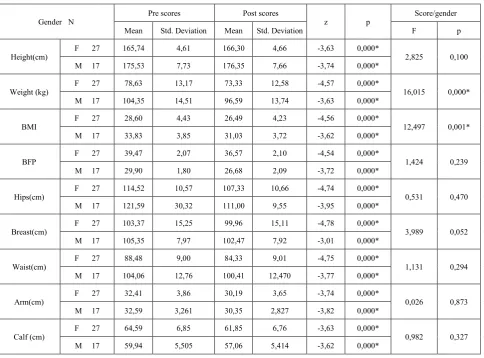
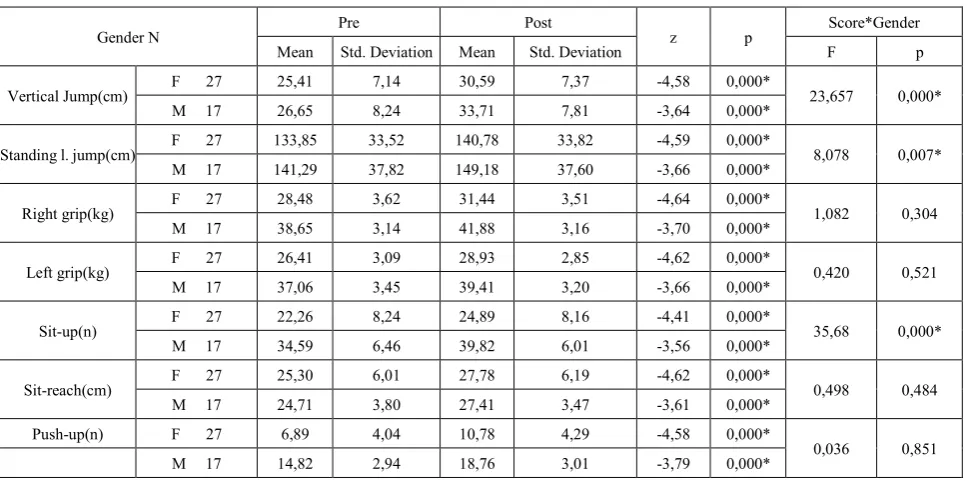
Here are the anthropometric pre-post scores, comparison in terms of gender, and comparison of pre-post performance scores of experimental group, members of which can be defined as obese or pre-obese according to measurements, with no previous experience of exercise.
For all variables, a meaningful difference was found between the pre and post scores both in females and males. Although there is an increase in height, a meaningful decrease was found in other variables. Studying the score-gender relation, there is significant difference only in weight and body mass index in terms of gender. The decrease in males is more than that of the females.
[image:3.595.65.550.329.687.2]For all variables, a meaningful difference was found between the pre and post scores both in females and males. All performance scores increased for both genders. Studying the score-gender relation, males scored better in vertical jump, standing long jump, and sit-up.
Table 1. Comparison of the pre and post anthropometric measurement scores
Gender N Pre scores Post scores z p Score/gender
Mean Std. Deviation Mean Std. Deviation F p
Height(cm) F 27 165,74 4,61 166,30 4,66 -3,63 0,000* 2,825 0,100 M 17 175,53 7,73 176,35 7,66 -3,74 0,000*
Weight (kg) F 27 78,63 13,17 73,33 12,58 -4,57 0,000* 16,015 0,000* M 17 104,35 14,51 96,59 13,74 -3,63 0,000*
BMI F 27 28,60 4,43 26,49 4,23 -4,56 0,000* 12,497 0,001* M 17 33,83 3,85 31,03 3,72 -3,62 0,000*
BFP F 27 39,47 2,07 36,57 2,10 -4,54 0,000* 1,424 0,239 M 17 29,90 1,80 26,68 2,09 -3,72 0,000*
Hips(cm) F 27 114,52 10,57 107,33 10,66 -4,74 0,000* 0,531 0,470 M 17 121,59 30,32 111,00 9,55 -3,95 0,000*
Breast(cm) F 27 103,37 15,25 99,96 15,11 -4,78 0,000* 3,989 0,052 M 17 105,35 7,97 102,47 7,92 -3,01 0,000*
Waist(cm) F 27 88,48 9,00 84,33 9,01 -4,75 0,000* 1,131 0,294 M 17 104,06 12,76 100,41 12,470 -3,77 0,000*
Arm(cm) F 27 32,41 3,86 30,19 3,65 -3,74 0,000* 0,026 0,873 M 17 32,59 3,261 30,35 2,827 -3,82 0,000*
Calf (cm) F 27 64,59 6,85 61,85 6,76 -3,63 0,000* 0,982 0,327 M 17 59,94 5,505 57,06 5,414 -3,62 0,000*
Table 2. Comparison of Pre-Post Performance Scores
Gender N Pre Post z p Score*Gender
Mean Std. Deviation Mean Std. Deviation F p
Vertical Jump(cm) F 27 25,41 7,14 30,59 7,37 -4,58 0,000* 23,657 0,000* M 17 26,65 8,24 33,71 7,81 -3,64 0,000*
Standing l. jump(cm) F 27 133,85 33,52 140,78 33,82 -4,59 0,000* 8,078 0,007* M 17 141,29 37,82 149,18 37,60 -3,66 0,000*
Right grip(kg) F 27 28,48 3,62 31,44 3,51 -4,64 0,000* 1,082 0,304 M 17 38,65 3,14 41,88 3,16 -3,70 0,000*
Left grip(kg) F 27 26,41 3,09 28,93 2,85 -4,62 0,000* 0,420 0,521 M 17 37,06 3,45 39,41 3,20 -3,66 0,000*
Sit-up(n) F 27 22,26 8,24 24,89 8,16 -4,41 0,000* 35,68 0,000* M 17 34,59 6,46 39,82 6,01 -3,56 0,000*
Sit-reach(cm) F 27 25,30 6,01 27,78 6,19 -4,62 0,000* 0,498 0,484 M 17 24,71 3,80 27,41 3,47 -3,61 0,000*
Push-up(n) F 27 6,89 4,04 10,78 4,29 -4,58 0,000*
0,036 0,851 M 17 14,82 2,94 18,76 3,01 -3,79 0,000*
*meaningful at the level of 0,05
4. Discussion and Conclusions
There have been studies on continuation of being overweight at adulthood, which basically started at childhood. A study showed that 26-41% of fat children at preschool age, and 42-63% of fat children at school age went on keeping fat at adulthood (24). Having the parameters of stretching, vertical jump, shuttle, and push-up was foreseen in physical activity of obesity and Eurofit. Also in our study, a meaningful difference at the level of p< 0.05 was also seen in the aerobics exercise programme based on these parameters.
De Vito and others conducted a study on primary school students in Italy, in 1999. It was seen that daily physical activity span and obesity were inversely related. That is, a decrease in the span caused an increase in the incidence of obesity (12). Elgar, F.J. and others’ study on adolescents stated that sedentary lifestyle is effective on BMI, and sedentary lifestyle leads to gaining weight (14). Uskan and others studied the risk factors of obesity, and found out that a time-span of play less than 2 hours a day caused a meaningful increase in BMI measurements (35). Our study has also shown that physical activity decreases the incidence of obesity. It was also seen in our study that aerobics- exercise programmes lead to decrease in the incidences of obesity.
The study of “Changes in the Physical Composition” was conducted by Kaya. H.& Özçelik. O. on a group of students at the ages of 18-19. A difference was observed in female and male participants’ Body Fat Percentage. Body fat percentage measurements of sedentary participants who had no exercise, posed a risk in terms of obesity. A decrease in the capacity of aerobics was seen (21). Our study has shown that aerobics exercise lead to decrease in measurements of
weight and body fat percentages. Therefore the study has stated the importance of aerobics exercise in fighting against obesity.
It was seen that body mass index decrased in the study of Ahmet Ergün ve S.Fuat Erten (16), Monteiro and others (26), and this study presented. Therefore, there has been seen parallelism between BMI findings of the above-mentioned studies and this study.
The most effective exercise form in exercise theraphy is “Aerobics exercise” which provides the rhythmic training of big muscle groups for specific periods of time. The more the span and the frequency of the exercise, the better the effects received. In this way, meaningful decreases can be achieved in measurements of weight (29). Emine Aksoy ve Nihan Çakır found a meaningful difference in the relationship of physical activity, body mass index (BMI), and body composition. Our study also overlaps these findings. (1)
5. Suggestions
• Aerobics exercise and its importance should be taught to people as well as the obese.
• Aerobics exercise should be a fun activity! (such as play, music, dance, rhythm, and group work) • Children should be educated in terms of their
physical development starting from little ages. • Obese children and adolescents should be guided
thoroughly.
• Aerobics exercises should be accompanied by the exercise experts.
• The progress in aerobics exercise programme should be observed.
REFERENCES
[1] Aksoydan, E., Çakır, N.: The evaluation of Adolescents’ Eating Habits, Physical Activity Levels, and Body Mass Index. Gülhane Medical Journal, 2011.
[2] Alberga, A. S., Prud’homme, D. Kenny, G. P., Goldfield, G. S., Hadjiyannakis, S., Gougeon, R., Phillips, P., Malcolm, J., Wells, G., Doucette, Ma, J., and Sigal, R.J.: Effects Of Aerobic and Resistance Training On Abdominal Fat, Apolipoproteins and High-Sensitivity C-Reactive protein In Adolescents with Obesity: The HEARTY Randomized Clinical Trial, International Journal Of Obesity ,Published online, 25 August 2015.
[3] Alves, A. R., Marta, C., Neiva, H. P., Izquierdo, M., Marques, M.C.: Does intersession concurrent strength and aerobic training order influence training-induced explosive strength and VO (HASAN) 2 max in prepubescent children, The Journal of Strength and Conditioning Research ,March 2016 .
[4] Arslan, M.: National Obesity Guide. The Study Group of Turkiye Endocrinology and metabology association, 1999. [5] Baltacı, G.; Obesity and Exercise, Şubat, 2008.
[6] Baltacı, G., Düzgün, İ.: Adolescent and Exercise. Hacettepe University Health Sciences Faculty, Department of Physical Therapy and Rehabilitation. 1st Edition: Ministry of Health Edition Number: 730 ISBN: 978-975-590-246-3 February, 2008, ANKARA.
[7] Baquet, G., Berthoin, S., Gerbeaux, M., Praagh, E. V.; High-Intensity Aerobic Training during a 10 Week One-Hour Physical Education Cycle: Effects on Physical Fitness of Adolescents Aged 11 to 16, International Journal of Medicine, May 2001.
[8] Bompa, T. O.; Translated by: Keskin, İ., Tuner, A. B.; Theory and Method of Training Spor Publishing, Ankara, 2000.
[9] Bompa, T. O., Haft, G. G.: Theory and Methodology of Training, Çev. Bağırgan, T., Spor Publishing, Ankara, 2015. [10] Bouchard, C.: Handbook of Obesity, Clinical Applications,
2014.
[11] Caspersen, C. J., Powell, K. E., Cristenson, G. M.; Physical
Activity Exercise and Physical Fitness: Definitions and Distinctions For Health-Related Research, Public Health Reports, Vol: 100, No: 2, March-April: 1985.
[12] De Vito, E.: Over Weight and Obesity Among sedentary School Children in Central Italy, Epidemol, 1999.
[13] Donelly, J. E.: Effects Of A 16 Month Randomised Controlled Examine Trial On Body Weight and Composition in Young Overweight Men and Women the Midwent Exercise Trial. Arch. Intern. Med. 2003.
[14] Elgar, F. J.: Sedantery Behaviour Physical Activity and Weight Problems in Adolescent in Wales, Public Health, No. 119, 2005.
[15] Ergül, Ş.,Kalkım, A.: An important cronic illness: Obesity in Childhood and Adolescence. TAF Preventive Medicine Bulletin, Vol: 10, Issue: 2, 2011.
[16] Ergün, A., Erten, S.F.: The study of Students’ Body Mass Index and waist circumference values. Ankara University Journal of Medicine. Vol. 57, Issue 2, 2004.
[17] Ghorbani,F.,Heidarimoghadam,R.,Karami,M.,Fathi,K.,Mina sian,V.,Bahram,M.E.:The Effect of Aerobic Training Program on Cardiovascular Fitness, Body Composition and Mental Health among Female Students, Journal of Research In Health Siciences, 2014.
[18] Gümüşler, A.: Obesity Rate of High School students in Çayeli/Rize and Eating Habits MA thesis, Trabzon, 2006. [19] Hermassi,S.,Ingebrigtsen,J.,Khalifa,R.,Chelly,M.S.,Chamari,
K.:Effects of a Short-Term Aerobic High-Intensity Interval Training Program on Performance Parameters in Adolescent Handball Players, Journal of Human Kinetics, volüme: 44/2014 .
[20] Hugles, J. M., Li, L.: Chinn, S., Rona, R.J., Trends in Growth in England and Scotland, 1972 to 1994, Arch Dis Child, 1997.
[21] Kaya, H., Özçelik, O.: Changes in Body Composition. Journal of Fırat Medicine. Vol: 10, Issue: 4, 2005.
[22] Kın-İşler, A., Koşar,Ş. N.: Effect of Step Aerobics Training on Anaerobic Performance of men and Women, Journal of Strenght& Conditioning Research: May 2006.
[23] Kokino, S., Zateri, Ç.: Obesity and Exercise, Turkiye Klinikleri Journal of Physical Medicine Rehabilitation Vol: 4, Issue:3, 2004.
[24] Köksal, G., Özel, H. G.: OBESITY IN CHILDHOOD AND ADOLESCENCE, Hacettepe University –Health Sciences Faculty Department of Nutrition and Dietetics. February 2008, Ankara.
[25] Menteş, E., Menteş, B., Karacabey, K.: Obesity and Exercise in Adolescence International Human Sciences Journal, ISSN ISSN: 1303-5134, Volume: 8, Issue: 2, Year: 2011.
[26] Monteiro, P.A., Chen, K. Y.; Lira, F. S., Saraiva, B. T. C., Antunes, B. M. M., Campos, E. Z., and Freites, I. F.: Concurrent and aerobic exercise training promote similar benefits in body composition and metabolic profiles in obese adolescents, Monteiro et al. Lipids in Health and Disease, 2015.
Publishing
[28] Öztürk, M.A., Saygın, O., and Babayiğit Irez, G.: The Effects of Regular Aerobic Exercises on Blood Lipids and Some Physical Fitness Parameters of Obese Boys, Middle-East journal of Scientific Research, 2013.
[29] Özvergili, Ö.: Obesity and Exercise Treatment. K. U. Journal of Medicine Faculty. 2013.
[30] Pekmez, C. T., Özdemir, G.Ersoy, G.: Obezite ,The Importance of Exercise To Obesity Treatment, International Journal of Human Sciences, Volume: 9, Issue: 2, Year: 2012
[31] Şentürk, S.: Aerobic Gymnastics, Buca Education Faculty Media Organ, Physical Education and Sports Special Edition, Y: 1, Number: 1, October, 1992.
[32] Republic of Turkey Ministry of Health General Directorate for Health Research Health Statistics Yearbook 2013) Ministry of Health Edition Number: 956, Ankara, 2014.
[33] Thompson, P. D., BUchner, D., Pina, İ. L., Balady, G. J., Williams, M.A., Marcus, B. H., Berra, K., Blair, S. N., Costa, F., Franklin, B., Flecher, G. F., Gordon, N. F., Pate, R.R., Rodriquez, B. L., Yancey, A. K., Wenger, N. K.: Exercise
and Physical Activity In The Prevention and Treatment Of Atherosclerotic Cardiovascular Disease, AHA Scientific Statement, Circulation, June: 24, 2003.
[34] Follow up project of development in school age children in Turkiye, Research Report, 2009.
[35] Uskun, E.: Risk factors causing Obesity in Primary School Children. SDU Journal of Medicine Faculty. 2005.
[36] Uzun, N.: Healthy Living Behaviours of Adolescents, the relation between perceived parent control and depression, and obesity: preservative and risk factors for obesity. Republic of Turkey Adnan Menderes University Institute of Health Sciences Psychiatry Department KPJ-YL-2014-0003,
Aydın, 2014.
[37] Weineck, J.: Erlangen Optimales Fussball Training, Çev.
Bağırgan, T., Spor Yayınevi, Ankara, 2011.
[38] Welcome to Wellness; Die Besten Wohlfühltipps und-Programme Für Körper, Geist und Seele, Compact Verlag, 2006.
[39] Wenar, C., Kreig, P.: Developmental Psychopathology From