BLENDED LEARNING: AN INTERPRETIVE ACTION
RESEARCH STUDY
Aleksej HEINZE
Informatics Research Institute (IRIS)
Salford Business School
University of Salford, Salford, UK
Submitted in Partial Fulfilment of the Requirements of the
Table of contents
Chapter 1 Introduction to the problem area ... 1
1.1 Introduction... 1
1.2 Research problem overview ... 1
1.2.1 Technological advances... 2
1.2.2 Drivers for e-learning ... 3
1.2.3 From e-learning to blended learning... 5
1.3 The areas of this research ... 7
1.3.1 Particular use of blended learning – three themes requiring further research... 7
1.3.2 Pragmatic implications of blended learning ... 7
1.3.3 Blended learning pedagogy ... 8
1.3.4 Concept of blended learning... 8
1.3.5 Research questions and the contribution to knowledge ... 9
1.3.6 Conceptual framework ... 9
1.4 Thesis structure ... 11
Chapter 2 Literature review ... 13
2.1 Introduction... 13
2.2 Pedagogy ... 15
2.2.1 Early influences on pedagogy... 15
2.2.2 Associationism - functionalism ... 16
2.2.3 Behaviourism – constructivism ... 17
2.2.3.1 Behaviourism ... 18
2.2.3.2 Constructivism ... 19
2.2.4 Teacher - student interaction ... 21
2.2.4.1 Conversation Theory... 22
2.2.4.2 Conversational Framework ... 24
2.2.5 Student – student interaction ... 26
2.2.5.1 Johari Window ... 26
2.2.5.2 Zone of Proximal Development and Communities of Practice ... 27
2.3 Concept of blended learning... 30
2.3.1 Confusion surrounding the blended learning concept... 30
2.3.2 Preliminary local definition of blended learning ... 32
2.4 Practice of blended learning... 35
2.4.1 E-learning tools ... 35
2.5 Summary ... 42
Chapter 3 Research design ... 44
3.1 Introduction... 44
3.2 Research paradigm considerations... 46
3.2.1 Positivist paradigm ... 49
3.2.2 Interpretive paradigm ... 50
3.2.3 Critical paradigm ... 52
3.2.4 Paradigm choice ... 53
3.3 Research method considerations ... 56
3.3.1 Research method choice ... 56
3.3.2 Action research variations ... 58
3.3.3 Information systems action research characteristics ... 60
3.4 Data considerations ... 67
3.4.1 Data type... 67
3.4.2 Data sources... 69
3.4.2.1 Observations ... 70
3.4.2.2 Focus groups ... 71
3.4.2.3 Interviews... 71
3.4.2.4 Data sources summary ... 72
3.5 Summary ... 74
Chapter 4 Research implementation... 75
4.1 Introduction... 75
4.2 Research paradigm implementation ... 76
4.2.1 Research setting description ... 76
4.2.2 Description of participants... 78
4.2.3 Researcher’s background... 80
4.3 Research method implementation ... 81
4.3.1 Action research limitations management... 81
4.3.2 Addressing research ethics ... 84
4.3.3 Action research cycles outline ... 85
4.4 Data collection... 86
4.4.1 Observations ... 87
4.4.2 Focus groups... 89
4.4.3 Interviews ... 94
4.5 Data analysis ... 96
4.5.1 Stage 1: Analysis during data collection... 98
4.5.2 Stage 2: Analysis post data collection ... 100
4.6 Summary ... 108
Chapter 5 Stage 1: action research cycles one and two ... 110
5.1 Introduction... 110
5.2 First action research cycle... 111
5.2.1 Implementation and monitoring ... 112
5.2.1.1 Students and time of attendance... 112
5.2.1.2 Learning facilitation ... 113
5.2.1.3 Assessment... 114
5.2.1.4 Course induction ... 114
5.2.1.5 Discussion board support ... 115
5.2.1.6 Assessment on the Systems Analysis and Design module ... 117
5.2.1.7 Assessment on the Programming Business Information Systems module ... 118
5.2.2 Evaluation and planning ... 119
5.2.2.1 Staff training on the Virtual Learning Environment ... 120
5.2.2.2 Discussion board moderation ... 121
5.2.2.3 Impact of the Virtual Learning Environment ... 123
5.2.2.4 Staff – student communication... 124
5.2.2.5 Graduate Teaching Assistants’ Support ... 126
5.2.2.6 Programme layout: Session timings ... 127
5.3 Second action research cycle... 128
5.3.1 Implementation and monitoring ... 129
5.3.1.1 Training of new staff... 130
5.3.1.2 Utilisation of discussion board guidelines... 130
5.3.1.3 Harmonisation of the use of the Virtual Learning Environment ... 130
5.3.1.4 Optimisation of staff – student communication ... 130
5.3.1.5 Negotiation of Graduate Teaching Assistants’ support... 131
5.3.1.6 Implementation of two sessions per evening ... 131
5.3.2 Evaluation and planning ... 131
5.3.2.1 Staff training on the Virtual Learning Environment ... 133
5.3.2.2 Discussion board moderation ... 134
5.3.2.3 Student induction ... 135
5.3.2.4 Disparities of learners’ knowledge... 137
5.3.2.5 Pedagogy... 138
5.3.2.6 Utilisation of the face-to-face sessions... 139
Chapter 6 Stage 1: action research cycles three and four... 143
6.1 Introduction... 143
6.2 Third action research cycle ... 144
6.2.1 Implementation and monitoring ... 145
6.2.1.1 Staff training on the Virtual Learning Environment ... 146
6.2.1.2 Addressing disparities of learners’ knowledge ... 147
6.2.1.3 Integration of pedagogy ... 147
6.2.1.4 Optimisation of the use of face-to-face session... 149
6.2.1.5 Moderation of discussion boards... 149
6.2.1.6 Student induction ... 150
6.2.2 Evaluation and planning ... 150
6.2.2.1 Assessment... 152
6.2.2.2 Learning tools infrastructure ... 153
6.2.2.3 Virtual Learning Environment ... 154
6.2.2.4 Students’ confidence ... 156
6.2.2.5 Learning location ... 157
6.2.2.6 The utilisation of the face-to-face sessions ... 158
6.3 Fourth action research cycle ... 159
6.3.1 Implementation and monitoring ... 160
6.3.1.1 Assessment... 161
6.3.1.2 Improvement of learning tools infrastructure... 161
6.3.1.3 Set up of the Virtual Learning Environment ... 162
6.3.1.4 Students’ confidence ... 163
6.3.1.5 Learning location ... 163
6.3.1.6 Utilisation of face-to-face sessions ... 164
6.3.2 Evaluation and planning ... 165
6.3.2.1 Learning objects – SkillSoft... 167
6.3.2.2 Learning tool infrastructure - car parking ... 168
6.3.2.3 Student Community ... 169
6.3.2.4 Staff autonomy... 171
6.3.2.5 Programme benefits – retention ... 174
6.4 Summary ... 176
Chapter 7 Stage 2: overall findings of current research... 178
7.1 Introduction... 178
7.2 The Fine Structure of the Blended Learning Concept ... 179
7.3.1.1 Compatibility study and work ... 185
7.3.1.2 Retention or drop out rate ... 185
7.3.1.3 Disparities of learners’ knowledge... 185
7.3.1.4 Enthusiasm and motivation ... 186
7.3.1.5 Full time vs part-time students ... 187
7.3.1.6 Mature student... 187
7.3.1.7 Part-time student needs ... 188
7.3.2 Overall programme issues ... 188
7.3.2.1 Admissions admin issues ... 191
7.3.2.2 Course layout ... 191
7.3.2.3 Course content... 192
7.3.2.4 Support structure ... 192
7.3.2.5 Induction ... 193
7.3.2.6 Learning tool infrastructure... 194
7.3.3 Pedagogic beliefs ... 195
7.3.3.1 Staff views ... 197
7.3.3.2 Student views ... 197
7.3.3.3 Pedagogy related issues... 198
7.3.3.4 Assessment... 199
7.3.3.5 Implications for practice ... 201
7.3.3.6 Communication... 201
7.3.3.7 Local blended learning theory... 202
7.3.3.8 Culture of learning in higher education... 203
7.4 Learning: The Fine Structure of the Blended Learning Concept ... 203
7.4.1 Face-to-face facilitated learning ... 203
7.4.1.1 Too much theory in the lecture ... 204
7.4.1.2 Difficulties with face-to-face contact ... 206
7.4.1.3 Interacting in class ... 206
7.4.1.4 Utilisation of the face-to-face session time ... 207
7.4.1.5 Boring lectures ... 207
7.4.1.6 Face-to-face depends on individual... 208
7.4.2 E-facilitated learning ... 209
7.4.2.1 Poor induction to online communications... 211
7.4.2.2 Good online communication ... 211
7.4.2.3 Utilisation of the Virtual Learning Environment ... 212
7.4.2.4 Online sessions... 212
7.4.2.5 Communication delay ... 214
7.4.2.6 Connection speed ... 214
7.4.2.7 e-Communication issues ... 214
7.4.3 Self-study... 215
7.4.3.2 Expectation of study time... 217
7.5 The Key Issues of Blended Learning Pedagogy... 218
7.5.1 Communication ... 219
7.5.2 Social interaction ... 220
7.5.3 Assessment ... 221
7.6 The Bermuda Triangle of Blended Learning ... 223
7.7 Summary ... 225
Chapter 8 Discussion... 228
8.1 Introduction... 228
8.2 The Fine Structure of the Blended Learning Concept ... 229
8.2.1 The eight dimensions of blended learning ... 229
8.2.2 Stakeholder perspectives ... 232
8.2.3 Spatial representations of e-learning... 233
8.2.4 Student centeredness... 234
8.2.5 Blend as an improvement of learning ... 235
8.2.6 Preliminary definition of the blended e-learning concept... 235
8.3 The Key Issues of Blended E-learning Pedagogy ... 237
8.3.1 The current research and pedagogic theory ... 238
8.3.2 Associationism – functionalism and the key issues of interest ... 239
8.3.3 Behaviourism - constructivism and the key issues of interest ... 240
8.3.4 Teacher – student interaction... 242
8.3.4.1 Conversational Framework ... 242
8.3.4.2 Conversation Theory... 243
8.3.5 Student-student interaction ... 244
8.3.5.1 Johari Window ... 244
8.3.5.2 Communities of Practice and Zone of Proximal Development ... 245
8.3.6 Pedagogy for blended e-learning: Blended E-learning Skeleton of Conversation... 247
8.3.6.1 Communication... 247
8.3.6.2 Assessment... 248
8.3.6.3 Social interaction... 249
8.4 Pragmatic implications of the Bermuda Triangle of Blended E-learning ... 250
8.4.1 Staff development... 251
8.4.2 Face-to-face facilitated learning ... 252
8.4.2.1 Induction ... 252
8.4.2.2 Social community ... 253
8.4.3.1 Use of Blackboard Virtual Learning Environment – central support... 255
8.4.3.2 Discussion board moderation ... 256
8.4.3.3 Use of SkillSoft learning objects... 257
8.4.3.4 E-facilitated assessment ... 258
8.4.4 Self-study... 260
8.5 Summary ... 261
Chapter 9 Conclusions... 263
9.1 Introduction... 263
9.2 Contribution to the domain of IS research in educational settings ... 265
9.2.1 How is blended e-learning conceptualised locally? ... 265
9.2.2 How is pedagogy affected by blended e-learning programme delivery? ... 267
9.2.3 What are the pragmatic implications of blended e-learning? ... 268
9.2.4 How can blended e-learning be used to deliver a programme? ... 271
9.3 Research process ... 273
9.3.1 Evaluation of the use of the interpretive paradigm ... 273
9.3.2 Evaluation of the use of the research method ... 276
9.4 Limitations and future research opportunities ... 278
9.4.1 Limitations... 278
9.4.2 Suggestions for future work... 279
9.5 Final conclusions ... 280
Chapter 10 Appendices ... 281
10.1 Appendix: Consent form... 281
10.2 Appendix: Approval of this project by RGEC ... 284
10.3 Appendix: Graduate Teaching Assistant activities example ... 285
10.4 Appendix: Interviews and focus groups timeline... 287
10.5 Appendix: Online Discussion Guidelines ... 289
10.6 Appendix: Blackboard (BB) Features ... 308
List of figures
Figure 1: Conceptual framework: Chapter 1 ... 10
Figure 2: Conceptual framework: Chapter 2 ... 14
Figure 3: Skeleton of Conversation adapted after Scott (2001a:5)... 24
Figure 4: Conversational Framework adapted after Laurillard (2002:87) ... 25
Figure 5: Johari Window, adapted after Thurlow, Lengel et al. (2004:103) ... 27
Figure 6: Spectrum of E-learning adapted after Procter (2002:3) ... 33
Figure 7: Concept of Blended Learning adapted after Heinze and Procter (2004:2)... 34
Figure 8: 5 Stage Model, adapted after Salmon (2004: 29)... 41
Figure 9: Conceptual framework: Chapter 3 ... 46
Figure 10: Lewin’s cyclic model, adapted after: (Burns 2000:445) ... 62
Figure 11: Change with action research approach adapted after: (Bate 2001) ... 64
Figure 12: Conceptual framework: Chapter 4 ... 75
Figure 13: Screenshot of the logbook entries and associated table of contents... 89
Figure 14: Areas of discussion form used for initial focus groups... 91
Figure 15: C4 – QSR NVivo view of FG Students 100505 – Document Browser view ... 94
Figure 16: Components of Data Analysis: Flow Model, adapted after: (Miles and Huberman 1994:10)... 99
Figure 17: Screenshot taken from QSR NVivo illustrating document explorer view ... 102
Figure 18: Screenshot of QSR NVivo illustrating document browser view and visible coding... 103
Figure 19: QSR NVivo screenshot illustrating code ‘need for socialisation of students’ ... 104
Figure 20: QSR NVivo screenshot illustrating another code ‘need for socialisation of students’ ... 105
Figure 21: QSR NVivo screenshot illustrating Node Explorer view ... 106
Figure 22: QSR NVivo screenshot illustrating tree view of ‘need for socialisation of students’ ... 107
Figure 23: Summary of the Two Stages of Data Analysis in This Study ... 108
Figure 24: Conceptual framework: Chapter 5 ... 111
Figure 25: Prompt message ... 117
Figure 26: Cycle 1 Intersections ... 120
Figure 27: Communication channels hierarchy ... 126
Figure 28: Cycle 2 Intersections ... 132
Figure 29: Conceptual framework: Chapter 6 ... 143
Figure 30: Cycle 3 Intersections ... 151
Figure 31: Cycle 4 Intersections ... 166
Figure 32: Conceptual framework: Chapter 7 ... 178
Figure 33: The Six-Themed Blended Learning Concept ... 180
Figure 34: Part-time student theme... 184
Figure 37: Face-to-face facilitated learning ... 204
Figure 38: E-facilitated learning theme ... 210
Figure 39: Self-study theme... 216
Figure 40: Conceptual framework: Chapter 8 ... 229
Figure 41: Blended E-learning Skeleton of Conversation... 248
List of tables
Table 1: Eight dimensions of blended learning adapted after (Sharpe, Benfield et al. 2006:18) ... 31
Table 2: Tools for educational use adapted after (Hofmann 2005:29) ... 36
Table 3 Applications of computer based tools adapted after Collis (Collis and Moonen 2001:19)... 39
Table 4: Chua’s classification of paradigmatic assumptions (Chua 1986: 605) ... 47
Table 5: Paradigm comparison table adapted after Chua (1986). Original work modifications are italicised. .. 55
Table 6: Action research implications for this work ... 61
Table 7: Action research appraisal for this research... 67
Table 8: Data type considerations for the given research adapted after (Siegel and Dray 2003:2-4). Additions are italicised. ... 69
Table 9: Data sources utilised in this research ... 73
Table 10: Adapted after (Procter 2003:3)... 78
Table 11: Module observed by the author ... 81
Table 12: Action research risk management and mitigation... 83
Table 13: Summary of action research activities ... 86
Table 14: Research logbook Extract from observations on the 3 November 2003 ... 88
Table 15: Focus groups activity summary ... 93
Table 16: Data collection activities summary ... 96
Table 17: Summary of the first action research cycle ... 129
Table 18: Summary of the first two action research cycles ... 142
Table 19: Cycle 2 action research summary ... 144
Table 20: Cycle 3 action research summary ... 159
Table 21: Summary of the third and fourth action research cycles... 177
Table 22: Summary of the blended learning emergent themes and main branches ... 182
Table 23: Pedagogy themes from both stages of data analysis ... 223
Table 24: Summary of action research cycles ... 224
Table 25: Eight dimensions of blended learning – comparison with this study ... 231
Table 26: Comparison of Orey and the Fine Structure of the Blended Learning Concept ... 232
Table 27: Research evaluation summary ... 275
Acknowledgements
This thesis is the epitome of a challenging journey which started as an idea and led to a five year long study process. Along the journey I experienced many blind alleys, dead ends and treacherous terrains. A number of people provided guidance, support and motivation along this journey:
I am particularly thankful to my supervisor Chris Procter who was the key guide on this journey and provided frequent, constructive and detailed feedback. Thanks are also due to the research advisor Professor Elaine Ferneley, who was there to remind me of the ‘big picture’.
For continuous motivation and support I would like to thank my wife Beverley. Thanks must also go to David McCormick for reviewing the final draft of this work.
I would also like to thank colleagues in the Informatics Research Institute and the Salford Business School for their continuous moral support and encouragement to write up this thesis. In particular, thanks are due to Bernard Lisewski, Professor Yacine Rezgui, Professor Ben Light, Professor Heinz Klein and Professor Lin Norton for reading early drafts of this work and providing constructive feedback.
Declaration
This thesis contains material which the author has used before in the following publications:
Heinze, A. and C. Procter (2004). Reflections on the Use of Blended learning. Education in a Changing Environment conference proceedings, University of Salford, Salford, Education Development Unit.
Heinze, A. and C. Procter (2005). Communication - a challenge and an enabler for facilitating Blended learning community. Socio-cultural Theory in Educational Research and Practice, Manchester, University of Manchester.
Heinze, A., C. Procter, and B. Scott (2005). The Theory and Practice of the Conversational Framework: Proposed Amendments and Enrichments. Third Education in a Changing Environment Conference, University of Salford, University of Salford.
Heinze, A. and C. Procter (2006). "Online Communication and Information Technology Education," Journal of Information Technology Education, 5, 235-249.
Heinze, A. and E. Ferneley (2006). "Blending SkillSoft into Higher Education," Innovative Learning in Action, 5.
Abbreviations
The following abbreviations are used in this thesis.
C1, C2, C3 and C4 – represent the action research cycle number, i.e. C1 is ‘cycle 1’.
CoP – Community of Practice
f2f – face-to-face
GTA – Graduate Teaching Assistant
HEI – Higher Education Institution
ICT – Information Communication Technology
MBO – Management Business Operations
SAD – Systems Analysis and Design
PBIS – Programming Business Information Systems
VB – Visual Basic
VP1 - Visual Programming 1
VLE – Virtual Learning Environment
Definitions
The following terms have specific meaning in this thesis.
Blended learning: is a concept that is developed in this thesis. The definition based on the literature is as follows: Blended learning is the delivery of teaching/learning through the combination of online and face-to-face interaction resulting in improved student learning.
The final definition arrived at by the end of this thesis is as follows: Blended e-learning refers to the learning which takes place through a combination of face-to-face facilitated learning, e-learning and self-study.
Communities of Practice: “a group of people who share a concern, a set of problems, or a passion about a topic, and who deepen their knowledge and expertise in this area by
interacting on an ongoing basis.” (Wenger, McDermott et al. 2002:4).
Constructivist teaching: based on the assumption that learning is a process whereby a student is actively engaging with constructing their knowledge. The role of the teacher is as a
facilitator of that learning. This is contrasted with the didactic teaching process, where the
emphasis is on the teacher’s activity and not the learner’s.
Didactic teaching: a process whereby knowledge is considered to be ‘imposed’ on the learner. This places a great emphasis on the teacher and how he/she constructs the teaching
process. The role of the teacher is that of the ‘sage on the stage’. Didactic teaching is used as
an example to illustrate the opposite of constructivist teaching.
Distance Learning: is learning that takes place remotely, this means that the learner is not engaged in face-to-face communication but unlike in online learning, can utilise conventional
means of communication such as books, letters, and post.
E-learning: learning that is facilitated by any electronic means. This is a very broad term that encompasses every use of electronic communication technology for example e-mail,
Face-to-face: communication that takes place between individuals in an environment where they are physically present and are able to see each other and hence benefit from body
language and other non-verbal communication clues.
Learning: is a process of development which results in the acquisition of meaning. This can be new theoretical concepts or practical skills.
Node: a conceptual representation of codes that the author found significant during the
analysis process using QSR NVivo software. Nodes are represented in diagrams and
graphically illustrated with a ball.
Node tree: logical composition of nodes into a tree hierarchy. Tree node diagrams used in this study are organised so that the root of the tree is at the top. Each node is uniquely
identifiable within a tree by an automatically assigned number in QSR NVivo software. For
example node number (3 7 10 14) signifies that this particular node is located within the third tree, seventh branch, tenth twig and fourteenth leaf.
Online Learning: learning that takes place solely in an Internet connected environment. For example learning from online discussion groups is online learning because the participation
in these requires learners to be connected to the Internet to access the discussion board.
Pedagogy: general term used to justify a planned process of teaching which is based on specific assumptions about student learning.
Virtual Learning Environment (VLE): is a learning management software system that enables learner access to a number of learning tools. In the case of this thesis it is the
Blackboard (www.Blackboard.com) VLE which is used by students to engage in their
university related learning activities.
Zone of Proximal Development (ZPD): “the distance between the actual developmental level as determined by independent problem solving and the level of potential development as
determined through problem solving under adult guidance or in collaboration with more
Abstract
This study describes research on an undergraduate part-time blended learning programme within the former Information Systems Institute at the University of Salford. This research is based on the interpretive philosophical paradigm and examines four cycles of action research. The question being addressed in this research is: ‘How can blended learning be used to deliver a programme?’ In answering this question three overlapping perspectives were taken, as outlined below:
1) Concept of blended e-learning: This research suggests that a better term for ‘blended learning’ is ‘blended e-learning’. A Fine Structure of the Blended E-learning Concept comprising learning and learning context is proposed. This concept incorporates three nodes associated with learning: face-to-face facilitated learning, e-facilitated learning and self-study; and three nodes associated with the learning context: learner, pedagogic beliefs and the programme related issues.
2) Pedagogy in blended e-learning: This thesis identifies the three Key Issues of Blended E-learning Pedagogy, these are: communication, social interaction and assessment. Drawing on these issues, the thesis extends the Skeleton of Conversation to the Blended E-learning Skeleton of Conversation.
3) Pragmatic implications of blended e-learning: Building on the Fine Structure of the Blended E-learning Concept, three areas of pragmatic concern are identified as the Bermuda Triangle of Blended E-learning. These are the learning related nodes: face-to-face facilitated learning, e-facilitated learning and self-study. Both students and staff on blended e-learning
Chapter 1
Introduction to the problem area
1.1 Introduction
This thesis is concerned with the introduction of a blended learning approach to the delivery of a part-time programme. This programme leads to the award of a BSc in Information Technology at the University of Salford. The particular concerns of the work were the rationale for the introduction of blended learning, the design and implementation of the programme, and the subsequent staff and student responses.
This Chapter argues that this research is justified by the need for a better understanding of both the practice of blended learning and its pedagogical foundations and by the current lack of a generally applicable conceptual framework for blended learning. The Chapter is structured in the following manner. Firstly, the research problem area of blended learning is identified and contextualised by related developments in the field of technology, educational policy and learning technologies. Secondly, the scope of the study is introduced by outlining the main areas of the research: practical implications of the use of blended learning, pedagogy for blended learning, and the blended learning concept. These three areas of interest are translated into research questions, which provide the focus for the work. Thirdly, it outlines the organisation of the work, and the research plan, which is based on the research questions and the conceptual framework adopted for this thesis. Finally, the structure of the thesis will be presented using Chapter headings and their summaries.
1.2 Research problem overview
1.2.1 Technological advances
Information Communication Technology (ICT), which embraces the use of computers to facilitate electronic data manipulation and communication, has had an almost explosive growth in all aspects of modern societies (Mintel 2000). Figures compiled in 2006 suggest that around 97% (PricewaterhouseCoopers 2006) of businesses in the UK have access to the Internet. A similar impact is seen on the overall population, with over half of all British adults namely 62 %, having used the Internet in the three months of the survey (Mintel 2007). Similar take-up can be observed in Higher Education, where the majority of staff have access to Internet connected computers (Cooke, Greenwood et al. 2006). Not only do all Higher Education Institutions (HEIs) provide access to personal computers (PC’s) with Internet connection, but 95% have invested into the provision of a centralised Virtual Learning Environment (JISC 2005). All of this is quite remarkable considering that most of this development has taken place since the advent of the PC in the 1980’s and the introduction of the World Wide Web in the 1990’s (Hofmann 2005).
The use of computers in teaching and learning predates the advent of the Word Wide Web (the Internet) (Hofmann 2005), with developments such as ‘computer based learning’ (Kozma 1987; Merrill 1080) and ‘computer assisted learning’ (Barker and Yeates 1985; Kemmis, Atkin et al. 1977). However, the Internet brought into being what is sometimes called ‘web based instruction’ and on other occasions ‘online learning’. All of these attempts to bring ICT into the world of teaching and learning are now subsumed by the over-arching term ‘e-learning’ (Littlejohn and Pegler 2007; Procter 2002). Virtual Learning Environments are a development in e-learning (Britain and Liber 1999). They are learning management software systems which allow students and teachers to interact in a ‘closed environment’ in order to facilitate learning. Their functionality has increased in the last 8 years and recently some VLEs allow integration with other institutional information systems (Cook, White et al. 2007). Examples of VLEs include Blackboard, a commercial development originating in the United States of America and Moodle, an open source development originating in Australia (Britain and Liber 2004; Cole 2005).
e-learning for the country and argued that there existed the potential for revolutionising e-learning and teaching:
“e-learning has the potential to revolutionise the way we teach and how we learn.” (DfES 2003:2)
Obviously higher education pays a great deal of attention to Government strategy. However, the ways in which they respond to this depends upon how they perceive their necessities for development (Lisewski 2004). Universities are not simply about e-learning. The important drivers for e-learning in HEIs, along with meeting ‘student expectations’, were cost cutting (Bersin and Associates 2003), quality improvement (Russell 2001) and widening participation (Asgarkhani 2004; Littlejohn and Pegler 2007). Interestingly, pedagogy, which is considered in this work as a general term referring to the way in which teaching is organised in order to facilitate students’ learning, was not seen as an important driver for the introduction of ICT in HEIs (Kemmis, Atkin et al. 1977; Littlejohn and Pegler 2007).
1.2.2 Drivers for e-learning
At first sight it appears straight forward: if one can do away with lecturing staff then the cost of delivery must surely decrease and e-learning is therefore more cost effective. However, it is soon apparent that there is a high cost incurred in the development of e-learning materials (Gunasekaran, McNeil et al. 2002). Even so, since such materials can be reused, then there must come a point where the savings on staff exceed the initial investment in e-learning. However, this thinking fails to take into account the continuing support necessary in e-learning, which of course increases with the number of students. Once again there is a counterargument i.e. that if the number of students increases so does the assumed fee income. Obviously cost cutting through e-learning is not a simple matter. Two examples illustrate this point.
the travel and accommodation costs, if applicable (Barbazette 2007). The release of staff to attend an off site training event can be very expensive. If the company employs a large number of relevant staff then training costs can be almost prohibitive. For such situations the idea of on-site delivery through e-learning can be quite attractive; the economies of scale soon make themselves felt (Birchall and Woolfall 2003).
Similar economies of scale thinking were present in the establishment of the UK eUniversities Worldwide Limited (UKeU) in March 2003 (Bacsich 2005). The plan was for a group of British Universities to co-operate in order to develop and deliver
“online and worldwide the best degrees and degree-level learning that UK universities can provide.” (Bacsich 2005:7)
The UK Government invested £55 million in this initiative and a great deal of good work was done (Conole, Carusi et al. 2005). Nevertheless, UKeU was not able to attract sufficient student numbers to make it profitable and hence it was closed (Bacsich 2005; Conole, Carusi et al. 2005).
Obviously, there is a major difference between an enterprise commissioning an e-learning based programme of training for its many staff and educational institutions developing e-learning materials to be made available on a worldwide basis (Hallinger and Snidvongs 2005). The former is about demand; the latter is about supply. In both cases cost is a major driver. However in the case of the HEIs, it is not the cost that determines success or failure but rather the income relative to costs. Cost might be a driver in determining whether e-learning is an option for HEIs but it is income that is the determinant for success (Clark 1972; Littlejohn and Pegler 2007).
shown to be dependent on context (Littlejohn and Pegler 2007; Pepicello and Pepicello 2003; Ramage 2001). Because of the very individual and contextual nature of teaching and learning, others have criticised the very activity of teaching and learning quality measurement (Ramage 2001; Shevlin, Banyard et al. 2000). Looking at teaching and learning as a whole there is evidence that the administration of such activities is improved through electronic communication management and greater transparency (Hallinger and Snidvongs 2005). This is an important finding since the main use of technology in teaching and learning is still its administration (Conole 2004).
Widening participation is the third driver for the use of e-learning. Widening participation is a term that encompasses enabling access to education by learners who would not traditionally have considered taking part in higher education (Macdonald and Stratta 2001). Examples of widening participation include part-time students who cannot attend daily classes due to work and family commitments (Procter 2003), and generally those students who are not able to engage with learning for any other reason (Asgarkhani 2004). An example of the latter would be disabled students, who can make use of assistive technologies to engage with learning (Santos 2006). It is recognised that the move to using e-learning promotes an institutional adaptation of Virtual Learning Environments, yet these are not accessible for example for some visually impaired students (Jenkins, Browne et al. 2001).
There are arguments that access to ICT alone is not able to motivate adult learners to re-engage with learning (Selwyn and Gorard 2003). There are differing opinions on this topic. However, Littlejohn and Pegler (2007) argue that in order to address the needs of part-time learners in particular, who are not able to attend face-to-face sessions regularly, e-learning provides a viable solution.
1.2.3 From e-learning to blended learning
and is likely to remain, the main approach to utilising ICT in teaching and learning in HEIs (Bonk and Kim 2005; Collis and van der Wende 2002). As such, it requires to be treated as a special case both from the point of view of research and in this thesis.
The special case of e-learning is referred to as hybrid learning e.g.: (Rossbottom 2001; Woodworth and G. 2007), mixed mode learning e.g.: (Pincas, Saunders et al. 2003; Strømsø, Grøttum et al. 2007); blended learning e.g.: (Bonk and Kim 2005; Oliver and Trigwell 2005) and more recently as blended e-learning e.g.: (Hadjerrouit 2007; Sharpe, Benfield et al. 2006). This work has adopted the term ‘blended learning’, as a provisional term which will be discussed in more detail in the literature review Chapter.
In 2003, at the start of this research, there was limited research concerning the practice of blended learning in higher education (Procter 2003). However, over the last four years several journal articles, books and academic conferences have focused specifically on blended learning. For example in June 2006 there were two conferences that referred to blended learning: “From Blended learning to Splendid Learning” at the Manchester Metropolitan University Business School and the “Blended learning Conference” at the University of Hertfordshire. Internationally, there were also a number of workshops e.g. the Workshop on Blended Learning and SMEs held in conjunction with the 1st European Conference on Technology Enhanced Learning in Crete, Greece held in October 2006. Blended learning therefore appears to have both gained popularity and stimulated academic interest. Over six hundred books containing the term ‘blended learning’ have been published (http://books.google.co.uk 2007). These are some of the developments illustrating the importance of blended learning (Bonk and Kim 2005; Littlejohn and Pegler 2007).
1.3 The areas of this research
This section highlights the main areas or themes of research that require further study. The overall issue of blended learning use on a programme is discussed. More specifically, the themes: the pragmatic implications of blended learning; the pedagogy for blended learning; and the concept of blended learning, are identified as being under-researched and hence are the focus of the work. Research questions relevant to these areas are outlined and anticipated contributions to knowledge are identified. A research scope resolution is proposed and a graphical representation of this study is made within a conceptual framework.
1.3.1 Particular use of blended learning – three themes requiring further
research
Because of the relative novelty associated with the use of e-learning there are a number of research questions which need to be answered in order to enable a better understanding of how ICT can really improve teaching and learning (Conole 2004; Conole and Oliver 2007; Procter 2002). In order to advance our understanding in this area it is important to explore working practices and explain these using existing or emerging theories:
“We should also begin to see the development of new underpinning theories and models of explanation to account for the use of learning technologies, and perhaps even the emergence of new learning paradigms and working practices.”(Conole 2004:Conclusion)
The three main themes followed in this work will be concerned with the pedagogy of blended learning, the concept of blended learning and the pragmatic implications of the practice of blended learning.
1.3.2 Pragmatic implications of blended learning
2005) which suggests a research omission. Additionally, learning should be perceived from the students’ perspective (Oliver and Trigwell 2005), and there is a need for further research that takes learners views into consideration (Conole and Oliver 2007:17). Since most of these observations refer to e-learning in general, there is a need for research that is specifically related to the practice of blended learning.
1.3.3 Blended learning pedagogy
The importance of pedagogy in blended learning should not be underestimated. Nonetheless, some authors (Oliver and Trigwell 2005) think it necessary to point out that blended learning is concerned with student learning. This suggests that not enough attention is being paid to this simple fact. In a “Review of current pedagogic research and practice in the fields of post-compulsory education and lifelong learning”, it was highlighted that there was a gap in research that combined practice and theoretical concepts (Cullen, Hadjivassiliou et al. 2002). This gap might be attributable to the motivation for adopting e-learning in general and blended learning in particular. As mentioned earlier, pedagogy is not the main driver for the use of technology for educational purposes (Hara and Kling 1999; Littlejohn and Pegler 2007). It is also being stated that there is a need for the theoretical appraisal of ICT related practice in education (Conole 2004). In the light of all of this, this work aims to explore the potential pedagogic foundations for blended learning.
1.3.4 Concept of blended learning
1.3.5 Research questions and the contribution to knowledge
From all of the above it is apparent that the thrust of this research will be centred around the main question: How can blended learning be used to deliver a programme? In addressing this question a variety of interrelated questions emerge, which, in turn, centre around the questions:
a) What are the pragmatic implications of blended learning?
b) How is pedagogy affected by blended learning programme delivery? c) How is blended learning conceptualised locally?
In responding to these questions the research should contribute to knowledge in a number of ways. Firstly, and related to the other two contributions, the research will add to the body of knowledge concerning the practice of blended learning, both in terms of pedagogy and practice improvement on the given programme i.e. the pragmatic issues. Secondly, it will add to the general body of knowledge of blended learning pedagogy in higher education. In doing this it will provide the rationale for the introduction of blended learning, the design and implementation of programmes and the staff and student responses to them. Thirdly, through an examination of the programme under study it will add to our knowledge of how blended learning is conceptualised locally and how such conceptualisation changes with time and experience. Related to this, and to the conceptualisation of other blended learning initiatives, the fundamental question is whether it is possible to provide a conceptualisation for blended learning that is universally applicable.
1.3.6 Conceptual framework
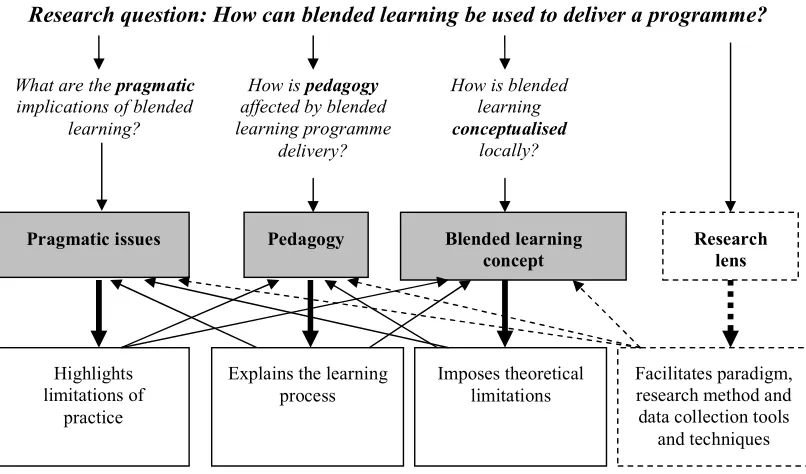
This thesis is a lengthy document, therefore to aid the reader, a conceptual framework has been developed to illustrate diagrammatically the main themes being investigated and their inter-relationships. The conceptual framework is depicted in Figure 1: Conceptual framework: Chapter 1.
pragmatic issues. These themes are connected using ‘cross links’ (Novak and Cañas 2007:2),
[image:27.612.121.529.248.488.2]which are lines with labels signifying their relationships. To illustrate the inter-relationships of the three themes there are arrows at the lower part of the concept which provide the connections. For example, the pedagogy theme ‘explains the learning process’ and therefore has an impact on both the blended learning concept theme and the pragmatic issues theme. Similarly, the pragmatic issues theme ‘highlights limitations of practice’ and therefore has an impact on the other two themes.
Figure 1: Conceptual framework: Chapter 1
The order in which these three themes are discussed in each Chapter will vary; this is due to their inter-relationship and the attempt to create a ‘flow’ within the individual Chapters. The research setting informs the way this research will be conducted. The research lens is based on the research paradigm, research method and data collection tools and techniques and will be used to interpret the three themes of interest.
This conceptual framework will be used at the beginning of each subsequent Chapter to set the Chapter into context and highlight the specific issues addressed therein. This will also
Research question: How can blended learning be used to deliver a programme?
How is blended learning
conceptualised
locally?
How is pedagogy
affected by blended learning programme
delivery?
Pedagogy Blended learning concept Pragmatic issues
What are the pragmatic
implications of blended learning?
Research lens
Imposes theoretical limitations Explains the learning
process Highlights
limitations of practice
Facilitates paradigm, research method and data collection tools
and techniques
remind the reader of the holistic view of this research process and how the individual sections relate to each other.
1.4 Thesis structure
So far this Chapter has set the scene for this research by highlighting the developments of information communication technology and how they have affected learning facilitation. The three themes which were identified as being under-researched are the pedagogy for blended
learning, the actual blended learning conceptualisation and the pragmatic issues of blended
learning. These were further focused using research questions and their inter-relationship
illustrated in the research concept map.
It is believed that an outline of the remaining chapters of the thesis will assist the reader in appreciating the structure of this work. This is given below.
Chapter 2: Literature review: This Chapter will draw on existing relevant work concerning the given research area. Influenced by the research question and sub-questions, the focus will be on current pedagogic research, blended learning concepts, and the pragmatic implications of blended learning.
Chapter 3: Research design: This Chapter will appraise the main philosophical assumptions, the research methods and data collection techniques within Information Systems research. Based on the given research setting, research questions and author’s beliefs, selections in relation to the research process will be made and justified.
Chapter 4: Research implementation: This Chapter will describe the implementation of the philosophical assumptions, research method and research tools. The research site will be justified and described. A rich description of data collection process will be provided. Data management and analysis will be outlined highlighting the two stages of data analysis: ad hoc and post hoc.
this study. It will particularly focus on the pragmatic issues associated with blended learning practice. The observations of practice and staff and students’ views will be discussed in the light of the literature.
Chapter 6: Stage 1: action research cycles three and four: This Chapter will provide a rich description of the first stage of data analysis describing the latter two action research cycles of this study. Building on the first two action research cycles, cycles three and four will focus particularly on the pedagogic relation to practice. As with the previous Chapter, the observations of practice and staff and students’ views will be discussed in the light of the literature.
Chapter 7: Stage 2: overall findings of current research: This Chapter will document the second stage of data analysis. Concentrating on the research sub-questions, a holistic view of all data analysis will be adopted. In relation to the concept sub-question, the local concept of blended learning will be explained drawing on six inter-related nodes of the ‘Fine Structure of the Blended Learning Concept’. In relation to the pedagogy sub-question, the analysis will identify the three inter-related ‘Key Issues of Blended Learning Pedagogy’. In relation to the pragmatic issues sub-question, the analysis will identify three inter-related elements of the
‘Bermuda Triangle of Blended Learning’.
Chapter 8: Discussion: The penultimate Chapter will compare and contrast findings from the overall action research with the literature. Influenced by the research questions, the comparison will be made between: the ‘Fine Structure of the Blended E-learning Concept’ and the blended learning concepts found in the literature; the ‘Key Issues of Blended E-learning Pedagogy’ and relevant pedagogic theories; and the ‘Bermuda Triangle of Blended E-learning’ and pragmatic issues identified in the literature.
Chapter 2
Literature review
2.1 Introduction
The previous Chapter introduced the problem area that this work attempts to address. The introduction of information communication technologies or learning technologies in higher education teaching has provoked a number of changes. The main question posed by this work attempts to provide a perspective on how blended learning can be used for the delivery of a programme. To answer this main question, three sub-questions are used to provide focus for this work.
This Chapter will review some of the existing literature. Influenced by the research questions, the focus will be specific to the pedagogic theories, general concepts of blended learning and pragmatic issues surrounding the introduction of learning technology, as highlighted in Figure 2: Conceptual framework: Chapter 2. The Chapter uses a number of specialist terms; their meaning in this work is outlined in the definitions section in the front matter of the thesis.
Figure 2: Conceptual framework: Chapter 2
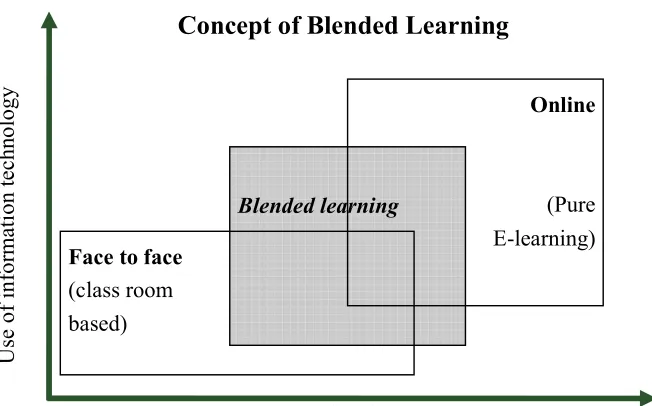
The second section of this Chapter explores the variety of blended learning concepts and interpretations. A definition of blended learning which is compatible with this current work is developed. The focus for the definition is the use of technology for facilitating learning interaction. With utility in mind, the development of the definition is guided by the principle of simplicity.
The final section of this Chapter focuses on the pragmatic issues and describes technology that has been used in higher education. This leads to a discussion of the use of technology in blended learning and theory regarding the introduction/use of technologies. The developments in learning technology and how these can be incorporated in practice are discussed. In particular, a detailed examination of computer assisted learning, e-moderation and assessment is presented.
Research question: How can blended learning be used to deliver a programme?
How is blended learning
conceptualised
locally?
How is pedagogy
affected by blended learning programme
delivery?
Pedagogy Blended learning concept Pragmatic issues
What are the pragmatic
implications of blended learning?
Research lens
Imposes theoretical limitations Explains the learning
process Highlights
limitations of practice
Facilitates paradigm, research method and data collection tools
and techniques
2.2 Pedagogy
Pedagogy in UK higher education has been influenced by many developments. This section provides a literature review related to these developments. It is subdivided into five sub-sections. The first sub-section examines the evolution from the Greek philosophers to the Roman Church and the medieval universities. The second sub-section draws on the associationist and functionalist debate of the 18th and 19th centuries. The third sub-section is concerned with the behaviourist and constructivist rationale for pedagogy. The fourth sub-section examines the interaction of teachers and students as part of constructivism. This is followed by a sub-section on student-student interactions in the light of relevant pedagogic theories.
2.2.1 Early influences on pedagogy
Learning is one of the oldest activities of humankind. There have been several major developments that have shaped views on how people learn and how they should be taught. These views on the method and practice of teaching are broadly referred to as pedagogy (OED 2004). The concern of Greek philosophers in the 5th century B.C. and Roman Catholic scholars in the 5th century A.D. was essentially the same. It was primarily with the issue of ‘What?’ should be taught; the ‘How?’ of pedagogy did not seem to have been addressed (Beck 1965; Butts 1971).
Roman scholarship was introduced by St. Patrick in Ireland in the 5th century and a century later by St. Augustine in England (Beck 1965). Obviously, in bringing Christianity to the British Isles these eminent preachers must have used a variety of teaching methods, however, the ‘ex-cathedra’ method is the one we most identify with the Church (Stanton 2007). The Church, through its local places of worship and its great Cathedrals, served as roots for both schools and future universities. This has influenced teaching methods and how teachers were perceived as an authority by students, who had to listen and absorb information (Kerr, Gade et al. 1994). The ex-cathedra method still exists in both schools and universities.
education was that the teaching was in vernacular languages instead of Latin (Kerr, Gade et al. 1994). However, there were other differences, particularly in the medieval craft guilds which concentrated on practical skills. A guild apprenticeship where a student worked with his/her master to learn these practical skills lasted from five to eleven years and was based on rigorous periodic examinations. The pedagogic model offered by guilds proved effective and influenced some of the first universities. The university education process also revolved around a master - apprentice concept with the master being the ‘expert’ and the student being the ‘learner’, hence concentrating on teaching rather than learning (Beck 1965; Lave and Wenger 2000 ). However, there were signs of growing student-teacher interaction. Because of the students’ desire to know more, questions were often followed by ‘disputations’ (Beck 1965:39). This is one of the signs that teaching was moving from the monologue of a master to a dialogue between master and his/her students. It was becoming a two way communication process, not a simple repetition of knowledge (Lave and Wenger 2000:169).
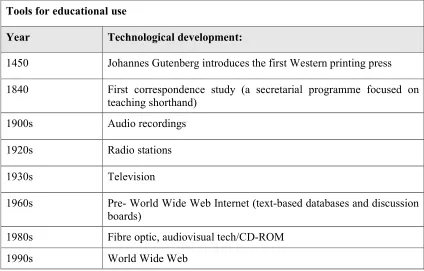
Technology made its first major impact on education through the work of Gutenberg and Caxton and the invention of print (Kerr, Gade et al. 1994). This fifteenth century technology allowed pamphlets and books to be produced in relatively large numbers (McLuhan 1962). Learning was no longer restricted to face-to-face encounters; off-site and asynchronous learning was now possible. There was a marked shift in emphasis from teaching to learning.
2.2.2 Associationism - functionalism
students ready by drawing out any issue related to the topic to be studied. The presentation step would explain the new topic, using concrete examples to explain the theory or concept in question. Association steps would connect the already known with the newly learned, with the differences and similarities highlighted. In the generalisation step students were asked to consider the larger picture and use these ideas in other subjects. The final application step would give students the opportunity to apply the learned theory in practice and appreciate new experiences (Beck 1965:99). These five steps have paved the way for the format of academic publications ever since; this thesis followed these steps in its ordering of the Chapter structure!
Herbart’s views were criticised by John Dewey (1859-1952), who observed that all work in a Herbartian class was teacher-and-subject-centred, in which case students were only concerned with remembering and reciting (Dewey 1916). Dewey, on the other hand, was of the opinion that students should learn problem solving (Beck 1965; Butts 1971; Dewey 1916). Dewey echoed Darwin’s evolution principles and related evolution to an individual’s learning. Dewey’s view of the mind was that it is driven by the need for problem solving, rather than the association of already known facts as proposed by Herbart. Although criticising Herbart, Dewey also recognises his main contribution to teaching:
“Herbart's great service lay in taking the work of teaching out of the region of routine and accident. He brought it into the sphere of conscious method; it became a conscious business with a definite aim and procedure, instead of being a compound of casual inspiration and subservience to tradition.” (Dewey 1916: Chapter 6)
To counteract Herbart’s beliefs, Dewey proposed his own five steps for teachers so that they could engage students in problem solving: The first stage was the student’s realisation of a problem, the second the inspection of the problem, followed by hypothesis building which was then proposed and tested experimentally. Then the extension of the hypothesis followed and finally, learning was concluded by the testing of the hypothesis in practice. It is not surprising that Dewey, a follower of Darwin, proposed a process that has great similarities to certain formulations of the scientific method (Butts 1971; Chalmers 1976; Dewey 1916)
2.2.3 Behaviourism – constructivism
sub-section advances the key differences between behaviourism and constructivism, consequently this sub-section is divided into two themes.
2.2.3.1Behaviourism
Behaviourism placed the emphasis on teaching and the need for repetition rather than learning as advocated by Dewey. Stemming from the Greek ‘didaskein’ meaning ‘teach’ (OED 2004), behaviourism is often linked to didactic pedagogic beliefs, concerned with the instruction of students. Behaviourism was inspired by the work on dogs and their conditioned responses to stimuli by Ivan Pavlov (1849-1946) and was developed by many others including Gagne (1916-2002), Hull (1884-1952), Skinner (1904-1990) and Watson (1878-1958). Behaviourists extrapolated the influence of stimuli and claimed that it is the environment that makes an individual. Therefore, humans and animals were conditioned to exhibit certain behaviour irrespective of their thoughts or feelings (OED 2004). According to Watson’s thoughts, the environment was responsible for a baby growing up to be a shoplifter or a law abiding citizen. Again, this work supported the associationist ideas of Herbart, setting aside the role of heredity and making the learner a passive recipient of instructions (Beck 1965:102). This is particularly evident in Watson’s assertion:
“Give me a dozen healthy infants, well-formed, and my own specified world to bring them up in and I'll guarantee to take any one at random and train him to become any type of specialist I might select – doctor, lawyer, artist, merchant-chief and, yes, even beggar-man and thief, regardless of his talents, penchants, tendencies, abilities, vocations, and race of his ancestors. I am going beyond my facts and I admit it, but so have the advocates of the contrary and they have been doing it for many thousands of years. Please note that when this experiment is made I am to be allowed to specify the way the children are to be brought up and the type of world they have to live in”(Watson 1997:82)
“The whole process of becoming competent in any field must be divided into a very large number of very small steps, and reinforcement must be contingent upon the accomplishment of each step. This solution to the problem of creating a complex repertoire of behaviour also solves the problem of maintaining the behaviour in
strength. … By making each successive step as small as possible, the frequency of
reinforcement can be raised to a maximum, while the possibly aversive consequences of being wrong are reduced to a minimum.” (Skinner 1954:94)
Behaviourist thought was very popular in the 20th century, to the extent that most official activities, such as passing a driving test, are seen to represent an objective measurement of the learners’ ability, at the end of the learning process (Shepard 2000). The following three characteristics of behaviourist teaching highlight the role of assessment in learning as an essential part. Since assessment, or in this case tests, are essential to ensure competence in a subject, they are equated to learning and serve as a motivating factor:
“Tests should be used frequently to ensure mastery before proceeding to the next
objective;… Tests are isomorphic with learning (tests = learning); … Motivation is
external and based on positive reinforcement of many small steps.” (Shepard 2000:5)
The next theory considered is that of constructivism. This advances the early debate on the roles of the teacher and learner in the work of Herbart and Dewey.
2.2.3.2Constructivism
The constructivist advocates include Jean Piaget (1896-1980), John Dewey (1859-1952) and Lev Semenovich Vygotsky (1896-1934) (Shepard 2000). The basic beliefs of the constructivists are that learning is a building-block based process in which certain stages had to be dealt with first before moving on to the next stage. The stages approach is similar to behaviourism, however, the differences are to be found in: a) the roles of the learner and the teacher and b) the acknowledgement by constructivists that learning is a socially and culturally determined activity (Shepard 2000). Instead of presenting stimuli to generate a response, the constructivist view suggests that it is the ‘facilitation’ of learning that is important and hence the role of the teacher is to move
“from Sage on the Stage to Guide on the Side” (King 1993)
The ‘sage on the stage’ however, represents the perspective held by behaviourist scholars. In constructivism, the learners are developed through social interaction with more capable others; the argument being that learning is primarily a social process (Shepard 2000). This view of learning was already highlighted by Dewey in his debate with Herbart. Dewey’s contributions are therefore acknowledged:
“Theory and a set of practices around learning [were] based originally on the work of John Dewey. The term [constructivism] refers to the idea that learners construct knowledge for themselves – each learner individually (and socially) constructs meaning – as he or she learns. Constructing meaning is learning; there is no other kind.” (Cullen, Hadjivassiliou et al. 2002:5)
A number of authors have built upon this concept which, in the western world, essentially draws on the work of Dewey; Vygotsky’s work was not accessible due to the Cold War and the language barrier (Vygotsky 1962:vi). Whichever source is followed, there is a general agreement that the main characteristic of constructivism is rejection of the didactic model of teaching. The emphasis is on the process of actively building learners’ skills and knowledge (Laurillard 2002:67). Generally, constructivism is concerned with learning through interaction with the world and is based on two tenets:
As can be seen here these two tenets are essentially the arguments that Dewey used against the early work of Herbart. The behaviourist - constructivist divide amongst university teachers is also characterised by the conceptions of teaching as being either ‘teacher-centred/content orientated’ or ‘student-centred/learning oriented’ (Kember 1997). However, in a review of current pedagogic research it was suggested that constructivist theory was becoming the predominant view influencing new pedagogy and one which is applied in four different ways:
“…expository methods; interactive methods; conversational methods and experiential methods….” (Cullen, Hadjivassiliou et al. 2002:11)
It is not the intention of this work to explore all of the ways in which constructivism could be implemented. This is outside of the scope of this research and has been done by others [see for example (Conole, Dyke et al. 2004)]. The emphasis of the current work is on the student – student and teacher-student interactions, and therefore the two are examined here. Teacher-student interactions are examined in the light of conversational methods and the Teacher- student-student interactions are examined in the light of the social theories of learning. In doing this one is aware that pedagogic theories can be:
“…joined up as compatible sub-themes”(Mayes 2007:84)
2.2.4 Teacher - student interaction
Constructivists, particularly social constructivists, recognise the individuality of learners and their social nature. Thus, individuals are at the centre of the learning process and teachers are there to facilitate their learning. The following quote from Vygotsky (1962) emphasises the social nature of psychological functions and psychological processes present in learning:
“All higher psychological functions are internalised relationships of the social kind, and constitute the social structure of personality. Their composition, genetic structure, ways of functioning, in one word, all their nature – is social. Even when they have become psychological processes, their nature remains quasi-social. The human being who is alone retains the function of interaction.” (Daniels 2005:81)
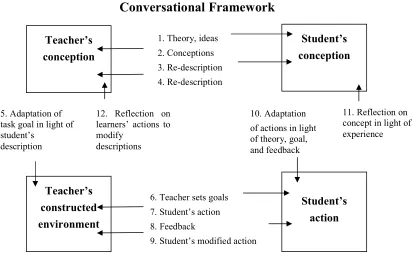
Conversational Framework has roots in Conversation Theory and Learning Conversation, these also need to be examined.
2.2.4.1Conversation Theory
The constructivist paradigm was advanced in the 1970’s through Conversation Theory as developed by Gordon Pask (1928 -1996) and others (Scott 2001b). Conversation Theory is generally a concept of interaction between the teacher and the learner where
“…one participant (the teacher) wishes to expound a body of knowledge to a second participant (the learner).” (Scott 2001a:3)
Some of the underlying assumptions of Conversation Theory are: firstly, that all human beings are learning systems which are continuously engaged in learning activities; secondly, that motivation should focus on what is learned and why it is learned; and finally, if one can ‘teach back something’, then it is considered as remembered:
“The brain/body system is a dynamic self-organising, “variety eating”, adaptive and habituating system, subject to boredom and fatigue. As Pask often put it, “Man is a system that needs to learn”, thus the problem of motivation is not “that we learn” it is
rather what is learned and why. …. For humans, learning is also about the
construction of symbolic representations, subject to constraints of logical coherence, acquired through the medium of dialogic, conversational interaction and the inner dialogic processes of strategic and tactical attention directing. In conversation, narrative forms are constructed and exchanged (Scott, 1999, Laurillard, Stratfold et al 1999, Bruner 1996). What is memorable is that which can be “taught back” (Pask and Scott, 1972).” (Scott 2001a:3)
These beliefs go back to Dewey’s thoughts on students’ motivation in learning and the creation of encounters that allow learning to be contextualised. It is also in line with the work of William Glasser, which suggests that most people learn only about 10 % of what they read, 20% of what they hear, 30% of what they see, 50% of what they hear and see, and that higher levels of learning – 70%- occur with subjects that people discuss together, 80% of what they use and do in real life and finally, most learning takes place when people teach someone else (Biggs 1999).
teacher and learner. The horizontal arrows depict the interaction of questions and answers. This verbal communication happens on two levels: the ‘Why?' and the ‘How?’. The ‘Why?’ (comprehension learning) level sets out a context in which the ‘How?’ becomes meaningful. The ‘How?’ (operation learning) is concerned with an understanding of the topic itself. The vertical lines on the other hand represent causal connections such as feedback. At the bottom of the figure is the practical modelling representation of the theory concerned. Thus a topic can be deemed as having been understood if a learner is able to demonstrate that they can ‘teach back’ the practical elements as well as the verbal explanations of ‘How?’ and ‘Why?’ (Scott 2001a).
The psychologists Harri-Augstein and Thomas utilised Conversation Theory and advanced it by emphasizing ‘How?’ the learning process should be implemented and the motivation for this process. The questions being answered in addition to the ‘How?’ and ‘Why?’ of the topic being taught should also address the issues of ‘How?’ and ‘Why?’ of learning. They highlighted the need for “conversational encounters” to achieve significant learning:
“…personally significant and valued learning… is achieved by exercising the freedom to learn in ‘conversational encounters’, which are valued by using criteria that arise from within the experience itself.” (Harri-Augstein and Thomas 1991:9)
Their emphasis goes beyond the notion of problem solving or problem based learning (Dewey 1938) to awareness, review and reflection upon an experience of learning. A ‘full’ Learning Conversation would therefore consciously include answers to the following questions (Scott 2001a:7): ‘Why of learning?’, conversation about the purposes of learning and the subsequent motivation; ‘How of learning?’, conversations about learning as a process and ‘Why and How of Topic?’, subject related discourse. The reflection upon ‘Why and How of learning’ affects individuals’ beliefs, values, needs and purposes and hence the emphasis on learning how to learn is the contribution of Harry-Augstein and Thomas (Scott 2001a:7).
Their modification to Conversation Theory is also referred to as a ‘Learning Conversation’ (Harri-Augstein and Thomas 1991).