Image Processing of Moving Object Captured and Received by GPRS/GSM Modem
Ayob Johari1, Mohd Helmy A. Wahab2, Liew Chia Woon3, M. Erdi Ayob4. M. Izwan Ayob5, M. Afif Ayob6, Ariffin A. Mutalib7
1,2,3,4,5,6
Faculty of Electrical and Electronic Engineering Universiti Tun Hussein Onn Malaysia
86400 Batu Pahat, Johor, Malaysia
7
School of Multimedia and Communication Universiti Utara Malaysia 06010 Sintok, Kedah, Malaysia
Abstract- Speed trap systems have been widely used worldwide by local authorities. This is one of the ways to control the speeding of public cars. The systems are often installed at hidden areas. In real situation, the image of over-speeding vehicle is captured by a high speed camera. In this study, a mobile phone equipped with a camera is used to capture the plate number and the image is sent by the mobile phone to the modem. The aim of this study is to develop a system that can be used by the public to capture over-speeding vehicles or offender images and send to the modem which is connected to the computer that acts like the main control office. The received image is analyzed to extract the plate numbers into individual character using image processing technique.
I. INTRODUCTION
Transport is a requirement for everyone especially in tropical countries like Malaysia. Weather and the needs of flexible mobility are examples of reasons to why four-wheeled vehicles are really needed. A total of 21,401,269 vehicles are registered in Malaysia in 2012. It was an increase of 1,211,199 new vehicles registered in the whole country in 2011 with the annual increase of around 4%. Based on the report released by Police Department, there were a total of 2289 death from 18,788 accidents in 2012 and 2403 death from 18,271 accidents involving vehicles in 2011. With reference to the figures, the number of accident seems to correlate with the number of vehicles on the road.
As an inititative to reduce the accidents, the government of Malaysia has initiated a Road Safety Campaign. Slogans such as‘Speed Kills’, ‘Don’t Let Your Family Welcomes You With Cries’,and‘Make Sure You Are Not In The Accident Statistic’ are examples of many slogans in the Road Safety Campaign. Besides this campaign, the Malaysian Police Department has also taken a stern action by enforcing speed traps on the highway, especially during festive seasons.
Speed traps had been used since the beginning of the 20th century as a means to enforce speed limits and the safety of the road users. Offenders are issued with speed limit tickets on the spot or receive their tickets by mail.
The speed trap system was developed to ensure that the drivers drive within the allowed speed limits. At the same time, the safety of the drivers and passengers can be improved. The
image of the over-speeding vehicle captured from the camera is received through a GSM/GPRS modem. Plate number is extracted from the image and stored in a database and the information of the over-speeding vehicle is displayed when the toll operator keys-in the over speeding-vehicle plate number upon exit.
II. IMAGE PROCESSING
Image processing is very important in any modern wireless communication, which involves image data. It is a form of signal processing for which the input is an image, such as photos or video frame, whereas the output of image processing may be either an image or a set of characteristics or parameters related to the image. Most image-processing techniques involve treating the image as a two-dimensional signal and applying standard signal-processing techniques to it.
All types of images for image processing must be in a digitized form, that is in arrays of finite length binary words. For digitization, the given image is sampled on a discrete grid and each sample or pixel is quantized using a finite number of bits. The digitized image is processed by a computer. To display a digital image, it is first converted into ananalog signal, which is scanned onto a display.
The techniques to be discussed are implemented in the spatial domain: the plane containing pixels. Therefore, this study operates on the pixels of an image.
The spatial domain processes will be denoted as g(x,y) = T [f (x,y)], where g(x,y) is output image, f (x,y) as input image and T is an operator on f, defined over a neighborhood of a point (x,y). The smallest possible neighborhood is of size 1x1 pixels. Therefore, g depends only on the value off at a single point (x,y). T becomes an intensity (gray‐level or mapping) transformation function of the form s = T(r), where s is the intensity of g at a point (x,y) and r, intensity of f at a point (x,y) as shown in Figure 1.
Figure 1. Level of intensity of an image
Figure 2. Inverse level of intensity
The intensity of the captured images varies depending on the visibility and lighting in the surrounding, be it day or night. This can be transformed using some basic intensity transformation functions Log transformation s = c. log(1 + r); r≥0.
Image processing can be implemented based on point processing technique:
B(i; j) = g(A(i; j)
Using Matlab, g(l) can be computed as an array by utilizing B = g(A + 1). In general a point operation/function B(i; j) = g(A(i; j) results in a new histogram hB(l) for the output image, which is different from hA(l). B(i; j) = g(A(i; j)).
Suppose g(l) represents an overall point function, which includes contrast stretching/compression, emphasis/de-emphasis, rounding, and normalizing. Given an image matrix A, B(i; j) = g(A(i; j)) is also an image matrix. g(l) may not be
“continuous” or connected and it also may not be composed of
connected line segments.
A. Scope of Project
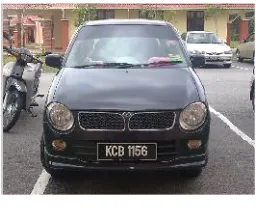
Capturing image of moving vehicles is the main scope of this study. The front view of the vehicle is the main focus of the image, which is taken at the pre-determined distance from the camera. Its image is transferred to the computer that analyzes via GPRS/GSM modem. Using Matlab as image processing engine, the plate number is extracted from the image and stored in the computer.
III.
E
XPERIMENTALS
ETUPThe image of moving vehicle is captured using a high speed camera. The image is then transferred to a processing unit using GPRS/GSM modem. There are three main parts involved in analyzing the image: image receiving, image processing, and data or image retrieving. In overall, this study involves three sequential steps as shown in Figure 3, which are investigating the project requirement, designing the interface and simulating program.
Figure 3. Research process
A captured images will be sent through a mobile phone via GPRS/GSM to the GSM modem. The image will be received and read by GSM modem and saved to the database (central computer).
The received image in the database is processed. First, the characters of the plate number are extracted from the image into individual character or individual data.
Then, the extracted characters are stored in the database. When the user keys-in the car plate characters that match with the car plate number in the database, the image will be displayed. This overall process is illustrated in Figure 4.
Figure 4. Block diagram of the system
The block diagram shown in Figure 4 explains that the process starts with sending an MMS by a mobile phone via GPRS to a GSM modem. The modem will receive the MMS and then the MMS will be saved in the computer. Further, the image or data stored in the computer will be processed in MATLAB to extract the car plate number. Then, the processed data will be stored in the database.
For the purpose of gaining information about the over-speeding vehicles, the vehicle plate number is used as the key. Once the plate number is matched with those in the database, the information of the vehicle is displayed on the computer screen.
All the steps described in the paragraphs above require specifications as explained in the following section.
A. System Requirements
[image:2.612.322.534.332.461.2]GPRS/GSM wireless modem (Figure 5). Billionton modem is a MC35i Dualband GSM/GPRS developed by Siemens. This modem can support SMS, voice call, and data and fax function.
Figure 5. The Billionton USB GPRS/GSM wireless modem
Alternatively, mobile phones that have GPRS/GSM
application can be used to replace the Billionton USB GPRS/GSM wireless modem. Ift is used, the MMS will be converted into and image file before being saved into the computer manually.
In terms ofsoftware, MATLAB is used for image processing part to extract the characters of car plate from the captured image. Meanwhile, Microsoft Access is used for the database. Additionally, Microsoft Communication is used to support the communication port-like modem. The connection can be detected by the Microsoft Communication, which will label the COM port number when the modem is attached or connected to the communication port.
B. Program Development
The software development is divided into three main parts: (i) sending and receiving MMS, (ii) image processing and extracting car plate number, and (iii) image retrieval. The development of these three parts can be performed in parallel.
i. Sending MMS
The mobile phone is used to send the captured plate number (in image form–MMS) to the Billionton GPRS/GSM modem.
ii. Receiving MMS
The MMS is received by the mobile phone. Then, the multimedia file will be converted into the image file manually and saved into computer.
IV.
I
MAGES
EGMENTATIONImage segmentation stage is done to remove noise and useless information from the image. It is important to ensure that this process does not remove significant information about objects being analyzed [6]. It involves steps as described in the following paragraphs.
i. Image Conversion
Image conversion is the process to convert the RGB image or truecolor image into a grayscale image. It reduces the bits in the image and it is easier for analysis.
ii. RGB Image
[image:3.612.368.496.192.296.2]A truecolor or RGB image (Figure 6) is created from an m-by-n-by-3 data array that defines red, green, and blue color components for each individual pixel. The row and column dimensions specify the pixel location, and the page or third dimension specifies each color component. The color of each pixel is determined by the combination of the red, green, and blue intensities stored in each color plane at the pixel's location. Graphics file formats store RGB images as 24-bit images, where the red, green, and blue components are 8 bits each. An RGB MATLAB array can be of class double, uint8, or uint16. In an RGB array of class double, each color component is a value between 0 and 1.
Figure 6. RGB image
iii. Indexed Image
Indexed image can reduce the file size of an image. It specifies the number of colors to store in the new colormap. An indexed image requires a colormap and interprets the image data as indices into the colormap matrix. The colormap matrix is a standard colormap: any m-by-3 array containing valid RGB data [8].
iv. Intensity Image
An intensity image scales the image data over a range of intensities. This form is normally used with images to be displayed in grayscale or one of the other monochromatic colormap [7]. An intensity image is also called grayscale image (Figure7). MATLAB grayscale image is stored as an individual matrix, with each element of the matrix corresponding to one image pixel. Grayscale process will remove the hue and saturation information from the input image but retaining the luminance.
Figure 7. Cropped image then convert into grayscale image
v. Median Filtering
[image:3.612.346.533.520.581.2]Figure 8. Image was filter by the median filter.
vi. Top Hat Filtering
[image:4.612.332.510.115.176.2]Tophat filtering can be used to correct uneven illumination of the background image. Particularly, im2 = imtophat (im,strel (NHOOD)) is used. Imtophat performs morphological top-hat filtering on the grayscale or binary input image IM using the structuring element SE, where SE is returned by strel. SE must be a single structuring element object, not an array containing multiple structuring element objects, where NHOOD is an array that specifies the size and shape of the structuring element. It makes the alphabets on the plate clearer as seen in Figure 9.
Figure 9. Top hat filtering
vii. Subtracting Image
[image:4.612.94.284.283.344.2]The function subtracts a constant value from an image. It uses the imsubtract function. imsubtract subtracts each pixel value in one of the input images from the corresponding pixel in the other input image and returns the result in the corresponding pixel in an output image. Image subtraction can be used as a preliminary step in more complex image processing [8]. In the end, this function further clears the alphabets as depictedin Figure 10.
Figure 10. Image after subtracting
viii. Global Image Threshold
The graythresh computes a global threshold (level) that can be used to convert an intensity image to a binary image with im2bw. It minimizes the intraclass variance of the black and white pixels.
ix. Image to Binary Image Conversion
This function converts the image into a binary image, based on the threshold. im2bw produces binary images from indexed, intensity, or RGB images. To do this, it converts the input image into grayscale format (if it is not already an intensity image), and then converts this grayscale image into binary by
thresholding (to convert an intensity image to a binary image). The output binary image BW has values of 0 (black) for all pixels in the input image with luminance less than level and 1 (white) for all other pixels [8]. It gives an output as seen in Figure11.
Figure 11. Image after converted to binary image
x. Characters Segmentation
1. Detect Car Plate Location
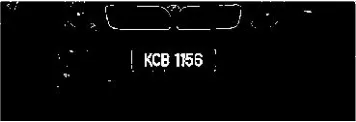
The function lp_area2=BW(y1:y2,x1:x2) is used to detect the plate number in the binary image (Figure 12).
Figure 12. Car plate image that is detected from the binary image
2. Removing Small Objects
Function bwareaopen is used to remove the small objects or removing connected components having fewer than P pixels from the binary image. Then, another binary image will be produced. There are two types of dimension connectivity for two dimensions that is (i) 4-connected neighborhood and (ii) 8-connected neighborhood.
The fewer P pixels means that less objects to be analyzed. The value of P pixels is obtained by observing the experiment to prevent over removing. This results in an image as seen in Figure 13.
Figure 13. Image after processed by bwareaopen
3. Image Cropping
The image cropping, in which Figure 14 demonstrates, is used to get the portion of the plate in image form. This will ensure that the important information or character to be processed is not lost.
Figure 14. Image show that the car plate had been crop from the binary image
4. Characters Separation
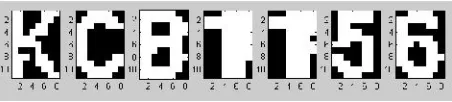
[image:4.612.81.281.480.549.2]illustrated in Figure 15) and it is easier for the recognition process.
Figure 15. Each character separated by the BoundingBox
xi. Characters Recognition
1. Neural Network
Each cropped character needs to be resized to 1 × 88 matrix before the characters recognition takes place. For this purpose, neural network is used to recognize 35 characters (A to Z and 1 to 9). The zero is not to train because it is similar to alphabet
‘O’. The network is trained by using backpropagation method
and the output after trained is in ASCII format.
E. Image Retrieved
After characters recognition, the data is stored in the database. The information of the over-speeding vehicles is displayed if the keyed-in plate number matches with the data in the database.
V. R
ESULT ANDA
NALYSESThis section briefly describes results of the analyses. Among analyses carried out includes modem functionality, image processing, and interfacing as well as databases.
A. Analysis of GSM Modem
[image:5.612.314.559.226.501.2]Billionton GPRS/GSM wireless modem was first tested. It was discovered that the modem can be used to send MMS but it cannot receive MMS. The message displays ‘Qapplication /vnd.wap.mms-message’, while the received mms is as shown in Figure 16.
Figure 16. The message shows that the mms cannot be read by the modem
B. Analysis of Image Processing
This system is able to detect plate numbers at a distance between 2 to 3 meters. The image of the plate number (Figure 17) is taken at a fixed angle. It was able to recognize the plate numbers from the image received by the mobile phone and load to the image processing software manually.
Figure 17. Single line Malaysian car plate
The luminance of lighting and weather will cause the threshold of the image being different. The threshold function is used to obtain the different luminance of lighting and weather condition. The gray thresh function uses Otsu's method, which chooses the threshold to minimize the intraclass variance of the black and white pixels.
Cropping method was used to crop the characters from the image manually (Figure 18) and compared with the ideal set ofcharacters to recognize the characters.
Grayscale Median filter Top hat filter
Subtract bwareaopen Resize input
Output character
Figure 18. The steps of the manual cropping
[image:5.612.75.279.464.593.2]The characters on the plate images have different sizes. In order to feed the input data to the neural network, the images need to be resized. Figure 19 shows that the characters have been resized into 11 x 8 pixels. Some characters were connected to each other during resizing. This problem was improved by resizing to 14 x 10 pixels.
Figure 19. The characters resize to 11 x 8 pixels
[image:5.612.319.545.604.655.2]11 x 8 pixels. It makes the matrix in 11 rows and 8 coulumbs, resulting in 88 total bits in the matrix. The function B = IM2COL(A,[M N],'sliding') converts each sliding M-by-N block of A into a column of B, with no zero padding. B has M*N rows and will contain as many columns as there are M-by-N neighborhoods in A. Using this function, the matrix will be rearranged into one row and 88 coulombs as a input to feed into the neural network.
C. Network Architecture
Figure 20. Architecture of the neural network
Figure 20 visualizes that the neural network needs 35 inputs and 26 neurons in its output layer to identify the letters. The network is a two-layer log-sigmoid/log-sigmoid network. The log-sigmoid transfer function was picked because its output range (0 to 1) is perfect for learning to output Boolean values. The hidden (first) layer has 10 neurons. This number was picked by guesswork and experience. If the network has trouble learning, then neurons can be added to this layer.
The function used to define the feed forward back propagation network is NEWFF(PR,[S1 S2...SNl],{TF1 TF2...TFNl},BTF,BLF,PF). Meanwhile the transfer functions TFi were selected among differentiable transfer functions such as TANSIG, LOGSIG, or PURELIN. The training function BTF can be any of the backprop training functions such as TRAINLM, TRAINBFG, TRAINRP, and TRAINGD.
D. Transfer Functions
[image:6.612.381.504.102.192.2]An elementary neuron with R inputs is shown in Figure 21. Each input is weighted with an appropriate w. The sum of the weighted inputs and the bias forms the input to the transfer function f. Neurons may use any differentiable transfer function f to generate their output. In this project, the logsig transfer function is chosen.
Figure 21. Elementary neuron model
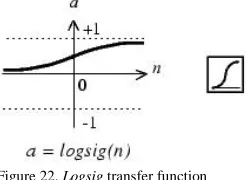
[image:6.612.71.278.179.289.2]Multilayer networks often use the log-sigmoid transfer function logsig. The function logsig generates outputs between 0 and 1 as the neuron's net input goes from negative to positive infinity.
Figure 22. Logsig transfer function
logsig transfer function (Figure 22) was used for both input and hidden layer. The function logsig generates outputs
between 0 and 1 as the neuron’s net input goes from negative
to positive infinity. This function can also be used to limit the output of the network to a small range, which is 0 and 1.
E. Network Training
traingdx stands for gradient descent w/momentum and adaptive lr back propagation. It is a network training function that updates weight and bias values according to gradient descent momentum and an adaptive learning rate.
Syntax
[net,tr,Ac,El] = traingdx(net,Pd,Tl,Ai,Q,TS,VV,TV)
traingdx can train any network as long as its weight, net input, and transfer functions have derivative functions. Back propagation is used to calculate derivatives of performance perf with respect to the weight and bias variables X. Each variable is adjusted according to the gradient descent with momentum.
For each epoch, if performance decreases toward the goal, then the learning rate is increased by the factor lr_inc. If performance increases by more than the factor max_perf_inc, the learning rate is adjusted by the factor lr_dec and the change, which increased the performance, is not made.
5.6 Database
i. Database in Microsoft Access
Microsoft Access is used to store data. There are two tables used in the database, which are CarPlate and Info as shown in Figures 23 and 24. Among fields in thetables are Car_Plate_No, Speed, Date, Time, Location, Image, Car_Owner, IC_No and Address. The table ‘CarPlate’ is
Figure 23. The CarPlate table
Figure 24. The Info table
ii. Microsoft Access Linking
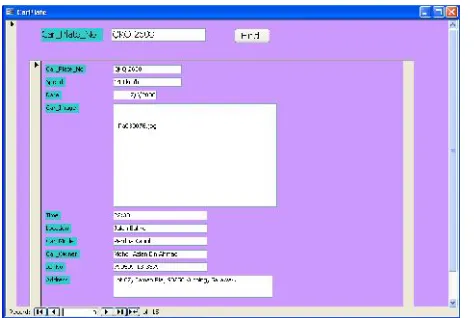
[image:7.612.68.305.440.599.2]Visual Basic is used to design the interface and to connect with the database. The database and the interface were linked by using the subform in Microsoft Access. The subform was created to display the information of the over-speeding vehicle. Info table shown in Figure 25 is displayed when the keyed-in plate number matches with the one stored in the database.
Figure 25. The information about the over-speeding vehicle is displayed
VI.
C
ONCLUSION ANDR
ECOMMENDATIONIn overall, the system functions well and successful. The Billionton GPRS/GSM modem is able to send the MMS to the mobile phone. However, it cannot receive the MMS from the mobile phone. The orientation of the plate numbers is important to prevent an inaccurate detection and this will cause failure to the whole recognition process. Higher resolution can perform better image but increases the image processing time. Also, the characters must be perfectly resized before going through the Euler Network for the character recognition process. In addition, the image must be converted into another format so it can be easily processed.
REFERENCES
[1] Asoke K Talukder and Roopa R Yavagal (2005).
“Mobile Computing Technology, Application and Service Creation.” New Delhi: Tata McGraw -Hill.137-138.
[2] Gunnar Heine (1998). “GSM Networks: Protocols,
Terminology, and Implementation.” London: Artech
House.
[3] Eun Ryung Lee, Pyeoung Kee Kim, and Hang Joon
Kim (1994). “Automatic Recognition of a Car License
Plate Using Color Image Processing.” IEEE,1994
[4] Anoop Sehgal A/L Paras Ram (2005). “Design of a
Recognition System For Special Malaysian Car Plates
Using Stroke Analysis.” Universiti Teknologi
Malaysia: Tesis Master.
[5] Haris Al-Qodri Maarif, and Sar Sardy (2006). “Plate
Number Recognition by Using Artifical Neural
Network.” University of Al-Azhar Indonesia.
[6] Gregory A. Baxes (1994) “Digital Image Processing: Principles and Applications.” Canada: John Wiley &
Son, Inc. 125
[7] Duane Hanselman and Bruce Littlefield (2001).
“ Mastering MATLAB 6: A Comprehensive Tutorial
and Reference.” New Jersey: Prentice Hall. 438
[8] MATLAB Help Documentation (2004). “Image
Processing Toolbox, Neural Network Toolbox,
Database Toolbox in MATLAB” Version 7.1: