Journal of Chemical and Pharmaceutical Research, 2014, 6(3):937-942
Research Article
CODEN(USA) : JCPRC5
ISSN : 0975-7384
Study and application on the factors of attacking effect by TKD downward
kick based on the influence of dynamic model
Chao Liu
Wushu Department, Shandong Sports University, Rizhao, China
_____________________________________________________________________________________________
ABSTRACT
As time goes by, the pursuit of self-defending increases in a high quality which prompts KTD to be more and more popular in China. Besides, KTD is the official event in Olympic Games. To improve and optimize the skill of Chinese KTD players, the essay sums up the static energy of the players’ downward kick by analyzing the mechanic and dynamic relationship caused by downward kick. On analyzing the data collected from the players’ training, some defects were found out when the players were downward kicking: it takes so long time to start and draw back the leg during which the crack might be caught by the opponents. When the players swig up the right legs, they will become more stable which reduces the angle of hip joint whose change will influence the power and attacking effect of downward kick.
Key words: Mechanics analysis, dynamics analysis, Lagrange dynamic function, data analysis
_____________________________________________________________________________________________
INTRODUCTION
KTD originated from Korea in 1950s, it was shaped by combining and normalizing various combat genres. It was found by General Cuihongxi around 1955 that combined KTD and the folk elements after his retirement. Since the Second World War, the people came back to Korea all over the world had integrated the martial art they learned outside with KTD. KTD was a demonstration event of Hancheng Olympics in 1988, only in the Sydney Olympics in 2000 had it become the official one. In 1989, KTD was brought into China and then the first KTD training class began in Beijing while the preparatory group was set in October 1992. By May 1995, KTD had made its fast development and spread among China as a competitive sport since the first KTD national championship race in Beijing [1-5].
ESTABLISHING AND SOLVING OF THE MODEL Basic steps of downward kick
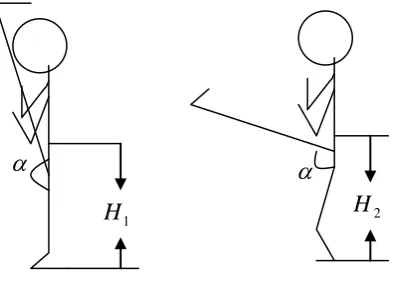
[image:2.595.211.403.153.229.2]First thrust against the ground by right leg, transferring the Centre of gravity to the left leg. Clinch your hands in front of your chest, lift your right leg with hip joint as the axis, put the knee joint onto the chest, stretch your right calf over your head around the knee joint and then make a downward kick straight to the ground with the right heels being the pivot, forming a posture of actual combat. Figure 1 and 2 are the drawings of downward kick.
[image:2.595.208.406.439.586.2]Figure 1: side drawing of downward kick
Figure 2: front drawing of downward kick Mechanic analysis of downward kick
When downward kick happens, one needs to stretch his right leg up over the head, with the right heel being the pivot and then straight down to the ground. The player’s right leg can be a rigid body during the whole process. So the downward kick of the right leg can be seen as a rigid body’s rotation around the fixed-axis. Pls refer to Figure 3:
Figure 3: drawing of the right leg’s rotation
A resultant moment will be formed during the process of the right leg’s rotation, the formula is as follows:
β
•
=
Bz
I
M
.
B
I
is the rotation inertia of the right leg,β
is the angular acceleration. Suppose the right leg is a cylindrical rigidbody, so its rotation inertia
2
2
2 2 2 2 1
1
r
m
r
m
I
B=
+
.
1
m
Shows the mass of right thigh,m
2: the mass of the right leg,r
1: the radius of the right thigh,r
2; the radiusα
1
H
α
2
of the right leg. Angular acceleration 2
2
dt
d
dt
dw
θ
β
=
=
.The player’s Centre of gravity will keep low when he makes a downward kick of the right leg, and then make the
gravity work
W
=
mg
(
H
1−
H
2)
.Dynamic analysis of the downward kick
Actually, there is a certain intersection angle between the thigh and the leg when a player makes a downward kick. So the right leg can be made to be a model of two degrees of freedom. See Figure 4:
Figure 4: Rigid body degree of freedom for right leg
So the essay set a limited formula of particle dynamics by Lagrange equation. With Lagrange function
L
to be the D-value of system energyK
and potential energyP
:L
=
K
−
P
.The formula for system dynamics is:
n i
q L
q L dt
d F
i i
i & =1,2,L,
∂ ∂ − ∂
∂ =
i
q
&
in above formula is corresponding speed,
q
i is the coordinate of potential energy.F
i Is the force in thei
coordinate,
θ
1,
θ
2 are the intersection angles of the thigh, leg and the axes, withl
1,
l
2 being the length. Thedistance between the Centre of hip joint/knee joint and gravity location for thigh and leg is
p
1,
p
2, so we cancalculate the gravity coordinate for thigh
(
X
1,
Y
1)
:(
)
(
)
+ −
− = +
+
= =
=
2 1 2 1 1 2 2 1 2 1 1 2
1 1 1 1 1 1
cos cos
sin sin
cos sin
θ
θ
θ
θ
θ
θ
θ
pθ
Y l pl X
p Y p
X
Likewise, the gravity coordinate
(
X
2,
Y
2)
of the leg can be calculated too. The expression ofE
k(system kineticenergy) and
E
p(system potential energy) is as follows: 2p
2
θ
1
θ
y
x
2
l
1
p
1
(
)
(
)
[
]
(
)
− + + − = − = + = + + + + = = + = 1 1 2 2 1 2 2 2 1 1 1 1 2 1 2 2 1 2 01 2 2 2 2 2 1 2 2 2 2 1 2 1 2 2 2 1 2 1 1 1 2 1 cos 1 cos 1 cos 1 2 1 , cos 2 1 2 1 2 1 ,θ
θ
θ
θ
θ
θ
θ
θ
θ
θ
θ
θ
gl m gp m E gp m E E E E p l m p m l m E p m E E E E p p p p p k k k k k & & & & & & &Write the above formula into the expression of Lagrange function, then by the formula of Lagrange system
dynamics, we can get the torques on the hip joint and knee joint
M
handM
k: + + + = 2 1 1 2 2 1 221 212 121 112 2 2 2 1 222 211 122 111 2 1 22 21 12 11 D D D D D D D D D D D D D D M M k h θ θ θ θ θ θ θ θ & & & & & & & & & & ijk
D
in above formula is :
(
)
(
)
(
)
+ = + = − = = − = + = + = + + + = + + + = = = = = 2 1 2 2 2 211 122 212 2 2 1 2 112 2 2 1 2 211 2 2 1 2 122 2 2 1 1 2 2 2 21 2 2 1 2 2 2 2 12 2 1 2 2 1 1 2 1 1 1 2 2 1 2 2 1 2 2 2 2 2 1 1 11 2 2 2 22 121 222 111 sin sin 2 sin sin cos cos sin sin cos 2 0 0 0 θ θ θ θ θ θ θ θ θ θ θ g p m D D D D p l m D p l m D p l m D p l m p m D p l m p m D g p m g l m p m D p l m l m p m p m D p m D D D DDATA ANALYSIS OF DOWNWARD KICK Each step’s analysis of downward kick
To find out the effective way for Chinese KTD players to knock down their opponents, video measurement was used to record the whole process of the player’s action by DV and then put the action image from the DV into the XYZ, selecting the head, shoulder, hand, elbow, hip, knee all together 20 aris of the players for digitization. After getting the XYZ of each aris, ant aliasing, count and analyze them to achieve the analytic data for the player’s downward kick [9, 10].
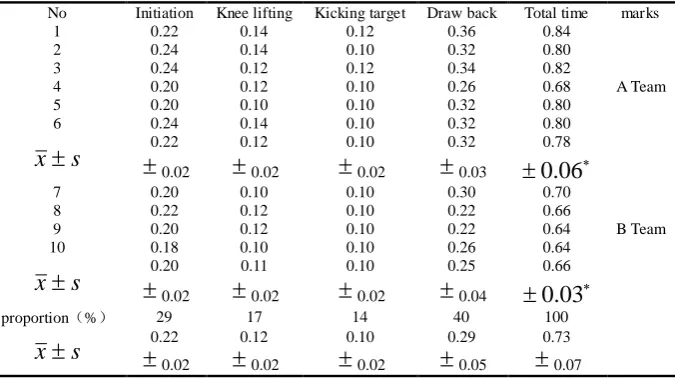
[image:4.595.139.477.563.752.2]Tablet 1 show the time a player takes for downward kick in different steps.
Table 1: the time a player takes for downward kick in different steps
No Initiation Knee lifting Kicking target Draw back Total time marks
1 0.22 0.14 0.12 0.36 0.84
2 0.24 0.14 0.10 0.32 0.80
3 0.24 0.12 0.12 0.34 0.82
4 0.20 0.12 0.10 0.26 0.68 A Team
5 0.20 0.10 0.10 0.32 0.80
6 0.24 0.14 0.10 0.32 0.80
s
x
±
±
0.22 0.12 0.10 0.32 0.780.02
±
0.02±
0.02±
0.03±
0
.
06
∗7 0.20 0.10 0.10 0.30 0.70
8 0.22 0.12 0.10 0.22 0.66
9 0.20 0.12 0.10 0.22 0.64 B Team
10 0.18 0.10 0.10 0.26 0.64
s
x
±
±
0.20 0.11 0.10 0.25 0.660.02
±
0.02±
0.02±
0.04±
0
.
03
∗proportion(%) 29 17 14 40 100
s
We can see from Table 1 that when a player make downward kick, the initiation takes 295 of the total time, knee lifting takes 17%, kick target is 14% and draw back the leg takes the most time: 40%. The average time that teams A takes to finish downward kick is T =0.78±0.06s, while the player’s is T =0.66±0.03s, in both of the dataP<0.05,
which proves that the data is reasonable.
We can see from above data, more time the players take in initiation and knee lifting, less time they leave to the opponents for reaction. So the players can finish downward kick and have the upper hand before their opponents take actions. If they spend more time on initiation, the opponents can make clear their intention and lost their initiative. So the players should cut down the initiation time. Besides, if draw back the legs take too much time, the players might lose their gravity, leaving a chance for their opponents to counterattack. So the players should try their best to cut down the time of drawing back the leg and use the suitable attacks.
Analysis of the gravity change while downward kicking
[image:5.595.194.419.288.445.2]Downward kick, expressed in KTD is to attack the opponent’s head, shoulder and collarbones. So the players need to improve the gravity and make sure they themselves are stable when they take downward kick. Otherwise, the upper hand will turn to the opponents. Table 2 shows the gravity change of the player’s downward kick.
Table 2: gravity change of the player’s downward kick
No Three dimensional gravity index(m) Marks
X Y Z
1 0.56 0.25 0.28
2 0.52 0.21 0.28
3 0.49 0.22 0.29
4 0.52 0.20 0.28 A Team
5 0.54 0.19 0.26
6 0.57 0.20 0.29
s
x
±
0.53±0.03∗ 0.21±0.02∗ 0.28±0.017 0.41 0.15 0.29
8 0.44 0.14 0.25 B Team
9 0.43 0.16 0.29
10 0.42 0.17 0.23
s
x
±
0.43±0.01∗ 0.16±0.01∗ 0.27±0.03PS: ∗ is the statistic of A and B, so P<0.05
When the player takes a downward kick, he thrusts against the ground with right feet, transferring the gravity to the left feet, finishing it under the lead of the hip joint and knee joint. Data from Table 2 shows: the maximum displacement of Team A on Y-axis is 0.25m, the minimum one is 0.14m. The data on X-axis changes a lot, with the
maximum displacement being 0.56m and the minimum being0.41m. According to the gravity on X-axis and Y-axis,
team B is more stable than team A. So the players need to hold themselves while improve the gravity in case the accident happens, losing the advantage.
Analysis on the displacement change of right leg swing in downward kick
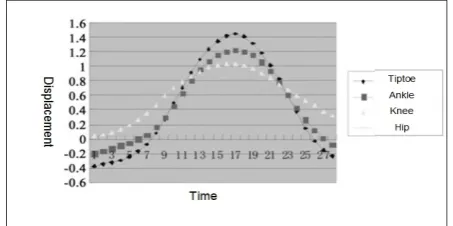
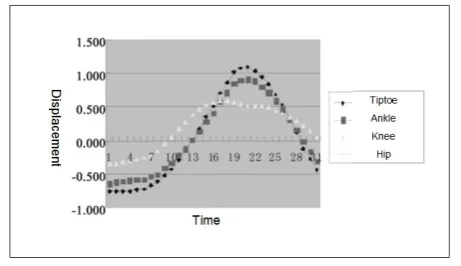
In KTD, downward kick is of high degree-of-difficulty, not only requires high flexibility and coordination, but also requires the power of the player’s abdomen, waist and leg. Figure 5 and Figure 6 are the curves for the time change and the displacement of hip, knee, ankle and the tiptoe collected by the time the players of Team A and B make downward kick.
[image:5.595.203.430.606.719.2]Figure 6: curve of the time and the right leg’s swing displacement of Team B
We can see from Pic 5 and 6, the commutation of the hip joint is the steadiest of all the process in downward kick. But when the player lifts his leg, the knee joint changes fast, even beyond the hip joint. When it comes to the target attack, the ankle and tiptoe starts to go up over the knee joint. Finally the right leg falls, and the curve of the ankle and tiptoe fall sharply. Seen from the data, when downward kicking, the minimum displacement of the tiptoe is1.89m,
which proves that the attack range of downward kick is much greater than that of the turning kick and side kick. Meanwhile, we can see that the swing distance of the tall player might not be farther than that of the short player. Because in the process of downward kick, the player can not make full use of their long leg due to the limit of the hip joint displacement and their own flexibility.
CONCLUSION
By analyzing the relationship between the mechanics and dynamics of the player’s downward kick, the potential energy caused in it is achieved. Besides, the essay finds out the defects of downward kick by analyzing the data collected in the training: it takes too long time for the player to start and draw back the leg, leaving chance and crack for the opponents. When the player takes a right leg kick, reducing the angle of hip joint will improve the stability while the change of knee joint might influence the power and attack effect of downward kick.
REFERENCES
[1] Zhixiu Hao,Huijie Leng,Chuanyong Qu,Chao Wan. Acta Mechnica Solida Sinica,2010,31(6). [2] HU Zong-xiang,LIU Xue-zhen. Journal of Beijing Sport University,2008,31(1):64-66.
[3] YANG Yue-Fei,Song Yue-xian,Peng Zhi-yu. Journal of Shandong Physical Education Institute, 2005, 21(4), 110-112.
[4] HU Zong-xiang,CHEN Xiao-guang. Sports Sciences Researches,2006,10(3):58-61. [5] LI Shi-ming. Journal of Wuhan Institute of Physical Education,2007,41(1):55-57,64. [6] JIN Bo , LIU Qi. Journal of Chengdu Physical Education Institute,2012,38(6):56-59. [7] LI Xiangjun. Journal of Shenyang Sport University,2012,31(2):122-123,137. [8] HU Zong-xiang. Journal of Hebei Institute of Physical Education,2006,20(3):63-65.