Effect of Pilot Injection on Mixture Formation, Ignition Process and
Flame Development in Diesel Combustion
Amir Khalid
1,a, M. Jaat
1, Izzuddin Zaman
2, B. Manshoor
1,b, M. F. M. Ali
1,b1
Centre for Energy and Industrial Environment Studies (CEIES), Universiti Tun Hussein Onn Malaysia, Parit Raja, Batu Pahat, 86400 Johor, Malaysia
2
Universiti Tun Hussein Onn Malaysia, Parit Raja, Batu Pahat, 86400 Johor, Malaysia.
a
[email protected], [email protected]
Keywords: Mixture Formation, Spray, Rapid Compression Machine, Diesel Combustion, Ignition Process
Abstract. The alternative combustion strategies with systematic control of mixture formation have provided new opportunities and considerable improvement in the combustion process and response to meet the stringent emissions standards. Purpose of this research is to investigate the influences of pilot injection on the fuel-air premixing especially during ignition delay period. During this period, the interaction between fuel spray and surrounding gas prior to ignition which linked to the improvement of mixture formation, ignition process and initial heat recovery thus predominantly influences the combustion process and exhaust emissions. This study investigates the effects of pilot injection using a rapid compression machine together with the schlieren photography and direct photography methods. The detail behavior of mixture formation during ignition delay period was investigated using the schlieren photography system with a high speed digital video camera. This method can capture spray evaporation, spray interference and mixture formation clearly with real images. Ignition process and flame development were investigated by direct photography method using a light sensitive high-speed color digital video camera. Pilot injection promotes mixture formation during ignition delay period and slower oxidation reaction and thus leads to earlier rise and lower peak heat release rate.
Introduction
In diesel engines, the improvement of diesel combustion regimes with controlling the combustion process has received considerable attention due to their potential for reducing NOx and PM to levels commensurate with the future emission standard.
Among the various phenomenon involved in diesel combustion, the fuel-air premixing by the physical factor plays a significant role in the ignition of diesel sprays and linked to the improvement of exhaust emissions[1-6]. The improvement of exhaust emission is dominated by the mixture formation behavior especially fuel-air mixing during ignition delay period and anticipated on burning process that strongly affects the exhaust emissions [7-9]. In this stage, the physical process prior to ignition is controlled by design parameter and chemical process of fuel decomposition and oxidation. The behaviors of relevant physical factor have been investigated with injection pressure and pilot injection. The potential of design parameters, injection spray behavior and air movement have proven its ability to achieve the sufficient rapid mixing between the injected fuel and the air[10]. Furthermore, Ikegami[11] has proposed that the oxidations reactions during first stage of mixture formation is depends on the physical process such air entrainment rate and responsible to facilitate the breakup of the jet spray and improving evaporation. The interaction between spray and air motion process are analyzed with the variants air motion, ambient condition and injection pressure. It is complicated for achieving the best preparation at first stage of mixture formation prior to oxidations reaction; as such behavior is expected to provide a significant amount of heat release and dependency of design parameters and physical factors related to the mixture formation and combustion process. However, it is necessary to make clear the effect of every design parameter on mixture formation and
combustion in detail. The aim of these investigations is to provide a better comprehension of the effect of pilot injection on air motion mechanism, the interaction between air and fuel, and fuel-air premixing including the fuel atomization and fuel spray propagation prior to ignition. Physical phenomena, heat release rate, and the exhaust emission have been examined under various design parameters such as injection pressure and pilot injection together with the schlieren photograph and direct photograph. Combustion process and exhaust emissions are more clearly observed by examining the characteristics of the evaporation of fuel spray and initial heat recovery process during the ignition delay period. Furthermore, tries to make clear the influence of the pilot injection on the early stage of mixture formation and fuel-air mixing, then it progress on ignition, heat recovery process and combustion characteristic.
Experimental Set Up
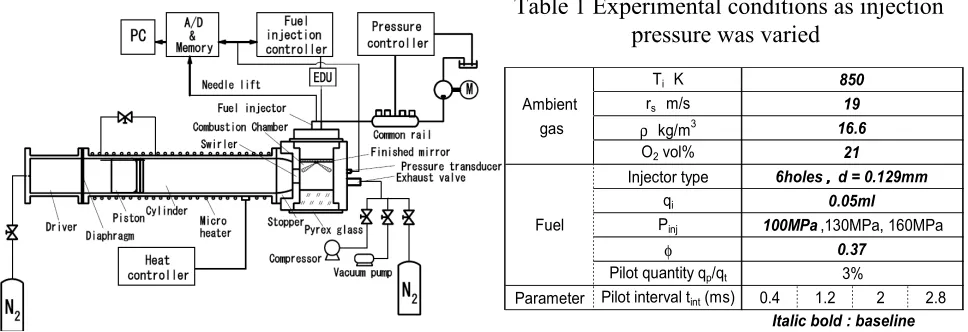
Measurements were made in an optically-accessible rapid compression machine (RCM) with
displacement of 1701.4cm3 and capable of a maximum injection pressure up to 160MPa, as shown in
Fig.1. Using this equipment, the diesel engine compression process could be reproduced within the wide range of ambient temperature, ambient density, swirl velocity, equivalence ratio and fuel injection pressure. The spray chamber was disc type with a diameter of 60mm and a width of 20mm. Measurement were made in an optically-accessible with one of the base surfaces of the chamber was composed of pyrex glass to observe spray and flame developments, and the other side surface had an injector holder. During experiment, the fuel injection is varied by controlling the common rail system. Nevertheless, the ambient condition of the combustion chamber was controlled by the air motion and temperature.
Table 1 summarizes the operating parameters and fuel injection system, including nozzle specification. A single-shot common-rail fuel injection system was used to inject JIS#2 diesel fuel (a
density of 836kg/m3 and lower heating value of 42.7MJ/kg) into the spray chamber. The injection
period was controlled to kept fuel quantity at qi=0.05 ml. In conducting this research, a parametric study of combustion process were investigated as comparing every condition with base condition as equivalence ratio was φ=0.37, ambient density of ρ=16.6kg/m3 (ambient pressure of pi=4MPa), ambient temperature of Ti=850K, swirl velocity rs=19m/s and oxygen concentration of 21vol%. Injection commencement was measured from the needle lift detected by a hole-sensor installed in the injector. The gas pressure inside the combustion chamber was measured by a piezoelectric pressure transducer (Kistler, 601A) and recorded by data acquisition. The decay in-chamber pressure with time are also analyzed to obtain the apparent heat release rate dQ/dt. NOx concentration was measured by a chemiluminescence analyzer (Yanako, ECL-77A). The ambient pressure pi were changed to pi=4MPa(pc=100kPa) and ambient density ρ was ρ=16.6kg/m3(pc=100kPa). The high-pressure fuel systems consisted of high-pressure pump, common rail, injector and pressure sensor. The
[image:2.595.57.541.407.573.2]Table 1 Experimental conditions as injection pressure was varied
Fig.1 Schematic diagram of experimental apparatus
Ti K
Ambient rs m/s
gas ρ kg/m3
O2 vol%
Injector type qi
Pinj φ
Pilot quantity qp/qt
Parameter Pilot interval tint (ms)
Italic bold : baseline
2.8
850
19
16.6
21
6holes,,,,d = 0.129mm
0.05ml
100MPa,130MPa, 160MPa
0.37
3%
0.4 1.2 2
high-pressure fuel discharge was controlled by a high pressure pump driven by an electrical motor (Mitsubishi). Moreover, injection pressure and nozzle parameter were variant at Pinj=100MPa, 130MPa and 160MPa with held fixed 0.129mm hole-diameter with 6 holes, respectively. This study kept injection quantity at q=0.05 ml. The injection durations were 2ms for Pinj=100MPa and 1.5ms for Pinj=160MPa.
Result and Discussion
Effect of pilot injection on mixture formation and burning process The effects of mixture formation causes by pilot injection in the combustion are discussed in this section. The modern injection system continues to have excellent benefits in fuel consumption and improves exhaust emissions with the possibility to perform multiple injections. In this section, author will elaborate the details of the new alternative mixing and combustion strategies that might satisfy the potential to reduce emissions. A new combustion concept based on compression ignition of a lean pre-mixture using multiple injections with a single injector. The effect of pilot injection on the pre-combustion fuel-air mixing and emissions was investigated as comparing every condition with base condition
ρ=16.6kg/m3, rs=19m/s, Ti=850K and Pinj=100MPa, as shown in Table 1. Experiments were carried out with multi-stage injection from single injector and six-hole injector with hole-diameter of dn=0.129mm. The injection pressure Pinj was varied at 100MPa (baseline) and 160MPa. This study kept the qa/qt for 3% from the total injection quantity at q=0.05ml(φ=0.37).
To investigate the effects of pilot interval tint on combustion development, tint of 0.4ms, 1.2ms, 2.0ms an
d 2.8ms were employed at Pinj=100MPa and Pinj=160MPa. The variation of combustion process and
pressure history during ignition delay are depicted in Fig.4 for the Pinj=100MPa and Pinj=160MPa. As seen in Fig.4(a), decreased tint under high injection pressure of Pinj=160MPa condition results in earlier rise initial heat release and reduces the peak heat release with longer combustion duration. On the other hand, under Pinj=100MPa and decreased the tint leads early rise in heat release rate by first injection due to an increase in over-lean mixture. In addition, the longer ignition delay promotes the mixing of second-injection fuel leading to higher peak heat release. However, at higher injection pressures a greater amount of fuel-air premixing occurs and prepared for combustion, despite it could explain the more rapid heat release and increased peak heat release compared than lowering Pinj and variant in Tint. It seems that both injection pressure conditions, the physical process period and the time period of initial heat recovery are nearly equal at the range tint=1.2ms-2.8ms as seen in Fig.4.(b).
Fig.4 Effects of pilot interval and injection pressure on ignition and combustion
0 1 2 0 1 2
-2 0 2 4
w/o pilot tint=0.4m s tint=1.2m s tint=2.0m s tint=2.8m s
Pinj=160M Pa
Ti=850K rs=19m /s φφφφ=0.4 qp/qt=3%
d Q /d t M J /s N L
Pinj=100M Pa
t m s
(a) Combustion process (b) Histories of pressure during ignition
delay period
0.0 0.5 1.0 1.5
-0.1 0 0.1 -0.1 0 0.1 0.2 P
inj=100M Pa
w /o pilot tint=0.4m s tint=1.2m s tint=2.0m s tint=2.8m s
t m s
P
inj=160M Pa
Ti=850K rs=19m /s qp/qt=3%
Next, the effects of Pinj at the same operating of tint are investigated on the point of mixture formation and combustion. Figure 5 depicts the spatial development of the mixture formation obtained at
variant in injection pressure and the time interval was maintained fixed at tint =0.4ms. As seen in Fig.5, the images of the spatial different of mixture formation obtained at different Pinj and variant in tint. Increased injection pressure promotes a greater amount of combustible mixture prepared for combustion and the fuel-air mixing than baseline condition and Pinj=100MPa with tint=0.4ms condition.
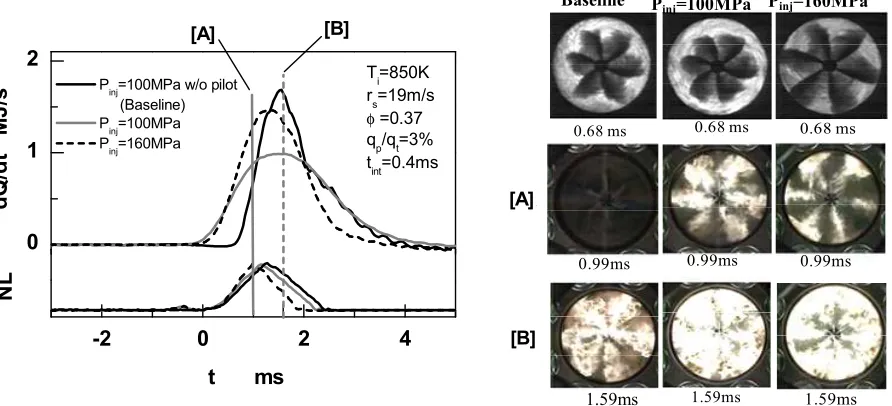
Figure 6 compares the spatial development of flame development and combustion process is obtained at variant in injection pressure and the time interval was maintained fixed at tint =0.4ms. the variation in heat release and flame development could be associated with changes of mixture formation behavior during ignition delay, as shown in Fig.5. Under tint=0.4ms, increased Pinj= 160MPa slighter slower the initial heat release, promotes more rapid and higher pick, as compared to Pinj= 100MPa. On the other hand, the peak heat release is found to decrease modestly with lowering injection pressure Pinj=100Mpa, despite the earlier rise initial heat release and slower oxidation rate which influences the evaporation and thermal decomposition of fuel. It seems the improvement in combustion process is insufficient to compensate for the increased Pinj and variant in tint, at which time the ignition and rate of heat release are expected to be strongly influenced by fuel-air mixing process.
tint=0.4ms, Pinj=100MPa
t= - 0.43ms - 0.13ms 0.17ms 0.31ms
t= - 0.43ms - 0.13ms 0.17ms 0.31ms Base condition without pilot ( Pinj=100MPa)
0.17 ms 0.24 ms 0.31 ms
[image:4.595.88.514.120.281.2]tint=0.4ms, Pinj=160MPa
[image:4.595.63.509.377.580.2]Fig.5 Effects of pilot injection and injection pressure on mixture formation
Fig. 6 Effects pilot injection at various injection pressures on flame development and heat release
Baseline
0.68 ms
0.99ms
1.59ms 0.68 ms 0.09 ms
0.99ms
0.68 ms 0.09 ms
1.59ms
Pinj=160MPa
0.99ms
1.59ms
1.54ms
0 1 2
-2 0 2 4
[A] [B]
Pinj=100MPa w/o pilot (Baseline)
Pinj=100MPa Pinj=160MPa
N
L
d
Q
/d
t
M
J
/s
Ti=850K rs=19m/s
φ =0.37 qp/qt=3% tint=0.4ms
t ms
[A]
[B]
Conclusion
In this research, design parameter of diesel combustion with variants in injection pressure and pilot injection were investigated. Parametric studies of diesel combustion have been fundamentally investigated by using rapid compression machine and image analysis. Discussions were made on relation between design parameter and the mixture formation behavior especially fuel-air mixing during ignition delay period on the ignition, initial heat release and combustion process. Results are summarized as follows;
1.. Pilot injection promotes mixture formation during ignition delay period and slower oxidation reaction and thus leads to earlier rise and lower peak heat release rate.
2.. The improvement in combustion process is insufficient to compensate for the increased Pinj and variant in tint, at which time the ignition and rate of heat release are expected to be strongly influenced by fuel-air mixing process.
Acknowledgement
The author would like to express his gratitude to Prof. Dr. Yoshiyuki Kidoguchi from Power Laboratory, The University of Tokushima, Japan for his advice and guidance in this research and experiments work. The authors also would like to thank the Ministry of Higher Education Malaysia for supporting this research under the COE-MTUN Grant Scheme VOT.C009, Fundamental Research Grant Scheme (FRGS) vot.1054 and Short Term Grant (STG) VOT.0997.
References
[1] Horibe, N., Annen, T., Miyazaki, Y. and Ishiyama, T., "Heat Release Rate and NOx Formation Process in Two-Stage Injection Diesel PCCI Combustion in a Constant-Volume Vessel", SAE paper 2010-01-0608, 2010.
[2] Bruneaux, G., Verhoeven, D. and Baritaud, T., "High Pressure Diesel Spray and Combustion Visualization in a Transparent Model Diesel Engine", SAE Paper 1999-01-3468, 2009.
[3] Khalid, A., and Manshoor, B., "Effect of High Swirl Velocity on Mixture Formation and Combustion Process of Diesel Spray", Applied Mechanics and Materials Vols. 229-231 (2012), Trans tech Publications, Switzerland, pp 695-699.
[4] Khalid, A., “ Effect of Ambient Temperature and Oxygen Concentration on Ignition and Combustion Process of Diesel Spray”. Asian Journal of Scientific Research, 2013. pp.1-11.
[5] Okamoto, S., Shibamoto, R., Kidoguchi, Y. and Miwa, K., "Effect of High Turbulence Mixing
on Reduction of Exhaust Emissions from a DI Diesel Engine Employing EGR and Pilot Injection", Trans. of JSAE, Vol.38, No.2, pp.93-99, 2007.
[6] Noge, H., Kidoguchi, Y. and Miwa, K., "A study on NO Reduction Caused by Thermal Cracking
Hydrocarbons during Rich Diesel Combustion", JSME International Journal, Series B, Vol.49, No.2, pp.526-532, 2006.
[7] Ogawa, H., Li, T., Miyamoto, N., Kido, S. and Shimizu, H., "Dependence of Ultra-High EGR
and Low Temperature Diesel Combustion on Fuel Injection Conditions and Compression Ratio", SAE Paper 2006-01-3386, 2006.
[9] Khalid, A., and Manshoor, B., “Analysis of Mixture formation and Flame Development of Diesel Combustion using a Rapid Compression Machine and Optical Visualization Technique”, International Conference on Mechanical & Manufacturing Engineering (ICME2012), pp.1-5, 2012.
[10]Yatsufusa, T., Kawakami, J., Kidoguchi, Y., Khalid, A., Fujita, Y. and Omae, K., "Effects of Supercharging, Swirl Strength and Fuel Injection Pressure on Development and Combustion of Diesel Spray", Trans. of JSAE, Vol.40, No.3, pp.755-761, 2009.