International Journal of Emerging Technology and Advanced Engineering
Website: www.ijetae.com (ISSN 2250-2459,ISO 9001:2008 Certified Journal, Volume 3, Issue 1, January 2013)
472
Distributed Packet Inspection By Using PIL-2 Language
N.Saranya
Assistant Professor/CSE, IFET College Of Engineering, Villupuram, INDIA..
Abstract— Packet Inspection language PIL-2 incorporates directly support for distributed processing into the language.PIL-2 supports generic header filter, payload scanning, packet replication and traffic flow in network. By distributing PIL-2 based on the possibility created for heterogeneous network of processing node, which gives monitoring architecture facilities with high speed packet processing. The result shows that perform complex processing at terra bit speeds. This proposed frame work can be used to execute distinct task as load balancing, traffic monitoring, firewalls and IDS at high bandwidth links.
Keywords—PIL-2,Load balancing, IDS, traffic monitoring.
I. INTRODUCTION
In the network flow there are different types of speed between bus and processor and network devices are occurred. This situation gives it ever more difficult to process the packets at line rate. Packet processing tasks such as network monitoring, intrusion detection and firewall demands are growing.
The parallelism is the solution to deal with packet processing at high speeds. A network processor is a device which is designed for packet processing at high speed by sharing the workload between no of independent processors. Payload scanning related application (scan warm signature)more power is needed than any one processor can offer. However, to develop NPs need more cost efficiency, so that we used alternative method to increase the scalability by exploiting the parallelism.
In this paper, we exploit packet processing parallelism at the level of individual processing units to (NPs or PCs) created the heterogeneous distributed inspection architecture NP-FFPF [1]. Incoming traffic is divided into multiple streams, each of which is forwarded to the IDS. Intrusion Detection System used for detect all intrusions in an efficient manner [7]. The implementation of IDS allows network administrators to detect security objective violations. These security objective violations range from external attackers trying to gain unauthorized access to network security infrastructure or making resources unavailable to insiders abusing their access of the system resources.
The main contribution of this paper consists of language that explicitly facilitates distribution of complex packet processing tasks:PIL-2 . This paper builds on the idea of traffic splitting that was advocated by Markatos et al. in [2] and Kruegel et al. in [3] for intrusion detection. However, we use it to provide a generic high speed packet processing environment. Markatos et al. focus on packet header processing and automatically generate the appropriate code for the splitter (implemented on a network processor)[5] from high-level snort rules. They show that traffic splitting improves the packet processing performance even if the splitter and all processing nodes reside on the same host. The traffic slicer in [3] employs a two-stage approachfor intrusion detection [6] where rules for
International Journal of Emerging Technology and Advanced Engineering
Website: www.ijetae.com (ISSN 2250-2459,ISO 9001:2008 Certified Journal, Volume 3, Issue 1, January 2013)
473 it allows for processing hierarchies that are arbitrarily deep and heterogeneous, whereby each level performs a part of the total computation. Moreover, NP-FFPF offers explicit support for such processing at the language level. By applying the splitter concept in a distributed fashion NP-FFPF can facilitate such diverse tasks as load balancing, traffic monitoring, firewalling and intrusion detection in a scalable manner, e.g., in enterprise gateways.
II.
RELATED WORKUsing traffic splitters for increased packet processing efficiency on a single host was previously explored in [2] and [3]. Our architecture differs in that it supports distributed and heterogeneous multi-level processing. In addition, we provide explicit language support for this purpose. As shown in [8], it is efficient to use a source-to-source compiler from a generic language (Snort Intrusion Detection System) to a back-end language supported by the targeted hardware compiler (Intel μEngineC).
We propose a more flexible and easy to use language as front-end for users. Moreover, our PIL-2 language is designed and implemented for heterogeneous targets in a distributed multilevel system. Many tools for monitoring are based on BPF in the kernel [4]. Filtering and processing in network cards is also promoted by some Juniper routers [12]. However, they lack features introduced in NP-FFPF such as extended language constructs, in-place packet handling and a distributed processing environment. BPF+ [13] shows how an intermediate representation of BPF can be optimised, and how just-in-time-compilation can be used to produce efficient native filtering code. PIL-2 relies on gcc’s optimisation techniques and on external functions for expensive operations. Like PIL-2 and DPF, Windmill protocol filters also target
high-performance by compiling filters into native code. And like MPF, Windmill explicitly supports multiple applications with overlapping filters. However, compared to PIL-2, Windmill filters are fairly simple conjunctions of header field predicates. N probe is aimed at monitoring multiple protocols [14] and is therefore, like Windmill, geared towards spanning protocol stacks. Also, N probe focuses on disk bandwidth limitations and for this reason captures as few bytes of the packets as possible. NP-FFPF has no a priori notion of protocol stacks and supports payload processing.
The SCAMPI architecture also pushes processing to the NIC [9]. It assumes that hardware can write packets immediately into host memory (e.g., by using DAG cards [10]) and implements access to packet buffers through a user space daemon. SCAMPI does not support user-provided external functions, powerful languages such as PIL-2 or complex filter graphs.
International Journal of Emerging Technology and Advanced Engineering
Website: www.ijetae.com (ISSN 2250-2459,ISO 9001:2008 Certified Journal, Volume 3, Issue 1, January 2013)
[image:3.612.70.296.113.263.2]474
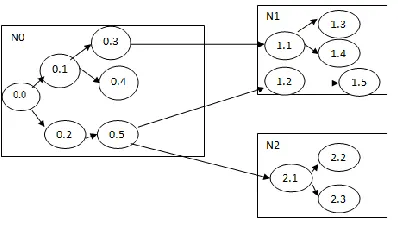
Fig 1.Distributed system overview
[image:3.612.75.274.459.581.2]Each node in the system performs a limited amount of packet processing(e.g filtering, sampling) and may split its incoming stream according to some arbitrary criteria into multiple output streams that are sent to different nodes at high levels. For example ,all tcp traffic is sent to node N1,all udp traffic node N2,As the traffic arrives at node N0 at the full link rate, there will be no time for complex packet processing on this node Distributed abstract processing tree:
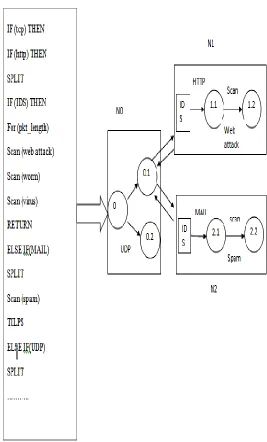
Fig 2.Distributed abstract processing tree IV. PIL-2 LANGUAGE
As our architectural design relies on explicit break pointing, we needed to introduce this functionality into our framework. With PIL-2 we adopted a language-based approach, following our earlier experiences in this field.
We designed PIL-2 specifically with these observations in mind: first, there is a need for executing tasks (e.g., payload scanning) that existing packet languages like BPF [4], Snort [3] cannot perform. Second, special purpose devices such as network processors can be quite complex and thus are not easy to program directly.
Third, we should facilitate on-demand extensions, for instance through hardware assisted functions. Finally, security issues such as user authorization and resource constraints should be handled effectively. The previous version of the PIL-2 language, PIL-1, addressed many of these concerns. However, it lacked features fundamental to distributed processing like packet mangling and retransmission
We will introduce the language design with an example. First, a program written for a single machine (N0) is introduced in Figure 3. Then, the same example is ‘mapped’ onto a distributed abstract processing tree by using PIL-2 language extensions in Figure 4.
Fig. 3 shows how the full stream is split at the root node N0.0 into two big sub streams: TCP and UDP. Then, the TCP sub-stream is again split into two sub streams, http and mail, by the intermediate node N0.1. Because each of these requires heavy computation, they are forwarded to the leaves: N0.5 and N0.6, respectively.
[image:3.612.336.560.583.666.2]International Journal of Emerging Technology and Advanced Engineering
Website: www.ijetae.com (ISSN 2250-2459,ISO 9001:2008 Certified Journal, Volume 3, Issue 1, January 2013)
475 The proposed language PIL-2 of Full stream is splitted into two big streams from Node N0 to 0.1 and 0.2.After inspection of packets in Node 0.1 the stream can be divided into two nodes like N1and N2.
N1 contains Http datas and monitoring web attacks. N2 contains mail datas and monitoring of spams. it produces the good result compare to the existing language PIL-1.IDS monitor the worms, viruses and web attack and also detect and prevent these attacks.IDS responds to the attack by initiating certain actions to the source or alert the network administrator.
When a task requires a large amount of per-packet processing power (e.g., a full packet scan for a worm), it becomes infeasible to perform this task on a single machine when network speeds go up. However, the layered style that all protocols reside onto a basic Ethernet frame gives enough parallelism for an eventually distributed processing environment. Thus, we give the same example, written using the SPLIT extension for a distributed processing environment and we take the hardware depicted in Figure 1 as environment. For the sake of simplicity we limit our tree to two levels.
[image:4.612.319.586.166.608.2]The program is mapped into the D-APT shown in Figure 4 by taking into account both the user request (our program) and a hardware description. As Figure 5 shows, the PIL-2 compiler translates the program into multiple output objects, one for each hardware device. Currently, the object files need to be transferred and loaded by hand, but we plan to incorporate a management system intoNP-FFPF that will take care of loading and releasing the runtime code as well as fetching the results of each node as one.
International Journal of Emerging Technology and Advanced Engineering
Website: www.ijetae.com (ISSN 2250-2459,ISO 9001:2008 Certified Journal, Volume 3, Issue 1, January 2013)
[image:5.612.46.292.103.267.2]476 Fig 5 User compiles an PIL-2 Filter expression
5.Implementation Details
NP-FFPF builds on FFPF, a monitoring framework designed for efficient packet processing on commodity hardware, such as PCs. FFPF offers support for commonly used packet filtering tools (e.g., tcpdump, snort, libpcap) and languages (like BPF), as well as for special purpose hardware like network processors (NPs). However, It is a single device solution. NP-FFPF extends it with distributed processing capabilities through language constructs. Currently, we have support for two target platforms: 1. IXP1200 network processors and 2. Off-the-shelf PCs running Linux.We briefly introduce first in next section.
V. NETWORK PROCESSORS
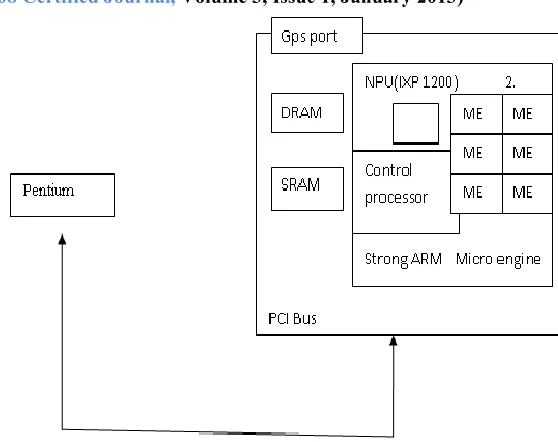
Network processors are designed to take advantage of the parallelism inherent in packet processing tasks by providing a number of independent stream processors (μEngines) on a single die. The Radisys ENP 2506 network card that was used to implement NP-FFPF is displayed in Figure 6. For input, the board is equipped with two 1Gb/s Ethernet ports 1. The card also contains a 232 MHz Intel IXP1200 network processor with 8MB of SRAM and 256 MB of SDRAM. 2)and is plugged into a 1.2 GHz PIII over a PCI bus 3.The IXP is built up of a single Strong ARM processor running Linux and six μEngines running no operating system whatsoever.
Fig 6: Components of the ENP-2506 board TABLE 1
statement-type
Operator
If/then/else IF(expr)THEN stmt1 ELSE stmt2 F1
For( ) FOR (initialise; test; update) stmts; BREAK; stmts; ROF
external function
INT EXTERN(filter, input, output)
hash() INT HASH(start byte, len, mask)
Return a value
RETURN(val)
Transmit to TX(table_type,table_index) or TX(table_type,id,table_index)
Split the code
[image:5.612.311.590.113.334.2]International Journal of Emerging Technology and Advanced Engineering
Website: www.ijetae.com (ISSN 2250-2459,ISO 9001:2008 Certified Journal, Volume 3, Issue 1, January 2013)
477
5.2 The PIL-2 language
The FFPF programming language (PIL) was devised to give the FFPF platform a more expressive packet processing language than available in existing solutions. The latest version, PIL-1, conceptually uses a register-based virtual machine, but compiles to fully optimised object code. However,PIL-1 was designed for single node processing. We now introduce its direct descendant, PIL-2, which extends PIL-1 with constructs for distributed processing.
TABLE 2
Operator type Operator
Arithmetic +,-,, /, *, %, --, ++
Assignment =,*=, /=, %=, +=,
-=, <<-=, >>-=, &-=, ˆ=, |=
Logical Relational
==, !=, >, <, >=, <=,
&&, ||, !
[image:6.612.41.274.305.505.2]Bitwise &, |, ˆ, <<, >>
TABLE 3 : PIL-2 Language constructs Data type Syntax
Register n
Memory Location n
Packet access -byte f(n) -word f(n)
-double word f(n) -Bit m in byte n -Nibble m in byte n
R(n) M[n]
PKT.B[f(n)] PKT.W[f(n)] PKT.DW[f(n)] PKT.B[n].U1[m]
PKT.B[n].U4[m] PKT.W[n].U1[m]
-Bit m in word n -Byte m in word n -Bit m in dword n -Byte m in dword n -Word m in dword n
-macro -ip proto -ip length -etc
PKT.W[n].U8[m] PKT.DW[n].U1[m] PKT.DW[n].U8[m]
PKT.DW[n].U16[m] PKT. Macro name PKT.IP PROTO PKT.IP LEN customised macros
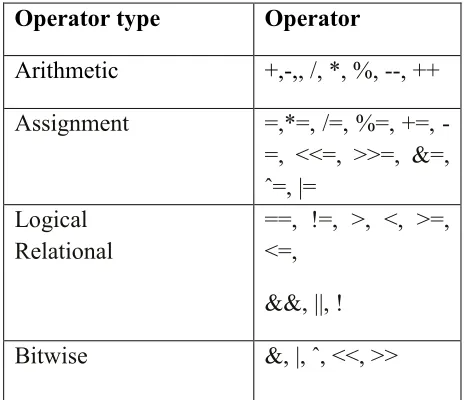
The PIL-2 syntax is summarised in Table 3. It supports all common integer types and allows expressions to access any field in the packet header or payload in a friendly manner. An extensible set of macros implements a shorthand form for well-known fields, so that instead of asking for bytes nine and ten to obtain the IP header’s protocol field, a user may abbreviate to ‘IP_PROTO’, for instance. Moreover, offsets in packets can be variable, i.e. determined by an expression. Execution safety is guaranteed by virtue of both compile-time and run-time boundary checks. As illustrated in Table 3, most of the operators are designed in a way that resembles well-known imperative languages such as C or Pascal. We will briefly explain those constructs that are not intuitively clear.
A)EXTERN() construct.
International Journal of Emerging Technology and Advanced Engineering
Website: www.ijetae.com (ISSN 2250-2459,ISO 9001:2008 Certified Journal, Volume 3, Issue 1, January 2013)
478 B)HASH() construct.
Applies a hash function to a sequence of bytes in the packet data. This function is hardware-accelerated on IXP1200 network processors.
C)TX() construct.
The purpose of this construct is to schedule the current packet for transmission. Currently, this operation involves overwriting the Ethernet destination address (ETH_DEST) of a packet with an entry from the MAC table (TX_MAC).
A simple use of TX() is illustrated in the example below:
TX_MAC[3] = {00:00:E2:8D:6C:F9,
00:02:03:04:05:03, 00:02:B3:50:1D:7A};// extracted by the compiler from the configuration file
IF (PKT.IP_PROTO == PROTO_TCP) // if pkt is TCP THEN TX (Mac, 2); // schedule it to be forwarded to the 3rd ELSE TX (Mac, 1); // or 2nd MAC address from the TX_MAC table FI
The example shows the first TX parameter to select a table (MAC or another field, such as IP_DEST, in a future implementation) and the second parameter to be the index into the table. Note that by inserting multiple TX() calls into the same program we can easily implement packet replication and load-balancing. D)SPLIT() construct.
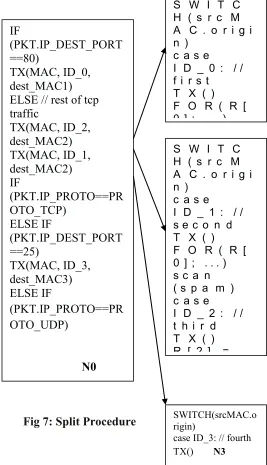
To explain SPLIT we will step through the example in Figure 4. When trying to match the given PIL-1 filter to a distributed system, the compiler detects the SPLIT construct. SPLIT tells the compiler that the code following and bounded by its TILPS construct can be split off from the main program. The example script is split into subscripts as follows: one script for the splitter node N0, and three more for each processing node N1, N2 and N3, as shown in Fig. 7. Then, the scripts are compiled into object code by the native compilers.
The current implementation is based on Ethernet header mangling (driven by TX constructs). A packet’s Ethernet destination address (ETH_DEST_ADDR) is overwritten to contain the next hop in the network. Recall that one of the NP-FFPF requirements is that processing at level N continues exactly where it had broken off at level N − 1.
The way we implemented this in the Ethernet implementation is by using the Ethernet source address to identify the out-node at level N −1. However, there is no need to use all six bytes of the source address for this purpose. For this reason we split the source address (ETH_SRC_ADDR) into two identifiers: processing state (four bytes) and originindicator (two bytes).
The origin indicator specifies the out-node of the previous level (allowing for 64K out-points), while the 32 bit state field can be used in an application-specific way. It allows nodes at level N − 1 to pass a limited amount of information to the next processing node. It is beyond the scope of this paper to discuss the use of the state field in detail. As shown in Figure 7, we can now efficiently continue the computation at level N, by using a switch statement on the origin indicator to jump to the appropriate point to resume. Observe that a switch statement is only needed if more than one out node is connected to this in-node.
International Journal of Emerging Technology and Advanced Engineering
Website: www.ijetae.com (ISSN 2250-2459,ISO 9001:2008 Certified Journal, Volume 3, Issue 1, January 2013)
479 Node N2 for instance, receives two classes of packets forwarded from node N0.
[image:8.612.47.314.287.752.2]As illustrated in Figure 7, the classes are identified by the origin indicator embedded in the ETH_SRC_ADDR field. Note that by passing the optional argument ‘node index’ to SPLIT a user can force packets to be forwarded to a specific node. This can be useful when a node has special abilities well-suited to a given task, e.g., hardware-accelerated hashing.
Fig 7: Split Procedure
5.3 Memory Data Addressing
The PIL-2 language hides most of the complexities of the underlying hardware. For instance, users need not worry about reading data into a μEngine’s registers before accessing it. Similarly, accessing bytes in memory that is not byte addressable is handled automatically by the compiler. When deemed useful, however, users may
choose to expose some of the complexity: it is, for instance, wise to declare additional arrays in fast hardware when that is available, like in the IXP1200’s on-board SRAM. Note that NP-FFPF has no inter-node shared memory.
Synchronising data across nodes is too costly relative to the high-speed packet processing task itself. To guarantee safe execution enough memory is allocated at each node to support the whole program, not just the subtask at hand. In the Ethernet implementation,limited data sharing is made possible by overwriting a now unused block in the ETH_SRC_ADDR field to communicate a 32 bit word processing state to the next hop
5.4 The PIL-2 compiler
The PIL-2 source-to-source compiler generates straight C target code that can be further handled by any C compiler. Programs can therefore benefit from the advanced optimisers in the Intel
μEngine C compiler for IXP devices and gcc for commodity PCs.
As a result, the object code will be heavily optimised even though we did not write an optimiser ourselves. In the near future PIL-1compiler support will be extended to the latest Intel NP generation (e.g., IXP2400, IXP28xx).
IF
(PKT.IP_DEST_PORT ==80)
TX(MAC, ID_0, dest_MAC1) ELSE // rest of tcp traffic TX(MAC, ID_2, dest_MAC2) TX(MAC, ID_1, dest_MAC2) IF (PKT.IP_PROTO==PR OTO_TCP) ELSE IF (PKT.IP_DEST_PORT ==25) TX(MAC, ID_3, dest_MAC3) ELSE IF (PKT.IP_PROTO==PR OTO_UDP) N0
S W I T C H ( s r c M A C . o r i g i n )
c a s e
I D _ 0 : / / f i r s t
T X ( ) F O R ( R [ 0 ] ; . . . ) s c a n ( w e b
a t t a c k )
N1
S W I T C H ( s r c M A C . o r i g i n )
c a s e
I D _ 1 : / / s e c o n d T X ( ) F O R ( R [ 0 ] ; . . . ) s c a n ( s p a m ) c a s e
I D _ 2 : / / t h i r d T X ( ) R [ 2 ] = H a s h ( 1 2 , 8 , 0 x F F ) M [ R [ 2 ] ] + +
N2
SWITCH(srcMAC.o rigin)
International Journal of Emerging Technology and Advanced Engineering
Website: www.ijetae.com (ISSN 2250-2459,ISO 9001:2008 Certified Journal, Volume 3, Issue 1, January 2013)
480 VI. EVALUATION
To evaluate NP-FFPF, we execute the filter shown in Figure 8 on various packet sizes and measure throughput. This filter is mapped onto a distributed system as shown in Figure 1 and the compilation results are the code objects of the three sub filters highlighted in same picture.
Filtering Results: Filter
Fig 8: Results of Filtering
VII. BENCHMARK
We note that only A is a traditional per-packet counter. The other two gather per-flow information. As the hash function used in C utilises dedicated hardware support, we push (by providing the parameter node index) the C filter onto the same hardware node as A
filter – N1. In B, a loop iterates over the whole UDP packet payload. While the filters A and C are easily performed on an NP even at high speed (1Gb/s), the B
filter incurs so much processing that even an IXP1200 network processor cannot handle its stream at such speed. As the processing results show, using this specific hardware, we can process the full packet data up to only ca. 100Mb/s. Therefore, we let the filter split to the second node – N2 and we can successfully process all the packets for a particular UDP port (assuming the packets related to a specific worm are within 100Mb/s bandwidth). If more bandwidth needed, then more processing nodes have to be involved.
As illustrated in Fig 8 , just as for the B filter, throughput also drops for the simple filters A and C
when processing smaller packets. However, these drops occur for a different reason, namely because the
receiving engine simply cannot keep up. Demonstrating the simplicity a concise special purpose language like FPL-3 brings, a naive load balancing program for a web-server is shown below. A hash over the flow fields of each incoming packet determines to which node the packet is forwarded. In a handful lines of code the web traffic is split into three equal sub streams.
IF (PKT.IP_PROTO==TCP &&
PKT.IP_DEST_PORT==80) THEN R[0] = hash(flowfields)%3;
SPLIT(R[0]); // thus, the main stream is equally distributed
<scan for web-traffic worms> // across of 3 processing nodes .
IF(PKT.IP_PROTO=PROTO_UDP) THEN SPLIT;
IF(PKT.IP_DEST==x &&
PKT.UDP_DEST_PORT==y) THEN M[0]++
FI; TILPS;
IF (PKT.UDP_DEST_PORT==1434) THEN
SPLIT;
FOR (R[1]=7; R[1]<PKT.IP_TOT_SIZE; R[1]++) IF (PKT.DW[R[1]] == ’sapphire sign’) THEN M[1]++; // take actions ... (e.g., drop pkt) FI;
ROF;
TILPS;
FI;
FI;
IF(PKT.IP_PROTO==TCP)THEN
SPLIT;
International Journal of Emerging Technology and Advanced Engineering
Website: www.ijetae.com (ISSN 2250-2459,ISO 9001:2008 Certified Journal, Volume 3, Issue 1, January 2013)
481 VIII. CONCLUSION AND FUTURE WORK
This paper exposed that NP-FFPF creates distributed network processing environment and PIL-2 Programming Language which enable user processing network traffic with high speed by using distributing task in the network of commodity and special purpose devices such as PC, Network Processor. This aim is distributed by constructing a processing tree that executes a simple task that splitting traffic near the root of the tree and executed more demand at the lesser travel leaves, this is explicit language which enable us to efficiently map a program to such a tree.
The Experimental result shows that NP-FFPF can give the traditional packet filters at Tbps on small scale tested. In future we have planned extend NP-FFPF and create management network environment and can take care of object code loading and program efficient. The first type of version of this management will act as a user issues for recompile request and next able to be automatically respond to changes in the environment and also availability of the network in the systems.
REFERENCE:
[1] Bos, H., de Bruijn, W., Cristea, M., Nguyen, T., Portokalidis, G.: FFPF: Fairly Fast Packet Filters. In: Proceedings of OSDI’04, San Francisco, CA (2004)
[2] Charitakis, Anagnostakis, Markatos: An active traffic splitter architecture for intrusion detection.In: Proceedings of 11th IEEE/ACM MASCOTS, Orlando, Florida (2003)
[3]. Roesch, M.: Snort: Lightweight intrusion detection for networks. In: Proceedings of the 1999 USENIX LISA Systems Adminstration Conference. (1999)
[4] McCanne, S., Jacobson, V.: The BSD Packet Filter: A new architecture for user-level packetcapture. In: Proceedings of the 1993 Winter USENIX conference, San Diego, Ca. (1993)
[5] Vassiliadis, S., Wong, S., Gaydadjiev, G.N., Bertels, K., Kuzmanov, G., Panainte, E.M.: Themolen polymorphic processor. IEEE Transactions on Computers (2004)
[6] Clark, C., Lee, W., Schimmel, D., Contis, D., Kone, M., Thomas, A.: A hardware platformfor network intrusion detection and prevention. In: The 3rdWorkshop on Network Processorsand Applications (NP3), Madrid, Spain (2004)
[7] Chun, B., Lee, J., Weatherspoon, H.: Netbait: a distributed worm detection service (2003)
[8]. Charitakis, I., Pnevmatikatos, D., Markatos, E.: Code generation for packet header intrusion analysis on the ixp1200 network processor. In: SCOPES 7th InternationalWorkshop. (2003)
[9]. Polychronakis, M., Markatos, E., Anagnostakis, K., Oslebo, A.: Design of an application programming interface for ip network monitoring. In: IEEE/IFIP NOMS, Seoul (2004)
10] Cleary, J., Donnelly, S., Graham, I., McGregor, A., Pearson, M.: Design principles for accurate passive measurement. In: Proceedings of PAM, Hamilton, New Zealand (2000)
[11] Kienhuis, B., Rypkema, E., Deprettere, E.: Compaan: Deriving Process Networks from Matlab for Embedded Signal Processing Architectures. In: Proceedings of the 8th InternationalWorkshop on Hardware/Software Codesign (CODES), San Diego, USA (2000) [12] Thomas, T.M.: Juniper Networks Router Architecture. In: Juniper
Networks Reference Guide: JUNOS Routing, Configuration, and Architecture. (2003)
[13] Begel, A., McCanne, S., Graham, S.L.: BPF+: Exploiting global data-flow optimization in a generalized packet filter architecture. In: In Proceedings of ACMSIGCOMM, Boston (1999)
[14] Moore, A., Hall, J., Kreibich, C., Harris, E., Pratt, I.: Architecture of a network monitor. inproc. of PAM’03 (2003)
AUTHOR’S PROFILE: