Journal of Chemical and Pharmaceutical Research, 2014, 6(10):319-328
Research Article
CODEN(USA) : JCPRC5
ISSN : 0975-7384
Comparative analysis of rainfall erosion force R by using different algorithms
for soil erosion controlling based on GIS and mathematical models
Ping Zhang
1, Liang He
2and Yuanyuan Wei
11
Xi`an Polytechnic University, Shaanxi, China
2Xi'an Environmental Monitoring Station, Shaanxi, China
_____________________________________________________________________________________________
ABSTRACT
In this paper, different mathematical models were used to quantitative assessment of temporal and spatial distribution of rainfall erosion force R based on geographic information systems, comparing the difference between the different algorithms, the results showed that rainfall erosion force by different algorithms are quite different, the calculation results of annual rainfall erosion force R sorted for Z> F>W>L model, while that of monthly results ordered as Z> W>L>F model. While carry out risk assessment of soil and water losses, should adjust measures to local conditions, it is very important to choose reasonable risk evaluation model for accurate prediction of regional soil erosion. Different algorithms has the different spatial distribution of rainfall erosion force R, high risk areas are mainly concentrated in the west and the south, however, low risk areas are mainly distributed in the north and east. These results can provide scientific basis for prevention and control of soil erosion.
Keywords: GIS, mathematical models, rainfall erosion force R, soil and water losses, comparison of algorithms
_____________________________________________________________________________________________
INTRODUCTION
Soil erosion refers to a process of the soil particles and surface appendages were eclipsed handling, migration, and deposition under external force [1-3]. Rainfall erosion force R said potential ability of soil erosion caused by rainfall to reflect the impact of climatic factors on soil erosion, is one of the calculation factors of Universal Soil Loss Equation [4-6]. How to accurately evaluate risk of rainfall erosion force R of soil erosion, has very important significance for identifying regional soil erosion risk and formulating reasonable measures of prevention and control [7, 8].
Risk of rainfall erosion force R of soil erosion is closely related to rainfall, rainfall intensity and rainfall time, it is difficult to directly measured, most with rainfall intensity, rainfall and other parameters to estimate [9-11]. To this end, researcher had proposed various calculation parameters and methods of rainfall erosion force R, and combined with the geographic information system, research on spatial and temporal dynamic of rainfall erosion force R [12-16]. However, the rainfall erosion force R algorithms in different regions is difficult to be extended to other areas, therefore, how comparative analysis the differences of spatial distribution and different algorithms the based on existing algorithm is an important research direction.
EXPERIMENTAL SECTION
2.1 Study area
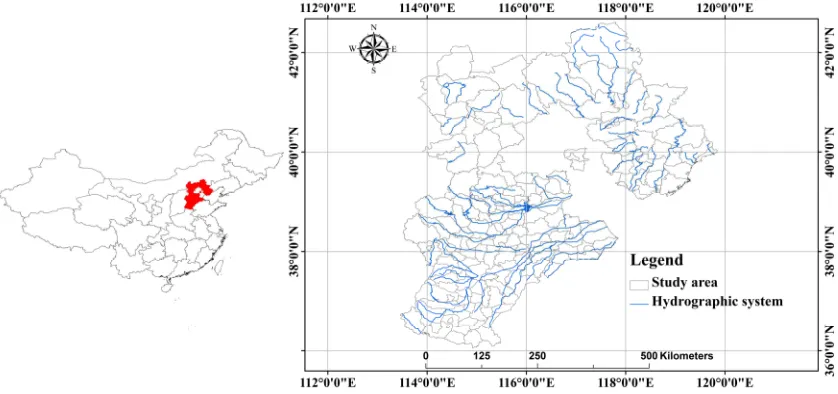
[image:2.595.99.518.180.377.2]Hebei province is located in north latitude 36 ° 03 '- 42 ° 40', longitude 113 ° 27 '- 119 ° 50', a total area of 188, 000 km². Landform with plateau, mountains and plains, which accounted for 9.3%, 49.5% and 41.2% of the total area, respectively, the altitude of roughly from the northwest to the southeast gradually declined. In western is Taihang Mountain, and northern is Yanshan, surrounded by a semi-circular Hebei Plain. A temperate continental monsoon climate, the annual average temperature of -0.3℃-4 ℃, the average annual precipitation is 350-15mm (Fig. 1).
Fig. 1. The study area of Hebei province in China
2.2 Z model
Zhang et al. established rainfall erosion force R model by daily rainfall data, referred to as the Z model, calculated for half monthly rainfall erosion force, the summary can be obtained monthly rainfall erosion force and annual rainfall erosion force. The Z model calculated as follows [17]:
∑
==
k j j iP
R
1)
(
δλ
(1)1891 . 7
586
.
21
−=
δ
λ
(2) 12 12455
.
24
177
.
18
8363
.
0
y dP
P
+
+
=
δ
(3)Where, Ri for the first k months of rainfall erosion force (MJ⋅mm/hm² /a/h); Pj said the first j days of rainfall of half period , k said the days of half period, Pd12 refers daily rainfall≥12mm, Py12 refers daily rainfall ≥12mm of annual rainfall.
2.3 L model
Its model requires only annual rainfall or average annual rainfall, we can calculate the average annual or multi-year of rainfall erosion force R-value by Roose [18], referred to as the L model, which was expressed as:
P
R
=
0
.
5
(4)Where, P is the average annual or monthly rainfall, R is the rainfall erosion force.
2.4 F model
∑
=+
−
=
12 1)
1792
.
0
15527
.
1
(
i iP
R
(5)Where, Pi is the first i monthly rainfall, P is the annual rainfall.
2.5 W model
Formula of rainfall erosion force empirical by Wischmemier referred to as the W model, as following [20]:
∑
= −×
=
12 1 ) 8188 . 0 lg 51 . 1 ( 210
735
.
1
i P PiR
(6)Where, Pi is the first i monthly rainfall, P is the annual rainfall.
2.6 IDW spatial interpolation method
Inverse Distance Weighted method is a global interpolation method, that is, all samples are estimated to be involved in a point estimate of Z values based on GIS, calculated as follows:
∑
==
n j ewjvj
v
1 (7)Where, ve (j = 1, ... n) is the point (xj, yj) of variable value, wj is the weight corresponding coefficients.
RESULTS AND DISCUSSION
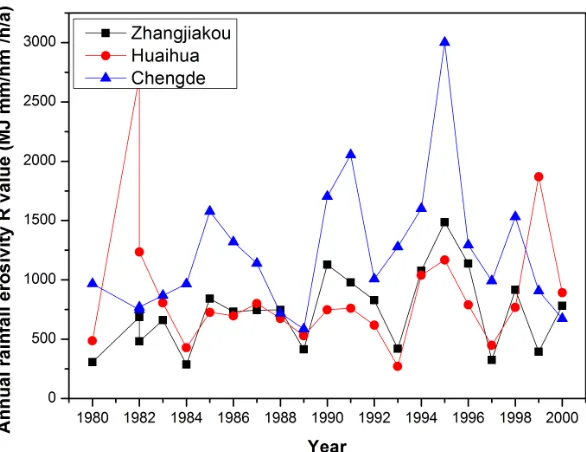
3.1 Comparison of different monitoring sites of rainfall erosion force R by using Z model
[image:3.595.122.457.399.647.2]3.1.1 Analysis of changes of annual rainfall erosion force
Fig. 2. Change trend of annual rainfall erosion force R in different monitoring sites
3.1.2 Analysis of changes of monthly rainfall erosion force
Fig. 3. Change trend of monthly rainfall erosion force R in different monitoring sites
Figure 3 indicates that maximum of the monthly rainfall erosion force R in the first half of July in Chengde was 9096.67 MJ⋅mm/hm²/h/a, ample rainfall period concentrated in June-August in Hebei, water shortage period focused on January-March, and December. Monthly rainfall erosion force R in Chengde is greater than the Zhangjiakou and Huaihua, showed that rainfall is larger in Chengde, monthly rainfall erosion force R is relatively higher, protection measures should be paid attention to the plentiful rainfall period to reduce the risk of soil erosion.
3.2 Comparison of different monitoring sites of rainfall erosion force R by using L model
[image:4.595.163.454.448.669.2]3.2.1 Analysis of changes of annual rainfall erosion force
Fig. 4. Change trend of annual rainfall erosion force R in different monitoring sites
3.2.2 Analysis of changes of monthly rainfall erosion force
The Figure 5 indicates that R value of monthly rainfall erosion force in 1980-2000 in Hebei province in the range of 16.00-1128.50 MJ⋅mm/hm² /h/a, minimum value in the Huaihua site in December, while the maximum site in Huaihua in July. High value period of rainfall erosion force R over 800 MJ⋅mm/hm² /h/a, and middle and low value were 100-800, and ≤ 100 MJ⋅ mm/hm²/h/a, respectively. It should adopt the measures of prevention and control, so as not to cause soil erosion in plentiful rainfall period.
Fig. 5. Change trend of monthly rainfall erosion force R in different monitoring sites
3.3 Comparison of different monitoring sites of rainfall erosion force R by using F model
[image:5.595.160.457.156.380.2]3.3.1 Analysis of changes of annual rainfall erosion force
Fig. 6. Change trend of annual rainfall erosion force R in different monitoring sites
[image:5.595.162.455.437.663.2]3.3.2 Analysis of changes of monthly rainfall erosion force
Fig. 7. Change trend of monthly rainfall erosion force R in different monitoring sites
Figure 7 indicated that, the monthly rainfall erosion R for 0.48-493.27 MJ⋅mm/hm² /h/a, the minimum value in January in Zhangjiakou, while that the maximum in Chengde in July. Monthly rainfall erosion R in Chengde was greater than Zhangjiakou and Huaihua. Showed that greater rainfall in Chengde, and rainfall erosion R is relatively higher, it should strengthen management and reduce soil erosion risk under the sufficient precipitation period.
3.4 Comparison of different monitoring sites of rainfall erosion force R by using W model
3.4.1 Analysis of changes of annual rainfall erosion force
Fig. 8. Change trend of annual rainfall erosion force R in different monitoring sites
[image:6.595.161.456.434.664.2]3.4.2 Analysis of changes of monthly rainfall erosion force
[image:7.595.159.458.166.388.2]The Figure 9 indicated that the monthly rainfall erosion force in the range of 0.03-2791.17 MJ⋅mm/hm² /h/a, the minimum value is Zhangjiakou in January and Chengde in January, while that of the maximum in Huaihua in July. Monitoring sites of the monthly rainfall erosion force R in Chengde was greater than the other two monitoring sites, indicating that the rainfall erosion force at different monitoring sites was quite different; the plentiful rainfall period should take effective measures to protect water and land resources, so as not to cause serious soil and water losses.
Fig. 9. Change trend of monthly rainfall erosion force R in different monitoring sites
3.5 Comparison of rainfall erosion force R by different mathematical models
The calculation results of rainfall erosion force R by different models were quite different. Among them, calculation results of the annual rainfall erosion force R sorted as: Z>F>W>L model. Comparatively speaking, results of L model are smaller, while that of the Z model is larger. Calculation results of the monthly rainfall erosion force R ranking: Z>W>L>F model. In contrast, Results of Z model is larger, while that of the F model is larger. It showed that rainfall erosion force R was greatly influenced by different models. Assessment of soil and water losses should be adapted to local conditions, a reasonable choice for evaluation model is extremely important for accurately predict the regional soil erosion risk.
3.6 Spatial analysis of rainfall erosion force R based on inverse distance weighted interpolation method of GIS
Spatial distribution of rainfall erosion force R was quite different by different models, but the overall trend was basically identical (Fig. 10).
CONCLUSION
In this study, a comparative analysis of different algorithms for rainfall erosion force R based on GIS and the mathematical models, results indicated that different algorithms has important influence on the calculation results of rainfall erosion force R, the annual change in the maximum by Z model for 4810.12 MJ⋅mm/hm² /h/a, while the L model is the smallest, is 437 MJ⋅mm/hm² /h/a. In contrast, the monthly change of largest by Z models for 9096.67 MJ⋅mm/hm² /h/a, but the F model is the smallest of 493.27 MJ⋅mm/hm² /h/a.
Interpolation analysis of inverse distance weighted results show, spatial distribution of rainfall erosion force R was different by different algorithms. Rainfall erosion force R was 0.83-345.31 MJ⋅mm/hm² /h/a by F model, rainfall erosion force R of western was bigger, while that of the northern and eastern southwest were smaller. Comparatively speaking, rainfall erosion force R for the 0-4341.92 MJ⋅mm/hm² /h/a by Z model, which eastern was larger, while the north, northwest and southwest were smaller.
Acknowledgements
This research was supported by the funding of National Science and Technology Support Program (BAD87B01) and PhD research startup foundation of Xi`an Polytechnic University (BS1306).
REFERENCES
[1] R. G. Evans, B. N. Girgin, J. F. Chenoweth and M. W. Kroeger. Agricultural Water Management, 1995, 27(3–4), 283-297.
[2] M. A. Fullen and R. T. Brandsma. Soil Technology, 1995, 8(1), 1-15. [3] K. P. Price. Remote Sensing of Environment, 1993, 45(3), 233-248.
[4] J. Busnelli, L. d. V. Neder and J. M. Sayago. Quaternary International, 2006, 158(1), 147-161. [5] Q. J. Liu, H. Y. Zhang, J. An and Y. Z. Wu. CATENA, 2014, 115(1), 11-18.
[6] X.-L. Xu, W. Liu, Y.-P. Kong, K.-L. Zhang, B. Yu and J.-D. Chen. Transportation Research Part D: Transport
and Environment, 2009, 14(7), 497-501.
[7] A. Vrieling, G. Sterk and S. M. de Jong. Journal of Hydrology, 2010, 395(3–4), 235-241. [8] C. Westmark and G. W. Lawless. Wear, 1995, 186–187, Part 2(1), 384-387.
[9] Q. J. Liu, Z. H. Shi, X. X. Yu and H. Y. Zhang. Soil and Tillage Research, 2014, 136(1), 1-8. [10] M. C. Ramos and B. Durán. CATENA, 2014, 123(1), 135-147.
[11] A. Vrieling, J. C. B. Hoedjes and M. van der Velde. Global and Planetary Change, 2014, 115(1), 33-43. [12] J. Arnáez, V. Larrea and L. Ortigosa. CATENA, 2004, 57(1), 1-14.
[13] H. Bouchnak, M. Sfar Felfoul, M. R. Boussema and M. H. Snane. CATENA, 2009, 78(2), 170-177. [14] J. A. Martı́nez-Casasnovas, M. C. Ramos and M. Ribes-Dasi. Geoderma, 2002, 105(1–2), 125-140. [15] M. Seeger. CATENA, 2007, 71(1), 56-67.
[16] W. Wei, L. Chen, B. Fu and J. Chen. CATENA, 2010, 81(1), 24-31. [17] W. B. Zhang. Journal of Soil and Water Conservation, 2002, 16(7), 43-46. [18] E. J. Roose. Orstom, 1975, 5(2), 1.