Green Practice Knowledge Profiling among the Technical and
Vocational Education Masters Programme Students
M.F.Lee, N.S. Muhtar & C.S.Lai
Faculty of Technical & Vocational Education,
Universiti Tun Hussein Onn Malaysia, 86400 Parit Raja, Batu Pahat, Johor
E-mail: [email protected]
Abstract. Global warming is utmost problem because of the negative impact to all creatures of the earth. The best solution for this issue should through education. Therefore, this study was conducted to identify the green practice knowledge among the Technical and Vocational Education Masters’ students in Universiti Tun Hussein Onn Malaysia. Green practice knowledge refer to National Green Technology Policy four key areas by KeTTHA which is energy sector, building sector, water and waste water management sector, and transportation sector. A total numbers of 87 students were selected as respondent using stratified sampling technique in this study. A survey method using questionnaire was employed as research design for this study. The gathered data were analyse using sum, mean score, standard deviation, Kruskall Wallis test and Mann Whitney U test. The findings found that the level of green practice knowledge was at the medium level. The findings also shown that there was no significant in the level of green practice knowledge from the aspect of gender and background of study among the respondents. However, there was a significant difference in green practice knowledge among the respondents in terms of age. As a conclusion, the global warming impact can be minimize by increasing the green knowledge, awareness and practising among the communities in their lifestyle.
1.Introduction
While the results of the study conducted by Muhd Hussin (2007) found that the environmental awareness and understanding of the students on green concepts were at a satisfactory level. However, assessments of student attitudes and practices on green are at a moderate level. The only way to overcome the issue of global warming is through education, and the teachers will play an utmost important role. When educators are knowledgeable about green practices in everyday life, they can influence their students and the people surrounding to participate in practising green during everyday life. Malaysia has been prominent as a developing country. Malaysia is facing a huge challenge in ensuring country development can be sustained. Among the environmental issues that are often discussed today are, urban air quality, river water quality, forest destruction, household waste and waste and chemicals from the plant are examples of environmental issues occurring in Malaysia. Although green practices were introduced in the early 2000s, the study on green practices in Malaysia is remain under investigate. Therefore, this study aims to determine green practise knowledge among the students of Master of Technical and Vocational Education, University Tun Hussein Onn Malaysia (UTHM). The research questions of this study are as follows:
What is the level of knowledge of Green practice among students?
Is there a significant difference in green practices knowledge level from the aspect of gender? Is there a significant difference in green practices knowledge level from the aspect of age? Is there a significant difference in green practices knowledge level from the aspect of courses? Is there a significant difference in green practices knowledge level from the aspect of mode of
study?
2.Green Practice Knowledge
The green practices emphasized in this study are the concept of vehicle sharing, energy saving and water resources, the reduction of use of disposable items and the use of green technology among the students. These elements are based on National Green Technology Policy Pillars (KeTTHA, 2011) as follow:
Energy - Seek to attain energy independence and promote efficient utilisation; Environment - Conserve and minimize the impact on the environment;
Economy - Enhance the national economic development through the use of technology; and Social - Improve the quality of life for all.
According to KeTTHA (2011), the significant progress and major improvement must be done in the following four (4) key areas to achieve National Green Technology Policy Pillars. The first key area is energy sector and energy utilization sector, which includes application of Green Technology in power generation and in the energy supply side management, including co-generation by the industrial and commercial sectors; as well as application of Green Technology in all energy utilization sectors and in demand side management programmes. Second key area is buildings sector that focus on adoption of Green Technology in the construction, management, maintenance and demolition of buildings. The third key area is water and waste water management sector that emphasize on adoption of Green Technology in the construction, management, maintenance and demolition of buildings. Fourth key area is transportation sector that cater on incorporation of Green Technology in the transportation infrastructure and vehicles, in particular, biofuels and public road transport.
3.Methodology
areas by KeTTHA which is energy sector, building sector, water and waste water management sector, and transportation sector. The reliability test for this achievement test using alpha Cronbach was .916. The gathered data were analyse using sum, mean score, standard deviation, Kruskall Wallis test and Mann Whitney U test. In order to determine the green practice knowledge level among the samples, the total scores of them was categorize into three group, namely low, medium, and high level.
4.
Results [image:3.595.104.498.295.332.2]Table 1 shows the score of respondents in green practise knowledge. Findings indicate that the level of knowledge in green practice among students of Master of Technical and Vocational Education, was at a moderate level. The average score among of them was 11.07 with standard deviation = 1.66. This means that the students only can answered correctly 11 from the 16 questions given. The minimum score was 6 and the maximum score was 15.
Table 1. Green Practise Knowledge Score among the students.
Mean Score Standard Deviation Minimum score Maximum score Level 11.07 / 16 1.66 6/16 15 / 16 Medium
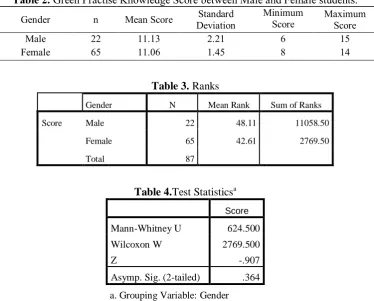
[image:3.595.112.487.452.753.2]Table 2 shows the score of green practise knowledge between male and female students. Findings determine that male students (M=11.13; SD=2.21) tend to have higher mean score than female students (M=11.06, SD=1.45). However minimum score for female was 8 while male was 6 and the maximum score for female was 14 while male was 15. Even though male and female tend to have different mean score but Mann Whitney U test in Table 3 and Table 4 show that there are no significant mean ranks of male (448.11) and female (42.61) on green practise knowledge, U = 624.5, p = .364.
Table 2. Green Practise Knowledge Score between Male and Female students.
Gender n Mean Score Deviation Standard Minimum Score Maximum Score Male 22 11.13 2.21 6 15 Female 65 11.06 1.45 8 14
Table 3. Ranks
Gender N Mean Rank Sum of Ranks
Score Male 22 48.11 11058.50
Female 65 42.61 2769.50
Total 87
Table 4.Test Statisticsa
Score
Mann-Whitney U 624.500
Wilcoxon W 2769.500
Z -.907
Asymp. Sig. (2-tailed) .364
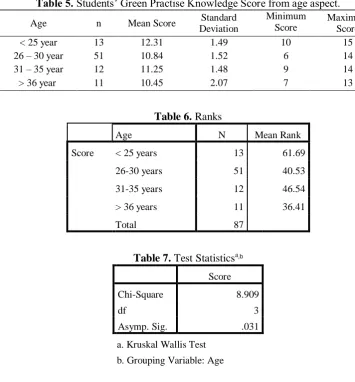
Table 5 shows the score of green practise knowledge among the students with different ages. Findings determine that students with < 25 year (M=12.31; SD=1.49) tend to have highest mean score than others age students. Kruskal Wallis Test in Table 6 and Table 7 show that there are a significant mean ranks of among the students with different ages on green practise knowledge, χ2 = 8.909, p = .031. The mean rank in descending order are less than 25 year (61.69) > 31-35year (46.54) > 26-30 (40.53) > more than 36 year (36.41) in green practise knowledge.
Table 5. Students’ Green Practise Knowledge Score from age aspect.
Age n Mean Score Standard
Deviation
Minimum Score
Maximum Score
< 25 year 13 12.31 1.49 10 15
26 – 30 year 51 10.84 1.52 6 14
31 – 35 year 12 11.25 1.48 9 14
> 36 year 11 10.45 2.07 7 13
Table 6. Ranks
Age N Mean Rank
Score < 25 years 13 61.69
26-30 years 51 40.53
31-35 years 12 46.54
> 36 years 11 36.41
Total 87
Table 7. Test Statisticsa,b
Score
Chi-Square 8.909
df 3
Asymp. Sig. .031
a. Kruskal Wallis Test
b. Grouping Variable: Age
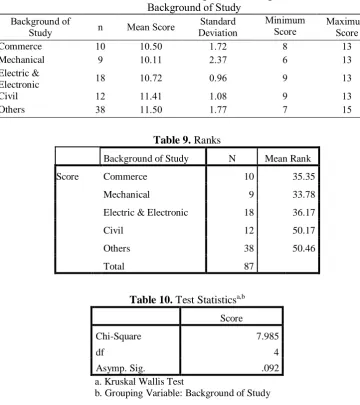
Table 8. Students’ Green Practise Knowledge Score among Students from different Background of Study
Background of
Study n Mean Score Deviation Standard
Minimum
Score Maximum Score
Commerce 10 10.50 1.72 8 13
Mechanical 9 10.11 2.37 6 13
Electric &
Electronic 18 10.72 0.96 9 13
Civil 12 11.41 1.08 9 13
Others 38 11.50 1.77 7 15
Table 9. Ranks
Background of Study N Mean Rank
Score Commerce 10 35.35
Mechanical 9 33.78
Electric & Electronic 18 36.17
Civil 12 50.17
Others 38 50.46
Total 87
Table 10. Test Statisticsa,b
Score
Chi-Square 7.985
df 4
Asymp. Sig. .092
a. Kruskal Wallis Test
b. Grouping Variable: Background of Study
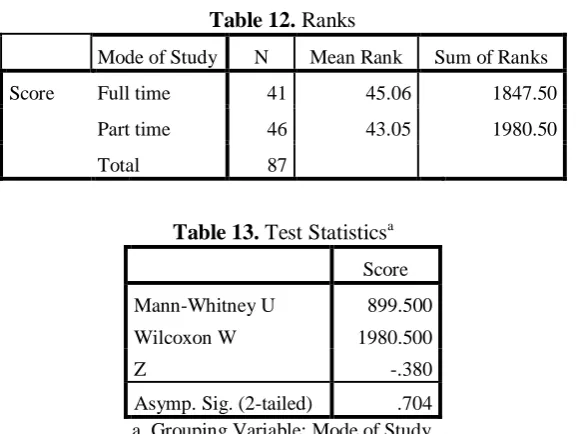
[image:5.595.104.490.674.726.2]Table 11 shows the score of green practise knowledge between full time and part time students. Findings determine that full time students (M=11.12; SD=1.73) tend to have higher mean score than part time students (M=11.02, SD=1.61). However, minimum score for full time was 6 while part time was 7 and the maximum score for full time was 15 while part time was 14. Even though full time and part time tend to have different mean score but Mann Whitney U test in Table 12 and Table 13 show that there are no significant mean ranks of full time (45.06) and part time (43.05) on green practise knowledge, U = 899.5, p = .704.
Table 11. Green Practise Knowledge Score between Full Time and Part Time students.
Table 12. Ranks
Mode of Study N Mean Rank Sum of Ranks
Score Full time 41 45.06 1847.50
Part time 46 43.05 1980.50
Total 87
Table 13. Test Statisticsa
Score
Mann-Whitney U 899.500
Wilcoxon W 1980.500
Z -.380
Asymp. Sig. (2-tailed) .704
a. Grouping Variable: Mode of Study
5.Conclusion
The knowledge on green practice among the students is at medium level. This condition needs to be improved because some of them are in-service teacher whereas some of them are the future teacher. They must aware that they are one of the individuals responsible for disseminating knowledge about of green practice to future generations in order to achieve the aims of sustainability development. Comparison of the green practice knowledge level from the aspect of gender, age, courses and mode of study showed that only students with different ages tend to have significant difference. The senior students need more exhortations and remind on green practise. Efforts to raise awareness about the importance of green practices in everyday life is utmost urgent. Additionally, future work on 5Rs (Reuse, Reduce, Reuse, Recycle, Repair and Recover) practising among the students is under investigation. As a citizen in the earth, they must remember their responsible with their waste throughout the 5Rs practising.
6.References
[1] Wan Omar, W. M. R. (2009). Minda: Ancaman Serius Pemanasan Global. Harian Metro. Retrieved from http://www.met.gov.my/pdf/newsArticle/HMetro6_26May2009.pdf
[2] Sulaiman, K. Dan Junus, L. (2005). Fenomena Ekuinoks dan Cuaca Panas. Utusan online. Retrieved from http://utusan.com.my/utusan/info.asp?y=2005&dt=0226&pub=utusan_ malaysia&sec=rencana&pg=re_05.htm&arc=hive&arc=hive
[3] Muhd Hussin, S. H. (2007). Penilaian Prestasi Alam Sekitar: Dalam Aspek Kesedaran
Alam Sekitar dan 3R Di Kalangan Pelajar Universiti Malaysia Sabah. Universiti Malaysia
Sabah: Tesis Sarjana Muda.
[4] KeTTHA (2011) National Green Technology Policy Main Areas. Retrieved from http://www.kettha.gov.my/portal/index.php?r=kandungan/index&menu1_id=3&menu2_id=75& menu3_id=95#.Wgphw1uCzIU
Acknowledgments